After the separation, Google won’t have an incentive to promote Chrome - so it’ll lose market share eventually, and Chrome won’t have an incentive to require things like Google accounts or use Google search by default - opening space for other companies to compete.
A better solution is to implement a bill like DMA in the EU to enforce competition among web browser vendors and fight monopolies.
I expect there will be some material constraints that emerge in what browser features they're actually allowed to ship as shipping without a browser also seems to be anti-consumer.
No there was never a browser choice mandate in the US
You can surely do better than these examples. Nobody would be better for lack of action against IBM, and lack of serious action against microsoft continues to hurt us today. C'mon. Break these useless, unproductive fuckers up.
Their monopolistic behavior in Windows led to their current browser, mobile, cloud, and game console dominance.
https://www.theguardian.com/technology/2001/sep/07/microsoft...
That's the difference.
If they're not competing well, then that's entirely their fault. Microsoft is not at any kind of disadvantage here.
The original comment was saying that Google is able to perform anti-competitively because they control the most popular browser.
The followup (which I responded to) is saying that the existence of Windows as the most popular OS, and Microsoft’s control over the default browser there, mitigates this anti-competitive potential.
The fact that Windows is not the most popular OS (and that, in fact, the most popular OS is controlled by Google) undermines that argument.
Linux is not the most popular OS in any context that includes doing searches with the thing, unless you include Android, but Android just uses Linux for the kernel mostly, and an OS is more than a kernel.
I’m not clear on what they meant by Linux. But if we use a definition of “Linux OS” that includes Android and is restricted to devices which people typically use to perform searches (aka consumer devices) (since that was the original topic), then Linux is mostly Android and it is a kind of pointless distinction to make.
If we want to use some definition of Linux that precludes Android, and covers all devices that use the Linux kernel, then we have a bunch of servers, streaming boxes, smart lightbulbs, whatever.
If we want to use a definition which is, like, what I think everyone means when they say Linux in the context of market share: GNU/Linux or BusyBox/other/Linux (I was hoping to avoid the GNU/Linux meme, but here we are), then that doesn’t have much market share.
It's actually more embedded in Windows than Google is in Android.
If you change your default engine in Android it changes across the OS.
In Windows, there are dialogs that say "search bing for" embedded into places like the right click menu when you have text highlighted that remain even after attempting to express a different search choice. Another example is the search bar in a new tab.
Not that I disagree with the overall point, but this is something the DOJ does not do. They would just look at the current laws and decide who to prosecute based on their interpretation of events.
Sounds almost like Firefox.
Seems like it didn't work though.
If another entity buys Chrome, they’re only doing so based on the belief of increased future value/revenue from it. Google doesn’t want to sell it because they see more future value in it. If Chrome sucked, there’d be no antitrust case. So this is all a “you’ve done too good a job, now give it all up.”
I don’t use Chrome or Chromium based browsers because Safari works well for all of my use cases. But I want to see alternatives prosper. I don’t think needing Chrome gets anyone there.
https://www.theverge.com/2024/5/31/24167119/google-search-al...
Yeah... Because massive companies use them anti-competitively as a moat against other companies, and as a loss leader to enable massive data collection and vendor lock in.
"browsers aren't really a self funding product" is a symptom of dysfunction, not the inevitable conclusion of a fair market.
The synergistic effects are so strong that most users would prefer there to be The System, in which everything works together and there's no risk of incompatible choices. They don't necessarily care which system.
The market in things like, say, file explorers is tiny. There's a few shell replacements (free), Midnight Commander and clones, and maybe over in the corner someone making a few thousand dollars a year from an Explorer replacement.
There are probably plenty of such examples.
I'm not sure this is fundamentally true, but regardless of whether it is or not, our political systems have followed an historical path of development such that it behooves political leaders to think like this, and encourage their followers to.
If you removed the money you paid me could say you're being more efficient, but I don't know if that's a useful definition of efficient. Just as you could steal some raw materials and say you're being efficient.
But the browser market is not currently highly competitive.
The best thing about open source is that cooperating on it is very easy.
Specifically, this one:
> browsers aren't really a self funding product
What do you think will happen if Google is forced to divest Chrome?
But not everything must be for-profit. Free/Libre/Open Source Software is a prime example. Projects like GNU, Linux, GNOME, KDE, WebKitGTK, LibreOffice are sustainable for a long time.
Konqueror and Epiphany are Webkit based, so presumably benefit from Apple's funding of Webkit.
Ladybird and Servo aren't real browsers yet, and have so far been funded by grants which doesn't seem to be long-term stable.
Brave is into crypto scams and advertising scams, so I guess you're right there. Their revenue is also tiny.
The rest aren't what I'd call "real" browsers, most don't have the same level of functionality and compatibility as Chrome, Firefox, Safari, Edge... Servo for example is literally just the rendering engine Firefox gave up on.
https://github.com/brave/brave-browser/wiki/Deviations-from-...
Maybe you could carve out a niche that's willing to pay, the same way C# did before dotnet core. But for a mass product the best-case scenario would be something similar to today's Opera.
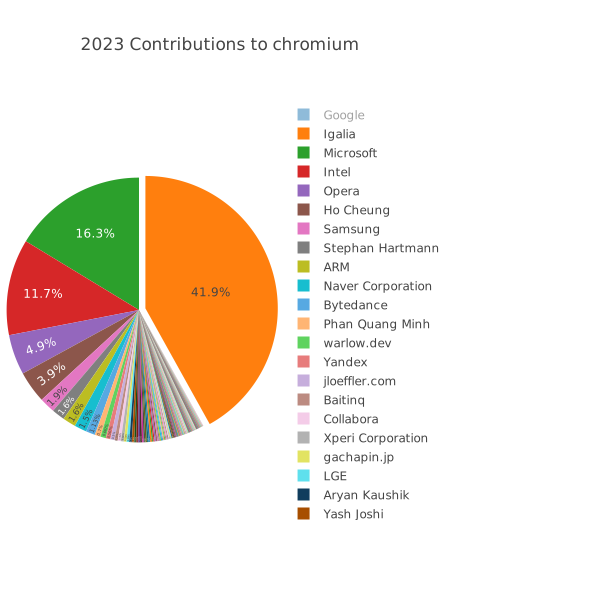
However what it would do is open up the market to competition. Right now Google is spending a lot on Chrome development and Chrome advertisement. Opera and Edge both have given up on their own engines because they couldn't keep pace with Chrome development, and Firefox kept its engine but can't compete with Chrome's ad spend. If Chrome had to compete on a more even playing field there would be more room for diversity and competition. That could be a net positive, even if it makes Chrome worse.
So who would buy “Chrome” when they can get Chromium for free and fork it?
There was a "Gold" version they sold at retail for some time that had a WYSIWYG editor in it, until they made it standard as part of the Communicator suite.
What if the browser had a similar model? The manufacturer pays a certain 'browser development fee' into escrow, then on first boot, the copmuter shows a browser ballot, which gets set as the default, and the fee goes to the chosen browser developer? There's probably a bunch of problems with this approach, and, at least initially, wouldn't break the monoculture, but it might be a good starting point for how to fund browser development.
The new Chrome company will struggle for a year or two then Apple will try to buy it but lose out after Oracle submits a higher bid.
We're in the worst timeline, so I could see that happening.
In all seriousness, I kind of wish that someone could build a sustained non profit like apache to take over chromium - if Google or Microsoft or others want to custom roll their own flavor fine, but Google being for-profit has been making decisions against the best for everyone browsing the web (such as the new plugin stuff around adblocks) (conflict of interest)
so, an utility.
create a (partially?) state-owned steward with a legislated mandate to develop the browser, self-funded via extra tax on digital goods and services.
I don’t think these engineers have the right incentives, and their interest is not aligned with mine. I don’t really care what they do to Chrome and their efforts benefit me only indirectly. I am also not convinced by the "best browser" thing, even using it every day on my office computer. So, meh. I don’t care too much either way but I won’t lose anything if Google has to spin it off.
Create a consortium or interested private entities but let's not give such an important piece of technology to governments where meritocracy is non-existent (also based on personal experiences).
Just wait until you have to justify IT expenditure to a for-profit corporation that isn't solely focused on technology.
Government screws things up because it's (by design) slow. Business screws things up because f*ck your needs, we need to get a check to a retiree who never even worked here.
Either your business is spending the economically optimal amount on IT or you're running at a net deficit disadvantage.
Note that the economically optimal amount may not be what people want or expect, which is why in general we rely on (mostly) free markets and not centralized human planning like the USSR.
The problem with this is that people think that the net deficit disadvantage matters.
It doesn't. Companies are now owned by shareholders that are set up to not have to care about that company within a fairly short period of time. They're not owned by people who have any pride in "winning" that market or an existential threat to their finances if things go poorly. Most publicly-traded shares of companies on stock exchanges are owned by pension and retirement funds, and the person at the head of that fund has exactly one job: make money for the members. If that means gutting the company they hold shares in like a fish, while simultaneously setting up to exit the position, that's what that means. The company's net deficit disadvantage is not the fund's net deficit disadvantage, and that's by design.
Now, that has massive economic consequences for the people who are at the company (and, y'know, actually do the work), and for customers who relied on the product or service, but the fund has made money. Whether its members spend it on anything that will create more economic value over time is another matter. For example, fast-rising homeowners insurance rates in places in the Southeastern US that have been popular with retirees over the last few decades would indicate that they aren't spending it wisely, but, hey.
But even then one party in the government wanted to defund PBS for being too liberal
https://fortune.com/2024/08/05/mozilla-firefox-biggest-poten...
If 90% of the contributors were non-Google, then it would effectively be controlled by non-Google, because they could fork it and their fork would still get 90% of development.
See Terraform for a live example.
The only reason Google "controls" Chromium is because Google funds almost, but not quite, 100% of its development.
On a similar note, there's nothing stopping Microsoft from investing equal or greater amounts and forking Chromium (well, arguably they might already have with Edge). Except that they're benefiting from all of Google's investment, for free. Why turn down a massive developer investment from your competitor with no strings attached?
They are, see how both Safari and Firefox, the 2nd and 3rd most popular browsers, have brought in tens of billions of revenue per year. Safari is immensely profitable, Firefox too would be if Mozilla wouldn't be run in an absurdly poor manner.
> the user gains a huge amount of value by a browser being integrated into the OS, webviews in other applications, etc
What is the huge value gain that e.g. Safari being integrated into MacOS is bringing me? Why couldn't webviews be backed by a browser of my choice?
The point was that developing Safari isn't what makes apple the money, it's setting Google as the default search engine of the default browser. So if Apple would stop maintaining safari tomorrow and would switch to preinstalling Firefox, they would still get the Google money (for setting Google as the default search engine of their Firefox installation). So Safari isn't profitable for Apple, as was claimed before.
Similar for Windows.
The exact way Safari itself is immensely profitable is under scruity in this exact DOJ case!
> As set forth in Section IV, the PFJ prohibits Google from offering Apple anything of value for any form of default, placement, or preinstallation distribution (including choice screens) related to general search or a search access point.
[1] https://storage.courtlistener.com/recap/gov.uscourts.dcd.223...
To what extent and I holding a stupid belief, and why? I think I might like to be talked out of this, if reasonable. Want to try?
You can use Firefox 3, programs don't rot.
In this specific case I'd be willing to bet that Firefox 3 probably doesn't handle current HTTPS/TLS standards and might not be able to browser the modern Internet at all (let alone display modern webpages, HTML5 video players, single-page web apps, WebRTC live calls, etc.)
Put it behind privoxy. All those SPA blogs exist solely due to google. No google - no SPA.
- Why would Google (which famously didn't index Javascript well, and liked clear super-optimized URLs) have contributed to the existence of single-page applications (which used to have terrible drawbacks for SEO)? Where's the incentive?
- And what is a SPA blog? That seems like such a far-fetched idea.
- the browser is undeniably critical as everyone's window through which they view the online world;
- the user gains a huge amount of value by a browser being integrated into the OS, webviews in other applications, etc
- browsers aren't really a self funding product
- having a single for-profit US advertising company control everyone's view of the online world, however slightly (e.g. by obstructing adblockers), is Not Good
Splitting it off solves the latter problem but immediately raises the question of how to pay for it. A very artificial arrangement where Google pay "arms length browserco" to maintain Chrome?