polishTar
We're not going to be smarter than a superintelligent AI. The things we conceive it doing if it were given a malicious task (bioterrorism, killer nano-machines, pure fusion bombs sidesteping the non-proliferation bottleneck of Pu239, etc) are likely not the full set of things it can do to harm us. I don't think it does us any favors to dismiss the risks here.
Even the things we can conceive of are very scary, to me at least.
We live in a society that has systems of market competition between companies and economic/military competition between countries. There's not just one country working on frontier AI, and not just a few companies in each country either. The incentives of these systems ensure AI advancement will happen quickly from here on out, no matter what, absent governmental action.
An individual researcher leaving the company does nothing, other than give their seat to someone else who likely doesn't share their same concerns.
Alternatively, using the influence they do have in their position to directly try to advance AI safety research, advocate for govt action, and make public arguments attempting to persuade the public to pressure the govt to act when they otherwise wouldn't be inclined is far more likely to impact things for the better.
"It's deliberate sabotage by Amazon", "It's retribution by Hegseth for embarrassing the DoW", "It's a brilliant marketing scheme by Anthropic", "It's because of the govt is considering investing in OpenAI and so they're crippling any competitors".
It's never just "a very poorly formed regulatory action in response to increasingly capable models".
Sure, this may be the most important invention ever with near certainty to reshape society over the next few years, but meh. We should probably just immediately dismiss the concerns of anyone working on it without addressing their arguments at all. It's easy, we can justify ignoring their warnings by saying they're self-interested or too self-important or whatever.
Life is more fun when you live it with your eyes closed! You should try it out too.
Those are some goofy numbers. Obviously incorrect.
They're just not willing to pay since there's no revenue benefit to search hosting it. It seems like Danish media doesn't like this and has chosen to withhold their content, which is their right of course, but it seems strange to contort that into a claim that Google is doing censorship.
It would be more correct to say Quake III Arena was released to the public as free software under the GPLv2 license.
Also, even if this weren’t the case you can’t sue for damages to other people (they’d need to bring their own suit)
Presumably Gemini 1.5 will be available there soon.
If you've ever used a VR headset you'll know the weight is extremely important when it comes to comfort. This isn't just a random marketing metric.
I don't know if this is the case, but if these images were released to press & public as part of a media resource pack with a permissive license used to market the movie (which I believe is commonly done in this industry), I'd have a hard time empathizing with the viewpoint that Midjourney is doing something wicked by including it in their training data.
https://images.macrumors.com/t/wMtonfH5PZT9yjQhYNv0uHbpIlM=/...
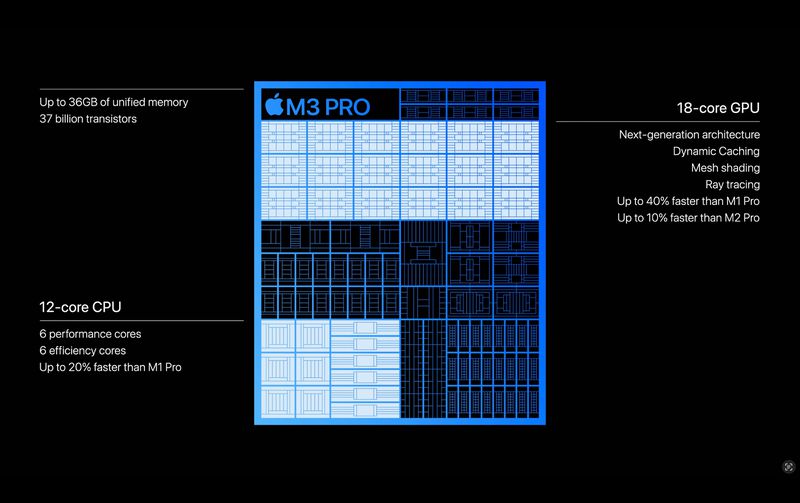
  M2 pro = 8*3 + 4 =28 (the *3 representing that the performance cores contribute ~3x more to total system performance than the efficiency cores)

  M3 pro = 6*3*1.15 + 6*1.3 =28 (apple claims 15% more performance for the p cores not 20%)
They don't claim either of those things. They claim the performance is 20% faster than the M1 pro. Interestingly, they made that exact same claim when they announced the M2 pro.
Energy efficiency might be better, but I'm skeptical till I see tests. I suspect at least some of the performance gains on the p+e cores are driven by running at higher clock rates and less efficiently. That may end up being more significant to total energy consumption than the change in the mix of p/e cores. To put it another way, they have more e cores, but their new e cores may be less efficient due to higher clock speeds. Total energy efficiency could go down. We'll just have to wait and see but given that apple isn't claiming an increase in battery life for the M3 pro products compared to their M2 pro counterparts, I don't think we should expect an improvement.
Apple's PR release for M2 pro: "up to 20 percent greater performance over M1 Pro"
Apple's announcement for M3 pro: "up to 20 percent faster than M1 Pro" (they didn't bother to compare it to M2 pro)
Apple's E cores take up ~1/4 the die space of their P core. If the M3 pro lost 2 performance cores but gained 4-8 efficiency cores it'd be a much more reasonable trade.
M2 pro: 8 performance cores + 4 efficiency cores.
M3 pro: 6 performance cores + 6 efficiency cores.
Not a great trade... I'm not sure the M3 pro can be considered an upgrade
This should apply for both threads software and meta.
I'm a bit surprised how many people here have sympathy for companies trying to enforce exclusivity over common names. Let anybody use "threads" if they want.
Agreed on gender/race/age. That should be made as blind as feasibly possible.
I wonder what went into the decision on the ratio of P to E cores. Naively it seems like more of the die space should be dedicated to E cores since they're so killer for workloads where efficiency or throughput matter. Obviously some jobs can't spread the load across multiple threads and are sensitive to single-threaded latency, but those workloads won't benefit from so many P cores anyways.
IMO, real power consumption in joules over the course of a benchmark needs to be the standard when it comes to comparing efficiency.
Just a quick google search shows prosecutors in the US also selectively choose which cases to prosecute (it appears there are around 4x as many cases get dismissed than go all the way to a jury trial), but nonetheless there are many meritless cases that do somehow make it to trial anyways.
I could accept that Japanese prosecutors are a bit better at filtering, but a 99.3% conviction rate does not seem right.