But not everything must be for-profit. Free/Libre/Open Source Software is a prime example. Projects like GNU, Linux, GNOME, KDE, WebKitGTK, LibreOffice are sustainable for a long time.
Konqueror and Epiphany are Webkit based, so presumably benefit from Apple's funding of Webkit.
Ladybird and Servo aren't real browsers yet, and have so far been funded by grants which doesn't seem to be long-term stable.
Brave is into crypto scams and advertising scams, so I guess you're right there. Their revenue is also tiny.
The rest aren't what I'd call "real" browsers, most don't have the same level of functionality and compatibility as Chrome, Firefox, Safari, Edge... Servo for example is literally just the rendering engine Firefox gave up on.
https://github.com/brave/brave-browser/wiki/Deviations-from-...
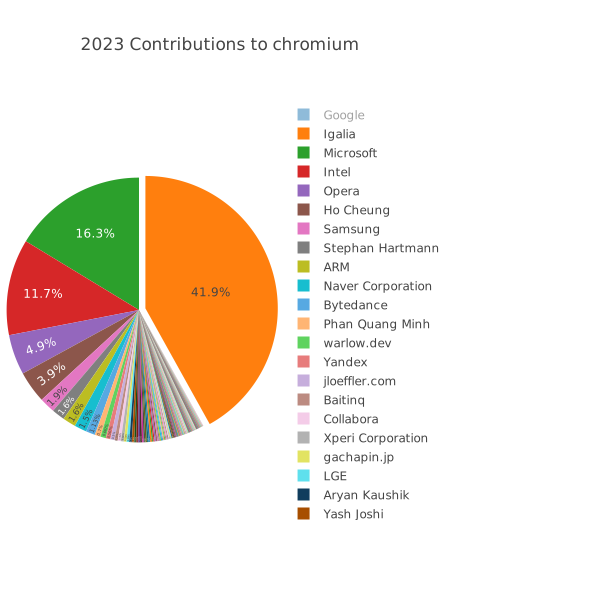
Maybe you could carve out a niche that's willing to pay, the same way C# did before dotnet core. But for a mass product the best-case scenario would be something similar to today's Opera.
However what it would do is open up the market to competition. Right now Google is spending a lot on Chrome development and Chrome advertisement. Opera and Edge both have given up on their own engines because they couldn't keep pace with Chrome development, and Firefox kept its engine but can't compete with Chrome's ad spend. If Chrome had to compete on a more even playing field there would be more room for diversity and competition. That could be a net positive, even if it makes Chrome worse.
So who would buy “Chrome” when they can get Chromium for free and fork it?
There was a "Gold" version they sold at retail for some time that had a WYSIWYG editor in it, until they made it standard as part of the Communicator suite.
What if the browser had a similar model? The manufacturer pays a certain 'browser development fee' into escrow, then on first boot, the copmuter shows a browser ballot, which gets set as the default, and the fee goes to the chosen browser developer? There's probably a bunch of problems with this approach, and, at least initially, wouldn't break the monoculture, but it might be a good starting point for how to fund browser development.
The new Chrome company will struggle for a year or two then Apple will try to buy it but lose out after Oracle submits a higher bid.
We're in the worst timeline, so I could see that happening.
In all seriousness, I kind of wish that someone could build a sustained non profit like apache to take over chromium - if Google or Microsoft or others want to custom roll their own flavor fine, but Google being for-profit has been making decisions against the best for everyone browsing the web (such as the new plugin stuff around adblocks) (conflict of interest)
so, an utility.
create a (partially?) state-owned steward with a legislated mandate to develop the browser, self-funded via extra tax on digital goods and services.
I don’t think these engineers have the right incentives, and their interest is not aligned with mine. I don’t really care what they do to Chrome and their efforts benefit me only indirectly. I am also not convinced by the "best browser" thing, even using it every day on my office computer. So, meh. I don’t care too much either way but I won’t lose anything if Google has to spin it off.
Create a consortium or interested private entities but let's not give such an important piece of technology to governments where meritocracy is non-existent (also based on personal experiences).
Just wait until you have to justify IT expenditure to a for-profit corporation that isn't solely focused on technology.
Government screws things up because it's (by design) slow. Business screws things up because f*ck your needs, we need to get a check to a retiree who never even worked here.
Either your business is spending the economically optimal amount on IT or you're running at a net deficit disadvantage.
Note that the economically optimal amount may not be what people want or expect, which is why in general we rely on (mostly) free markets and not centralized human planning like the USSR.
The problem with this is that people think that the net deficit disadvantage matters.
It doesn't. Companies are now owned by shareholders that are set up to not have to care about that company within a fairly short period of time. They're not owned by people who have any pride in "winning" that market or an existential threat to their finances if things go poorly. Most publicly-traded shares of companies on stock exchanges are owned by pension and retirement funds, and the person at the head of that fund has exactly one job: make money for the members. If that means gutting the company they hold shares in like a fish, while simultaneously setting up to exit the position, that's what that means. The company's net deficit disadvantage is not the fund's net deficit disadvantage, and that's by design.
Now, that has massive economic consequences for the people who are at the company (and, y'know, actually do the work), and for customers who relied on the product or service, but the fund has made money. Whether its members spend it on anything that will create more economic value over time is another matter. For example, fast-rising homeowners insurance rates in places in the Southeastern US that have been popular with retirees over the last few decades would indicate that they aren't spending it wisely, but, hey.
But even then one party in the government wanted to defund PBS for being too liberal
https://fortune.com/2024/08/05/mozilla-firefox-biggest-poten...
Specifically, this one:
I feel the same. I also feel the same about a modern C library and C compiler (and C++, if you like). They are essential to build any modern system and applications. Yet, those are also (mostly) no longer self-funding products.What do you think will happen if Google is forced to divest Chrome?