One way to tell whether you're in an 80s house would be to look around for reference books, encyclopedias, rolodexes, filing cabinets. If you wanted to know more about something, you probably had to go to a library, which might not even have a book on the topic (maybe if you were particularly determined to know the answer you'd wait a few weeks for an ILL).
Its a bit sad to me that you look at this enormous sea change in how we interact with the world and see Angry Birds.
Honestly, it seems like you're just picking some incremental or marginal technological changes that happened, then promoting them to something more fundamental than they really are. Electric cars? Come on. They're barely even a change from a consumer perspective. Someone from 1950 wouldn't even notice the difference, unless you told them exactly what they were looking at.
And some of those other things are debatable. For instance: I deliberately stopped using GPS for several years, because I realized it was preventing me from building up geographic/navigational knowledge, and instead was just training me to follow instructions blindly and never learn anything (e.g. by picking weird routes that were marginally faster but very difficult to systematize). [Edit: The following is about non-map online information.] The computerized "knowledge at your fingertips" is a common slogan of computer-age propaganda, but it's probably true that a greater fraction of that "knowledge" is in fact garbage and overall may just be a marginal improvement.
Sufficiently advanced marketing is indistinguishable from technological progress.
The change over even 10 years ago is also really dramatic for how I use public transit, since I not only know where I am but where the vehicles I'm planning on getting into are so I can reroute that way. It's only in the past 5 years or so that the data has gotten reliable enough that I trust it to use in that way.
I remember what it was like to get lost, and be lost for hours, late at night nothing open, no one but unsavory characters out.
I remember how hard long trips could be even with maps or trip-tiks from AAA (which were awesome)
GPS enables all sort logistics, it allows transport companies to ensure trucks are driven safely, to know when and where goods in transit are there is an entire world of productivity improvement right there.
I'm not saying it's not useful. I'm just saying it's not as big of an advance as it's being made out to be.
> And come on, maps are excellent, there's no garbage there.
I've above clarified, but my "garbage" comment was not referring to maps, but other kinds of material you'd fine online. Maps are actually one of the few types of online references that tends to have very little garbage.
For me that’s incredible and very reliable. Thousand of kilometers to arrive in a place I’ve never been before without memorizing the road in advance is innovation. My dad never could’ve done that at my age.
You went all the way to Europe and didn't even look at a map? You could have been 100 yards from some amazing place and never even known it. Your dad never would have done that.
Technology has generally eliminated the worst scenarios -- getting totally lost or stranded -- but also generally eliminated the best -- discovering something new, an unexpected detour. I can also speak from experience and say that I barely remember the trips in which every detail was planned and executed exactly according to plan. The times when I was lost, or had no place to sleep, often turned out to be the best and most memorable trips of my life. Actually being forced to interact with other human beings has its upsides.
A GPS makes it even easier to discover the world
So not only convenience and leveling the information playing field, but pricing fairness. I'm sure quite a few minorities would have some testimonials about the benefits of getting quoted the same price as everyone else.
Did they say they had only room left and 3 people were looking at it right now, despite it being obvious the hotel was only half occupied?
However, I largely consider technology advances to be rather unimpressive, especially services and apps built on the internet. Access to information has definitely been improved though, but this is one of the few major improvements and now with more information being siloed behind corporate mega-sites we may be regressing back to the libraries for free access again.
On family trips in the 90s, I'm pretty sure my dad almost never paid the asking price for our rooms. If you were coming in from about the mid-evening on, without a reservation, but they still had some rooms unlikely to be filled, and there were any other hotels with vacancies around, they'd gladly knock off a few dollars if you asked, since the alternative was likely having $0 of income for that room, that night.
What I've noticed traveling more recently is that there seem to be fewer vacancies if you try that "just show up and find a room" thing (which used to almost always work out fine, except at extremely popular places on very busy travel weeks), like the whole industry's running with way less slack (i.e. more efficiently). But also room prices have gone batshit crazy, even more so than general inflation, so the savings from that efficiency doesn't seem to be reaching customers.
After moving there I've started to appreciate a decent, frictionless, fixed price service a lot more.
That’s a fine personal choice to make if you value building up geographic knowledge for its own sake, but I don’t really get your point. You could say the same thing about giving up your dishwasher because you value hand washing dishes for its own sake.
Wut? I call major bullshit on this. Yes, obviously electric cars generally do the same thing as ICE cars, but the consumer experience is so much better for me is that after owning an electric car I will never, ever even consider owning an ICE car.
I mean, by your analogy, an ICE car is just an "incremental or marginal improvement" over a horse and buggy. Heck, I've got to feed my horse grass and clean up after its poop, and I've got to "feed" my ICE car gas and clean up after its oil leaks. What's the difference, right?
Sure, not common in 1950, but the user experience difference between an ICE car and electric is, to a 1950s or 1910s person, basically noise. The ICE car is noisy, electric not. The acceleration, ride comfort, features - all are similar enough to be interchangeable to someone far removed from this time.
This is not true at all. Ride comfort and features is massively improved in todays cars compared to 1950. Or to 1980. That goes for both the driver and passenger.
Bottom line is that cars have been available to get us from point A to point B at high speeds for over 100 years and that is why we buy them.
Active (electromagnetic) suspension systems are a huge improvement over the 1970-80 land yachts that couldn't corner to save their lives.
Better yet, you can adapt your suspension system to ride however you want.
Get a sports car for fast corners.
The fact that the per-mile cost is much lower? Isn't that pretty much the definition of productivity?
Not a big deal. And on long trips with an electric car, don't you have to plan around relatively extended stops at (currently) relatively rare charging stations?
Took a quick look at the map of the superchargers exactly once before the trip, just to doubly make sure there are any at all on the way, and that was it. The car navigation system automatically added the needed one to the path and showed exactly the calculated amount of charge i should have left by the time i get to the charger and/or destination. There were at least 6 supercharger stations on the path to my destination (didnt even look at the regular chargers).
I didnt charge my car prior to the trip, it had about 40% charge before I headed out. A bit past halfway through to the destination, i stopped at a supercharger (that the car notified me about and added as a stop on the navigation as soon as i started the trip, because it calculated i won't have enough charge to make it to the destination). Charged the car to 90% in about 40 mins tops (was one of the older v2 145kW superchargers, the v3 ones that I've seen before are much faster), went to mcdonalds and stretched my legs in the meantime.
There was a tradeoff of stops vs charge time: i waited to 90% to avoid additional supercharger stops, but if i was ok with those, my stop time would have been even shorter, because the charge speed is faster the less charge you have, it is like a logarithmic curve. I.e., about 10 mins of wait for 100 miles of range on the lower end of the charge, but 40 mins if i want to reach the 90% (with the total range being about 330 miles total).
I went into a lot of detail to explain things here, but during that trip (around 400 miles total), at no point have i even thought of or planned for charging specifically, the navigation system handled it for me just fine with pretty much no detours. And i wasn't driving through dense city areas either. Once i got out of Seattle and nearby areas (about 30 mins into the trip), it was all rural areas through and through, but somehow they still had about 7 supercharger stations conveniently placed on the way.
Nope, sorry. An electric car is still just a car, not some revolutionary different thing. It gets you from A to be exactly the same, the only difference is you plug it in at night rather than visiting a gas station.
> I mean, by your analogy, an ICE car is just an "incremental or marginal improvement" over a horse and buggy. Heck, I've got to feed my horse grass and clean up after its poop, and I've got to "feed" my ICE car gas and clean up after its oil leaks. What's the difference, right
Nope, sorry. A car is an order of magnitude faster, have far longer range, haul more than a horse and buggy.
I don't agree at all. Especially in the sciences, the collaboration across countries over the internet has been tremendous. The ability to instantly know what papers are being published in your field and use their results to further your own research can't be overstated. We rely on that to do our work at our company. But going back to tech, the ability to do open source projects _at all_ wouldn't have been possible before. The interconnected nature reduces 'local maximas' of knowledge, skill and expertise. I have learnt so many things from watching youtube DIY channels that I otherwise would never have in my own local community.
And so I ask - What makes your claim "probably true"?
No it isn't. I moved to a new city and realized after a couple years that I still barely knew my way around. I then correctly diagnosed that the cause was the overuse of turn-by-turn directions. You're trying to frame it as some hipster cooler-than-thou thing, when it isn't.
If your use case is travelling to a new place once or twice and never again, there is no point memorising the route / area.
Memorising a route doesn’t help you figure out there is an accident on the route, or unusually heavy traffic.
I don’t disagree with you about memorising common routes and learning about your local area, it’s a good thing to do imo. It’s just no longer required because technology is good enough to let you get by without having to do that.
You really should go to some museum or google how cars in 1950 looked like, functioned and sounded.
> I deliberately stopped using GPS for several years, because I realized it was preventing me from building up geographic/navigational knowledge, and instead was just training me to follow instructions blindly and never learn anything
You are in minority there from pretty much all aspects. People are not ditching GPS. They are not looking into GPS constantly either, generally people don't go to places they don't know that often. And if you are refusing "weird shortcuts" then you are lessening your geographical knowledge even more - you are opting out for routes with easy to memorize milestones instead of learning how streets are really connected.
I was surprised the first time a Tesla went by because I had no idea a car could be that quiet.
IMO the Web has done a terrible job of realizing all the wonderful knowledge-spreading and educational purposes it was supposed to.
What it has done is make it so idle, trivial thoughts that would hardly have reached the level of consciousness before, become an itch until I find out the answer—because now I can find out the answer ("who was that one actor in that one show"). And it's great at answering those kinds of questions.
It's 2022 and in tons of fields you'll still run out of material on the Web as soon as you go past the barest surface of a topic, and have to go track down some books (which may have no digitized version, so I mean actual books). I have niche reference books from decades ago that are exactly the kind of thing that an online catalog-of-knowledge ought to be good at, but what's on the web is far less complete than them. That kind of thing.
All that, plus it's so crammed full of spammy shit that using it is like trying to track down a poorly-marked Little Free Library box on the Vegas strip.
Physical libraries with inter-library loan remain much more valuable overall—and university libraries, especially—which is kind of pathetic.
The most valuable sites on the Web are probably piracy websites like Library Genesis, and they still can't deliver everything you can get on dead trees. But they come the closest.
We definitely communicate vastly different than 30 years ago and prior.
Literally every piece of the car is in a different class and the tech is insane that just didn’t exist then, I mean it basically drives itself. It’s dramatically safer, more efficient, comfier, faster, quieter.
I no longer hate long drives, they’re quite nice. The speakers are amazing and the road noise is basically gone. I can stream anything, talk to friends anywhere in the world while driving, massage and heat my back, and do it all with half the gas at a cost that’s equivalent to the 4Runner when it was new back then. It also goes 110 as comfortably as the 4Runner would do about 60, and breezes up hills that the latter would break a sweat on. I press a button for roadside assistance, I lock and start/stop it from my phone, I don’t have to bother with the key, the list just never ends.
Meanwhile a car from 1965 honestly is a lot more similar to a 95 than a 95 to today.
Run out vs. new is a straw man w/r/t/ old tech vs new.
These are all iterative changes. You still stop at red lights. You still sit in traffic. You still have the same speed limit as everyone else. While someone from the 90s airdropped into 2022 would be impressed with the stock features of a '22 car, they would not experience any fundamental shift in the movement of goods and people. We still using the same barges, shipping containers, trains, cars & highways, and jets that we were back then.
Having just done two 12+ hour road trips, each, in both cars, I can say that it's not the same. The 4Runner I arrive tired, angry, back hurting, and dizzy from focusing on the road every second, having spent way more on gas. With the new car, I basically enjoy podcasts and movies on my dash while keeping an eye on the road and it does the rest.
We literally have mostly automated driving while turning cabins into ultra-premium dens filled to the brim with every comfort from massage to heat, and people claim it's not tangibly different. It's so, so different.
Even lives saved due to all the safety features and hardware is like hundreds of thousands of human-years of productivity. Reducing it down to "technically they go the same speed" is a silly game to play, I can reduce any opposing argument down in a very narrow and specific way and "win", but that's not the game.
I stand by cars being a great example of progress, and again we're talking velocity of change - compare 1968 car to 1995 cars to today, and it's not really debatable which one is a bigger leap.
Finally, this bits vs atoms is stupid. It's another arbitrary way of slicing things to win an argument. But even if we did want to cut out computers, phones, AI, high speed internet, etc - which we totally shouldn't - you only have to look to SpaceX, or all the crazy new manufacturing tech like industrial 3D printers and AI-powered robotic arms that are actually driving all the innovation in things like cars.
There's just too much tech in it that will go wrong, or be unsupported in 10 years.
No one will know how to fix it.
We are adding complexity where we should not be, but then cars are designed to be sold, not to be used for more than 3 years.
As the sibling comment points out on average longevity is way up, another point against older cars. Safety also way, way up.
Nostalgia mixed with contrarianism are potent drugs, but cars are the perfect case against things not changing, positive change has accelerated the last 20 years.
We often buy nice, comfortable, complex things with the assumption that the comfort and niceness of now as well as the infrastructure that lets them function well are static things that will never cease. Of course, they're not, and sometimes they can recede very abruptly.
Your second point is shifting the entire conversation to something else entirely.
I find it regrettable that sooo many comments focusing on "like" rather than actual hard results. The original topic is about the latter, not about the subjective experiences. And for results, a 1960s care got you from A to B pretty much the same as a 2022 one.
That does not make the subjective aspect invalid, but I would at least like to see some self-awareness in comments that we are talking about at least two separate things, and arguments for one are not useful for the other.
.
Recently I also found myself thinking about another aspect. It was when I looked at the tram station not far form my house, which for a year or so has been upgraded to have a display with the expected arrival times of the next three trams.
It sure is very convenient! However, compared to a similar transport system of fifty years ago, which achieved the same thing, we now have a lot of additional effort to maintain such infrastructure. It got waayyyy more complex, all the electronics, and software has to be written and maintained, screens installed and maintained, computer infrastructure - all just for some slight improvement in convenience.
Is it worth it? I have no conclusion, I just have to think about that when I hear yet another "we need more 'Fachkräfte'" (skilled workers). How many people do we need for mostly just minor convenience upgrades?
Sure, the transport system also can get more efficient with things like those displays. But here again, A LOT of additional effort, planning and thinking has to go into it for such gains to not just be theoretical. If we can afford it - sure, why not.
It's just that I have to think about the challenges ahead: The more stuff we produce and have to use energy on the worse for climate change and resource use.
I think it is good when new stuff is tried, but I have doubts that all those many minor "upgrades" are worth spreading so far. The effort for minor gains is gigantic, and we don't have free power, overabundance of skilled workers and free (material) resources (yet?). How much worse would for example said city tram system really be with less sophistication and IT?
I've become a bit skeptical about my own line of work. IT is nice and all and I love it, but it also takes a lot of effort to prepare and also to maintain. Here took, too many only look at the gains, which of course do exist. But there is a bias "newer and more complex is better" IMO.
Very much related:
"Humans solve problems by adding complexity, even when it’s against our best interests"
https://www.washingtonpost.com/business/2021/04/16/bias-prob...
Nature (paywall, try Sci-Hub): https://www.nature.com/articles/d41586-021-00592-0
> Adding is favoured over subtracting in problem solving
> A series of problem-solving experiments reveal that people are more likely to consider solutions that add features than solutions that remove them, even when removing features is more efficient.
I think our economic and financial system is an additional driver. Not doing something is "being lazy" and is punished (unless you are wealthy already). If you manage to sell stuff that is useless or even detrimental, you are fine, and there still is a wide gap between this and doing something criminal.
It looks to me like our own biases and our society and systems push us towards increasing complexity just for complexity's sake. Then come the biases that let us find the justifications but not see the downsides nearly as clearly. We also have a huge bias for measurable/quantifiable outcomes, and what things with an attachment to money.
All this complexity relies on huge supply chains also for maintenance. Given the possible issues ahead, both political and climate, maybe less complexity and more locality and less international-network requirement might be a good idea.
I am way more productive and happy:
- I save more money so I have more to spend towards productive uses.
- I don't die as often, living is productive.
- I listen to podcasts, diverse videos (just listening) or music, learning more during my drive.
- I call friends and family, enhancing connections and communicating more.
- The car drives for me, leaving me more relaxed and energized when I reach my destination, and I am more likely to travel further than I would normally.
- The car is much safer, lowering anxiety, so I use it more often for productive uses and generally feel safer and happier, and therefore more productive.
- It accelerates and coasts at higher speeds easily, so I get there faster.
- My back doesn't get sore nearly as easily (I get back pain easily sitting up), a huge productivity boost.
- The AC is cooler and heat is faster, sound is nicer, every material is nicer, tint is stronger, wipers are automatic and fast, lights are automatic and fast, etc etc - all this adds up to lower stress and higher safety, meaning less death, less injury, higher likelihood to use it productively, and less stress.
To wave away these things as minor is a very Thiel-like thing to do, but I find it ridiculous. You want to go to space? To be in the most inhospitable environment possible? What does that do for us, again?
I'd rather have better Wifi and more legroom on a flight than a rocketship that went 2x faster but didn't have either. We didn't get flying cars, we got unlimited knowledge and communication at the speed of light, even when flying through air. I'd like to fly a car, but again:
Cars from then 2020s are spaceships compared to cars from the 90s, while cars from the 90s are not really much different than those from the 60s. Within a decade we likely have self-driving electric cars completely dominate, and suddenly the Theilians look silly because all these "non-important" advances like, oh, computers and AI, suddenly solved a big problem, ignoring the fact that those same computers are already solving medical problems left and right, landing rockets from space, folding proteins, re-inventing Chess and Go, saving millions of man-hours of work, connecting people all over the world and greatly enhancing their general knowledge, amongst a few hundreds of other things.
> I call friends and family, enhancing connections and communicating more.
I also question the validity of statements such as these. It does not seem to me to be supported by evidence that our connections between people - and lets concentrate on connections between already connected people to remove the question if new tech lets us make new ones more often - are qualitatively better than in the past. I would think such a statement very much deserves a [Citation needed] response. I think a lot of your statements are equally... creative and subjective, or worse ("I don't die as often, living is productive.").
I don't feel like I know my friends or family very well these days, despite being friends for almost thirty years with some.
Twenty years ago we would talk on MSN or email and arrange to do something or hang out. These days you just see photos of their lunch.
I also feel like a lot of folks are scared to hang out, even pre-COVID, because they have nothing to talk about that isn't already on Facebook. What they do discuss is pretty much solely consumption of "I ate x", "I bought y".
I largely feel like folks have lost the art of conversation. Instead they're now content creators.
They have more hobbies and more interesting hobbies (the internet has really exploded the ability to learn about and try things, and new tech like kite surfing is popular with my friends). My wife learned how to sew during the pandemic using just YouTube.
There's a massive and tangential discussion to be had about tech and it's influence on culture and connectivity, but that's not for this thread.
I'm a bit baffled, what does your reply have to do with either of my previous comments? I mean what I actually wrote, I'm aware I prominently mentioned such a convenience feature. It's just that there was no question that it was convenient.
> It was when I looked at the tram station not far form my house, which for a year or so has been upgraded to have a display with the expected arrival times of the next three trams.
> It sure is very convenient! However, compared to a similar transport system of fifty years ago, which achieved the same thing, we now have a lot of additional effort to maintain such infrastructure. It got waayyyy more complex, all the electronics, and software has to be written and maintained, screens installed and maintained, computer infrastructure - all just for some slight improvement in convenience. Is it worth it? I have no conclusion, I just have to think about that when I hear yet another "we need more 'Fachkräfte'" (skilled workers). How many people do we need for mostly just minor convenience upgrades?
You made up some arbitrary thing that you admit improves quality of life, and I pointed out that your example doesn't really even capture the difference. 40 years ago you had to ask around, or call to ask about the times of tram. Now you can find the exact times, delays, of any tram anywhere directly from your tiny pocket supercomputer. The difference is so stark, and yet you focused on signs at the station when the revolution was in your hand.
---
Realizing you brought up like 5 different things, and now every time I refute one you're motte and bailey-ing to the next thing. I don't owe you to refute every point you put out, the thread here was a specific example of tech improving productivity, and I think it's definitive.
The study is ridiculous and proves nothing, and the rest is pathos and too broad to reply to.
I still don't see how the reply fits to the comments I made. You missed the point of my example by miles, is my impression still. I think I already expressed it well enough even in the original comment, so I have no idea how to re-express it for you.
> 40 years ago you had to ask around, or call to ask about the times of tram
No you didn't. The train or bus schedule was and still is posted at each station, and pocket watches have been a thing for a very long time. I find your style of a bit tiring to be honest.
> You made up some arbitrary thing
Even more misrepresentation! I did not make up anything! That happened!
> Realizing you brought up like 5 different things, and now every time I refute one you're motte and bailey-ing to the next thing. Realizing you brought up like 5 different things, and now every time I refute one you're motte and bailey-ing to the next thing.
You keep ignoring my point and keep talking about deliberate misrepresentations of some minor examples that merely serve as illustration!
> The difference is so stark, and yet you focused on signs at the station when the revolution was in your hand.
Given what the parent comment is about, the really huge difference e.g. between tech such as gas lights and electricity, or horse carriages and modern transport, your claim of a "stark" difference seems unjustified to say the least. You still get from A to B in about the same time and with at best a minor improvement in efficiency and convenience. It is certainly not a game changer to have computerized timetables compared to paper schedules plus watches and clocks, unless a transport system is so grossly broken that it barely ever runs anywhere close to the posted schedule.
I see no basis for you claims of "stark difference" and "revolution", given the context of this entire discussion. The Internet and computerization are, but not replacing paper tram schedules with electronic boards. Again, unless your experience is from some place where the paper schedules were completely useless and trains and buses ran randomly and you had huge random wait times. In which case they would still be far better off fixing their broken transport system so that the schedule actually has meaning.
> I don't owe you to refute every point you put out
You keep "refuting" what there never was to begin with. For example, as if I had said "there is no benefit" (of changes), a point I never made.
Never once did you even acknowledge (or ever even see?) my point, which is the position in a larger context. You keep attacking positions I never took. I will not repeat them here, since I already mentioned them in my original post.
You said this is your main point, and I directly replied to that.
Another point you made was that electronic signs at trams aren’t an improvement. I agree! Wholeheartedly. I mean showerheads haven’t improved either! We could list all sorts of things that either haven’t changed or that aren’t improved by tech. But that would be silly.
You in fact have avoided the very valid point I made in reply to that. Electronic tram signs are a red herring. The revolution is in your pocket. I can check flights, trams, buses, anything in about 15 seconds anywhere in the world. That is a huge productive improvement.
Anyway it’s clear this convo isn’t going well, but glad we had it. I very much got your other points, I just didn’t feel them relevant to the article or this thread, it’s a whole other conversation on simplicity or satisfaction, not really productivity. You can see one of my sibling replies for what I think about it.
> You said this is your main point, and I directly replied to that.
You don't refute my statement. You still only get from A to B in about the same time. It's just slightly more convenient. But if the schedule is actually kept by the trams it's not even that, you can just look at the posted paper schedule at the station. The difference in convenience then only is that you have to walk a few steps to see the much smaller print.
I never disputed the utility of GPS. Although there is indeed the disadvantage of using it too much, having lived long enough in the pre-GPS time using maps and/or trying to use just my brain to find my way felt good in different ways, and I still use that method when going somewhere where the journey is the goal itself. It's like when one of my flight instructors covered up all the instruments and got me to fly by sight - including things like angle of attack, at least in level flight (yes that only works for small planes, large ones must be flown by the numbers and instruments, same with IFR conditions).
You still overlook all the larger picture things, the systemic stuff. A discussion so limited to only the thing itself instead of the system is useless in my view, and quite boring, more like trying to gain the upper hand in a discussion by selecting a limited scope and reading into the comment only as much so you can find some angle of attack, instead of using good will and really actually trying to see one's point. You began like that right from the very start, when you started your first reply: "What a horribly myopic take". Zero good will and insulting. AFAICS you keep looking for ways to "win". This is quite tiring.
Also turning a smartphone with internet, realtime transit info, route planning, which can do it anytime in the future, anywhere on earth, and let you plan travel across any number of travel modalities (it shows me transfers between bus, train walking, weather along the way, etc) into... "GPS" is just a great example of myopia. And that's just scratching the very surface! For just the narrow, narrow use of travel, the phone solves whole entire large brick-and-mortar industries that used to exist like travel agents - remember, you used to go to a dedicated store to book travel? And trusted one person who actually didn't know much about anything? And they had like a few packages, and you browsed them in a low-res pamphlet? I mean really, travel is the topic you want to say hasn't improved, and your example is electric sign-posts? The, well, myopia in that is stunning.
But I worry even bringing in one extra point, because you've shown yourself to be the type who latches onto examples and reduces, rather than expanding. Remember - smartphones replacing travel agents in a 100x better fashion is but one of thousands of improvements it's made to transportation (Google search, Wikipedia, Tripadvisor, Uber, Getaround, Yelp, HotelTonight, Airbnb, online booking), which is but one of thousands of use cases it's done similar for.
And I pointed out ~10 ways I do accomplish more because of it, refuting exactly the point.
The rest of the comment cites a ridiculous one-off, narrow social science study with a few vague pathic appeals to the quaint simplicity of the before-fore-times.
I think you both want to zoom way-way out to 10-guy "like, what does accomplish even really mean? Isn't simplicity, like, the real accomplishment?" and I'm all for a simple life well lived, but that's pretty much re-defining the entire discussion to be about something else. And no one is getting rid of cars or phones at this point, I'd love to see that argument.
You write to me on an internet-connected device, on a forum on the web, from likely a laptop or phone built within the last 5 years. That same phone you likely use all day, every day for hours a day. And you'll argue it's somehow a sinister regression? So... why are you here? A laptop, the internet (and modern healthcare that saves lives, modern cars that save lives, etc) doesn't exist without "complexity". It's such a ridiculous attempt to de-rail an interesting and specific debate.
It's also such a uniquely HN-specific type of person that pines for olden days while distinctly relying on modern technology all day every day, so weird. The same types will laud the Framework Laptop - yet talk about reducing complexity and supply chain reliance.
People had lots and lots of paper maps. Every gas station had a rack of them. You'd probably have had a good spiral-bound one of your entire region in your car. Wrong turn? Just check the map and save God's help for later.
GPS, you just wait a second for it to update and you barely miss a beat.
So maybe if we by "productivity" mean "can get away without acquiring useful skills" then sure, "productivity" has definitely gone up.
Navigational skills are likely not only improving our mind in ways we might not otherwise appreciate, but also serves a countless practical scenarios. Something as simple as getting around at a large market or mall often comes down to the exact same skills as reading a map. In fact that is what you're often literally doing as you find a floor map to locate the location you'd like to go to.
There are also examples on the other side. Read this [1] warning from the national parks service about GPS and Death Valley. Multiple people blindly following GPS there have lost their lives because of it, and countless other similar locations that are quite remote and where what your GPS tells you, and what reality tells you may often contradict.
Finally, if we ever enter into a war against another major power - on day one of the war, all GPS is going to cease to exist for the foreseeable future (with the internet not far behind). Those satellites are sitting ducks and are going to be high priority targets. This shouldn't even be an argument, but this scenario is looking increasingly likely with every passing day.
It's been over 2 decades since I got lost outdoors (and then only for about an hour), but I do sometimes get lost in a complex urban environments. Which street goes where again? Especially when I'm on a continent I haven't been on for awhile. I've been told I have an excellent sense of direction.
I also grew up before hand held GPS was a thing, let alone smart phones.
Even back then, almost no one had a decent sense of direction, people got lost and delayed getting to new places all the time, etc. If you asked someone which way was North, at least 75% of people would have no clue or thought they knew and then pointed the wrong way.
The way people dealt with it was by NOT GOING TO NEW PLACES MUCH, or by bringing someone who had been there before, or just being late a lot the first few times.
I also think it's dumb to suggest someone be trying to juggle a (usually outdated) paper map and orient themselves that way, ESPECIALLY in traffic with little notice, instead of just using GPS. And if you think people are going to be able or willing to pull over somewhere to pull out the map and look, well, go watch what people actually do in traffic now and tell me again. A lot of people don't seem to be willing to even go to the next freeway exit when they miss theirs, preferring to rampage across dividers instead.
It also used to be people would bring someone along to be the navigator because it was so difficult. Now people can explore on their own easier.
In the event of a war and GPS gets taken out, solar apocalypses, etc. it's going to suck for that and many other reasons, but it's not like it helps suggesting they use the old terrible way in the mean time. Because even on a good day, that was pretty terrible.
Well yes, it’s exactly like that argument, and they’re both valid!
And I've never seen somebody who learned to navigate on a map effectively actually locate their position in moments.
Ah yes, “just” check the map. When I was a kid if my Mom made a wrong turn on a way to a doctor’s appointment a few counties over (I got sick a lot as a kid) I’d have to reach under my seat and figure out which of the multiple paper map books corresponded to where we were. Until GPS I had no visual sense of “where we were” when we were out of my town (I don’t understand the “relying on GPS makes you worse at navigating” people), so I was basically useless at reading or interpreting the maps. Mom would need to pull over, but that meant finding some way to get off the unfamiliar highway we’d just turned onto, which could take a few minutes (or more, if the exit we took put us on another highway).
So now we’re several minutes off course, flipping through the pages in this other county’s map, trying to figure out how to get to a doctor’s office in a building whose parking lot has a one-way entrance that’s in the back, but first we’re low on gas and need to find a gas station that hasn’t closed down since the maps were printed.
And then suddenly, we got this GPS thing, and this awful fixture of my childhood was gone. “Getting lost” just stopped being a thing around the mid-2000s. Screw the 1950s, 1990s me would find the current status of driving to be an unimaginable utopia.
GPS maps are an improvement not a major innovation, which is the main point. They are more convenient and require less skill, but they are functionally a paper map with a dot on it that changes based on your location.
Finding a gas station in an unfamiliar area, however, is definitely improved by a GPS map. So, you can now run the fuel tank down a little further before filling it up. Nice, but again not revolutionary in my opinion.
For example, when I tried picking up electronics as a curious high-schooler, I managed to pick up a clearance sale copy of The Art of Electronics - it had all the information I could possibly look for (and I'm pretty sure once could make a career in Electrical Engineering using nothing but that book as a source even today). I'm pretty sure I'd be hard-pressed to find such an accurate and comprehensive reference on that topic anywhere on the internet.
You can find The Art of Electronics on the internet... And you can put it on an old tablet with dozens of other reference books.
Furthermore, plenty of stores sell you files to consume however you want.
Oh and e-ink works fine in sunlight and lasts weeks without charging. And FYI, there's plenty of notetaking systems.
My partner and I have been using these e-ink devices for almost five years. Works fine. No replacement required thus far. It is a specialized version of Android.
The World Book entry on enormous subjects of great importance was still maybe a few pages long. Today, a fair amount of primary source material in archives on different freaking continents is available online.
Printed documentation for hardware and software was frequently not exhaustive and there was no way of asking for help quickly. Maybe you had a help line. Maybe you knew hobbyists in a local meetup group. But that old DOS manual wasn't anywhere near as useful as what is available today.
It's more productive having somebody show you how to do something, than trying to learn it yourself. Perhaps in the 1980s when the economy was going better, it was easier to connect with people willing to share, teach, mentor. Perhaps people have been forced to be more competitive now. Also, cut back in education meant many programs have been cut.
We would not feel so stagnant if manufacturing was more of a thing in N. America. Lots more factories with lots more 3d printers, laser cutters, drone, robots would exist. If you needed to get your hands on some such tool, you'd only have to ask around. 3D printers didn't penetrate the home like desktop publishing did in the 1980s and 90s.
We have all the internet but damn even books are better and broader today. I can order that rare special indy book and print it on demand and have it show up in 3 days
There's also no YouTube tutorial to tell you something like "don't mix types of metals for you gas plumbing or you'll kill your family" because there's no professional watching you make stupid mistakes.
What cut backs? We spend more on education than ever. We might be getting less out of it, but not for lack of spending.
https://nces.ed.gov/programs/digest/d19/tables/dt19_236.70.a...
Now I can just fire up a browser and understand a hard math concept in minutes in a much easier way. With free as in freedom CAS tools and such, and with a netbook bought at a ridiculous price 20x cheaper than the book volume set itself, which back in the day costed A LOT.
There are arguably more opportunities now for learning things from a professional than in the past.
Public schooling has very rarely been about mentorship anyway. Arguably higher education always was to some extent, but it very often still is; you end up in debt nowadays, but it's still widely accessible.
And I don't see what loss of manufacturing has to do with anything. Some of those manufacturing jobs were in skilled trades, sure, but there are still plenty of opportunities still to learn skilled trades. And even then, I don't think that has much of anything to do with learning things from a book at the library vs. a course on the Web.
What I see is that people have no clue anymore about where they are. They rely on GPS. Is this an improvement? As long as GPS is working, yes.
That’s a pretty bold statement supported by literally nothing, just because you don’t feel like certain tech has added anything doesn’t mean it hasn’t.
Productivity is an incredibly hard thing to capture, especially with the move to away from manufacturing and physical production.
One could easily argue that the productivity numbers are failing to increase because technology has lowered the barriers to entry all over the world so now there’s more competition for every good and service creating pricing pressure on the “value of goods and services produced”
- cellphones, the internet and GPS saves insane amounts of time coordinating RL events. I'm never gonna get back the 1000+ hours I spent with paper maps trying to find places, playing "phone tag" coordinating activities, etc. Kids these days, they just have no idea.
- remote work & learning = 2+ hours PER DAY. I used to pay $500 (in today-dollars) a month to sit on the Long Island Railroad and read books. Now I work when I'm ready to be productive. I listen-in on zoom calls, whisper questions to people, read docs, all "soaking up" information. Recently, I got tons of work done while on a grand jury - 21 cases in 8 days and no problem interleaving work, thanks to excellent WiFi and work-from-anywhere.
- e-commerce and youtube = no more repeated trips to the store for stupid shit. I've got a dozen major home improvement projects going at once, with ecomm orders every which way, from lumber to jigsaws, electrical to plumbing. Easy returns means I can experiment more. YouTube means fewer mistakes and far fewer disasters.
- globalization = variety = better tools for the job. No seriously, you have no idea how limited and shitty products used to be. In software, we had no source control let alone CI/CD - reproducibility was not a thing, let alone distributed computing. IRL, I remember trying to buy stuff at Sears and Service Merchandise and the only review system was the store clerk on commission. You can't imagine the BS we put up with, simply for a lack of variety.
(I could go on... you can't imagine healthcare back then... in the starkest definition of "productivity," cancer was often a death sentence even caught early, and now people routine survive stage 4 cancers... also everybody knew people who died young in car accidents, it was tragic but normalized, and then DUI laws and education, crumple zones and airbags all made this rare...)
Now it's true, we "waste" our newfound freedoms binge-watching Netflix, wasting time here on HN, going to the gym, and so on. Put another way, I dunno about you, but my daily/weekly "productivity limit" is not based on output, but on my brain maxxing out, from too many projects, too many names, too many details.
It's also true that many upgrades are "trivial" - vacuums with lights and on/off buttons on the handle; better quality audio and video; 1000s of streaming shows. Back in the day, we had maybe a dozen channels and the quality was often terrible, from mediocre writing and acting, to hilariously simple production values that even pre-dated the demands of 4K. Historical fiction wasn't popular because it sucked. Sci-fi and horror weren't much of a thing because the special effects sucked. And and and.
These don't make you productive, and they don't even make you happier unless you remember to appreciate them.
Which is why I'm taking the time to write this comment. I just had another amazing day that my older self simply couldn't imagine, let alone someone from mid-century or before computers.
OP/Thiel's point: It's not that we haven't made any progress, but rather the progress since the cold war has been disappointing.
I'm a bit ambivalent about Globalisation and whether that can be considered progress. We globalized several times (Early trade routes, 14th century, British empire and then again in post-modern era).
I suggest listening to his interviews with a completely open mind and thinking on your own. I sometimes disagree with him but in no way he is evil/satanic as media portrays him. Sad.
I'd add, though, that the entire complex of metrics we use to define "productivity" were invented to quantify and guide the improvement of things that were a problem 100 years ago
Of course the second 50 years were worse than the first 50 years, because if the people working during the first 50 years accomplished anything, then all the easy wins were taken.
And the problems being solved changed. If your entire population has moved on from the problem of producing enough to meet material needs, then of course the work being done now will score poorly. You need to update your metrics as fast as your technology changes, and we just haven't done that.
Everything you've described above is a real added value, but it's not the kind of value that the old metrics were designed to measure.
Classic case of grading fish by their ability to climb trees.
The software we use is 1000 times more complex than it was 20 years ago, leading to performance that really have not improved a lot, and a lot of functional stagnation. Many applications are slower to start today than they were 10 years ago, because back then they were binaries and today they are Electron apps. Your average web based word processor with cloud storage performs about the same as Microsoft Word did on Windows 3.1 on a 486 saving onto a floppy. Screens are bigger, resolutions are bigger, but the content is largely the same because the limit is human perception not technology.
If you actually keep things simple, you can build absolutely ridiculous things off modern hardware. I'm running an Internet search engine out of my living room. You could not that 20 years ago. What makes it possible is modern SSDs and the absolutely mind-boggling computing power of modern CPU.
Except (gdocs for comparison) I now can:
1. Effortlessly access the doc on multiple devices, wherever there is cell or WiFi. 2. See a visual history of every change I've ever made to the doc. 3. Collaborate with many other people in real time. 4. Easily incorporate images, tables, drawings, and other files. 5. Compare documents. 6. Use other character sets and emoji. 7. Add, have others add, and review comments.
I'm sure there's more. I don't remember everything about how primitive things were 30 years ago.
ahh, the no true scotsman style of logical fallacy.
Document processing is not strict nor defined. The features listed in the parent comment are all very useful, and if the floppy disk document processor of 30 years ago could do it, the people there would also find it useful.
Other tasks have become more efficient in that time period. Anything involving graphics has gotten much easier to do on computers than before and can be done by more people. Project Management tools are much faster and easier to use.
What I do see in a corporate world is an emphasis efficiency that requires spending a lot more time tasks and running alternate scenarios to be more efficient. This seems more doable now because some of these things are easier but its too easy to ignore the time spent doing more of this kind of thing.
I couldn't disagree more. The general choppiness a modern application has is noticeable by literally everyone. I'm so bothered by it that I even went back to a wired mouse recently because the latency of my bluetooth mouse made me uneasy. And another point is that VR is rewriting entire technology stacks JUST to get lower latencies, precisely because a lot of people just get sick if it isn't good enough. 120Hz+ displays are becoming more commonplace thank god. And I could go on.
But what I meant was like pixel density and so on. My screen is a lot higher resolution than it was 20 years ago, but it doesn't actually display much more information as my ability to actually resolve fine details has if anything worsened with the years. My screen is farther away and my font size higher, that's the big difference.
It's the same with code editors. Sublime Text 3 is crazy responsive and it's a joy to use, however I missed certain features that VS Code had, so I switched, however the latency issues are very noticeable. Typing is a little slower, switching tabs is very slow (like 100-ish ms?) and when you're opening new files you could literally watch the text being color coded before your eyes on my i7 laptop I used back then. Things got worse when I started developing Flutter applications while running the Flutter and Dart extensions. VS Code would sometimes take several seconds to react to me pressing the backspace button, which made it incredibly frustrating to work with.
How is it possible that our computers are so incredibly performant these days, yet seemingly not fast enough for simple document editing or text editing tasks?
I wonder how much of today's software is designed to make us more productive or efficient, by helping us manage... software?
Also known as Wirth's law: https://en.wikipedia.org/wiki/Wirth%27s_law
Sometimes it worries me. If we had a boring set of usable and safe tools to use for development, that would also be pretty fast, i wouldn't have to update my hardware every 5 years or so. But JetBrains IDE's (just one example) basically demand that I do, if I want their other shiny features.
Perhaps something like Java instead of Python. Perhaps something like Go instead of Java. Perhaps something like Rust instead of Go.
Just boring (predictable), stable and dependable programming languages, supported on every platform with a set of native libraries. Perhaps a bit like what LCL did in regards to GUI in particular: https://en.wikipedia.org/wiki/Lazarus_Component_Library
Long ago I started coding in gedit. Since then the language got only faster, I need less code because more major libs do more of my work.
Also my computer is like 8 years old, my laptop until recently was over 10 years old and my current one about 3 or 4 (T420 and T480s)
Ruby is not native, but we'll portable. My point is this 'boring' work style is here, people just choose to not use it.
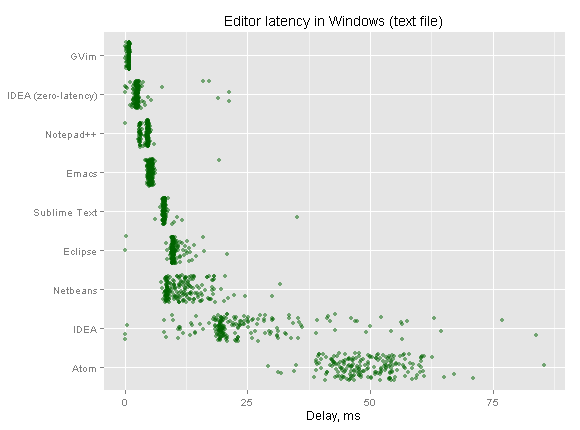
That's interesting, because there have been articles that indicate that Atom has not only comparatively worse startup times (which may or may not matter to people), but also really bad typing latency: https://pavelfatin.com/typing-with-pleasure/
In particular, this image gets the point across well: https://pavelfatin.com/images/typing/editor-latency-windows-...
> Ruby is not native, but we'll portable. My point is this 'boring' work style is here, people just choose to not use it.
This is a good point, though! As far as I know, plenty of people still use Ruby (typically on Rails), or also other "batteries included" solutions like Python and Django pretty successfully.
That said, most of these languages have pretty severe limitations in regards to their performance and resource usage: https://jaxenter.com/energy-efficient-programming-languages-...
Some lovely benchmarks seem to confirm that, in relatively real world conditions: https://www.techempower.com/benchmarks/
Admittedly, that doesn't matter for all projects, but why couldn't we have the ease of use of Python with the performance of Rust and the developer experience of Rails/Django?
well, they aren't doing the demanding, if you're the one who wants those shiny features!
That's just the thing: they use all of these browser based UI technologies, these slower scripting languages and other ways to ship software in a reasonable time and so i could have the actual fancy features that pertain to the logic...
...except that I'd be far happier if they hadn't cut those corners and I'd have a fully native app using the OS UI frameworks and so on. Of course, that isn't possible, if I want the software in the next few years, not a decade from now, or much more expensive (at least that's the prevailing argumentation).
In my eyes, it is the coupling between the desirable bits (what the software actually does) and the undesirable bits (mostly how it does it). But it's all about tradeoffs, similarly to how we often choose to ship code that isn't thoroughly tested just to meet some deadline.
The modern GUI designers in IDEs are notably better, but many shops don’t take advantage of them due to issues with slow performance (eg storyboads in xcode) and issues with multiple developers modifying the resource files simultaneously.
Refactoring and static analysis tools are improved as well, but none of these improvements afford orders of magnitude in efficiency.
The biggest gains in efficiency come from the extended libraries, open source code, ORMs, and the fact that most of what is coded has already been built by someone into a framework or library.
Software development does not now require the expertise of knowing the intimate details of the code and how it works. Many modern apps are plugging together libraries that developers do not understand and are unable to fix any issues in those libraries. The default now is to Copy / paste from Stackoverflow or submit an issue to the library maintainer on github and pray that it gets fixed; or find another library and swap that in. Software development (especially web development) has become a more decentralized effort usually resulting into in a mishmash of layers and dependencies whose inefficiencies are allowed by the amazing hardware. Unfortunately, performance and user experience are sacrificed to the interests of “efficiency” and using the latest language/platform fad of the year.
Oh, also, for a while I ran GitLab which is written in Ruby and still run OpenProject, which also is. Both of those underperformed and wanted both unreasonable amounts of memory whilst also running slowly when under load.
I'm yet to see a Rails codebase that can actually compete with the likes of Java/.NET/Go, since projects like Gitea are snappy and use about 1/10th of the RAM. Then again, nobody really picks languages/tech stacks for their performance outside of a few industries/domains where that is indeed necessary (HFT?).
Most of the time people just choose whatever is the easiest to work with, has the best integrations/frameworks/libraries and will let them ship features in a timely manner. Now, upgrading old Rails projects, though, is something that I cannot recommend doing. Very much not a fun experience.
  local data = readfile("file1”)
  writefile("file2", data)
Polymorphism is just sugar over type inspection and branching.
Recursion-free function calls are just sugar over variable renaming and text movement.
It is now trivial to embed high definition photographs in a document. There is a figure-creation tool right there in the application. I can make notes and comments and mark up a document. I have an automatic and recoverable record of the history of my document. I can collaboratively edit that document with people from across the world. I have spellcheck that works across dozens (perhaps hundreds) of languages.
In the sense that we have a WISIWYG editor whose primary interaction is a keyboard typing letters - sure. But I wouldn't describe this as "about the same."
Performance has improved dramatically, but latency went up too.
You could simply open windows media player and stream video 20 years ago. The resolution would have been the main impressive thing, along with how much money you spent on that high speed internet connection. But far from utterly unbelievable. I'm not sure anyone would have cared which program you used.
I don't remember any trouble with screens or moving windows around or doing streaming video around that time.
> Also, which single cable would you have used to carry video and audio, and which could be plugged into a laptop and a TV?
Oh, I didn't realize you were suggesting the audio moved to the TV. Well HDMI came out a couple years later and didn't really blow minds.
Of course not. All of those improvements were, taken on their own, iterative and evolutionary – as nearly all technological development is. But taken together, they make a big difference.
You could still do a 20 year comparison if you wanted, 1992 vs. 2012. Since the experience has barely changed in the last 10 years.
> The difference between a car right now and a car 30 years ago is that you can now play angry birds on a tablet.
Energy efficiency and fuel economy have made massive gains. Materials are stronger and lighter. Batteries last ages compared to 30 years ago.
Also if you crash one, you're vastly less likely to die.
I always liked this IIHS crash test: 1959 Chevrolet Bel Air vs. 2009 Chevrolet Malibu
It really shows the progress. Seatbelts, the "rigid cage" to protect the driver, air bags, etc. etc.
The 1959 Bel Air crash-dummy is clearly dead, bouncing around the cabin during the crash.
The 2009 Malibu crash-dummy has a sprained neck and the face hurts from hitting the air-bag, but clearly survives.
In the 50's the industry propaganda, parroted by bought and paid for regulators, was that all people involved in an automobile collision were irresponsible drivers deserving of death and disfigurement. And especially so for the colored ones, they probably drove recklessly after stealing them. You can't trust the lot of 'em.
However, it IS unfortunate that we've shifted the risk to people AROUND those vehicles instead of the driver. People drive around in their noise-insulated, airbag-laden tanks these days and they're definitely safer. But it's unfortunate that pedestrians and bicyclists around those cars are actually more likely do die in the event of a crash now because vehicles are so ridiculously tall and overbuilt.
If you ask me, I'd rather that driving was more dangerous for the driver than people around the vehicle. They're the ones taking the risk when they drive poorly. It's unfortunate that the externalities are imposed on those around them instead, now.
The basic mechanism to reduce such risks was established in the '80s.
The 1880s: https://en.wikipedia.org/wiki/UL_(safety_organization)
We used to have Christmas tree lights from the 1950s that were passed down from our grandparents. Two unshielded wires and no fuses, we burned out many an outlet and tripped the breaker every year.
Candes, fireplaces, cigarettes, and cooking stand out in my memory.
A current industry report puts cooking as the greatest risk, followed by heating equipment. Electrical ranks third:
https://www.nfpa.org/News%20and%20Research/Data%20research%2...
I don't have trending data at this point. If you or others care to provide any, that would be appreciated.
Yes. Even the cheapest house built to code will be noticeably better than one from 1980s. The quality of materials, technology of materials, wiring, plumbing, flooring, insulation, etc will all be better.
> The difference between a car right now and a car 30 years ago is that you can now play angry birds on a tablet
Not true, for similar reasons as above. Name a 2022 Corolla equivalent that could be purchased in the 1980s, safety, fuel efficiency, and reliability wise, at a similar inflation adjusted price. No 1980s car will even come close, and that is just for the most basic car today.
Today's house in the same region uses lower grade lumber, carpeted floors, Romex, and plastic plumbing.
Agreed about the Corolla. I owned a second hand 80s Corolla, and it was the best car I had ever experienced up to that point, but a second hand Corolla would be so much better today.
But I do not see how quality of life are any worse with LVT flooring instead of wood, or PEX plumbing instead of copper, or wiring in a hard conduit instead of not wiring in a hard conduit. I would even say quality of life is better. Why would I want to wax wood, and have a more difficult to repair floor. An LVT piece gets damaged, I just pop it out and put a new one in.
Effectively, advances in materials technology has made a home cheaper, and better in my opinion. I would buy a random 2022 house over a random 1960s house anyday.
Land in certain locations of course a different matter, as well as labor.
The average house size in 1960 was 1200 sqft, so call that $82/sqft in 2022 dollars.
The US average cost to build a new house in 2021 was $124/sqft. Meanwhile, the construction workers building the house were getting paid on average $6933/yr ($67,700 in 2022 dollars) whereas a construction worker now averages $47,000/yr.
So the labor costs have gone down by 30%, but the price of the house has gone up by 51%.
The materials might be better or they might be worse, but they're sure not making houses cheaper.
Another huge advantage is you can easily do plastic pipe plumbing yourself. You just need one clamping tool, that costs less than one hour of plumbing labour would cost. Plumbing with copper piping or steel pipes requires way more time, skill, and expensive tools.
PVC drain pipes are also simple to install correctly: a tape measure, a saw, and some PVC solvent cement is all you need for simple jobs.
Assuming you follow directions of course: PEX has zero UV resistance and if exposed to the sun for a couple months will break down and be useless.
Need to fix a leak in a copper pipe? Get ready to weld and bend pipes. Need to fix a plastic pipe? Unscrew that section, and screw in a new one. No drama.
The relevant question is how do the cheapest materials today compares to the cheapest materials in the 1980s?
The garbage materials of today didn't exist nearly as much in the 80s so they'd have to have used at least cheap solid wood instead of sawdust foam.
Most of the 80s homes I have looked at have plenty of garbage materials: wasn’t the 80s when polystyrene decorative mouldings started being popular? Polystyrene houses and leaky building syndrome are definitely an 80s thing, but crappy claddings[2] have existed since the 20s.
There are plenty of garbage homes made with a variety of different garbage materials in the decades before that e.g. ticky-tacky[1]. Different types of particle board have been around for a while.
Watch out for embedded asbestos fibre in stucco ceilings or external claddings especially before the 80s - that shit can really tank resale value because it is hideously expensive to remove (vendor doesn’t legally have to declare it {in New Zealand}, but at some point in the future I expect that will be required).
Cheap and terrible homes and apartments are built in any decade or century. The Road to Wigan Pier written in 1937 talks about the crappy old brick homes in the UK. Survival bias and “the good old days” can make us think old homes are better.
[1] https://en.wikipedia.org/wiki/Little_Boxes
[2] https://soundhomesnz.co.nz/what-type-of-cladding-does-your-h...
Best not to remove asbestos unless it is flaking and unpainted. Disturbing it is likely to make things worse. It lasts forever and has incredible insulative properties despite its toxic nature.
Almost all older homes (pre 1973 I think) have lead paint too with the same caveat to not disturb it unless absolutely necessary. Lead plumbing is a different matter and should be removed unless possibly it is a sewage pipe.
Resale prices are relative to other homes in the neighborhood. If all the other homes are old too, then they all have the same toxic building materials so no devaluation is likely.
This is definitely not true. Old houses have solid lumber, new ones are lightweight softwoods. Copper pipes replaced with plastic. Maybe Marble kitchens are nicer? More energy efficient is likely. Certainly 30 something families can't afford big suburban houses like their parents/grandparents.
For lightweight softwood, I can at least think of the utility that it will be cheaper. And for plastic over copper plumbing, same thing, it will cost less, but it will also be more resistant to corrosion and easier to repair.
I have a new house built from this 'crap' wood you distain, and you can't hear people in the next room because it has sound deadening materials in the walls.
If you removed all the screens you'd probably first notice what's missing as opposed to what's different. In many of today's homes you wouldn't see things like tape / record players, stereos, VCRs, telephones, books, maps, yellow pages, rolodexes, calendars - all of these having a digital replacement.
And depending on the affluence of the home you'd notice a lot more variety of specialty things - for example kitchen equipment (espresso machines, burr coffee grinders, instant pots, sous vide machines, mini blow torches, automatic ice cream makers). There are thousands of available board games now compared to the 80s - and it is super easy to have specialty hobby items as they're cheap and readily available. If you went to the grocery store you'd see a far greater variety of vegetables, prepared foods, cheeses, meats, "exotic" ingredients etc.
I think the big differences are around convenience, variety, and availability - and for whatever reason they don't feel quite as big, even though the work that goes into making that possible is astoundingly large and complex.
People seem to like it, so the argument that they shouldn't have so much junk is a bit flat.
The stuff I own is not keeping up with the neighbours, it's stuff that is meaningful to my hobbies. I have a cupboard full of board games because that makes me happy. My friend has a cupboard full of kitchen equipment because that makes them happy. My other friend has a basement with a home gym, my other friend has a mountain of books, and another friend has lovely furniture.
Which all implies that we're not really trying to keep up with each other, because if we were, we'd now be competing in completely different races. And even when I meet people with a similar interest to me (e.g. board games), the wealth and variety of the medium means that we'll probably still have very different interests within the world of board gaming.
So it logically seems to me that, if anything, the era of social competition is waning because people are more willing to accept that they want different things to their neighbours.
Maybe your values are different, but those people don't understand your values any more than you understand theirs
Is that about it? You can't "productivity" sleeping or oven baking or raising children or relaxing or socialising or a lot of household living experiences. You can productivity your paper work, insurance, banking, but that's screen based. Once you've got clothes from a hand wash to a machine there isn't much pressure for it to be very fast compared to kinda slow, since you aren't hanging around waiting.
I just watched this video of Office 3.0 from 1992:
https://www.youtube.com/watch?v=MsTydF09hbg
This looks and feels like the Office I use everyday.
Likewise, I feel like the changes in the realm of software development, a purportedly fast moving, tech and investment heavy industry, have been a mix of sidegrades, new paradigms enabled by faster hardware, and just stuff as it ever was before.
If a 2005 programmer, who knew C++,JavaScript,Java,HTML,C#,Python,Bash etc. would have been frozen and thawed yesterday, would be able to be brought up to speed on modern iterations of technology and tooling.
Growing up in the 2000s, I hung out on internet forums instead of Reddit, chatted with people on IRC instead of Discord, and used MSN messenger instead of Whatsapp, but these programs almost served the same social purpose.
Considering video games, a canary in the coal mine for the bleeding edge in software and hardware (at least it used to be that way), one could be forgiven for mistaking Crysis, a 2007 game for one that came out yesterday. Halo Infinite released just last year, with almost identical gameplay to the original 2001 Halo.
I feel like the pace of improvement has slowed considerably starting with the 2000s, and I'd be hard pressed to point out anything life-changing that came out in the last decade.
At a slightly larger scale, there was what some historians refer to as a "secular boom" from the 1700s to the 1970s, and then since the 1970s we've seen the onset of what some call The Great Stagnation.
How this ends and what comes next is anyone's guess.
and https://en.wikipedia.org/wiki/Timeline_of_historic_invention... - Pasteurisation, dynamite, barbed wire, ballpoint pens, radio waves, x-rays, polyethylene, incandescent lights, Zeppelins, laminated glass, vacuum cleaners...
In 1900? Quite a bit has changed.
The general shape of daily life today is not so different than say 1970. Email instead of letters, cell phones instead of searching for dimes for the pay phone.
But we fly in jets that average about 450 MPH, cars with a top road speed around 60 or 70 MPH, television but now with an Internet or cable feed, supermarkets are much the same, etc etc.
Except we now have cars with self-driving (however limited, it's a massive improvement over a car from 30 years).
Another interesting thought experiment is, how many digital services, modern tech and so on would you be willing to trade for something mundane, say your dishwasher, a hot shower, the toilet, a car, soap, if you could only have one or the other?
I would absolutely choose a mobile phone over any of those things.
If we are measuring by using dollars, well that's silly. We could have $100TN or whatever of tokens in circulation and be living like wild animals or colonizing the solar system.
I grew up in the late 2000s driving manual cars in France. My electric Hyundai Kona is a wildly better experience by a lot. It accelerates easily, corrects my mistakes with emergency braking / lane centering, and it's stupid easy to park or start on a hill with it.
OK I’ll shut up.
The above comments seem to assume that progress is limited to consumer goods.
As for progress in terms of atoms (rather than bits) behold the elaborate global supply chain.
1 A plaintiff's lawyer specialising in class action securities fraud litigation might be one exception. He might be watching CNBC and drafting a new complaint at the same time. :)
2 https://content.time.com/time/magazine/article/0,9171,809673...
3 Circa 1996 https://github.com/mikemurr/nc110/blob/master/scripts/web
"The web sucks. It is a mighty dismal kludge built out of a thousand tiny dismal kludges all band-aided together, and now these bottom-line clueless pinheads who never heard of "TCP handshake" want to run commerce over the damn thing. Ye godz. Welcome to TV of the next century -- six million channels of worthless shit to choose from, and about as much security as today's cable industry!"
I am still using original netcat every day to deal with the dismal kludges band-aided together, now run by pinheads. Although I use scripts I write myself instead of those of the author, netcat's simplicity, portability and reliability over 26 years is one of the few things I still enjoy about the www. In the rare chance he still uses the www and reads HN, thank you Mr Walker for one of the best programs ever written, not to mention the entertaining source code comments.
No, that's religion.
In 1960, you either had to have cash or find a place that took a check to make purchases. Maybe some places took a credit card. Ever have to wait in line behind someone that is writing a check? "Productive" won't come to mind.
To get that cash you had to walk into a bank during banking hours. Then we got ATMs and could get our money any time of day. No more cutting out of work to deposit that royalty check.
More places started taking cards as well as cash. I distinctly remember asking businesses if they took cards _before_ making a purchase. We still had holdouts like restaurants that didn't split the check.
Now look at 2010. Pay with cash/check/card. Wait a few more years and you can do this with your phone. Get your meal tab split however you like. Owe someone money? No more writing checks, going to the ATM, just hit up Venmo.
Now, what's the productivity measure in that? I have no idea.
Up until at least the mid 90s everywhere took checks. Honestly today interacting with the cash register at CVS takes longer than writing a check.
Sure, a 30 second check writing reduced to a 10 second tap to pay can be a little bit of an improvement (except when it doesn't work), but really it's not that much better.
We can't even do international banking properly. There is literally a list of countries I can't do 'normal' wire transfers to or get from without complicated hoops or huge waiting times and fees.
There is a huge list of things I can't pay for with credit card. I am not even allowed to open a shop selling dildos without getting a highly specialized and expensive credit card middle man. I had to stop several projects because I couldn't find a payment processor that was accepting low volume clients. Strengthening the monopoly in some niches.
If holidays fall weird a wire transaction can take days. 5 days is my recent record. This should be normal in 2022?
You can't just send any amount of money to anyone. High amounts can trigger bells and further complicate and lengthen transfers. We have literally lost control about our own money. In many countries it is already illegal to buy something expensive with cash.
So the productivity won for a credit card users is wasted somewhere else in this utterly complex system of payments & finances. If not a coder that bangs his head in frustration it is the tax office wasting human hours.
We have 'solutions' like Crypto, PayPal, Payeer but all come with their own issues and benefits.
Bordering on nothing, I think, other than that we have the opportunity to make street robbery much less lucrative if we stopped artificially inflating the price of phones, because people don't have to carry cash any more (if they're content with each purchase being recorded and data mined by 20 different companies and their government's intelligence agencies.)
Burglary rates have dropped precipitously with cheap big screen tvs and cheap audio players. My dad built his entire young life around putting together his very expensive stereo system, I have a single dirty old bluetooth speaker that sounds nearly as good. Being not worth stealing makes it even better.
50 years ago, the average person did not cross the Atlantic at all. Flights were so expensive they were completely inaccessible to the vast majority of people.
Today, most of the middle class can eventually afford a European vacation, if it's something they want to prioritize. I'm not rich and I've been to Europe three times in my life.
The way in which we travel is also significantly safer and more efficient. For as much as I hate airports and airlines, I can't deny that the state of things today is still at least an order of magnitude better than "decades ago".
America was a powerhouse of innovation in 1950-1970 both in private and public sectors. The progress was impossibly exponential.
First step is admission of failure. Even the valid praise that "World of bits has seen tremendous innovation" should be followed by "Why did it not progress even faster and why is there so much malaise in the world of bits (ad tech)?"
A 15-bit computer[0] brought us to the moon, whereas this time awash with 64 bit mobile supercomputers, infinite RAM, search engines and cloud computing has brought us high profile failures in corporate drone programs. In such an environment, cost is not the issue. In the private sector and public at large, perhaps we've forgotten how to work together. The military sector seems to have constant cost overruns and occasional big failures but at least gets the job done.
What I’m hopeful about is some new innovation happening in certain corners. Companies such as SpaceX, often made fun by people that are resentful as “Cowboys”, forget that the entire Apollo program was more “Cowboy” than anything SpaceX is doing today.
Read “Failure is not an option” by Gene Kranz if anyone is interested in the old school Cowboy culture of NASA. Warning: It might make you an optimist.
A fantastic book!
But give it up. You tried but you can't explain that argument in a few paragraphs in a social network. That's a level of intelligence that is simply not possible here.
Just look at the answers you got. You (and Gordon) talk about changes in the fundamental, in the daily routines of everyday life, in the organization of life, cities and markets. However almost all answers here completely miss that point and go: "but product X is so much better now!".
They'd need to read Gordon's book to grasp it.
Would be nice if the discussion focused on one particular point in the past, say 25 years in the past, 1997. What has dramatically improved since 1997 as a result of technological advances? It’s a much harder case to make, e.g. the first Prius was released in Japan in 1997, Windows 98 was in beta, Netflix was started…
Sure, the rich people of the 60s had cars and dishwashers. Now many more millions of people do.
Innovation is driven by demand, and demand for faster travel times is mainly fueled by people wanting quicker business trips, not people on holidays.
Demand for business trips has waned dramatically due to the meteoric rise of video-conferencing. So businesses are spending less less time and money sending humans traveling around the world, which has had undeniable gains of productivity in businesses.
Well yes, because we have solar panels and heat pumps and battery powered power tools and vacuum cleaners and dishwashers and microwave ovens and smart lights and ...
You wouldn't expect walls and carpets to change.
Ugly (but very bright and power efficient, and cooler) LED lighting. Bright blue power LEDs on everything. Less fluorescent, minimal incandescent lighting.
Everyone is working at home.
Few books, no newspapers or print magazines, no typewriters, maybe even no wired telephone.
The post office only delivers packages and "junk mail."
No "long distance" phone charges.
No ash trays.
New/improved appliances: air fryers, instant pot/automated pressure/multifunction cookers, high-efficiency washing machines, etc.. Fewer toaster ovens and gas ranges or ovens.
Mandatory smoke alarms and carbon monoxide alarms.
Lower power usage for most appliances.
No bottle returns. Much more "recycling" and industrial compost.
No large stereo systems, AM/FM radio, cassette players, or boom boxes. Fewer (and poorer quality) record players.
Home delivery of everything via amazon, grocery delivery, restaurant food delivery, etc.. UPS, FedEx and Amazon deliver many more packages than the USPS.
Fewer people actually own their houses.
Student loan debt. More monthly bills in general.
mainstream since at least the 1950s
> dishwashers
1970s
> microwave ovens
available but fairly expensive in the 80s, ubiquitous in the 90s
Electric motors are noticeably lighter, more powerful, and more energy efficient today. Yes vacuums in the 1980’s worked but they where significantly heavier, louder, and far more power hungry not to mention more expensive. It might not seem like much but I remember the exhaust from the family vacuum being noticeably warm. It’s even more noticeable with cordless vacuums which got not just better motors but vastly better batteries as well.
Often it’s the parts you don’t notice that make a world of difference. The finger saver shutoff on a modern saw might not seem like much, but those things really make a difference in peoples lives.
"Hoovering" really became dysoning.
I agree, Dyson is quite a bit better than the vacuum my parents had (though central vac was pretty damn good).
Dishwashers are quieter, though not that different. Microwaves seem about the same.
In all these responses what I'm noticing is people missing the vast gains in efficiency from our appliances over the last few decades: everything we have gives more, and uses less.
[1] https://www.aceee.org/files/proceedings/2008/data/papers/1_1...
Probably a feature I wouldn't want to give up.
Canister vacuums date to the 1910s and were probably mainstream by the 1930s (wasn't Herbert Hoover mocked by connecting him to Hoover Vacuums?)
Battery powered vacuums are ubiquitous now and were not in the 1980s (for example the first Dirt Devil model was corded.)
Of course. What about battery powered vacuum cleaners?
Yes, but even there we're not using flammable polystyrene ceiling tiles, nor asbestos floor tiles and asbestos glue any more.
Also air conditioning is ubiquitous.
Exactly! In fact I‘d go further and say - in some cases - “innovation” has made things worse not better.
As a kid our family TV had one remote control. You switched the TV on and it “just worked”. Today to watch your “Smart TV” you need at least 3 remote controls apparently and the time between switching it on an actually watching anything seems to get longer and longer. Sure there’s all this choice now available of what to watch - although mostly it’s a choice between many variations of low quality content - but the basic usability of a TV is way worse than what I had when I was 10.
Another example is “smart lights” … it used to be you just switch a light on and it worked. But now there’s at least an additional 200 ms to wait for a light to turn on, and a little glimmer of anxiety when you’re unsure what “mode” the light will boot up in, especially when your Wifi was down…
I do a comedy podcast and we were ranting about this stuff a little while ago about how “innovation” is making things worse https://youtu.be/HvtCfUMJEk0
As an office worker, I’d stay what is capping productivity right now is actually not good enough software. Too many manual processes done by hand, copy-pasting in excel. It is still too slow and expensive to develop software to do automation and those things are still too damn complex for business users to automate it themselves.
But in that space the gains of productivity have been massive. MS Outlook has eliminated the job of a secretary. Remember the armies of accountants computing financial reports. By cleaning up an old room on a trading floor I found a stack of blank paper trade tickets (printed in 1999…), you’d have a guy running between sales and traders and ops to get it signed off. Then ops people typing it. I read a book of a guy in the French secret service saying that his career consisted in compiling information about what paper people wrote, who knows who, and to know your way around that file so you could search it efficiently. This guy has been replaced by google and linkedin. The hours saved finding information immediately, saving you a trip to the library are countless. I think software has enabled huge productivity gains and there are more to come.
Today..
* we can have pretty much any food delivered to me with a click of a button
* We can have a ride at anytime to any destination with a click of a button
* Communicate instantly with millions of people with a click of a button
* Huge automation in business operations and logistics
* AIs that can literally draw pictures and write sentences
* Practically look at any place across the globe, find directions in any country and translate nearly any text to any language
* Listen to unlimited amount of music and entertainment with a tiny wireless thing in my ear that can also make calls
* Automated vacuum cleaners that run on schedules, mop floors and dispose their trash
* Cars that are much more efficient, can detect pedestrians, red lights, road signs, have blind spot monitoring, can warn you when you are drifting off, warn you if you risk collision, ..
* MRNA vaccines and breakthroughs in many areas of science (CRISPR for example)
* SpaceX, Starlink satellites and adoption of electric cars
* We literally have 3 rovers and 1 lander currently in operation on Mars, transmitting images and data
I could go on but I think I've made my point.
To claim that we have not progressed is ridiculous. Yes, we need screens and internet to accomplish some of these, but we also need fuel and electricity to build a lot of tech in 1960. Some technology simply require other technology and I think that point is irrelevant.
We don't have the ability to regenerate someone's arm in real time or program it to become the limb of another animal in real time.
Teleportation, FTL, flying cars (anti gravity), consciousness transfer, 3D printed food from raw atoms, seamless BCID, direct matter to energy conversion, space elevator, real holograms, all those currently sci-fi/impossible things
plasma/laser/particle weapons which Nikola Tesla supposedly was working on back then but with miniaturized fusion energy sources maybe it'll be a thing (small cyclotron too).
active camouflage (cheap mass produced lcd display/camera overlaid on aircraft) haha name every sci-fi concept you've ever seen
I remember the first time I saw a helmholtz coil in action (bending glowing electron beam into a circle via magnetism) that was crazy but of course tv, even those tiny ones size of a walkman
My guess is that many would prefer having internet access.
Many more people, at least in the US are considered walkable communities than in the recent past.
One the one hand, humanity is totally capable of destroying our planet. On the other, we've already reached, so it seems, the limits of whats is physically possible. Both problems made us abandon reality and instead embrace virtual reality, and virtual "space time".
My robot vacs say yes, you can.
By the way, Neato’s robot vac regressed from its peak, completely autonomous models like Signature Pro from 10 years ago, to the cloud only lineups of today.
Sometime during the last 10 years was when data harvesting became more important than real consumer tech.
Peter Thiel and industry counterparts are directly to blame for consumer regression and the “world not changing much”.
Sorry. They don’t get a free pass.
Hardware/Physical innovation also takes 20 years delay "lab to fab" - you can't cheat it or speed it up. It simply takes time.
And more importantly: if you don't continuously (not continually) fund that 20 years of work (financially, human effort, etc.), the delay goes to infinity.
In general, that "pipeline" has emptied out in the US as manufacturing was outsourced overseas. And so anything you start today merely starts the 20 year clock but if and only if you have the infrastructure in place to support it.
The difference between a car right now and a car 30 years ago is that you can do online many of the things you needed a car before. The speed difference is between minutes or hours to milliseconds - much more than the difference between cars and horses.
The whole aspect of looking at cars is funny. It’s like judging progress 60 years from now by checking by how much their resolution improved.
This is a good question, but I think you'd be surprised by some of the answers. I'd give up indoor toilets before I gave up my smartphone.
You're about half as likely to die in a car crash as you were 30 years ago. It's incremental, but not hedonistic.
https://injuryfacts.nsc.org/motor-vehicle/historical-fatalit...
However, near-instant access to the entirety of humanities’ collective information vs a dishwasher? I’m fine washing dishes by hand.
Mapping a novel virus genome and formulating an RNA-based vaccine in mere weeks vs “look how many dams and bridges we can build”?
You know what happens when you compound incremental progress? Huge advancements.
Progress is real, and it’s only getting faster as exponential tech from the past few decades is just now hitting “whole numbers” and converging.
Of course, it’s not fundamentally inevitable, but the future is decided by the possible-ists.
Please take the time to read the latest works by Diamandis and Kotler, Kevin Kelly, Steven Pinker, and Harari.
I cannot imagine your perspective will still be the same after so much history, theory, and real-world examples beyond the point by point counters you’re receiving as replies.
Besides computers have changed the world just as much in the last 40 years as we have moved from horse carriages to cars, if not more. Just because it didn't require retooling of cities doesn't mean it isn't a giant leap.
The amount of reporting large corporates need to do today internally and externally would not be possible with 1950s technology, for example.
People had high hopes for mRNA, (no doubt people will take this the wrong way) but so far it seems to have been way overhyped. That kind of thing - the ability to arbitrarily protect against viruses - would potentially qualify.
Overall I think the world is in decline progress wise, even as we make incremental gains in previously discovered tech, we lose e.g. Concorde or moon landings or even open borders. And soon the availability of internal combustion engines to the masses if elites have their way.
Other than the neotlithic and industrial revolution, humanity has mostly languished. We could easily be in for more of that.
It’s clear to me krugman never held a hammer in his life bc that is just laughable statement
The point is that the differences are largely incremental. Same stick built frames, same flimsy building wrap, same poorly installed fiberglass batts.
None of that compares to the quantum leap that was indoor plumbing, in home telecommunications, automatic kitchen and laundry machines.
But it's also that such massive change happened prior to the 80s that afterwards we have focused more on optimizing than new categories in our houses. And optimizing isn't bad, it's just a different type of advancement.
In theory we can 3d print houses now, but those are not more useful than a stick built house. They are very easy to change and repair which a feature most people like. The building wraps these days have rather insane R values and do a good job insulating the house. And most houses have some kind of blow in for insulation.
Building wraps have almost no R-Value. The basic function of building wraps is to keep water out, which is why they are called WRBs (Weather Resisting Barriers). Some higher end ones also block air infiltration, but those aren't used very much.
For example, staple up house wrap doesn't block air the way it's typically installed, whereas fully adhered wraps do a much better job of that.
Some sheathing systems (not house wrap) like Zip-R have insulation value, but not "insane" by any means. The maximum R-Value Zip-R gets you is 12 (at a big price premium compared to alternatives), and the code minimum for 2x4 walls is 13.
In many climate zones that experience both extremes of heat and cold, it makes a lot of sense for homeowners to exceed code minimums for insulation, although it makes less financial sense for production builders who are trying to minimize their build costs.
A little more insulation, and they've gotten even bigger, but they are otherwise pretty static.
The other quantum leaps are multiple electrical appliances participating in demand response programs that are helping to balance the electric grid from the demand side.
What I wish I could do (constrained by space, finances, or technology)
- Geothermal heat pump
- Vertical modularity
- Neighborhood microgrid
- Rainwater capture
1) Identify any small parts (no need to try and remember what something is and if it is useful).
2) Sort things into boxes.
3) Give me a matching object (e.g. I want a screw with the right length/diameter/pitch).
> The Pressure Induction Heating Rice Cooker & Warmer uses pressurized cooking and AI (Artificial Intelligence) to cook perfect rice. Platinum infused nonstick inner cooking pan helps rice cook sweeter. Pressure cooking helps turn beta starch into alpha starch for softer and easier to digest rice. Now with convenient Jasmine, Congee and Steel Cut Oatmeal settings.
A very close friend died of a cancer in the early 1990s for whom treatment has advanced little from the late 1960s, and is largely based on compounds developed in in the 1910s, for chemical warfare during the Great War. Other than genetic sequencing now telling us what specific chromosomal mutation is responsible for the disease, the situation remains largely unchanged to this day.
(This is one of the messages I continually send Past Me, who was as is all to typical, bombarded with "information" about "novel treatments" promising to aid in their disease. Those were, and are, utter bildge.)
The largest improvements in health outcomes, measured by decreases in mortality and increases in life expectency, occurred during the decades of the 1910s (women) and 1920s (men). The largest increases since have largely come about through improved healthcare access (especially to the poor and minorities, with Black women and men making huge increases in life exepctancy since the 1950s) and through te elimination of risks: air pollution, asbestos, lead, cigarettes, reductions in alcohol consumption, IV drug use, overdoses, unprotected sex, and the like. AIDs and other novel infectious diseases have been a counter-trend.
5-year survival for my friend's cancer was and remains about 1 in 5. 60 years after 1960.
Gordon in the Rise and Fall of American Growth gives a similar example, what if you went into a time capsule between say 1890 and 1950 compared to 1960 and 2010? In one case you're going to see skyscrapers, commercial airplanes, nuclear power plants, electricity everywhere, cars going at amazing speeds. In the latter case what's the difference, people paying with their phones and different fashion mostly.
'Innovation' in the internet age, say the last 30 years has mostly been limited to enable hedonistic digital consumption with very little impact on how we fundamentally move through the world. The difference between a car right now and a car 30 years ago is that you can now play angry birds on a tablet. A 100 years ago to 50 years ago meant going from horse carriages to trains and from weeks on a ship to hours on a plane. Today the average person crosses the Atlantic no faster than we did decades ago.
That's why productivity growth is low, the world hasn't changed that much. There's still marginal improvements obviously which do add up over time but the 'unprecedent pace of innovation' you hear about from tech evangelists is nowhere.
Another interesting thought experiment is, how many digital services, modern tech and so on would you be willing to trade for something mundane, say your dishwasher, a hot shower, the toilet, a car, soap, if you could only have one or the other? I think it really puts into perspective how much or rather little value those 'innovations' add.