There are a few factions - but this is not a drug war - it is in a total civil war. The difference is: the ability to control government. Taking over towns, expelling the police, trying to murder top police cheifs [1], negotiation of prisoners [3] -- all examples of what happens when a society is divided - in civil war. They are not fighting over pot farms.
Killing 24 people in a rehab clinic isn't reported much in the US due to politics [2], but, this country needs international help NOW. The US is purchasing drugs at a massive rate on the I5 corridor and is now a drugged out enabler. I wouldn't expect help from the US. The cash stakes are huge: some cities import drugs in metric tons in the US and avoid prosecution [4].
[1] https://www.nytimes.com/2020/06/26/world/americas/mexico-cit...
[2] https://www.usnews.com/news/world/articles/2020-07-01/24-peo...
[3] https://www.vice.com/en_us/article/ne8k9w/mexico-confirmed-t...
[4] https://www.washingtonpost.com/local/public-safety/no-charge...
According to https://en.wikipedia.org/wiki/Unlawful_combatant#Prisoners_o... they certainly fulfil three conditions:
(a) That of being commanded by a person responsible for his subordinates;
(b) That of having a fixed distinctive sign recognizable at a distance;
(c) That of carrying arms openly;
but for whatever reason they feel they have an advantage in not fulfilling:
(d) That of conducting their operations in accordance with the laws and customs of war.
Nota Bene George Washington would return, unopened, letters from the British that were not properly addressed, because he wished to emphasise that his men were regulars.
In more recent news, the sundry poorly regulated US militia may have (a) and (c) but fail on (b), while the "boogaloo" have (b) and (c) but fail on (a), and neither has yet shown any sign of how far they might observe (d).
if my maths are correct, we have 4,5/100'000 firearm homicides reported for the US.
This is less than the hot conflicts (including, per TFA, the mexican drug war), and same order of magnitude, but still less than iraq (7/100'000 in 2019).
However, it's an order of magnitude more than ukraine (0,3/100'000 in 2019).
(These are probably the reasons the cartels have for not becoming recognised belligerents: they likely see themselves as having unbundled the profitable aspects of violence from the unprofitable parts of governance.)
to switch references from the Geneva Conventions, consider the formal definition provided by Dr. Linebarger: http://www.gutenberg.org/files/48612/48612-h/48612-h.htm
> Formally, war may be defined as the "reciprocal application of violence by public, armed bodies."
> If it is not reciprocal, it is not war, the killing of persons who do not defend themselves is not war, but slaughter, massacre, or punishment.
> If the bodies involved are not public, their violence is not war. Even our enemies in World War II were relatively careful about this distinction, because they did not know how soon or easily a violation of the rules might be scored against them. To be public, the combatants need not be legal—that is, constitutionally set up; it suffices, according to international usage, for the fighters to have a reasonable minimum of numbers, some kind of identification, and a purpose which is political. If you shoot your neighbor, you will be committing mere murder; but if you gather twenty or thirty friends, together, tie a red handkerchief around the left arm of each man, announce that you are out to overthrow the government of the United States, and then shoot your neighbor as a counterrevolutionary impediment to the new order of things, you can have the satisfaction of having waged war. (In practical terms, this means that you will be put to death for treason and rebellion, not merely for murder.)
> Finally, war must be violent. According to the law of modern states, all the way from Iceland to the Yemen, economic, political, or moral pressure is not war; war is the legalization, in behalf of the state, of things which no individual may lawfully do in time of peace. As a matter of fact, even in time of war you cannot kill the enemy unless you do so on behalf of the state; if you had shot a Japanese creditor of yours privately, or even shot a Japanese soldier when you yourself were out of uniform, you might properly and lawfully have been put to death for murder—either by our courts or by the enemies'. (This is among the charges which recur in the war trials. The Germans and Japanese killed persons whom even war did not entitle them to kill.)
I don't know much about history but my understanding is this true only exists as long as it is convenient. The union didn't care for this role during the US civil war iirc
> So we train our military according to our values which renders them incapable of being able to maintain an occupation the way Chinese army or Russian army would be able to do.
The US military has been involved in all sorts of atrocities since the end of WWII, they just sometimes failed at achieving their military goals, e.g. Vietnam, and sometimes the government resorted to the use of other aggression tools, e.g. Cuba economic blockade.
But if the real problem is your army is corrupt, no quantity of guns and personnel will fix that.
As far as I know, the cartels are closer to an asymmetric military adversary, and have subverted the Mexican state rather than defeating it directly.
I found this paper by Charles Tilly, a well-known sociologist, to be enlightening and eye-opening.
And I think the flip-side is also true, "organized crime" being little different from "legitimate state", except in scale and sometimes scale.
But even more enlightening to me, building on top of this paper, was the opinion of a chief named Bear in the Vietnamese (iirc) jungle, who had to deal with both the "legitimate" (dominant) government and the "paramilitary" groups, who would both alternate tearing through his village and terrorizing his people.
To Bear, all of this activity was the inevitable result of existence of power itself, just a fact of reality. Power which, inevitablly, one or another would struggle to acquire, with similar results regardless of who it was. This perspective allowed him to maintain and protect his tribe from both organizations, by acknowledging their power, acquiescing to it, and letting the wind bend his stalk but not break it, so to speak.
Bear was a wise man who lived to old age in a place with everyday danger, so his words are worth something, IMO.
---
I learned of Bear and his wisdom from a book written by an anthropologist who lived with his people for several years. I remember one of the stories being about how an unwanted premature baby was allowed to die, and how much this upset the anthropologist at first.
Unfortunately, I do not remember the name of the book anymore. If anyone recognizes it, please comment here.
In a more historical note, compare https://en.wikipedia.org/wiki/Warlord_Era
Maybe there are lines in Mexico that cannot be crossed, but from an non-American perspective I struggle to see where those lines are.
The main rule is don’t antagonize the Americans too much. The big example is Camarena who was kidnapped, tortured, and killed by the cartels in the 1980s. It brought such a response from the US, that the cartels in general avoid trying to kill US DEA agents.
Anyone know if there have been any resulting probes, north of the border? (I didn't pick up much english just now in a quick news search, and this is not very relevant to my interests.)
Maybe they have more info?
The origins of Los Zetas date back to the late 1990s, when commandos of the Mexican Army deserted their ranks and began working as the enforcement arm of the Gulf Cartel. In February 2010, Los Zetas broke away and formed their own criminal organization, rivalling the Gulf Cartel.
Needless to say, going after some gang is likely to be different than going after a gang of ex-commando military personnel, and that's before you factor in that there's probably a steady stream of military that still leave to join Los Zetas and that they probably still have active military contacts...
I'm talking "refuse to be bribed and we will skin your teenage son alive in front of you and send the video to his mother".
It's brutal, but the cartels have to be treated in the ways that you would treat terrorists.
Unfortunately it is not that simple.
The US doesn't have the maturity to produce cocaine and distribute internally w/o becoming another cartel. The CIA already did this as a funding source, I could see it being done to destabilize cash flow for cartels. Simply legalizing the possession will allow the focus to be spent elsewhere but will not stem the tide.
It already does.
Stepan, a chemical company in New Jersey, is the only company in the US licensed to import coca leaf, which primarily comes from a Peruvian state-owned company. The cocaine is extracted and sold to Mallinckrodt for pharmaceutical use (it's used in ENT surgery, as it's both a local anaesthetic and a vasoconstrictor), whilst the remnants are sold to the Coca-Cola Company for use as flavourings.
https://www.nytimes.com/1988/07/01/business/how-coca-cola-ob...
The process to get cocaine from coca leaf is the same as to extract any alkaloid from a plant.
The problem is the supply is not controlled in the USA, is dependent on the government of Peru and the drug manufacturing cartels have tons and tons of land in Colombia just for growing cocaine. It grows naturally.
https://www.researchgate.net/profile/John_Casale/publication...
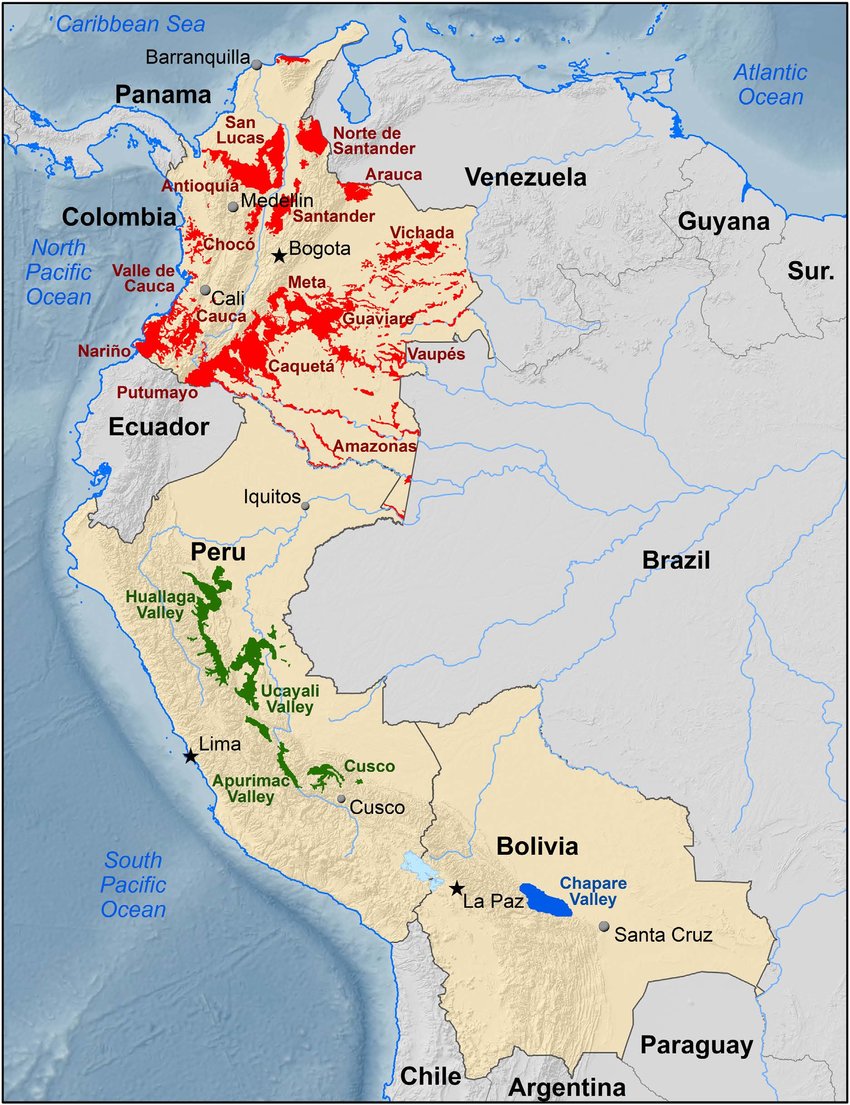
Look at this map, see Peru, See Colombia?
That's your competition.
Marijuana confiscation at ports is down 80% over the last decade, but under the current administration (Mexican), violence has exploded to levels triple that of the peak of the previous drug war when CDS/Zetas/CDT/CDG were engaged in multiple wars over lucrative plazas.
The next Saturday a black trashbag was deposited on her doorstep.....with the chopped up body of her son inside it, and a message to "be careful who you speak bad about".
It's terrifying to think of how people try to navigate such savagery just trying to go about their lives.
One from last month shocked...
Folks know what happens to countries the US deems to contain terrorists.
Obrador's excuse was that he feared that officially recognizing los Zetas as a terrorist organization would tarnish Mexico's reputation. This alleged fear of the US only fits if they feared an outsider intervened to put a stop to the mafia's dominance.
Intelligence agency black budgets have been partially tied to drugs for a while.
Opium -> Heroin -> fentanyl
So maybe legalize opium?
The other thing is there is a huge difference between by a powder that you don’t know what’s in there versus buying a 100 ug ampoule of pharmaceutical fentanyl.
People tend to trust that their doctor is right. If the doctor gives you oxycodone, you assume that it's safe.
Tied in with that is the increased availability of heroin and fentanyl, and now decreased availability of prescription painkillers, pushing users from taking relatively safe pills to injecting drugs, which is an order of magnitude more damaging.
Scary.
My wife for one, even 5mg Vicodin would give her unbearable nausea and head spins.
Whereas that plus a glass or two of wine would be very (too) enjoyable for me.
Not everyone said weed wasn't dangerous either. Leading up to cannabis deregulation there were any number of experts warning of disaster due to its claimed severe effects.
The point of the deregulatory argument is that you can't really entrust a homogeneous monopoly to act optimally, because there's lack of competing perspectives and alternatives.
The current drug regulation regime has failed in all sorts of ways that go far beyond drugs of abuse, into siphoning off funds surrounding less recreational substances, through rent seeking. Anyone who has tried to get a prescription for something harmless or nearly so that they've taken for years can attest to this. Acyclovir, for example, is an essential medicine per WHO, and articles have been written in which it is acknowledged to be safe for the general public (with empirical data) but still argued should be kept as a prescription to avoid viral resistance (even though there's no evidence of this, and other sources of microbial resistance are routinely ignored).
The current system has failed in part because discussions are presented in this black and white fashion where it's things stay as they are or nothing. Pharmacists could be used much more than they are, for example, as could other provider types, not just for drugs but for lots of things.
The pandemic is full of other examples. The CDC demonstrated early on how regulation can fail, and people managed to poison themselves without involving prescribers or their illegal drug dealing counterparts at all.
That's what I'm really unsure about, the physical and psychological addiction potential and an extreme stance which would take it as justification, that the victims are weak of will. The eugenics argument would even encourage this as a way to selection for fitness. IMHO, the physical addiction is countered by the adverse effects of the come-down. I hold some arguments against it, but consider the psychological component much more important. 30% of first time heroin users became addicted in the last German federal report on domestic drug use. I'd say only 30%, in contrast to the myth of the immediate addiction--which is real in a sense, for if addiction-affinity is considered, it's effectively correct. Arguably, understanding the history, these people must be extremely racist, fascist, socialist, liberal, you name it, basicly selfish egoists in any sense you might find offensive.
Simple adversary population dynamics settle at an optimum in the infinite limit (I've watched a video by numberphile or so on the Logistic Function, haha). If the government is a regulator, it should seek to estimate the optimum. The pretense that the optimum is the extinction of drug use and users is ...
I have no idea what I'm talking about, lol
The opiate crisis happened because weed wasn't legal soon enough. Most opiate users for pain release could swap.
I'm sorry but I have to call you out on this. It's complete BS - we simply don't have anything that's remotely comparable to opiates for pain relief.
That being said I'll second that the opiate epidemic in the US is largely the fault of prohibition. Illegality feeds all sorts of negative cycles that wouldn't otherwise exist.
I wasn't saying they were comparable drugs. I was saying one is overprescribed for pain level that could be managed by something less drastic.
These people would be better off on thc.
Marijuana is a great replacement for those who never started down this path and okay a means of getting off opiates. https://www.ncbi.nlm.nih.gov/pmc/articles/PMC6777788/
The linked paper doesn't appear to me to make the claim you did. The combination group (the one from which you could validate the claim you made) is very small - only 486. In fact the paper appears to very carefully outline its own considerable limitations. The authors detail the lack of research in the area and point out a number of conflicting results, including results that directly contradict their own.
That being said, it is a well written, interesting, and thoughtful piece of research. It (and the nearby comment by waheoo) raise quite a few interesting questions for me regarding patient perception and how withdrawal symptoms might interact with marijuana. I also wonder which specific symptoms and underlying conditions might correlate with the various groups. I'm glad you brought this paper to my attention!
All crime is not fungible.
Presumably a similar transformation will be carried out by many Mexican cartels when and if the drug trade will dry off.
Organized crime doesn't go away overnight. It's not like all the gangs immediately disappeared after the end of Prohibition in the US. You just have to keep taking away their revenue sources, eventually they're too poor to fight back.
> “It’s good business,” El Polkas says with a shrug. “It makes a lot of money.” When I ask how gasoline compares to narcotics, in terms of overall revenue to Los Zetas, he rubs his index fingers together. “Fifty-fifty,” he says. “It’s approximately as profitable as drugs.”
[1] - https://news.ycombinator.com/item?id=18101141
[2] - https://www.rollingstone.com/culture/culture-features/drug-w...
"Stories like this are unfolding in industries across Mexico as criminal groups branch out far beyond drugs. Cartels have siphoned millions of dollars’ worth of fuel from Mexican state oil company Petróleos Mexicanos or Pemex in recent years; they steal cargo and pilfer lumber. The tentacles of organized crime extend even into Mexico’s avocado growing regions, where gangs extort farmers and hijack loads of the green fruit."
Look at other mafia run states. Most of them aren't dependent on the drug trade. It's a parasitic part of the economy that won't let the rest of the economy flourish.
Legalize it and the gangs go bankrupt or pivot to another black market.
It's unfortunate many do-gooders are more interested in enforcing their mores on others than working toward harm reduction.
People will always crave drugs and humanity has always had junkies. Embrace this with compassion, not intolerance.
They're already doing that with the avocado trade.
See how that "always been like this" logic doesn't make any sense? I have yet to hear a coherent reason why drugs should be decriminalized or legalized.
When you have invited substances to take over your mind, you can't be sure that it will let you be the captain on the boat without a heavy fight.
It's a slippery slope argument, it's like saying cutting yourself should be a crime, because people who cut themselves have issues and could harm others.
Just like drug users, they should be helped, not punished.
Tell that to the children of addicts
The current legal status of most drugs in the US has a profoundly net negative affect on drug use and its ripples, not positive, because anyone wanting to help those addict parents risks just having them simply thrown in prison for who knows how long. Until seeking help isn't a massive risk, addicts will always end up helplessly trapped.
Cigarettes and alcohol harm those near them, but there are stiff regulations in place, there are social stigmas attached, and heavy legal consequences.
The legalization gives the government the funding to actually do something about it in proportion to demand.
We already have seen this during prohibition. It’s either regulate demand, or pretend that it can be banned and let a non government entity rise up and take power.
Though buying (some) drugs is like buying blood diamonds, funding misery for your own satisfaction.
Openly turning that sophisticated intelligence apparatus against the citizenry is simply not politically tenable in the US at present. (Note that I said openly. What Snowden revealed wasn't open.)
The government has no problem turning its tools against the citizenry - well, particular parts of the citizenry.
These aren't hypothetical techie concerns about the NSA seeing your dick pics. This is actual police departments behaving like we live in a police state.
In contrast, the current shenanigans are occurring within a declared state of emergency (pandemic) on top of which widespread protests over an unrelated topic broke out. Even then, what's happening appears to be status quo police brutality that's piecemeal. (As opposed to open, centrally coordinated mass surveillance of everyone's actions - both physical and digital - with the approval of the legislature).
A state, any state, can take on private armies. They can get all the help needed from USA and EU if they were weak. Even Escobar was beaten, one way or another. Cartels employee a lot of people but the state can make them fight each other and then take on the winner. But then, what does Mexico have to offer to the many millions that wet their beaks in the drug trade? Go work daily on corn fields for $x a day when you can make $xx on opium ones?
What would Jesus do?
https://en.wikipedia.org/wiki/Drug_policy_of_Sweden
"The drug policy of Sweden is based on zero tolerance focusing on prevention, treatment, and control, aiming to reduce both the supply of and demand for illegal drugs."
That's obviously difficult. The actual situation is even more difficult: you have to simultaneously deal with the supply and demand factors.
It's not enough just to legalize everything (which will never happen, 80-90% of the globe will never do such a thing under any circumstances, regardless of what the US does). If you do that, the demand will of course still be there. Someone has to wipe out the cartel production/supply by competing with it.
So the US has to go into the production business for cocaine, heroin, etc. It wouldn't be reliable to leave it to Mexico, it would be too easy for the cartels to hijack and control.
Any country that doesn't legalize globally - which will be most of them - will still remain a target for the cartels to sell into. Latin American cartel networks are effective enough and big enough now that they move product globally.
Legalize it all requires that a very large portion of all countries go in on that. It will never happen.
The US will fully legalize marijuana and it will hardly make a dent in taking down the cartels or reducing cartel violence in Latin America, which demonstrates their considerable staying power. There was widespread opinion that it would make a big difference, in reality it'll have hardly made any difference (Mexico is more violent now than it has ever been in its history).
Cutting the US demand (and the prices the US will pay) out of the illegal business will make the cartels far less profitable, even if the rest of the world does nothing.
> So the US has to go into the production business for cocaine, heroin, etc
If it's legal in the US, US business will rush into that domain. Especially if it's not legal to produce in the rest of the world, so they only have domestic competition.
> The US will fully legalize marijuana and it will hardly make a dent in taking down the cartels or reducing cartel violence in Latin America, which demonstrates their considerable staying power. There was widespread opinion that it would make a big difference, in reality it'll have hardly made any difference (Mexico is more violent now than it has ever been in its history).
The US hasn't legalized marijuana at all. (Individual states have, the feds have just paused enforcement of laws on the books, with no guarantee that they won't retroactively resume them within the statutes of limitations. Everyone doing business in the field is in danger of not just garden-variety narcotics offenses but make-enough-money-and-its-life-in-prison kingpin laws. Which effects the willingness for mainstream businesses to get involved and means that the state-legal businesses are often operating at only a remove or two away from traditional organized crime. You can't judge anything about actual legalization effects on legal and illegal business networks from the current state of affairs.)
Pharmaceutical companies already produce everything you could imagine and more. I can't stress enough how much of a non-issue this concern would be in practice. (Also we already produce an impressively wide range of opiates for medical use.)
> Any country that doesn't legalize globally - which will be most of them - will still remain a target for the cartels to sell into.
So you're saying we shouldn't try to move in the right direction because our actions alone wouldn't immediately and completely solve the problem? This is an incredibly defeatist point of view.
Such as Cocaine: http://www.mallinckrodt.com/products/generics/compounding-po...
Methamphetamine: https://www.rxlist.com/desoxyn-drug.htm
Ketamine: https://www.fda.gov/news-events/press-announcements/fda-appr...
And obviously the dozens of opiates more potent than heroin.
Funny aside, the company that Mallinckrodt gets its coca from is the same company that Coca-Cola gets its de-coca'd leaves from.
No, it wouldn't.
The UN Charter has nothing relevant.
There are various drug conventions, but IIRC, all of them have denunciation provisions, and in any case there is no basis for the claim that either violation or denunciation of those conventions would result in expulsion from the UN. Violation, rather than denunciation, might result in a suit and adverse ruling in the ICJ by another aggrieved nation. Or it might not.
sure, there won't be a un police action against them, and today i learned that denunciation is an option in the relevant treaty, rather than expulsion. but, there is a good reason (treaty obligations) why countries won't just 'legalise all the things' and have traditionally followed softer approaches.
https://www.independent.co.uk/news/health/united-nations-wor...
The distinction between government and gangs in Mexico is subtle. Just as in the US, many former military become mercenaries. But unlike US mercenaries, Mexican mercenaries operate domestically.
But then again, there is a somewhat thriving black market for detergent and soaps: In the US, Tide is often targeted, as are branded department store body soaps, shampoos, and razor blades. This isn't because soaps and things are taxed.
Also, does tax make up for all of the risk markup? I very highly doubt it. IIRC, prices have gone down in places with legalization, in no small part because the whole process can be done out in the open.
In New York there's a $4.35 excise tax on a single pack of cigarettes. In Missouri it's $0.17. That huge delta provides a big opportunity for arbitrage.
And there are lots of people involved, each one adds markup.
The cigarette tax rate in New York is 2500% higher than the tax rate in Missouri. That's more than a few %, and that's just the state tax; NYC has their own additional tax that increases the difference even more.
A black market only exists when there's legal hurdles to avoid. Some markets have low enough legal hurdles, that there's no black market.
(But I agree with the rest of your comment.)
Eg some countries have black markets in currency, because of tight controls. Singapore doesn't really have black markets in currency, despite some (light!) regulation and taxes on money changers.
Stopping the illegal trade by making it legal destroys everything.
But it also destroys a lie we've been telling ourselves.
Arguably the government is the Mafia.
> These guys just throw up repeaters and not only do they not try to hide them, they actually mark them to show who is going to be destroying your life if you take them down. Oh, and you have to pay if you want to work on your own legitimate equipment that is rightfully on that tower.
As I said, modulo "rightfully" which I won't take away from you just for sake of the argument.
> The illegal drug trade exists on a scale unimaginable to most people
That's why the previous two remarks are necessarily exagerated. If the government governs and the drug trade drug-trades, pretty much by definition--Isn't that a bit myopic (I'm at a loss for words here, as much as you are).
I mean, the tinfoil hat says: if governments wanted to sustain a deadly drugmarket they could not do it in the open. The counter-point, that nobody would want this, is evidently wrong, and that unreasonable cartells did it only for the money is again myopic, if money is really about power.
> Mexican cartels employ 450,000 people and make $25 billion annually (...). The Mexican military would have to be incredibly skilled to take them on with 177,000 people and a $7 billion budget.
Wow, that's incredible--how one could draw such a black and white back of the envelope calculation cobbled together on a quick google search. Not only is the us-versus-them perspective quite difficult, reducing moral to a binary number. It is also conflating a lot of that in the economic measuring stick that is the dollar.
Seen another way, that's 250.000 tons market capitalization of Mexican cocaine and equivalent substances p.a. (at a guessed street price of $100 per pure gram). This would be a gram per day for 1/10,000 of the population, if they compete in a market of ca. 10 billion potential consumers in the market. Realistically though, the street price is grossly inflated after each border. So, if the inflation would be x100, you'd have to have a 1% share of the population in the developed world (more, if my numbers are too high) being highly addicted daily drug users, who can afford to spend between 10 and 100$ a day. This seems like something is off--my numbers, sure, if Mexico is more of an intermediary than a producer.
And it’s not just arms, it’s military training and procedures. The cartel mentioned most often in the article (the Zetas) literally WERE the army - they were special forces and commandos that decided to become the muscle for the Gulf Cartel because it paid more.
Then the Gulf Cartel learned the problems of relying on mercenaries when the Zetas turned on them as well, becoming one of the most dominant cartels in the world.
Anyway, to answer your question: the cartels have tanks, helicopters, ships, submarines, mortars, grenades and missiles.
Many of them are crude versions of course (https://en.m.wikipedia.org/wiki/Narco_tank) but it’s definitely not just small arms fire.
A bunch of highly trained ex-commandos with billions in budget and hundreds of thousands of “troops” (in aggregate) that doesn’t much care about hurting civilians can do a lot of damage.
> 'What about mercenaries?' said Boggis.
> 'The problem with mercenaries,' said the Patrician, 'is that they need to be paid to start fighting. And, unless you are very lucky, you end up paying them even more to stop -'
(from the book Jingo by Sir Terry Pratchett).
It's so different to the reality that most of us inhabit that it's hard to imagine.
They literally overpowered and brought the city to a standstill.
They run Mexico, no illusions anymore. Still a beautiful place to visit fwiw.
Only the Zetas are really “offshoots”, having been started by former anti-drug special forces IIRC, the rest are more business partners.
> In May 2010 an NPR report collected allegations from dozens of sources, including U.S. and Mexican media, Mexican police officials, politicians, academics, and others, that Sinaloa Cartel had infiltrated and corrupted the Mexican federal government and the Mexican military by bribery and other means. According to a report by the U.S. Army Intelligence section in Leavenworth, over a 6-year period, of the 250,000 soldiers in the Mexican Army, 150,000 deserted and went into the drug industry.
Are cartels lobbying to prevent drug legalization ? I suppose they make more money on illegal drugs than they would if they converted to legalized drugs (if it'd ever come to be)
One of those organizations was a Mexico Army unit.
I wonder if it would make a bit dent, if Mexico just legalised production and distribution of most drugs? Instead of waiting for the US to get their act together.
Then he captures the son of El Chapo, and because they began threatening the government they let him go. It's just a disaster. At this point my only hope Trump is reelected so he puts some pressure on him to actually do something about the problem.
What I can tell you is it's probably never been so brazen. Couple weeks back they shot the chief of Police of Mexico City in broad daylight in one of the nicest (most expensive) neighborhoods in the country. They killed his bodyguards and gravely injured him despite of having an armored SUV. An attempt like that was unheard of so far
The "cross border gun trafficking operations" you're referring to involved about 2k guns, of which 1/3 were recovered. Terrible bungling, surely, but a drop in the bucket.[1]
The CIA/Contra cocaine trafficking was probably far more consequential.[2]
The brazenness of the cartels comes from the insane profits they earn. They can buy off anyone, and if they can't they can hire anyone to get rid of them. And their insane profits are due to how scarce and illegal their products are in the US. Take away their economic base and they become far more vulnerable.
1. https://en.wikipedia.org/wiki/ATF_gunwalking_scandal
2. https://en.wikipedia.org/wiki/CIA_involvement_in_Contra_coca...
A decade ago, Chapo was burning tractor trailers on all the major highways in plazas to box his enemies in, fighting them for hours in broad daylight.
With that said, the homicides in Mexico have absolutely exploded under the current US and Mexican administrations, CJNG shot a helicopter down, etc. It's sad this escalation doesn't get more attention.
OTOH, I may not really think highly about how AMLO has done things, but I do applaud him for following a strategy to act against the structural causes. We have enough history on how the Militar strategy doesn't work, and actually a couple of examples where the "tough on drugs" guy is actually colluding with the drug dealers.
Therefore neither guns nor drugs are readily available in Mexico?
I think to solve this situation, you'd have to diminish the demand for their product in the target markets, which is next to impossible due to the addictive nature of the product. One way to do this would be to legalize and promote therapeutic use of drugs which are known (among many other positives) to break drug addiction (in just a few sessions), like psilocybin mushrooms or Ayahuasca.
Exactly. Just look at the much larger market contested by the Apple/Google blood feud for an example!
This doesn't actually happen. The expense of running a private army makes a firm catastrophically non-competetive vs. the new flood of now-legal competitors selling at a much lower price.
Legalising the production of drugs would make it so that they could, at least in theory, turn to the police for help.
These guys just throw up repeaters and not only do they not try to hide them, they actually mark them to show who is going to be destroying your life if you take them down. Oh, and you have to pay if you want to work on your own legitimate equipment that is rightfully on that tower.
The illegal drug trade exists on a scale unimaginable to most people. Imagine if we could figure out how to legitimize it- we'd save countless lives over stupid stuff like having your life threatened just because you work for a telecom company and need to do your job. If we could tax drug money at just a couple percent we could invest in all sorts of social programs and infrastructure, rather than funding thugs. The crazy part is that a lot of the drug lords don't even spend a good chunk of their fortune, they just store massive amounts of money in houses they'll never even live in.
Edit: To clarify my point a little, the reason the Mexican government isn't willing to do anything is that they couldn't do anything about it even if they tried. The Mexican military has fewer people than the cartels and have a smaller budget. According to this article from 2012 (https://muse.jhu.edu/article/485071) the Mexican cartels employ 450,000 people and make $25 billion annually (these numbers have probably increased in the last eight years). The Mexican military would have to be incredibly skilled to take them on with 177,000 people and a $7 billion budget. And even then, that's just the Mexican cartels, there are more in South America and the rest of the world. Stopping the illegal drug trade would take a unified policy effort from every government in the world, we're past the point of being able to be able to fight the cartels with military power.