Most recently for me, it was a plumbing part. Now I have targeted ads everywhere for these parts. Sorry org, I finished my project and I won't be doing something similar, hopefully, ever again.
You buy x at y store, y store has an ad buy with ShadyAdCo. If you see product x in an ad within z time afterwards, it counts as an influence towards your purchase. ShadyAdCo just made money, and y store can give record numbers.
EDIT: typo
It also fails to account for awareness being a major reason to buy ads. Ford want to advertise to everybody (probably including Amish) because most people will eventually buy a car, and it is important that you think Ford then. Even if you bought a car yesterday it is important to them that you not forget that you can buy a Ford - they know you won't buy for a few years, but they still want you to think of them.
"This location tracking ability has allowed Google to send reports to retailers telling them, for example, whether people who saw an ad for a lawn mower later visited or passed by a Home Depot. The location-tracking program has grown since it was first launched with only a handful of retailers. Home Depot, Express, Nissan, and Sephora have participated."
[1]https://www.washingtonpost.com/news/the-switch/wp/2017/05/23...
Ask yourself why Facebook counts "post-view" conversions instead of only post-click like AdWords and most others.
New client had been working off the assumption they were seeing ROAS of around 3 (not terrible). When we showed them how to see just the post-click, ROAS is now at 1. That means even if they are selling a product they received for free or stole, ie COGS = 0, they still only breakeven.
Attribution is the key. All this assumes that ad companies and Facebook are honest in the first place about the number of views and clicks an ad has received. Their behavior does not engender much good will for a benefit of the doubt situation.
It's genuinely bizarre when Amazon does it. They know I just bought a $500 vacuum... surely they've got the machine learning chops to teach their algorithm that means I shouldn't ever see a vacuum as a sponsored product for a couple years?
Like come on, I just sent you a bunch of these!
If you buy something, you might land in one of those buckets. Advertiser can buy impressions to those buckets. The buckets are not refreshed on a daily basis (depending on the audience provider), and therefor can contain stale data.
e.g. you bought a blue striped t-shirt from H&M and it is continually advertised to you by H&M for a few days.
In a completely different context, ads can be used to reenforce status. That was a separate distinct point gp was making. If you want to buy luxury goods, but can't afford them, a well placed gucci ad can act as a brand anchor & keep you yearning.
Your point stands, that the "mega retarget post amazon ads" are a flaw in the system, but as the system gets more data, they will be tweaked to be more effective.
This specific case - "here are some other vacuums you didn't buy" - is one that seems more likely to hurt my brand loyalty and post-purchase feelings than anything else.
Chances being that anything that irks you about your new vacuum are going to be most accutely felt in the initial period.
So reminding you heavily that there are other, greener-grass vacuums out there seems productive in inceptioning "I'll never buy X brand again!" resentment.
They can do that with random data and it'll work just as well. It's called divination and you don't need to track me for it.
I think personal info, what you view, search for etc can be useful to both sides when both sides are seeking each other out.
But when it's one-sided is where things get ugly. When Alex Jones is trying to build a captive herd, the kind of data being misused is not so much your personal info/things you have searched for or viewed, but what I call "counter" type data surrounding the content you produce i.e. likes, retweets, views, upvotes etc.
This type of data is what drives the creation of an Alex Jones or a Kim Kardashian. Cause no sane person is out there searching for these clowns. The clowns come into existence only because these count numbers have an influence on people. 14 year old girls from Ecuador to New Zealand look at these counts for guidance on what is hip and that produces a Kim Kardashian with 110 million followers on Instagram.
These counter numbers need to be removed/hidden/shown less frequently or with delay and automatically the world will be a diff place.
When attacking FB and Google(YouTube), Twitter etc these numbers and their visibility to the uninformed and vulnerable of society is what needs to be attacked.
But what happens is people attack the personal info, search and view histories data collection which is actually useful. And that causes unneeded confusion and defensiveness.
even though the conversion rates maybe low.
The argument is that because the conversion rates are low anyway then the targeting doesn't make a big difference.
The sales/marketing guys are just doing what the hivemind says. Maybe I'm unlucky, but I seldom hear one suggest something against the grain. Usually they just say whatever hubspot says.
Different perspectives, different conclusions.
Hah. You're forgetting that the real customer for these adtech companies are infact the sales and marketing teams.
It’s almost as if their business model’s primary focus is not to connect sellers and buyers. I wonder how Palantir feels about the effectiveness of fb data.
1. doesn't benefit the merchants (by providing better targeting)
2. doesn't benefit the consumers (by providing better targeting)
C. I really don't care if they're running a scam, I'm not on FB nor am I advertising on it.
Then what the hell do they actually need all this tracking data for?!!
All that's left is that it benefits the political influence ecosystem (like you said, Palantir & co).
But! We used to believe it benefits the merchants, too (I don't think we ever honestly believed it benefited the consumer, ever). And for all the same, what if in a few months we'll hear political marketing companies and super-PAC whotsits complain that, also for them, FB ads don't really give a great ROI. That it's so much more effective to cold-call people or go door-to-door and do flabby meatspace stuff.
Then what? Why are they tracking us? Really, why are the big machine learning data centres tracking us? I'm just saying. Anyone who still thinks this century can't get any crazier hasn't been paying attention.
Generally the ad network does not know if you really completed a purchase or dropped off during the funnel. Presumably advertisers could set up a hook to inform the ad network if you did purchase or not, but I guess they don't care enough to do so.
They may have improved.
I just bought a ladder on amazon, what information does that tell them? Since it's the only tool I've bought from them it doesn't tell them much. They now know that I might be willing to buy more tools from them in the future but doesn't help in targeting which kind or how often. Me being a ladder buyer is a very weak signal that I will buy any particular item from them.
If on the other hand, I've bought 15 Aubrey Maturin books from them over the last few months, it doesn't take the most sophisticated model to determine that I probably want to buy number 16 next. Or that I might like to read the Horatio Hornblower books.
The ads drove you to post here and as a result, I'm reminded amazon is an option for white goods.
It's almost as if, because it's rumoured to have powerful, dark & unknowable Machine Learning behind it, people assume it must be doing something reaaaaaally clever, and we're just not clever enough to realise what it's truly masterminding.
But I don't know.
https://cdn.static-economist.com/sites/default/files/images/...
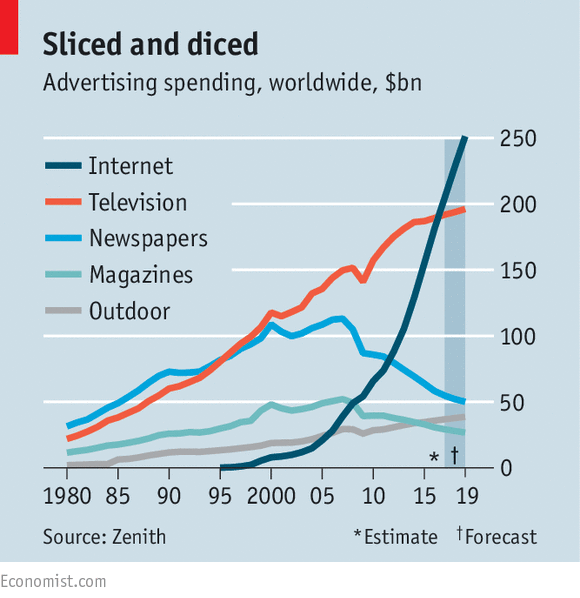
This saves money for the advertisers, by transferring wealth away from content creators.
It boggles my mind that publishers still favor this model over display ads (targeted to articles, not readers).
Eyeball time is a commodity. Microtargeting by "smart people" is what enables you to sell $1 worth of eyeballs for $10.
It's going to hurt. But in favor of Google and Facebook is that maybe they have enough last mile and market share that they can just charge the same thing for commodity advertising.
Not really. It actually increases the pool of money available to content creators.
Everybody wins.
> It boggles my mind that publishers still favor this model over display ads (targeted to articles, not readers).
Because they generate more revenue, I'd guess. Mind-boggling, I know.
Well, except for the people being targeted, and the ones being served malware, and the ones having their cross-Internet activities being tracked, logged, and analyzed. It's not such a win for them.
They win too. They get content without having to hand over cash.
Everybody wins because the value of what they are giving is, for them, less than they are receiving. And the value of what they are giving, for others, is more than what others are giving.
Going back to non-targeted ads would significantly reduce monetization, reducing the pile of money available to content creators, and driving many (if not most) of them out of business.
You can always not access any ad-funded content or service, the option is yours. Take it.
MySpace used to have animated DoubleClick style untargeted ads. It sucked. Facebook crushed them partly because it's a much cleaner experience and Facebook ads are so much higher quality.
The problem with all the people claiming this sort of move is great is it doesn't ring true, they sound almost in physical pain over "tracking" (a scary word for very primitive and broad-brush techniques, by and large).
But where are the people who have actually suffered concrete, quantifiable harm? Some real, unarguable case where someone suffered because of ad targeting? If there were a real harm here, given the enormous scale of the internet, there should be millions of such stories but the only one I can think of was years ago, about a supermarket that discovered that women who buy X, Y and Z things together are very likely to be pregnant. They caused a minor family drama by sending a teenager adverts for baby stuff when her parents didn't know. Arguably this is a hole the teenager dug for themselves, but even so, it wasn't even internet based stuff from what I recall.
And as far as harm goes, that's about it. I've never been harmed by ads. I've never met anyone else who has been either.
But I remember a LOT of people complaining back in the bad old days about the barrel-scraping punch the monkey inventory that typified the web experience.
There are other cases where no such inference is possible, for example, if the person writing things down is a tax inspector investigating benefits fraud. In that case objections on privacy grounds would be ignored.
http://gawker.com/5671582/how-facebooks-targeted-ads-reveale...
I only skimmed parts of the paper but I also question the premise. It seems the attack is entirely dependent on you being 100% sure your ad is so carefully targeted it'll only show to a single person. If there's any doubt at all that it might match even two people, the attack doesn't work. Seems rather hard to pull off in anything other than lab conditions.
Then just don't access any ad-sponsored content. You are the one deciding to use it, just make that call.
I hate ads like anyone else, but I know that ads pay for the services and content I access. As much as I'd love for them to go away, I don't want it because I know the impact it would have on the availability of content and services.
I’m trying hard not to. My wallet is always open when there’s an option to not have my privacy violated.
The issue? Most services don’t allow me to pay, and the ones that do still try to track me after I’ve paid.
The result? My adblocker is happily giving them the middle finger and I can’t wait for adtech to die in a fire.
You do realize that with adtech dying those sites and services will go out of business, right? Or you didn't think that through?
Your comment makes it seem like these businesses are invented recently.
I'm tired of these excuses of business dying.The online ad tech industry brought it themselves.
Also I care more about people than a corporation that exploits people; which is opposite of American culture.
When will this happen? Does it happen before or after Hollywood stops making films because piracy, and the entire recording industry falls over and bursts into a fire?
> creating and distributing low-quality clickbait content profitable, pushing more serious content aside.
Sure, you can make that argument, but why should anyone decide what kind of content is worthwhile?
Are you suggesting a "internet content quality board"?
Let users decide what content is worthwhile, voting with their clicks, eyes and wallets.
I don't see any need for any quality control.
You're saying that you don't like the content, so you'd be ok with it going away.
What about people who like it and use the services?
Nobody is forcing you to consume ad-sponsored content.
Apple appear to be giving us, the users, some ways to claim our privacy back. I really don't see a problem here. Want content that relies on tracking for revenue? Use software that supports the tracking. Don't want it? Use software that doesn't support it.
Then don't use those services. The choice is yours. Let other users assess the value for themselves.
This also doesn’t work given the masses have zero idea of the tracking that is happening and blindly trust Zuck’s lies on how Facebook respects their privacy. If people knew the extent of the tracking you’d see a lot more backlash.
And since when should you have a "choice of products"?
Companies offer products, if you like them, use them.
I don't have a choice of free cars.
You may not have the choice or free cars, but you have a choice of plenty of paid cars, including ones that don’t stalk you everywhere you go.
I don’t have a choice between a free Facebook and a paid Facebook that doesn’t stalk me. I have to either take the free Facebook and be stalked.... or not take the free Facebook and still get stalked by their like buttons everywhere.
Remember, you're the one accessing. The choice is yours.
> They win too. They get content without having to hand over cash.
Nonsense. I'm targeted and the content I get for free is markedly better than the clickbait listicle crap is offering where the vast majority of tracking shit is coming from.
The ONLY place I've noticed the "ads for content" story even remotely work (in the 20 years I've been on line) is some YouTube channels. And they broker their OWN ads. The shit monetised by YouTube itself is still the same 99% clickbait poop.
There's a few exceptions that get monetised and make quality, but they are sooooooo not worth putting up with this shit, nobody ever asked me if perhaps I would like them to take their content AND their ads. Because what is left over WILL contain 99% less loud screaming attention whores.
Nobody is a winner when the people making beautiful things for free are being duped by ad network vultures.
If I want to read articles online, I'd love to pay $10/m and have it go to the content creators. Ads for me are unacceptable, but I'll happily pay, and I barely even read tech articles.
The specifics of the implementation would have to be very consumer friendly though. Ie, I can't imagine I make all sites combined more than $1/m from my ad traffic each month.. maybe that's not true, I just don't see it happening. So I don't want to (as a consumer) pay $5/m per site or anything silly like that. That's why as a consumer I like the idea of splitting an amount (say, $10/m) up between all places I go.
I remember a service like that... flutter I think? It never caught on though, because people don't like paying. We've got a tough hill to climb in this ad war, heh.
I think this would be a contentious point, the advertising giants have invested significantly in targeting based entirely on their metrics of it actually working, random anecdotes aside.
Source?
How much infrastructure does Facebook need to serve this city? Facebook will be fine.
Targeting has become a boogieman I think.
It's the individual targeting that has such high costs (in resources and privacy) for an apparently small increment in effectiveness.
Besides, for Google, they don't need Facebook style personal targeting. When you search for womens shoes, they feed you ads for womens shoes, it's a wildly lucrative approach and it doesn't matter if you're 28 or 34 years old, or what your favorite music is (yes, there are gains to be had with more personalized ad targeting even in that case, it doesn't matter, Google's model is still an extreme money machine).
Radio, newspapers and TV were absolute dogshit for targeting for the prior 60 years. It was mostly blast and pray. At least with the Internet, even with less personal targeting, you still gain a lot of tech capabilities to improve ad systems (including intricate content targeting, matched with information on the demographics that like that content, and so on).
I worked at a smaller tech company, and we kept saying "Correlation does not imply causation", and trying to come up with ways to separate them, etc. We spent/wasted a lot of time on this, explaining it to non-mathy people (which leads to even less confidence in data).
Then I went to work at one of the big tech companies, which is probably one of the best in the world at testing/data for product, and there I never heard it. If there was correlation, unless it was clearly spurious or a statistical fluke, they pushed on it hard. "It looks like more X means more DAUs. So let's manufacture more X." And it works pretty well for that company.
My takeaway is, I stopped thinking about this too much. Today, if there's correlation, unless it's clearly spurious/etc, and unless somebody has a better idea, I tell the product/eng team to push hard on it and don't even mention correlation vs causation.
Even in science where the focus is actually on proving things, it is difficult to prove causation. I see this more as a question of whether you act on a correlation that you’ve discovered or whether you simply talk about it. While it’s fine to discuss things, it sounds like at the small company you worked at, that that was more important than taking action (or perhaps the company was too insecure to make a decision about what to do). At the big company, the focus was on making experiments and seeing what the results are, and then iterating on that. In the end, the business doesn’t care whether something causes something else, it is only interested in adjusting things, measuring results and if they increase some important metrics, then the business is happy. That said, it can be taken to an extreme where only the metrics are thought of as important, rather than other qualitative or hard-to-measure things. It is much easier with web companies who can quickly roll out changes and use AB testing to run experiments. Also, those companies with larger user bases will have better sets of data on which to base their decisions. Companies that are well established will also have historical data that will make it easier to interpret results.
It also sounds like at the first company, the tech team was interested in being theoretically correct, while at the second one, the engineers were interested in trying things.
It is an understandable problem in some ways: good programmers are lazy and won’t want to make unnecessary changes, so they tend to argue against changes that haven’t been proven ahead of time to yield results. However, for the business to thrive, knobs must be adjusted and experiments made. And those programmers have to turn the knobs (or make them adjustable by someone else). So there is a strong counter-motive at play there.
However, good programmers who are also engineers with a focus on the product / business will understand the importance of doing this. It’s important for the engineering team to be aligned with the business and it helps to have cross functional teams. Otherwise you may end up with departments protecting their own interests. See also Conway’s law and its derivatives.
Because it's actually a stupid thing to say. Correlation does not conclusively prove causation would be better. It certainly gives a sensible place to look.
It's no broader a statement than the one you prefer.
What do you think the relevant difference between the terms 'imply' and 'conclusively prove' is?
'to involve something or make it necessary'
'to have as a necessary consequence'
'to involve something as a logical consequence'
Thus XKCD's extension of the phrase to `Correlation doesn't imply causation, but it does waggle its eyebrows suggestively and gesture furtively while mouthing 'look over there'.` -- which is essentially what you're getting at.
They can though - they can go back to untargetted advertising based on page content as they were doing 10 years ago. All the personal tracking data is a layer on top of that tech aiming to improve the 'targettedness' of adverts. Nothing in the online ad industry really needs any of that personal data, and arguably it doesn't actually make many ads more effective anyway.