And specifically the horn button being capacitive co-located with the voice assistance and windscreen wiper buttons.
Which in a safety situation was difficult to locate and press.
https://www.tesla.com/ownersmanual/models/en_us/GUID-DEB259C...
For vehicles manufactured as of approximately January 2024: To sound the horn, press the middle of the steering yoke (or steering wheel). For vehicles manufactured prior to approximately January 2024: To sound the horn, press and hold the horn button on the right side of the steering yoke (or steering wheel).
"press and hold" doesn't seem like it'd be easy to do if all you wanted was a quick toot.
One can easily see this "meme" if one searches for images of "driver honking horn":
https://www.google.com/search?q=driver+honking+horn&tbm=isch
Teslas are the Dunning-Kruger cars. Designed by people who seemingly do not really know how to design cars (a wheel is boring; let’s put a yoke because video games! Look how cool we are! Also, touchscreens!) and built with poor quality control. I was not aware of the horn button, but if I had to guess, Tesla would be my first choice.
Sometimes even Elon admits he was wrong.
In driver's ed they tell you to not to use your horn when you're annoyed at other drivers - only use it if there's an imminent danger to avoid a crash.
But you better hope it works because if it doesn't, the airbag behind it explodes.
...
I'm not sure Tesla improved the situation, but it definitely seems like the situation has room for improvement.
This is definitely not a cultural universal. Different countries have different practices. In some places the horn simply means “I’m here, check your mirrors”, in other places it means “You bastard!”, and in some other places it means “We are both stuck in traffic let’s make as much noise as possible to pass the time”
> only use it if there's an imminent danger to avoid a crash
Therefore the difference between the horn being readily accessible and being hidden away could be the difference between life and death.
Being readily accessible is a must. The point I was trying to make (poorly; it was late) was that having the horn button in the middle of the wheel is about the worst place imaginable if you lay on the horn to avoid a crash and it happens anyway, because some portion of your arm is probably going to be broken when it gets crushed between an exploding airbag and your rapidly-decelerating body.
>But you better hope it works because if it doesn't, the airbag behind it explodes.
... what? I had a car who's horn stopped working and the airbag didn't explode or go off.
If you hold your horn down trying to alert someone that you’re about the slam into them, your hand is going to be on the wheel as the airbag deploys.
... Wait, is this a real thing, or just a joke about them being bad at UX? If a real thing... goodness, I'm quite surprised that doesn't break some mandatory safety rule.
Yes: https://antiquecarmuseumofiowa.org/wp-content/uploads/1913-F...
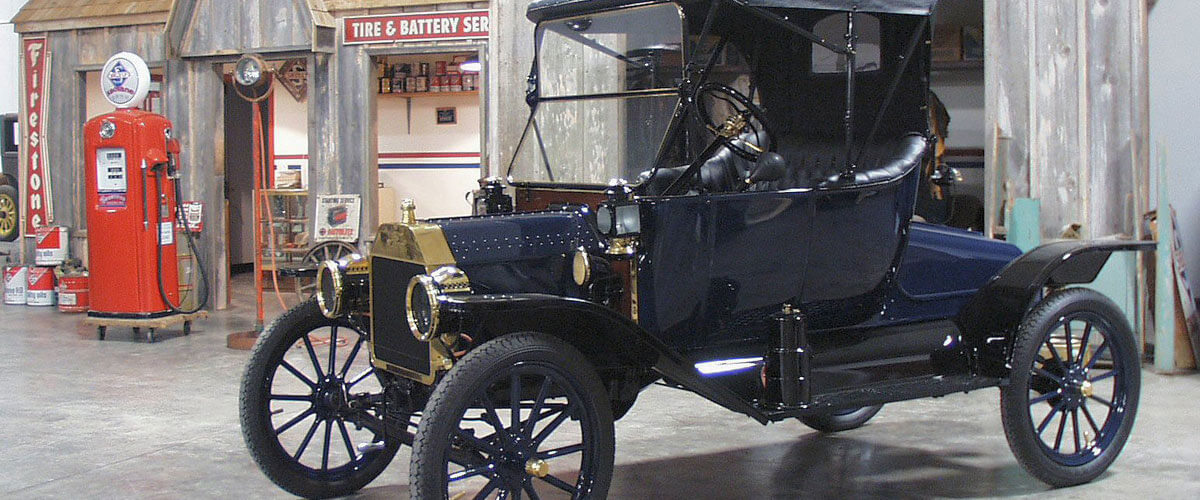
Well ... "are" is kinda stretching it...
The Model T (Ford) had a throttle on the steering wheel and 3 pedals, but not the ones you'd expect today:
https://www.fordmodelt.net/images/ford-model-t-controls_smal...

Due to regulation.
The US Congress mandated the PRNDSL quadrant for automatic transmissions. (GM had PNDSLR, and people kept shifting into reverse by accident.)
I would prank my 6-7yo cousin at the time that all you had to do is ask the car to beep and it would do
In my EV it literally is a potentiometer. I really miss the feel of a physical throttle linkage on the snow and ice, I feel it's much more difficult to judge grip.
Also, since it's just a pot, I don't know why there's not a speed mode for it, it to make it operate the cruise control speed set-point rather than torque.
Of course, could be he was wrong.
The throttle is separated from the wheels/ground by the transmission and the whole engine, which makes me wonder if the response you felt probably was a combination of eg rpm/physical vibration and a few other factors. It should be possible to recreate these even in an EV, then.
We had an older non-turbo car before the EV.
The sound of the engine also changes greatly depending on the throttle position and engine load but for me it was more audible and I couldn’t feel it from the throttle. Modern cars are pretty good with sound insulation from the engine, but I’ve heard some “sporty” cars direct the intake sound to the cabin for giving the noisy sports car experience to the driver without being obnoxious with the exhaust side.
I think there are a few reasons for it, one of which is simply increasing efficiency by smoothing the accelerator input a bit. I’ve only driven an electric car a few times, so I’m not sure if they also have this delay, but I would expect they do.
Right, it feels very much like I'm just changing a set-point. Putting the car in eco mode makes it very noticeable, but even though it's less noticeable in sport mode it's still not the same.
I did learn to drive manual, but I'd never buy another car like that. Maybe it's fun for racing, but for every day driving, automatic requires less effort and longevity isn't a concern today.
Manuals proliferate in EU, but we have also always had automatics on the road - and a significant increase since DSGs hit the market - so no one who has driven a few normal cars would be surprised by two pedals in an electric.
To stop, not to slow down.
One can also just put the car in neutral and let it roll to stop occasionally correcting with the break pedal, if we want to be pedantic.
If you don't press the clutch during a stop, you risk increasing your stopping distance both due to engine inertia and due to it fighting back below idle - especially in a diesel van. We only have muscle memory when we panic, and it's bad if someone is taught in a way that makes them miss a pedal.
That's also part of why you are taught with stick over here - better be trained to press a pedal too much than a pedal too little. If you do take the license in an automatic, you get a mark on your license disallowing you from driving stick.
For now, companies are experimenting with drive by wire. Don't think I like that concept.
In an electric power steering system there are steering angle and torque sensors that know what direction the wheel is turned an how hard it has turned, and this is connected to an electric motor that powers the gears to move the steering rack.
There are still regulations in place that require a mechanical connection to the steering wheel and rack, but try and turn the wheel with the car off and see if your wheels move... But when the car is running when you turn the wheel you're just a voting remember in the system.
There are no such regulations for throttles. Pretty much every car since the late 80s has electronic throttle control and there are no mechanical linkages from pedal to throttle body.
That was also strongly discouraged on older cars and only possible with big steering wheels and good grip. Just move very slowly and the turning becomes really easy even without assistance (and which is what you were thought when this was still a thing in countries with required driving lessons).
Are you sure? Fully “steer by wire” vehicles with no mechanical steering link are already in production. The Tesla Cybertruck is the most well-known example.
Toyota/Lexus has also been demonstrating steer-by-wire for a while (Lexus RZ), and it will apparently ship in consumer vehicles later this year.
https://www.drive.com.au/news/toyota-lexus-steer-by-wire-sys...
(In some aspects the US automotive regulations are actually stricter than in Europe. For example, in Europe there are some vehicles (eg: Audi) where the wing mirrors are replaced by screens/cameras, but this is not permitted in the US. Adaptive matrix headlights are also not allowed in the US.)
Electronic throttles became widespread much later than the 80s. Pop the hood of common 2000s economy cars and you’ll find a mechanical throttle linkage.
All 90s cars I've had or worked on had a real cable from gas pedal to throttle body.
At least on brake by wire ICE systems I could let engine braking slow me if the brake system fails somehow (even if I have to blow the engine to save my life, worth the trade).
A drive-by-wire system had better be a lot more reliable and also notice impending failures.
I feel like I have had several close calls that would have been accidents for sure had I been driving with power steering.
The steering deadzone is not purely a function of power steering. Some of it is design or could be attributed to that, but a bunch of it also comes from slop in the physical connections in the steering column, as well as the suspension bushings, your tyre profile, etc.
These systems have improved.
Relatedly I had a Hyundai i30 for a while which has a well known fault where the plastic gear connection (called a Spyder Bush) from the electric motor to the steering column would break. Resulting in slop and a clunk. Not hard to imagine similar failures or bad design.
It's not a problem at those speeds, having it crap out when turning slowly and sharply around fast traffic is much more likely to be deadly.
If your steering assist conks out just as you're trying to turn at slow speed you could end up heading into oncoming traffic, at an angle at least.
It's actually pretty dangerous, good thing you don't drive it any more.
But yes, I agree, unpredictable steering response is dangerous.
There has been a number of plane accidents related to physical connection between the yoke and the actuators (cables loosing tension under high temperatures, or cut/trapped on a deck failure). Electric cables does not suffer that, and they are easily doubled.
SbW makers are already making software that does constant surveilance of the system, something that traditional systems has never done.
The number of dead people caused by the steering column going straight through their chest in a collision is huge. That shouldn't happen with SbW.
I hate the trend towards car controls in a screen, but Drive by Wire sounds like a real advance towards better cars to me. DbW without redundancies and continuous tracking could be a safety issue, but with them I don't think it's an issue. Fly by Wire has a good safety record.
Because there are dozens of people helping keep each plane safe.
Don't give them ideas...
This is the norm for most cars with servo steering.
If a booster fails you have a chance of overpowering it, it's not that strong. A faulty steer-by-wire will swing you into the oncoming lane with no recourse.
When all of that is implemented in cars and weathers for 10-20 years I might consider it.
Otherwise, seeing as Toyota's regen braking code had like 10k global variables, I'm not touching that with at 10 foot pole.
Acceleration/braking can be quite bad but there's normally neutral and ignition switches. With steering there's literally nothing between you cruising along a highway and you splattered on some concrete pillar 200ms later.
As long as the steering wheel is there it might as well be connected to the rack, forever.
It stops making sense to have a bunch of rods zigzagging everywhere.
Also inside the wheels makes no sense at all, google unsprung weight.
They generally have the following root safety requirements:
- the assist system must not cause "blocking" (unturnable wheels/steering wheel)
- the assist system must not cause unintended steering
- the assist system must be able to restart in less than 20 milliseconds
- the assist system must stay passive after a number of unsuccessful startups/unrecoverable errors (typically 3). In this case the mechanical steering column still provides a way for the driver to control the car.
It has been 10+ years since I last worked such a system, but drive by wire was only on the horizon, not the norm, and as far as I know the authorities only allowed drive by wire solution some 2-3 years ago, with product development lifecycle of around 5 years that means they are still not the norm among new cars I believe.
Back then more redundancy in the electric motors (more gradual failure if one phase goes bust, not going into deadlock in certain angles when any of the 3 phases is malfunctioning) and authenticated communications on the system bus (which was considered trusted earlier) were on the roadmap for the next gen steering systems, which are mandatory requirements before you can get to steer by wire.
Having redundant bus and redundant sensors usable by multiple subsystems is a better way.
Well, I have heard of power assist using a single simple potentiometer as a steering wheel position sensor in some really cheap cars... I'm not sure how much of an urban legend that is, but nowadays it surely wouldn't cut it for road permission in the EU.
Having to account for a DOS attack from a compromised head unit or some such just seems like a nightmare.
To overcome this the plan back when I was working on that product was to use 2 system buses, one isolated internal for the safe critical sensor/control network, and one user facing untrusted bus, with a ECU designed to serve as a firewall basically.
https://www.yahoo.com/news/man-alarmed-cybertrucks-steering-...
Why are you just making stuff up? Cybertruck has lots of redundancy.
Do you have any actual evidence that Cybertruck steer-by-wire design is bad?
The French made some really… interesting choices with their cars.
Not a thing over here.
fair enough!
> when someone forgets to watch traffic signals after stopping at a red light
I dunno. If you wouldn't blow a horn while walking the sidewalk when inconvenienced, I don't think drivers should either. You're not the only two people on the street, there's other people around here and they don't need to be abused by impatient drivers. ymmv, ianal, etc.. of course.
If somebody enters your lane at speed, the safest thing to do is to let them know you're there. Swerving or breaking in response multiplies the problem, as now there are two cars driving erratically. The horn won't always resolve everything, but it's by far the most effective way to get somebody's attention in a hurry.
Holding your steering wheel with a single hand will cause you to drive erratically too.
>The horn won't always resolve everything, but it's by far the most effective way to get somebody's attention in a hurry.
That's why it should be possible to activate it with an easy to reach button or lever, preferably next to the emergency lights, instead of a heavy pressure button right in the center of the steering wheel.
You’ve never had to give someone a “hey don’t back into me” toot in a parking lot?
You’ve never seen your friend Ricky, on the sidewalk?
99% of time there is absolutely no reason to honk. People only do it because the button is there and they're safely insulated from getting punched.
Could it also be that in different places, there are different expectations, and different environments that makes people use the honk for various purposes?
I get that in the US it seems to mostly be a social signal of "fuck you", but in Spain where I mainly drive, I've avoided a couple of accidents by honking after seeing cars slowly coming close to my own car on the highway, especially when passing lone cars when things are no so busy. People seem to stop paying attention then.
Then in Peru the honking is seemingly constant, and people honk in prevention when they pass you, like a "just in case" honk. Honking seems to be a way of life there, rather than for emergencies.
For a while Ford was putting the horn on the turn signal stalk, I hated it:
https://www.reddit.com/r/Justrolledintotheshop/comments/l08q...
Are there really cars where the horn is not a physical button/ring on the steering wheel?
IMHO the driving UX peaked in the 1960s, and was largely unchanged into the 2000s, until touch screens started taking over.
Compare:
https://i0.wp.com/www.curbsideclassic.com/wp-content/uploads...
https://images-stag.jazelc.com/uploads/theautopian-m2en/2010...
https://www.motortrend.com/uploads/sites/5/2017/07/Tesla-Mod...
At least the steering wheel and pedals still behave the same.