This thing might work out better than the bike because it’s a lot more visible, but I actually doubt there’d be much take-up. As someone else said, a second-hand leaf or similar would probably be better.
It's sort of like a market failure. It's in everyone's best interest to ride bicycles, but since we can't individually control what everyone else does, it's in our best interest to ride automobiles -- thus continuing the safety issue.

I haven't been since before pandemic but I really want to see that. It sounds like a great experiment.
p.s. Dutch did not like to hear this, but somebody had to say it.
Berlin, in fact, is not a country.
As I've said cannot be used as a template for any other country in the World, **except maybe some flat urban area**
Paris is not the Netherlands, you cannot export the Netherlands ways to Paris.
Moreover, there are on average 150,000 street accidents in Berlin every year.
Last year (2020), 14,782 people were hurt in road accidents in Berlin - the lowest figure in 30 years, according to police data. (thanks COVID I guess...)
In Rome, considered the hell on earth of street rage (69 cars every 100 people, negative record in Europe) ~10.500 people were injured in the same period.
Same population, 1.4 times more accidents.
Perception is very different from reality.
Of course nobody is doing these 500m every day, but its common to see parents bring their children to school by electric bike, and maybe doing 100m of height elevation.
I drove in Paris past August, and didn't notice any bans.
Parking availaibility and price varies a lot, but it's workable.
At 30km/h and lower cyclists have a risk that simply does not exist for a vehicle like the ami and other cheap car like vehicles : being driven over. A car can kill a cyclist while driving as low as 1 kilometer per hour if the cyclist fell on the ground and the car is running the cyclist over. You can't "drive over" an ami. Unless you're driving a Monster Truck.
As a cyclist I am extremely paranoid about things like blind sides on larger vehicles because it takes very little to kill you. VERY. LITTLE.
I wish there was cycling infrastructure and lower speed limits, but that's not how it is now. I used to own an e-bike here and it wasn't very practical.
At anything above a walking pace shunt in a typical Yank Tank, your insides are mush.
Is it just a speed thing, or is distance always in miles there? Do people use metric for everything else? (I’ve heard Brits quote their weight loss in stones which makes me feel positively progressive)
Update, Wikipedia:
“ Most of government, industry and commerce use metric units, but imperial units are officially used to specify journey distances, vehicle speeds and the sizes of returnable milk containers, beer and cider glasses, and fresh milk is often still sold in multiples of pints, with the metric equivalent also marked. Imperial units are also often used to describe body measurements and vehicle fuel economy. In schools, metric units are taught and used as the norm. ” https://en.m.wikipedia.org/wiki/Metrication_in_the_United_Ki...
The Ami has a primitive heater but no air conditioning, but there’s no reason that these limitations are inherent to a vehicle of this size. I imagine an Ami-sized car with creature comforts of a regular vehicle would sell extremely well in cities.
Biking is great when the weather is amenable to it. When the weather is not, I'd rather not show up to my destination drenched in sweat, soaked in rain, or freezing my ass off.
I thought I would never use it in the winter, but a cheap rain suit is perfect to keep me warm and dry, and takes about 20 seconds to put on or take off. I don’t have to worry about sweat since if I get too hot I can just use the throttle or dial up the electric assist.
I thought I would never use the thing in winter, but I actually find it absurdly practical.
You adjust speed and cycling style to the conditions, and for winter cycling there are plenty of good options for studded tires. The Nordics have succeeded in making winter cycling a more common activity, and you might want to check out the "winter cycling capital of the world": Oulu, Finland.
Also I don't have windshield wipers on my face (or windshield for that matter) - but maybe I'm just wired like that.
Yesterday, local news, a car crash with all three involved drivers dead.
2 wheels make you extremely sensitive to small traction loss - hitting a patch of wet leaves/gravel/mud/ice with a car tire is a nuisance at best - and a potential fatality on a ebike/motorcycle.
But my point is, while you're better protected in the car, with speed and kinetic energy the stakes go up. If they were three cyclists instead of three drivers in heavy vehicles on that road yesterday, they would likely all still be alive.
What should I learn from this one off incident?
I have a non-zero chance of getting into an accident, but on the other hand, I haven't been so fit in 30 years.
My guess is that my expected lifespan is increased by this decision. (I would add that I live in a very bike-friendly city.)
---
There's a further ethical calculation I would do, which is that using a car is wildly irresponsible giving that we are systematically eating through our resources and destroying our climate and with it our biosphere. (Electric cars are better, but still tremendously consumptive of resources.)
So even if I were less safe and the fitness issue were less important, I would still choose not to use a car, like I have chosen for my entire life.
As I said in my comment, I actually do this, and surprised myself with how practical it is in all but the absolute worse weather (there are about 7 days per year where my bike won’t work, but generally that means that it is dangerous driving conditions as well). I live in rural Canada. I’m no stranger to riding in snow, rain and darkness.
I could equally say that it is delusional to allow minimally trained civilians access to multi ton vehicles with limited visibility, built in devices intended to distract powered by explosive liquids. But that system works as well.
The only two accidents I've ever had on a motorcycle were low speed manuvers in heavy rain when I got caught by a shower.
On a bike just riding on a slippery road is terrible and wading through umbrellas, getting splashed by cars in traffic, rain in the eyes.
Riding on two wheels makes you extremely exposed - ebikes are just shit motorcycles (especially self built ones) and have a higher accident rate statistics from what I can tell.
If you're not aware how risky it is compared to a car you are you are being delusional.
https://www.youtube.com/watch?v=Uhx-26GfCBU
/s
(Yesterday I watched a youtube called "Retrofuturism", that turned out to be, nearly verbatim, an old propaganda piece by GM. It was only about using cars and roads, not about the future (i.e., our world) at all. Some parts were hilarious, but overall it was deeply depressing.)
It sounds like your experience is different because haven’t actually tried using an ebike. I used to think that a bike and an ebike were basically the same use case. After having used a bike, an ebike, and a motorcycle for commuting I can say that they are three very different machines.
Please let me know what your experience was commuting in northern bad weather using an ebike before you call me delusional. It sounds like you are extrapolating incorrectly based on inexperience
People think because kids can drive it that it's safe - like I've said - quick Google search shows higher accident rate for ebikes than motorcycles ! And we are comparing to cars here - that's like >10x risk increase.
And every self built one I've seen had a way to remove speed limiting block (interested if have yours limited ?). That's a recepie for disaster.
You can ski in the snow perfectly comfortably if properly attired, but you can't bike?
In fairness icy streets can get extremely dicey on two wheels-- no arguments there. The US in particular has a lot more extreme weather than Holland. You'll have extended periods where biking on icy concrete is not a great option.
I.e. a bike slipping and falling tends to hurt the risk taker. A car slipping and crashing tends to protect the occupant at the expense of whatever gets crashed into.
www.techtimes.com/amp/articles/274249/20220413/e-bike-injuries-rise-despite-safety-precautions-according-dutch-organization.htm
And that's in a place with top tier biking infrastructure.
Per Capita, cycling in the Netherlands is far far safer than cycling in the US.
> “The Dutch data for last year (2019) shows that in absolute figures more people died in car crashes (237) than on a bicycle (203). If you calculate the figure per kilometre travelled that is reversed. Per one billion kilometres travelled the figure for cycling is 11 while the figure for car occupants is 1.6 fatalities.”
Why do I have to google these self-evident facts ? No matter how good your bike lanes are two wheels are very sensitive and unforgiving and the vehicle offers 0 protection (and in fact gets in the way of softening the landing/balancing back).
The bike enthusiasm seems to override rationality - like if I strapped a child seat on a rear seat of a motorcycle social services would take my child - meanwhile if I do it on an ebike I'm praised for being environmental - despite the similar risk factor.
You're being told repeatedly by Europeans your take isn't right but you keep digging in and entrenching. Why is that? Have you considered you might actually be wrong?
The unsafest I've ever been was commuting between Brooklyn and Manhattan for two years as a cyclist: the number of near misses and actual side swipes (yes from cars) would shock you.
As in I come from Norway and winter tires for bikes work just fine :)
Yes, it's more dangerous. No one said it's not. No one even mentioned safety until you brought it up yourself.
If you want to bring up safety: great! Go for it! But no need to start calling people "delusional" right from the bat.
Get the nice warm gloves and raincoat out for winter, or the super light and loose shirt with sunglasses for summer.
Below about 250K the "nice warm clothing" needed to make this comfortable would become too bulky to make ordinary movement practical, so we skimp. We tell ourselves nope, we're just not going outside except to do stuff, and then we're coming straight back. Below 200K it's no longer practical to keep humans alive with anything resembling "clothing". You should use a building to keep warm instead. Earth is capable of both these extremes, although outside temperatures below 200K are usually only seen in the Antarctic interior during storms.
Considering we spend most of our lives trying to increase the standard of living for ourselves and for others it's not all that surprising people resist reducing it, is it?
At some point we have to look in the mirror and make choices for ourselves, and yes, lots of people became absolutely pathetic excuse of human beings, if you can't stand the rain I'm sorry but you definitely are a cry baby.
What's the end goal of this pursuit of "quality of life" ? Living in a matrix style pod, being fed food through your veins while being sedated and transported into the metaverse ?
If you can't imagine a world without cars and the idea of using a bike repulses you because "rain" you're the problem, or at least a very big part of it
Yes, it increases the standard of living by pulling poor people out of poverty. So the rich consumer nation has their life decreased due to over consumption while increasing the standard of living of those from poorer nations. The rich consumer nation cannot consume AND increase life expectancy at an infinite rate.
You have a waterproof bag that attaches to it. Problem completely solved.
It rains quite a bit in Netherlands, and it's the biking capital of the world.
It's almost as if rain isn't really that big of a deal.
A significant number of Parisians don’t own cars so this is no different than before for them.
They have those huge backpacks [1]. Some fasten it like a kind of top-case.
https://www.revzilla.com/motorcycle-top-cases?gclid=Cj0KCQiA...
A human needs some 2kJ / kg / km to ride. That's 1.6MJ.
A car needs ~15L gas per 100km, so that's 45MJ for a 10km ride.
While the car uses 30x as much energy, it will only cost you $1.30.
The human needs 1.6MJ of food. That's about a grilled chicken sandwich. Which will cost you $4.30...
(Also for the human-powered case, biking often displaces some other exercise. And of course using gas is bringing about the climate catastrophe so it's unethical, money isn't everything)
I live in Montreal and winter cycling used to be a really hardcore thing. Not anymore. Winters are warmer now, just a bit, but enough to make winter cycling pleasant on most days. Dedicated, snow-plowed cycling lanes made a huge difference.
(I use my car most of the time, because usually a daycare run with kid, but now we're equipped for maybe once a week by bike)
Office and apartment buildings here (Helsinki) even compete by providing convenient bike storage even for cargo bikes with easy access, washing spots for bikes/muddy or sandy gear, drying cabinets etc.
But fuck it, let's buy a car and fuck the planet, that's much more convenient, god forbid we sweat or touch the rain, oh the horror !
This hints at another counterpoint: it's not just yourself you have to protect from elements, but also whatever it is you want to transport with you. Like those extra shoes. Or electronics. Or groceries. Etc.
Waterproof bags probably exist, but I can't say I've seen them available, or used, by anyone at all.
What? Almost all non-cheap backpacks are water-proof. Water-proof packs are around everywhere.
I get on my bike, go to the store, office, friends, &c. rain, snow, sun, wind, it won't kill you really
No kids?
What you described was my bike centric life as well until it wasn't.
When you have to do school drop-off a couple miles away for middle schoolers, or do that weekly store run for a family, it gets a bit trickier on the bike.
Bike packs 100kg of stuff or a large shopping trolley in volume. Works for the weekly shopping without issue.
The only time it sucks is ice on the road. Snow is fine, but ice is not - because bike lanes get treated like third class infrastructure, worse than pavements.
There’s currently football matches being played in Qatar in stadiums with AC set to 20°C in 32°C weather. Thousands of people have travelled there by plane.
Me having a car is fine.
Using fallacies to invalidate arguments should be a fallacy by itself. Maybe my argument is a fallacy logically speaking, but in the real world, not everything is ruled by formal logic. If A is completely negligible compared to B, the « A not as bad as B » fallacy doesn’t apply anymore.
To me, your argument sounds pretty much the same as "The us dropped a nuke on Hiroshima. Me throwing a molotov at my neighbor is fine."
Sure that molotov is negligible in front of B. Doesn't make it okay
The atmosphere is global, there's no Qatar's atmosphere and my neighbor's atmosphere
FWIW, this is effectively solved by an umbrella.
I've had interest in an e-bike in the past, the problem I personally run into is that I'd still need a car for most trips due to the way my region is laid out. (I think I had -one- job where an e-bike was viable for a commute range-wise, but only based on published specs which probably wouldn't fit the real use thermals of my region.) [1] Speaking of, the 'too cold' argument holds a bit more water for e-bikes; I doubt many have the thermal protections of a BEV, which could lead to a destroyed pack.
Also, IDK what it's like in other parts of the world, but in the US much of the population sees decent bicycles as a 'hobby/sport' rather than a mode of transport.
Personally I blame big box stores and terrible, cheap, 'disposable' bicycles. Aside from having cheap, unreliable, unsafe components (my favorite: I was fixing one of these, while trying to run through the gears, the grip shifter broke in such a way it shot a plastic shard at my eye,) they are at time assembled by people that are paid based on production rather than hourly. [2]
Bike shops, as a result, tend to cater to either the MB hobbyist or the Road folks. (At least in my region.) To be clear many of these are good reputable shops, but it means that oftentimes the items you would want to make daily riding practical (i.e. the right racks/bags for a reasonable grocery trip, are at best special order.)
Honestly?
If someone wanted to really give e-bikes a spiffy image in the US, I know exactly what to do. Take two Sun EZ Classics [3] and the SxS kit [4]. I also know at one point they made a middle 'rumble' seat as well as a special drape shroud for the SxS [5]. Redesign the SxS kit with an 'E-Motor' option (I'm not sure whether you could get by with just one or if dual would be required.)
Bam. You have a comfortable e-bike that has some protection from the elements and has some room for crap in the back like groceries/etc. Additionally, you have the ability to have a 'passenger'. I'm -guessing- in volume you could sell the finished product for ~2000-3000 USD, but that would assume that you are doing enough volume to make it worth it to all involved parties. (Why the wide swing? Last I knew the SxS kit was done by a small, low-volume shop, making it almost as much as one of the bikes.)
[0] - To be clear, safety is different than comfort/ease of ride. I've ridden through 3 inches of snow, and while it was a grueling ride, It was honestly safer than a typical ride due to everyone's reduced speeds. OTOH I've had times where there was no snow but enough (black) ice on the roads/sidewalks that snap physics calculations became important.
[1] - As we have observed with BEVs and the like, cold weather has a pretty big impact on battery efficiency. Even in my Hybrid I can see a 5%-10% fuel economy difference between 28F and 40F
[2] - At least, that's what happened at some of the stores around here. They would essentially abuse a system where infirm people can be paid less than minimum wage, by an 'output' system compared to how much a normal hourly worker would produce (easily rigged with the right person as a 'benchmark', of course.)
[3] - https://www.sunseeker.bike/index.php/products/ez-classic-sx/
[4] - https://www.sunseeker.bike/index.php/products/ez-classic-sid...
[5] - We actually did one of these full setups at the shop once for a family that had a child who had physiological/mental developmental issues but loved the feeling of riding. He could pedal when he wanted to. Them picking it up was the happiest sight in the world. Things you miss about working at a simple bike shop I guess.
Ami don't have air conditioning or heating systems.
Cold I don't mind.
Yes and no. I have a three wheeler cargo bike I use for most of my commuting or city riding and very rarely do I opt for my car, particularly when the weather is bad. The main reason is that since where I live I basically cannot find parking and when the weather is bad, the roads are full of cars. In that case I'm usually quicker and more relaxed just loading the kids into the cargo bike (they have a roof) and I accept the wetness / cold than to try to use my car instead. It just works out much better for me.
Not being exposed to rain... well... I dunno, I live in Europe and people just dress up as needed. Mostly it is just a matter of using an umbrella anyways.
Or go to the bathroom, change tshirt, use some deo and you're set for the day, it really isn't rocket science. You're exercising, saving hundreds of kilos of co2 per year, and saving 10+ sqmeter of parking space. Not to mention no gas, no insurance, virtually no maintenance.
Of course not, but the manufacturer tried to keep the costs down as much as they could. An Ami with A/C for double the price would be a lot less attractive.
Although maybe a reversible heat pump could make the heating kinder on the battery...
> I imagine an Ami-sized car with creature comforts of a regular vehicle would sell extremely well in cities.
Seems rather doubtful, it would still have to provide limited amenities, but the price would shoot way up. And given the range of the car, the amenities are a lot less problematic: you can not use the car for long.
Isn't a normal AC a reversible heat pump?
Especially in cars, it's a very recent development in some EVs: on an ICE, the ICE provides the heating so a reversible AC is just more complexity for no gain.
Also if I'm going to spend any time outside, I need to spend equal amount of time picking my clothes and dressing for the weather regardless of whether I pick the car or the bike.
This was quite enjoyable most days, it was only 3.5 miles each way. On rainy days, I packed a 2nd set of clothes wrapped in a plastic grocery bag, and also wrapped my laptop in one.
The worst was when it started to drop below 40F outside, and raining.
It was fun until it wasn’t- then repairing the car went near the top of the list.
[1] https://nikrob.at/ edit: typo.
I did never broke something, yes I did stupid things on a bike. Even in the snow and ice. Using a bicycle isn't difficult.
I did that. Running, cycling, walking, etc. Substantially more walking than 5 minutes a day, too...
> instead of having their body give up at 40
...and my right knee became unfixable trash somewhere between 45 and 50 (a variety of ailments, possibly exacerbated by a ~2001 injury.)
There are also electric adult tricycles, etc.
You really think, that we people who do drive bicycles, do not think about cold and rain? We are the first to notice it first hand. So we do think about it, as we have to regulary deal with it.
The solution is adequate clothing.
But yes, I also own a car as I do not live somewhere with good public transport system. And I do know people who ride a bike in their 70s, but I am aware, that there will likely come a time, when I will be indeed too old for riding in the winter. But chances are, that by then I am also so fragile, that I might be too old for save driving also. Hopefully self driving is ready by then.
Although it's bizarre because in the US 70-year-olds seem incredibly frail compared to 70-year-olds anywhere else.
The elderly can only drive safely under ideal conditions: sun high, not on the horizon, not at night, in clear weather where nobody is using their headlights.
One of the reasons I stopped driving 20 years ago (~30) was because I have this problem. Made night driving much more stressful.
That does not invalidate the point of a mean of transport alternative to big empty cars riding one person each and to bikes, that ride one person each and have no trunk.
Bikes are also more dangerous than small slow 4 wheeled vehicles. Because, you know, bikes don't stand on their own, their braking abilities are very limited due to very thin tyres, they have no stop and turn signals, no rearview mirrors, etc etc
Cars are expensive because of safety devices and regulations, not because a box of metal with an engine could not be built for a couple of thousands euros.
ALSO the subway is much faster than a bike, cost much less and does not interfere with pedestrian walking spaces, I can pay 10 years of public transport with 1,200 euros.
Of course bikers of HN will not like it, but cars are the killer app for private transportation, the ICE engine is an accident, it's their form factor that wins.
Decades of design have been spent on them. while bikes are still the same old two wheelers now with an electric engine, so more like stripped down mopeds, not so great if you ask the majority of people who simply need to move and don't care about the flex.
Please, don't be un parisien.
p.s. I'm a biker and a pedestrian, I drive less than 100km a month, only when I have to and don't own a car since 10 years ago. But Ican't stand the attitude of many bikers that think that if they do it, everybody should or could do it. It's simply wrong.
Cars are WAY more dangerous than bicycles.
wrong.
cars are more dangerous on average (the concept of average should be banned from any statistical analysis) because they travel many many many more kilometers than the average bike and mostly for very long distances at high speed.
But if you notice, I wrote "than slow 4 wheeled cars".
Ami is much safer than a bike, especially for the occupants.
A bullet weights 50 grams.
Would you prefer to be hit by a bike or a bullet?
All the traffic rules had to be created just because how dangerous and deadly cars are.
that's part of the problem.
The bullet is also shaped to cause damages
If the same 50 grams were a disc of few microns of thickness and a diameter of 50 cm, they would be much less dangerous.
A bike is shaped like a battering ram, an Ami has to pass very rigorous safety tests and is shaped to cause the less damage possible on impact, because it's the law.
So a bike going 20mph is more dangerous than an Ami going 25mph.
Because the Ami has a real braking system and it's possible to maneuver it out of the danger zone at the same time. A bike is much harder to handle in emergency situations, because, you know, the aforementioned gyroscope effect does not work as flawlessly as having 4 stable wheels on the ground.
Good news is that when a biker does some stupid shit, they can blame cars.
Except that when a bike hits a pedestrian it usually causes grave damages, ask my cousin, who got a broken hip from a bike riding on the pavement.
> All the traffic rules had to be created just because how dangerous and deadly cars are.
That's like saying that rules around train safety were created after trains were invented.
No sh*t Sherlock!
Bike safety rules existed before, because bikes existed already.
This is absurd. It makes me really doubt if you have any understanding of physics.
I also don't appreciate you editing your earlier posts to pad out your arguments.
You are looking at the problem from the wrong angle.
Weight is not the issue.
How about this: would you prefer to be hit full force in the face with a pillow weighting 1Kg or with a bar of steel weighting the same 1Kg?
Or maybe you would prefer to be hit with a metal ruler weighting less than 100 grams.
Sounds better than 1Kg, doesn't it?
I don't know you, but I would choose the pillow any time.
I might be wrong, but I think that density is discussed in physics too.
The point is not that a bike runs as fast as a bullet, but that a bike is basically a bar of very hard, very dense, very rigid, indeformable stuff (metal and/or composite materials) like a bullet, while a car is made in a way that in case of impact its deformable body absorbs a good chunk of the kinetic energy.
The same way being hit with a piece of metal embedded in a pillow causes less harm than being hit by the naked piece of metal, even though the weight of the pillow + metal bar is higher than the metal bar alone.
TBH a car is a very heavy pillow, running too fast too often, but looking at just 15 years ago cars have gone a very long way towards safety, bikes haven't, they have in fact gained a brand new clean and green engine, becoming much heavier, much faster and much more dangerous.
The bicycle is also more dangerous for the occupant, it's irrelevant what the biker hits, could be a wall, a car, a bus, another person, the person riding the bike will be projected forward at the same speed she was riding, no way to stop it, no safety mechanism.
That's why in the Netherlands are worried about "fewer road fatalities but more serious bike accidents" and are thinking about making it mandatory to wear an helmet when riding a bike.
I'm quite sure the problem is speed.
Specifically they state that
- the number of motorcyclists or moped drivers who died following an accident increased by 24 victims to 101 last year
- While the overall number of road fatalities has reached a seven-year low, number of cyclists seriously injured in accidents continues to rise, data released by Dutch safety organisation SafetyNL reveals that the number of cyclists seriously injured in road accidents has increased by a third over the past 10 years likely as a result of the rise in popularity of the e-bike. (too fast, maybe?)
When we talk about safety, rising numbers are always a net negative, no matter the reason why. Cars are getting safer, bikes are getting less safe over time.
Bikes are not for everybody, I think not everyone should drive a car, but slower, lighter, smaller, mostly made of derformable plastic city cars will have a major impact on urban transportation, while bikes will not.
Let's talk about it in 5 years, I bet I won't be proved wrong.
maybe a video made by someone "addicted to cycling and coffee", living in a very bike friendly Country, will give you some more perspective.
Confirmed. Kinetic energy is E = 1/2 m v^2.
A bullet might have v = 1000 m/s, m = 0.01 kg, E = 5000 J.
A bicycle with rider might have v = 5 m/s, m = 100 kg, E = 1250 J.
Does that mean we should all ride bullets traveling at 20 km/h?
cars are much more comfortable than bikes though.
so ranking things by speed we get
- bullet +3
- car +2
- bicycles +1
ranking them by comfort
- car +3
- bicycle +2
- bullet +1
final ranking
- cars +5
- bullet +4
- bicycle +3
cars win, bikes come last.
and most of those deaths were caused by cars.
Or by the humans driving them?
It's no surprise that the most common vehicle is involved in most of the fatal accidents.
Absolute numbers are not very interesting in this context, the difference in number of vehicles is at least an order of magnitude, it's obvious that cars are top of the list, like adults cause most of the homicides and you won't find many toddlers there.
As a data point, when Rome was in lockdown and cars were banned from the streets, accidents involving bikes and other means of transport like e-scooters, went up 5x and hospitalizations to HR went up 3x for the same kinds of accidents, compared to when cars were allowed to drive around.
Not to mention no need to stand in an overcrowded metal box.
yeah, the subway in Paris is not great, but that's mainly because a lot of people use it.
one particular reason people feel they are fast using bikes is because a few people use them.
it's always underestimated by bike users how terrible bike jams are.
https://www.theglobeandmail.com/resizer/2nIUJ2wOHIuaxiM6vvCL...
https://www.fastcompany.com/3052767/this-is-what-rush-hour-l...
If you are the only one crossing a street with your bike, good, if you are in a lane with hundreds other people, not great.
Paris has that problem with the subway, doesn't mean that the subway is slow, it is simply crowded.
Bikes also seem faster because they break every rule in traffic, stopping at the traffic light is mostly about biker's own safety, but skipping traffic lanes it's not permitted by any traffic regulation and yet every biker does it (every two wheeler actually).
This is what the average traffic light stop looks like where there are a lot of bikes or motorbikes.
https://thumbs.dreamstime.com/b/crowd-motorbikes-stand-red-t...

https://cdn.road.cc/sites/default/files/styles/schema_org/pu...
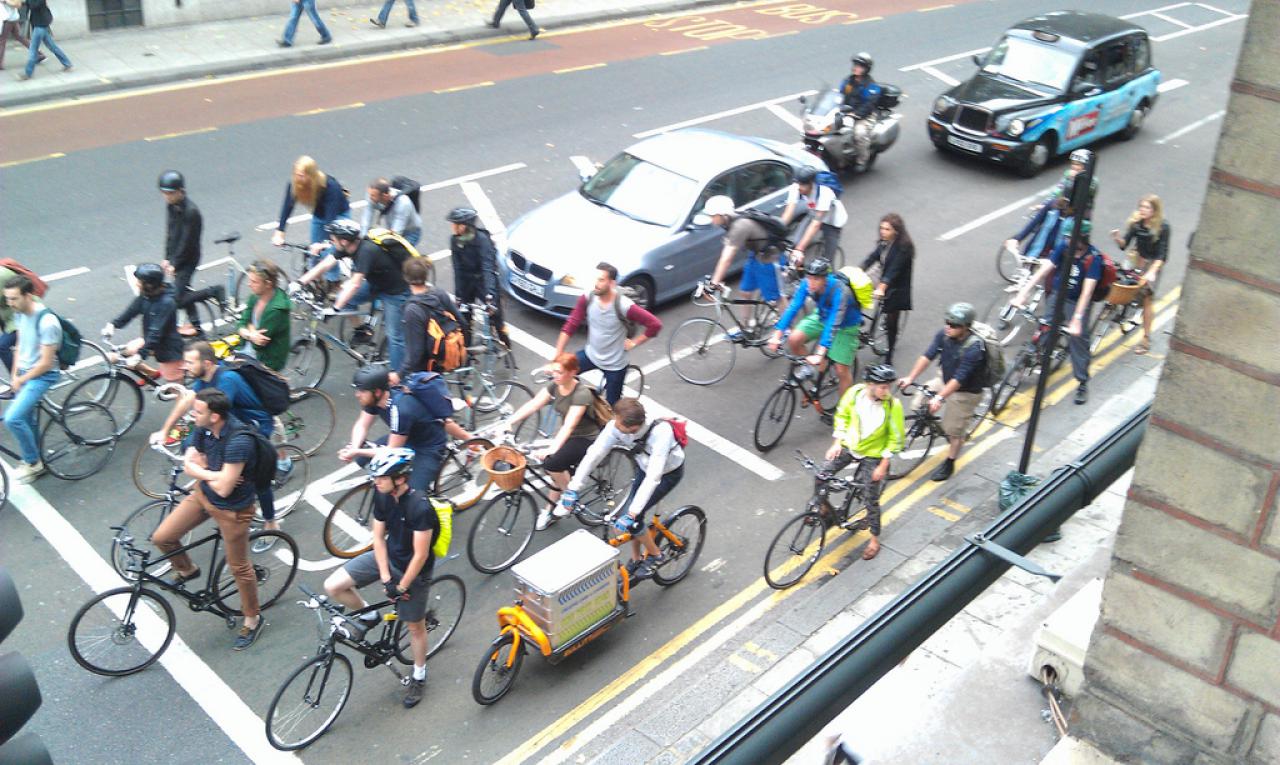
Even in the presence of bike lanes, everyone tries to be in front, of course they are faster, they are literally cheating.
I would be the fastest in every line, if i could skip it and pass in front of everyone else.
Truth is other people would not like it, but we tolerate it for bikes (and motorbikes) for reasons I still don't fully comprehend.
Paris has one real feature: it's a greatly enjoyable city to walk and a terrible city for bikes (or cars)
So if you are in Paris, walk!
Nobody can steal your feet!
- As bicycling boomed in the French capital during the Covid pandemic, so has the number of stolen bikes.
- “This is the worst place for bikes, The mafia networks are organized to steal them. With everyone currently riding bikes in Paris, it’s become a simple and easy way for thieves to make a lot of money.”
No way, man. The Ami has flames on the side:
https://www.topgear.com/car-news/weird/ha-check-out-citroens...
And does your e-bike strike fear in the hearts of criminals everywhere?
https://www.topgear.com/car-news/electric/citroen-ami-now-po...
I think not.
I live in Paris and do everything with an e-bike that also has no boot, no passenger seat, a top speed of ~20mph, a range of ~30 miles... but cost me around €1,200 (since I built it myself).
It now has over 7,500 miles. In day trafic it's probably much faster than the Ami, and it can also be put on a train. Couldn't be happier.