If humanity were to take your opinion, we'd never evolve as a society, lest we remove a need in society and with it, someones job.
To improve the efficiency of a particular group, we create problems elsewhere. The result may not be net positive. In fact, I think it isn't, since those saved "couple of minutes" will probably be spent browsing Facebook.
- that automating all jobs will cause all prices to go down. (It seems just as plausible that if everything were automated, then the relatively small class of people who work building and maintaining the machines wield monopoly-like power and charge accordingly, concentrating wealth even more than it's concentrated today.)
- that with lower prices, people will want less money. (It seems just as plausible that people will expect to be able to keep working and buy more to raise their standard of living.)
- that the intermediate state, where many jobs are automated, but people still need to work for a living, is tenable for society
- that there are no significant social problems resulting from a society where nobody has to work
I don't know whether these are true or not, but if they're not, the result will greatly impact the lives of millions (billions?) of people. Obviously, banning automation isn't a solution either, but it seems flippant to bet the lives of so many people on what we think might happen in a system as complex as the global economy.
[edited formatting]
The problem is assuming that total wealth means anything for anyone but the capitalist class that owns said wealth.
Instead, those with the means of production have hoarded the benefits. Despite all of our technological progress after the American industrial revolution, we are working more hours and earning less as a whole. Despite record profits, companies are not increasing wages and prices are not decreasing for anything except cheap, low-quality, mass-market consumer goods.
See: trickle down economics.
And, behold, we see someone rediscovering the central tenet of Marxist economic theory.
(Entirely serious; not an insult. HN readers could really do with a more balanced economic diet – reading more Marxist theory and less Chicago School...)
(This is why I've read a solid chunk of the Austrians. I generally laugh at them. But I've read their stuff and I can think in it once I get into the mindset.)
I'm promptly shutting up about anything for which the valid answer isn't "Lisp does it better". ;).
Yes! It's a useful lens – just as Hayek is. No-one has a monopoly on absolute truth in the social sciences, so understanding (and empathizing with) all the framing narratives, most all of which have some kind of a point, is crucial to being able to navigate these kinds of discussion.)
Understanding Marxist (and Hayekian) thought has been very helpful to me in framing my own politics – which, ironically enough, wind up being moderate market/social liberalism in the European tradition.
To this day I'm so thankful that I got a B.A. that let me actually leave the CS cage during college instead of just taking more math.
That assumes we can find something better for them to do, of course. But man, we have to try! Forcing people to do things a machine can do is inhumane.
The job-saving technology will live forever, long after the people who are temporarily displaced die. You're doing an immense amount of good for the untold number of people who aren't even born yet.
Technology is also global, but the political problems associated with eliminating jobs are problems on a state-by-state basis. Is it immoral to develop a technology just because some political systems are incapable of handling the gains in productivity, while other states are?
If that notion is correct, moving towards an educational model focused around creating the components needed for general entertainment (video/AR/VR/Music etc) might alleviate the problems we'll face.
Where are these people getting the money to spend on entertainment if they aren't working? I don't think this will happen.
What I do see happening, however, is that people have less free time between juggling more than 1 job and a side gig with Uber/their ilk.
I grew up in a country (Finland) where people bag their own groceries. The table behind the cashier just has a bit more room and some dividers, so even 3 customers have room to bag their own groceries simultaneously.
So an utopia without the "grocery-bagging class" is certainly possible.
So what is new? We have been automating jobs out of existence for a long time. Every era has had a lot of people that are redundant, every era has had useless governments get to grips with it.
Recently I automated three jobs out of existence, making the computer do the data entry work with the customer filling in forms. This is great for the customer as they now get what they want done instantly instead of having to wait a week for the human to do what the computer can do. It is great for the company as 3 people don't have to be managed, provided office space and paid. But as for my colleagues?
I obviously have had thoughts about automating my friends on the next desk out of existence, how I see it is that there are actually plenty of vacancies in the company, there are plenty of vacancies outside the company and the writing has been on the wall for the last year regarding the changes we put through. 2 of my 3 former colleagues are now working elsewhere, having moved on fine, but there is the one that did not step up and go for other interviews within the company or look elsewhere. Now I am sure that government handouts are available, however, if someone does not look out for their own job and assumes it will always be there for them, what can you do? Is it always the government's fault in this situation?
My above sentiment is a tad Thatcherite, it was Norman Tebbit who said 'on your bike', i.e. if there isn't a job for you in your home town then you have got to move, the government isn't going to magically create a job for you. The 'on your bike' remark didn't go down too well in the 1980's, but 'on your bike' it has been since then.
There comes a point where flexibility and gumption don't get you far enough. When the pool of good quality jobs shrinks so much that the ecosystem cannot support the species.
I'm not calling for a halt to progress. If you hadn't automated away those jobs someone else would have. There are very strong economic incentives to do so. I just wish governments would see the writing on the wall and start planning for the future where the status quo leaves most people out in the cold.
In practice what [is and] is going to happen is that the jobs of the poor are removed, because they are more easily automated and the capitalists will retain much of the revenue that would formerly have been spent on wages.
Nothing is going to be done politically until there is either civil unrest or until there is so much impact to those with lowest wealth in society that the capitalists start getting poorer returns because too few people can afford to purchase the goods produced. In either case the situation is going to be very dire IMO before we get there.
This on top of the apparent existing inequalities and the increasing pay gap that the gig economy is creating (the efficiencies don't appear to be improving pay for the workers nor reducing costs as much as they could), and things like zero-hours contracts are pushing [in the UK] makes for a bleak outlook for those who are not already rich IMO.
The problem is the civil unrest seems to be moving in the direction of ethnic nationalism and isolationism, which may not turn out to be the best long term solution to this problem.
But how can we be sure that enough meaningful jobs will exist for all people who want to work? It would be kind of surprising if there was a meaningful full job for everyone.
This feels like former communist countries where everyone was employed, although many jobs were pointless.
It's not clear there's anything a person can do that a machine can never do, in principle.
So then what's the point of having people?
A): None (catastrophic). People die out, or are wiped out, as advanced machines outcompete them for all resources.
B): The boundary (hopeful). AI capable of creating new ideas is either impossible or just too difficult to invent (hard to prove which way it goes), so people keep pushing it farther.
C): None (utopic). Machines do anything people would have done for society, including the creation of new things to have and/or do. However, machines don't reach the level of autonomy required for them to actively eliminate people, or decide against it because there's plenty of resources for everyone, so people have 100% leisure time (which may happen to resemble what used to be work, if the people in question enjoy the process, but is no longer necessary to society).
D): The boundary (dystopic). Machines end up being more complex than people - to the degree that people are valued less than sufficiently advanced machines, and are put to work rather than manufacturing robots to do the jobs.
A note on D: Generally relatively soft sci-fi that does this, because the stories generally put humanity's role as hard labor, which doesn't make sense. However, I could see a story in "The Thinking Machine of the Future has become so Incredibly Advanced that the Absolute Pinnacle of Human Thought is to them what Plowing Fields is to Us." Humanity as the intellectual equivalent of the plow ox (or the tractor), doing the jobs that the machines (with their much higher potential for more complex thought) find to be beneath them and refuse to subject each other to. Possibly with the assistance of basic nonintelligent machines, the way we wouldn't try to make an ox plow a field without first affixing a plow to it.
But we're far from that point now. Anything machines can currently do is, pretty much by definition, drudgery. I'd be happy to reevaluate that statement if and when this changes.
I have no idea what the ultimate answer to that question would be. Lots of SF authors have tried to address it, coming up with answers varying from humans always having something they can do better, to humans existing to have fun, to humans having no point at all and therefore get wiped out by the machines.
Now they're just plain out of work. Hooray?
It's utopian to think job losses mean everybody gets their workload reduced, as this has never happened before. Automation has never reduced anybody's workloads. In fact, every reduction has happened to either eliminate de-facto slaves (industrial revolution) or because excessive workloads actually reduce productivity.
If we have the technology to replace those people and we don't do it, then we as a society are already supporting them just to survive. You're talking about artificially maintaining inefficiency. If we're going to go down that road, we might as well start paying people to dig holes and fill them back up again.
The 40 hour workweek is significantly shorter than the 6 12 hour work days people used to endure.
Why not reduce the workweek again, to say, 32 hours?
It's not a 'natural' evolution, but organized fight from labour.
The same with the general conditions of work: https://en.wikipedia.org/wiki/Mines_and_Collieries_Act_1842
So, in my opinion, reducing the workweek or, an alternative that I think is more practical, stop working younger it's against powerful interests and can't be done without a fight.
The transition will be difficult (they usually are) but the end result (more free time for everyone) sounds good to me.
Honestly, I think this is never going to actually be the case. Why would a grocery store lower prices just because their costs went down a bit? Neither the demand nor the supply has changed, nor has the price people are willing to pay for their groceries.
If nothing has changed but your costs, why lower the prices when you can simply report increased revenue to your shareholders? If competition comes along, a quick "we're premium, they are cheap" marketing campaign (or buying them out) would probably cost less than lowering the prices to match.
I think it's fair to say that even if Walmart could half their operating costs with technology, those savings would not find their way into the pockets of consumers.
It can, that's clear, the problem is convincing the people who didn't lose their jobs that they should take a take hike to support the others; that's not an easy sell in Western Capitalism at least.
Fallacy; apart from a short break thanks to syndicalist wins, we're just working more and more since the industrial revolution.
Reading suggestions: "A People's History Of The United States" by Howard Zinn, and Noam Chomsky.
unlikely - can think of a bunch of reasons why this wouldn't happen.
> people will not have to work full weeks anymore, or rather, focus on learning and reaching higher education
too idealistic - why aren't the people who "aren't working full weeks" today focusing on learning and reaching higher education? The logic doesn't work for the people already in this target group, today.
There are many reasons. "Not working full weeks" doesn't always mean "not busy". Some of the reasons are:
- they're taking care of children / sick parents
- they're themselves sick or disabled (including various psychological conditions that can make you unable to perform effectively as a worker in this economy)
- they don't have a way to find a job that would let them earn more than they get from benefits (going to work in such circumstances is stupidity from economic POV)
- higher education they need costs money they can't get due to reasons listed above
I'm specifically asking about the assumption that "if we remove cashiers, supermarkets will obviously bring the prices down" (as a counter-example, I remember reading somewhere that Seattle's minimum wage didn't affect inflation in any meaningful way)
This feels like a natural evolution. It's a outcome product of the environment.
However "I am unsure we are evolving" sounds like paradox. Isn't a version 2 of anything always "evolving" by definition? Otherwise, what's "better"?
False. Sometime I go to the grocery store for social interaction. You know, to get out. I generally go to a particular wine shop cause I like chatting with the guy at the counter. The idea that we do all this "stuff" ("processes") to get "stuff" done, and then separately we go somewhere for the express and sole purpose of socializing, is just clearly wrong. It's all mixed in. We're social creatures. We socialize while at the barber shop. We socialize at the grocery store. We socialize at work. At church. At football or soccer games. If we attempt to "refactor" out the "process" to make it more efficient, fine. But, don't pretend like whatever we replace that effort with we're not going to be socializing while we do that new thing.
It's frankly really sad that we have all these people that used to be persons we knew and visited with at the checkout counter, now they're in some warehouse being super efficient having no time to visit with coworkers while they work, meanwhile, we pretend that stuff magically shows up at grocery stores and we can walk in and walk out and magic and future wow.
> We socialize at the grocery store.
I never go to the grocery store for socializing. When I was still in England, I constantly ordered online. Now it's a chore and I miss england.
> We socialize while at the barber shop.
I shave my head to avoid having to go to the barber shop.
> We socialize at work.
I work remotely to avoid having to deal with that.
> At church.
Not religious. Probably because I'd have to go to church if I were.
> At football or soccer games.
I play tennis just so I don't have to deal with a team.
I can't wait for this technology to make its way here. The grocery lines on saturdays are insane. Also maybe that means the shops will be open longer hours and I can go in the middle of the night so I can avoid meeting people even more.
Wait, where's your evidence for this claim? I live in a small town in Croatia and, no, the overwhelming majority of the people in my neighborhood are not in a hurry to get their shopping over with. The speed at which groceries are acquired is just one metric out of many influencing their experience.
This is not to say that progress is necessarily bad or that checkout lines are great, merely that reducing every transaction down to its economic value risks overlooking other, less quantifiable aspects of the transaction.
You're biased by your experience, because you live in a world that's starkly segmented between work and play. I lived there, too, so I understand your perspective. But your values -- and Silicon Valley values in general -- are not necessarily universal.
Where is your three-year, peer-reviewed study into the emotional motives of shoppers? After all, you flatly stated that "The overwhelming majority of people do not go to the grocery store as a social exercise."
Since you seem to be a very serious, data-minded person: CITATION PLEASE.
I shop fast too. I get in and out as fast as I can, because - after all - the attendants in the store where I go to would not know a leaf of spinach from a leaf of kale...
The same applies to my electronics shopping...
...at least I can justify the guys there not knowing kale!
Jokes aside: not all stores are like that, and not all people shop like that.
I can think of many elderly people using shopping as a main daily source of social interaction.
Diversity means choice and choice is generally good.
I think the interesting point here is that when you remove social interaction and product advice from physical stores, then really you might as well only buy online... and Amazon is the king of online.
So this looks like a fantastic move by Amazon.
Most people want to get their shopping done quickly and efficiently.
However, I could easily see niches keeping people around. The first thing that comes to mind is a higher end sort of place where customers want some knowledgeable help in selecting what they're buying. Spend some money on a few people who know their products well and give good advice, and maybe have time for some chit chat.
    > This makes sense from a suburban, car-based perspective.
    > From a walking, city-based lens, ...
Someone else points out the security benefit of a cashless store, which again I'd have thought is more of an advantage to the high street shop than the suburban warehouse-like supermarket.
I really don't think that's why. Vending machines can't compete with humans still for freshly produced goods. There have been a few shots across the bow, but producing food that requires adjustment is still beyond the range of our sensors.
I can't imagine a robot "dialing in" an espresso machine based on taste like a barista would, at least for another decade.
I don't think the "productive atmosphere" concept is fully realized yet. Imagine how happy starbucks would be if they could reclaim all of that bar area for more seating (and more customers ordering more drinks!) or less area and less rent.
(I can't help but think that half the attraction of Starbucks is having chipper college students hand-write a personalized drink order...)
Also, the chipperness is a lot less likable when you're friends with some of them and all they can talk about is how much they hate customers :( The unspoken secret of retail is that it's soul crushing to work in.
While it's possible that some people "want groceries as cheap and fast as possible," I don't think either of those is true of the hundreds of people I join at my local market every week.
I go there mainly because I like buying directly from the producers. I want there to be independent farmers in the future too, for reasons of taste, culture, ecology, and food safety.
But I also enjoy my interactions with some of the sellers. Some people probably go mainly for that reason. The market is full, despite a big ugly multinational supermarket 100m away that has cheaper (and worse) versions of just about everything on offer. That supermarket is also full, though I think the reasons why are not as simple as market efficiency.
A lot of us will continue to share the parent poster's opinion, and hopefully in sufficient numbers to keep all the little bodegas going. Because we care about food, and we care about living among humans.
I certainly hope the poor folks who toil at Aldi or Safeway might find a better thing to do with their lives, and if those stores are displaced I won't be too sad.
    > People want groceries as cheap and fast as possible.
    > They don't go to the grocery store for social
    > interaction and forcing the majority of people to pay
    > extra for something that only the minority get value out
    > of is not a competitive strategy.
(... or some other big American city, but it's more impressive if that's right.)
The parent commenter describes something I immediately recognise as "very European"; there's room for both of you.
Interesting. I don't believe I want us to evolve in that direction.
This pretty much sums up _everything_. So, why do we even try to have societies?
Edit: You use an example of going to a bar. You realize "... not everyone may want ..." to socialize at a bar? Some just go to drink.
I don't think that is a fair comparison at all. Somethings are inherently social, like going to a bar, where as others are much more of a grey area. I would argue that many of these have historically been social experiences out of necessity (no automated machines, no online shopping, etc.), not out of the need for social interaction.
May be the stigma of drinking alone, where one is sometimes considered a drunk if one drinks alone.
Shops in the place I live in are fine, but I've heard about "greeters" in America, so it wouldn't surprise me at all if there also were paid people to talk to...
Not true for my grandmother and many other elderly people. Maybe it's loneliness. But maybe it's a generation thing, not sure. We need to question if it's best to not interact with people who sell us stuff.
People said the same thing about DVD stores -- yet the numbers didn't back it up. People stopped going.
People are inefficient sacks of meat with finite potential. When we have designed a black box that solves all problems, answers all answerable questions, maximizing all efficiencies for us, and protects us from any possible threat, what do we do next? What is left?
The value of humanity isn't a universal purpose, that's just how we fool ourselves into believing that there is a point to our lives. That's how we reason about pain, suffering, and hardship.
Human existence, our experience is existentially pointless. It is down to the individual to create a purpose. Perhaps you view the purpose as being something tangible and 'out there' to be had. Others see the purpose as simply just being, enjoying the small things, finding pleasure in the pointlessness.
No one can say what the value for another is. There is ultimately no value except that in which you find in yourself.
So let's not kid ourselves that we as a race are working toward some kind of ultimate design because that design is in our minds only and as such can't be 'ultimate' or significant to the 'other' in any way. Indeed it is likely to be a folly of our mind, a foolish solution to the non-problem of being.
"I know all the people who work in these gas stations. The attendant at the pump always whistles a quiet song while he pumps my gas. He knows my son and is always nice and friendly."
Yet, besides the completely weird laws in New Jersey and Oregon, society has moved on and people now pump their own gas.
I understand the parent's post point to some degree. I don't want a cold a sterile society where no one never interacts with anyone any longer. However, I also get stuck in grocery store lines all the time. It would be a net win for me to skip these lines all together even if the places I shop at become a little more impersonal.
At least in the United States, places have continued to staff less and less cashiers and have relied more and more on self-checkout. So, for many of these stores, it isn't like I'm missing out on any real connection. This just seems like a way less stressful self-checkout.
Apple lets you check yourself out using their app at the Apple Store but I rarely do this because I feel like I'm shoplifting or that people are watching me suspiciously. I'm curious if I would have that same reaction to these stores or not. I'm guessing not, because it is the only way to pay.
I don't see a huge difference between valuing interactions vs. having workplace safety standards or requiring that employers provide health insurance. Both of them raise transaction costs and eliminate at least some economic models because we as a society have decided we don't like the outcome. The sticking point is usually how to do it fairly.
Edit: clarification of point
Not true. The giant store I work at has so many regulars that it's family. Often the store is one of only a few places customer's pasts are unknown or forgiven.
It's not all about increased producivity.
What evidence do you have for this claim? A study of some sort?
It is also obvious from reading the news that some people do not want this.
"They don't go to the grocery store for social interaction and forcing the majority of people to pay extra for something that only the minority get value out of is not a competitive strategy."
Again, this sounds like hearsay or a personal opinion.
The fact that people go to supermarkets, to get their groceries faster and cheaper, instead of going to half a dozen small stores where the potential for fulfilling social interaction is much bigger.
I think that, per the grandparent, current initiatives are not grasping nor addressing the entire scope of the existing... "paradigm" -- sigh, to try to find a word for it.
To reduce it severely but pertinently, in the news recently, "studies show" that people who feel valued and that they have a roll in society, family -- in life -- they live longer.
And what happens when we stop interacting with each other? When that daily communication between work domains and social classes ends? Again, reduction to the almost absurd -- but we're living it -- we get President Trump.
Trump may end up doing ok -- we'll see. But the shock on many maybe liberal, Amazon Prime shopping upper middle class faces? Try actually talking to, with, and not at, the people around you, serving you.
When people stop to think about it, I think most find value in the people around them, much more than the things.
Not all value is encompassed in the fastest delivery for the cheapest price. (Which Amazon seems to be increasingly falling down on, anyway, per my recent experiences.)
Besides, if most people lose their jobs to automation in the near future, there won't be enough people who can afford to buy stuff at these stores anyway, so won't it become uneconomical to run these stores?
Software can be write once, run everywhere. You could replace thousands of cashiers with software written by a team of 10 software engineers.
Maintenance of hardware/software could be taken care of by a few people running to multiple stores throughout the day. Example would be Starbucks in San Francisco. There is a Starbucks nearly every block in the inner-city. You could just have two guys walk from store to store to perform checks/maintenance.
So yes, I see big possibility of thousands of service workers being out a of a job due to automation. Which is why a lot of people are saying we need to seriously consider something like universal basic income for the near future ..
At the profit levels usually seen in retail supermarkets, you can't stop paying all those people minimum wage and suddenly start paying them software dev salaries without an enormous hit to the income statement.
"won't it become uneconomical to run these stores?"
Essentially these stores are already smart vending machines stocked by humans occasionally at night. In the long run that might be where fresh food comes from. "Go to the vending machine and pick up a head of lettuce".
Also, I can walk downstairs and say "Alexa, turn on the living room lights" and my Amazon Echo turns them on. Same thing to turn them off again. That's extremely convenient...way, way more convenient than walking around and turning 4-5 lamps on and off.
They have come way down in price to the point to where you can either pay $20 for a smart bulb versus $10-12 for a standard LED.
Will be interesting to see what happens though...I do agree that life isn't just all about efficiency. But people certainly do enjoy convenience.
They will, one day, when companies stop with the vendor lock-in bullshit. An app - a siloed, sandboxed program that cannot meaningfully interact or seamlessly share information with any other program on the device - is a very crappy interface for doing anything. But we're stuck with it, because it's easier for companies to make money off apps, and cooperation is hard.
How much of our lives do we want tech to live for us? Part of what makes life awesome is meeting random people standing in lines.
> Part of what makes life awesome is meeting random people standing in lines.
By all means go search for lines to meet random people. But spare me because for me that time is wasted, and I rather recover all of it to spend it with my friends, or doing sport, or even watching TV with my wife. This thing won't make lines disappear altogether, so you'll be fine: you'll be able to find them in the post office for example.
crazypyro, you may want to do as Brian Regan said (https://www.youtube.com/watch?v=l8kThoZpF_U ) and pick up some Montana brochures. If you don't have 3-5 minutes in the day to talk to your neighbors, you either need new neighbors or a career change. Life is a lot of things, but it ain't all GSD all the time either.
Yes, they do. It's a human need. Many people satisfy it that way.
The typical grocery store here (i.e. what Go is actually going after) is basically a warehouse, with checkout lanes staffed by apathetic teenagers. The process is already almost entirely devoid of meaningful human contact. It might as well be more convenient.
Hopefully, whatever has protected your local stores from the economic forces that have produced the experience I describe will also protect your local stores from this incremental improvement on automated checkout.
It really drives wages down, so they're overstaffed compared to other countries, and instead of it being an entry-level job for teenagers the norm is to have them staffed by 30-60 year olds with lots of experience, but likely few other options when it comes to employment.
So does putting people who work at grocery stores ultimately help things? I'd like to think so, technology advancement is our only hope of getting rid of most menial jobs. Those who rail against it rarely do so with any sensitivity to all the menial jobs we've gotten rid of already, for the good of all.
However, I suspect that when presented with the choice, people will take the machine store in exchange for lower prices. And I suspect that you suspect the same thing, otherwise you wouldn't be concerned.
My best guess at the risks is that we may lose something valuable as a society or damage mental health if we push people away from social interaction. Many people will remain healthy, but those who are in difficult circumstances may find themselves on a downward spiral as they are further isolated from their communities. What if your community doesn't have a large supermarket? We talk about food deserts in the US right now, what if we have social deserts?
A simple example of short-term v long-term, look at soda and sugar-sweetened carbonated beverages. They're extremely cheap. Often less expensive than bottles of water in the US. This encourages many people to buy them as they are a cheap source of calories and sweetness. However, it's only many decades later that we've discovered the damage they can do when consumed for long periods of time. Many people consuming them don't have better food options. A few cities are starting to tax them to make the costs more evident.
Gasoline is another good example. The US is addicted to cheap gasoline and doesn't know how to stop even though we are now aware of the potentially catastrophic consequences.
1. Social interactions at commercial centres are valuable and Amazon and others who follow will be unable to offer such value.
2. Social interactions at commercial centres are more valuable than the beneficiaries are conscious of.
#1 I think we all agree on. #2 is the critical point and the degree of which is arguable and would swing Amazon's innovations between good and bad.
Let's imagine that on average, whenever someone goes into a shop and interacts with another human they are gaining 50% of their social wellbeing (i.e. a lot). Let's also imagine that on average whenever someone goes into a shop and interacts with a human they leave believing they have gained only 1% of their social wellbeing (i.e. not much). Such a person is likely to stop shopping at a shop with tills and cashiers in favour of a humanless shop such as Amazon Go. However that would likely be a mistake because they would lose half of their social wellbeing without even realising. This in my opinion would put automated shops into the category of a socially 'bad' thing.
Now imagine the actual social benefit of traditional shops is 5% (not huge but not insignificant) and the perceived social benefit is also 5% (i.e. we're fully aware of this benefit). In that case, people should be able to make the choice of which kind of shop is best for them based on a complete set of information. This in my opinion would put automated shops into the category of a socially 'good' thing. They offer more choice coupled with the relevant information to make that choice.
The discrepancy of perceived vs actual benefits can explain why we make the wrong choices with regards to a lot of market decisions from driving a gasoline car to eating at a restaurant. The best way to determine whether a market option is socially good or bad is to try to measure this discrepancy, see if it exists and if so, is it significantly large?
It seems to me that there must be better ways to give people social interaction besides making some people sit at a cash register for eight hours a day and making a bunch of other people wait in lines to be served. But that's a tougher argument to make.
Religious institutions provide avenues for nominally non-commercial social interactions. Mutiple variants are available to account for taste (e.g. Christianity, some forms of yoga).
Economically it makes more sense to buy cheaper and faster. But this eats into the fabric of society and offers nothing in exchange.
And what are all these people supposed to do then ? Sleep all day ? They will fight back with their votes at first, which they are already doing in the US and Europe..
Then there's the centralisation, control and privacy part - amazon gets to decide what products your area will be supplied with, it gets to know your eating habits, your walking habits, etc. Will pretty much own you and the neighbourhood.
But then again, I don't really see an alternative - it seems that we're being 'innovated' by force into the future and there's nothing we can do to stop it.
Economically it makes more sense to buy cheaper and faster. But this eats into the fabric of society and offers nothing in exchange.
Then there's the centralisation, control and privacy part - amazon gets to decide what products your area will be supplied with, it gets to know your eating habits, your walking habits, etc. Will pretty much own you and the neighbourhood.
The world has enough money to do these things, it's just a question of priorities and replacing greed with compassion.
There will still remain room for shops with cashiers in the market just as there is still room for restaurants with waiters, tables and chairs despite the innovation of drive throughs and fast food.
As long as you are part of a large enough group who is willing to pay for traditional style shops then they will continue to exist.
The economy often gives us good solutions, but it also often gives us bad ones. The economy doesn't care either way.
C.f. http://slatestarcodex.com/2014/07/30/meditations-on-moloch/.
My point is that if you look at this from an economic point of view, you should be able to figure out whether or not it is good or bad (or at least know what information you need to figure out if it's good or bad). See my other comment on this thread: https://news.ycombinator.com/item?id=13108119
You're spot-on in splitting the problem into two in your other comment.
--
[0] - especially if you frown at one of its most powerful form in a large society - government regulations.
I've been to restaurants where you order from a terminal and your only human contact is someone who delivers your food without a word. There were a bunch of them at one point and they all closed down, and I don't remember thinking they were cheaper or more expensive at the time. I just remember feeling like the experience of going out with friends to a restaurant felt diminished.
Also at one point, Home Depot and Lowes switched to a majority of self checkout lines, but all that did was move everyone over to the "old fashioned" lines that ended up taking 3x as long to check out, but people continue to do this.
The unstated assumption is that the people using the stores have sufficient capital to value interaction with people over lower prices.
You can imagine that if the shoppers also worked in jobs where their humanity was valued, they might have this capital, but that's not the case for most of us because we work in systems that trade humanity for efficiency and the value extracted is captured by a tiny elite.
If you look at what that elite spends money on, it is exactly more personalized human interaction.
The problem is an artifact of people making choices in a system that concentrates wealth in the hands of a tiny few, and nothing to do with what people in general prefer.
If your goal is to create a society where relaxed human interaction is prioritized, then it would be deeply inefficient to accrue the majority of surplus resources to a tiny few.
If on the other hand, you are a member of elite whose interest is in competing with other members over resources, you would define efficiency in a way that minimizes the value captured lower down the hierarchy.
So yes, I am essentially saying that, but I don't want us to fall into the trap of using a single definition of 'efficiency' based on the assumptions of a particular system, but recognize that it depends on what is being optimized for.
I don't think that relaxed human interactions work against the elite's goals per-se - they just don't contribute directly to their goal and so are optimized away wherever possible.
Taking an authoritarian approach is really a shameful way to handle it.
For you, as the customer, maybe it seems cute and fine as a job but from my time in the job it's basically hours of mindless labour that teaches you little and offers no room for growth.
Your opinion on this is actually kind of despicable. You want people to perform robotic menial jobs because you feel like it adds humanity to your shopping experience but you seem content to ignore the fact that the job in question is a boring, tedious slog.
It wasn't a job that had a future for me, and at some point during the last job there, I realized that I needed to find something else or I was doomed to a life of barely having enough money to get by each week.
Luckily, it wasn't that I didn't have skills, just that I wasn't using them for profit. But I'll never forget my time there and how soul-sucking it can be to do the same things over and over with no real interactions with the people I was helping.
Could I have been quirky like the cashiers in the story above? Sure, but that isn't me. And I know a lot of customers would have complained about it, because so many customers love to complain, rather than just enjoy things that are happening around them for what they are.
There was therefore a lot of resistance to self-supermarkets. Where people had to go and select their own items off of the shelves. The concerns expressed were the same as yours.
We don't miss the neighborhood grocers. People have come to expect and demand a variety and quality of goods that the old grocers could not hope to match, at prices that the grocers again could not match. The descendants of those grocers have new kinds of jobs, and on average a level of wealth that again grocers could not hope to match.
It has been the same story with every kind of automation. From the Luddites opposing weaving machines that brought cheap clothing to the loss of telephone operators to the development of self-service kiosks today.
I also live walking distance from supermarkets. I also joke with cashiers. But at busy times of day, waiting in line can take me longer than it takes to go to/from the store and select items. You don't mind the wait. I do. Amazon Go seems like a great idea to me.
SOME of us are willing to pay 2x. Some aren't. We all get to choose what it is that we want.
Choice is good. :-)
Social interaction besides the usual benefits also makes otherwise dull or tedious jobs more tolerable. If those people didn't have to work as cashiers anymore (how that could work is an entirely different matter but something like a basic income would be a start) they wouldn't simply disappear but be able to make better use of their time, for example by serving the people in their neighbourhood in more expedient ways.
Keeping jobs for the sake of it just leads to stagnation. People working on a job until they retire (or drop dead, whichever happens first ...) because they either have to or don't know otherwise is not something virtuous but actually quite sad in my opinion. It's often required to make a living and support yourself and your family but we shouldn't accept it as the natural state of affairs.
That the majority of comments in this thread seem to imply or at least tolerate this assumption is quite saddening.
EDIT: Sorry for the snark, I feel bad. This is a real dogpile. You don't deserve this much shit.
I know all the people who work in these supermarkets.
The significant bit is that the walk-ability indicated in the 1st sentence enables the community indicated in the last sentence. I know there was one neighborhood in Cincinnati in the early 2000's, where you could walk to the grocery store, walk to the hair stylist, walk to the library, walk to the bank branch, and have a friend shout from their balcony to invite you up for dinner. Enable people to interact with their world on a village-scale, and you will have village-like interactions. However, if you turn people into paranoid-other-ignoring drones and cargo in metal capsules, then you have dystopian sci-fi city interactions. (This is a spectrum, not a binary bit, of course.)
I live in Seattle. Many neighborhoods are very walkable. I can and do walk to grocery stores all the time. No, I don't know the cashiers personally. I also have to wait in long lines quite often.
When I lived in New York, one of the most walkable cities on Earth, it was even worse: long lines and anonymous, interchangeable cashiers.
I grew up in a small town where everyone drove to the grocery store, and that's the only time in my life where people knew their cashiers and genuinely cared about their lives.
Effectively, you still lived in a village. One neighborhood in Cincinnati functioned like a village for me in the early 2000's.Many neighborhoods in Barcelona function that way.
When I lived in New York, one of the most walkable cities on Earth, it was even worse: long lines and anonymous, interchangeable cashiers.
I'm not, as you imagine, touting walk-ability as a panacea. My point is that it's the societal structure that gives the humanity perceived by the Barcelonan commenter, not the checkout jobs per se.
I'll never understand the view that superior technologies mandate removal of the "old" ways of doing things. No one is forcing you to change, but dont be surprised when most people dont share the nostalgia you have.
[When Vonnegut tells his wife he's going out to buy an envelope] Oh, she says, well, you're not a poor man. You know, why don't you go online and buy a hundred envelopes and put them in the closet? And so I pretend not to hear her. And go out to get an envelope because I'm going to have a hell of a good time in the process of buying one envelope. I meet a lot of people. And, see some great looking babes. And a fire engine goes by. And I give them the thumbs up. And, and ask a woman what kind of dog that is. And, and I don't know. The moral of the story is, is we're here on Earth to fart around. And, of course, the computers will do us out of that. And, what the computer people don't realize, or they don't care, is we're dancing animals. You know, we love to move around. And, we're not supposed to dance at all anymore.
Me: "Sir, are you Mr.Vonnegut?".
KV: "Hmph". Me: "It is an honor to meet you. Fan of yours from when I was 16".
KV: "OK".
Still very fond of him and his works :)
Technology like this will make a lot of jobs obsolete. And, in the short-term, there will be a lot of problems with unemployment or underemployment. But, ultimately, a system of universal basic income (or something like it) will be implemented, allowing people to disassociate their identities with their jobs. It will free up their time to do other things, like help out in their communities, create art, or pursue their other passions. They can still work if they want to, but they won't need to. And they'll be able to choose jobs that they're passionate about instead of the jobs they have to do to pay rent and provide food.
Stores like this won't remove the interactions you have with your neighbors - those interactions will just change locations. Instead of seeing the cashier at the supermarket, maybe she'll be giving your daughter singing lessons because she was allowed to focus on something she loved doing instead of something that paid the bills.
I'm not going to argue that we should hold back innovation to preserve jobs, or that we should have people working 40+ hours per week as our goal. The simple fact is, however, that attitudes and government policies are really far away from supporting a 'post-work' society, and are actually getting further and further away.
People who control capital in western societies - and are the primary beneficiaries of automation and other techniques that are causing many jobs to disappear - already feel like they pay too many taxes, and are generally good at finding ways to make sure they pay less. Even a level of basic income that would provide a poverty-level standard of living for people feels politically impossible right now.
I don't fully disagree with you, but I find a lot of these "post-work" responses to be really hand-wavy.
Phrased another way, inefficient services sector processes are imposed upon us, and the preferable alternative is "opt-in" (e.g. farmers markets, bars, or what have you).
You might also find interesting the pro-feminist discourse around automating "traditional" roles. Preserving long supermarket lines exacerbate social inequities you may not be so fond of.
he said, here in the U.S., business is business. nobody gets attached to a store.
That being said, there is value in daily ritual and routine, and we need to find a way to replace our current ones with new ones that are just as meaningful if we wish to automate all jobs away.
These guys might have been ordered by management to smile for customers. That doesn't make them happy. Just a bit more miserable, but you don't see any of it.
I can't see why anybody will like to finish their life counting stuff and money for other people. I can hardly see them happy even if they smile to me.
And here is another guess: They are probably getting a salary that barely covers their basic needs and won't cover urgent ones.
How about: Machines do this for us while we work on more interesting thing. Maybe if the bright of us are failing to get married and raise kids, we let these guys handle the task for us. I can see women being much more happier raising kids than processing mail for the post office.
Anecdote: my wife is from Barcelona, and is currently finishing her PhD in a technical field. We're in the US at the moment and she could likely get a well-compensated job after graduation if she wanted, but is considering applying to be a barista at Starbucks or similar instead. It's not that she particularly dislikes what she studied -- just that she doesn't particularly care about work life one way or the other at all. I've observed this attitude a lot with Spanish friends.
Another useless job: A door-man.
Men too
You may be accused of being overly sentimental. And yes, grocery shopping is not always fun. But just by being out in the world and interacting with humans is worth something. Take that away, and at some point, these little brushes with humanity have to be replaced or we starve as social creatures. It is the increasing lack of social contact in many areas of modern life that drives many of us to social media platforms that promise to fulfill these needs.
We talk all the time about filter bubbles. What about physical interaction bubbles? Soon you won't have to see or talk to anyone outside your friends and coworkers if you don't want to. What does that do to empathy?
IMO non-specialty grocery stores with a few staff closely knit in the community have already been mostly eliminated by the larger corporations.
With "just walk out" the friction is extremely low. It might see less pushback than other technological approaches. However I have to think security will be a major issue. If I can rob the store by just leaving my phone in my car or leaving a cheap phone in the store while I walk away with the products. Tap-in/out gates are probably the best bet, but can still be tailgated, so you'll need to have pretty tight security and monitoring ready to beat anyone down who doesn't pass the checks or looks fishy at the gate or in store attempting to fool the system into believing they're another person. Or write those off as losses, I suppose most retailers today already do a lot of that.
Suppose the minimal cost solution has a cost of c.
Suppose there is an extra "human touch" factor that costs x extra. So the total cost is c+x.
Suppose there are n customers, of which m prefer the human touch.
In a world with humans everywhere, it costs everyone c+x/n to deliver a product that satisfies everyone.
In a world where two solutions are competing, one with humans and one without, it costs c+x/m to deliver a product that satisfies m, and c to satisfy everyone else.
The subset m that prefers the human touch has to pay more. But notice there's no magical majority cutoff here; that's not how it maps out. It's a curve that gradually increases the cost the lower the m:n ratio is, until it becomes a very expensive boutique service that only very wealthy people can afford. And the increasing slope makes it hard to fight.
It is in fact people with the least sensitivity to price and preference for the human touch that will help maintain the status quo. And those people are usually in the minority.
The only real difference here is that it's a technology you didn't grow up with that is putting people out of work, so it's seen as unusual to you. We make this choice of technology over manual labour in virtually every industry every single day. But it's normal because we grew up with it. And the kids that grow up with this technology today will see this as normal too. Eliminating cashier jobs in supermarkets isn't fundamentally any different to eliminating textile worker jobs in the 18th century.
Every supermarket around here has self service checkouts already, it's just a matter of time before something like this comes in.
I don't like it, for the reasons you outline. I think we'll lose something. I'm especially thinking of old people who might be living alone and see their shopping trip as an opportunity for social interaction. Unfortunately that's the way things are going though.
Human cashiers will probably exist in the future too, and if you value it you'll be able to pay extra for it.
If this were true, the shopping experience would be very different for all of us! Stores would look like Soviet-era warehouses, with everything done at the least possible cost.
In reality, customer experience matters a great deal. That's why you see companies like Amazon creating these sorts of innovations.
There is short term pain in automating jobs that no longer need to be performed by humans, but no sane person would look at the long term result of that automation and say it was a bad thing.
> When can I visit Amazon Go? Amazon Go is currently open to Amazon employees in our Beta program, and will open to the public in early 2017
I think all the discussion here are very pre-mature. It looks like a controlled beta-test at best.
That's not true. There are nice people in the world.
Being nice is not a behavior that is only exibited when paid to do so, as you seem to believe.
I didn't say that. I said they would be fired if they were rude. It's a selection process that favours nice people, it does not make people nice (whatever that means).
Supermarkets are not great places to shop or to work. Most employees are working far less hours then they want to on an income that is dependent on welfare top ups in one form or another.
Since there is no chance of UK supermarkets adopting a Spanish philosophy I think these people would be happier, and no worse off, if they were put out of a job tommorow.
For evidence just look at how many people opt to queue in the self service aisle, even when there is no queue at the human alternative.
Well it sort of depends on where you want to shop. Staff at my local M&S and Waitrose are always up for a chat if you want it (certainly the older generation seem to like this, and it probably keeps them coming back). But the guys at the Tesco Express are clearly only interested in keeping the lines moving as fast as possible.
In all cases they also have the option of self checkout if you want to save time and avoid the chit-chat!
I'd noticed that too here in London. TBH I feel I get better and more 'human' interactions from the people that police the self-service checkouts than behind the counters, because generally they're trying to help me when I need it.
So, sometimes the more automated option is also the option that involves more net 'humanity' for me (or at least more time for close/meaningful human relationships).
For me, this retail model would be attractive.
Separately, I agree that automation may be displacing people who need assistance as a result, but I think the best way to address that is to offer government assistance, not to avoid the valuable automation.
And, I'm all for people having careers that are meaningful and fulfilling. But, is supermarket cashier the most valuable thing these people can be doing?
Imagine we had all the money we wanted and could pay people to do anything and buy robots to do anything. What would we choose to buy robots to do and what would we choose to pay humans to do?
You point out that there are a good number of employees in your local stores who have a productive job which they enjoy and from which they get personal meaning. You fear losing all of that if we introduce fully automated stores.
Let's do a thought experiment. Suppose we already HAD fully automated stores, but we also had this same group of 60 people who (in the actual world) work in those 5 supermarkets. What would we invent for them to do which would pay them, give them something productive to do which they enjoyed and from which they could get personal meaning? Scanning groceries for 8 hours a day just wouldn't be my first pick to address this problem.
So I guess what I am trying to get at is that I agree with your sense that there IS a possible problem with eliminating the need for these jobs -- but I don't think it's a problem of "shops need to have people". I think it is a problem of "the benefits of improved automation need to be more widely shared". If all of the benefits go to a few people who happen to own Amazon stock, then what's to happen to the 60 folks in your neighborhood?
Personally, I'm in favor of some sort of universal basic income along with a change in our society to create socially acceptable niches for people to do small, simple projects -- but I certainly don't know all the answers.
Similar reason why Amazon hasn't caused small bookstores to close down.
I think there are plenty of ways humans can improve the world that doesn't involve jobs but it's going to be a rough transition. Where there might be fewer cashiers, I hope there will eventually be more educators, scientists, artists, and caretakers.
Do you want to bring back elevator operators?
https://muenglish111.files.wordpress.com/2011/08/vonnegut-3....
"How beautiful it is to get up and go out and do something. We are here on Earth to fart around. Don't let anybody tell you any different"
The problem isn't that Amazon is doing this and that this will drive out those mom&pop shops. The problem is that people will choose to go to Amazon and willingly destroy the mom&pop shops. The consumers are more culpable for the destruction of those mom&pop shops than Amazon. By placing the blame entirely on Amazon you are taking agency away from people which in my opinion sounds more wrong than a nice neighborhood losing its charm because of Amazon Go.
What people don't realize is that economic forces are completely within their control and it's their daily choices that add up to neighborhoods maintaining their charm or turning into Starbucks and Amazon Go automation factories. There is a sustainable way to drive innovation and it requires people to be cognizant of those daily choices. I don't think you can make people come to that realization by stopping or delaying progress.
So yeah, technically if you, and me, and everyone else agreed not to use Amazon Go and stick to our regular grocery routine, mom&pop shops would survive. But that doesn't take into account the fact that coordination is a super hard problem. One that's essentially impossible to solve for a group larger than a dozen people without creating some strong external incentive structures[0]. On the other hand, a company like Amazon is in a position to unilaterally change the incentive landscape. There's no consumer agency to talk about here, anymore than we talk about agency of sheep being herded.
--
[0] - that's also why every society, as it grows, invents structured forms of governance.
All you're saying is "If your offer is far more attractive than anything else on the market, people will flock to your store and buy. What a bunch of fools acting like lemmings, Lol."
How are people supposed to react when faced with more interesting alternatives? NOT choose them to demonstrate their free will? That doesn't make much sense.
The upfront effort needed to steer consumer behavior is shockingly minimal.
More of the world will enter into pop stabilization and decline and this is where this will fit in. Where it will not fit in is in places still experiencing pop growth and few prospects for rewarding jobs.
On the other hand I'm a bit Orwellian and I do see value in people doing these kids of small quotidian things which are the basis for human fabric since civ --that is, engaging in small transactions which reinforce human connectivity.
Perhaps not. I worked at a supermarket as a starving student decades ago and the number of non-cashier employees dwarfed the number of cashiers. Most of the people in a store at any given time are stocking a department or cleaning or providing counter service or rather optimistically all three. We had more people employed at 3am stocking shelves and scrubbing floors than employed serving customers during 2nd shift...
There is an assumption in the comments, that might come from confusing urban convenience stores with supermarkets, that the only employee in a supermarket is the cashier.
You could make something like a quik-trip gas station/convenience store almost staff-less, but an actual supermarket is crawling with non-cash-handling employees.
But in reality, many other shoppers in the world don't have your experience. I live in a large American city and my shopping experience is the exact opposite of yours: I have to drive 10-20 minutes to my supermarket; it is gigantic warehouse-sized; I don't know the cashiers on a personal level (I don't even recognize any of them as they always seem to be different); I usually wait a long time in line (10 minutes). So yeah I would gladly prefer shopping at a supermarket powered by Amazon Go technology.
But I am guilty of sacrificing them for convenience myself, e.g. I tend to avoid the cheese counter at the supermarket in favor of prepackaged stuff from self-serve shelves. Removing final checkout is just more of the same.
At least Amazon seem to be trying to the robomarket with a permanent all-seeing-AI installation instead of the not too unrecent consensus prediction of RFID on every single bar of gum and on every piece of fruit. Much better to talk about social implications than about technicalities in RFID surveillance.
From my perspective it's annoying. I need to go in to a crowded market get all my stuff. Once I've done that I either need to wait in line for an automatic check out station (because there are not enough), or wait in line for a cashier which takes forever especially if someone decides to pay with cash.
For me this potentially gets me out of the store faster so I can do things I actually want to do. I honestly wish I did know the people but that's not really how it works and so this is exciting for me
There's no reason why your human interaction would suffer if you truly value it. With the money and time saved, perhaps people now go to the cafe and talk more often, or perhaps there's now a vendor outside the shop where you can get a conversation and a coffee. More than likely there will be a solution that i can't even think of.
Oh, that, and I get to be more self-absorbed and isolated from people in my community than I already am...not that I couldn't make a greater effort, but there is something to be said for a world where face to face interaction used to be expected and normal.
Generations that are being born today won't see a supermarket as a social place at all, and those are the generations that will be accepting and shaping how humanity interacts, so you better adapt to their "normal" life.
This technology would be extremely valuable to a shop like that. More choice, more customers, better shopping experience. And employing staff for 3 short-lived peak periods must be expensive.
> I don't mind waiting in line for 3 minutes. Or 5. It's never longer than that, even if the cashier discusses the latest news with the old lady.
If I go to the Stop & Shop, I spend about fifteen minutes in line on average, and the cashier is consistently rude.
That being said, when I go to the more "local" stores, I have similar experiences to what you've described.
Edit: To be fair, looking at the video, it's mostly prepared food, so I'm probably not even in the target audience for this store. (I tend to buy raw ingredients, like produce and meat.)
It's cheaper to only have 1 person watching to make sure everyone scans into the the store. Really there is no need to elaborate beyond that point alone. Also it cuts theft because you must scan to get in.
I don't think every store is going to change to this model overnight. It will be gradual over years and years. But it will happen.
This probably says a lot more about me than it does Amazon Go...
Maybe I'll miss out on these interactions with these friendly people who sell me stuff but if it means I can get my groceries done faster so I can go meet my actual friends faster, there's a clear benefit to me.
And this is one of the many reasons why automation has always won in the long run.
With automation, supermarket costs will reduce, otherwise there would be no reason to automate.
This also happens with books, buying online is not so pleasant as go to a store, but people do, for different reasons.
Though appealing to Amazon, of all companies, about humanity where workers are involved is sadly, comically unfitting.
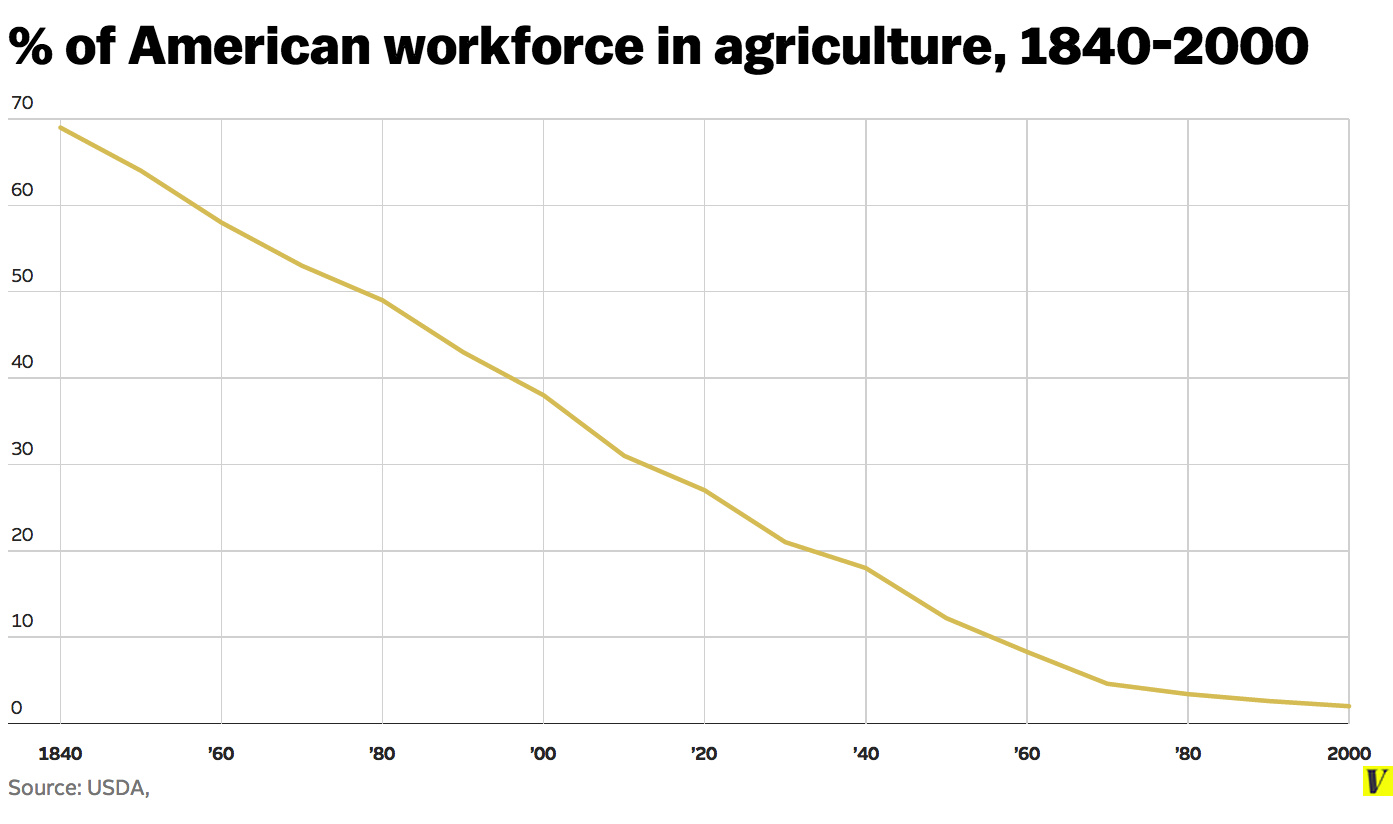
So how is this possible? It's possible because the very reason that fewer people work in agriculture is because each human is more productive, resulting in cheaper goods on the shelves, because each salary can produce more of the same good. In other words: when an employee becomes more productive, a company can sell its product at a lower price, and earn more money. It can use this money to hire more employees, to produce more goods, rather than result in a layoff. In a free-ish market (with healthy competition), competitors will force incumbents to lower their prices, in search for profits.
This has been seen countless times, in many different areas of industry (from pantyhose to, TVs to phones, cars etc.). All of these products have become significantly cheaper (relative to median income) over the past decades, and this has resulted in more people buying them, such that layoffs have become unnecessary because the increase in productivity is offset by an increase in demand.
So, it's relatively simple. 1) If the decrease in price does not cause an increase in demand, employees will have to be laid off. 2) If it causes an increase in demand, then the company can afford to hire, perhaps dramatically more. So, for example, if shoppers buy 5% more items because prices are reduced by 5% (because of automatic checkout), then the cashiers can work at the packaging facility, or the farm, or in transportation, needed to make 5% more goods available to consumers.
[1] https://cdn2.vox-cdn.com/assets/4565243/Ag_workforce.png
If it where not for capitalism I'd rather self-checkout then have someone serve me and waste 1m of lifetime per visit to the supermarket.
Why not just give them actual welfare?
In the US, it might require some doublespeak to keep people from revolting at the "socialist" implications of paying people for not working.
> The humanity of it has value for us here and that value is greater than the time we'd save by removing the people from the shops.
I wish this sentiment existed in other realms and for the countless un/underemployed millennials out there. I wonder how many marketing assistant and assistant media planner jobs have been killed by the use of one janky "online marketing suite" after another.
I doubt that sentiment would be shared by most cashiers at Walmart and other retail chains.
As I see it, there are two separable things in your view and separating them can be good for everyone.
One the one hand there are the people who facilitate your shopping experience. They help you with this task that is part of your daily life and they provide a social connection between you and your neighbors as you gather in a common space.
On the other hand they are the 'mechanism' behind moving money you've earned back toward the farms and factories that have produced the goods you use.
Both functions are important, and through history have been inextricably tied together and the basis for a rich history of the 'merchant' class. But it is important to note that the merchants are not necessarily aligned financially with you their customer. The merchant is in the position of choosing how much money to take out of the flow for themselves.
As a process, the merchant tries to get the lowest possible prices from the suppliers for goods and charge the highest possible price to the customers who are buying the goods. The cost sold must remain higher than the cost paid for the merchant to exist, and the merchant incurs costs while being a merchant (from venue maintenance to employee salaries to shoplifting and theft) and so the total cost of the goods has to remain below the price it is sold for in order for the merchant to remain solvent. The cost of goods sold must remain materially lower than the revenue they generate so that the merchant can accumulate some savings in order to offset unforseen expenses as well.
Now all of that mechanical operating of a grocery store has nothing to do with the social and service aspects of going to the store, sharing gossip with employees, and meeting and chatting with neighbors.
And now we have the set up to understand the actual problem and the cost of the actual solution.
You mention that there are 5 medium sized markets within a 5 minute walk. Why do you walk to one or not the other? I don't know for your case but in my case I will go to a market that I know is likely to have something I need, or one that has a good price on something I'm buying, or one that is near my travel route too and from the office because it is then not too far out of the way.
Historically, if one market has generally lower prices than nearby markets, people shop at it preferentially and the other markets suffer (sometimes failing completely). Using WalMart as an example, it has gone into regions and decimated the local retail outlets by offering lower overall prices in essentially unlimited quantities.
But the mechanism that allows Walmart or Target to do this is that the profits from other stores in the chain can cover the losses of individual stores. So a Walmart in a small town can still offer lower prices than the local grocers and merchants because they do not depend strictly on local profits to keep their store there open.
You could legislate that all shops had to be locally profitable rather than depending on outside of market help. However, that has the down side of specialty shops like hardware stores may become impossible to operate because they don't have enough regular customers to stay in business.
Then there is the local staff. For the merchant they are technically only necessary for collecting the money and protecting the shop from theft. But for the customers, as you mention, they are an important aspect.
We could imagine a scenario (we may not believe it to be possible but can imagine it) that through video surveillance and facial recognition that a computer can ascertain where every piece of stock that has been put into a store has been removed. Further, that surveillance would take care of charging the person acquiring the stock regardless of how surreptitiously they did so. This would be a big improvement in the shops economic model if everything they brought in was "sold" and charged for. Shops today have complained of losses from employee theft and shoplifting reaching 3.23% of sales at grocers[1] and that cuts into their profits significantly. Take that loss away and the grocer gets to keep more money from its revenue.
What to do with that extra money? The biggest job category at risk is cashier, but what if those people became roaming store customer assistance agents? For the same amount of pay they would now spend their days helping the customers find the groceries in the store, reaching high shelves for people who are short or disabled, restocking shelves from the larger stock in the storage area. Baggers would still be useful as people with many groceries would still want help going out to their car. Butchers and bakers, and counterstaff for lunch counters would still be needed.
But then here is the rub, the prices for the groceries wouldn't change at all. The cost savings of automated checkout are going into the salaries of former cashiers.
Now if at another Grocery they instead simply lower their prices. You the consumer get to decide if the former cashier has a place in the store or not. You decide by paying a price for your groceries that lets the merchant pay the former cashier to be there as service personnel.
My experience suggests that the bulk of the customers will go to the 'cheap' grocer and end up taking away the cashier's jobs because they are unwilling to pay a bit extra to support that person. People will rationalize it and blame other factors but the bottom line will be that by patronizing the less expensive store with no cashiers, they will cut off revenue to the store that had found alternate employment for their cashiers. And that shift will result in either the re-employed cashiers losing their jobs or that other store going out of business, or both.
[1] http://fortune.com/2015/06/24/shoplifting-worker-theft-cost-...
I'm not talking about the technology behind it (I think it's an amazing achievement)..
I live in Barcelona and I have at least 5 medium-sized supermarkets within 5 minutes walking distance from my home. Plus there are several smaller shops that sell fruits and vegetables.
I know all the people who work in these supermarkets. The cashier in the supermarket downstairs always sings a quiet song while she scans my products, she knows my daughter and she's always nice and friendly.
The cashier in the other store talks to the customers. She stops scanning and starts talking while the line waits. Some customers might join the conversation. I know she has an old cat that eats an unlimited amount of food if allowed to do so...
There are similar stories about other shops in the neighbourhood - they come to work, they serve the people in the neighbourhood, they go home. They do this until they retire.
These people like their jobs because we respect them for what they do, so they feel useful and they work hard.
I don't mind waiting in line for 3 minutes. Or 5. It's never longer than that, even if the cashier discusses the latest news with the old lady.
The humanity of it has value for us here and that value is greater than the time we'd save by removing the people from the shops.