In 2013, Harvard researchers did a study of how financial stress affects decision making. Denise Cummins, Ph.D. explains their findings in Psychology Today:
"When the cost of [a car] repair was increased to $3,000, a very different picture emerged: The cognitive performance of those at the upper end of the income distribution was unaffected by the increase. But those at the lower end suffered a 40% decline! The authors interpreted this to mean that scarcity impaired people’s ability to think clearly. The threat—even an imagined threat—of a large bill made it difficult for poor people to focus on the cognitive tasks at hand."
Financial stress impedes human thinking / problem solving. People get consumed by the short term challenges in front of them, and can’t see the big picture.
Sources: http://www.sciencemag.org/content/341/6149/976 http://www.psychologytoday.com/blog/good-thinking/201309/why...
It feels like, rather than a basic income, we need two orthogonal currencies: one for necessities (food, rent, utilities) and one for niceities. Everyone would just have two numbers in their bank account, for each of the country's two official currencies. Basic income would be paid in one, while all income from trade in the economy would be in the other.
Economists liken money to votes for demand in a decentralized allocation scheme. They liken taxes and fines to punishing people by taking away their voting-weight in said scheme, relegating them to suboptimal options that they wouldn't have voted for. (Basically, the equivalent of pairing them up with a non-first-choice partner in the Stable Marriage Problem.)
This works fine at a theoretical level where every agent is participating in economy X without depending on economy X (e.g. an economy consisting wholly of foreign investors), but falls apart when people are expected to also eat and live in some of the things they vote for, because those things have inelastic demand—taxing/fining people doesn't make them consume any less of those things, because they need to consume those things; and frequently inelastic supply—there just aren't options for places to live below a certain cost, because all the suppliers' prices are being "floated up" by said inelastic demand.
If, instead, we said something like:
• A new currency—"necessity dollars"—is allocated to people by the government each month to pay for a basket of goods with inelastic demand. The original currency persists, renamed "nicety-dollars."
• Necessity-dollars can only be used for goods and services with inelastic demand (as found by the BLS during CPI calculation), though they are not restricted to goods with any particular "moral cleanliness" value (so cigarettes are just as applicable as bread†.) This is enforced by only permitting certain sellers to accept necessity-dollars, and only on certain transactions.
• At point-of-first-sale, necessity-dollars are actually sent off to the government and the seller receives nicety-dollars instead. There's probably some exchange-rate involved, that the government can manipulate to some interesting end. Thus, companies never hold necessity-dollars, or pay out in necessity-dollars; they're just a thing individuals have and transparently give back to the government at payment-processing time.
• You can't tax or fine anyone in necessity-dollars. People just receive them, hold them in an account, and spend them voluntarily, and that's it: no other operations are valid. Importantly, banks aren't allowed to impose necessity-dollar fees on necessity-dollar accounts for holding them, and so forth. (They could impose nicety-dollar fees on fancy necessity-dollar accounts, but see the next point:)
• If you get taxed or fined or liened or collected on for anything in nicety-dollars, and you don't have enough nicety-dollars, this doesn't "spill over": you can't pay a nicety-dollar cost in necessity-dollars. You're not allowed. This means that if you run out of nicety-dollars, you're effectively bankrupt (in all the current meanings of that word—all the same machinery kicks in), while still being able to afford necessities. Your niceity-creditors get chased off/annulled by your bankruptcy, without disrupting your ability to afford necessities.
---
† Addiction causes need just like hunger does. You can't really economically disincentivize addicts from seeking a fix; that's basically definitional. Addicts under pressure commit crimes to get the money to pay for their fix, rather than going without. Just freakin' build the infrastructure to treat addiction, if you don't want people spending taxpayer money that way.
It is overly judgemental of what people living on a basic income are allowed to do, thus making living on only the basic income less viable. Your mother is dying and you need to fly to a different city to visit her? Nope sorry, long distance transit is a nicety. You want to take some time to switch careers? Sorry, books are a nicety. Have back trouble? Sorry a fancy chair is a nicety. You may say that those things could be necessities but a huge fraction of goods typically a 'nicety' can be a 'necessity' in the right circumstances. Better not to tie people's hands.
I think this adds a lot of complexity, cost and bureaucracy for a net loss in how effective the basic income is.
I don't actually want to restrict people from deciding what to buy; I want to restrict the government and corporations from wielding the tool of economic incentivization—a tool that works in most of the market—near the margins, where it just becomes a punishment to no end.
Left to their own devices, UBI will be treated as "free votes" in the economy: it will be entirely soaked up by corporations raising prices, because people will still have all the same "non-free votes" they had before, along with the free ones, and everything will adjust to the expectation that people spend both.
Along with this, the government will continue to levy harsh fines, liens will continue to be applied, etc. In UBI, these will take away the money that was supposed to be people's social support. (In fact, in the "pure" UBI most advocate for, these will take away more their social support than is possible today, since we'll have also disassembled welfare, disability assistance, medicare, pensions, etc.)
---
Now, you're right in that people's needs vary. I don't agree that (pure) UBI is the best possible solution to this problem; it's just an easy one to conceptualize.
Do note that, of your hypothetical scenarios, I'd posit that the "fancy chair" is probably a medical device (and the entire healthcare system would be paid only in necessity-dollars; all demand there is inelastic.) And the book is probably a nicety. (Why not use a library? Unless it's a textbook—those are really, really inelastic, which is why they've gotten to be as expensive as they are.)
The flight situation is the truly confounding one. I would agree that this is something that people should be able to do. Yet most flights are for leisure or business, and it's nearly impossible to distinguish from any sort of government-verifiable context why someone is flying somewhere. There's no component of the economy-wide pricing of flights to pick out as being inelastic demand. It's a good example.
I'm not sure what to do about it, though. Even if you allocated people regular (nicety-dollar) UBI along with the necessity-dollars I've been talking about, that UBI would still suffer all the same problems plain UBI does. Flights (and anything else you could spend the UBI on) would just get more expensive by exactly how much everyone was getting.
---
Now, maybe I'm coming at the problem all wrong. The problem is that suppliers of goods with inelastic demand right now get to charge $(elastic demand + inelastic demand), whereas everyone would be better off if they could only charge $(elastic demand), and then get the $(inelastic demand) paid from some other source.
You probably don't need a separate currency to do that. You don't need UBI, either. You just need, basically, the cheapest house in a market to cost $0, and for all other houses in that market to be shifted down in price by that same adjustment. That could be accomplished with simple government rebates, probably. Find products+services with inelastic demand, write people rebates for the amount of that inelastic demand, done.
The idea that the poor can't handle money or would somehow be better off without it is silly paternalistic thinking of the sort that basic income is supposed to do away with. The income streams we're talking about are pretty modest and all the evidence so far is that most people can handle it.
Its effects on inflation are overblown too. Other than real estate, we're not seeing much in the way of inflation. And on the margin, an income that's not tied to a job makes it easier to move to cheaper places. (Why do you think so many retirees live in Florida?)
Is there any evidence for this, or is this purely conjecture?
- decide who actually "needs" the benefit
- figure out how to recognise these people ("means-tested" benefits!)
- catch the people defrauding the system
Instead, you could just say, e.g. for the case of child benefit, that every child receives $400/month and get rid of:
- the complexity in deciding who gets $400/month
- the enforcement of fraud
The "underserving" middle- and upper-income will receive this money too, but it doesn't matter - it's effectively coming out of the higher taxes they are paying already.
UBI is just a generalization of this idea to all benefits.
Introducing two kinds of dollars smacks, to me, of the same mindset that introduced means-testing/etc in the first place: "we don't want fraud", "we want this to only go to deserving purposes". Lots of complexity, hard to manage, and for no convincing benefit.
Even if some people waste the money on drugs the net benefit is still higher. The person determined to waste whatever income, in whatever form, will do so. The person who just needs cash to make ends meet doesn't need ever changing rules and calcified structures to try and work around.
Just give everyone the money, including the entire buildings of people who follow around making up rules and then making sure the rules are followed.
Welfare by basic income can be run by a set of scheduled tasks in a server. It's sheer simplicity outweighs all other drawbacks. Add a flat tax rate to the income side of the ledger and shackles are really starting to fall off.
Such a system will still require systems to prevent multiple claims, ensure people aren't claiming for others and making sure people aren't claiming on behalf of dead people.
Sure you remove means testing, but that is only one part of it. The measures which will need to be in place will still require a lot of bureaucracy.
#2 Uniquely, correctly identifying every single person participating in the economy is currently being done by data aggregators like LexisNexis (nee Seisent), ChoicePoint, others. Basically a private (non govt) RealID. This could and should be a government function.
#2 The system you describe is also bureaucracy.
The claims made by davidgay are flawed and if UBI is a good policy, it should work despite those claims.
Making weak, unsubstantiated claims about anything is a good way of undermining it. My criticism here is to stop muddying of the waters and focus the discussion on the core arguments around how social protection should be done.
For a pretty balanced fictional treatment of a future with UBI I recommend James S. A. Corey's novel series "The Expanse" (now a SyFy TV show). Specifically, the novella "The Churn" deals with characters living in a society with universal basic income, and to a lesser degree "The Vital Abyss".
Thanks also for "The Churn" tip. I'm enjoying syfy's version.
They're called "Ticket Alimentación", and they're provided by Edenred. They're electronic these days to prevent the easiest ways to convert them into real money.
https://en.wikipedia.org/wiki/Edenred
Among the problems:
- most places don't accept it, so you HAVE to go to the places where they accept them. That sucks a lot (nowadays I can't go to the small local places as they don't have the infrastructure to process them, since government heavily monitors their use)
- you can only buy essentials with them, but that does not include stuff like paying rent.
- all taxes and stuff are taken from the "real" money, and you can have a negative "real" income while having too much in food vouchers (which can't be used to pay rent or utilities or transportation).
- you're basically forced to spend them (I make more than what I'd like to spend on food & essentials), you can't save unless you do some kind of hoarding or buy-to-sell scheme. I'm pretty sure some kind of black market would emerge where your proposed "necessity dollars" would be exchanged for "nicety dollars"
I don't have enough leverage to individually negotiate not getting paid in food vouchers, but it's definitely a factor I'm going to consider.
Thank you very much for posting this. I owe you.
there are so many reasons why this wouldn't work. The whole point of UBI is that you are not creating a judgemental system by which certain products are or are not reified by the system. Would tampons be covered by UBFS? Let's say then we allow for UBFS to cover female menstrual products. Would cups then be covered? Why or why not? How would you validate a product as being "for a given use"? How much political maneuvering would be required to get a permit for a product?
* inelastic demand (as found by the BLS during CPI calculation)
Pray tell how does one measure demand elasticity[0]? And if you're entrusting the BLS to do this, will they apply fudge factors? Why or why not? Who gets to influence the BLS to get the 'stats right' on their
* You can't tax or fine anyone in necessity-dollars
one word: Arbitrage.
[0] usually a merchant does this by dicking around with the price.
The phrase "during CPI calculation" should be the key to understanding here. CPI tells you how much prices have gone up or down generally, by just sending a bunch of secret-shoppers around to measure a bunch of prices.
Knowing the treasury's current bond interest rates, the current exchange rate, and Core CPI, you can derive economy-wide aggregate demand—which is the point of the whole exercise. You can then look at any given good's economy-wide demand (i.e. the same formula, where Core CPI is calculated in terms of just that one good) relative to total demand as a time series, take their co-variance, and that's the good's demand-elasticity. (All the numbers are public at every step; there's no real way to fudge them.)
> Would tampons be covered by UBFS? Let's say then we allow for UBFS to cover female menstrual products. Would cups then be covered? Why or why not?
Again: you plug in the demand-elasticity formula and get an answer. No politics, just cold automated logic. Female menstrual products as a category are very likely to be calculated to be inelastic.
Now, how that breaks down to individual items within the category is something I didn't define. As a raw guess, the government could define base inelastic-value for the category, which would apply as a sort of rebate to all the items in that category. Any individual item's price should, after this "rebate", reflect exactly and only its additional elastic demand—making the "premium" products cost some number of nicety-dollars, while the "economy" products in that class cost "nothing" in nicety-dollar terms. (The real key there is the creation of a law preventing companies from increasing their prices in response to this—because, without market manipulation, of course prices would rise to reflect all the same competitive demand as before, plus the extra "free" votes each person got. The law would just need to force companies receiving necessity-dollars to price according to demand in an alternate world where demand was exactly [the amount of inelastic-demand] lower.)
> one word: Arbitrage.
No reason to allow individuals to trade in necessities at all, which would nearly completely prevent arbitraging opportunities. (e.g. it's obvious enough that you shouldn't be able to rent your necessity-dollar-paid apartment out on AirBnB.) Consider anything paid for in necessity-dollars to be tainted and have no legal nicety-dollar value after that.
CPI tells you how much prices have changed, it doesn't explain the source of the changes (and, particularly relevantly, it doesn't measure isolate effects of changes in the supply of dollars chasing the good -- that would be attributed to the degree of elasticity -- vs. other influences on the price of an item.)
To go with your tobacco example, I personally don't believe that tobacco should be considered a necessity. (Though I have no problem with Nicorette / nicotine gum being in that category, which could be used by someone unable to buy cigarettes to satisfy their craving.) Someone else may have a different definition of a necessity vs nicety altogether.
It's much simpler IMO to just give people ordinary currency, and let them decide how to spend it best.
And my point was that even UBI falls over when someone gets their UBI taken away by a fine. Starving is starving.
So if you get a parking ticket (presumably <1% UBI), you can just pay it, but if you get a large fine (20% UBI), you'd pay it off in two monthly payments of 10% each.
You'd probably need something in place to intervene if someone's constantly paying 10% every month due to multiple fines to prevent people racking up daft amounts of fines and just 'living on 90%'
Everyone has a slightly different demand elasticity for certain goods. To use myself as an example, I would buy the same amount of coffee if the price doubled tomorrow, but someone else may choose to cut back on their coffee consumption.
You could also see food stamps as a parallel currency. You get work done, you fix the payment as N food stamps. The guy who takes this, uses the same method to pay others... and so on, until the final guy in the chain exchanges those N food stamps for actual rations. This has other side effects, since there is a parallel currency, it can't be regulated, its supply cannot be controlled. You can't levy taxes on it and so on...
These sort of parallel currencies already exist in India.
Necessities were more or less shared communistically, while "money" was mainly used to elevate status within a social group.
There was little to no trade surrounding necessities.
Your suggestion might or might not be impractical, but I think the general thrust is correct.
If you provide UBI and people can have fines, interest, judgements, etc. levied against it, many predatory practices will render people destitute even with it.
Needless to say, it distorts all kinds of incentives and the black market thrives anyway.
There isn't really a difference here. Need vs. want isn't a binary classification, even though we treat it as one. It is a spectrum. Even worse, it is a spectrum where ever people with choice don't always make the choices of need. Take someone thirsty who is drinking soda. Enough so that they are lowering their life expectancy. They have a need for water, not soda. Soda is worse, comparable to slightly dirty water in how it impacts their life expectancy, but they choose it for other reasons.
It would be far easier to give people money and let them choose how to allocate it. If someone's immediate needs is a safer location to shelter in then they can decide what do they need less (maybe reduce their food budget to compensate). The only issue needing government involvement is with ensuring parents meet the needs of their children (but once again, needs isn't a distinct classification).
No we don't. "Vote with yer dollers" is a political talking point.
I knew someone in a rough spot that went there and spent a day building a rabbit cage or something. When he got back to the center he was told that his SO earned too much for him to work there, they had failed to mention that when he got there first. So now he has checks worth nothing hanging on his walls.
  You can't really economically
  disincentivize addicts from
  seeking a fix; that's basically
  definitional.
So I think that is a good argument against them being, uh, necessary, and then there is the whole thing where if it is a real currency, it will be fungible, so people will still be able to use them stupidly on things that aren't necessities.
  1. Buy allowed item with necessity dollars.
  2. Merchant credited with nicety dollars.
  3. Return item to merchant.
  4. Receive refund as X% of the nicety dollars.

  1. Buy $X banana with necessity dollars.
  2. Merchant credited with nicety dollars.
  3. Give $Y rebate card to merchant.
  4. Receive rebate in nicety dollars.
One interesting effect of this is that if you calculated it per-market, then different goods would have different inelastic-demand floors in different markets. In e.g. Vancouver, where tiny one-bedroom detached homes can cost >$1mm, there'd be a pretty large necessity-dollar allocation for rent/mortgage. In Cleveland, where houses go for $65k, it'd be much lower.
You might not want this effect—you might want to incentivize people to move to cheaper markets instead. But the network-effect of cities is another of those things economic incentives just don't seem to work very well to treat.
  It feels like, rather than a basic income, we need two orthogonal currencies:
  one for necessities (food, rent, utilities) and one for niceities. Everyone
  would just have two numbers in their bank account, for each of the country's two
  official currencies. Basic income would be paid in one, while all income from
  trade in the economy would be in the other.
… that in a planned society "political democracy can remain if it confines itself to all but economic matter". Such assurances are usually accompanied by the suggestion that by giving up freedom in what are, or ought to be, the less important aspects of our lives, we shall obtain greater freedom in the pursuit of higher values. On this ground people who abhor the idea of a political dictatorship often clamour for a dictator in the economic field.
The arguments used appeal to our best instincts and often attract the finest minds. If planning really did free us from the less important cares and so made it easier to render our existence one of plain living and high thinking, who would wish to belittle such an ideal? If our economic activities really concerned only the inferior or even more sordid sides of life, of course we ought to endeavour by all means to find a way to relieve our- selves from the excessive care for material ends, and, leaving them to be cared for by some piece of utilitarian machinery, set our minds free for the higher things of life.
Unfortunately the assurance people derive from this belief that the power which is exercised over economic life is a power over matters of secondary importance only, and which makes them take lightly the threat to the freedom of our economic pursuits, is altogether unwarranted. It is largely a consequence of the erroneous belief that there are purely economic ends separate from the other ends of life. Yet, apart from the pathological case of the miser, there is no such thing. The ultimate ends of the activities ofreasonable beings are never economic. Strictly speaking there is no "economic motive" but only economic factors conditioning our striving for other ends.
What in ordinary language is misleadingly called the "economic motive" means merely the desire for general opportunity, the desire for power to achieve unspecified ends. If we strive for money it is because it offers us the widest choice in enjoying the fruits of our efforts. Because in modern society it is through the limitation of our money incomes that we are made to feel the restrictions which our relative poverty still imposes upon us, many have come to hate money as the symbol of these restrictions. But this is to mistake for the cause the medium through which a force makes itself felt. It would be much truer to say that money is one of the greatest instruments of freedom ever invented by man. It is money which in existing society opens an astounding range of choice to the poor man, a range greater than that which not many generations ago was open to the wealthy.
Money is a good way to avoid abject poverty, but it doesn't give poor people freedom, because poverty for most is a matter of education and socialisation. Basic income can pay your bills and put a roof over your head, but it won't create opportunity.
Nor will free markets. Left to its own unregulated devices, no form of social organisation is quite so good at destroying economic freedom for most of the population as a laissez-faire zero-regulation regime.
Most of the civilised world has affordable health care precisely because it offers financial freedoms that market-based "solutions" reliably try to destroy. The cost of health insurance in the US is literally crippling. It's a prime driver of personal bankruptcy, it makes would-be entrepreneurs think more than twice about setting up - and none of this is an issue in countries where public health care is available.
Likewise with student loans. Who has more freedom - a student with $100k of debt, or a student with no debt?
Who benefits from a generation of students with huge debt burdens? It's certainly not the students.
The real road to prosperity and economic freedom is a regulated market in a broadly prosperous economy with minimal cost of entry for entrepreneurs. That means easy and cheap access to investment funding, plenty of high quality blue sky government-funded seed R&D, a strong culture of academic research and independence, serious investment in public infrastructure, a broad variety of independent media, free unrationed access to world class educational resources, and seed level support for entrepreneurs and business creators from all social backgrounds.
It doesn't mean the "freedom" that makes the proverbial 1% extremely rich while everyone else's economic and personal freedoms are diminished.
This issue happens because one has to constantly juggle many priorities in the mind all at one time. This can come down very heavily on a person. To have to make decisions to chose one over the other, a.k.a making sacrifices can be soul depleting if done for a very long time.
There are often conflicting priorities many demanding attention at the same time. In case of trade off you often stand to lose something for the other.
That's me. I was recently fired for having severe narcolepsy. (Irony: The medication that might help with this condition for the first time in my life arrives tomorrow, a few days before our health insurance runs out.) It's been surreal to be excluded from most life aspirations due to being unable to participate in the 9 to 5 that society expects. Part of why it's hard is that no one can relate to this at all. When you throw your back out and are unable to work, people understand. When you arrive at 1pm because you have no memory of waking up and turning off all three of the alarms you'd set, no one cares why. You're damaged goods.
A basic income would at least assist with searching for my next job. My wife and I are now in a situation where we either start receiving income within three months max, or completely run out of money.
I know intellectually what needs to be done: Port a webapp from an older framework to a next-gen framework, then write a detailed post about how it was done and what the benefits were. That would be enough social standing to at least get some freelancing gigs.
Trouble is, I'm completely frozen. It's not quite fear -- closer to profound loss of hope. When a medical condition excludes you from society, it's easy to let it get the better of you, or feel bitter. Those are precisely the opposite feelings that will result in income.
In that light, it's not strange that a $3,000 bill would reduce someone's performance by 40%. Even if it's not a disaster, you end up wishing that you could take your wife on that honeymoon you've talked about for four years. When it took 6 months to save up $3,000 dispite a decently high salary, you know that your future will never be free from the "money problem," and that it will permeate every aspect of your life.
So what do you do? Try to be intelligent, of course. Try to see your situation as amusing. Amusement, yes; anger, no. It's easier to deconstruct a problem when it feels like a puzzle rather than a prison.
Easy to say that. What do I do? Pull up React docs while trying not to cry.
None of my ambitions matter anymore. Life is a years-long process of trying to recover from a tailspin. I'm 28; blink a few times and I'll be 50.
A basic income might help. When the company fired me without notice, they mentioned that our health and dental insurance will expire at the end of the month. This translates into a few things: (a) an extra $350/mo of bills, which accelerates our impending bankruptcy; (b) choose to remove my wisdom teeth and get a root canal right now, this week, which will knock me out for at least two weeks when I have to perform, and will cost at least 15% of our reserves anyway, so I'm not going to do that. Maybe it will result in messed up teeth for life, but that's an abstract problem that Future Me will deal with later.
On the other hand, maybe a basic income would hurt. I don't want handouts. I want to participate in life and to add value to my pursuits, just like you. It's easy to imagine feeling like maybe this basic income should be my lot in life. At least if I know we'll hit a brick wall in 3 months and that my wife won't be able to graduate, I can sort of force myself to try to use React / etc, and to otherwise hustle.
But I miss being 13, when life was an endless intellectual playground, and that "forcing yourself to have fun learning a programming framework" was an absurd contradiction.
Why post this? I don't know. It's not a sob story, and it's not really a warning. It seems like no one else will learn a thing from any of this. But at least it won't seem so mysterious that a $3,000 bill can subvert you.
I didn't choose to be sick. I don't want handouts either. I am very fortunate. But I do think it's a damn shame that health insurance is so tightly coupled with employment when employers come and go but your health follows you everywhere. I can't imagine that a public option would be worse than this.
Why isn't buying a subsidized ACA policy an option?
Either way I had a $2500 out of pocket max on my old plan that I usually met in January. $6k a year in premiums + $2500 out of pocket + some out of network costs is a relatively palatable deal.
Even for software development it's not always reasonable.
EDIT: and while I don't currently have a steady stream of work available, when I do, I favor working with people who for whatever reason have trouble finding or keeping 'normal' work (having dealt with my own share of issues in this area).
I don't see why narcolepsy should be a problem, especially in our area. I mean sure, meetings and stuff like that might be harder to do, but our industry is/should be lenient to things like office hours. There have been tons of times where I go to the office at "late hours" (e.g. 1+ PM), and as long as I turn in my deliverables on time (or let my lead know I won't be able to), there is no issue.
So again, very sorry to hear that.
Also, if I may, I would like to give you the following suggestion.
What about, instead of porting something and then writing about it for the PR, why not take the lowest hanging fruit you can find and do some local web dev/mobile dev, even if you only get a small fraction of the money you need each month.
I am saying this not without reason. I have a friend that is doing bad financially, and doing only one gig that got him around 1k USD (different country and situation of course, but at the current exchange rate, it's about that amount) gave him some hope.
And the thing is that he got a big relief when he saw with his own eyes that he could basically turn code into money. Not enough money necessarily, but at least some amount. That in turn lowered his stress and things started to look less bleak.
Just to tell a bit of his situation: he has kids and a wife that for medical reasons as well, can't work, so he is the sole wage earner at home. His job is very likely going to end soon, and has about 1 month runway.
So just in case you check back the comments, and if you are willing to take some random advice from a random guy on the Internets, why not try this? Just take a gig, very very simple one you can find through friends, your local laundromat/liquor store/etc, family, that consists of doing a simple but sleek-looking webpage or something very low hanging-fruity, and after you get your first few bucks, rinse and repeat.
Hopefully the boost in morale will be enough to get you to try maybe a bigger gig, etc, or at least buy you some time while you get to find another job.
Sorry if this is of no use to you, since I know that this route might not afford you the medical care you need and that definitely sucks. But I truly feel you and I was hoping I could chip in at least a very very minor idea in case it's helpful in any way.
Not sure what else to say except to try to keep going as hard as you can, and that I can definitely lend an ear if you are so inclined (let me know and I can send you an email or something). If not, I sincerely hope things get better soon.
I don't see why narcolepsy should be a problem, especially in our area. I mean sure, meetings and stuff like that might be harder to do, but our industry is/should be lenient to things like office hours.
I've interviewed at I-don't-even-remember-how-many companies that claim to offer extremely flexible hours, or don't care about telecommuting, just make sure you deliver... until you tell them that you can't promise to be there for the daily stand-up at 9am. This is typically justified by "it's only one meeting a day!", but if that one meeting is in the middle of the night for you because you work in a different time zone, or you can't make it in till 10 because you've got kids to take care of, etc., etc.... that doesn't really seem so reasonable anymore.
Congratulations, you have now saved 10 minutes per day for everyone in the office. Oops, now they have to come up with some other reason for everyone to be physically present at 9 AM sharp.
"Flexible hours" have always been BS at almost every company I have worked for.
Basically, kanban, sure; but you've also missed what is (IMO) the main values provided by the "Daily Scrum", and the reason something like it is useful even in systems that use better methods for communicating status of progress items:
1. Coordination and conflict resolution on next tasks, and 2. Early and rapid identification (and, ideally, resolution or escalation) of barriers/issues.
(That's not to say that there aren't ways other than a daily in-person meeting that could be proposed to meet these goals, just that a status board doesn't replace the functionality of the Daily Scrum.)
For the record, I didn't like doing oral reports in front of the entire class in school, either.
Regardless, I hope you are able to recover from this setback and do better than ever. Please don't lose hope - there is always an option.
There is a ton to learn from your story.
Most people think retirement is what you do when you get old. Retirement planning begins on the day you get the first pay check of your life. In fact the whole purpose of working should be to eliminate the need to work.
If you are not doing this already. You are sitting on top of risky avalanche which will go downhill any day.
As some already mentioned, you are likely covered by ADA - if your company is larger than 15 employees.
There are some apps that might help you in this regard that require increasingly complex tasks to disable an alarm. (https://play.google.com/store/apps/details?id=com.kog.alarmc...)
It also has an option to resound the alarm 5min after being disabled.
I have used it and it was effective for me even on 'easy' difficulty challenges, though I don't have a condition like yours, just sort of heavy sleeper. If you haven't, you should definately give it a try.
No. The right dose of the right medications for the individual affected might mitigate the issue, but another person wouldn't solve it any more than puzzle alarms would (which is not at all, essentially.)
> Or is it an even worse condition than I think it is?
It is of varying severity, with various interventions available that may mitigate the effects to a greater or lesser extent for some sufferers, but its a different kind of condition than you seem to think it is. That is, its not like being a non-narcoleptic heavy sleeper except superficially to outside observers, at least, based on what I've read and the narcoleptics I've known.
College debt, for example, is a problem for those who were successful enough to get into college into the first place, and who, simply by getting into college, are already increasing their lifetime earnings by millions of dollars.
Technological services for K-12 ed is pushing a string. The largest predictor of a student's performance is the educational level and socioeconomic status of their parents, not any in-school factor. Classroom technology offers the most benefit to the students best equipped to make use of it, which is again the privileged and better-prepared students.
Increased political engagement helps those who already have enough leisure and status to spend time following and engaging politics.
Poverty is a more basic problem.
People who grow up in wealthy families naturally find themselves on a college track that seamlessly routes them to elite schools when they're 18 years old.
People who grow up in poverty aren't on that track and might not even have much agency (due to their circumstances, requirements to work young, entanglements with the law) until they're in their 20s.
The fastest growing stable white collar jobs all require a 4-year degree. Even if college were free, people of reduced means wouldn't have equal access to it, because taking 4 years off the workforce isn't an option for most people. Meanwhile: a 4-year degree has actually not much value in predicting one's ability to perform as e.g. an HR director.
So what I'm suggesting is the startup that finds a way to turn smart, enterprising 24 year olds working in retail jobs into HR directors, credibly enough that they'll be competitive with Russian Lit majors.
(I'm not picking on Russian Lit; it's just, that's the undergrad degree my sister got at UChicago before becoming a lawyer, so it's the first one that pops into my head).
Please don't discount free education as "not changing much", in the US I would be probably working at Mc Donalds or dealing crack and in jail.
For a BA, MA, etc, the goal shouldn't be a job, but the pursuit of knowledge. Part of that is the value in knowledge itself, but it also gives you a broader skill set that can be applied to many kinds of jobs, where a technical degree is much more specialized.
On the other hand the public has an interest in liberally educated neighbors and voters.
Is this really the case? Sure for identical education free is better than non-free, but I know even in software development if you're applying for jobs in the US and your degree is from Poland there are places that won't interview you, let alone hire you.
The US poverty line is about 15k for a two-person family. That would mean that earning that much would make 1-3 years of family income in debt.
In the case of education this is not the case; the federal government provides (or backstops) the loans.
I have a twin sister whom was better at saving than I. When it came time to apply for FAFSA loans, she had $2k in the bank and I didn't. She qualified for exactly $2k less in loans than I did.
This is what always irked me about how the bailouts were handled. They should have been controlled government regulated destructors that would tear off and re-attach resources that were viable to other companies and leave the investors with none of their investment.
People on HN may ridicule them for being stuck in an optimization for a terribly low local maximum, but the danger of feeling "rich" on a fat loan is real: "if it's ok to burn through a decade worth of low wages to get to where I can easily pay it pack, what difference does it make if I burn through a few years more?" Valuing debtlessness is the established safeguard against that and going deep to exit high would be perceived as close to amoral by their peers.
- people studying for 10 years just to extend the childhood. (government pay 15k a year to the uni)
- some Unis accept people just to get money off of the government (accepted 500, graduate 100)
- lack of quality due to poor funding
Uni should not be free, but cheap. (50% of yearly median salary)
Note: in Spain it is expected to fail some subjects in Engineering
I do agree with you in principle about the HR director thing. College is treated too much like a white collar vocational school.
HR still prefers somebody who went through the trouble of getting the paper as it signals putting the effort in.
Now many jobs that previosly didn't need university education have such applicants and it becomes more mandatory to get one in order to compete. And why would you not, it is free after all.
In the end more people get higher education. it won't necessary help you getting a better job but I think it is good for society anyway.
For many others this "useless over education" is one of the reasons to introduce fees to schools. To make vocational studies worth more again and force people to think education more like an investment.
Why do you equate poverty with inevitable entanglements with the law?
In my experience, those of us who had to work (formally employed) young are less likely to have entanglements with the law, as one natural result of spending time working is having less idle time in which to get into trouble.
But.... It does help a lot of kids who find it hard to afford college/uni while also having other responsibilities.
Those people who sell a pint here and there to afford gas to get to class, etc. It's not an insignificant amount of people.
So chip at this first, then chip away at the abjectly poor or who simply don't think they have a chance at college/uni.
Of course there is always the danger of human nature wanting to claim, I went to uni as told but still can't get a job. That is it's not just a rite of passage, you have to show personal progress.
The limiting factor here is the regulatory regime, which makes it all but impossible to move money around without using a bank as an intermediary. That gives the banking cartel effective veto power on all new financial services.
The key reform here is to separate the movement of money from the provision of credit, and to have access to money transfer be classified as a basic human right along with food, water, and internet connectivity.
Good luck with that.
Otherwise it's a terrific list!
And yeah, good luck extracting the banks from the profit-making niches they've carved out in that process. They will fight that to their last breath.
Here in New Zealand, there's pretty much no restriction on getting bank accounts. It's almost unheard of to not have a bank account.
Transaction fees aren't really a thing either. Most people only have to pay to withdraw money from other banks ATMs. There's no fees for bank transfers (regardless of whether it's to the same bank or a different one). Bank transfers are within the hour in the same bank, and either within the day or overnight for between different banks.
One thing that definitely has helped in this situation (somewhat counter intuitively) is that we have an oligopoly of banks, so standardisation and cooperation is simple. That's why we have chip and pin cards as standard here (and contactless cards). It's also meant that almost everywhere accepts EFTPOS.
Hell, I had to cash my first check ever today. I don't even carry cash, unless I have a specific reason to need to carry it.
Me too, but it's very unlikely to happen. Payday loans (according to http://thehill.com/regulation/237538-borrowers-default-on-ne... and the study linked there) have a default rate of about 46% in the first two years, making them risky plays; to compensate for that, they have to increase interest rates and fees, which is a huge part of what makes them evil in the first place. Of course, the fact that 80% of payday loans are due to loan churn itself (paying off a payday loan with another) contributes to that in a big way, so maybe it could be done somehow.
I'd be interested in seeing a saner way of handling payday loans than exists right now, but I'm skeptical that it could be done in a way that isn't -- in some way -- predatory.
Building the credit lines economy from the ground up on social networks based in trust.
Each user is assigns trust level to another users and sum of trust is calculated with decentralized algorithm [1]
[1] http://earlbarr.com/publications/trustdavis.pdf [2] https://medium.com/@kacperwikiel/social-lending-alternative-... [3] https://www.youtube.com/watch?v=kTqgiF4HmgQ [4] http://rachelbotsman.com/work/collaborative-finance-by-the-p... [5] Landing page for this project: https://getline.in/p/landing
Edit: I am giving 10% of service revenue to users as a basic income prototype.
Edit 2: maximum depth reached.
I have no idea if you can get expense cards here, but it's easy to just get another card and connect it to another account, and then load funds onto it as you need.
Several of my friends have their cards attached to an account that's usually empty, and transfer funds when needed to the card. It takes literally seconds to transfer the money, you can do it on your mobile phone in the store.
Instead we depend on forms of payment which have latency measured in days (checks, direct deposit) and we process debit card transactions on a delay of hours to days. If you are playing close to $0 it's very easy to make a mistake and then fall below $0. The bank has effectively trusted you not to do this, and you did it, so they charge you a fee as punishment. Except you have less than $0, you can't pay the fee.
If you do this, then your bank might close your account and put you on the ChexSystems blacklist, which will prevent you from getting any new accounts for a few years.
AFAIK ChexSystems blacklisting is pretty much the only reason to be unbanked (except by choice as a form of protest, I guess?) Simply doing proper OLTP would eliminate the weird artifact that is overdraft and entirely sidestep the problem of unbanked people.
After fruitlessly disputing the fees, I simply opened an account elsewhere and changed my direct deposit through my employer, leaving my BofA account in the red. After about two months without issue, my new bank informed me that they would be closing my account because I'd been reported to ChexSystems by BofA and blacklisted. They wouldn't tell me the reason for the blacklisting (though I obviously knew what it was). I was not even allowed to withdraw my existing funds and had to wait for a check to be sent to my home in 7-10 business days.
I ended up getting a TD Ameritrade debit card through a pseudo-checking/brokerage account they offer and have been getting direct deposits there ever since. It was an infuriating and dehumanizing process overall.
[1] http://www.forbes.com/sites/halahtouryalai/2013/06/11/yes-ba...
If you were to only bank amongst one Credit Union here in the states you'd see similar levels of service to what you mention (other than chip & pin which is only recently deployed).
Pretty much the same but:
1. Loads of free ATMs, the ones that charge are privately owned/run typically and in shops. While banks may run them and slap their logo all over it, it's effectively just advertising, it doesn't matter which one I go to. The idea that it would matter seems really weird.
2. No fees for bank transfers, most will complete within the hour I think and are generally immediate.
3. Chip & pin has been required for quite a while now, contactless cards are extremely common.
4. Pretty much everyone has some kind of bank account, I'm not sure how it works if you're homeless or have absolutely no proof of identity/address, but there might still be things that can be done there.
Most accounts are also free, though sometimes with usage requirements (deposit at least £X + have two direct debits is common), and many will pay you ~£100 to switch to them.
Due to the way this was implemented in Europe and the fraud it enabled[1][2], I wouldn't consider it any sort of plus.
1: http://www.wired.com/2015/10/x-ray-scans-expose-an-ingenious...
It's a lot more effort to make a spoof card like that, more effort than the 5 minutes of practice required to vaguely copy someones signature and get it past a disinterested, minimum wage store clerk.
It's not like the magnetic stripe is particularly secure either, you could pretty easily clone someone's card and then even use your own signature.
Even then, if someone is required to take the card, put it in a reader and type in the correct pin it's a bit harder to 'skim' a bit extra at the till.
The question should not be "is chip and pin entirely secure" but "is it better than a magnetic stripe and a pen marking".
> The UK, for example, has seen a nearly 70 percent decline in counterfeit card transactions since adopting chip cards, according to Barclays.
https://squareup.com/townsquare/why-is-the-u-s-the-last-mark...
I was floored when I had to sign my name (on a brand new touchscreen) in the US but EMV wasn't deployed.
Contactless payments were brand new too (I couldn't use Android pay at that point), but we'd had "tap and pay" in Australia for two years at least. In Canada, someone took a carbon copy imprint of my card. An imprint, in 2015!
I can't find the exact dates, but EMV has been in Australia for at least a decade, signatures were "deprecated" at the end of 2014 and cheques are pretty much gone now.
https://www.commbank.com.au/about-us/news/media-releases/200... says that NFC payments started in 2006, but they took a few years to really take off. Last year I could finally use my Android phone to pay pretty much everywhere (and it's more secure than an NFC credit card, because I need to unlock my phone and enter a PIN to make a payment)
Also, what's the deal with interbank money transfers in the US? All I need to send money to someone in Australia is the BSB (Bank-State-Branch) and an account number. It takes about 2 days for the payment to clear.
Transfers are generally free in the USA, too.
Something like 'basic citizen right' makes more sense. If you want to opt out of being a citizen, you're still a human.
Debit cards?
* Modern logistics-driven solutions for inexpensive high-quality elder care.
If working this sort of thing sounds interesting to anyone then check out hometeamcare.com and ping me. We're hiring for basically every role in the company. It's a very interesting business!
For example: University education changes don't help most people over 30 at the moment. (some indirectly because of children / family) Similar restricted set for child care. (provided someone has a need for childcare because they're employed) Both won't help people who were already affected by current system and are post that phase.
I don't mean these are bad ideas, but it's a list of specific issues in a comment about basic income which actually supposed to help everyone. People had decades to provide solutions to those specific issues - why are they relevant now?
Why not just free university education for people who have the prerequisite academic qualifications?
How do you really find a good job then? Mostly through family networking. And who has a good family network? The same kids that could afford college regardless. Many college educations are just years wasted, not unlike bad degrees in the US. No matter how many people might think about the wonders of classical educations, and how college taught them to learn, and similar drivel, in practice, those things only matter if you have opportunities handed to you anyway. For people that do not get the opportunities, college is only helpful if it helps them get the opportunities! Whether that's through non-family networking, or because what they studied in college is something in demand in the job market.
When studying the effects of any policy change, we have can't just stop at the first level: We have to see how the rest of the world will react to the primary results to the policy change. It's a bit how student loans didn't really make it that much easier to go to college: What they really did was make all colleges a lot more expensive, making a mistake in major and/or institution that much more dangerous. I think of a friend of mine, Ph.D in Biology with a 6 figure college debt, and no good American jobs that would take her. She's teaching technical english in Japan, because it pays marginally better than her American options! All those years of study, all that money, to go unused, along with being saddled with terrible debt.
So all I am saying is, bad outcomes can happen in a whole lot of cases. Want better outcomes? Create more jobs.
* Simply attending a 4-year university has costs beyond tuition and books; there are plenty of people who don't go to college because they can't afford 4 years out of the workforce.
* The 4-year university system is extremely brittle, in that it creates good outcomes primarily for people who are in the right place (somewhere they can easily attend a good university) at the right time (right after they graduate high school) --- do anything to get off the college track during your high school years and it becomes extremely hard to re-engage with it.
Funny, where I come from, going to a school that takes tuition means you're too dumb to graduate from a "real" university. Most notably, most universities don't accept for-profit faculties. This means that you can at most pay for a "4 year degree", but not for a "university degree".
I don't know if it's like that in all of, or even most, Europe. But it's definitely like that in all the countries I've heard about from friends who live there.
I'm uncomfortable with the idea that a university degree is entirely about workforce skills.
Would our society be better if more citizens were liberally educated and thusly enriched? Perhaps. But that doesn't invalidate the desire to offer students greater opportunities at lower opportunity cost.
Can most of these aspects of a "more well-rounded education" not come from reading, travelling and extra-curricular activities (like music lessons and trips to the theatre)?
But, It's a rational view. The soaring cost of college is what makes it largely an economic proposition for many these days.
Everyone bemoans the increasing in tuition and increase in admin staff.. these things are intimately tied. The cost of education on a per-student basis hasn't increased very much in the US. Most of the cost burden has just shifted from taxpayers to students (for better or worse). Much of the admin staff is necessary to handle all of the financial aid, grant applications, etc.
Simply providing tuition-free education would eliminate much of the bureaucratic overhead.
We didn't have a problem paying for college in the US until everyone decided that the government should help pay for it. Throwing more money at the problem won't fix it; in fact, it's been a huge part of the problem!
I've fought this battle on HN before and nobody wants to believe that college isn't any more expensive than it previously was, so I'll leave this here -- but do a bit of research and you'll be surprised.
Edit;
Since everyone seems to be downvoting this point, here's the inflation-adjusted cost per student in California from 1987 - 2013:
http://keepcaliforniaspromise.org/wp-content/uploads/2013/12...
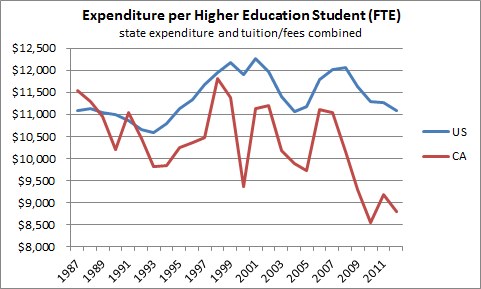
It actually costs about $2,500 less per student today than it did in the late 80's -- yet during the same time, tuition has increased by upwards of 5x. That delta used to be carried by taxpayers but has been shifted to tuition.
Where in the world did you get this idea? College if three (3) times more expensive than it was 40 years ago:
> but do a bit of research and you'll be surprised.
Research: http://trends.collegeboard.org/college-pricing/figures-table...
http://keepcaliforniaspromise.org/wp-content/uploads/2013/12...
Seemingly nobody understands, or wants to understand this point.. College used to be an investment made by the working class in the youth paid for via taxes (state expenditures >> tuition), it's now flipped to an investment made by 18-year olds in their own careers (tuition >> state expenditures) -- Both approaches have their own merits, but focusing on cutting the cost of education misses the forest for the trees when those costs haven't increased over time.
So it looks like the cost of college is yet another burden the boomers have placed on our doorstep (and even more, the doorstep of those younger than me). I'm skeptical that saddling 18-year-olds with mounds of irrevocable debt has any merits to speak of, but am curious what argument could be made in that direction.
I don't buy that line of thinking at all, but some surely do.
When my daughter was attending a private university, she had an enlightening conversation with a professor who worked on pricing for her university. He told her their prices were not going up in response to increased costs, but rather to maintain a certain price relative to in-state tuition. Of course, in-state tuition has been steadily increasing because it is becoming less subsidized.
In other words, the cost increases are a response to cutting government funding, both for private and public.
Could you clarify this statement? It seems like you could be saying the state universities are a relatively recent phenomena. If so, could you give a few examples? I suppose Alaska and Hawaii, being the newest states, have the newest "state" university system, but even the University of Alaska predates Alaska becoming a state.
Free? There is no such thing. Someone will always end up paying for it.
You can divert that "free" money and have "free" things for the middle class. That the wealthy would then be "paying" for it is a philosophical perspective that presupposes the status quo for wealth distribution is somehow "correct"
There's a very real stipulation that regardless of whether an individual actually attends a university or not they will be having the monetary products of their labor forcibly taken and used to pay the professors, construct the facilities, and heat the buildings.
Bad filters look for weaknesses and good filters look for strengths. Anyone who excels in at least one area has potential to do great things.
The solution to the problem isn't hiding in what we already know although many of these things of course would be hugely beneficial to people.
The underlying problem. Technology is still going to be there.
Problem is still there. The rich get richer compared to the poor while everyone is getting richer overall.
BTW I was curious and looked at list of US states by human development index. There's no obvious correlation between size of a state and its ranking. https://en.wikipedia.org/wiki/List_of_U.S._states_by_America...
[1]: https://en.wikipedia.org/wiki/Where-to-be-born_Index [2]: https://en.wikipedia.org/wiki/Human_Development_Index
Doctor salary only makes up ~8.6% of overall Healthcare spending. Since, right or wrong, people want to see doctors rather than nurses when they bother to go into the hospital in person, I predict this tech will actually increase healthcare spending. The main change will just be that people seek nurse advice from home for minor issues they would have ignored previously. That may more may not be a net benefit.
You're missing the secondary costs. What are the costs of people having to sit at the hospital all day waiting for the doctor to see them. And what are the costs of people putting off seeing a doctor since they can't get an appointment?
Since, right or wrong, people want to see doctors rather than nurses when they bother to go into the hospital in person
Only if the 'costs' are them same. If you just ask people when they come in if they want to see a nurse (short wait and pay $X) or a doctor (long wait and pay $3X), I think you'll find many people opting for the nurse.
Another thing is liability. There are cases where a triage nurse could easily tell a patient "you're fine, go home and rest". But that can't happen right now because everyone's scared petrified about liability issues.
Things like child care and finance are not as obvious to me though: these are already competitive industries, with very price-sensitive clients too, and (IMO) mostly sensible regulations, so if something both cheap and competitive was possible, why hasn't it happened yet?
Also, as for "Equally credible alternatives to university education": I'm not sure if I get this one right, wording is a little confusing -- you mean the problem being that people feel forced to spend lots of $$ to study things they won't actually need for their jobs? IMO, to answer that, we also first need to answer why exactly is it the case currently: e.g. no government sponsorship of community colleges is going to help if the reason is that education is primarily used as a signaling device... (Edit: I see your response to another question -- namely a startup offering an independent alternative to screening on education -- and I agree that this can be promising. Not easy, but promising.)
Worse, these are all minimum numbers. You need extra staff to cover someone being sick, or turn people away.
Humans are not a product. They are an end in themselves. It's like trying to automate your friends or your spouse.
Again: once your kid turns 5 (4, if you're rich and you send your kid to private all-day preschool), you're generally sending them somewhere where one adult will watch as many as 30 kids concurrently, all the while educating them to the point where they can creditably pass standardized tests. That's a harder job than just making sure kids are happy and engaged, and yet we pay far less for it than we do for child care.
Child care is a huge part of why people get crappier jobs than they might. You can't go back to school if you have no savings and need to pay at least $15/hr for child care; in fact, you can't even speculatively take a lower-paying job for career advancement if that job doesn't pay enough to offset child care.
Sure, if we want to subsidize stay at home parents for young children that's a reasonable choice. But, pushing daycare out of reach of most low income family's pushes people into poverty which also has significant long term negative impacts on those same children.
Results are best when there is a single primary care-giver and a small number of other regular care-givers, and day-care tends to not allow for this.
Things get much worse, however, when the staff of the day-care is either too few or too neglectful, as human contact and interaction is so important for early development.
It is possible that we could create a sufficient facsimile of a human to allow for automated care of a child that would fulfill these needs, but there is a creep factor in that, and there remains the question of how one would ethically test the efficacy of such a system.
Here in Australia child care is also very expensive, and I agree this is a problem for disadvantaged families (there is some means-tested subsidisation but it only helps to a degree). However: the government has recently lowered the required educator:child ratios, despite the extra cost, because research shows it is important for education (and health, not just when young but into later life). More than this: the research suggests these improvements are most significant for disadvantaged kids.
For more info start here: http://archive.acecqa.gov.au/research-and-publications/.
By law (usually state), the ratio of caregiver to child is much lower when the child is under 5. There's documented rationale for it too.[0] Also, there is a ton of research now suggesting the importance of education at that age as a function of interaction of words with parents.[1] So to suggest that "small children are better off exploring the world on their own, and making social connections on their own" is IMHO a very dangerous conclusion without understanding all of the implications associated with it.
How about dippers that can wireless notify you when there wet? Or for something that exists, a baby monitor so a caretaker can keep up with a crying child while another sleeps.
PS: Don't forget it's not just daycare workers who can use assistance, actual parents are also run raggid while caring for infants.
That's different from automating the content of our relationships. It is dehumanizing to have to navigate an automated phone tree rather than speak to an actual person. Now, sometimes it is more efficient to not deal with people, but when you are talking about real human relationships, then dealing with real human people is the point.
Child care isn't just changing the diapers, it's about talking, interacting, and playing with children. Personal interaction is the only way that infants acquire language and language skills, for example.
Marketing desperately needs some sort of empirical way of hiring. Unfortunately, I think you'll find that half the people currently in marketing roles though would lose their jobs.
A couple points:
Alternatives to patient-present doctor-mediated health care to cover the 80% case in which doctors are expensive overkill; some combination of telemedicine and nurse-practitioners.
We have police departments and we have fire departments. We should have "nurse departments" that are clinics but much more structured as are fire and PD services for each given area.
(I know there is a grey version of this with EMT/clinics/hospitals etc... but this is something that could be made better.)
---
Modern logistics-driven solutions for inexpensive high-quality child care.
We talk a lot about "getting more women in tech" for example...
Getting more women JUST TO BE ABLE TO WORK involves insuring child care!
Sending a kid to child care full time costs MORE than many women can make per hour! Its ridiculous.
If you have ever tried to look for child care services on Care.com or otherwise, sitters all want ~$25/hour in the bay area.
Of course then they are out of the workforce and 'unhirable' when they try to re-enter it.
Pro tip: Have the full time parent take classes part time and do volunteer work. These days, blogging and online freelance work can also play a part.
Those things help preserve your employability. They give you something to put on a resume. The one and only thing that has the ability to increase your earning power while you take time off work is education. I read that somewhere and I have experienced it firsthand.
I got my first full time paid job at age 41. It paid better than minimum wage and I worked for the largest company in town. Any time I made small talk while buying myself lunch or getting a haircut, telling people where I worked got oohs and aahs. They didn't even know my job title or that I was stuck in an entry level job and never managed to get promoted. Just having a job there at all was statusy and a ticket to a real career.
I wasn't making the kind of money my ex made, but I wasn't doomed either. I ultimately left (for health reasons). I now do freelance work and, with my health issues resolving, my income is going up. At some point, I expect to live comfortably.
Solution: Childcare Visa. Many women in other parts of the world would LOVE to come to America. We need a special visa for them, and perhaps they can take care of your children from 8 to 6PM M-F in exchange for room and board and weekends, or some type of arrangement.
It's not free, but it's significantly less than the aforementioned $25 / hr.
What do you mean by this?
We can simply offer basic income for everyone, then we can get rid of most special rules, such as food stamps, minimum wage, all kinds of deductibles, flexible spending, childcare. We can tax all incomes at fixed rate and be done with it. All these can be trivially tracked by simple computer system, the only thing needed is identify verification once a year or two.
We would have a much greater society and economy, and avoid the need of "job creation like Walmart".
Serious answer: besides the ongoing need of the 'elite' for childcare, most proponents of basic income argue that people would not just play video games all day. If you think about everything you or other people might want to do in your free time today, even - how many of those would you prefer to do without simultaneously minding children?
When I was a kid, I used to ask why poor people don't just start a business, or go out and get a better job? That was before I understood the way that poverty traps people in a cycle. And the fact that we don't all possess the capacity to become entrepreneurs and creative thinkers.
I think a basic income is most important for the uncreative people. The people who don't really have any talents, and never had any big aspirations. The 50% of all people who have a below-average IQ. Maybe they can't think of something productive to do, but in a post-scarcity economy, why should they need to? When the whole farm-to-table pipeline is completely run by autonomous machinery, then I think there's nothing wrong with just relaxing and enjoying life.
I'm worried that this YC research program might end up making the wrong conclusions, if the results are only analyzed by startup people who are hell-bent on "changing the world" and being ultra-productive all the time. So what if a recipient just chills out all day, goes for walks, swims at the beach, takes some photos, and plays some video games. I hope they wouldn't call that a failed experiment.
Unfortunately this is not the case. What do students who live on student loans and/or parental stipend as a "basic income" do? You can expect more of that when the government becomes the parent doling out the stipend.
Simple change with 100% guaranteed positive outcome.
Whereas a startup that had a really good solution for inculcating the kinds of skills and values white-collar employers are looking for could outcompete universities instead of legislating them out of the picture.
When people discuss the value signaling provided by elite universities, their first example is usually "the diligence and hard work it takes to get into the university". That strikes me as the kind of value you can find ways to signal just effectively without asking for $150k.
Graduation rates at universities for the elite are nearly 100%. Getting into the club is the only hard part and everyone involved knows that.
Empirically, what's required to get into the club is being wealthy enough to afford the private schooling, tutoring, and extra circular activities necessary to help your child game the admissions process.
As long as people value these prestigious brands, the elite will continue to buy them for their children. It's got nothing to do with education itself, which could be obtained any number of ways already.
If their process was an "Empirical, blinded, skills-assessment", and they funded anyone who met their predefined requirements, we'd have a real alternative to class-based universities. At least for anyone willing to create their own business.
YC is already more fair (less gameable) than the elite universities, but it's still far from being fair enough or big enough to really change things.
The student can then turn around to some great companies and say "I got into X university, but am thinking of waiting a semester and want to learn a bit about your business. Would you be open to some sort of internship?"
I don't know if that is the correct solution though. Much of what I learned came from being at school, but not necessarily the classroom. I learned a ton about alcohol and drugs and sex and other things that simply being in an environment with so many of my peers produced. Additionally, I'm a designer. If I weren't an editor for the school paper, I'd never have picked up a copy of creative suite and probably would be working a miserable corporate job somewhere otherwise.
The way to fix this is to sue lots of employers for requiring or discriminating based on college education. Or at least win a few high-profile cases.
This is the first I'm hearing that IQ testing is illegal as a basis for employment. AFAIK the military and many police forces employ IQ/aptitude tests as part of their hiring process.
Though sometimes we're trying to tech-fix things which are broken on a whole different level. Education is effectively free today. You pay to get the certificate. I think that's a broken system.
(I am not opposed to legislative fixes! I'm a statist liberal Democrat. I'm confining my response to the terms 'sama set out.)
So don't ask yourself "What degree does this guy have?", but "How much physics research has this guy done? Can I see his body of work? Is it high-quality stuff?" The latter is performed anytime a competent person performs a hire anyway. It's fine to skip/ignore the education when someone can demonstrate competence. The problem really comes in "soft" degrees like business, marketing, communications, etc., where it's not really possible for a body of work to be presented as evidence that the individual knows what he/she is doing.
Seeing the degree is a shortcut to verifying that the basic level of knowledge in the applicant's major has been satisfied. The testing necessary to verify that independently (and redundantly - one for each company being applied to) seems prohibitive.
For HR directors, purchasing managers, corporate controllers, practice managers, financial advisors, and jobs like that? Yes, I think you can devise filters for anything colleges filter for that would be both more effective and far cheaper than college.
Eventually I don't see why not but I don't think it's an easy thing to do nor do I know how to do it for a physics R&D type of position. Obviously education isn't the only criteria people use today anyway (I can't tell you how many CS grads I've interviewed who really struggled or flat out didn't know a lot about CS).
It's an age-old problem: how do tell if someone can do what you need them to do without wasting your time and money? As the skill and knowledge requirements go up this becomes harder and harder to do, with or without the degree shortcut.
But I don't need to - smarter people already did the work for me. This approach is already practiced (mini scale I believe) in our industry.
I am not sure I understand this. If you are going to a doctor, you would want to make sure she is qualified, isn't it? And the only way (currently at least) to make sure is that degree that proves she knows what she is doing. Of course this doesn't apply to all professions.
It's true if someone can do those 3 things without going to medical school they may be missing a great deal of knowledge passed from medical school that maybe they were not explicitly tested on or experienced in the field. I'm not sure what to do about that. If you could find a solution for that then banning from asking or considering education could actually work, I think...but that's a hard problem to solve.
In terms of education there are two options. Ban mentioning degrees only credentials, or ban mentioning school names which deflates the ivy name recognition. In both cases schools would need to focus on education not name recognition.
The thing that unlocks legal professions from the grip of $200k law schools is going to be something that reimagines the role of a lawyer, creating a new kind of legal professional that makes radically less money than a BigLaw lawyer.
I really, really, really doubt that.
*I'm an 18F employee speaking in a personal capacity.
Sidenote - high-five for the stuff going on at 18F :)
You're talking about trade schools? Good. That's a step in the right direction. It doesn't go far enough though. One unfortunate reality of our existence is that people differ markedly in cognitive skill. These differences are innate and immutable. Not everyone can benefit from an education.
If we pitch education as the way to address to inequality, we're not only going to waste a lot of money on useless education, but we're also going to give these negative-marginal-value people false hope of economic success.
We need to figure out an alternate way of living for people who are intellectually incapable of contributing to a modern technologically advanced economy. A basic income is a good start.
I agree on the education front, but disagree that there are significantly many negative-margin-value people. Personally I think a huge amount of that perception comes from the fact that people just don't fucking move to better economic opportunities. That problem may be solvable as things like distributed call centers and other location-independent work becomes more common.
There is another dimension to this problem though; national borders and status.
There are a TON of really smart mexicans and other immigrants of every nation who are stuck into an effective caste system based on their status.
In fact, modern American society would literally fall apart if all the mexican service workers were raptured.
My point is that while we look at those who cannot contribute to a technologically advanced economy, we also are pigeon-holing many many others who are based on the complexities of citizenship status problem.
The result would be extremely visibly racist, but I think the right response to that is to understand that existing immigration laws are in effect equally racist. It's the visibility that would change, rather than the degree.
Now it's racist for a country to provide services to its own citizens that it doesn't provide to the citizens of other countries?
The alternative to college education isn't going to look like a college.
What you end up with ends up looking a lot like a college. Now, we can talk about changing how funding for college works, but that's a separate discussion from changing the fundamental model, which I don't see as a practical goal.
There doesn't need to be one universal answer to this suggestion; it would be a boring suggestion if that were the case. Instead, you could look at the market for white-collar jobs and break it down looking for lucrative subsets, and then devise some kind of apprenticeship scheme.
If you could eliminate the 4-year degree requirement for HR directors, company controllers, purchasing managers, or jobs like that, replacing it with something tailored to the specific job, you could allow people to get an early start on a white-collar career while offering them opportunities later in their career to get something like an MBA or a JD.
But because the only current credible signaling mechanism we have is a 4-year degree, there is currently no good way to get the kind of job that might legitimately demand an MBA or a JD without first getting a degree in Russian Lit.
Any college replacement scheme is going to have to perform the same kind of filtering if it's going to be useful, and anything that performs this kind of filtering will be subject to exactly the same controversies the college system is subject to today. This outcome is because disparities in intelligence matter, and as long as we these differences exist and we need jobs with a certain cognitive threshold, we'll need something like college to indicate that certain candidates possess the needed traits.
It's important that it be very hard to lie about these qualifications, because anyone who could, would, due to the clear economic benefits of doing so. The only surefire way to determine whether someone has intellectual chops is to make him or her do something intellectual. That's what college is.
The good news is, we don't have to dig into that. All I'm saying is that it's calamitously expensive, across multiple axes (direct cost, opportunity cost, brittleness of opportunities) to assess capacity to perform the job of "HR Director" by looking for a 4-year degree.
I doubt that you believe a UMich Russian Lit degree is intrinsically an important qualification to work in HR (HR: one of the fastest growing white-collar jobs in the US, hence that example). I'm saying: that's a market inefficiency, and if you could find a way to arbitrage it, you could make a mint while making it possible for more people to get stable white-collar employment without reading Solzhenitsyn in a dorm room.
Leaving the defeatist mentality aside, instead of saying they do not fit our current model, why not work on personalizing education. People go to school and meet a few professors with this attitude and they leave convinced they cannot be made good for anything. Not good.
* Equally credible alternatives to university education for professions that don't involve students shouldering $100k-$200k in debt based on decisions they have to make when they're 18 years old.
* Empirical, blinded, skills-assessment based turnkey hiring solutions that outperform interviews for non-technology roles like marketing, purchasing, &c, so that people who avail themselves of alternatives to universities can get good jobs regardless of social signals.
* Tools that make it possible for companies that today exploit the 1099 labor classification to cost-effectively offer benefits and handle taxes, to make on-demand employment legal and fair while remaining competitive.
* Alternatives to patient-present doctor-mediated health care to cover the 80% case in which doctors are expensive overkill; some combination of telemedicine and nurse-practitioners.
* Technology-mediated services that drastically improve outcomes in K12 education.
* Modern logistics-driven solutions for inexpensive high-quality child care.
* Products that offer serious competition for incumbents in the financial sector to bid down the 7-10% of the economy taken by financial services.
* Tools to improve engagement with local elections and make it easier for people to take flyers on standing for election.
* Modernized fee and fine collection for things like traffic and parking tickets, which currently default out to "charging minimum wage workers $2,000 to get the boot off the car on which they happen to owe 3 parking tickets".
* Similarly: a way to do things like enroll a credit card with your local government to automatically pay fines and fees at their reduced early-payment rate --- which is something you might be able to do without getting permission from local governments.
Later: I added some things