News for hackers. Stuff that matters.
Re:Request For Research: Basic Income by stcredzero on Wednesday January 27, 2016 @03:53PM (#10983225)
Equally credible alternatives to university education for professions that don't involve students shouldering $100k-$200k in debt based on decisions they have to make when they're 18 years old.

Why not just free university education for people who have the prerequisite academic qualifications?

Re:Request For Research: Basic Income by hibikir on Wednesday January 27, 2016 @08:12PM (#10985219)
I hail originally from Spain, a country with extremely cheap college education compared to the US. Did free college provide better outcomes? Only to a point. Spain is a country with over 20% unemployment. The country is full of people with college degrees who can't get a job anywhere near their field. Given that degrees are so common, they become artificial gates: You are asked for a degree to do jobs that do not need a degree at all!

How do you really find a good job then? Mostly through family networking. And who has a good family network? The same kids that could afford college regardless. Many college educations are just years wasted, not unlike bad degrees in the US. No matter how many people might think about the wonders of classical educations, and how college taught them to learn, and similar drivel, in practice, those things only matter if you have opportunities handed to you anyway. For people that do not get the opportunities, college is only helpful if it helps them get the opportunities! Whether that's through non-family networking, or because what they studied in college is something in demand in the job market.

When studying the effects of any policy change, we have can't just stop at the first level: We have to see how the rest of the world will react to the primary results to the policy change. It's a bit how student loans didn't really make it that much easier to go to college: What they really did was make all colleges a lot more expensive, making a mistake in major and/or institution that much more dangerous. I think of a friend of mine, Ph.D in Biology with a 6 figure college debt, and no good American jobs that would take her. She's teaching technical english in Japan, because it pays marginally better than her American options! All those years of study, all that money, to go unused, along with being saddled with terrible debt.

So all I am saying is, bad outcomes can happen in a whole lot of cases. Want better outcomes? Create more jobs.

Re:Request For Research: Basic Income by tptacek on Wednesday January 27, 2016 @03:56PM (#10983255)
* There are limited seats available at the highest-status universities, so admission to those schools will remain a privilege disproportionately available to wealthy parents who can pay to game the admissions process.

* Simply attending a 4-year university has costs beyond tuition and books; there are plenty of people who don't go to college because they can't afford 4 years out of the workforce.

* The 4-year university system is extremely brittle, in that it creates good outcomes primarily for people who are in the right place (somewhere they can easily attend a good university) at the right time (right after they graduate high school) --- do anything to get off the college track during your high school years and it becomes extremely hard to re-engage with it.

Re:Request For Research: Basic Income by Swizec on Wednesday January 27, 2016 @05:35PM (#10984102)
> There are limited seats available at the highest-status universities, so admission to those schools will remain a privilege disproportionately available to wealthy parents who can pay to game the admissions process.

Funny, where I come from, going to a school that takes tuition means you're too dumb to graduate from a "real" university. Most notably, most universities don't accept for-profit faculties. This means that you can at most pay for a "4 year degree", but not for a "university degree".

I don't know if it's like that in all of, or even most, Europe. But it's definitely like that in all the countries I've heard about from friends who live there.

Re:Request For Research: Basic Income by arohner on Wednesday January 27, 2016 @04:27PM (#10983550)
Yes. I'll also add the 4-year education is incredibly inefficient, in terms of skills added over time. Even in highly technical STEM degrees, you probably don't need 4 years "full time" to gain all of the skills an employer expects a fresh-out-of-school STEM graduate to have. The same is even more true of less technical degrees.
Re:Request For Research: Basic Income by termain on Wednesday January 27, 2016 @04:50PM (#10983758)
"Yes. I'll also add the 4-year education is incredibly inefficient, in terms of skills added over time"

I'm uncomfortable with the idea that a university degree is entirely about workforce skills.

Re:Request For Research: Basic Income by dikaiosune on Wednesday January 27, 2016 @05:03PM (#10983865)
It shouldn't be, but there are a lot of people who don't give a damn about a liberal education for themselves, and just want a degree to improve employment opportunities. For them, I think it's kind of a sham to say that the only way to get the jobs they want is to sit through lots of non-employment-related material.

Would our society be better if more citizens were liberally educated and thusly enriched? Perhaps. But that doesn't invalidate the desire to offer students greater opportunities at lower opportunity cost.

Re:Request For Research: Basic Income by neuro_imager on Wednesday January 27, 2016 @07:11PM (#10984704)
I know I'm at risk of sounding tremendously disparaging but, how critical is it to actually go to college to get a liberal arts education?

Can most of these aspects of a "more well-rounded education" not come from reading, travelling and extra-curricular activities (like music lessons and trips to the theatre)?

Re:Request For Research: Basic Income by dikaiosune on Wednesday January 27, 2016 @08:42PM (#10985399)
I agree completely, and that is my approach. But not everyone agrees. I would prefer to study history, philosophy and literature because I enjoy them, not for class. On the other hand, not everyone who would be interested in those things would do that without some place to make it official, so I still see a reason for schools that make it their focus to exist. However trying to improve the populace through underfunded, half baked, required courses taught by rote memorization specialists... I don't really agree with that since most students are just there for "job skills" anyway.
Re:Request For Research: Basic Income by Riseed on Wednesday January 27, 2016 @10:05PM (#10985871)
Many pieces of education, both the purely educational bits and the well-rounded bits, can come from experience and other sources. A degree often operates as a third-party certification that an individual has completed these tasks, and/or can stick with something for x years.
Re:Request For Research: Basic Income by tptacek on Wednesday January 27, 2016 @04:58PM (#10983829)
It isn't. That's the problem.
Re:Request For Research: Basic Income by termain on Wednesday January 27, 2016 @05:12PM (#10983933)
In the context that it's required to get certain jobs? So we -- society -- have screwed up in conflating education and job training?
Re:Request For Research: Basic Income by tptacek on Wednesday January 27, 2016 @05:25PM (#10984027)
Yes, we have.
Re:Request For Research: Basic Income by aidenn0 on Thursday January 28, 2016 @12:52AM (#10986562)
One conversation I had with a senior employee at a very large company said that university was very important for signalling. They knew that someone who went to (for example) MIT was admitted to MIT, which indicates a certain amount of raw intelligence. Their legal department would not allow administering any sort of IQ test, so the school one went to was a proxy for IQ.
Re:Request For Research: Basic Income by unclebucknasty on Wednesday January 27, 2016 @05:19PM (#10983991)
>I'm uncomfortable with the idea that a university degree is entirely about workforce skills.

But, It's a rational view. The soaring cost of college is what makes it largely an economic proposition for many these days.

Re:Request For Research: Basic Income by neuro_imager on Wednesday January 27, 2016 @07:12PM (#10984710)
I know I'm at risk of sounding tremendously disparaging but, how critical is it to actually go to college to get a liberal arts education? Can most of these aspects of a "more well-rounded education" not come from reading, travelling and extra-curricular activities (like music lessons and trips to the theatre)?
Re:Request For Research: Basic Income by notlefthanded on Wednesday January 27, 2016 @05:02PM (#10983859)
Some people only need / can afford to acquire said skills, and so aren't a good fit for the college track.
Re:Request For Research: Basic Income by eemax on Wednesday January 27, 2016 @04:24PM (#10983532)
The same entity should not be responsible for both education and certification/credentialing. It creates a serious conflict-of-interest, and a better system would be to separate the entities that grant degrees from entities that sell education. This is especially important if the purchaser of the education is a third-party like a government or a bank, and not the actual student. (i.e., when the education is "free")
Re:Request For Research: Basic Income by mikeyouse on Wednesday January 27, 2016 @04:09PM (#10983393)
Yes.

Everyone bemoans the increasing in tuition and increase in admin staff.. these things are intimately tied. The cost of education on a per-student basis hasn't increased very much in the US. Most of the cost burden has just shifted from taxpayers to students (for better or worse). Much of the admin staff is necessary to handle all of the financial aid, grant applications, etc.

Simply providing tuition-free education would eliminate much of the bureaucratic overhead.

Re:Request For Research: Basic Income by jdreaver on Wednesday January 27, 2016 @04:16PM (#10983458)
Much of the increase in admin staff and university spending has come from all of that free government aid money we keep giving them. If we make tuition "free" for everyone, then universities will get a bottomless pit of money to spend on useless things. They will be almost totally divorced from the incentive to keep costs low. Right now, universities don't compete for funds on the basis of the quality of education. They compete on a political basis to collect as much money from the government as they possibly can.

We didn't have a problem paying for college in the US until everyone decided that the government should help pay for it. Throwing more money at the problem won't fix it; in fact, it's been a huge part of the problem!

Re:Request For Research: Basic Income by mikeyouse on Wednesday January 27, 2016 @04:30PM (#10983581)
This isn't supported by much.. The cost per student hasn't increased, only the proportion charged to tuition rather than taxes. It's easy to blame easy government money for the increase in admin staff, but during my grad program I GA'ed in the office and half of the staff were dealing with financial aid / loans / scholarships. They would be there regardless the source of the cash.

I've fought this battle on HN before and nobody wants to believe that college isn't any more expensive than it previously was, so I'll leave this here -- but do a bit of research and you'll be surprised.

Edit;

Since everyone seems to be downvoting this point, here's the inflation-adjusted cost per student in California from 1987 - 2013:

http://keepcaliforniaspromise.org/wp-content/uploads/2013/12...
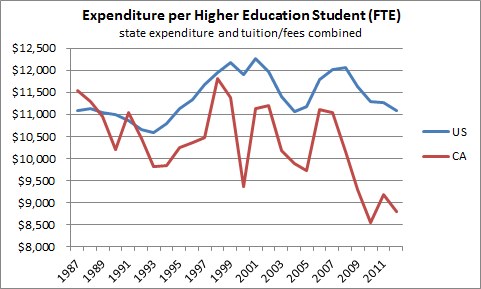
It actually costs about $2,500 less per student today than it did in the late 80's -- yet during the same time, tuition has increased by upwards of 5x. That delta used to be carried by taxpayers but has been shifted to tuition.

Re:Request For Research: Basic Income by jnbiche on Wednesday January 27, 2016 @04:57PM (#10983827)
> I've fought this battle on HN before and nobody wants to believe that college isn't any more expensive than it previously was

Where in the world did you get this idea? College if three (3) times more expensive than it was 40 years ago:

> but do a bit of research and you'll be surprised.

Research: http://trends.collegeboard.org/college-pricing/figures-table...

Re:Request For Research: Basic Income by mikeyouse on Wednesday January 27, 2016 @05:25PM (#10984029)
As Unimpressive pointed out, that's the cost of tuition. The total cost (tuition + state expenditures + fees + endowments) per student has roughly paced with inflation over the same time frame -- and in some cases, dramatically decreased. You have to dig a little deeper to see those numbers, but several states have done their own analysis. Here's one for California:

http://keepcaliforniaspromise.org/wp-content/uploads/2013/12...

Seemingly nobody understands, or wants to understand this point.. College used to be an investment made by the working class in the youth paid for via taxes (state expenditures >> tuition), it's now flipped to an investment made by 18-year olds in their own careers (tuition >> state expenditures) -- Both approaches have their own merits, but focusing on cutting the cost of education misses the forest for the trees when those costs haven't increased over time.

Re:Request For Research: Basic Income by jnbiche on Friday January 29, 2016 @10:28AM (#10995697)
This is very enlightening, although very counterintuitive.

So it looks like the cost of college is yet another burden the boomers have placed on our doorstep (and even more, the doorstep of those younger than me). I'm skeptical that saddling 18-year-olds with mounds of irrevocable debt has any merits to speak of, but am curious what argument could be made in that direction.

Re:Request For Research: Basic Income by mikeyouse on Friday January 29, 2016 @04:25PM (#10998615)
The premise at least is that if you hold kids responsible for their own educations, they'll choose careers and topics of study that lend to paying off that debt. If you let kids mess around in college for 4 years with no financial incentive, they might all study underwater basketweaving.

I don't buy that line of thinking at all, but some surely do.

Re:Request For Research: Basic Income by unimpressive on Wednesday January 27, 2016 @05:19PM (#10983990)
No. His argument is that the actual total costs paid by all actors to provide the service has not changed, the share of the pie paid by students has changed. Which would look exactly like the cost rising in that table.
Re:Request For Research: Basic Income by beat on Wednesday January 27, 2016 @04:55PM (#10983800)
The rate of college attendance and graduation increased dramatically with the introduction of state universities and financial aid programs - it was no longer just the province of the wealthy. This obviously had good effects on the economy, and on society.

When my daughter was attending a private university, she had an enlightening conversation with a professor who worked on pricing for her university. He told her their prices were not going up in response to increased costs, but rather to maintain a certain price relative to in-state tuition. Of course, in-state tuition has been steadily increasing because it is becoming less subsidized.

In other words, the cost increases are a response to cutting government funding, both for private and public.

Re:Request For Research: Basic Income by flubert on Wednesday January 27, 2016 @07:48PM (#10985009)
>The rate of college attendance and graduation increased dramatically with the introduction of state universities

Could you clarify this statement? It seems like you could be saying the state universities are a relatively recent phenomena. If so, could you give a few examples? I suppose Alaska and Hawaii, being the newest states, have the newest "state" university system, but even the University of Alaska predates Alaska becoming a state.

Re:Request For Research: Basic Income by hourislate on Wednesday January 27, 2016 @04:33PM (#10983609)
This word "Free" amuses me. I am curious why you think that something can be offered for free with no payment associated with it? Will the Professors work for free? Who will pay the electricity bill to heat or cool the buildings? What about the course material?

Free? There is no such thing. Someone will always end up paying for it.

Re:Request For Research: Basic Income by elif on Wednesday January 27, 2016 @05:19PM (#10983983)
Well, if you want to get abstract, the money itself is "free," printed by the Fed almost arbitrarily. By any number of mechanisms that money ends up primarily concentrated in one group of very wealthy people.

You can divert that "free" money and have "free" things for the middle class. That the wealthy would then be "paying" for it is a philosophical perspective that presupposes the status quo for wealth distribution is somehow "correct"

Re:Request For Research: Basic Income by TeMPOraL on Wednesday January 27, 2016 @04:49PM (#10983753)
Ultimately this is just mixing up definitions of "value" in disguise. It's the reverse of assuming price is tied to some kind of intrinsic "value" of the good. Here, you're assuming nothing can be free (in economical sense) because physics. But it's not true. If you give stuff away no strings attached, it's free, period.
Re:Request For Research: Basic Income by Omniusaspirer on Wednesday January 27, 2016 @05:09PM (#10983908)
In the specific example being discussed of government funded "free" college education it most certainly is not being given away with "no strings attached".

There's a very real stipulation that regardless of whether an individual actually attends a university or not they will be having the monetary products of their labor forcibly taken and used to pay the professors, construct the facilities, and heat the buildings.

Re:Request For Research: Basic Income by Joof on Wednesday January 27, 2016 @09:01PM (#10985528)
It just happens by means of taxes instead. Right now, banks get a pretty hefty profit off those that can't afford it upfront, it's a tax on the poor (and often middle class) more than the rich.
Re:Request For Research: Basic Income by PKop on Thursday January 28, 2016 @12:20AM (#10986458)
Can you provide an example of a "stuff" that is given away for free, and also specify who is "giving" it, and to whom?
Re:Request For Research: Basic Income by goldbrick on Thursday January 28, 2016 @06:09PM (#10992256)
I'm giving you this stupid comment right now. No charge.
Re:Request For Research: Basic Income by kasey_junk on Wednesday January 27, 2016 @03:59PM (#10983282)
I think for me one of the open questions is are "prerequisite academic qualifications" as they currently stand, the right precursors to the kinds of educations we might dream up in the future.
Re:Request For Research: Basic Income by staunch on Wednesday January 27, 2016 @04:09PM (#10983394)
Einstein famously (and actually) had poor grades in subjects he had no interest in, and did great in subjects he enjoyed. It seems to have delayed his progress that no one recognized his skill and passion early on.

Bad filters look for weaknesses and good filters look for strengths. Anyone who excels in at least one area has potential to do great things.

Re:Request For Research: Basic Income by ssalazar on Wednesday January 27, 2016 @06:28PM (#10984442)
University education has become such a bloated juggernaut, I don't feel its sustainable or sensible to continue to feed it growing amounts of free government money. Im hopeful that free/inexpensive/subsidized online education, packaged into degree/certification programs and sanctioned by educational institutions, will be able to take the place of much of what is really being offered at traditional 4-year schools.