We shouldn't be gatekeeping the ability of the average person to publicly petition their government for a redress of grievances. That's kind of a core function of an engaged populace.
While I can think of examples that I personally think are a bit silly, I'd agree it's not really a useful contribution.
This speaks volumes
The action alternative to that is massive numbers of calls to representatives, attendance of town halls, and large-scale protests to attempt to limit political maneuvering. People in America aren't rich and can't afford to take time off work to protest, so protesting off hours is more convenient... seems kind of insulting and elitist for you to dismiss civic participation.
And then there's the people who shout "impeach" or other absurdities, or criticize others taking actions while doing nothing themselves.
Many of the GOP Senators are holdovers from that discredited prior regime. They cower in front of Trump because the base trusts Trump far more than it trusts the party establishment. And that’s not because Trump has magic powers, but because the Bush/Cheney era was utterly disastrous and about half the GOP has turned hard against libertarianism in trade and immigration.
The fact that Senators are afraid to cross Trump is a good thing. It means they are being responsive to their voters. If it wasn’t for that, they’d already be talking about TPP 2.0 and amnesty again.
In that case, why didn't they switch sides and become Democrats?
> about half the GOP has turned hard against libertarianism in trade and immigration
Oh, that's why--at least to some degree. But it's an incomplete explanation. Any GOP leader could have run on a more restrictive trade and immigration platform.
Then the question becomes, why does the base trust Trump so much? How much of it is because they're actually hurting (and in a way that can actually be cured by him); how much is because they are being lied to; how much is because they're easily manipulable; how much is because they are delusional; and how much is because they are morally bereft? Whatever it is, it cannot be explained by competence.
Because they’re republicans. The GOP historically was skeptical of engaging with the rest of the world—tariffs were a foundational plank of Lincoln’s party. The Reagan-era globalism was a temporary response to the soviet union—which threatened to spread atheism and socialism around the world—that brought liberal internationalists and neoconservatives into the coalition. Bush-era foreign intervention revealed that approach to be obsolete post-soviet union. So the party reverted to something more like it has been.
The minority of the coalition for whom bombing middle eastern countries and exporting jobs to China was the whole point did become democrats. Jennifer Rubin and Bill Kristol are cheering for abortion now as partisan democrats.
> Any GOP leader could have run on a more restrictive trade and immigration platform.
But they didn’t, because the party leadership was overrun by globalists and neocons.
> Then the question becomes, why does the base trust Trump so much?
Because he overthrew the globalists and neocons and has proven in office that he’s neither. Other republicans can’t be trusted. Mitch McConnell would vote for amnesty in a heartbeat if it was in exchange for going to war with Iran.
The USA’s global influence and entanglements go all the way back to the Monroe Doctrine and grew substantially after WWII as we sought to help reconstruct the world thereafter (Marshall Plan, Bretton Woods, etc.). And the fact that we could produce goods while the rest of the world was practically shut down, given all the destruction that resulted from the war, boosted our economy into the stratosphere. There was practically zero competition for complicated and technologically advanced goods for 30-40 years. Many people forget (or simply weren’t taught) that the USA was not an economic powerhouse until after WWI. Until then, it was Britain, France, and the Netherlands.
Some of the adverse consequences of globalization started to appear domestically during the Reagan administration, though, as imported Japanese automobiles and electronics began to impact American sales, which in turn led to factory closures and pink slips.
Many of those impacted did get other jobs, but the echoes of anger reverberate. They reverberate even longer when they believe foreigners, who they have no power over, are to blame.
> Because he overthrew the globalists and neocons and has proven in office that he’s neither.
It still doesn’t explain how he won the GOP primary the first time and continues to maintain a cult-like following. If the poll numbers are to be believed, isolationists and nationalists never made up more than a slim percentage of the American electorate until very recently.
Even if they all voted for and support Trump based on this alone, it’s a losing battle. The 1940s-1970s were a unique period where American economic victory was practically assured because everyone else was nearly out of business. We’re not going to return to that situation by raising both trade and immigration barriers. Unless we’re willing to bomb the world to line our pockets again (which I’m not sure we have either the stomach or the practical capability to do), globalization is the most rational path to take. It’s a shame we all must suffer until they come to see the light themselves.
The U.S. had virtually no engagement with the world outside the western hemisphere between the GOP’s formation in 1854 and World War I. Between Lincoln’s election in 1861 to World War I tariff rates exceeded 40%: https://commons.wikimedia.org/wiki/File:Average_Tariff_Rates...

> It still doesn’t explain how he won the GOP primary the first time and continues to maintain a cult-like following.
He won the primary because he curb-stomped Jeb Bush on live TV and called for immigration bans when Rubio was proposing amnesty. https://youtu.be/H4ThZcq1oJQ?si=DCUKC_kDG0JpaREn.
He maintains a cult-like following because he’s the first republican in recent memory to actually deliver conservative victories instead of blowing all their political capital on wars. Since he took office in 2016, conservatives have ended affirmative action, overturned Roe, cut border crossings nearly to zero, established a legal framework for prosecuting DEI under the civil rights laws, ended disparate impact, shut down entire federal agencies, raised tariffs for the first time since the 1960s. We might get a $45 billion budget for ICE! I’m not even covering everything in the EOs, which have gone under the radar because everyone is flipping out over tariffs. Trump makes clear that Bush/Cheney republicans weren’t even trying.
> If the poll numbers are to be believed, isolationists and nationalists never made up more than a slim percentage of the American electorate until very recently.
Those are abstract labels that don’t mean anything to people. For decades, the de facto policy has been more and more immigration, something that has never garnered more than 34% support among the whole country: https://news.gallup.com/poll/647123/sharply-americans-curb-i.... The percentage of people who want immigration decreased has far exceeded the percentage who want it increased since 1965 except for a brief period around 2020.
The New York Times of all places did a great piece on this: https://www.nytimes.com/2024/10/29/podcasts/the-daily/electi....
Most republicans aren’t “isolationists” in the sense they’d oppose intervention in a situation like World War II. But for example only 20% of people in 2022 favored boots on the ground in Ukraine: https://www.theamericanconservative.com/new-americans-oppose.... That is de facto isolationism because you’re not going to get a stronger test case for liberal internationalism absent Russia invading a country like Germany.
That’s not true. For example, there’s the Treaty of Wanghia (1844), the Treaty of Kanagawa (1854), the Treaty of Amity and Commerce (1858) the annexation of Hawaii (1898), the Open Door Policy (1899), and the Philippine-American War followed by our nearly 50-year possession of it.
> Between Lincoln’s election in 1861 to World War I tariff rates exceeded 40%
Until the Sixteenth Amendment which permitted the collection of income taxes, tariffs were the primary means of funding the Federal government. Also, protectionism was the global standard before WWII, so we were in good company. But, like the gold standard and mercantilism, it still wasn’t an economically efficient thing. We get rid of antiquated ideas for good reason and to make the world better and more prosperous.
You can yell “economic efficiency” until you’re blue in the face, but most of the country isn’t buying that. You may well be right but the only way to know is to try change and see what happens.
Did you mean unhappy? That's always true of a democratic system. Making everyone happy is impossible, so we strive for something that tries to make everyone equally unhappy (if not in kind, then at least in degree).
> You may well be right but the only way to know is to try change and see what happens.
I don't think that's necessarily true. Logical people can follow the math. And if people can look past their own biases and limited horizons (which I know is not always possible), they will also clearly see that the world as a whole is much better off, and that even if they feel poorer, they themselves are objectively better off from a quality of life perspective, especially when compared to previous generations. I realize it's a difficult sell, but it is true.
The downside risk of erecting barriers is much worse than the upside risk. For those of us approaching retirement without a guaranteed pension to look forward to, the prospect of having our savings significantly diminished is incredibly scary. And poor people should be frightened, too, because maintaining their existing standard of living (which, BTW, is much better than it ever was, historically) is about to become much more difficult.
I've never seen a cogent and defensible theory of a nation that's economically and socially better off for most as a result of putting up higher barriers to trade and immigration. ISTM anyone who wants to eliminate free trade is cutting off their nose to spite their face.
That suggests you’ve just got a simplistic worldview that ignores variables. Do a thought experiment: say you replaced 200 million americans with Bangladeshis overnight. Would the country be better off or worse off? Obviously worse off. The things Bangladeshis think and believe and do that make the country the way it is—everything from corruption to littering to overthrowing the government—won’t change just because they step foot on american soil. They’d immediately vote to turn America into an officially Muslim socialist country, like back home.
Now, if you agree that 200 million Bangladeshis overnight would be bad, but say 100,000 Bangladeshis a year would be fine, you’re applying unstated assumptions about the rate and quality of assimilation. Which you likely have no empirical basis for assuming.
I would say your assertions about free trade are similar. You’re looking at a simplified model of the world that leaves out important variables and then declaring that free trade has no downsides.
I think it's time to close this discussion.
I used Bangladesh as an example because I’m from there. My entire family on both sides going back to time immemorial is from there. Yet half my family left Bangladesh for the west. We didn’t leave because we were desperate—like most skilled immigrants, we were affluent back home. We left because we didn’t want to raise our kids in a society run by Bangladeshis.
Bangladeshis are very different from Americans on numerous cultural dimensions. You seem to think either we’re not (self-evidently false), that those differences disappear when we set foot in America (false), or that those differences are superficial and don’t alter the society around us (more debatable, but based on my experience and analysis, false).
You cannot form a cogent view of immigration policy without delving into the link between culture and societal outcomes, and the stickiness of cultural attitudes in immigrants. Otherwise you’re like a hippy complaining about nuclear power even though you don’t know anything about it.
Good materials:
https://paulbacon.wordpress.com/wp-content/uploads/2010/04/z...
https://www.sup.org/books/economics-and-finance/culture-tran...
https://docs.iza.org/dp17569 (Dutch study about net contribution of immigrants; look at p. 39, showing how immigrants from different cultures have different contribution levels even adjusted for education)
Nevertheless, modern immigration doesn't change a place that dramatically and for the worse, especially when it's controlled. If you read your history, you'd know that every wave of immigrants to this country has been met with fear, contempt, and opposition (including my family's, as starving Jews escaping the Third Reich). Yet, in the long term, the feared outcomes--similar to the ones you describe--never came to pass. America doesn't look like Italy. It doesn't look like Ireland. It doesn't look like Israel. It doesn't look like Mexico. It doesn't look like Vietnam. It doesn't look like India. Maybe certain neighborhoods do for a while, but that's actually one of the nice things about America: that you can go spend some time and enjoy the fruits of a different culture without leaving home. Yet they're still subject to American laws, regulations, and supervision.
And immigrants don't get to vote, so they don't have much political influence for a long while, even locally. Remember, too, that it takes a supermajority to amend the Constitution, so for immigrant culture to have a serious impact on the USA itself would take generations, to the extent it ever does.
I never suggested that immigration should be entirely unregulated and that people and cultures are fungible. That's a straw man you created. And the fact that you are assuming that's the situation people want and the inevitable outcome that will result reveals who you are, and yeah, I'm going to fucking moralize on it. Racists and fearmongerers are evil, even those who hate their own kind. Your own argument supposes that morals are a part of transplantable culture, and let me tell you: Racism, fear, absolutism, and contempt for outsiders are not American values. Perhaps you need to work better on assimilation, yourself.
Now you’re backtracking. You asserted above that you don’t see a “cogent” reason for “higher barriers to immigration.” Now you’re quibbling about how “dramatically” immigration changes the country, whether the changes are “for the worse,” and about how the changes depend on how immigration is “controlled.”
We agree 200 million Bangladeshis overnight would be a bad thing, and 1,000 per year is immaterial. But what’s your basis for asserting that there’s no “cogent” reason for “higher barriers to immigration” than we have now? It seems to me that the acceptable point between 200 million Bangladeshis and 1,000 Bangladeshis depends on all sorts of factors, and “cogent” arguments can be made based on various assumptions.
Your problem is that you are relying on assumptions about those factors that you either can’t or won’t state. Which isn’t surprising because you’re getting emotional over what is a purely logical analysis.
> Yet they're still subject to American laws, regulations, and supervision.
A telling concession! Woodrow Wilson observed, in his seminal work on the administrative state, that multiculturalism compounded the challenges of democracy: https://teachingamericanhistory.org/document/the-study-of-ad... (“The bulk of mankind is rigidly unphilosophical, and nowadays the bulk of mankind votes…. And where is this unphilosophical bulk of mankind more multifarious in its composition than in the United States? To know the public mind of this country, one must know the mind, not of Americans of the older stocks only, but also of Irishmen, of Germans….”)
Wilson’s solution was top-down control of the country by civil servants and bureaucrats. Wilson’s successors succeeded, ironically by mastering ethnic machine politics to mobilize immigrants. Today, we live in Wilson’s administocracy, and de Tocqueville’s America—a land of participative, bottom-up democracy—survives in only a handful of places.
> Remember, too, that it takes a supermajority to amend the Constitution, so for immigrant culture to have a serious impact on the USA itself would take generations, to the extent it ever does.
If legal documents could change people, then Iraq and Afghanistan would be flourishing democracies today.
It’s blindingly obvious that immigration changed the U.S. without rewriting the constitution. Have you been to Oregon and New Jersey? Which place is populated by British settlers with the means to travel thousands of miles across the country, but the desire to get away from civilization? Which one is populated by impoverished immigrants from southern Italy, and lots of recent Indian immigrants? Impossible to tell!
Which city was built by Mormons? Salt Lake, which is clean, orderly, and full of young moms pushing strollers? Or is it Newark? Why do my German au pairs all like Chicago and think New York is intolerably dirty? Why were the first two places in the world to legalize gay marriage (Massachusetts and the Netherlands) both historically Calvinist? These are imponderables!
> I never suggested that immigration should be entirely unregulated and that people and cultures are fungible.
Then why did you flip out at my hypothetical about 200 million Bangladeshis? If you concede regulation is necessary and cultures aren’t fungible, then you need some cogent view of how different cultures are (including the cultures of people who are immigrating today versus in the past), how sticky those cultures are, how pressure to assimilate today is a lot less than in the past, the degree to which European immigrants actually did or did not fully assimilate, etc.
These questions, however, are very difficult to answer, and most pro-immigrationists haven’t thought about them and are uncomfortable thinking about them. But you can’t have a cogent view of immigration without thinking about and reaching these issues.
> Racists and fearmongerers are evil, even those who hate their own kind.
“Racism” is if you assume I eat curry most nights because I’m Bangladeshi. Assuming that most Bangladeshis in Bangladesh eat curry most nights is a (correct) factual observation. And assuming most first generation Bangladeshi immigrants eat curry most nights is a plausible inference (that happens to be true).
It goes without saying that food preferences aren’t the only ways in which Bangladeshis differ. Assuming that those differences are only superficial is an unfounded assumption—one that happens to be false. In fact, everything from social trust to savings behaviors are transmitted culturally and sticky in immigrants: https://www.sup.org/books/economics-and-finance/culture-tran...
None of these observations are “racism.” They’re simply observations about groups, which can be reliable because individuals average out leaving aggregate characteristics for groups as wholes.
We’re done.
Religion is likely to stay for longer, and will change to become more like average US culture slower. For example, I don't know if and when a mild American version of Islam will develop which is more adapted to live in harmony with other cultures found in the US.
Putting that aside for the moment, the argument rayiner made, and that you appear to be supporting, is that if you bring too many foreigners into a country, it will change the cultural makeup of that country. It's an argument that seeks to exploit people's fears. It's not a new argument, and it's a largely discredited one. People who make this argument have to anticipate at least the following questions and provide some very difficult answers to them:
1. What exactly is American culture?
2. Is American culture homogeneous? If not, how do you know where immigration will disrupt existing culture, and where it won't?
3. How will you know when American culture is disrupted because of immigrants as opposed to intrinsic forces?
4. How much immigration is too much? How do you know?
5. Which immigrants do you believe are OK to permit into the country, in what numbers, and where?
6. For any potential individual immigrant, how do you know this immigrant will or won't assimilate?
7. How long should an immigrant be given to assimilate? What will assimilation look like for them? What does the bar for "good enough" assimilation look like?
8. Why isn't conformance to our laws sufficient for an immigrant to be accepted?
9. Should new immigrants be Judeo-Christian? If so, how do you square that with the First Amendment's freedom-of-exercise clause? What about all the Muslims already in the USA? Have they adversely impacted America? If so, how?
10. How do you think about the difference between a Black person already in the USA (see question 2) and a new African immigrant?
11. Do the impacts of immigration--particularly of Africans--manifest differently in the Americas than they do in other countries, say, in the UK? If so, why?
12. What about native-born Americans who don't conform to whatever American culture is (see question 1)? Should we eject them?
When I ask people these questions, they invariably end up falling all over themselves. People don't think about immigration rationally; they fall back to primitive "in-group" and "out-group" thinking and engage in "otherism." Sometimes it's religious hatred; sometimes it's racial hatred; other times it's class hatred. I encourage anyone who believes that immigration causes problems figure out for themselves the answers to the above questions and how they would craft a policy that serves everyone better, and not one that just suits their own prejudices.
Bizarre to blame “the Right” for not voting to change a system democrats created 91 years ago.
That said, how is it bizarre to blame the Right for failing to take back Congressional authority, delegated for 'emergencies', when the President is abusing that delegated authority? This is like a basic concept the 'Right' has pushed very hard, now taken to the biggest extreme by a President that it ever has. Or are we getting too much fent from that Penguin Island and it's a real emergency that requires tariffs on them to stop?
The 'right' are showing themselves for nothing but hypocrites and liars, that beleive in nothing. Not even party over country. One man's zero thought out tariff scheme from the last century over EVERYTHING.
https://www.financialexpress.com/trending/trump-tariffs-vira...
That said, what’s the correct answer is only weakly relevant. One side vigorously defends the existence of executive-branch agencies that are supposedly “independent” of the President but somehow can make regulations with the force of law like Congress. The GOP would be committing political malpractice if they listened to those people’s quibbles about non-delegation doctrine.
Your charge of hypocrisy is misplaced. A charge of hypocrisy has persuasive force only insofar as the argument is “your rule isn’t a good one because you can’t even follow it yourself.” You can’t invoke it to insist that your opponents adhere to rules that you don’t even accept as valid. Constitutional norms are a two-way street. If you think “emanations from penumbras” is constitutional law, then I’m under no obligation to apply a different standard from that.
Of course, liberals will promptly proceed to squander even that advantage with their usual grating condescension and smug incompetence, and then blame everyone else for their own myriad failings, again as always.
The Trumpers will blame Biden, Obama, Clinton, and every other Democratic POTUS going back to FDR. But you knew that.
They will not blame Trump. The cult leader cannot fail; he can only be failed by others.
It's up to business owners to capitalize on that advantage. Neither liberals nor conservatives are beholden to stabilizing prices at Costco or Adam&Eve. These are privately owned businesses that are fundamentally allowed to plan their businesses apart from (or even against the wishes of) the federal government.
This is how we ended up importing our cars from Japan and Mexico, and why our iPhones and Nike won't get made without slave wages. It wasn't Obama or Reagan that did that, it was executives and shareholders.
That pretty much sums up the delusion of the Left. The buck stops with the government, oligarchs understand that and work skillfully to turn the government into their tool. It wasn't ONLY Obama and Reagan who did that (the tool thing), it was the Democrat and Republican parties who almost unanimously did that, helped by a few gatekeepers who made the process more effective.
Bernie Sanders was a genuine and extremely credible leftist presidential candidate in 2016, and a sellout stalking horse for establishment liberal candidates in 2020 and 2024. Understand why that is and whom his antecedents are in the American political tradition into which his example falls, and not too much else in American politics remains obscure.
And then when he does, it will be his most amazing, brilliant strategy ever conceived and his backers will eat it up. Even though they're suffering the most.
By all means, share the wisdom!
This is why ballots are secret. At least for now.
My spouse's ex put commie pamphlets in her luggage when they traveled. She was stopped for it. For many years after she was thoroughly audited by the IRS. If that's the price of free expression, put my name on the list. I won't go quietly.
What? Tell us more.
Who stopped her? Why was she actually stopped and searched? They aren’t going to just see or know you have “commie pamphlets” in your suitcase.
Parent’s spouse just got really unlucky that their ex put pamphlets in their luggage the same day they got randomly selected to have their luggage searched? And the TSA agent cared so much about pamphlets that they reported it somewhere? And then stopped her?
That’s a lot of really bad luck all in one day, don’t you think? That’s why I’d like a little more information before I blindly believe this isn’t just made up.
My ray of hope is that the full effect of these dumb policies have not really hit yet outside of the stock market. Once they do hit, hopefully it wakes up enough of them. The argument for pessimism is that many people convinced themselves that covid was fake and that the vaccines were some kind of conspiracy, so even when their own life was on the line, they chose ignorance tot he point that many people lay dying in the hospital in denial that covid was killing them.
Stories that create identities in peoples mind are a hell of a drug.
If you think the Dems didn't know that, think again. The Democrats put Trump into office with their insane choice of identity hills to die on. Then Biden woke up in mid summer: "Gosh am I still a presidential candidate? How come? Let's do Kamala now" ... with her disastrous electability record. Yeah right, "an honest mistake".
> "many people convinced themselves that covid was fake"
Covid has nothing to do with it... Trump was the first and most vocal vaccine salesman and he got elected anyway because in the eyes of the public there was no difference between Dem and Rep, the election was decided on a different set of issues.
[1]: https://www.thenation.com/article/politics/democratic-turnou...
The thing is, Trump's poll numbers are declining rapidly, with his support being driven by people who just don't believe the consequences of his policies will happen. So the conclusion most people reach is that protesting and talking are the most effective things to do right now. If we're 7 weeks out from empty store shelves, then we're 7 weeks out from a huge surge of discontent, and we want to be ready to tell those people that Donald Trump is clearly responsible and they can help stop him if they'd like.
A mass strike in particular definitely doesn't make sense today. You can't run a mass strike if the Teamsters aren't on your side, and they support the tariffs.
Part of the logic here is that Trump is indeed different from other authoritarians. He's even less competent. He's blowing all his political capital on imploding the economy. He also can't understand the legal battles, so when Stephen Miller tells him they won the Supreme Court case 9-0, he believes him. This seems to have been a big wake-up call to Gorsuch, Coney-Barrett and Kavanaugh. The administration has shown its hand much too quickly, before it fully consolidated its power.
What the Democrats should be doing already is campaigning more. Run ads that are literally just Trump quotes. Show people Trump calling January the "Trump economy" before inauguration, then calling April the "Biden economy" now that he's crashed it. If Trump polls low enough, more senators will jump ship, and impeachment could be possible.
This alone will never convince anyone of anything who isn't already convinced. But as an absolute minimum, it should be effortless for anyone to demonstrate his lack of ideology every single time he speaks about how he's always/never supported something.
Maybe we could even educate "journalists" and the media on its existence so they can do more than "agree to disagree" whenever they talk about things.
Our tax money hard at work. What a fucking joke.
They need to rise from the dead.
And it needed to be done way before Trump got elected the first time.
What were people thinking then, and why haven't they gotten off their butts yet?
Someone needs to stop listening to Carville. Every time I see/hear him I am reminded of everything wrong with the DNC. They don't even pretend like they want to fight for people's rights. That's not gonna win them any elections. I would argue the reason they lost the election was for how little they actually promised they would do beyond "maintain the status quo".
1. Just make stuff up, MAGA and stupid people will believe it. For example, there are so may AI-generated political videos on Youtube that resemble Facebook boomer posts, with completely fake stories about some conservative figure getting the best of a liberal '...and then everybody clapped'. Even when it says in the description that the story is fictional, there are often hundreds of approving MAGA comments. (example: https://www.youtube.com/watch?v=nM_ylQmJIHo )
2. Say the Democrats subverted something. Example, blaming judges or deriding DOJ lawyers who admitted the government deported someone by mistake as 'Democrat plants'.
3. Castigate the Dems for not actively supporting the President and imply they created a morale crisis.
I don't think many GOP senators are going to jump ship because they are afraid of MAGA people on a personal level. They are more afraid of being branded as traitors and putting their family in danger than they are of losing re-election.
> Run ads that are literally just Trump quotes.
TIL cliché "Democrats buy ads, Republicans buy stations."
I mosdef 100% utterly agree Dems should campaign more.
It's just that... Per the entire duration of the Biden Admin and post mortems of 2024 election, voters barely hear any Dem messaging. So I question the ROI on buying ads.
Like most others fretting from the sidelines (I'm still recovering from activist burnout, sorry), I have no idea how Dems, and "The Left" more broadly, can connect with voters.
AOC & Bernie's nationwide tour is doing a good job. A good start.
Insert something here about embracing social media(s).
Insert something here about owning our own media ecosystem.
Insert something here about loudly and proudly pivoting away from neoliberalism into full throated support for our working class(es).
Blah, blah, blah building and nurturing a movement.
Etc.
Please share any tips, ideas you have. TIA.
If you subscribe to the views of documentarist Adam Curtis, that is because no one has any clue whatsoever.
Doing something to fix the US' executive branch problem with the proper Amendments would be likely to fail because it would be too neutral to collect from lobyists or sell on emotion.
This isn't about which tools should have been used at the end of the cold war. This is about which tools should have been used before the Great Depression in a country under a political party that has spent decades dismantling the tools that helped it end the Great Depression.
The Fascist Right does not, which is why they are winning this War of Ideology.
They’re clearly not! Around the developed world, people—especially younger people—are angry that their economies have been exported to the third world while their countries have been filled with cheap third world labor. Acela-class liberals and highly educated Reagan conservatives teamed up to bring about that state of affairs. Maybe they should do some introspection instead of crowing about how they’re right and half the country is just too stupid to realize how great they have it.
If (neo-)liberalism worked, people wouldn’t be so unhappy about the current state of affairs.
Making socks for $10,000/yr is not what these people want, nor will it help them. Instead, they will see housing and cost of living slip further from normal salaries as a result of tariffs.
Germans and Japanese don’t make socks for $10,000/year. Our former au pair lives in a small town in Germany. She was tracked into an apprenticeship program at 16 (off the college track), but now in her early 30s has a solid white collar job doing logistics for a baby formula manufacturer. Her boyfriend works in logistics as well—a big industry in a country that makes things.
By contrast, GDP is higher in the U.S., but is that real? As a corporate attorney, I make probably double what I would in Germany. Pay differentials seem to be similar for other knowledge-economy jobs like software development, marketing, etc. Our laptop class makes tons of money compared to their counterparts in Germany or Japan. But is that a good thing?
> By contrast, GDP is higher in the U.S., but is that real?
Yes it's real, we live in larger homes, have more cars, have more stuff. Maybe that doesn't drive a huge change in quality of life, but making us poorer isn't going to do that either. And when you talk to Europeans about why they like Europe they don't list how poor everyone is there, or how many factory jobs there are. They list a bunch of stuff that is anathema to conservatives like the socialized medicine (some love it, other's hate it), a carless culture, a social safety net, a slower speed of life, lots of vacation. (Which is a big reason why they are poorer)
And it's not just the laptop class, almost everyone who is full time is richer in the US. The exception is people who are marginally employed who would probably benefit from Europe's larger social safety net.
The liberals were right about this, and the Reagan/Bush conservatives were wrong. What you’re observing is simply the reshuffling of the party coalitions. The Buchanan wing of the GOP has gained the upper hand, and many of the Rockefeller republicans and neocons have become Democrats. Meanwhile, many blue collar Democrats in the midwest and south have become Republicans.
Mean purchasing power does, which roughly tracks GDP per capita, and this is what tariffs will hurt.
I think the characteristics you are looking at are orthogonal from the issue of tariffs. It is about labor mobility and income differentials.
For some reason, people seem to think tariffs will raise labor pay more than the cost of goods.
Cost of goods goes up more than labor compensation.
[1] To use a domestic example, compare Iowa and California. California has higher GDP per capita, but Iowa (which isn’t a manufacturing economy but rather an advanced agricultural one) is a flatter and less hierarchical society. People in Iowa can afford houses and afford to start families. Who is really better off?
It may be the case that tariffs reduce disparity by making everyone poorer
For those that went through Brexit, can you detail when the larger population realized it was stupid? That's the only pattern I can see the U.S matching at this point.
The three pillars of the Republican party were conservatism, religion, and race. I'm not saying every R is concerned about all 3 of these, but that they couldn't win elections without all 3 of them. Over the past 50 years, traditional conservatism has been hard pressed to explain itself to the working class in light of the rising prosperity of liberal democracies, and has become further detached from reality. People are becoming less religious, and more racially diverse. I think the R's realized that they were running out of runway, and also figured out how to exploit nearly 100% dominance over the "new" media.
Instead of progressive taxes and taxing the rich more, you end up instead with tax _breaks_ for the richest and regressive taxes instead (tariffs, which are effectively a national sales tax).
I guess the current tactic is to distract people with "those terrible immigrants are at fault" and DOGE and constant policy changes.
[1]: https://www.pewresearch.org/social-trends/2020/01/09/trends-...
[2]: https://www.pewresearch.org/social-trends/2020/01/09/trends-...
So quite literally, the wealthy holding the money means less money to go around to everyone else. The more they hold themselves, the more is withheld from everyone else. You can have debates about wealth distribution endlessly because it's subjective and complicated, but you can't argue that the wealthy getting richer is good for anyone except the wealthy. Trickle-down-economics has already been established as propaganda at this point.
I understand that wealth is not static in the world and it's possible to create wealth for everyone, but my point is money hoarding is definitionally the cause of wealth inequality.
This is, I think, a blind spot for most people. Hoarded wealth isn't idle at all.
At the _very least_ it accrues interest (and compounds!) and grows!
I'm not talking at all about wealth being idle in my previous comment. My point is entirely that the more money the rich have, the less money the poor have.
What you're bringing up is how the wealthy use their money to change their political environment to benefit themselves. This is also a problem, but is parallel to the point I was making.
I'm curious how Google/Microsoft/Apple/Amazon/Netflix/etc have transferred money out of your bank account to their hoards.
Personally, I've transferred money to them, but only for things I wanted to buy from them and thought was worth the money.
You did say "less" money for the poor. That implies the wealth is being transferred from them.
> by definition there can be no wealth inequality without rich people
That doesn't all mean they are "holding" money. Money is not the same thing as wealth. Personally, I don't have any money other than pocket change.
> you're projecting so much political vitriol onto it.
Am I? I thought my statements were objective facts, and not at all political.
I'm using money and wealth interchangeably here because there is no meaningful distinction in this context. I cannot take you seriously when you keep bringing up irrelevant things. It's obvious you don't understand my point. And I've had enough arguments with you on this site over the years to know it's a waste of my time to engage with you more than I already have.
An investment in a company is not a "hoard".
You're free to make up your own definitions of words, but it doesn't work to expect others to adhere to them.
> it's a waste of my time to engage with you
I'm definitely the wrong person if you want to only engage with people who agree with you.
I'm satisfied just letting you know there is a case for free markets. I also admit that it is not an easy thing to understand. How can a chaotic system possibly work?
I 100% agree.
> I'm satisfied just letting you know there is a case for free markets.
I'm a big believer in free markets. You just cannot stop projecting your assumptions onto me. I've clarified my point multiple times already so I'm not going to bother repeating myself again. I think we can both agree it's okay to be misunderstood by people on the internet.
For a given definition, it doesn't. At least, not without vastly understating the gov's role (some might say responsibility) to step in and monopoly bust, regulate strategically important sectors of the economy, and generally try to provide human-scale stability to a system that tends to want to burn itself and polite society down more than a caffeinated toddler with an outlet, a fork, and a dream.
Regulation along the lines of enforcing contracts, protecting rights, and internalizing exernalities are the proper role of government.
Governments have never managed to make economies stable.
Pre-industrial growth that was driven largely by settler colonialism does not make for a useful economic model since we're unlikely to find any new continents any time soon. To say nothing of the horrors inflicted on native populations, but I suspect that's not a group you'd be too sympathetic towards.
I would recommend you stop confusing your own willful ignorance with lack of evidence. You could take a cursory look at the wikipedia page on Australia's response to the GFC as a case study in government doing it's actual job, instead of this fantasy of auto-regulation via free market competition. You can have a bit of both and reap outsized benefits as has been the case for every great to super power sunce the dissolution of the USSR.
There's no such thing as "free markets", it's A. Smith's BS.
> "I also admit that it is not an easy thing to understand. How can a chaotic system possibly work?"
A chaotic system cannot work for any meaningful stretch of time. Moreover, we don't have a chaotic system, actually it's a system under finely tuned control: Biden placed 100% tariff on Chinese EVs, helping Tesla. Trump added more tariffs on China, exempted Tesla... Truly a chaotic coincidence /s
Wealthy entrepreneuers created their wealth, it was not transferred to them. It does not reduce the amount of money elsewhere.
The wealthy do not "hoard" wealth, either. They invest it. All of it. Even checking accounts are not hoarded wealth, because the money you put in it is loaned out by the bank (less the reserve requirements).
Everything relies on thousands of other things. Products and services are huge graphs that nobody truly understands and that span hundreds of years. How much is created, and how much is reused? Hard to say.
At least some of the money is taken via exploitation. For example, if you opt to outsource product X to some third-world country and you drop labor cost 10%, and that in turn grows your company, you did not "create" that growth. You systematically stole it.
Another example we see a lot today is cutting quality. A lot of goods today are produced more efficiently, but not as much as you may think, because some of the productivity gains is simply pseudo-monopolies using their market dominance to cut quality without recourse. It's just human nature that we can't perceive a, say, 1% cut in quality. But if you cut 1% every year for half a century, then congratulations, you "created" a bunch of wealth. But you didn't actually create anything.
Pointing a gun at someone to get them to work is theft. Putting your name on a contract or your brains is also theft.
Work, especially for vulnerable, exploited populations, is not voluntary. Particularly when we talk about pseudo-slavery tactics used on migrant workers or other vulnerable populations.
There's a reason companies will often progressively move down to poorer, more vulnerable populations for their labor. Those people are much easier to exploit. We even see this in the US, to an extent. Tyson recently had a debacle where they threatened their (knowingly undocumented) workers with ICE if they attempted to unionize. To call this "voluntary" is willfully ignorant, at best.
Some things that are effectively out of reach for at least half of everyone:
  Mansions and Luxury Condos in desirable locations
  Private Jet
  Private Island
  The best quality food
  2021 Ferrari 812 GTS
  The best legal advice
  A favor from a US Senator
The federal government's credit card is funded by the saving of the rich, which allowed us to run up huge debt.
The vast inequality you seen is the result of undertaxation of monopolies and deliberate granting of monopolies. Disney wouldn't be as big if copyright actually expire some 20 years after the fact.
Anyway, the billionaire are less relevant to you than the average homeowner next door. They are the one who hold further infill development hostage and are inimical to anyone who would depress the value of their home.
(Apparently California has only issued 4 permits so far for people to rebuild after the fires.)
Texas's population has also gone from ~20M in 2000 to ~30M today.
With no zoning a place like Houston has shown what can be done by encouraging building.
Austin recently has also done well with allowing more building.
That's why we're in this predicament.
This split is particularly difficult to address because money is easy to tax (redistribute) while assets that may or may not be for sale at some arbitrary asking price are a lot harder to break up in this way.
Ultimately, to attempt to extract and redistribute this sort of ethereal wealth requires unpopular adjustments to long-held values of personal freedom and ownership that make the whole system possible in the first place.
The problem may in fact be insoluble sustainably. Most of human history provides examples of extreme wealth inequality.
Just because team-R beat team-D doesn't mean both weren't being driven by huge amounts of special interest money from the wealthiest individuals.
HN has a lot of good people. HN also has a lot of people who consider themselves supporters of meritocracy and see everything they've achieved as solely a result of their own hard work. HN also has a lot of people with absolutely mind blowing levels of wealth. HN also has a lot of people who, saying it as kindly as I can, just do not know what life is like for a normal person.
I actually wonder how much of the stagflation in the 1970s was caused by tax cuts for the rich. It would make sense, if you think about it. If rich people spent more on luxuries, then the free market would naturally move resources away from creating necessities. This results in a shortage of necessities, resulting in higher prices. There's no increase in productivity caused by just shuffling jobs around, so the economy would be relatively stagnant.
I'm not saying the oil crisis wasn't a major factor, but I'm curious how much of it was from voodoo economics...
I agree. And further, the whole concept of "trickle down economics" always seemed like a propaganda scam to me -- I mean, how much _do_ the exceptionally wealthy even spend when going about their daily lives? And how much of that just ends up going to other super wealthy people anyway (private jets, yachts, fashion, etc)?
It isn't like they are buying millions of dollars worth of locally sourced items in their communities every day of the year.
They invest in companies. Take a look at the annual report for any public corporation. The category of "Expenses" is what gets spent on plant, equipment, salaries, interest, etc.
Roughly speaking, "Profit" is Revenue minus Expenses. Profit accrues to the investors. If the Profit turns out to be less than zero, that loss is attached to the investors.
> It isn't like they are buying millions of dollars worth of locally sourced items in their communities every day of the year.
The companies they invest in do.
Within limits. "Limitation of liability" circumscribes the investors' exposure to loss. The loss may also be attached to creditors, workers, and the general public.
Poor people spend close to 100% of their income on consumption, middle class people a little less, and up into the billionaires we're looking at less than 1%.
They "move money" in other ways, but I think the key here is that those other ways are just necessarily less economically stimulating.
Inflation results from deficit spending.
That can come from deficit spending, or that can come from tax cuts freeing cash for people to spend.
Tax cuts do free cash to be spent that otherwise would be spent by the government. As it gets spent either way, it is not inflationary.
Inflation is the result of an increase in the supply of money relative to the value of goods and services in the economy.
Interesting.
For example, let's say the only things you spend money on are eggs and gas. One day, the price of eggs goes up. You buy eggs, now you have less money to spend on gas. The demand for gas goes down, and so does its price.
I.e. a rise in the price of eggs does not result in an increase in your income to cover it.
But with money creation, there is more money chasing the same goods, so your income goes up along with the prices.
It's the Law of Supply and Demand in action.
That depends on their fiscal behavior and obligations.
Yes, I am. They always do. Federal, state and local.
Sorry to burst your bubble but the racially diverse shifted towards voting for Trump in the 2024 election: https://navigatorresearch.org/2024-post-election-survey-raci...
The shift couldn't have been huge, given that the election was won on the slimmest of margins.
For many Leave voters, the fact they voted Leave necessarily means voting Leave was correct - some of them rationalise this as "I was lied to" => "Maybe Leave was the wrong choice but I was misinformed" plenty more reached "Leave was correct but politicians screwed up Leaving somehow, it's not my fault". The current iteration of the Nigel Farage party, named Reform, takes this sort of line.
Once I was writing about the Achilles and the Tortoise story in GEB where the Tortoise rejects Modus Ponens and Achilles discovers, the hard way, that it's useless to argue any point with an interlocutor who rejects this principle. Somebody else on HN pointed out that most people probably would not accept Modus Ponens. And they're probably right, as hopeless as that outcome is.
TIL that the resulting defeat was soundly milked by Mussolini and friends to rise to power.
If at first you don't succeed, blame the Voices of Reason (and demonize them), until you do succeed.
> One of the saddest lessons of history is this: If we’ve been bamboozled long enough, we tend to reject any evidence of the bamboozle. We’re no longer interested in finding out the truth. The bamboozle has captured us. It’s simply too painful to acknowledge, even to ourselves, that we’ve been taken. Once you give a charlatan power over you, you almost never get it back.
Some people seem constitutionally incapable of ever doing that.
> It’s simply too painful to acknowledge, even to ourselves, that we’ve been taken.
It's very difficult to suggest to someone "hey, even though you invested thousands of hours ingesting this content, you actually don't know anything about it" - who wants to admit that, first to themselves, and second to your enemy?
Your Ben Shapiros, your Tuckers, Rogans, Maddows, Jon Stewarts are part of the industrial complex.
We need to find an off-ramp for people that lets them keep their dignity while accepting ignorance. I personally don't have any ideas on how to do this because here in tech, you either know your stuff or you don't, there's no ego when you don't know (you'll just look stupid).
There is obviously the nature of admitting to enemies that you were wrong that you touch on.
What I'm referring to is admitting to yourself that you're wrong, which seems much harder to do.
I just experienced this recently even in comments. For the record, I'm not a Trump hater, I'm rather neutral on politics. But in a recent interview Trump made an absolute fool of himself re: some guys hand tattoos. I felt secondhand embarrassment even watching it.
Yet there were so many defenders show up, to explain what he -really- meant, or that he knew it was wrong but was proving a point, etc.
I just don't get the mindset. Sometimes it's ok to admit the person you admire made a mistake. But not in the US, apparently. Because too many people have tied not only their identity but income to it.
That’s not really a balanced take in any way. Sure there are things that Stewart can be criticized about but at least he is generally semi rational and not a lying treasonous degenerate (like e.g. Tucker). It’s like saying that Trudeau, Trump and Putin are all the same because they are all politicians..
This is close, as it mentions changing beliefs for consistency, but not exactly the same still. The root isn't consistency, it's not having been dumb enough to get scammed.
I'm asking because I'd really like to believe that there's a point where a convincing majority of Americans will wake up and realize that Republican (and particularly Trump) politics are a sham and have been unabashedly so since at least the first Trump administration. I would like that, but I'm not hopeful at this point.
As an American generally uninformed on the manner, I only heard of pro-Brexit people in Britain.
The fact that they had literally no idea what would happen to Northern Ireland after Brexit tells you all you need to know about how well considered the idea was.
Part of this is down to the politicians who were running the show - David Cameron, the prime minister at the time, thought the referendum was a good way to put the issue to bed - you've had your vote, we're staying in, shut up.
He more or less directly said that they weren't going to make any concrete plans, because he thought the idea was so bad that they weren't going to spend the money on them, and because releasing explicit plans would probably just give ammunition to the 'leave' side. It certainly would have torpedo'd one of the major arguments of the 'remain' vote, which was that a vote to leave was a vote for uncertainty.
So in that way it was a self-fulfilling threat - you don't know what's going to happen because we refuse to make a plan!
> The referendum passed because people were largely ignorant of what Europe actually is
This too is a failure of politicians over several decades - the EU was always 'them', not 'us'. It was something that happened somewhere else. It was convenient to blame the EU when UK politicians couldn't or didn't want to fix something. MEPs were always pretty anonymous, unknown by local people who then (predictably) didn't turn out to vote in EU elections very much.
To the rest of europe brexit looks like voting Donny back in: the bicycle-stick-frontwheel meme. Except brexit was a bit more contained so easier to laugh at, Donny siding with the enemy in our biggest armed conflict is no joke.
How have those countries spun Brexit's failure? Just... "that wouldn't happen to US because we would be DIFFERENT?"
They always have like five taking points to whip their base in anger and it doesn't really matter what they are but they're always a bit lunatic.
In fact a lot of the sentiment tends to be more like "good riddance".
As a Brit who left the UK about 4 years ago but still keeps up on UK issues and news, I think this is overplayed. Sure, polls have showed the result would probably go a different way now, as it was somewhat marginal in the first place.
But the people shouting loudest about how much of a mistake it was are generally the same people who were shouting loudly about how much of a mistake it was going to be before the vote, who are (rightly or wrongly) still very bitter about it.
The generally accepted viewpoint on the ground seems to be "are we still talking about that?"
Which isn't so much an endorsement of the status quo, but a weariness of endlessly going over old ground and old battles, and general ennuis with the topic.
Politicians in the UK don't really discuss it much. The conservatives are still very pro-brexit because they own it, and because they are dancing towards the alt-right in an effort to end-run the 'Reform' party that's currently nipping at their heels (and who may as well be the UK branch of the MAGA franchise). Labour just don't want to touch it because they know that it's still divisive and they have enough other stuff to contend with. The most they're willing to say at the moment is that they would really like a better trading relationship with the EU and are pursuing closer trade deals. In the wake of Trump's tarriffs this seems to be accelerating as everyone else is scrambling to trade with whoever is more reliable than the US.
The media, AFAICT, have mostly lost interest too. The Guardian still runs some half-hearted pieces in the general direction every so often, but there's no serious 'rejoin' campaign even there. It doesn't help that many EU countries have since swung rightward and are taking anti-immigration stances now, so it's not such an obvious left-wing panacea as perhaps it once was.
The UK feels like a country in decline, and Brexit is probably a part of that, but while it casts a big shadow over everything it's not necessarily the most important problem the nation faces and it's not like there's an active political campaign to rejoin. It's been "kicked into the long grass" so to speak.
The UK public in general were never all that crazy about it, over the 47 years of membership the EU was always 'them', not 'us'. It was something that happened somewhere else, less important than local politics and local concerns. It was convenient to blame the EU when UK politicians couldn't or didn't want to fix something and needed a scapegoat. EU elections were always a sideshow with low turnout. For most it never felt like some aspirational thing, or relevant to daily life, just another layer of bureaucracy and a very remote one at that. British people were some of the least active users of freedom of movement to relocate, with more emigrating to the US, Australia and even China in recent years. It's easy to see why that created a situation where leaving was on the cards, and why the overwhelming response to it five years after leaving and almost a decade after the vote is "meh"
I think there were a good number of people to whom it was a coin toss: "maybe it'll turn out ok". I have friends in this group. Those, I suspect, have changed their mind. There have been no tangible benefits, and they weren't particularly attached to the idea.
For others it was a chance to give the establishment a kick in the balls. They were fed up with the stagnation and rot at the heart of our country. An honest assessment would have pinned the blame on conservatives that had been in power for a decade. But the EU made a convenient scapegoat for their own failings. By and large the media and politicians opposed Brexit. So the attitude was let's stick a knife in. Shake things up. I'm not convinced this group have changed their mind. Maybe some of them. But the Reform party promise to fix the whole mess (which they championed) in exchange for their votes. And I think they will get them.
For a more hardcore contingent it became an entire political identity. It's them, fighting for Britain's future, versus the "remainiacs" and the "media elite" etc who are frustrating the process. It would have worked out if people _just believed_ in it more! If we'd hard a harder Brexit. These people will never change their mind.
The politicians who told them (even for the time) quite obvious lies have not suffered any political consequences, far from it. A photo circulated on the night of Brexit where Farage was stood in front of a chart of GBP tanking while laughing. You'd think that would be his death knell! He likely shorted the pound for personal gain. Yet today he is more successful and more prominent than ever.
In short, I don't think there has been a reckoning. We are still dealing with the consequences, and likely will for a long time whether directly or indirectly
Perhaps it's obscene the US doesn't have an equivalent!
But what do I know, I just live here!
The politicians didn't enact it decisively enough. The EU punished us. The media lied about it. The "remainiacs" did everythig in their power to stop it. etc etc
To many, Brexit is their political identity and it is a politics of blame and grudges
It'll take probably 5-10 years before the 10-20% own up to "being had".
And, by then, the damage will have been done. And you'll only start to be thinking about how to repair it then ... and then that will take a generation to execute and recover from.
Source: Brexit.
Approval numbers are already declining rapidly on key issues. The main effects of tariffs haven’t even hit them yet.
But honestly, there's one thing being "disapproving" and a whole different thing getting people to admit they were wrong.
And either way - given it doesn't matter who disapproving any of us are - the 5-10 year time frame is realistic as given your political terms.
49 percent for sure knew and voted against.
I think a charitable reading of your comment ought to replace Brexit with the subsequent implementation of Brexit by successive Conservative governments.
That’s also quite possibly what you meant anyway, but it’s still worth saying aloud.
It's like signing your name on a blank contract and trusting the counterparty to write up something that's good for you.
The UK government explicitly refused to make a plan of action.
It turned out to be a foot-gun moment.
The leave campaign was not representative of people in office who were basically all remainers, and the referendum would not change the makeup of Parliament because it's not an election. As a result they had no ability to make an official plan or even an unofficial one which could be put into place afterwards, because they did not have the power to do that and the vote was not going to give it to them.
The government's reasoning for not making a plan seemed to be that it might be too appealing if there was a plan, and they didn't want to give leave campaigners the ability to say "See, there's a plan, it'll be fine", when remain campaigners could instead use the lack of plan to say "Are you crazy, you're voting for the unknown! There's no plan!". And they were confident that the leave vote was DoA so making a plan was a waste of time and money anyway.
This seems like dirty pool to me, and it backfired anyway. Turns out that chaos and uncertainty was more or less explicitly what some leave voters wanted - give the whole establishment a kick in the pants.
I voted remain, FWIW, but I think holding "there was no plan" over leave-voters heads is a bit rich given why there was no plan.
Could you elaborate on that?
I would assume that it would be the responsibility of the leave campaign to provide that, but that's not the case?
I wonder, then if the mistake was to allow the leave to be executed, even if a plan couldn't be created in the time frame allowed. Maybe having an abort clause instead of jump off the cliff if the bridge isn't built yet.
Maybe the referendum should have required the government to build the plan which would be decided on later.
The mainstream political parties in the UK since the 70s were pro-EU, though with some muttering at the fringes. Among the general public there was a bit more ambivalence. Anti-EU sentiment was generally written off as racist, stupid etc etc and this wasn't necessarily wrong because the loudest voices were parties like the BNP - basically 'out' fascists.
This changed with the accession of central and eastern european countries to the EU. <ost western EU countries imposed a two year stop on free movement but then Tony Blair wanted to "rub their noses in diversity" (referring to the sceptics) and opened the doors to the UK on day 1. Immigrant populations became much more visible very quickly and as a result so did anti-EU parties like UKIP. When a woman asked the next PM, Gordon Brown, something about migration, he was caught on a microphone he thought was deactivated saying something about "that bigoted woman" and the flames were fanned ...
2010s - the UK has a coalition and to curry favour with the eurosceptic side of the electorate the conservative prime minister, David Cameron, goes into the 2014 election promising a referendum. He's still sure it's a fringe issue and once people have had their say on the matter UKIP, (who are starting to eat 'his' vote share on the right, will be neutralised and we can all stop talking about it. This had worked for him twice - in coalition he was forced to run one on changing FPTP to AVC voting and through a campaign that I think was run on disinformation he managed to head off any further discussion on democratic reform. He also granted the Scottish government's wish to hold an independence referendum and then successfully campaigned for a "remain" vote there. He was on a roll.
So he calls the EU membership referendum.
The terms are set - a simple in/out question. It was legislated as a guiding referendum rather than a binding one. The difference is that the act of parliament introducing the referendum on AVC already contained legislation that would have been triggered the next day to change the voting system if it had passed. Power was actually delegated from Parliament to the people in that case. In contrast the EU referendum and the Scottish Independence referendum were more like national opinion polls - they didn't establish anything in law beyond the result itself.
So when the official Leave (https://en.wikipedia.org/wiki/Vote_Leave) and Remain (https://en.wikipedia.org/wiki/Britain_Stronger_in_Europe) campaign groups were established, that was their sole mandate - get information out there about your position, get people voting. They weren't the only campaign groups, but they were the official ones.
The PM and his whole cabinet are pro-business, fairly socially progressive conservatives. Definitely pro-EU. As are the main figures in the Labour party (mostly). So the establishment all rally behind the remain campaign. It is assumed that there will be an easy, comfortable win for remaining even among hardcore leave supporters. Despite the referendum being advisory/guiding, David Cameron says that a vote to leave will be acted on immediately with no plan or preparation to try and scare people into voting remain. When opinion polls start to look a little bit dodgy, the chancellor threatens the country with a punishment budget including big tax hikes if leave wins. The spectre of uncertainty is raised repeatedly but in the end that gives ammunition to the 'leave' side who call it out as "Project Fear", a term the pro-independence scots had coined to describe the 'remain' campaign in their referendum.
> Maybe having an abort clause instead of jump off the cliff if the bridge isn't built yet.
> Maybe the referendum should have required the government to build the plan which would be decided on later.
So thats the thing - the law that created the referendum didn't include any requirement or any plan to do anything whatever the result. The way the whole shebang was run, nobody had the power or the mandate to make a plan because the referendum was advisory and was really only meant to be for show. The real plan was that on the 24th of June 2016 David Cameron could address the nation and say "See, we told you, the British people have spoken, shut up about the EU, let's get on with our lives".
But when you as Prime Minister call a referendum and promise (or threaten) that the result will be carried out post-haste, even when you have quite deliberately not set out a course of action or legislated for it, and you lose ... you've backed yourself into a political corner and you basically have to do it.
Which is why he resigned the next day.
And that's why there followed years of parliamentary arguments, court cases and in-fighting about what the hell to do next. You can't just throw that sort of thing aside. If over half of the people who voted, voted to leave, it's probably electoral suicide to ignore it and you're paving the way for UKIP to rise. You can't ask for a do-over, because there's a perceived history of the EU getting people to re-vote on important issues (Ireland, Denmark IIRC(?), to do with referenda rejecting the new EU constitution/Treaty of Lisbon) and the 'leave' side would have had a field day portraying the whole edifice as profoundly anti-democratic. But the majority of the people who are tasked with coming up with a plan don't want to do it. Eventually the government collapses, but the conservatives are re-elected on a promise to "get brexit done", which brings Boris Johnson to power and gives further political mandate to leaving. Through a variety of political manoeuvres, some questionably legal, a plan is finally approved and put into action four years later.
Sorry for the wall of text :)
Anyway, all of that is to say that while Brexit may well be the greatest act of political self-harm the UK has carried out in a good long while, that's why I feel the specific criticism that "You voted for something when there wasn't even a plan you dumb shits!" isn't really fair. There was never going to be a plan, and if they didn't vote for it there was probably never going to be another chance.
tl;dr - there wasn't a plan because the people with the power to make one didn't want one.
>the chancellor threatens the country with a punishment budget
Biased. And whatever cause and effect ended up being, our taxes have risen, immediately after the result came in GBP dropped, we had inflation, and to counter it all interest rates were dropped from already extreme low levels even further. There are no widely respected economists (though they're hard to take seriously anyway) who think leaving the EU has not harmed the UK.
So, I consider it the duty of the chancellor to have informed us of this, because the other side of the argument (the brexiters) had not one bit of moral integrity to present reality. Remember, we're dealing with a group of people who lied for 40 years to achieve their aims. No other country in the EU required an EU hosted web page dedicated to countering all the anti-EU lies.
The brexit side effectively ran at least two campaigns, with plausible deniability by the "official" campaign because Farage wasn't on their team. Farage was the face of the less savoury side of the campaign, and his group ran using things like this: https://ichef.bbci.co.uk/images/ic/1920x1080/p078zmng.jpg
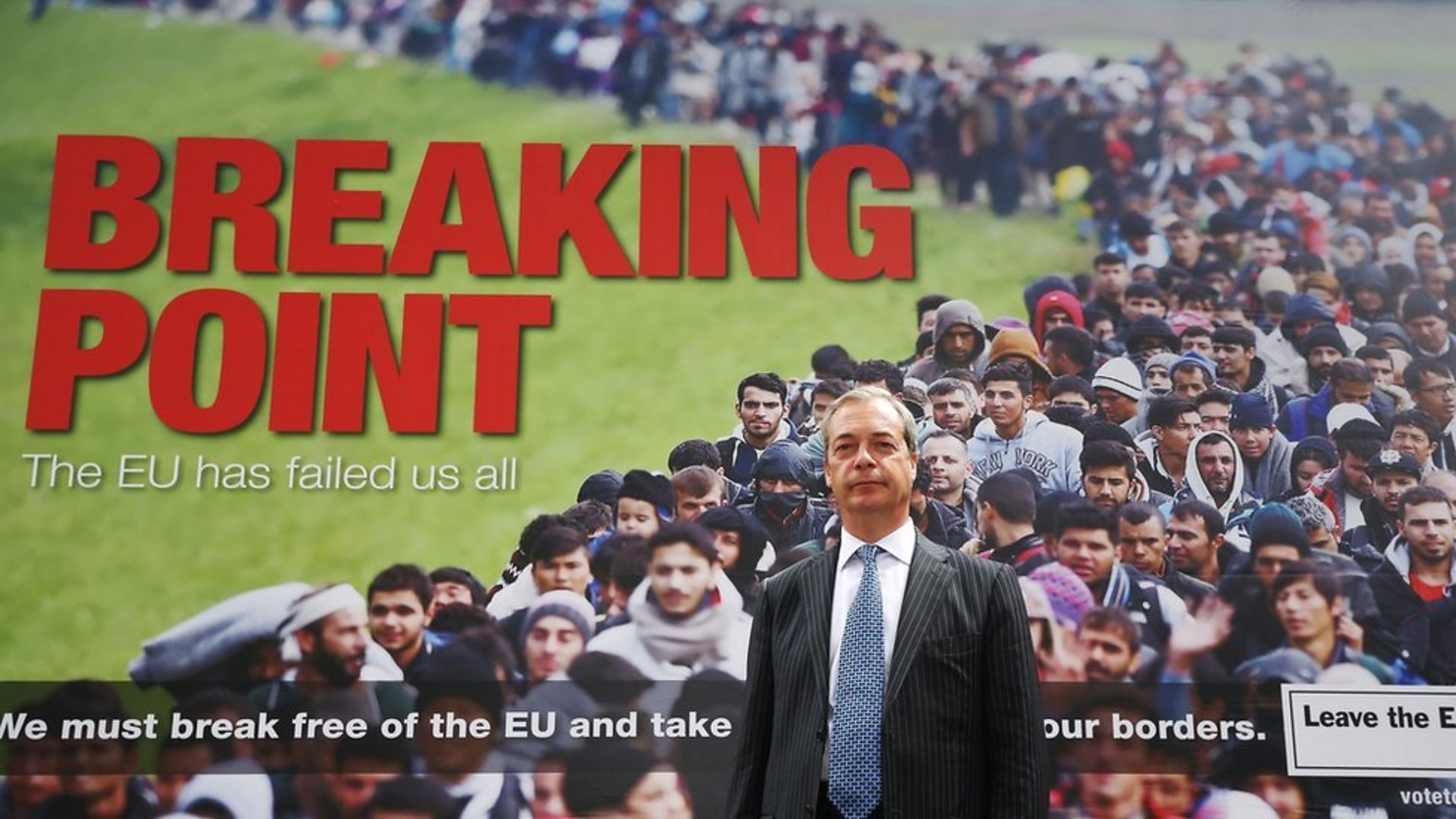
While on the "official" campaign we have gems like this (I still genuinely laugh when I read this blog post):
https://www.reaction.life/p/britain-looks-like-brexit
I watched all of this unfold, as an immigrant living in the UK, and we (immigrants) were very acutely aware of the sentiment that drove the brexit vote.
So, what is my main take-away from all of this? That this referendum was about two valid political choices, remain inside a pooled sovereignty union, or leave that pooled sovereignty union. Both valid choices. But the travesty was how poorly the referendum was constructed and run. And that is because we just don't have a history of running referendums very well (see the alternative voting referendum), and this would never have passed the sniff test in for example Switzerland.
I don't think that bit's biased, myself, George Osborne literally threatened a punishment budget before the referendum. He may not have used those words, but everyone else did and he did come out telling everyone that he would be having an emergency budget after the vote which others in his party described at the time as "economic vandalism". IMHO there's a difference between telling people that they're making an economic mistake and detailing what will go wrong (which he did too), and saying "I'm going to raise income tax, raise inheritance tax and slash the NHS budget within a few weeks if you vote leave".
See - https://www.theguardian.com/politics/2016/jun/15/osborne-bri...
or for a perspective from the other side - https://www.telegraph.co.uk/business/2016/06/15/osbornes-pun...
> So, I consider it the duty of the chancellor to have informed us of this
Absolutely agree, but that's not what I'm referring to.
I agree with the rest though, it was a clusterfuck in so many ways. I'm not going to try to claim I'm entirely unbiased - in the lead up to the referendum I was definitely in the 'leave' camp, part of the group of people who just wanted to see British politics given a righteous kick up the arse, regardless of what form that came in. I sorta came-round in the last few days and voted remain, mostly because I knew if Brexit happened a lot of people I care about would be upset, and some would have their lives upended. And then I got to watch it happen anyway.
Having seen the news from Runcorn today, I feel it's a shame the British people haven't got tired of the Farage clown show yet. But then my own father would probably vote for him (probably does), because he's got suckered into the Old-people's-outrage channel, GBNews, which can't be good for his blood pressure let alone British democracy. Currently I'm hoping (I think realistically) that my adopted home of Australia does better in the general election tomorrow. I'm not yet a citizen so just spectating on this one.
> https://www.reaction.life/p/britain-looks-like-brexit
"It’s 24 June, 2025, and Britain is marking its annual Independence Day celebration. As the fireworks stream through the summer sky"
My word! I haven't seen that before, I can tell it's going to be a hilarious read from the first sentence!
Frankly, I don’t think any of the Brexits we stood any chance of actually getting could have been good: it was only a question of how bad the one we eventually got would be.
And the problem with the less bad Brexits was: they would be less bad, but they would also be more directly comparable with no Brexit (e.g. “in order to improve trade we’re going to follow all the EU’s rules but not have a say in any of them”).
We de facto do that anyway, because most of our trade is conducted with the EU and companies aren't stupid. They don't want to design and build to multiple different standards, so they just adhere to EU rules for simplicity and cost reasons. But now we don't get a say in those rules.
https://en.wikipedia.org/wiki/Economic_effects_of_Brexit#:~:...
https://www.bloomberg.com/opinion/articles/2024-03-19/brexit...
Without immigration, future demographics will be fucked. Which means government finances, welfare, and the NHS.
That's one thing I don't get about anti-immigration opinions: it's burying ones head in the sand about demographic problems.
The real debate, if there is one to be had, should be about enculturation / integration and policies around that.
(Because unless developed countries substantially increase their fertility rate, immigration is a non-negotiable requirement)
There isn't a very high bar to understanding that immigration from "the thirld world" had nothing to do with the EU.
As an immigrant to the UK, I was very acutely aware of the sentiment leading up to, during and after the referendum, but I was mortified by the ignorance displayed by people around the topic.
I'm from one of those third world countries by the way.
Policy discussion seems to be something the masses cannot handle without clearly defining an "other". I feel Jeffersonian (bigoted) in suggesting that it's a mistake to give ordinary people access to this debate. Almost like letting ten year olds get involved in how mom and dad handle the mortgage.
It was hard to be sure as there were so many options - hard Brexit, soft and so on that it was unclear what the deal would be. At least with Trump you can vote him out again whereas we are kind of stuck with Brexit.
We hope. He keeps talking about ignoring the term limits set in our Constitutional Amendments. Jan 6 2021 was an ineffective coup attempt, but a coup attempt nonetheless.
Heinlein's Future History saw Nehemiah Scudder win the last American elections in 2012. We've luckily made it a few elections past that date, and the Future History was not a prophecy and was a bit kinder in that you could escape to the Moon or Mars or Venus this decade. But it's hard not to fear the same sorts of theocratic and fascist "urges" are cyclically at play in the current decade and not worry about possible consequences, such as and including the end of the US as we know it.
[1] https://en.wikipedia.org/wiki/%22If_This_Goes_On%E2%80%94%22
Also, I believe the above had an additional layer of an economics joke: https://en.wikipedia.org/wiki/Black%E2%80%93Scholes_model
And my (formerly) trusty Black-Scholes model, based on the normal distribution, had to be replaced with a fat-tailed distribution model after the financial meltdown. Shoddy materials.
https://en.wikipedia.org/wiki/Black%E2%80%93Scholes_model?wp...
Our trade deficit in the 1990s was under 1% of GDP. Some people may not remember that time, but we had toys on the shelves, toilet paper, etc. Not at all what the doomers are saying will happen without unrestricted free trade.
If trade deficits are so great, why does the EU try to maintain a consistent surplus? I can accept that Trump is an idiot and doesn’t know what he’s doing on trade. But I think the EU bureaucrats are pretty smart! I think the Germans and Chinese and Japanese are very sharp and have deliberately sought to maintain manufacturing-oriented economies with a large trade surpluses.
You know who else ran large trade deficits? The UK: https://ercouncil.org/2016/chart-of-the-week-week-19-2016-uk.... And it seemingly worked for awhile so long as people gave a shit about the pound and London banks, but that proved to be extremely fragile. The 2008 recession destroyed that and erased the UK’s higher standard of living.
Can you link to any left-of-center elected official who has advocated for "unrestricted free trade?"
Or are you making these people up so you can win imaginary arguments?
Minor surgical changes aren’t going to move the needle when you have an economy addicted to debt-fueled consumption of foreign goods. Anyone who isn’t proposing major structural changes is endorsing the status quo of “trade deficits are great” and “unrestricted free trade.”
I have a trade deficit with my local grocery store. Does that mean I'm being taken advantage of?
Imagine a small country rich in raw materials but whose people are otherwise poor. They export tons of valuable minerals to the U.S. but the profits are kept by an elite few who spend most of their time outside the country, and nobody inside the country has enough wealth to buy goods from the U.S. The U.S. would have a large trade deficit with that country, but would be benefiting enormously from the relationship. In this scenario, the country's people are certainly being taken advantage of, but the U.S. is absolutely not.
That's the problem with the trade deficit: it tells you almost nothing on its own. You can manufacture scenarios between countries involving a huge trade deficit, surplus, or an even balance, but where trade is fair, or where either country is taking advantage of the other. It's just not a useful number on its own.
Your example about small countries is irrelevant because nobody cares about the trade deficit between the U.S. and Bangladesh. Virtually the entire trade deficit is the EU, China, Japan, Vietnam, Canada, and Taiwan. The EU, Japan, and China are big, diversified economies and there is no reason we should have a trade deficit with them.
Yeah, it is not like someone would create a U.S. tariff policy with tariffs set based on (goods trade deficit with the US) / (bilateral trade volume with the US), irrespective of size of the country, because no one is stupid enough to care about the (goods or general) trade deficit between the U.S. and, e.g., Bangladesh.
Virtually our whole trade deficit is China, the EU, Japan, India, Vietnam, and Canada. Should we have just singled those countries out by name and grouped them together for purposes of imposing tariffs? Don't you think lumping Japan together with China like that would piss them off even more than tariffs would do anyway?
Except for the person in charge of America's trade policy, lmao
"He won't do massive tariffs, it's just posturing"
"He won't do mass deportations, it's just posturing"
"He doesn't care about those countries, it's just posturing"
"He won't ignore due process, it's just posturing"
"He won't ignore SCOTUS's orders, it's just posturing"
Meanwhile you're attributing beliefs like "trade deficits are great" to the other side so you can win imaginary arguments with them. Absolutely hilarious stuff.
I didn't say he won't put tariffs on those countries, I'm said he doesn't care about them one way or the other. Those countries have tariffs because Trump wanted a simple, blanket policy.
What is simple about tariff rates changing literally day by day via all-caps blurted tantrums on Truth Social? I am actually curious for your direct answer to this.
He thinks that a trade deficit is an actual subsidy, giveaway, or "loss" to the other country. He has said it for literal decades. Sure, he may care more about bigger thieves than smaller ones, but all signs point to him to caring about every instance of "loss" to foreign countries. Both his words and his actions are in accordance with my theory. Neither is in accordance with yours.
He is an actual stupid person surrounded by sycophants. It's a really consistent explanation! No need for this whole "he didn't say that → he didn't mean it → he's just posturing → it's for simplicity → it's Good Actually" thing.
How do you know that?
He didn't say he was going to do the thing. It's liberal propaganda.
Okay, he did say he was going to do the thing, but he's not. It's just posturing.
Okay, he did the thing. But it's good! Everything will be better!
Okay, it's not making everything better. But it will soon! 5D chess!
Okay, everything is worse. But it's liberals' fault.
Okay, it's his fault. But we deserve it.
If it is just posturing, do you worry Trump will improperly benefit from it? UAE investing $2BN in his memecoin today. Maybe the posturing will lead to other countries making similar "investments."
In world wars, America never wanted to stop being militarily capable so they spend almost a trillion ensuring there's no deficits of the ability to wage war.
No one in government prior to trump was operating under the idea that all deficits are ok. Strategic deficits are bad. Now all deficits are bad, which is not the case, at all.
America would not suffer any reasonable damage having a coffee bean deficit. Or a tea deficit. Or beer deficit.
The terms of the current regimes debate is simply trying to use the word tariff in place of national sales tax and corrupting it as a Nazi isolationism tool.
Most of the trade deficits create a security dependency, because you need to secure the entire supply and skill chain. Prior to World War II, the U.S. had largely demobilized its military. But the U.S. built the world’s largest military virtually overnight thanks to its industrial capacity. At one point a Ford factory was churning out one B24 bomber every hour: https://www.assemblymag.com/articles/94614-how-fords-willow-....
Doing something like that requires a depth of capability the U.S. no longer possesses, but China does. To build warplanes you need, for example, aluminum and titanium machinists. Where are they? In China making Macbook cases.
China has 230 times the shipbuilding capacity of the U.S.: https://www.csis.org/analysis/threat-chinas-shipbuilding-emp.... Or if you think the future of warfare is drones instead of planes and ships, guess who makes all the drones?
This entire section is full of people (not everyone, but several) analyzing it carefully, as if it were a scientist handling a moon rock inside the nitrogen environment of a glovebox.
I can't see anything productive emerging from this post-hoc theorizing.