Also, centrifuge aren’t used by advanced nations to make nukes. They use plutonium from spent reactor fuel. The US has lots of spent fuel that could be reprocessed for the plutonium.
Where full nuclear war means a full exchange of strategic fire, yes. For tactical nukes or bombardment of a non-retaliating state, less so.
Yep, the trajectory to North Korea (from US mainland) has to pass over Russia and the Russians have to trust that it's not coming for them.
Not that Russia would be okay with us striking NK in the first place, but you get the point.
Can the trajectory of an ICBM be inferred by the height of it’s arc?
I guess that depends on current relations between the two countries and assumes there wouldn't be a breakdown of communications when launches are detected.
> Can the trajectory of an ICBM be inferred by the height of it’s arc?
From the book I mentioned in another comment, Russia has very flawed satellite systems for tracking nuclear launches. There is a lot of focus on the fact that you don't have much time in the event of an imminent nuclear strike so I don't think there is much calculations being done if the missile is (generally) coming towards your homeland.
Annie Jacobsen has a book "Nuclear War: A Scenario" on all this where she interviews high ranking officials and pries into government documents related to nuclear war.
Depends a lot on who/where/why, how much primary and collateral damage, and so on. You may be right that any use of any nuclear weapon turns into a global doomsday. It's hard to say unless it really happens. I'm often surprised that terrible war related incidents end up not escalating beyond the general region where they happened.
This avoids the possibility of gradual nuclear escalation, which can be more easily miscalibrated.
On both sides of the wall - it would have been feasible for a country to attempt to establish it's own alignment separate from the superpowers through the use of nuclear weapons
B-2 bomber crews regularly train for this exact mission.
even if iran can't retaliate with nukes, the geopolitical cost would be insane.
[1] https://www.eurasiantimes.com/us-flaunts-massive-ordnance-pe...
If a bomb can actually rip through 200 meters of cement and ground, then the 60 meter statement is also true.
It also has a history of revealing the actual limits of weapons systems, but only after better capabilities exist (with the limits of those still classified or understated) - that is the 60M limit was the max of the old bomb and they don't need to know about the new one.
https://www.twz.com/iranian-underground-nuclear-facility-may...
But I do agree that the labeling is largely pointless because there are nominally "tactical" weapons with payloads exceeding 100kt. For contrast, Hiroshima (which was enough to destroy a mid-sized city and kill hundreds of thousands with a single bomb) was 16kt. So "tactical weapons" can easily destroy cities. Even if strategic weapons can be hundreds of times higher yield, at some point you're just beating a dead horse, or city as it may be.
Not sure about the landmines, but the US and USSR retired their nuclear artillery decades ago. I'm not sure how much effort it would be to put existing warheads inside shells, or about other countries.
In any case, for the specifics - Wiki gives 2004 [1] as the date the US reportedly dismantled its nuclear artillery, and in 2000 Russia reported that "nearly all" of its nuclear artillery had been dismantled. Nuclear landmines [2] fall under 'atomic demolition munitions' which are basically any sort of small/mobile nuke, so you get everything from landmines to the suitcase nuke weirdness.
[1] - https://en.wikipedia.org/wiki/Nuclear_artillery
[2] - https://en.wikipedia.org/wiki/Atomic_demolition_munition
If we escalated in to full-scale nuclear war this July that'd be unexpected but we're way past 0 warning. There are lots of warnings. In terms of raw risk the last few years might be the biggest risk of a nuclear war breaking out that the species has ever faced.
We have escalated beyond the point we have been in for the last 80 years. Russia have lost more troops than in any war since WWII. That is a lot of dead Slavs. Their strategic nuclear defences have already been attacked [0] and NATO currently appears to be organising direct strikes on Russian territory. They've made it quite clear that they want the war to continue until something in Russia breaks. When more warnings are you expecting to see? There are a lot of warnings out there.
We could easily discover that someone tried to launch the nukes already in this conflict. It would be precedented; the situation is more tense than it ever has been before and we've had fortuitous near misses in similar situations. We're already in territory where we are rolling the dice for a catastrophe with low odds.
[0] https://www.nytimes.com/2024/05/30/world/europe/ukraine-dron...
Russian aggression reinforced the need for a buffer state - before it wasn't obvious, now it is. NATO is intending to force Russia to leave Ukraine and they are willing to play a very long game bc it's a buffer state in play, not a NATO state.
The end result of this strategy is either Russia breaks or the war escalates.
But thanks for playing.
Russia-NATO relations were pretty good, even heading (slowly) towards such membership under Putin in 2000.
Unfortunately, Putin didn't like GWB leaving the ABM treaty, and did like having the old USSR back, so aggression and all else as you say.
Which was a surprise at the time, and left some convinced it was a UN rather than NATO operation.
Able Archer was one of a series of (annual) scheduled training exercises. The Cuban missile crisis was a fairly civil dispute over where people stationed military assets that was resolved diplomatically. The Ukraine War has involved the mobilisation of the Russian military with estimates in the 100s of thousands for Russian casualties and active strikes on Russian military infrastructure.
How are you construing the first two are more tense than the last? The last is a significant escalation of tensions from the first two. We're a long way up the escalation ladder.
And, putting it to you a second time, what warnings are you expecting to see months before a nuclear war starts? I don't think you can see any path from any scenario to nuclear war. I doubt you would have seen a path from Able Archer to nuclear war, or a path from the US deploying missiles in Turkey to nuclear war either.
So yes, I think we were closer to "full scale nuclear war" during the Cuban Missile Crisis than we are today. There isn't much point in continuing the conversation if you can't agree with that.
Then, 40 years later, someone ion the Russian military would explain to you that a person attempted to fire the nukes and it was narrowly prevented by a coincidence. At that point you would see a path to nuclear war. And based on my read of this conversation you probably wouldn't make the connection with the escalatory policy in Turkey as a threat to the Soviets without decades in hindsight either. That was less threatening than the NATO work the US has been orchestrating in Europe.
The publicly available information we have on the Ukraine war suggests a tenser situation than the Cuban missile crisis in 1962. Russia's mainland nuclear defence infrastructure has literally been targeted. That is pretty dicey compared to harassing a presumed-harmless submarine near Cuba.
[0] In case you haven't read up on it, the incident you are referring too wasn't publicly discussed until 2002. A lot of other details also weren't available without hindsight.
Come on, people couldn't see a path to nuclear war during the Cuban Missile Crisis? The whole reason it was labeled a "crisis" was because it made the path to war incredibly short. I know it is hard to say "I was wrong", but it is better than tying yourself into knots until you are spouting nonsense like this.
The reality of the situation, whether it was known in real time or not, is that one person prevented the use of nuclear weapons in 1962. How do you get closer to the use of nuclear weapons than it being prevented by one person? Half a person preventing it?
Yes, but the reason the Ukraine war isn't called the "Ukraine crisis" is because the crisis point came, went and then a war began. That is why tensions are higher - we're further up the escalation ladder. The Russian army has partly mobilised and people are shooting at them. The situation is a lot more fraught than a relatively civil argument over where missile emplacements were going to be put and nobody had any actual intentions of killing any Russians.
I put my challenge to you again - what warnings are you expecting to see months before a nuclear war starts? Your last answer was that you'd discover those signs 40 years post-hoc when the Russians told you and I don't think you can defend that as a rational position. If you want an explicit reason, 40 years hindsight is not a warning sign. Warning signs come before the event.
Your argument is that USSR stationing assets, including nukes, in Cuba isn't a provocation against the US while the mere thought of Ukraine joining NATO (not involving any actual NATO assets in Ukraine before the invasion in 2014!) is a provocation?
But compared to the Ukraine war it was a pretty civil dispute. Nobody was intended to get hurt.
Huh? I'd expect most non-Russian-aligned parties would be happy to see Russia retreat from Ukraine, pay reparations, and call that a peace. Russia only needs to break if Russia persists in occupying other countries.
The war can end tomorrow. All that has to happen is for Russia to pack up and leave the territory of another sovereign country. It's really that simple.
If Russia gives up, the war ends. If Ukraine gives up, there is a genocide.
“I believe everything this former KGB operative says about my government! Finally, a neutral party without self-interests who can reveal the truth!”
I'm paraphrasing, but I have friends that believe 100% of Russian propaganda they hear on the Internet and 0% of western mainstream media. "What the BBC is saying is just propaganda!" is a common comment I hear from people quoting Russian disinformation verbatim.
> likely outcome of NATO's persistent expansion
That is literal Russian disinformation. If they cared about NATO expansion, they would have invaded Finland to stop them joining. Or would have bolstered their border defence with them instead of reallocating the local troops to go fight in Ukraine, as they have.
They only cared about Ukraine joining NATO because that would have stopped them invading, as they were planning for over a decade and are doing right now.
A thief that plans to rob you cares deeply about your security system being upgraded! Not upgrading your security to appease the thief will not stop the robbery.
PS: Alexander Lukashenko accidentally let slip in early 2022 that the next target for invasion after Ukraine would have been Moldova. Guess which country Trump suddenly thought shouldn't be joining NATO right after meeting Putin?
Not any other country in Europe. No. Just Moldova, very specifically. Trump was very concerned about it, a country he would not have known the name of or been able to place on a map the day before that meeting. (Or, most likely, even after that meeting.)
> Alexander Lukashenko accidentally let slip in early 2022 that the next target for invasion after Ukraine would have been Moldova. Guess which country Trump suddenly thought shouldn't be joining NATO right after meeting Putin?
Well done Trump? Do you want to see Moldova invaded? If a similar stance had been taken to Ukraine this current war could probably have been avoided too. The response to Russia panicking and doing a puff-up-threateningly routine shouldn't be to poke them.
That is the type of negotiating skill that means Trump keeps doing well and his opponents keep ending up running in to walls. He doesn't provoke randomly and meaninglessly; he has a tendency to only try and annoy people for strategic reasons.
If you take the position that war with Russia is just a self-evident good then sure, the Trump-alternative style of negotiating has been a great success. The issue is there is no reason for there to be any wars involving Russia. This war is a disaster for everyone (bar East Asia)
You’re wilfully ignoring the reality that Moldova was always going to be invaded. Not because it might join NATO but because Russia has to invade it “while it still can.”
The same applies to Ukraine, and all of the -stans.
This. Is. The. Stated. Plan.
PS: the same people that believe Russian disinformation now will also believe the made up bullshit excuse China will cook up for invading Taiwan, something they’ve been planning and practising for literally decades now.
PS: I know a sociopath narcissist. She’ll make up a hundred reasons why she did something bad and argue them vehemently, but always pivoting on a dime and switching arguments mid-sentence if proven wrong. The real unstated reason is always “because I wanted to”, but she can’t say that so instead everyone gets an endless stream of ever changing “logic” of why things had to be so. Russian arguments for invading Ukraine are precisely this, and Chinese arguments for Taiwan will be the same.
Your argument here appears to literally be that Russia invades countries randomly. Not just without provocation, but for no reason and with no ability for countries to comply with their demands rather than being invaded. You might want to come up with a better theory before trying to put it to people. This type of nonsense is why the so called "disinformation" does a lot better - it involves the Russian government having motives and acting in a reasonable if stupid manner.
I've found people struggle to come up with a motivation that isn't NATO expansion. One fellow said it wasn't NATO expansion it was that Ukraine was about to integrate with the EU which is a bit ... we can call it EU expansion if that makes people more comfortable. Same difference. Big lump of people who turn out to be disturbingly cheered at the thought of killing lots of Russians. Lots of US funding.
> Russian arguments for invading Ukraine are precisely this, and Chinese arguments for Taiwan will be the same.
I mean, sure. But you're not grappling with the obvious question of why did Russia decide that it wanted to invade Ukraine. In the 90s it decided it "wanted" to give Ukraine independence [0] and through the 90s and 00s decided that it was happy to have Ukraine as an independent state. Even in the 10s as the situation started to deteriorate Russia didn't abandon negotiating.
The issue here is that like everyone else they have 30+ years of experience watching how the post-USSR NATO and they had some idea of what was about to happen, ie, Ukraine folded in to the greater anti-Russia military alliance. Obviously they are still a bit naive given that Ukraine was much better prepared than they expected.
[0] I wouldn't say that was acting out of sociopath narcissism on that one. More it was forced to.
No, not randomly! There's has been a plan in motion since well before 2014 to reinstate the former Soviet Union. Putin has repeatedly said that this is his "dream". These countries aren't picked at random, they're all former members of the USSR.
Look at it this way: Belarus is a puppet state without border controls, a part of the new Russian empire all but officially. Ukraine very nearly fell within days during 2022. If it had, the Russians would have kept right on rolling through Transnistria and into Moldova. Kazakhstan or one of the smaller -stans would be next, and so on, until the former USSR was reformed.
> Not just without provocation.
Countries can be invaded even if they didn't "provoke" it.
I want you to pause for a second here and think about what you just said.
Are you the type of person to believe that everyone that gets punched in the face "provoked" it somehow? Or every woman that got raped was responsible by "provoking" the rapist?
I ask you to ask yourself these questions because there are people that think that YES, every woman that got raped was at least partly responsible for it.
Are you that person?
If not, why does the same logic not apply to Ukraine?
Must they have "provoked" Russia?
And if they did provoke them somehow, was Russia justified in killing hundreds of thousands of people in response?
What... exactly... was the thing that Ukraine did that justifies 200K dead, 500K+ wounded, millions displaced, etc. Please be specific, outlining how the provocation is somehow a worse outcome for Russia than the dead and wounded they have caused.
Just to reiterate: before you go off on a tangent, please very specifically explain how Ukraine joining NATO has a "greater material impact" on Russia than hundreds of thousands dead and wounded.
By specific, I mean: "If Russia hadn't invaded, they would have lost N million people to X because Ukraine would have done Y, and the evidence for this is Z." Make sure 'N' is > 200K and the source of the information predates 2022.
> In the 90s it decided it "wanted" to give Ukraine independence [0] and through the 90s and 00s decided that it was happy to have Ukraine as an independent state.
At no point was Russia happy about the USSR member states leaving, and Putin has repeatedly stated that this is the "greatest geopolitical disaster of the last century".
You're arguing against the core motivation stated by Putin himself repeatedly in personal interviews.
https://www.nbcnews.com/id/wbna7632057
https://www.reuters.com/world/europe/putin-rues-soviet-colla...
https://carnegieendowment.org/research/2022/12/putins-long-w...
Etc...
Armies don't just charge out because Putin has his "dream", and certainly not sustaining the sort of punishment that the Russians have had to undergo in Ukraine. We can see from the response to Prigozhin's coup that the military actually supports the war to a significant extent; if it was unpopular then Putin would have been rolled by now. You aren't trying to understand the Russian motivation; this is unhelpful straw-manning and caricaturing.
And othering the Russians with irrational motivations is stupid. As a culture we've passed up too many opportunities to calm the situation down because of a russophobic attitude out of the US. Years of unhinged rhetoric from 2016 onwards turned out to be unhelpful in de-escalating a dangerous situation.
> Countries can be invaded even if they didn't "provoke" it...
I'm not going to quote specific parts but addressing the points you raise from this onwards - nearly nothing justifies war. But what does happen regularly is unfair war. The lesson out of something like the Afghanistan invasion in 2001 is if a major power tells you to do something you have about a month to comply before something unjustified happens and the faster the weak roll over the better it is for them.
If I can swallow that and stay friends with my US friends - which I can - then I can handle almost anything.
> At no point was Russia happy about the USSR member states leaving, and Putin has repeatedly stated that this is the "greatest geopolitical disaster of the last century".
That would be like the British PM lamenting the fall of the British empire. I don't see why believing that would lead to a war or even bad feelings. I do see why NATO expansion into Eastern Europe would though, especially given that with hindsight we know NATO sees Ukraine as an arena to inflict crippling losses on Russia. People in the Russian military probably have sleepless nights worrying about NATO.
And I note you didn't link to speeches by Putin. That'd be wise, it is rare to see a western media outlet accurately representing even western politicians. Not as a partisan thing, but as a blanket failure. It is better to go to the source material.
During WWII, Russia first allied with Germans and together they rolled over entire Europe until there was no-one else left and they attacked each other for the final deathmatch. Out of two bad choices, the US supported Russia with massive military aid against Germany. As an unintentional side-effect, that aid allowed Russia to prevent half of Europe from restoring their independence as Germans were defeated, and enabled Russians to dig in to dominate and exploit Central and Eastern Europe for 50 years. Entire generations of Russians, including Putin, grew up thinking that it was the norm. When the domination withered away, Russians saw that as a great humiliation and historic injustice that they are trying to reverse.
There's nothing more to it, really. All that huffing and puffing about NATO is only because NATO stands in the way. Drop the ambition of enslaving Europe again and NATO isn't an issue anymore. Russian complaints about NATO are best summed up as thieves complaining about neighbourhood watch.
It is just too easy to draw parallels between what is happening in Ukraine and what happened in Iraq or Afghanistan in the earlier part of the century. There is a lot of precedent for the globe standing aside and lodging strongly worded diplomatic protests to this sort of meaningless violence. The determination of NATO to do as much damage as they can to the Russian military is concerning; that isn't the sort of thing a group open to diplomatic solutions would do. With hindsight it seems likely that their policies of strategic pressure in Russia provoked the entire conflict.
> There's nothing more to it, really. All that huffing and puffing about NATO is only because NATO stands in the way.
If NATO wasn't involved it does seem likely that nobody would be talking about NATO's involvement.
If you want to argue that NATO should be involved then sure, that is a popular position. I'd disagree; the downside is large and the upside is hard to spot. But to argue that Russia isn't acting with reference to NATO's involvement is just displaying a void of strategic empathy. What they've been doing makes a lot of sense through the lens of a group of people panicking as NATO keeps tightening the noose on them.
Armies don't just charge out because Hitler has his "dream", and certainly not sustaining the sort of punishment that the Germans have had to undergo in Poland. We can see from the response to Ernst Röhm that the military actually supports the Führer to a significant extent; if it was unpopular then Hitler would have been rolled by now. You aren't trying to understand the German motivation; this is unhelpful straw-manning and caricaturing.
And othering the Germans with irrational motivations is stupid. As a culture we've passed up too many opportunities to calm the situation down because of a Germanophobic attitude out of the US. Years of unhinged rhetoric from 1930 onwards turned out to be unhelpful in de-escalating a dangerous situation.
And I note you didn't link to speeches by Hitler. That'd be wise, it is rare to see a Anglo-American media outlet accurately representing even Anglo-American politicians. Not as a partisan thing, but as a blanket failure. It is better to go to the source material.
If we entertain multiple theories though, the "Hitler is just crazy!" theory fits, but so does the "gee, it is pretty easy to see why they'd be scared of France and Britain, look at what France and Britain did to them at the first opportunity" theory. Especially since it has been a factor in conversation for decades. People have been pointing out that the Treaty of Versailles was raising tension with Germany since the end of the Great War.
If the Treaty of Versailles wasn't involved in German Rearmament it does seem likely that nobody would be talking about the Treaty of Versailles.
But to argue that Germany isn't acting with reference to the Treaty of Versailles is just displaying a void of strategic empathy. What they've been doing makes a lot of sense through the lens of a group of people panicking as France and Britain keeps tightening the noose on them.
Well, yes. As a Brit I would like to believe I would have been saying things like "this Treaty of Versailles approach is a disaster, we're just giving the Germans reasons to re-arm and fight us. We should have made more of an effort towards ensuring that Germany is prosperous and wealthy despite losing the Great War. Given what the British and the French did to them at the first opportunity, they are likely to be really angry with us the next time tensions rise".
Given what then happened, I would probably have scored myself pretty well for geopolitical acumen too. roenxi approved policies towards Germany in the interbellum period would have been less likely to see the British Empire make enemies and get its back broken. As we saw in the aftermath of WWII, the policies that work were occupation, respectful treatment, rebuilding and creating prosperity in the vanquished countries [0]. Similarly, the policies that would have helped with Ukraine would be a similar approach. We can't manage occupation but Russia seemed to be feeling cooperative back in the 90s, we should have taken advantage of that when the chance was open and tried to achieve all the other parts. Not salami tactics of advancing a hostile military alliance towards their borders.
Creating reasons for great powers to fight you is remarkably foolish policy. Even middle powers for that matter. That is not the sort of thing that should be done. These stupid policies have consequences.
[0] Policies adopted because, given the sheer scale of the disaster that was WWII, even the politicians had to admit that a new approach from WWI's failed peace was needed.
NATO does not expand on its own like a dough left on a windowsill. My country is in NATO because we were scared stiff when we saw the methods Russia used in the First Chechen War in 1994. Nothing had changed since Russia invaded us during the WWII. As an insurance and deterrent against that happening to us again, we made a decision to build relations with other European nations to ensure tight cooperation and remove as many obstacles as possible for coming to mutual aid, hoping that even the possibility of receiving aid through organizations like NATO would make a Russian invasion less likely.
This is "raising tensions" only because Russia intends to invade us as soon as they can, and us being in NATO makes that more costly and risky for them, because they can't be sure where the aid ends - might go as far as American nukes flying.
> What they've been doing makes a lot of sense through the lens of a group of people panicking as NATO keeps tightening the noose on them.
Nobody in Russia is panicking. The narrative about NATO tightening a noose is an artificial talking point thrown to western useful idiots for self-flagellation to undermine the support of Ukraine. It is not a topic of discussion in Russian political and military circles. Instead, they talk about reclaiming their lost prestige and taking back what "belongs to them". For Russians of Putin's generation, the domination over Central and Eastern Europe was normalcy and they want it back.
Until Putin expires, or his lights grow sufficiently dim. At which point they'll be worrying simply about their political and physical survival.
All these words about "NATO expansion" and "western influence" are just a code word for what ultimately just means "no longer under former Soviet-block influence".
Just about any sovereign choice that a country like Ukraine makes that is not bowing their head to Moscow is by definition taken as a direct assault to their god-given right to rule their former empire.
So let's just cut all this crap about NATO or whatnot and let them say clearly:
"I want all the territories of the former Russian empire to remain under their former rulers. Ukraine. Georgia, ... are not free to do what they want with themselves, they are not really sovereign. We Russians have a god-given mandate to rule them. And when they don't want to be ruled by us we will leverage the Russian minorities we have planted in those countries to justify invasion"
It's a perfectly simple and honest way of framing what they really want. And they can claim that "the west" has already done much of that meddling with their imperialistic past and whatnot. Then we can discuss things. But you have to be honest about exactly what you want to happen.
There is no point pretending that the problem is NATO expansion and if it wasn't for NATO a former-soviet country could just do whatever they wanted. The desire of joining NATO is just a reaction to a threat of being dragged back into the Russian influence sphere against their will!
> The issue is there is no reason for there to be any wars involving Russia
Do they know that? Russia (well, Putin, who is the state) seems to think there is a reason for Russia starting a war involving Russia.
Well. Ukraine just wants to shoot at the places where rockets and artillery are shooting at them. It happens that the Russians conveniently are doing so behind the border. They can shoot at you. But you can't shoot back.
I honestly don't understand how people can spin this up as that NATO wants to strike Russia with a straight face.
That’s when it gets scary too.
See Maria Butina and the total ownership of the NRA. Starting with Putin bare-chested riding horses in the GWB “I’m looking into his soul” era to today, the American right wingers are pretty much pro-Russia… amazing feat considering that killing Russians has been historically a priority for them since 1917.
The chances of a Russian fizzle are very high given the maintenance issues with the regular army, but nobody wants to take that bet.
The larger issue is once the “nuclear taboo” is broken nation states will start using them. Nukes aren’t magic, they’re just really big bombs. Most likely the smaller ones are more practical to deliver and will be used on military targets (Bunker busting, destroying fortifications, etc). It wouldn’t play out like Mad Max but basically WWII but with small nukes and regional missile defense systems playing a huge role.
So a total war scenario, but with multi megaton nuclear weapons? That sounds civilization ending to me.
“There was a strong wind that night and as I came out of the shelter, all I could see around us was fire…burning clothing, 'tatami' mats, and debris were blowing down the road and it looked like a flowing river of fire… I remember seeing other families, like us, holding hands and running through the fires…I saw a baby on fire on a mother's back. I saw children on fire, but they were still running. I saw people catch fire when they fell onto the road because it was so hot.” [1] This isn’t an account of the atomic bombs. This is the firebombing of Tokyo, which killed more people and destroyed more homes than either atomic bombs. The US was firebombing Japanese cities week after week, leveling over 60 Japanese cities and killing between 330,000 and 900,000 people (though we will never know for sure because the very records needed were obliterated in the conflagrations). WWII destruction was limited completely by the technology of the time. Total war means total war.
[1] https://www.dw.com/en/tokyo-firebombing-survivors-recall-mos...
I think a Mad Max style post apocalypse type situation wouldn't come about until maybe 30 years after a full nuclear war. As disease and civilization continue to deteriorate over time eventually I can see much of the word getting to that state. Kind of like how a polluted lake doesn't kill all the fish immediately, it slowly dies over time.
This sounds exactly like Mad Max. If you remember, in the very first "Mad Max" movie, civilization was not completely gone yet: Max was a policeman, but civilization was in tatters and murderous biker gangs ran wild. The later movies showed civilization being completely gone.
https://en.wikipedia.org/wiki/W54
And they do have the potential for outsized impact:
https://en.wikipedia.org/wiki/Nuclear_electromagnetic_pulse
Interesting quote: "Physicists have testified at United States Congressional hearings that weapons with yields of 10 kt (42 TJ) or less can produce a large EMP."
On top of all that, the only practical way to have any hope of "winning" a nuclear exchange is to hit the other side so unexpectedly hard and fast that they can't mount a strong enough response to completely destroy you in return. There were multiple serious high level discussions about doing exactly that at various points during the Cold War by both sides.
We should all want the world to be as many rungs down the escalation ladder as possible. One or more countries breaking the prohibition on nuclear weapon use and using tactical nuclear weapons would bring the world dangerously close to a full nuclear war. Being a few short steps from such an event is not a stable situation, and it is one that will break badly at some point.
Our current situation is too unstable; deliberately making things much worse is a terrible notion.
to demonstrate this point you can find the end of the movie War Games on youtube. A rouge AI (heh) is determined to launch an ICBM and only when the computer is tasked to play itself in a game of nuclear war does it determine there is no possible way to win. The movie ends with the iconic robotic voiced line "strange game, the only winning move is not to play".
+France
Macron understood it well and basically told him to get lost with his threats, or in simple words - France also has nuclear weapons. That's the only language Putin understands.
It is precisely the fact that dictators like Putin are so pampered and disconnected from the consequences of their actions that worries me. He won't think twice about the lives that will be lost. He's constructed his own alternate historical timeline to justify his assault on Ukraine. He could do the same to justify dropping some nukes.
> It is precisely the fact that dictators like Putin are so pampered and disconnected from the consequences of their actions that worries me.
Which is exactly the reason to make it clear that consequence of his actions like nuclear war would he his immediate death. I.e. the logic goes the other way around and that logic works. You can't use the logic of "let's not escalate" with such people.
I think this is absurd and I really don’t like this line of thinking. This is being blown away out of proportion.
Russia wants ukraine and China wants Taiwan. These are localised issues, nobody is invading Texas, and core territories of nuclear powers are not in danger.
Much bigger chunks of lands have changed hands over the last 60 years, think collapse of USSR, the debacle in Afghanistan, Vietnam war, etc. The world did not end.
In 2008 American banks did more damage to the world than Russia/China would by successfully taking these areas of land.
Starting a nuclear exchange over these relatively small-ish issues would be peak idiocy. Yes, it sucks for the locals but there are 3 civil wars in Africa and conflict in the Middle East causing the same amount of misery, they are easier to solve but no one cares.
Starting nuclear war under any conditions would be peak idiocy. We still have relatively regular near misses. The current issues appear to be more significant than situations that have caused near misses in the past.
Smart!
megaton size has not been disclosed. The majority could be small nukes.
The big factor is that the deployment platforms are limited. There are 400 Minuteman III missiles sitting in silos. They could put more warheads on them, but those are sitting in storage. The same is true of Trident missiles on submarines.
They could make nuclear gravity bombs but those aren’t really useful. We also have lots of those in storage.
However for practical purposes. One simply needs enough missiles and warheads of sufficient yield to overwhelm opposing interceptors, avoid risks of pre-emptive strike/miss-fires+500.
After that there are rapidly diminishing returns for more warheads.
We disassembled a bunch of AFAPs so have a lot of weapons grade plutonium around. But Pu is nasty to work with & Rocky Flats--the previous pit production facility--closed down years ago. Pit production moved to Los Alamos but it is at a much reduced capability.
Also, Pantex--where nuclear weapons are assembled--isn't exactly the model for speed & efficiency.
If you really want to go carpet-bombing with nukes, miniturization isn't as important as having a lot, quickly and reliably.
I'm not sure. This used to be the case in WW2, but today enriching uranium is quite inexpensive.
Here's an enrichment calculator [1]. The cost of enriching to 80% (weapons grade uranium) is $80000/kg, so you can enough uranium for a Hiroshima-style bomb for about $5 million.
$5 million for a nuclear bomb is basically nothing.
I assume that's something like the amortised cost over the lifetime of a factory dedicated to making them, rather than something which at least a few people on this forum can personally afford?
Urenco is a company that specializes in uranium enrichment. It is owned by the UK government (1/3), the Dutch government (1/3) and 2 German energy companies. They will not sell you weapons grade uranium, and if you don't have a legitimate reason, they will not sell you anything.
But if the UK or the US government asks them for weapons grade uranium for the purpose of making nuclear bombs, I imagine that they would be willing to provide.
As for Iran, they needed to build from scratch the many thousands of centrifuges, and they don't have any paying customer that could help recoup some of the cost. Plus, for a long time they needed to do the enrichment in a covert way, to hide it from the International Atomic Energy Agency inspectors. Once they were caught enriching, they first got hit by Stuxnet then they got sanctioned. Then they did a deal with the US and some European countries, where they promised to stop the enrichment, which they did. They restarted when Trump withdrew from the deal, and now they have enough enriched uranium to make several bombs if they want.
A number of the pits in the active stockpile are actually composite Pu/HEU pits & you can actually use HEU in implosion weapons as well.
If we assume 1 pit per month ages out due to phase and corrosion, then they would presumably have a pipeline of 12 pits in refurbishment continuously.
Since the stockpile is still measured in the thousands, I would assume the stockpile of plutonium pits running through pantex facilities is at a similar scale.
(this also assumes there is no neutral gas non-corrosive, phase stable storage)
https://www.scientificamerican.com/article/behind-the-scenes...
https://ananuclear.org/wp-content/uploads/2020/06/53f947439e...
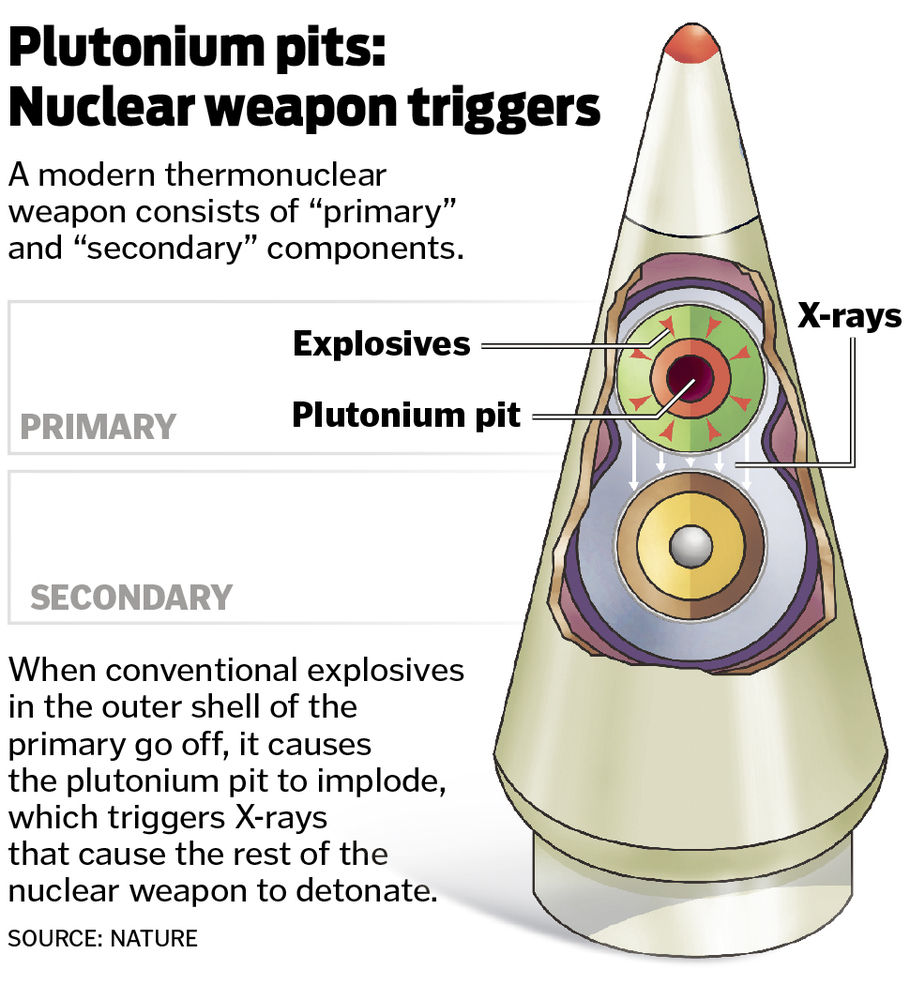
The pit (primary) is a hollow shape that gets crushed, producing a fission explosion. The X-rays released by that are absorbed by a (highly classified) foam encasing the secondary, which vaporizes (explodes), compressing the secondary causing fusion. The foam, and the secondary, are encased in a substantial tamper made of U-238.
The tamper’s mass impedes the expansion of the secondary, making it more efficient. The tamper is also largely converted to Pu-239 by the neutron flux from the secondary, and immediately fissions releasing a whole lot more energy. This approach is used in all modern thermonuclear weapons, with the majority of the total energy coming from fission.
The ‘Tsar Bomba’ weapon, the largest ever detonated, was designed to be a 100 megaton blast, but Khrushchev was concerned about fallout. So, he directed the U-238 tamper be replaced with lead, which reduced the explosive yield to ~60 MT.
“pits,” which are spherical shells of plutonium about the size of a bowling ball
I assume that when weapons are decomissioned, the pits are put in storage. So, if they were able to use the same pit design, they could be reuse them?
Possessing an overwhelming amount of retaliatory force and the combined ability and willingness to deliver it immediately in the face of an enemy's first strike serves a useful purpose for deterrence. "Mutually assured destruction" means that both sides are prevented from attacking, because the other side can respond in kind. It's irrational for either side to attack, since everybody would just die. (and yes, MAD comes with its own problems)
The ability to build a bunch of bombs in the future is entirely unrelated. I mean, who cares?
It's not like missiles or ammo, where the more we produce in times of conflict, the more of an upper-hand we have. We've already reached the ceiling for the finite amount of nuclear warheads required to do the most conceivable damage. Beyond is irrelevant.
The conversation around nuclear winter focused on burning petroleum storage tanks because (in contrast to burning houses and burning trees) those kinds of fires produce the darkest smoke with a particle size small enough to get high in the atmosphere and to stay in the atmosphere for a long time. "100 oil refinery fires would be sufficient to bring about a small scale, but still globally deleterious nuclear winter," said one prominent paper.
Then Saddam lit 700 oil wells on fire (and deployed land mines to slow down firefighters with the result that it took 7 months to put the fires out), and although there was some slight cooling effect, you really had to go looking for it with precision instruments to detect it at all:
https://en.wikipedia.org/wiki/Nuclear_winter#Kuwait_wells_in...
https://en.wikipedia.org/wiki/Nuclear_winter#Climatic_effect...
Repeating myself: before the 700 Kuwaiti oil fires, the most influential scientists warning about nuclear winter, like Carl Sagan, relied heavily on petroleum fires to make their argument.
As I recall from the time there were three camps on this:
* pro MAD cold war political scientists who stressed that world ending Mutualy Assurred Destruction scenarios were essential to peace keeping,
* antinuclear horrified scientists, Carl Sagan, Betrand Russell, et al who wanted disarmament and peace through understanding and stressed the world ending horror of nuclear weapons and nuclear winter and wrote a lot of papers light on detail.
* actual working geophysicists modelling the world who seemed largely undecided about the actual threat of nuclear winter .. very much in the maybe | maybe not camp.
ADDED: I just read through the wikipedia Nuclear Winter article and seems (by my recollection) to have been culled in the decade since I last read it when (by my recollection) it referenced a great many more papers that fell on the probably not catastrophic side. It now appears to emphasis only papers that agree with the nuclear winter hypothesis.
Mao was particularly disconcerting, to paraphrase, "Nuclear war doesn't scare me, we've got more than enough people and cities, we can rebuild"
Upon further looking into it, I fear MAD may have been at the time an overexaggeration to prevent what would be the most devastating war. Could be true now tho - things have leveled up
It was part of it, for sure. There was at least one apocalyptic science fiction story about the Soviets testing a bomb underground and accidentally setting a massive oil field on fire. (it was called Anvil? Or written by Christopher Anvil? jeez, it's been a while...) But it's strange to see it commented on as the main concern.
If Earth's megacities get nuked I refuse to believe that it would not have consequences for the climate.
I think it's easy to lose scale/context when looking at things like nuclear test footage, so let's go the other direction. This [1] is the "Mother of All Bombs / MOAB / GBU-43" that was detonated in Afghanistan. It's the second largest conventional weapon ever fielded, weighing more than 20,000lbs and and 30+ft long (so that little blip on the screen is 30 ft for scale). It had a yield of 0.01kt. So now imagine something with literally hundreds of thousands of times greater yield - that's a modern nuke. Or, if it helps for visualization purposes, imagine hundreds of thousands of those raining down - same net effect.
So if nuclear war ever breaks out it's not going to be countries using their nukes to target isolated (and nuclear fortified) launch silos and bunkers in the middle of nowhere - they're going to try to destroy the other country (targeting things like population, economic, health, agriculture), so that they can completely eliminate the threat. And suffice to say - it won't take many nukes. The only reason you'd have thousands is to overwhelm any sort of future-tech missile defense systems as well as to eliminate any possibility for an effective first strike attack attack against you. Although even the nukes themselves are also designed to deal with missile defenses, with one missile often breaking up into multiple independent warheads on approach. This also maximizes the damage for reasons outside the scope of the post.
---
So the point of this is that thousands of nukes is already enough to basically destroy every single major city in the world and thus destroy basically every single country in the world. There's no scenario where suddenly you need to scale up to tens of thousands of nukes or whatever. In fact nations like North Korea already clearly have an effective deterrent with a stockpile that's in the tens of missiles.
another fun fact, the drop plane had only a 50% chance of survival with the 50MT version. They weren't _that_ worried about the crew's fate.
There are at least two falsehoods here. Of course missile silos will be targeted if it's possible to do so. If you're the Russians you might need to make an honest assessment of whether your weapons are accurate enough to destroy a hardened silo, but the US believes they can target silos (and has since at least the eighties).
And prioritizing destruction of enemy population over destruction of the enemy's nuclear weapons and other military assets would just be dumb.
US Cold War targets have been declassified. [1] That was from an era with less effective detection, and also where launching would generally involve planes, so airfields were targeted, but again you can see the extreme focus on agriculture, industry, medical, economic, and many targets simply labeled "population." The USSR's target list would have looked, more or less, identical. Modern target lists likely aren't even bothering with silos and just going for complete destruction of the enemy civilization.
Nuclear war, has as a prerequisite, the end of any sort of norms. It's not about destroying the opponent's military, but about literally destroying the opponent's country. Military can be rebuilt and redeployed - by targeting population, industry, economic, medical, population, and so on you completely eliminate the enemy's ability to ever be a threat again.
[1] - https://www.nytimes.com/2015/12/23/us/politics/1950s-us-nucl...
[1] - https://nsarchive2.gwu.edu/nukevault/ebb538-Cold-War-Nuclear... (a much more informative, but less approachable article/datacache)
A "dummy" silo does not mean a fake silo, though those may also be used, but simply a silo without a live weapon. Silos are cheap and be constructed extremely rapidly. Beyond dummies, there's also the issues of them having already launched their payload, hardened against attacks (which does not mean immune), and so on. Then there's also the nuclear triad in that weapons will also be coming from the sea and possibly from the air as well.
The goal of this obfuscation and deception is not to avoid masking how many weapons you have, but rather to prevent the enemy from being able to meaningfully disrupt your nuclear retaliation capability; in other words - to protect yourself against a nuclear first strike. In modern times it's unlikely either side believes they can significantly disrupt the opponent's nuclear retaliation capability (unlike in the past when strikes would generally have come from the air and had far lesser range overall), and so it simply makes much more logical sense to optimize the damage caused by your own strikes in pursuit of your opponent's "systematic destruction."
But asking in the clear under the pseudonym "transcriptase" here isn't going to get you put on the exact same lists? How do you think this list making process works?
There's probably a declared number where this matters, but the current number of warheads is high enough that's there's no need to make more. 3,000 is plenty to retaliate against an opponent with 30,000. More doesn't provide a benefit.
Nuclear disarmament, as practiced by the US and Russia is a negotiation to reduce the number of warheads in a coordinated fashion so that it's possible to convince warmongers on both sides that it's reasonable. The benefits are primary a reduction in cost to maintain and secure the warheads and a significant reduction in the risk of accidents related to the warheads. Mutual destruction is still assured --- you'd need a lot fewer warheads for that and involvement of other nuclear states; but then your question of production capacity would be more interesting.
I think a big part of this is that the long-distance missiles, when all of this was invented, were not very accurate. Sending 10 to do the job of 1 might have been necessary just to hit the intended targets.
Modern missiles are quite capable of precision strikes.
yes, this is also why yields have dropped considerably. I'm not sure if there are any > 5 MT weapons in the US arsenal anymore. I think most are in the 500-750KT range, the missiles and delivery vehicle are accurate enough to produce the same result as the larger warheads and 5-7 (can't remember exactly) warheads can be carried by a single missile. So instead of having one missile launch one giant warhead that may hit 50 miles away from the target you have one missile launch 5-7 smaller warheads that hit within 50 meters of 5-7 different targets.
If you eliminate your arsenal and then decide later you want it back, you're giving adversaries a lot of time to beat you to the punch, all the while advertising that you are pursuing nuclear as opposed to conventional weapons to fight your war.
As mentioned probably two posts up, any ramp up would be obvious to adversaries, have some lead time, and would take away from other production efforts.
I view arms control as a reduction of the number of variables in play (launch vehicles, warheads, etc). Both sides will always retain their God-given right to unleash nuclear holocaust, but both sides also reason they don't need 10,000+ warheads to do that. They can accomplish that goal with far less nukes than war planning 40 - 50 years ago called for. Partly that is due to accuracy having increased rapidly since gen 1 ICBM. There is a great book about missile guidance and accuracy, it is called "Inventing Accuracy". If you can't find a local copy or can't afford it, the Internet Archive has a PDF you can check out and read. Really insightful as to the "why" we don't require 30,000 nukes (1965) -- we only require ~5000 today and the enhanced accuracy makes them even more potent than prior bomb designs (which had a much larger yield).
Things like uranium and plutonium require digging up a lot of earth to obtain a tiny bit and the enrichment process is very complex and laborious as well.
I wonder if this really ramps up so easily.
To your specific point, I think if Ukraine had the keys to even one nuclear weapon and Russia believed they'd use it the invasion would never have happened in the first place.
Ukraine returning the nukes was a pragmatic move that, at the time, removed Russian military presence from Ukrainian territory. Think about it another way: the USA maintains nuclear weapons on other country’s territory. They sure as hell staff those sites with US troops!
Arming codes gives a nation time to recover or destroy them, but it’s not a long term solution.
More generally a handful of soldiers isn’t the full might of a countries military. Bribes, blockade until they run out of supplies, or just shoot them.
As to bombing 130 nuclear silos with non nuclear ordnance is problematic and doesn’t destroy the enriched uranium which means building a bomb from the wreckage isn’t nearly as expensive as starting from scratch. None of this came into play because the Ukraine government was still reasonably friendly at the time.
You seem to be missing the key point that I've repeated twice already.
UKRAINE DID NOT WANT RUSSIAN TROOPS IN THEIR TERRITORY.
There was no path to Ukraine maintaining the nuclear weapons while also NOT having the Russian troops on Ukrainian land. The discussion of "oh, they can re-wire the weapons" would have trigged IMMEDIATE WAR with Russia. Ukraine DID NOT WANT TO DO THIS.
I really don't understand why you're bringing up any other information because what I've written is the start and the end of the discussion.
Clearly war was one option to remove Russian troops. Saying there’s no options, is a vast oversimplification.
Call up the troupes on the phone and say we’re unhappy about those ICBM’s in our territory where going to start artillery bombardment noon tomorrow and suggest you leave before then.
Please explain how instigating a war with Russia leads to less troops on Ukrainian land.
There’s been 2 wars between Russia and Ukraine without any nukes involved. Nuclear bombardment of a country on your border isn’t such a great idea of a whole host of reasons.
“Leave us your nukes or we’ll take them by force.”
Talk me through the next steps.
As things stabilized inside Russia it quickly became too late, but actually shelling the location of using an EOD team to ‘destroy’ the nukes puts a different spin on things.
The USA would do nothing because why would they defend an antagonistic state trying to become a nuclear power?
If you think otherwise, you really aren’t living in the same reality as the rest of us.
How do I know this would have happened? Ukraine chose to give them back. They did the same calculation but, unlike you, they understand how things really work and what would really have happened.
Nuclear proliferation is the main reason I am pessimistic about nuclear power as the main global solution to decarbonizing. I don't think a world with 200 threshold nuclear states is a good idea, nor would that be in the interests of any of the major powers, most smaller countries should be aiming for a 100% renewables grid.
On the other hand, that's how we ended up with Hanford Site.
Turns out having fickle, lazy, stupid, feckless politicians have the ability to destroy projects with the stroke of a pen on a whim after every election means nobody is willing to put up their own investment, and having a business sector that is largely run by shithead middle management types who have never worked a day in their lives that wasn't just balancing a spreadsheet are unwilling to do something because it doesn't promise a HIGH ENOUGH return on investment.
God forbid you don't make ALL the profit.
Because if they could start churning out a dozen or a hundred a week within a short period of time, why does the standing arsenal really matter? Does it really make a difference in global safety or geopolitics? I don’t know the first thing about the topic so this is all genuine curiosity, and I feel like the googling required to get an answer would put me on lists I don’t really feel like being on.