I never bothered with the butter etc, though maybe I should.
As the popping slows, I take the lid off entirely (there's enough popcorn at that point to keep new popping from splatter or jumping out), and add salt, and then rotate the bulk of the popped corn with a bump to one side, salt again, bump-rotate, etc, getting the salt on it evenly without letting it cool too much. I like popcorn that's just-popped hot.
Two other notes:
I only use peanut oil, because at fast popping temperatures, some oils smoke. The popcorn does not taste like peanuts, if you'd worry about that.
I use more oil than most commenters, such that the single layer of kernels (3/4 cup in my pot) are nearly submerged at the start. Cleanup is more involved than a wipe of the pot, but the popcorn is a lot tastier and I don't need any butter or parm.
The silicone bowls are by far the best. Big consistent, crisp pops. Minimal waste, you can even repop the unopposed kernels. But easy to burn if you are not careful.
Air poppers are by far the worst. The pop corn always came out like styrofoam. I’d bite into the popcorn and it would just flatten.
I don’t believe the comments about getting minimal un-popped kernels using a pot, by just swirling around a bit of oil. Sounds like baloney to me. Results are good but waste is relatively high in a flat bottomed pot.
The best vessel for stove top is a metal container with a curved bottom - wok, large metal bowl. Add popcorn and oil as normal. Heat for about a minute. Turn the heat off. Stir the kernels for 30s to a minute to let the heat even out. Turn the heat back on and cover. As they pop shake the container to help the kernels settle to the bottom. The same technique can be used in a normal pot, but the heat distribution is not as good.
It works, though!
I use an ordinary 3qt pot (Cuisinart MCP193-18N, if it matters; this is a tri-ply pot). Choose enough kernels to make a single layer on the bottom of the pot (that's about 1/2 cup for this one, if I'm remembering correctly... I'm usually on autopilot doing this though) and set aside. Add enough oil to the pot to basically half cover the single layer, or a bit more. Add five kernels to the pot and start the heat at medium-high to high. Add the rest of the kernels when 3/5 of the test kernels have popped. Cover with lid. You're done when the pot is full (and it will be!). Pour the popcorn into a separate bowl to season and serve.
Works every time, with very little waste kernels.
I took or adapted my stove top method from Alton Brown. And it works on every wok so far.
I guess you don't have to believe it, but I rarely get more than two or three unpopped kernels that way, personally.
* truffle zest (a powder, smells good, not much taste) https://www.amazon.com/dp/B01FDFL2RQ
* truffle sauce (it's bits of truffle and other mushrooms in oil) https://www.amazon.com/dp/B00V3M9VLI
* truffle salt (it's a very fine salt and very good for popcorn) https://www.amazon.com/Italian-Black-Truffle-Sea-Salt/dp/B00...
(or just do the truffle salt alone)
i like this combo because it's not as chemical smelling as the "white truffle oil" or whatever they sell that doesn't contain any truffle at all.
We have much to learn from their culture.
Corn explosion is louder than rice one.
You have to study the grain. Most kernels have a left to right grain, and they will pop between 140-150C, because the cell structure of the skin is weak in several places. A relatively rare genetic mutation leads to around 1-2% of kernels having a right to left grain, and because of this orientation the skin is actually more robust in the typical popping spots, meaning that temperatures as high as 450C are required to pop these! That's why they typically will remain unpopped when cooking popcorn in this legacy manner.
To detect the right-to-left kernels, you can actually use a UV flashlight - you will see that they have a softer glow compared to the bright left to right kernels.
Hope that helps!
1: https://americasfavoritepopcorn.com/blogs/all-blogs/why-do-s... 2: https://popcornity.com/why-some-popcorn-kernels-dont-pop/
I only realize that I've never thought of comparing, but I've got the habit of using unground salt when cooking. My grandmother used to do this for some reason, so I picked it up.
Unground salt is also useful for cleaning things, like cooking pans.
It's therefore easier to only buy salt in one big pack that lasts forever.
A 1 kilo bag is like 0,23 EUR
In my neck of the woods, unground salt is the most expensive kind, because the only place you can find it is in upscale gourmet stores.
Usually you see anti-caking agents and Iodide added.
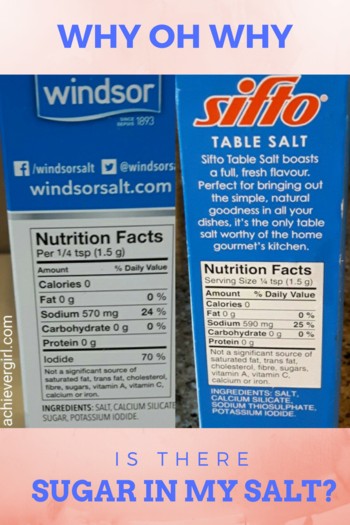
You want your anti-caking agent to absorb a lot of moisture and a salt is the way to do it.
The reason to grind your own salt is to get it at the right size.
EDIT: I looked it up. It's supposed to stabilize the iodide. The reason they use corn sugar is that it's cheap. Thankfully there are brands that don't include additives in their salt. I'll have to keep an eye out for them. I already get plenty of iodide in my diet.
https://en.m.wikipedia.org/wiki/Sodium_ferrocyanide
The amount is small enough, that it is supposed to do no harm, but I just prefer my salt without cyanide.
And even they can be wrong, sure, but I can still avoid poison where possible, so if I see no reason to voluntarily add cyanide on top of all the other shit for no good reason, I simply won't.
If you ate enough salt to reach a toxic dose of sodium ferrocyanide, you’d already be dead from hypernatremia though?
The dose makes the poison.
Yes it does and it all adds up. So why would I add more things, that are poisenous even at small doses, when I can easily avoid it?
No, it doesn't, because sodium ferrocyanide is poorly absorbed in the first place and not bioaccumulative in humans. I suppose you also don't each spinach or almonds either?
But my point is, sodium ferrocyanide intake is not beneficial, (unlike ordinary sodium). Even if it might do no harm, why should I risk even little harm?
And with adding up, well there is a whole libary of other toxic or potentially toxic additives in the normal food you can buy. I prefer to minimize the potential bad intake, that's all.
Some people don't each rice for this reason, but I just eat around it.
Only for substances that accumulate, which is not the case here...
Now if your salt has PFAS sure
NaCl: 3.000 mg·kg−1 [0]
Na4[Fe(CN)6]: 1600–3200 mg·kg−1 [1]
[0] https://en.wikipedia.org/wiki/Sodium_chloride
[1] (german, as the english version has no LD50) https://de.wikipedia.org/wiki/Natriumhexacyanidoferrat(II)
I was recently planning to get back to a regular pestle/mortar setup after yet another costly failure. Did you manage to find a way to work this around?
There are ceramic grinders now. I'd expect those to not rust, but I don't know how long they stay sharp.
Blade also gets kicked around more going around the salt instead of grinding through, more bending = shorter lifespan.
I've successfully used this method on a sun gear for a planetary gear box designed for a low speed, high torque application. Due to mechanical constraints, the gear only had about 1.2mm of wall thickness at a 5mm radius, and it was prone to shearing off. Remelting it in salt solved the shearing, without having to redesign anything else.
It's nothing special, some no-name Himalayan pink salt in a plastic grinder.
According to the National Institutes of Health’s Office of Dietary Supplements, tests have shown that the population in the United States is “iodine sufficient.” Most Americans who eat a varied diet get enough iodine even if they don’t use iodized salt. They are at little risk of iodine deficiency*
https://www.nytimes.com/2017/07/21/well/eat/should-we-be-buy...
I think the “varied diet” usually means Americans get enough through non-home use iodized salt (like processed/restaurant foods). As the article says, seafood (plant or not) and dairy are good iodine sources, if you consume them.
It links Americans being iodine sufficient to getting varied diet but that’s not a conclusion made by the source from what I can see.
The article also says bread is a good source of iodine when the source says it’s a very poor source of iodine.
So I think the article is making stuff up, linking a source but hoping no one will actually read it, and probably written by someone trying to get iodine supplements removed.
Normally I’d expect to see this kind of writing from some blog but not the NYT.
https://en.wikipedia.org/wiki/Himalayan_salt
> Some salts mined in Pakistan are not suitable for food or industrial use without purification due to impurities... Although a study of pink salts commercially available in Australia showed Himalayan salt to contain higher levels of a range of elements, including calcium, iron, magnesium, manganese, potassium, aluminum, barium, silicon, and sulfur, and reduced levels of sodium, compared to table salt, the authors concluded that "exceedingly high intake" (a level in excess of the recommended daily salt intake by almost 600%) would be required for the differences to be clinically significant, levels at which any potential nutritional benefit would be outweighed by the risks of elevated sodium consumption such an intake would entail.
I've never really like iodized table salt, the pink salt tastes "right" to me.
Totally without evidence.
For some reason, normal salt just sticks on the top of the tomato despite it being wet and I can "taste" the salt not just saltiness. However, with crunched salt crystals, they basically dissolve and disappear into the moisture of the tomato. This just tastes better too.
Don't ask me why or how it all happens, it's just what I've found using my taste buds.
And the way the salt "tastes" is different because the powder dissolves on your tongue differently/quicker.
Salt "dust" is a really interesting way of adding salt to food -- and you actually end up adding less than larger grains
I've never seen on-the-spot ground salt smaller than the stuff you can buy already grounded. Except if you buy flakes, but then why do so if you want finer salt?
Therefore, grinding things at the last minute makes them taste better, goes the simplification.
Therefore, grinding salt must make it taste better.
But salt is not like the aromatic flavors in a peppercorn. Salt is geologically stable. NaCl itself does not need a last minute grind to retain its salty flavors. NaCl is not a chemically complex flavor.
I qualified that as NaCl specifically because it is faintly possible some of the fancy salts could have their fancy flavors come out better if they are ground, but I'm yet to even notice a difference when any of these are used in food in any manner so I can't judge. Those flavors must be awfully darned stable as it is if they're still hanging around in a 99+% NaCl environment. I'd want to see a specific chemical that can survive that but will suddenly wilt if exposed to oxygen. (We're sure not talking about traditional benzene-ring aromatics at that point!) If there is a difference it is hovering at the very bottom of human detectability.
Salt grinders are annoying. They're hard to use because you're trying to grind a rock, a soft rock sure but still a rock. It's wasted effort, and it occurs to me to wonder if they even do anything to speak of; now I want to find one and compare the before and after of the chunk size; I find myself suspicious that many of them are just theatrics and the salt basically passes through unscathed because "cheap plastic" and "grinding a rock" are not compatible with each other. Even if it does do some real grinding it's still a waste though because it was never necessary, you could just have bought it at the right grain size.
Usually you'd just use two sizes of salt. I don't own a salt grinder, can't remember ever seeing one in a professional kitchen, don't recommend people buy them. But it does produce a particular effect that you could prefer for some applications.
And in fact I suspect popcorn might be one of the places where it would shine. An even background of salt dust with bursts of intense saltiness from larger grains sounds good here. I'm not going to buy a salt grinder to test it but it's not an absurd idea.
I think you’re misunderstanding the use. It’s a different goal from grinding spices. It’s functional. And I’ve never seen powdered salt selling anywhere in Canada. (Except for expensive artisan stuff). So, the best way to achieve it is with a grinder+rock salt. I’ve been using a simple Amazon grinder and it’s easy to use.
Powdered salt tastes different not because of a differing chemical composition, but because of its different physical nature + your tongue.
Or... it's an after the fact rationalization for the cargo cult!
At best this might be your goal, for whatever reason. 99% of the people who cargo cult a salt grinder don't have that reason - and regular sold salt would be 100% OK for their purposes.
Right off the bat any real consideration will make you aware that large particles will distribute very differently from small particles of the same volume.
Additionally that large particles will be substantively different from small particles in how they interact with the toungue. Eg large particles will "burn" more due to their extreme concentration and will be effectively "hot spots" of seasoning.
From just that it would be apparent that there would be truth to the claim of substantial difference in experience when using the two forms.
Right?
Interesting. I like to keep that excess oil/water, as that extra moisture on the surface of the popcorns later helps the sugar/salt stick to it - without the need for additional butter/grease.
I had no idea that a quart is about a litre.
But I prefer to measure butter (and most other things -- especially sticky/messy/powdery things) by weight because it's easier. 1 cup of butter weighs about 227 grams, so 1/8 cup is about 27 grams.
Her: Why?
Me: Because you're a qt!
[0] https://www.google.com/search?q=10+imperial+quarts+in+liters
Can't be worse than the PFAS infused kind right?
Why do we just happen to glance over those issues so easily?
How is that not sustainable? It means that you can turn the heat off earlier and coast on the stored heat.
I don't cook on gas, so that's not a concern for me. But no butter?? That's the same as saying "no popcorn".
Also, more of the world needs this in their lives: https://www.youtube.com/watch?v=3fG8rNHUspU
(not bdg - well yes also bdg - but in this case the pep corn)
My favorite is to use beef tallow.
Stir popcorn maker something like this https://www.amazon.com/gp/product/B00004RC6R
flavacol salt (optional if you use flour salt) https://www.amazon.com/gp/product/B004W8LT10 or flour salt https://www.amazon.com/Morton-Popcorn-Salt-Green-French/dp/B... or both 1/2-1 tea spoons at most.
'butter' oil https://www.amazon.com/gp/product/B000UZLQG2 1/4 cup after cooking (warm it in a microwave)
The butter oil is a bit of a pain as there is so much of it and you can not really buy in small quantities, and it will go rancid before you use it all. It is meant for movie theaters to use. I have not found any supermarket versions that are correct. Usually they are kinda gross.
You can use a coconut oil for cooking with. Most theaters do not do this at all. The butter oil is closest to the same as movie theater as that is what they use during cooking and topping at the end. I personally use the coconut oil when cooking as it imparts a nice texture and flavor to the popcorn. 1-2 tsps for cooking with for either. Then top with the butter oil.
The flavacol and butter oil are the key ingredients.
For the popcorn I just buy orville redenbacher popcorn. They have a decent process of removing the duds before they get into the container. You can buy generic just expect a few duds.
Microwave is also fine, I just use a Pyrex bowl put in kernels and cover with a non-metal plate. The plate is necessary or they end up everywhere except the bowl.
Also, try using coconut oil instead of canola oil to cook the popcorn--its pricier, but its a great taste. I think it removes the need to add butter afterwards.
But plain old butter is still my favorite.
Thick bottom pots also reduce burning. Use a vented lid so steam can escape which prevents soggy popcorn.
In my experiments heating the pan and oil to a medium-high temperature, just before smoking, with 3-4 test kernels preloaded allows them to generate an alert by their popping, signalling the optimal time for addition of the rest of the kernel package.
* 3 tablespoons bacon grease * 1/2 cup popcorn kernels
Put the bacon grease in a large pot and add three kernels of popcorn. Heat it on half heat (5 on a gas burner, anyway) until the three kernels all pop -- this will usually be the point at which smoke from the grease is accumulating in the pot (if you have a large lid you can watch). Once the three pop, dump the rest in. Scoot the pot vigorously back and forth on the stove to shake the unpopped kernels to the bottom. Turn off the heat when the popping stops.
Pour in a bowl and salt to taste. No butter required. As above, you get almost no unpopped kernels this way!
We use "rainbow popcorn," which is multi-color and we think tastes better. It doesn't pop as big as the regular yellow kind.
I'll have to try the paper towel trick, especially with the smaller pot I sometimes use.
Method:
  - Prepare: Measure out 1/3 cup of popcorn and have a serving bowl ready.
  - Add high temp oil to the pot.  I use 1-2tbs of coconut oil.
  - Place in stock pot along with 3 kernels over medium high heat.
  - Cover with a kitchen towel (to let out some steam during popping, don't want a soggy popcorn).
  - Once the kernels pop, immediately dump in the rest of the kernels (I usually do 1/3 cup, whatever the instructions recommend).
  - Immediately take off the heat and shake gently to the count of 30.  The kids love participating in the count.
  - Put back on the heat and shake a little to make sure the kernels are evenly distributed.
  - Once the popping slows, immediately take it off the heat and dump into a serving bowl.  This prevents burning.
Cool tip, thanks. I use basically the same steps except fort this one. Living in a high humidity environment (it's rarely below 70%), any step to reduce excess moisture helps improve the crunchiness of the popcorn.
> I like to suspend a paper towel between the lid and the rest of the pot, absorbs excess oil and water.
Brilliant! I never thought of this, and I'm going to start doing doing it. Thank you!
This is what I've been missing...
Also I usually toss in 3 kernels to the oil. When they pop you add the 1/3 cup as the oil is preheated and ready to get to work.
Heat oil first. Use the 3 kernel method to make sure oil is hot enough then add sugar and rest of kernels. Use a large lightweight pot with lid to shake every few seconds or you get uneven coated or crispy burnt pieces.
I tried different oils and sugar mixes but coconut with white sugar seems the best.
I read there are ways to use an air fryer also but haven’t tried yet.
> Take one large pot (the kind that holds like 10qts).
Ideally a dutch oven or similar heavy bottom that distributes heat well. This makes the process nearly foolproof on any heat source.
> Add a bit of oil, basically just enough to swirl and have everything covered in an oil sheen, not enough to have them submerged.
If you are looking for "movie theatre" popcorn the "secret" is using (extra virgin) coconut oil along with flavacol dissolved in the heated oil with the kernels popped in it. I use 2-3tbps of coconut oil and 2tsp of flavacol for 3/4 cup worth of kernels.
Flavacol should not be used as a topping imo, but as part of the popping substrate.
> Cover
This is tricky. Covering traps moisture released during popping, and a moisture results in soggy (or at least not crisp!) popcorn. You do need some sort of cover though for obvious reasons.
I found a pot+metal strainer combo that fits perfectly together, where the strainer has about as many holes in it as you could get away with without creating oil splash mess. This lets as much steam as possible out immediately upon popping with as little kernel contact as possible. A more easy to come by lid is using a mesh oil cover meant for deep frying.
The commercial poppers accomplish this by having a very small popping pan, that kernels get "pushed out" of fairly quickly after they pop into a well vented holding tub.
> Toss 1/8 cup butter in the hot pot, melt the butter with residual heat.
Disagree on butter on popcorn, but it's a personal preference. I find butter makes popcorn soggy due to water content - and the flavacol+coconut oil is typically what most US theatre chains use vs. real butter, so it's what I "expect" the flavor to be. That said, I sometimes do melt up some butter to switch things up.
> Salt(I prefer a salt grinder)
I prefer pre-made popcorn salt in a wide metal popcorn salt shaker to really get a nice even spread.
> transfer back to the mixing bowl.
One trick: If you are making a lot of popcorn "to go" (e.g. for a party later) the best way I've found to keep it fresh is inside doubled-up paper grocery shopping bags. This helps soak up residual moisture, and the difference is noticeable after a few hours.
Take one large pot (the kind that holds like 10qts).
Cover the bottom with kernels.
Add a bit of oil, basically just enough to swirl and have everything covered in an oil sheen, not enough to have them submerged.
Cover, put on high (I use gas). I like to suspend a paper towel between the lid and the rest of the pot, absorbs excess oil and water.
Once popping slows, turn off the stove. Dump popcorn into large mixing bowl.
Toss 1/8 cup butter in the hot pot, melt the butter with residual heat.
Pour popcorn back in and toss to get the popcorn evenly lightly buttered, transfer back to the mixing bowl.
Salt(I prefer a salt grinder) and toss, add a bit of grated Parmesan and toss.
There should be less than 10 unpopped kernels, no burned popcorn at all.
Cleanup is a wipe down of the large pot with the moisture capture paper towel.