I hope they don't mean Robert Malone.
Why does a government has to "lean" on a private media company in a "democrat" and "liberal" democracy? Not able to "mandate" is total bs, see the Pentagon-related leaks where there wasn't any need of any "mandating". If anything, this shows how hypocritical the whole industry has become, including many of its workers.
Hopefully this will scare away all potential future Aaron Swartz-es from this industry, or from the main parts of it at least, and hence bring it all down a peg or too.
There are people within the government whose job it was to respond to the covid pandemic. Part of that response involved educating the public about the disease and best practices related to it, which therefore included fighting misinformation. Misinformation is spread on platforms such as Twitter, so it made sense for the government to communicate with Twitter and let them know what it considered to be a good course of action. Do you disagree with this explanation?
And even granting, for the sake of argument, that someone within the government had that job, suppressing disagreement and debate is not the right way to do it.
"Internal emails that I viewed at Twitter showed that both the Trump and Biden administrations directly pressed Twitter executives to moderate the platform’s content according to their wishes.
At the onset of the pandemic, the Trump administration was especially concerned about panic buying, and sought “help from the tech companies to combat misinformation,” according to emails sent by Twitter employees in the wake of meetings with the White House. One area of so-called misinformation: “runs on grocery stores.” The trouble is that it wasn't misinformation: There actually were runs on goods. "
> There are people within the government whose job it was to respond to the covid pandemic. Part of that response involved educating the public about the disease and best practices related to it, which therefore included fighting misinformation.
It wasn't Trump pushing Twitter to ban anything that disagreed with the CDC's official position, and Trump separately pushing to ban misinformation about panic buying doesn't justify it.
I fail to see how this conclusion is automatic or helpful in action. Educating people and providing best practices is harmed by taking direct action to shut down criticism and debate.
This part I disagree with, because what is misinformation is unknownable before serious scientific study is done. It just makes the government look untrustworthy if they flip-flop from "masks are pointless" to "masks are essential" and back simply all because these policies were not based on any real science.
Similarly debate of other aspects like COVID origin, vaccine health effects etc was stifled when the real answers were unknown to science, and by steering the conversation in any particular direction before that it's done irreparable harm to the reputation of government, science and tech.
Yes, otherwise what happens when the ruling party is no longer your team?
What if everything becomes inverted, so if you tried to say Bill Gates isn't one of the biggest beneficiaries of COVID then you get "visibility filtered" AKA shadowbanned?
Then you make a detailed explanation about how the story of the Wuhan lab having had a virus leak was all just a hoax, but oops that is a final strike and now you're banned?
The bar for censorship shouldn't be so low and arbitrary. Social media platforms should exist to help us change our minds by discussing and debating with others (like we are doing right here), not be all echo chambers and filter bubbles.
The bar for censorship shouldn't be so high that you legitimize misinformation by giving it a bigger platform than it merits. Social media can be a good place for discussion & debate, but in times when there's a national crisis occurring & you have people continually posting about how to take off-label drugs causing shortages for people who actually need it & injury to those taking it incorrectly, you run into misinformation causing real tangible harm to people. You cannot just ignore that. It's not just a run-of-the-mill philosophical debate about misinformation & censorship. The stakes are much lower in our discussion here.
No, my OP and this thread's link is about government intervention, which then lead to social media action.
Whilst I do think social media platforms should have additional regulation once they are big enough to become the new public square, there's no need to go that far yet and I'm uncertain of the appropriate balance.
However when it comes to the government's own response, they should have higher bar for taking action due to the oppressive influence it can have backed by it's monopoly on force. And again I state that this should be serious scientific study as the minimum prerequisite for this bar.
> in times when there's a national crisis occurring & you have people continually posting about how to take off-label drugs causing shortages for people who actually need it & injury to those taking it incorrectly, you run into misinformation causing real tangible harm to people. You cannot just ignore that.
Just like you cannot ignore the horror of slipping into a tyrannical police state like China.
Instead of shadowbanning and actual banning I was previously in favour of fact checking and warning labels under legitimately harmful information. Unfortunately even this tool has been abused by being misapplied to factual information, as well as non-harmful opinions. I have yet to see an intervention method since COVID that hasn't been corrupted to oppress the population, so I'm inclined to think that some harm is an inevitable tradeoff for living in a free society.
I don't see a problem with private and public sector collaboration, it happens all the time. Not all communications between Twitter and the government resulted in Twitter taking action, and even when Twitter took action it does not mean they did so outside their own community guidelines.
>Whilst I do think social media platforms should have additional regulation once they are big enough to become the new public square, there's no need to go that far yet and I'm uncertain of the appropriate balance.
So which is it? You want regulation or you don't? Stop speaking out of both sides of your mouth.
>However when it comes to the government's own response, they should have higher bar for taking action due to the oppressive influence it can have backed by it's monopoly on force. And again I state that this should be serious scientific study as the minimum prerequisite for this bar.
No, governments are expected to lead and provide information to their citizens on urgent matters. In a situation like COVID you can't wait 12 - 24 months for comprehensive scientific meta-analysis studies to confirm things. It seems you want a very hands off approach during a national crisis. I assure you this would not go over well, and is just as reprehensible(e.g. lackadaisical responses to Hurricane Katrina in Louisiana or Hurricane Maria in Puerto Rico), as an overly heavy handed approach(e.g. China welding people's doors shut).
Also my original reply was regarding your claim that it's not possible to disprove misinformation without serious scientific study. That statement in and of itself is misinformation. You do not need exhaustive proof to show an in-vitro study does not mean a drug is a cure for COVID, or to show confounding variables, or that there were zero cited sources for claims being made in a post.
>Just like you cannot ignore the horror of slipping into a tyrannical police state like China.
You also cannot ignore a million+ dead people, many of whom were likely duped by charlatans into believing something that eventually lead to their demise. As you note later, you're fine with this harm, it's the cost of "freedom", except you don't actually want a private company to do as it pleases it sounds like, yet you also seem to lack any tangible action items or regulations you want applied. It seems like you just want to put your hands in pockets. I dunno?
The reality is that truly unfettered free speech & unmoderated discussions/debates devolves into all sorts of distractions from the primary goals of the platform (e.g. spam, hate speech, illegal activity, off-topic discussion). There must always be some level of moderation and censorship, even if that is at a basic level watching for spam bots & illegal activity. Typically that's not enough to ensure decorum, so you end up with additional community guidelines to set the tone for the platform.
My point here is that freedom of speech on online platforms is a mythical unicorn, that never existed, nor will it ever exist. It seems more like a wedge issue certain people like to bring up, because they're unhappy with how a platform has acted towards them, and want to claim superiority by championing "free speech", even if they don't actually believe in it. For all the belly aching Musk did about Twitter, he is doing exactly the same things he complained about. That'd be fine, if he wasn't such a hypocrite about it & understood the ramifications and expectations of free speech, and the complexities of competent content moderation.
I'd also disagree that crackpot ideas are best debated in the open on social media. I think in a well moderated forum where people are held accountable, and expected to cite their sources yes. In the firehose that is social media where attention spans are limited, consumption is often on mobile devices which may hamper ability to do in-depth research, it leaves much to be desired as a place to find deeper truth easily. Also with puppet accounts, the moment you debunk one thread, ten more have popped up regurgitating the same talking points.
A lot of the mis/disinformation about COVID passed this bar (i.e. serious study had been done, and there was direct evidence that countered their claims).
On top of that, if you're going to make a positive claim about something, "unknowable before serious scientific study is done" means that you shouldn't make that claim, not that anyone can say anything they want because the truth is unknowable. If no one has studied the effects of drinking bleach to cure COVID, it's not appropriate to say "drinking bleach cures COVID".
It's a nice way to explain the consequence without resorting to accident or malice.
Nevertheless, in the end, they way overstepped what was needed or helpful.
Secondly, this kind of moderation is counterproductive. It gives all the conspiracy theorists a true conspiracy to point to -- they really are being suppressed by "the man" or "the Feds" or whatever. Also, no matter how much stuff gets moderated, the left will never be happy.
End result: everyone is mad at Twitter, nobody trusts anything, conspiracy theorists get to make true claims about suppression, and more people are attracted to misinformation because it was suppressed -- e.g. "the government doesn't want you to know this!" or "see what the government is trying to hide from you!"
And it's fine to make an argument against moderation in general. But that's not what this article is doing.
That sort of gaslighting?
Or maybe the implication that Twitter will henceforth not allow government or govt affiliated entities to request content moderation (they will) or that they won’t give such requests preference (they will) or that they shouldn’t give such requests preference (a matter of opinion, but not crazy to believe they should).
Geopolitical hat on.
Elon Musk is getting close to the Saudis (Twitter), China (Gigafactory Shanghai), and Russians (necessary industrial inputs). In the past few months he's casually suggested a handover of Ukraine and Taiwan. Now he's turning on the Democrats and the FBI, or at least certain members of those organizations.
My mind wonders if the DoD will sour on his role at SpaceX. We've recently seen lawmakers impact the valuation of Tesla vis a vis tax incentives.
Perhaps he or the company he keeps have enough friends within the DoD chain of command that there won't be any issues. But I am half expecting to see sparks fly.
(I'm 100% reading between the lines here, and I don't have any evidence for any of this. Feel free to dismiss outright, though I would appreciate additional commentary if anyone has anything interesting to add.)
4 hours later he tried to backpedal, which is perhaps the only move more pathetic than having boosted the propaganda in the first place.
The much more reasonable explanation for Musk's behavior with respect to the Democrats and FBI is that he does not like the censorship going on with the gradual fusing of the US security sector and US Tech companies.
No, it wasn't. It was Bidens presidential campaign asking to remove revenge porn.
----
These debates are always tricky because as things start to get more polarized, people start to expect you to either be fully on board with Twitter as it was or fully on board with Musk's running of the place. Twitter did have moderation issues. And governments do try to weigh in on moderation decisions from companies, sometimes appropriately and sometimes inappropriately. But all of Musk's takeaways about those problems are wrong.
Twitter is a pretty good example of the difficulties of getting moderation to scale and how that can go wrong. They were in an unfortunate position of needing to figure out what medical debate was legitimate and what debate wasn't legitimate. And that was made more difficult because of the top-level executive decisions, because of poorly trained moderators, and because of a reliance on automated moderating that couldn't take tweet context into account.
And those are all real problems! They're not surprising problems, they're not a revelation, they're probably not the biggest issue facing free speech today, but yeah, they're real problems.
But what's Elon's reaction? Musk comes into this situation and slashes the moderation team, leans even more heavily into AI moderation, starts crowdsourcing decisions (because heaven knows random internet crowds definitely won't be vulnerable to group-think during contentious public debate /s), and pushing more moderation decisions to the executive level rather than into independent moderation boards that would be trying to resist personal bias in their decisions. He basically leans into every single decision up above that was problematic about how Twitter handled Covid moderation.
Even where government involvement is concerned -- if you're concerned about government pressure on your moderation team, one thing you could do to combat that pressure is have a strong legal team that helps respond to these requests. So naturally Elon gutted that team too. Because hey, who needs a bunch of lawyers who are specifically trained to respond to legal threats to free speech and who have a ton of practical experience arguing for those rights in court? They were probably Democrats or something, better to get rid of them. /s
----
The whole thing is just a bunch of people taking somewhat concerning but also relatively unsurprising information and treating it like it's the end of the world and the most important free speech issue of our time; and then... not doing anything to fix the problems. The whole story begins and ends at the outrage and the outrage is all that they're interested in. There's zero followup from Musk about actually solving any of these problems, he's gone in the opposite direction of a solution.
There are real free speech advocates who took issue with how Twitter handled moderation; but my guess is that most of them have probably moved to Mastodon by now because the overall ActivityPub ecosystem is more censorship-resistant than Twitter is and is better positioned to reject government pressure to censor. Meanwhile Musk's strategy is that he'll be very mad about moderation going wrong, and that will somehow fix things.
You literally have the person breaking this story calling out specific problems with Twitter's moderation process, and they're all problems that Musk has been doubling down on. I don't know how to take that response seriously.
There are reasons to be worried about community silos, but my point wasn't that Mastodon is perfect, it was that it's more resistant to censorship than Twitter is (particularly government censorship).
Having large community spaces where everyone interacts might be a worthy goal, but those spaces are often going to require a larger degree of moderation and policing to stay civil. It's a tradeoff that (as far as I can tell) Musk doesn't seem to advocate for -- his policy seems to be that people should block/mute whatever they disagree with, and the platform shouldn't make that decision for them. If that's someone's approach to free speech and they want individual or small-group control rather than platform-wide standards, then Mastodon is a pretty interesting implementation of that idea.
Compare this with something like HN -- there's one feed for everyone and limited blocking tools. That forces everyone to interact with each other, but also means that HN mods and users are both a lot more involved in debating what stories are allowed and how discourse is conducted, and those decisions impact more of the community when they're made.
Seems like a large percentage of that team was former employees of the government, former FBI agents, former DOJ, etc. or have close familial ties to active government agents
If that is who you hire to "push" back against the government then you are not going to get much push back, it seems to me (and many others) Twitter was not forming teams to resist government influence but to deepen it.
I think gutting the teams was the correct move
If you don't trust the previous teams, then fire them and hire new people. Firing these teams and leaving them gutted was definitely not the correct move. If you're worried about the effectiveness of your current fire department, the solution is not to stop having a fire department, it's to get a better one.
----
Going after the legal team in particular is a little strange, because you can call out Twitter's upper management, moderation teams, and policy stakeholders as lacking nuance/neutrality, but Twitter's lawyers were arguably the best free-speech advocates in the room. They challenged government/police orders to unmask users, went to court on behalf of users during lawsuits. They were good at their jobs.
If there was any team you were going to keep to help you push back against government requests, it probably would have been the lawyers.
----
But it goes back to -- it doesn't seem like Musk is actually interested in building effective structures to support free speech, it seems like his interest begins and ends with complaining about the existing structures. Hire whoever you want, but having a shoestring moderation/legal team at Twitter will make these problems worse.
Personally I think the platform is better today. The most "journalist" scream about it being unsafe the more I believe Elon is doing a great job, because I do not trust anyone at Washington Post, NyTimes, NBC, CBS, CNN, or any other major main stream propaganda source, and I trust even less their politically baised "research" non-profits.
>but Twitter's lawyers were arguably the best free-speech advocates in the room.
No they were not, the most recent one fired was literally former FBI. Under what basis to you believe Twitters lawyers were the "best free-speech advocates". they are for "free speech" the same way the modern ACLU is, only if you have the "correct" speech
>>They challenged government/police orders to unmask users, went to court on behalf of users during lawsuits. They were good at their jobs.
Sorry that does not make you the best free-speech advocates.
>>Hire whoever you want, but having a shoestring moderation/legal team at Twitter will make these problems worse.
If you listen to the people that took over from the ones that were fired it seems like the former Management was not providing money and resources for real enforcement for things like CSAM, instead were more worried about suppressing political speech and carrying the water for one political party.
Because Twitter's staff numbers are public? What are you talking about, are you going to try and claim that Twitter has the same number of moderators now that it used to? It doesn't.
This is not something that's debatable, Twitter's moderation teams today are smaller than they were before he took over the company.
> Under what basis to you believe Twitters lawyers were the "best free-speech advocates". [...] Sorry that does not make you the best free-speech advocates.
It's a heck of a lot more practical and useful than just complaining about it. They did what lawyers are supposed to do, they showed up in court and defended free speech rights.
Twitter's lawyers took on government cases and challenged police orders that other social media companies would have rolled over and accepted -- in particular around the right to anonymity and parody. This is important foundational stuff that free speech rights online are built on.
But again, if Musk disagrees, more power to him. It's not a problem for Musk to hire different lawyers, the problem is that he hasn't really done that. The most he's done is brought over some lawyers from Tesla that are essentially doing double-duty now, but he doesn't seem to have built a legal team that's centered around specifically defending free speech rights for users or challenging government requests.
----
> If you listen to the people that took over from the ones that were fired it seems like the former Management was not providing money and resources for real enforcement for things like CSAM
See, this is exactly what I'm talking about. Musk makes a big deal about this stuff, but he has literally just gutted these teams. There are way fewer moderators right now on Twitter looking for CSAM, and Musk is leaning into automated/contracted moderation to try and fill in the gaps -- which pretty much everyone dealing with child safety agrees is not a sufficient approach for this kind of moderation. He's dropped CSAM teams for some countries down to the single-digits of workers.
Musk has criticisms about the amount of resources that Twitter was devoting to CSAM. But his response isn't to increase those resources. His policy seems to be that if you say something is important, it just magically gets better because you say you care about it. But it doesn't, you have to actually put work into it and devote resources to making it better.
The CSAM example is just so wild to me, because it's such a clear example of Musk criticizing Twitter for something and then doubling down and doing the same thing to an even greater degree.
----
> Personally I think the platform is better today.
Good for you, but this is a wildly simplistic take on free speech. It undermines legitimate conversations about real problems Twitter had with moderation in the past to simplify the issue down to "he banned some journalists I don't like and let some right-wing people back on the platform."
Structurally, he's not really doing anything. He's just gutting teams and complaining about the way they used to run.
Where? that was true when they were a public company and such things were part of the Investor reports, and SEC filings, but as a private company I dont think that data is public anymore.
>>This is not something that's debatable
Everything is debatable, I will debate if the sky is blue
>Twitter's moderation teams today are smaller than they were before he took over the company.
The question is not raw numbers but the effective nature of the teams. I think there was ALOT of babysitting jobs at pre-elon twitter, people not doing a whole lot of actual work, i.e Wine on Tap, meditation rooms, etc like the "day in the life" videos showed
I am sure they were having alot of meetings about doing work, but very little work being done
>>They did what lawyers are supposed to do, they showed up in court
would it surprise you to learn that a good percentage of lawyers never go to court at all? Specifically corporate lawyers?
>>Twitter's lawyers took on government cases and challenged police orders that other social media companies would have rolled over and accepted
This is false, other companies have taken objections to government over reach as well, I think you have a rose colored view of their legal team. I will fully admit I am biased agaist them because clearly did not like or want to have people like me speaking on the platform. I wonder if you can recognize you bais in favor of them where by you simply forgive, forget or excuse all their bad behavior because they did a a few small good things
to me they were a net negative for free expression, I am sure you disagree simply because the speech you like was not suppressed, and the speech you think should be suppressed on the platform was.
>but he has literally just gutted these teams
That is actually false, there were separate teams dealing with moderation, CSAM was not under the same team, he infact gutted the other teams and expanded the resources for the people working on CSAM.
Twitter has publicly laid off about 75% of its staff fairly evenly across the entire company. We don't have exact counts of employees, but we know how many employees the company used to have, and we know roughly how many were fired.
So now look at job postings; has Twitter put out calls to hire thousands of moderators to replace those people? No.
> Everything is debatable, I will debate if the sky is blue
Sure, whatever, you can debate anything you'd like. But you're going to have a hard time getting people to humor you or take you seriously. If your argument is that actually Twitter hasn't slashed its staff and there are tons of moderators and that all of the reports about it are false, then you're not arguing a coherent enough position to take seriously.
> The question is not raw numbers but the effective nature of the teams.
When you are doing human moderation specifically, raw numbers matter. A human being can only physically review a finite number of abuse reports a day, and as they are stretched more and as they are pressured to make faster decisions, their accuracy goes down. This is generally agreed on by pretty much everyone -- which is exactly why Twitter was criticized in the past for its moderation approaches.
Twitter's moderation teams (which were heavily reliant on contractors who didn't get the perks you're talking about in the first place) were understaffed before Elon took over. The article we are talking under directly calls this out as a problem.
So no, you can't fire most of those people and not replace them and expect the remaining people to be better at moderation, it just doesn't work that way. Human moderation means that at some point in the process, a human being needs to physically look at the content being reported and make an informed decision. That requires raw numbers.
> would it surprise you to learn that a good percentage of lawyers never go to court at all? Specifically corporate lawyers?
Twitter's legal team did often show up to court. Why do you think I'm praising them? Yes, I know that many legal teams in corporations don't get involved in actual cases that often, that's why Twitter's legal team deserves some level of praise for being different.
> This is false, other companies have taken objections to government over reach as well, I think you have a rose colored view of their legal team.
Twitter's legal team was not perfect, but they were uncharacteristically aggressive about preserving anonymity compared to other social media companies. I'm not talking about just taking objections to the government, Twitter's legal team has literally sued the government on behalf of individual users before.
Again, not perfect. But noticeably aggressive about this stuff beyond what many of their competitors were doing.
> and the speech you think should be suppressed on the platform was. [...] I wonder if you can recognize you bais in favor of them where by you simply forgive, forget or excuse all their bad behavior because they did a a few small good things
I feel like you're conflating Twitter's legal team with every single other team on the platform? Do you think that Twitter's lawyers were specifically responsible for every bad moderation decision that the company made? Twitter's lawyers were not in charge of hiring moderators or deciding what resources they would get. They weren't in charge of deciding Twitter's overall moderation direction, you are thinking of management and heads of safety.
Once again, you don't have to like Twitter's legal team. Are you able to recognize that regardless of whether or not you like the legal team Twitter used to have, it is still important for free speech that Twitter have a proactive legal team today that isn't jumping between multiple companies? The problem isn't that Musk people fired people, the problem is that he didn't follow that up by hiring.
I don't particularly care if Musk feels good about existing staff. It's just foolish for his followup to firing people not to be to bring in qualified replacements.
----
> That is actually false
It is actually not. Twitter's overall moderation teams are smaller than than they used to be, and that has included the dissolving (and near-dissolving) of specific CSAM teams, and severing ties with a ton of contractors. Now, I'm sure that Musk would argue he's just merged teams together or given people shared responsibilities. But I will point out that doubling up responsibilities for CSAM moderation teams is also stretching them thin.
You can't just say something is false if you don't like it. Who has been hired to replace the heads of child safety that were fired? What contractors have been brought in to replace the contractors that Twitter severed ties with? You don't think Musk would be bragging about those job postings and hires if they existed?
As a piece of history, Twitter tried to launch an OnlyFans competitor in pre-Musk days and the project was scrapped in part because Twitter acknowledged internally at the time that it did not have resources to do CSAM moderating at the scale necessary to support that platform. Unless you have a press release somewhere about Twitter hiring thousands and thousands of additional moderators specifically for handling CSAM, that problem hasn't changed.
Shuffling people around wouldn't be enough to fix that problem even if Musk had the people available to shuffle around. Which to be clear, he literally doesn't, Twitter's employee count across the board including its moderation teams is a fraction of what it used to be.
No I trust experts in the field who by and large say CSAM is WAY WAY WAY down on the platform since Elon took over, and previous twitter exec turned a blind eye to the issue ignoring both internal and external sources while they focused on banning wrong think
>>Unless you have a press release somewhere about Twitter hiring thousands and thousands of additional moderators
I care about the amount of content, not the number of moderators.
Just look at the tweets from Ella Irwin [1], current head of trust and safety where she specifically before Elon "were 0 engineers and very few employees working on CSE and still no funding." Or the Account of @elizableu where she as chronicled the rapid improvements Elon has brought to this subject.
it is not a matter of my personal preference, I trust the people on the ground, not the media.
[1] https://twitter.com/ellagirwin/status/1601310614948745216
Which experts and how is this being measured? Because I can't find sources that confirm that claim: https://www.forbes.com/sites/alexandralevine/2022/11/18/elon...
Do you have ANY actual numbers to back that up, at all? Let alone numbers measured by independent experts and not just filtered through Twitter PR?
> I care about the amount of content, not the number of moderators.
I don't know how to get across to you that human moderation requires humans.
----
> Just look at the tweets from Ella Irwin
That Elon's current head of safety is praising him isn't surprising -- one thing we've all learned from the way he's run Twitter is that you don't get to work for Elon at all unless you're pretty proactive about praising him.
But there have been zero independent measurements that confirm these claims, and actual experts in the field (read, not just a current employee and a couple fan/activist accounts) are concerned about the direction the platform is going and about the lack of investment in moderation teams.
But since those experts talking to journalists and not just posting to Twitter, maybe it doesn't matter what they think /s.
Quite true. Thing is, there wasn't that much of it before the CDC spent over a month spewing bullshit telling people not to wear masks because masks don't stop the spread of COVID. It was obvious to everyone and their dog that masks help stop the spread of respiratory infections. That irrevocably shattered a whole lot of people's faith in the CDC and the government in general. People saw that the agency tasked with protecting their lives had lied to them, and once the truth was revealed discovered those lies had done nothing but open the door for price gougers to buy up the entire mask supply. What the CDC had told them not to buy for a dime a piece they now told them to buy for ten dollars a piece, and the new law now required them to have it. Once they threw their own credibility on the fire, people had to go looking for something else to believe in. For many of them it was crazy conspiracy theories and demagogues.
They made it clear after the fact that this was done because there wasn't an adequate supply of masks for 330M people, and they needed to secure a supply for first responders. The job of the government is to make tough decisions like this in times of crisis. You can agree or disagree but this was neither malicious nor in my opinion outside the scope of the role.
We also knew a lot less about what was going on at that time, and once again, that means we need to extend some degree of leniency to folks making conservative if difficult choices like this. If it came down to it yeah of course we need to secure the supply for first responders first.
Now we never should have been in that position in the first place but that was the fault of past administrations, not the CDC in the moment and didn't change what needed to be done.
> It was obvious to everyone and their dog that masks help stop the spread of respiratory infections.
Some masks, but not all masks. Single layer cloth masks do nothing. [1] N95s sure, but even at peak COVID most people weren't wearing N95s, they were wearing non-medical surgical-style masks, which only block between 30 and 70% of particles.
Even still while less effective than N95s, those surgical masks do help. [2]
[1] https://globalnews.ca/news/8460528/masks-effectiveness-omicr...
That's still lying. They gave you, the individual, false information, and not for your own good. Quite the contrary, that misinformation would actually harm you if you believed it.
Do you really not see how destructive this was? Do you really expect people to not only forgive but most importantly forget this lie, just because they "made it clear after the fact"? How were you supposed to know they're not lying, again, about the vaccines and their safety?
I'm no American but it was the exactly the same here in Germany, with exactly the same consequences. It really baffles me when now government officials whine about people not trusting them, anymore.
Yes it was lying. Yes it was false information. No, that's not outside the scope of their role at times.
> ... and not for your own good. Quite the contrary, that misinformation would actually harm you if you believed it.
No, it was for the individual good. Hoarding of masks by randos in the middle of nowhere leading to no supply for the first responders in hospital puts you, the individual, at greater risk.
If all the hospital staff have COVID and no ability to stop transmission within hospital because Bob the Prepper has filled his underground HEPA filtered bunker with masks, yes, that puts you at risk.
You can weigh the trade-offs but your statement that there was no other way of viewing the situation is simply wrong.
> Do you really not see how destructive this was? Do you really expect people to not only forgive but most importantly forget this lie, just because they "made it clear after the fact"? How were you supposed to know they're not lying, again, about the vaccines and their safety?
Again, a crap situation, but one that the CDC wasn't responsible for. It was their job to mitigate to the best of their abilities. Tough times call for tough decisions. We know how groups react, we knew what people would have done.
I'm pissed the stockpiles were allowed to run low, and I'm happy the first-responders were prioritized as I believe this gave everyone the best chance.
> It really baffles me when now government officials whine about people not trusting them, anymore.
It doesn't surprise me, but that doesn't mean it was the wrong choice at the time given what we knew.
[edit] They had an optimization problem: basically nobody in the population had COVID at the time, but those who did were likely to end up in hospital. Spreading out the limited masks over a population where almost nobody had it put far more people at risk than concentrating the supply in hospitals where far more people had it. This isn't rocket science. People were hoarding pasta at the time, and you think people were going to make good decisions about masks? The first casualty of War is Truth as they say.
Lying to people about their personal health for the greater good of society gets you the Tuskegee Experiment.
And that's the thing. The CDC didn't come out and say "we lied to you but the ends justified the means; killing some of you was worth saving more of you". They just tried to pretend it never happened, or alternatively that nobody could possibly have any idea that face masks could help you not infect your neighbors.
Primum non nocere
No, it is not. The parallels are there so strikingly.
Shades of grey exist and context matters. The world is not black and white and that isn't comfortable. However the point of delegating authority is to make difficult decisions with imperfect information in challenging circumstances that don't make sense at an individual level.
>As early as November 2020, Dr. Robert Karas, the jail’s doctor, told inmates who had contracted COVID that he was giving them a cocktail of vitamins, antibiotics, and steroids when in fact he was administering dangerously high doses of the dewormer.
>“At no point were Plaintiffs informed that the medications they were consuming included Ivermectin,” the lawsuit says. “Further, Plaintiffs were not informed of the side effects of the drug administered to them or that any results would be used for research purposes.”
>As a result, these men experienced diarrhea, bloody stools, stomach cramps, and vision problems, the lawsuit says, all of which suggest ivermectin poisoning.
Since this was in the middle of a public heath crisis, that behavior is acceptable and the doctor in question should not have lost his license, right?
Also, once you know you have been lied to, the trust is shattered, whatever the excuses. How people is going to trust again the CDC, knowing that it lied before?
Look at toilet paper - one rumour that it would run out, despite shops, the government, everyone, saying there is more than enough and the rabble went out and hoarded.
Masks could have been handled in the same way: from the manufacturer/retailer end. Masks could have been pulled off shelves and diverted to healthcare workers until they could be sold in limited numbers to consumers.
To be clear “handling” here meant that there were extensive and pervasive country-wide shortages, and many people went without toilet paper for weeks, including myself. People who needed toilet paper went without, while others hoarded more than they’d need for a year.
That’s the problem people were trying to avoid with masks. First responders and doctors needed them most, but we had people out there literally willing to buy as many as they could for their own personal supply. You can’t wait for the invisible hand of the market to just sort this kind of thing out.
https://www.today.com/news/brothers-who-hoarded-17-700-bottl...
Get a bidet, and buy a newspaper (no need to read it; it's already covered in shit).
Buying toilet paper when there is a toilet paper "bank run" is rational just as it is rational to take out your money from a failing bank.
Were I lived we had toilet paper but were all out of yeast. One person could buy all the store's 300 yeast bags for like 30USD. And as soon as people realized the yeast were gone they seemed to always buy yeast when available, making a shortage for a long time.
A way to prevent this is some soft limit on the amount people can buy. But it need to be in place before the shelves are empty.
So you are saying, the authorities should have send out a public messaging: "Don't buy toilet paper, toilet paper doesn't work", and that would have solved the situation?
You are coming up against a confirmation bias.
They simply messed up. All they had to do was say nothing and reach out to the manufacturers making N95 masks and their retailers. Just going to Walmart and Amazon and getting them to pull their stock would have prevented the vast majority of people from getting their hands on them. A non-trivial number of Americans at the time had already been wrongly and loudly bleating about how masks were useless and about "controlling the population".
The CDC lying to the public was plain wrong. However well-intentioned, it was a terrible shortsighted error in judgement that cost them all credibility. The CDC is perhaps the one agency we most need people to trust and they proved themselves to be untrustworthy.
Why isn't this being asked and discussed?
The bigger issue is the sheer cost of preparation against an exponentially-reproducing threat.
All other disasters can be prepared for with state of the art gear because they are, by nature, limited. Ergo, a limit amount of gear can be rapidly transported to location and will suffice.
In contrast, a pandemic requires "multiple for every single person" levels of stock. Which is outside most capitalist supply bohnds (i.e. no one can even produce that much stock).
N95s are used in many industries, and it’s a liquid market. Not hard to call up a big industrial distributor and say “hey, we have these masks that expire in 1yr, want to have a sale?”
Too many people were buying up shops of marks and sending them back to China. That hurts us even more.
If the goal is pandemic preparedness, it would probably be most efficient to just build and mothball production lines, doing limited runs yearly to exercise the machinery.
The government has more than enough land and warehouse space.
As far as I understand, none of the components (or machinery to produce them) are particularly cutting edge... just limited because they were sized for pre-pandemic sales volume.
The only responsible excuse is incompetence or negligence. We, the USA, were completely unprepared.
“Shelf-life” on non-perishable goods is highly conservative and often regulated by profit motive. Millions of N95 and P95 respirators were destroyed shortly before the pandemic due to “shelf life” and yet would have been a god send compared to having nothing or treating active COVID cases with a t-shirt or bandana over your face as happened in many US hospitals.
Proper planning could have rotated stock to maintain shelf life, slightly less proper planning could have realized the sheer stupidity of destroying working strategic materials due to an arbitrary and made up number.
This is Respiratory Pandemic 101. It's a threshold no expert should be tolerant of and/or should fail. Any other excuse is propaganda.
At the federal and provincial levels.
And no, they didn’t replace the stock.
https://www.thestar.com/opinion/star-columnists/2020/03/25/p...
If someone could produce even one document implying that this was discussed at all it would’ve been catastrophic.
They screwed up a bunch of things during COVID, but not many really trustworthy organizations actually just straight-up lied. Having something concrete to point to can’t help.
If they really wanted to save PPE for the hospitals, they could have made some calls to Walmart, Home Depot, and friends to pull it from the shelves. If it were an attempt at manipulation it would have been executed more smoothly.
Why? that sounds like a pretty reasonable measure to me. The government has every right to ask companies to limit supply or pull stock off shelves in a crisis. Hell, it could force them to if needed and bring back rationing. https://en.wikipedia.org/wiki/Rationing_in_the_United_States
In these circumstances capitalism directs us to the cheapest solution. Not the most robust solution. The solution is basically government as a guaranteed buyer. Yet this factory never had that and went out of business and even in Covid times didn’t come back afaik.
Finally remember that mask-nationalism was popping up in 2020. China was restricting exports of masks and so was the U.S. and Europe. The difficulty of acquiring masks was not to be underestimated. There were additional sordid details of government sponsored programs being used to personally enrich certain (relatives of potus) people.
And during the alpha strain of Covid it turns out the relatively low infectiveness combined with droplet control via cloth masks actually did the trick and reduced spread. Pediatric flu deaths went from ~150 to 1 in the 2020 season. One! All thanks to distancing and masks. We literally made a strain of the flu extinct via masks.
https://news.3m.com/3M-Aberdeen-workers-make-1-billion-N95s-...
I guess 95 million a month isn't enough for everyone in the country to put a new one on weekly, but it probably covers a significant portion of institutional need.
It's amazing how quickly human fallibility is forgotten when the motivations align with ideologically.
The achilles heel of every conspiracy is the idea that everything that happens is 100% planned and intended.
The open-world answer is to tell people the correct information, use government mandates to mitigate the immediate shortages for healthcare workers, and use government economic power to spin up production asafp, and make politicians actually do their job of leading people through the crisis.
As a bit of a prepper, being a prepper is about being prepared. Being prepared means you don’t need to buy essential PPE in the midst of a crisis.
What I observed were people hoarding to intentionally cause supply shortages so they could price gouge on the secondary market. Scalpers in other words. Preppers and Scalpers are not the same thing and the continuous insinuations that they are is as offensive as it is stupid.
Preppers are the only reason many communities had PPE for medical staff. I donated respirators and P95 masks to my local hospital during COVID, exactly zero of which were purchased during the pandemic. In fact I didn’t buy any masks during the pandemic except a cloth mask later on.
Given that a situation like COVID was pretty much bound to happen sooner rather than later, most preppers consider biohazards as one of the primary things they prepare for.
Was it pragmatic? Sure. Morally right? Probably no, if ends don't justify means.
Doesn't mean the pragmatic answer also wasn't a conspriacy.
It reminds me of a time where multiple governments were really sure that Irak had WMDs.
Then the Korean government instituted limits on exports and rationing of what was on the market. I worked in a hospital in Seoul, and we (non-caregivers) got two N95s per week.
This is what the US government should have done: used the defense production act to provide a guaranteed purchaser with 2 or 3-year contracts for whoever could manufacture masks or mask components domestically ASAP, instead of ruining their credibility to calm panic, and then coordinated the states in temporarily controlling rationing until supplies stabilized.
The idiocy that is a national stockpile is another thing. If the stockpile is of persihables what you really need is a nationally mandated buffer, with the govt paying suppliers to rotate through X days of stock on hand.
The WHO guidelines are to assume an atypical pneumonia is airborne until it’s proven not to be.
The WHO didn’t follow its guidelines and instead parroted the CCP propaganda.
(We knew it was airborne in December 2019)
I understand how dangerous it is for the government to lie, but what do people think would have been the proper approach here? Do we not remember what it was like during the early pandemic and all the hoarding that was going on? Did we forget how hospitals and retirement homes were using garbage bags and scuba equipment as PPE? Sometimes all the choices are bad. The choice to put the safety of medical professionals fighting the pandemic head on above the safety of the general citizenry seems like the least bad option. Because if the medical system collapsed, which seemed like a real possibility at the time, that would put the general citizenry in even more danger.
And yes, I think that between lying to literally everybody, and confiscating the property of some companies, the latter is much preferable from a democratic perspective. Indeed, it's just eminent domain, for which there's explicit provisions in constitution and/or laws of most (all?) democratic countries. And since it's done openly, if citizens are unhappy about it, they can always punish the politicians who did so in the next elections; but you can't do that to unelected bureaucrats and private actors, and especially not if they conceal what they're doing.
Quality of life is also important, and her experience sounds unpleasant, so your concern is justified regardless.
It is the difference between action and speech. Action is generally more dangerous. It is a little weird to me that in this discussion of the dangers of the government limiting speech, some people are more fearful of the government's speech than the government's action. It is a lot easier to simply ignore what the government says than try to hold on to my property when the men with guns come knocking at my door.
And as for the difference between "speech" and "action", what the released emails show is that the government didn't stop at speech - it used Twitter as a proxy for censorship, and censorship is an action.
I don't know why you think that's more dystopian.
Tell us the truth. "N95s should be reserved for medical personnel but surgical masks provide nominal protection for yourself and significant protection for others you might infect."
People realizing the CDC can and will lie to them has already been and will be far into the future responsible for countless deaths. Not only that, it makes us question what else the CDC has just decided is worth lying to us about. Do they manipulate statistics to "save people"? Do they falsify treatment data? If they'll lie to us about one thing they'll lie to us about another. Every single effort they make for the next decade or more is irreversibly tainted.
Maybe it is just that I started this ordeal in a more cynical place than others, but this one example of the CDC not telling the full truth is not some earth-shattering revelation to me. The government has lied to us countless times. I assume they will continue to lie to us in the future. At least this example shows that the people at the CDC were trying to think strategically about the best approach to save the most lives. That is their mission and they are probably in a better position to make the right decision on matters like this than either of us.
Prior to COVID, the CDC and vaccination programs in general had a sterling reputation for helping you a an individual. So much so that Amish and Hassidic communities would sometimes get vaccines at their recommendation. That reputation is now out the window, at tremendous damage to our public health.
For instance, absolutely nobody follows the CDC’s cooking recommendations and they say women should never drink alcohol because they might be unknowingly pregnant.
I can tell you with 100% certainty that not everyone was as cynical as yourself, trusted the government, and as a result of these lies will be more cynical than you originally were. The lies did immeasurable damage to people's trust.
I don't understand how you can say hoarding might not have been any worse if the CDC revealed how important masks were to safety unless you believe that no one was listening to the CDC anyway which invalidates your entire point.
I can say it because it wasn't tried. They went straight to lying and like you said, the hoarding still happened. If it was going to happen anyway why lie!?
I do honestly believe if they made a distinction between N95 and surgical masks, and their appropriateness in each setting, maybe it could have been different because I believe the world is full of good people but we'll never know. When another pandemic comes we still won't know. These lies that were told will never be forgotten and I believe the damage they caused in the long run is far greater than the problems they solved in the short run.
You seem to think that we've been living in a dystopia where governments have been lying to us forever, there's none you can trust, and everyone everywhere believes and knows this as if it were fact. I don't think that was anywhere close to true before the pandemic but I'm more likely to believe it today because of how many more people distrust their governments and the WHO because of their lies.
That kind of logic also invalidates this conversation because you don't know if your suggested approach would be better because we didn't try it either. I guess there is no point discussing any hypotheticals because it is all unknown.
>You seem to think that we've been living in a dystopia where governments have been lying to us forever, there's none you can trust, and everyone everywhere believes and knows this as if it were fact. I don't think that was anywhere close to true before the pandemic but I'm more likely to believe it today because of how many more people distrust their governments and the WHO because of their lies.
No, I do not think we live in a dystopia because I don't think "the government lied to us" is enough to merit this type of hyperbole. I also don't see how something like "the CDC lied to us in an attempt to save lives" is somehow more threatening than "the government lied about WMDs to start a war with Iraq" or "the government is not telling us about their borderline unconstitutional mass surveillance of American citizens". I just don't see how this is the lie that caused anyone distrust the US government. There are countless more nefarious examples of the government lying. This one at least has a very easy to understand altruistic motivation behind it.
Lying losing credibility permanently! There is no going back, that trust is lost. Just letting covid rip though those nursing homes would be way less damaging in the long term.
I feel like just outright telling people "hey, we don't have enough, please give it to most vulnerable people first" would be better approach than "lie and hope idiots believe it", thus producing whole swathes of idiots repeating the lie
People were fighting each other over toilet paper.
So make your own mask. Lots of people did, and there were loads of instructables. Sure, an N95 is better than a surgical mask, which is better than a homemade mask, which is better than a scarf or bank-robber bandana.
I wore a mask to protect others, not myself. I'm not confident that a mask protects me from the effusions of others; but I'm pretty confident that wearing a mask reduces my own effusions.
If you remove an N95 in a smokey environment, you’ll immediately smell the smoke, while you didn’t before you removed it.
Exception: if someone is close enough to hit you with droplets when they speak (a foot or so), then a procedure mask is better than nothing.
The last time I "gave up" smoking, I said to the doctor that I was expecting to get less winter colds. She said I was completely wrong, and that I should expect to get everything that was going around; that tobacco smokers maintain a lung environment that is hostile to anything living, including microbes, and that quitters can expect to catch everything that's going.
I have no idea whether that was true. But I'm still standing - yeah, yeah, yeah.
I haven't started smoking again, despite the potential health benefits associated with smoking.
I have known asthmatics that told me that smoking tobacco relieved their symptoms. But please don't take these remarks as advice to take up (or maintain) smoking! My comments were supposed to be taken as ironic.
I admire your optimism but people (en masse) don't work like that.
I wouldn't ever be able to trust a govt org again if it was revealed they'd made the decision to deliberately lie to their populace. There are few things that a government can do which is unforgivable, and brazenly lying to the faces of its citizens is one of them.
That's a pretty naive position and by its definition one shouldn't trust any government on earth.
Government exists to provide glue for societies when individual motivation is insufficient or harmful.
These situations are generally pretty serious (national health crisis, economic failures, intelligence, war) and thus require triage.
"The first casualty when war comes is truth" isn't actually pointing to an absolute devaluing of truth: it's noting that suddenly there are many other goals that people perceive as more important than truth. E.g. preservation of national sovereignty, prevention of casualties, maintaining civil morale, etc.
Most wars would not be fought if governments were trustworthy. And those that remain could be fought with full transparency.
Trust is everything in society. When you start making exceptions everything falls apart.
Tough decisions? Yes, lies - with a straight face? No. Now what? How can you do public health without public trust?* How can you govern effectively when the record showed you lied?
The irony? I still see people wearing masks; the kind of mask that are proven to be ineffective.
* On top of it we were assured these people were "the experts." However, this wasn't our first respiratory pandemic. Yet we were completely unprepared? What is their area of expertise? Lies?
Publib health and government based on lies isn't sustainable. Yet anyone who questioned that was marginalized? It get worse and worse.
But they didn't do that either. They could have requisitioned the masks from private retailers, or just gone and bought them, but instead retailers continued selling them and the Surgeon General just tweeted at individuals telling them to stop buying them.
Partly..
There is no specific evidence to suggest that the wearing of masks by the mass population has any potential benefit. In fact, there’s some evidence to suggest the opposite in the misuse of wearing a mask properly or fitting it properly,” Dr. Mike Ryan, executive director of the WHO health emergencies program, said at a media briefing in Geneva, Switzerland, on Monday.
“There also is the issue that we have a massive global shortage,” Ryan said about masks and other medical supplies
https://www.cnn.com/2020/03/30/world/coronavirus-who-masks-r...
I hear this a lot. Do you have a citation?
My impression is that nobody knew what was going on, underprepared officials jumped the gun with premature statements, and after the fact some people tried to rationalize the incompetence.
This Fauci interview in early March has him saying that he thinks masks aren't necessary at the time but also saying that he isn't against people wearing them (both things together at ~1 minute if you are impatient):
https://www.youtube.com/watch?v=PRa6t_e7dgI
This CDC transcript doesn't talk a lot about PPE, but it talks about directing it to healthcare workers that are at higher risk:
https://www.cdc.gov/media/releases/2020/t0303-COVID-19-updat...
I'm sure there's stuff that looks worse if you go back through the 6 weeks previous to that, but early March is when things started to really happen in the US (I remember making a relatively large shopping trip that felt like it put me on the cautious side of things, and then the next week I started working from home).
There's a lot of people saying that the government was saying not to wear masks, which is subtly different from saying that people don't need to wear masks, or that masks won't benefit most people. The surgeon general was out there saying they weren't effective for the general public, which is bad but still different from saying not to wear them. And I'm not sure it's entirely fair to attribute his comms failures to the CDC (they might have had a hand in it, who knows, but they don't control the surgeon general).
Given how well people do with their masks (I still regularly see people wearing low quality masks incorrectly!), it seems true enough that they should be secondary to things like social distancing. I was sort of pleased and surprised a few weeks ago when my hospital was handing out N95s. Of course, it didn't matter much when half the patients had them under their nose (one confused lady had it sideways with the straps around her ears). They started self screening the next week, with only procedure masks available.
My push is that people are characterizing statements made by government officials as lies, but they are more or less misunderstanding them to do so. There were a lot of statements that look bad in hindsight, but they were about the limited effectiveness of masks much more than they were about masks not working.
I'm also claiming that talk of the shortages was pretty much from the beginning, there was no attempt to hide the idea that they wanted to prioritize use of masks for healthcare providers.
It's not unreasonable for someone to talk about N95 masks not providing a lot of benefit for naive users when the full benefit of the mask only comes if it is worn properly and fits well. That people choose to a wear a mask when it is voluntary and then do a horrible job of it sort of backs up the reasoning. There's literally no reason to wear a procedure mask over your mouth and not your nose, and yet I regularly see it in my small town (which is probably net anti-mask in sentiment).
That claim is what I've been disagreeing with in all my text above. I don't think there's been any rational explanation, let alone apology, for what were at best unsubstantiated claims early in the pandemic, and at worst, lies to the public. Probably somewhere in between.
Jerome Adams is perhaps the worst culprit, but he was not alone in saying that masks don't work, and the CDC never offered a lucid explanation.
Really? If an infected person standing in front of you in a crowded room sneezes, you believe the risks would be unaffected by whether or not they were wearing a cloth mask? Whether their sneeze were blocked or droplets of spittle and mucus went spewing throughout the room, your exposure and that of people standing in distant parts of the room would be identical?
In general I hate the “citation needed” forum response, but extraordinary claims require extraordinary evidence.
> A better option, he says? Start with a two-layered cloth mask that has been washed, which gives it the capacity to filter better. If you want to go one step further in protection, use a KN95 mask, he says.
So it isn’t like the suggested option is some esoteric thing that you need a 3M factory to make. “Single layers cloth masks don’t work” isn’t technically a lie but it omits that there was an alternative solution that was within the means of like… anybody with a sewing machine and a washing machine to make.
I can’t see the logic of telling the public that masks don’t help, if it is possible for people to actually increase the supply of masks by making them at home. In this case it isn’t a small manipulation that doesn’t hurt anyone, but harmful misinformation.
The CDC did not say that makes do not work. They said we do not know if masks work, which was (and mostly still remains) true.
Only person who said we have positive knowledge that masks don’t work was USSG Jerome Adams, and that was pretty late in the ordeal.
They said what was true: we don’t know if they do work.
The communications and advise from the medical establishment and media, were so terrible that that I question incompetence and lean towards corruption.
The flip flopping, the political and idealogical justifications, the theatre of everything without substance.
The People can handle nuanced messaging, what they can't handle is lies, obfuscation, and leaders who refuse to admit they are wrong.
What we probably know is that if 100% of the population wore masks 100% correctly 100% of the time and kept 100% of their prior behavior, it would probably reduce transmission more than 0% for some pathogens.
This is another way of saying, “we don’t really know,” and it gives you an idea of why it’s hard to figure it out.
The ambush on “masks don’t work” was because it seems almost certainly the case that masks don’t hurt, and it’s likely the case that if masks have any benefit, that benefit will be proportional to levels of compliance, so if we get to choose between levels of compliance, higher is probably better.
My personal view is that after half the population came to view “no masks” as a part of their political identity, the overall pushiness on masks probably netted out to negative, but this is not blame I can assign to CDC et al.
The Magic Answer Box people are demanding that they be trusted with nuance and detail and yet continuously demonstrate Magic Answer Box thinking in the face of nuanced and detailed information.
You did get nuanced messaging
"Yeah well... Mandela effect!"
We've also had the CDC telling us the vaccines are safe and effective, when neither are strictly true. They may be less dangerous than getting a severe case of COVID, but they don't confer immunity, and they don't stop you from spreading it, in direct contradiction to other statements they've made.
Is it any wonder that people misremember who exactly told them that masks did or don't work, and when they heard it?
"Vaccine is effective" does not and has never meant "confers 100% protection from infection."
The vaccines remain both safe and effective in the same way that e.g. Tylenol is safe and effective. If you want the fully nuanced definition of these statements mean in the Tylenol case or the vaccine case, you can literally look up the data from the clinical trials and see it. Of course your rebuttal to this will be, "well, I can find X dataset with real world evidence of Y claim" and I'll say: well, there's a reason real world evidence is (counterintuitively, given the name) not considered to be very good evidence in pharma world. That's because it's incredibly hard to isolate variables in analysis of real world data, even assuming the data exists in an analyzable format (which it generally doesn't - also contrary to most people's expectations).
Hmm no, it's no wonder that people misremember who exactly told them what. We have a shitshow of a media ecosystem and you have "contrarians" like yourself who are pumping nonstop garbage like "CDC said X" into it when CDC did not, in fact, say X.
Mistakes were certainly made and everyone was learning as we went, but your line of inquiry actually points pretty solidly away from the solutions we actually need: 1) there should NEVER be PPE shortages in the richest country on earth, 2) there should RARELY be testing capacity shortages and sitting presidents should NEVER deliberately slow down pathogen testing, and 3) there should be much better data infrastructure that allows us to understand all of these things in real time.
Some blame for each of these lays at CDC feet, some at FDA, some at NIH, and so on, but fixing these requires an entirely different conversation than the one we're having.
We don't know this about condoms, either.
It took decades to get medical doctors to start washing their hands [1]. It took decades to get people to use seat belts in cars [2]. It took decades to accept that tobacco smoking causes lung cancer [3].
Masks work [4], but it will take decades before this is accepted through the chain of command in the medical profession, and not only by front line science.
[1] https://en.wikipedia.org/wiki/Ignaz_Semmelweis#Conflict_with...
[2] https://en.wikipedia.org/wiki/Seat_belt#History
[3] https://en.wikipedia.org/wiki/Health_effects_of_tobacco#Hist...
[4] https://www.scientificamerican.com/article/masks-are-a-prove...
There are people who understand how air moves, and have a good understanding of how viruses travel.
Masks have been hailed as a silver bullet (so that people don't have to get active and eat well and be healthy, and government and businesses don't have to upgrade HVAC systems), to the point where people think they work outside!
Are there masks that work? Yes. Is that cheap surgical mask or a cotton one really effective? No.
Nevertheless, we’re capable of appropriate risk based inference. We can verify that masks slow down the spread of airborne particles and we know SARS-type viruses spread that way. Combined with the low cost of mask wearing and the huge impacts of a pandemic, a good risk analysis weighs heavily in favor of using them.
Even accepting the over-skeptical view you’ve given, official statements were still overconfident. Fauci was saying in February 2020 that “there’s no reason for anyone to be wearing a mask”, which you can’t justify by these claims of ignorance. “A small chance of slowing a SARS-type virus” is a great reason to wear a mask!
[1] https://slatestarcodex.com/2020/04/14/a-failure-but-not-of-p...
Note that what confuses people here is not that the consensus on whether masks work or not changed, but that it didn’t change. “We don’t know if masks work, don’t get them” turned to “we don’t know if masks work, start wearing them.”
I agree it would’ve helped the credibility issue a lot if they were more open about the supply calculus behind the scenes, but I’m personally pretty confident this would’ve yielded worse outcomes. No chance that the population wouldn’t have scrambled for masks and therefore no chance that the people who did actually in reality need them most would’ve gotten them.
Of course there’s a lot, a lot of room for criticism of the mask/PPE shortage existing at all, but obviously the solution to that looks different than the solution to “CDC said masks don’t work.”
That was stupid, and foreseeably so.
It's completely believable to me that future mask compliance among the general population is way less valuable than ensuring that medical professionals had N95s in the first half or first quarter of 2020. Also seems believable that that guidance reduced N95 consumption among the general public.
Of course there was a mask shortage. But like the others said, the correct way to fight a toilet paper shortage is not to tell people that it’s ineffective at removing feces from your anus. It’s to a) throttle sales at retail, b) give guidance on alternatives (here, how to turn a shirt into a mask), c) coordinate on increased production.
If masking up had been a high status thing to do early on, that would have saved a lot of effort in policing later.
Yes, lying to the public and expecting them to both trust and keep up with the latest lie is foreseeably stupid. I hope you don’t need insurmountable evidence to agree with that part.
Again, CDC did not say masks aren't effective. They said we don't know if they are. This was and largely remains true. For your other solutions, you think instituting a nationwide rationing system was a more accessible solution than saying "we don't know if they work [true] and medical professionals need them more [true], please don't buy them?" And yes, we very obviously should've invoked the Defense Production Act pretty much immediately on testing and PPE. Quite indefensible that we didn't.
"Has foreseeable negative consequences" != "is stupid," especially in emergency scenarios where you're picking between bad options and worse ones.
Like I said, it was "true" only in the sense that "we don't know if parachutes work [to save you're life in freefall from an aircraft]", which is to say, it's criminally bad to communicate that as your advice, given the costs and benefits to the user. There was no great shift in evidence that caused the CDC's change in advice, only a change in which way they wanted to clumsily manipulate the public.
>"Has foreseeable negative consequences" != "is stupid," especially in emergency scenarios where you're picking between bad options and worse ones.
Correct, and the path they took foreseeably led to the worse ones rather than the mere bad ones. The few people who correctly saw through the CDC advice still hoarded masks, still made up for the non-buying of those who nobly held back (it only takes a few hoarders to exhaust the supply), and health care providers still saw the very same shortage ... it's just that now, they have to walk back the advice against mask-wearing and suddenly pretend the evidence became ultra-strong overnight, even though half the public has made the earlier statements their hill-to-die-on, and we missed a very large window in which we could have been advising people to make good-enough ad hoc masks.
In what world is that the less-bad outcome? Or somehow not foreseeable that the public might actually believe you when you lie about your position on masks?
The completely plausible world in which our healthcare providers wouldn't have been able to get any effective PPE during the initial wave and died, became seriously ill, or refused to work en masse in the first month of the pandemic?
Explain why that was not a believable risk in Jan/Feb 2020?
There was no such spared supply. It was either saved by retail throttling or state pre-emption, not because it was withering unwanted on the shelves.
The second part here just doesn't actually substantiate the first part. If this were strictly true then I would've never been able to observe 1) a medical professional purchasing a mask from a retailer and 2) a non-medical professional declining to purchase an available mask from a retailer.
In fact I observed both.
Of course it's an open question as to at what scale this occurred and how it nets out in the end against the credibility hit, it very well could've been minor and not worth it, but that's the thing that remains not obvious even now, never mind in early 2020.
From https://reason.com/2022/02/07/that-study-of-face-masks-does-...
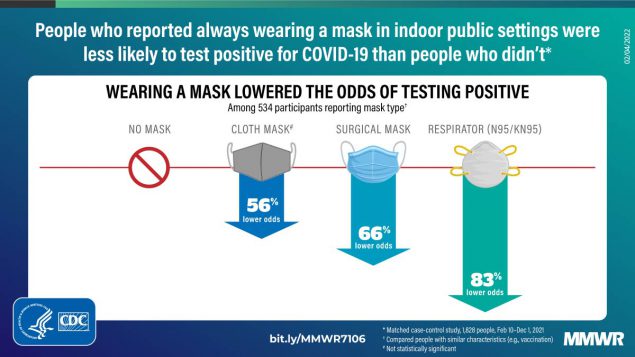
"A study[1] published by the Centers for Disease Control and Prevention (CDC) supposedly shows that wearing a face mask in public places dramatically reduces your risk of catching COVID-19. The CDC summed up the results in a widely shared graphic[2] that says wearing a cloth mask "lowered the odds of testing positive" by 56 percent, while the risk reduction was 66 percent for surgical masks and 83 percent for N95 or KN95 respirators.
If you read the tiny footnotes, you will see that the result for cloth masks was not statistically significant. So even on its face, this study, which was published in the CDC's Morbidity and Mortality Weekly Report, did not validate the protective effect of the most commonly used face coverings—a striking fact that the authors do not mention until the end of the sixth paragraph.
In 2020, the CDC went from dismissing the value of general mask wearing[3] to describing it as "the most important, powerful public health tool we have." In September 2020, then–CDC Director Robert Redfield asserted[4], without any evidence, that masks were more effective at preventing infection than vaccines would prove to be. Even before the spread of the highly contagious omicron variant, Redfield's successor, Rochelle Walensky, implied the same thing, exaggerating[5] the evidence supporting mask use in a way that made vaccination seem inferior."
So even in 2022, they are misleading the public.
[1] https://www.cdc.gov/mmwr/volumes/71/wr/mm7106e1.htm
[2] https://www.cdc.gov/mmwr/volumes/71/wr/social-media/mm7106e1...
[3] https://reason.com/2020/04/06/the-cdcs-revised-face-mask-adv...
[4] https://reason.com/2020/09/17/suggesting-that-face-masks-are...
[5] https://reason.com/2021/11/09/the-cdcs-director-implies-that...
Could it possibly be the case that these statements are all true?:
1) We don’t know if masks donned by untrained people in normal public settings impacts transmission
2) We do know that masks donned by medical professionals in a medical context impacts transmission
3) We know there are not enough masks available for both the general population and medical professionals
And if those three statements are all true, couldn’t it make sense to arrive at the position: the public should not get masks until medical professionals are equipped with what they need?
>the public should not get masks until medical professionals are equipped with what they need?
disagree. I think people should be free to acquire any product they want on the market, and I believe it is HIGHLY unethical for government to come in cease medical equipment / masks/ or anything else under the guise they "do not work" for the public so we need to take them from you and give them to these other people that are better than you
Regarding Fauci, are you pointing to his March 8 2020 communication that "there's no reason to be walking around with a mask?"
The full statement is here: "In America, right now, there's no reason to be walking around with a mask. When you're in the middle of an outbreak, wearing a mask might make people feel better and it might even block a droplet here or there. But it's not providing the perfect protection that people think that it is. And often, there are unintended consequences - people fiddling with their mask and touching their face."
This was both at the time, and currently, an open question as to how these things net out at the population level. This is a pretty nuanced and detailed communication that, unsurprisingly, the "I deserve nuance" crowd has completely eliminated.
From your comments you clearly on the camp of supporting government tyranny, I bet you fully supported lock-downs, mandated masking, mandated vaccinations as well?
let me ask then, are there any limits on government at all in your worldview or can the government exclaim "national emergency" and wipe away any an all limits to their authority?
>>the government does have the ability to seize most anything for the national interest. Both of these powers are well established and have been used throughout history both for good things and bad things.
that is absolutely incorrect, as the Supreme Court has shown more than a few times (see case law around the seizing of guns after Katrina for an example of government exceeding their authority). There has not been much if any adjudication around the ceasing of medical supplies during the pandemic, or the seizing of labor (i.e lockdowns) both of which should clearly be 5th amendment violation and require just compensation. I would love to see some lawsuits over that, if the ACLU was actually about protecting civil liberties they would be at the forefront of those suits.
>>are you pointing to his March 8 2020 communication
No I am pointing to multiple TV interviews
"The government has the ability to seize most anything" == there are not classes of items the government cannot seize. Rather there are circumstances under which they can and circumstances under which they cannot. I suspect the reason you're not seeing much adjudication about these circumstances (medical supplies during a pandemic) is that it's not that controversial an application in legal circles.
Ah yes the vague "that thing I remember that I cannot point to."
All studies done at scale, in peer reviewed journals before and since the pandemic have shown that not to be the case. N95s work, if used properly, that’s it.
If you work / have worked with people in biosafety labs they’ll tell you. What we did during the pandemic was effectively role play. Cloth masks, surgical masks, kN95s, all do approximately nothing. Only thing you could maybe argue is people avoided each other a bit more and spit didn’t travel… but the virus was airborne and that was considered highly likely even in Jan 2020.
Fauci’s FOIA requested private emails cover a lot of this; as does many many of the top epidemiologist (who were censored).
*Addendum*: It’s the same with the companies, CDC and FDA who suppressed ivermectin research
https://twitter.com/rwmalonemd/status/1607710183022628864
IMO the real reason they claimed “masks didn’t work”, “alternative drugs don’t work”, etc is because they needed the EUA. The companies producing the vaccines lobbied to get everything else suppressed so they could role out mRNA tech. That tech will allow them to offer pretty much any genetic therapy. Government had every incentive as well, more centralization and no liability. Pushing alternatives would pose more risks, with no upside.
Imo this was inevitable. It was only preventable with an open market of ideas, which Twitter, Facebook and others suppressed.
There’s also no reason that hearing there is “no evidence” for something requires you to adopt the silliest possible assumption for whether it’s actually true, but doctors seem to like doing this anyway.
(The actual answer for whether masks are “effective against covid” is “which covid?” - cause it’s different for 2020 covid and Omicron.)
Studies show that surgical masks are only marginally effective at their goal of reducing transmission, and then only if they are worn properly. Of course, one can rely upon medical staff for that. Not so much the general population.
https://med.stanford.edu/news/all-news/2021/09/surgical-mask...
It's just one source, but I'm genuinely curious.
Trillions of dollars were pumped into propaganda and research in 2020. It takes years to go through, receive grants, construct experiments, get approvals, analyze and validate. We are only now starting to see initial results for new masking studies. They still need to be replicated, etc.
Here’s an example of a large scale study from 2015 where cloth masks increase risk of illness (over nothing):
https://pubmed.ncbi.nlm.nih.gov/25903751/
Here’s a 2021 study showing masks aren’t really good as well (a randomized control trial) https://www.acpjournals.org/doi/10.7326/M20-6817
My general point isn’t the specifics, it’s that the jury is out.
Can you provide the source for this?
Nobody knew what was going on, I read as much about covid as I could (including HN comments about something to do with quinine that was popular for a day or two)
This is the source I found https://www.latimes.com/science/story/2021-07-27/timeline-cd...
I think there is a big time Mandela effect here. I remember “don’t buy masks” as being about preserving masks for essential workers and medical professionals, I don’t necessarily recall the portion where they said it didn’t help infection rates, but yet there it is.
I think any reasonable person can acknowledge there's a huge leap between "I was confused by what you said" and "YOU LIED TO ME!!!!"
Assuming you were alive and paying any attention the past two years, the source would be your own eyes and ears, consuming the (US) CDC’s official communications. I wasn’t even in the US and encountered them! In fact, I once even repeated their false claim about masks very early last year during a recorded zoom call with a friend. Then after looking at the very different claims from my local CDC, I realized the US one was wrong.
This specific messaging has been a rallying point for people who don’t even believe covid exists. At least that was the case in the US
To be fair though, the VP was an epidemiologist, so there was an unfair advantage.
My opinion at the time (when vaccines looked very distant) was that places like Japan, Taiwan, Singapore and Korea could still control the pandemic via border quarantines and contact tracing (which happened) and that places like the US also could also achieve good results via mass testing (which didn’t happen).
It would have taken about a billion tests per week, but the US certainly had the industrial capacity do it. The problem, IMO, was lack of state capacity. Even as the pandemic spread around the world, the FDA continued processing applications for PPE producers, vaccines and everything else at the same sluggish rate (of a 6+ months delay) that it had been.
Tyler Cowen spoke at length about this on various economics and other podcasts.
So in early 2020, with limited data - china really screwed is here - the initial lockdowns in places like SF Bay Area made sense. But the lockdown didn’t persist of course and realistically speaking people always had freedom of movement: the police were NOT and we’re directed to not aggressively ticket/arrest: all those contacts just increased the chance of infection anyways.
Now as for the rest of the US I disavow what happened there.
And comparatively, they are way more critical for medical personnel. They should have just communicated it that way rather than trying to downplay effectiveness. Shortages abounded anyway.
They've used two different narratives at two far apart times that CNN highlights quite well.
You don’t have to assume the CDC was full of lies if you remember that they were working from an inaccurate hypothesis at a time when reducing transmission rates seemed like it might be the most important thing in the world.
Dr Fauci feared the rising costs of masks and whether the medical system would have enough. That wasn't his decision to make, but he made it. He later started using a new line, which is that they weren't aware that 40-50% of people were asymptomatic which was irrelevant for the problem at hand.
If Covid was only transmissible by people with symptoms, you could control spread by asking those people to stay home and everyone else is clear — no masks needed. If it’s impossible to know if you’re infectious without testing, masks make more of a difference. More effective ones are obviously better.
I certainly knew at the time that I was triaging masks because health care workers were more important than me. I still have a note on my fridge from February thanking me for donating some N95s I had from wildfire season. The trade off was pretty clear.
the CDC was initially correct in assessing that (the way we wear) masks would not be a panacea for covid, but that was politically unpalatable which is why it was walked backed so haphazardly. masks, and all the CDC outrage around them, was effectively mediopolitical redirection of our anger toward each other rather than toward our corporatocratic institutions to quickly and correctly assess the threat and then appropriately deploy (only) effective measures.
While this is true, at least in the early pandemic when social circles were pretty tight (often just your household, but even if not quite a bit smaller than during normal times), the virus has to be introduced to that social circle, it won't just manifest itself out of nothing in one of it's members. Masking when not interacting with that circle will help keep the virus out of that circle of people in the first place.
This is a very hard thing to maintain for long periods of time, but in the context of 2020 it's a reasonable approach to take.
as i see it, masks make sense in 2 general cases:
1) when uncertainty about transmission and lethality is high, as was the case in nov/dec 2019, until population risk is more closely bounded
2) when situational risk is measurably elevated over baseline, like having comorbidities, surgery, packed mass transit, etc.
by april 2020, we (in the US at least) had enough information that masking wasn't going to be that panacea, when taking human behavior into account (trust channels, weariness, etc.). yet, it was still weaponized by the media and politicians.
i know this because i was making these very same points back in april 2020. to be effective, a mask has to be worn at the right times (like being face-to-face with another human) and correctly (creating a tight seal around the nose and mouth using an effective filtering material). most people weren't doing either of these most of the time.
1. A severe shortage of masks which were considered to be particularly effective, specifically N-95 masks capable of filtering viral particles. Such masks as were available were being preferentially directed to healthcare providers and first-responders.
2. A concern that the general public would not wear or use masks appropriately, and might take additional compensatory risks on the premise that masks, often utilised suboptimally, provided strong protection. Note too that at the time vented masks, which had a flap that opened on exhale (and hence transmitted any viral particles to the environment) were fairly popular and widely-utilised.
3. A thought that COVID-19 was not as subject to airborne transmission as it turned out to be --- fomite-based transmission (particles on surfaces generally transferred by hand) was thought to be significant. Subsequent evidence has shown this to be far less the case than thought at the time.
4. A general lack of hard knowledge of specifics of the novel coronavirus, resulting in recommendations based on general principles of vector reduction drawn from other diseases.
5. A decidedly muddled, politicised, and anti-scientific response from the US administration at the time. For those keeping score, that was not the present Administration, though from discussion in this thread, that might not be clear.
6. In an epistemic environment in which trust in media, government, and expertise had been under prolonged attack.
All of this was discussed at the time, and in particular Zeynep Tufekci was discussing most of these factors as early as 17 March 2020 in New York Times opinion pieces and elsewhere. Example:
"Why Telling People They Don’t Need Masks Backfired"
Subtitle reveals much: "To help manage the shortage, the authorities sent a message that made them untrustworthy."
... First, many health experts, including the surgeon general of the United States, told the public simultaneously that masks weren’t necessary for protecting the general public and that health care workers needed the dwindling supply. This contradiction confuses an ordinary listener. How do these masks magically protect the wearers only and only if they work in a particular field?
Second, there were attempts to bolster the first message, that ordinary people didn’t need masks, by telling people that masks, especially medical-grade respirator masks (such as the N95 masks), needed proper fitting and that ordinary people without such fitting wouldn’t benefit. This message was also deeply counterproductive. ...
It is of course true that masks don’t work perfectly, that they don’t replace hand-washing and social distancing, and that they work better if they fit properly. And of course, surgical masks (the disposable type that surgeons wear) don’t filter out small viral particles the way medical-grade respirator masks rated N95 and above do. ...
[P]roviding top-down guidance with such obvious contradictions backfires exactly because lack of trust is what fuels hoarding and misinformation.
<https://www.nytimes.com/2020/03/17/opinion/coronavirus-face-...>
There's much more, the piece is well worth revisiting and should be a key document in future studies of the pandemic and its senselessly botched response.
Failures to accurately describe the circumstances and context of the CDC advice, or to acknowledge that the CDC rapidly reversed course once this became evident are themselves harmful.
Science is that which adapts to new knowledge and understanding. Dogma is that which clings to articles of faith despite evidence, in the interest of advancing a specific ideological agenda.
For all its faults, the CDC followed science. Incorrectly initially as it turns out, but ultimately correcting itself rather than insisting on dogma.
That point is made in another comment on this thread: <https://news.ycombinator.com/item?id=34150615>
The further complication is in crafting effective, credible, useful, and actionable messaging in a time of crisis. Here too the CDC failed, but in large part because significant other actors were strongly intent (and remain strongly intent) in seeing it fail.
That's not what they said, which kind of highlights just how much misinformation was indeed being spewed well before then.
One solution might be for n moderators to evaluate and give the label to the reported violation, and ensure n is odd and larger than 1. However, this is tedious (although that is the tradeoff for fairness) and assumes there's an equivalent number of moderators who lean liberal, conservative, and neutral (in addition to assuming there's no biases created by the culture of the social media platform and management).
Perhaps each report should be given a detailed criteria as to why it was labelled as inappropriate, but this too would be subject to bias, emotional response from both parties, and slow down the moderation process which is likely backed up with many events in the queue, without really any direct benefit to the bottom line of the company although one could view this as a quality issue and lack of QA will ultimately produce an inferior product that is heavily QA'd.
Misinformation - False information that is spread regardless of intent to mislead.
Disinformation - False information that is spread with intent to mislead.
Misinformation can fall in the category of "Bullshit" quite often. There's no regard for the truth. Rather only a care that individuals are persuaded. This lack of respect I believe is the core problem these articles are trying to discuss.
This is the post-truth politics world we live in. Encouraged truth-telling, fact checking, not reopening settled debates, pressure big tech to combat disinformation(note the word used here, not misinformation), etc.
“A lie can travel halfway around the world while the truth is putting on its shoes” - Unknown
If big tech has to combat disinformation. Big media should be held accountable to correct earlier misinformation. Rather than the "all or nothing" approach we see today until the next developing story makes headlines years later.
Moderated implies it's unbiased while it's clearly not.
How about: you don’t. It’s not up to twitter moderation to determine what is fact in real-time.
100% yes. The process used by multi-billion dollar global communication platforms for fact-checking should not be this sloppy, where they themselves become purveyors of misinformation in marking accurate information as misleading.
It's one thing for some regular Joe Blow to post misinformation. It's another for the party with the full weight/authority of being the platform provider, and all of the credibility that comes with that, to post misinformation.
"Twitter executives did not fully capitulate to the Biden team’s wishes. An extensive review of internal communications at the company revealed that employees often debated moderation cases in great detail, and with more care for free speech than was shown by the government.
...
But Twitter did suppress views—and not just those of journalists like Berenson. Many medical and public health professionals who expressed perspectives or even cited findings from accredited academic journals that conflicted with official positions were also targeted. ... There were three serious problems with Twitter’s process [bots, contractors, and biased decision making by top level execs]".
This seems to be more a story on the complexities of content moderation than anything. There WAS a lot of misinformation about covid, and a lot of it could cause real harm. At the scale Twitter operates at, false positives are impossible to avoid. Should Twitter have opted for more false negatives than false positives? I don't think so.
That is not to say this is article does not share useful information, but the headline is rather misleading.