They said what was true: we don’t know if they do work.
The communications and advise from the medical establishment and media, were so terrible that that I question incompetence and lean towards corruption.
The flip flopping, the political and idealogical justifications, the theatre of everything without substance.
The People can handle nuanced messaging, what they can't handle is lies, obfuscation, and leaders who refuse to admit they are wrong.
What we probably know is that if 100% of the population wore masks 100% correctly 100% of the time and kept 100% of their prior behavior, it would probably reduce transmission more than 0% for some pathogens.
This is another way of saying, “we don’t really know,” and it gives you an idea of why it’s hard to figure it out.
The ambush on “masks don’t work” was because it seems almost certainly the case that masks don’t hurt, and it’s likely the case that if masks have any benefit, that benefit will be proportional to levels of compliance, so if we get to choose between levels of compliance, higher is probably better.
My personal view is that after half the population came to view “no masks” as a part of their political identity, the overall pushiness on masks probably netted out to negative, but this is not blame I can assign to CDC et al.
The Magic Answer Box people are demanding that they be trusted with nuance and detail and yet continuously demonstrate Magic Answer Box thinking in the face of nuanced and detailed information.
You did get nuanced messaging
"Yeah well... Mandela effect!"
We've also had the CDC telling us the vaccines are safe and effective, when neither are strictly true. They may be less dangerous than getting a severe case of COVID, but they don't confer immunity, and they don't stop you from spreading it, in direct contradiction to other statements they've made.
Is it any wonder that people misremember who exactly told them that masks did or don't work, and when they heard it?
"Vaccine is effective" does not and has never meant "confers 100% protection from infection."
The vaccines remain both safe and effective in the same way that e.g. Tylenol is safe and effective. If you want the fully nuanced definition of these statements mean in the Tylenol case or the vaccine case, you can literally look up the data from the clinical trials and see it. Of course your rebuttal to this will be, "well, I can find X dataset with real world evidence of Y claim" and I'll say: well, there's a reason real world evidence is (counterintuitively, given the name) not considered to be very good evidence in pharma world. That's because it's incredibly hard to isolate variables in analysis of real world data, even assuming the data exists in an analyzable format (which it generally doesn't - also contrary to most people's expectations).
Hmm no, it's no wonder that people misremember who exactly told them what. We have a shitshow of a media ecosystem and you have "contrarians" like yourself who are pumping nonstop garbage like "CDC said X" into it when CDC did not, in fact, say X.
Mistakes were certainly made and everyone was learning as we went, but your line of inquiry actually points pretty solidly away from the solutions we actually need: 1) there should NEVER be PPE shortages in the richest country on earth, 2) there should RARELY be testing capacity shortages and sitting presidents should NEVER deliberately slow down pathogen testing, and 3) there should be much better data infrastructure that allows us to understand all of these things in real time.
Some blame for each of these lays at CDC feet, some at FDA, some at NIH, and so on, but fixing these requires an entirely different conversation than the one we're having.
We don't know this about condoms, either.
It took decades to get medical doctors to start washing their hands [1]. It took decades to get people to use seat belts in cars [2]. It took decades to accept that tobacco smoking causes lung cancer [3].
Masks work [4], but it will take decades before this is accepted through the chain of command in the medical profession, and not only by front line science.
[1] https://en.wikipedia.org/wiki/Ignaz_Semmelweis#Conflict_with...
[2] https://en.wikipedia.org/wiki/Seat_belt#History
[3] https://en.wikipedia.org/wiki/Health_effects_of_tobacco#Hist...
[4] https://www.scientificamerican.com/article/masks-are-a-prove...
There are people who understand how air moves, and have a good understanding of how viruses travel.
Masks have been hailed as a silver bullet (so that people don't have to get active and eat well and be healthy, and government and businesses don't have to upgrade HVAC systems), to the point where people think they work outside!
Are there masks that work? Yes. Is that cheap surgical mask or a cotton one really effective? No.
Nevertheless, we’re capable of appropriate risk based inference. We can verify that masks slow down the spread of airborne particles and we know SARS-type viruses spread that way. Combined with the low cost of mask wearing and the huge impacts of a pandemic, a good risk analysis weighs heavily in favor of using them.
Even accepting the over-skeptical view you’ve given, official statements were still overconfident. Fauci was saying in February 2020 that “there’s no reason for anyone to be wearing a mask”, which you can’t justify by these claims of ignorance. “A small chance of slowing a SARS-type virus” is a great reason to wear a mask!
[1] https://slatestarcodex.com/2020/04/14/a-failure-but-not-of-p...
Note that what confuses people here is not that the consensus on whether masks work or not changed, but that it didn’t change. “We don’t know if masks work, don’t get them” turned to “we don’t know if masks work, start wearing them.”
I agree it would’ve helped the credibility issue a lot if they were more open about the supply calculus behind the scenes, but I’m personally pretty confident this would’ve yielded worse outcomes. No chance that the population wouldn’t have scrambled for masks and therefore no chance that the people who did actually in reality need them most would’ve gotten them.
Of course there’s a lot, a lot of room for criticism of the mask/PPE shortage existing at all, but obviously the solution to that looks different than the solution to “CDC said masks don’t work.”
That was stupid, and foreseeably so.
It's completely believable to me that future mask compliance among the general population is way less valuable than ensuring that medical professionals had N95s in the first half or first quarter of 2020. Also seems believable that that guidance reduced N95 consumption among the general public.
Of course there was a mask shortage. But like the others said, the correct way to fight a toilet paper shortage is not to tell people that it’s ineffective at removing feces from your anus. It’s to a) throttle sales at retail, b) give guidance on alternatives (here, how to turn a shirt into a mask), c) coordinate on increased production.
If masking up had been a high status thing to do early on, that would have saved a lot of effort in policing later.
Yes, lying to the public and expecting them to both trust and keep up with the latest lie is foreseeably stupid. I hope you don’t need insurmountable evidence to agree with that part.
Again, CDC did not say masks aren't effective. They said we don't know if they are. This was and largely remains true. For your other solutions, you think instituting a nationwide rationing system was a more accessible solution than saying "we don't know if they work [true] and medical professionals need them more [true], please don't buy them?" And yes, we very obviously should've invoked the Defense Production Act pretty much immediately on testing and PPE. Quite indefensible that we didn't.
"Has foreseeable negative consequences" != "is stupid," especially in emergency scenarios where you're picking between bad options and worse ones.
Like I said, it was "true" only in the sense that "we don't know if parachutes work [to save you're life in freefall from an aircraft]", which is to say, it's criminally bad to communicate that as your advice, given the costs and benefits to the user. There was no great shift in evidence that caused the CDC's change in advice, only a change in which way they wanted to clumsily manipulate the public.
>"Has foreseeable negative consequences" != "is stupid," especially in emergency scenarios where you're picking between bad options and worse ones.
Correct, and the path they took foreseeably led to the worse ones rather than the mere bad ones. The few people who correctly saw through the CDC advice still hoarded masks, still made up for the non-buying of those who nobly held back (it only takes a few hoarders to exhaust the supply), and health care providers still saw the very same shortage ... it's just that now, they have to walk back the advice against mask-wearing and suddenly pretend the evidence became ultra-strong overnight, even though half the public has made the earlier statements their hill-to-die-on, and we missed a very large window in which we could have been advising people to make good-enough ad hoc masks.
In what world is that the less-bad outcome? Or somehow not foreseeable that the public might actually believe you when you lie about your position on masks?
The completely plausible world in which our healthcare providers wouldn't have been able to get any effective PPE during the initial wave and died, became seriously ill, or refused to work en masse in the first month of the pandemic?
Explain why that was not a believable risk in Jan/Feb 2020?
There was no such spared supply. It was either saved by retail throttling or state pre-emption, not because it was withering unwanted on the shelves.
The second part here just doesn't actually substantiate the first part. If this were strictly true then I would've never been able to observe 1) a medical professional purchasing a mask from a retailer and 2) a non-medical professional declining to purchase an available mask from a retailer.
In fact I observed both.
Of course it's an open question as to at what scale this occurred and how it nets out in the end against the credibility hit, it very well could've been minor and not worth it, but that's the thing that remains not obvious even now, never mind in early 2020.
From https://reason.com/2022/02/07/that-study-of-face-masks-does-...
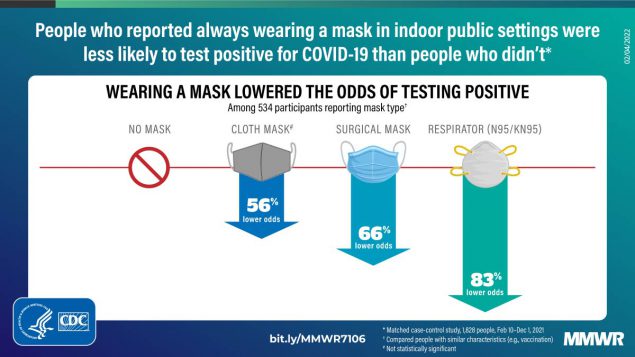
"A study[1] published by the Centers for Disease Control and Prevention (CDC) supposedly shows that wearing a face mask in public places dramatically reduces your risk of catching COVID-19. The CDC summed up the results in a widely shared graphic[2] that says wearing a cloth mask "lowered the odds of testing positive" by 56 percent, while the risk reduction was 66 percent for surgical masks and 83 percent for N95 or KN95 respirators.
If you read the tiny footnotes, you will see that the result for cloth masks was not statistically significant. So even on its face, this study, which was published in the CDC's Morbidity and Mortality Weekly Report, did not validate the protective effect of the most commonly used face coverings—a striking fact that the authors do not mention until the end of the sixth paragraph.
In 2020, the CDC went from dismissing the value of general mask wearing[3] to describing it as "the most important, powerful public health tool we have." In September 2020, then–CDC Director Robert Redfield asserted[4], without any evidence, that masks were more effective at preventing infection than vaccines would prove to be. Even before the spread of the highly contagious omicron variant, Redfield's successor, Rochelle Walensky, implied the same thing, exaggerating[5] the evidence supporting mask use in a way that made vaccination seem inferior."
So even in 2022, they are misleading the public.
[1] https://www.cdc.gov/mmwr/volumes/71/wr/mm7106e1.htm
[2] https://www.cdc.gov/mmwr/volumes/71/wr/social-media/mm7106e1...
[3] https://reason.com/2020/04/06/the-cdcs-revised-face-mask-adv...
[4] https://reason.com/2020/09/17/suggesting-that-face-masks-are...
[5] https://reason.com/2021/11/09/the-cdcs-director-implies-that...
Could it possibly be the case that these statements are all true?:
1) We don’t know if masks donned by untrained people in normal public settings impacts transmission
2) We do know that masks donned by medical professionals in a medical context impacts transmission
3) We know there are not enough masks available for both the general population and medical professionals
And if those three statements are all true, couldn’t it make sense to arrive at the position: the public should not get masks until medical professionals are equipped with what they need?
>the public should not get masks until medical professionals are equipped with what they need?
disagree. I think people should be free to acquire any product they want on the market, and I believe it is HIGHLY unethical for government to come in cease medical equipment / masks/ or anything else under the guise they "do not work" for the public so we need to take them from you and give them to these other people that are better than you
Regarding Fauci, are you pointing to his March 8 2020 communication that "there's no reason to be walking around with a mask?"
The full statement is here: "In America, right now, there's no reason to be walking around with a mask. When you're in the middle of an outbreak, wearing a mask might make people feel better and it might even block a droplet here or there. But it's not providing the perfect protection that people think that it is. And often, there are unintended consequences - people fiddling with their mask and touching their face."
This was both at the time, and currently, an open question as to how these things net out at the population level. This is a pretty nuanced and detailed communication that, unsurprisingly, the "I deserve nuance" crowd has completely eliminated.
From your comments you clearly on the camp of supporting government tyranny, I bet you fully supported lock-downs, mandated masking, mandated vaccinations as well?
let me ask then, are there any limits on government at all in your worldview or can the government exclaim "national emergency" and wipe away any an all limits to their authority?
>>the government does have the ability to seize most anything for the national interest. Both of these powers are well established and have been used throughout history both for good things and bad things.
that is absolutely incorrect, as the Supreme Court has shown more than a few times (see case law around the seizing of guns after Katrina for an example of government exceeding their authority). There has not been much if any adjudication around the ceasing of medical supplies during the pandemic, or the seizing of labor (i.e lockdowns) both of which should clearly be 5th amendment violation and require just compensation. I would love to see some lawsuits over that, if the ACLU was actually about protecting civil liberties they would be at the forefront of those suits.
>>are you pointing to his March 8 2020 communication
No I am pointing to multiple TV interviews
"The government has the ability to seize most anything" == there are not classes of items the government cannot seize. Rather there are circumstances under which they can and circumstances under which they cannot. I suspect the reason you're not seeing much adjudication about these circumstances (medical supplies during a pandemic) is that it's not that controversial an application in legal circles.
Ah yes the vague "that thing I remember that I cannot point to."
The CDC did not say that makes do not work. They said we do not know if masks work, which was (and mostly still remains) true.
Only person who said we have positive knowledge that masks don’t work was USSG Jerome Adams, and that was pretty late in the ordeal.