China has a fantastic subway system in most big cities, for example. I once took a subway ride from the Shenzhen airport to the Hong Kong border, crossed the border, switched to another subway and arrived in downtown Hong Kong. That's around 65km (40 miles) by public subway!
I have owned a car before, and I did not use those other transportation methods any less. We don't own a car anymore because it does not make economic sense for us.
When we need to travel by car inside the city, we just use Uber (~30 EUR/month is what we currently pay). When we need a car for a couple of hours to pick up stuff, we use one of the car sharing vendors. We can get "the right car" for whatever we need for ~4 hours with gas for less than ~20 EUR (~once every two months). When we want to travel around with a car, we just rent a high end one for the weekend for ~300 EUR. We do that once every two months, although in the summer a bit more often. This means we end up paying ~3000-3500 EUR/year in rentals/uber.
If we were to own a high end car, we would at least have to pay 30.000 EUR/year for a used one with 100k kms. On top, we need to pay insurance (~500-600EUR/year), parking (~150EUR/month where we live), maintenance (~200/year), handle some other burdens (wheel changes, etc.), and if for whatever reason we need a different car (to pick up something big), we still need to rent that. That puts the costs of owning a car at 2300-2400EUR/year + unforeseen maintenance + gas + rentals + (30.000 EUR - reselling value) / (years until re-selling).
Where we live, unless one uses the car at least every weekend, it makes no sense owning one. At one weekend usage per month, you can just rent, and are more flexible.
I occasionally drive a 20 year old Opel that was purchased 7 years ago for €2500. It works great. I ride my bike most of the time, but it's really handy to have a car to haul kids or heavy/bulky stuff.
€30k is enough for pretty much any new entry level or basic trim car outside of Audi/BMW/Porsche.
But it also depends on how and where you live and work specifically. If I lived in a many of the areas outside of the Périphérique in Paris, not owning a car would probably impact your overall quality of life, but I'd still not want to take it into the city.
We use public transit and bicycles (lots of parents have cargo bikes for transporting little kids e.g. https://www.babboe.de/lastenraeder/big).
Anyway, could you also elaborate on your parking situation? Is this mostly destination parking? I'm just a bit surprised, since a resident parking permit is like €20 for two years here in berlin [0].
[0] https://service.berlin.de/dienstleistung/121721/ (german)
In japan you even have vending machines to pay for your restaurant food inside the restaurant, where your usually paying upfront. And some parking lots have per stall locks that don't let you drive away until you pay. You could argue that is symbolic of lower "trust".
For stuff outside, they just don't have problems with vandalism and theft the way America does, so it makes it much more feasible to have lots of vending machines outside: no one is going to deface them or break into them.
This is also really useful for bicycling. Bikes in Japan all seem to have little locks on the back which go through the rear wheel's spokes, so someone can't just hop on and pedal away. But there's nothing stopping someone from picking the bike up and carrying it away, putting it on a truck, etc. But theft is almost nonexistent in Japan, so people just leave their bike parked on the sidewalk and don't worry about it, and this makes biking very easy and feasible, whereas in the US you have to worry about someone stealing it if it isn't U-locked to something completely immovable, and even then someone might steal parts off of it.
In general people are less reticent to bring a foldable bike in the subway for instance.
The subway systems in Taipei and Kaohsiung are great, but it's easy to ignore just how much of each city isn't serviced by underground or above ground rail, and are only accessible via public transportation through spotty bus networks.
As opposed to the peculiarity of Japan, where cash (often in envelopes) is used for a lot of stuff (instead of cards). :)
There is some public healthcare but no universal healthcare.
ER is not healthcare. You do not get treatment for chronic diseases, cancer etc. ER only treats you for the life or health threatening consequences of not getting treatment.
Folks suffer until things are an emergency as well and hospitals won't always help if you, say, need surgery for cancer that isn't presently killing you and isn't an emergency.
My wife's hospital was hit hard by ACA because it reduced federal funding for uncompensated care. The idea was that the funding could be cut because more people overall would be insured. Unfortunately enough of their patients still are without insurance that the funding shortage led to two rounds of layoffs. They seem to have adjusted to the new financial reality now and are hiring again. But the first couple years after ACA passed were tough.
I guess it would be more accurate to say that the federal government funds uninsured ER visits, but the funding falls short of what is necessary especially after ACA.
1. https://www.usatoday.com/story/news/politics/2017/07/03/who-...
So there's plenty of drama. Medical bankruptcy in particular is something that I don't think occurs anywhere else.
I doubt the veracity of this oft-repeated meme, but I'll let Snopes provide the detailed analysis: https://www.snopes.com/fact-check/643000-bankruptcies-in-the...
I would appreciate similarly-detailed evidence to the contrary.
So Americans are already paying for socialised health care, they're just not receiving it.
No public health care? That isn’t true either. Medicaid and Medicare are public health care.
Another legitimate peculiarity of Americans is the vastly higher disposable income compared to most other countries. Even with all of the “free” stuff, the French have lower wages and far less disposable income than Americans.
I think you know that "public healthcare" was referring to universal healthcare in this context. US is the only western democracy without universal healthcare.
I am afraid your data is outdated: it is now used for less than 15% of payments, mainly by old people or for C2C payments.
I am in my late twenties and have emitted only 3 checks from my account, in my entire life.
When living in France I never came across the use case you describe, at least not in this form. But I did often come across people wanting money from me sending their RIB as an image attachment to emails rather than copying and pasting their IBAN into the body of the mail like elsewhere in Europe.
You also have venmo, square cash, fb messenger, etc.
[0]https://www.weforum.org/agenda/2016/12/this-map-shows-how-mu...
Table 6 of p.10 [1] shows zero deaths from salmonella in the UK for the period 2006-2015.
https://assets.publishing.service.gov.uk/government/uploads/...
In the context of public healthcare the OP felt like an unwarranted and overly simplistic diversion, which I think is why I got frustrated.
EDIT: I also realised I typed "US" twice in my original comment; the second should be "UK".
- Food prices inc. agricultural protection & consumption taxation;
- Income;
- Food availability;
- Consumption patterns;
- Preference trends inc. health, food safety, production process & taste;
- Demographic trends;
- Retailing & regulation (e.g. consolidation laws).
Some of the factors it highlights that may cause lower expenditure on food in the US than in the EU are:
- Lower food pricing due to protection & taxation;
- Food safety concerns in the EU since mad cow disease and dioxin in chicken feed (and foot & mouth disease in the UK) leading to lower confidence in food supply regulation;
- Greater willingness in the EU to pay more for higher animal welfare in the food chain;
- Higher proportion of organically grown food across the EU and differing definitions of "organic";
- Longer history of consolidation laws in the US.
Every city looks nice as a Tourist, but then it's hard if you live there and in the false zone of the city (=farest away)
I sometimes waited for hours in NY state blizzards to catch a bus before I was able to afford a car. I walked 2-3 hours to a mall and to Walmart when all other students went home for break. Bus service was irregular and spotty.
We have shittier bus services in small towns and villages as well and people often use cars for convenience. But public transport is still present at a minimum level.
I honestly don't get this dependence and focus on cars in the US. Must be some former Detroit lobbyism that led to this.
-On macro scale, the US is bigger, more spread out, with tons of land, and there's something in the American psyche that pushes Americans to expand, settle, and use all of it.
-On a micro scale, and as a consequence of the first point, Americans are accustomed to homes that are much bigger, have yards, and are more adverse to sharing a wall with a neighbor. Sure there have been exceptions like tenements in NYC, but even in those cases those residents could wait to get their own Levittown cape cod in a residential subdivision.
-Finally, a ton of this growth happened at right after cars became mainstream and affordable, but before the long terms downsides of car based societies were well understood. Therefore, a huge majority of infrastructure investments were made on what people wanted (cars and space), and not public transit.
-Now, while many of the problems of car based societies are better understood, that doesn't nullify the often ignored benefits of car based societies. Also, for public transit to work at a massive scale, people would have increasingly do two things that Americans intrinsically hate: Move closer together and pay more taxes. There may be a growing population that finds that appealing, but the silent majority in this case is an enormous and entrenched one.
The central part of most EU cities is pre-1914, when cars were a curiosity. And for decades after that, cars were nowhere near as affordable to citizens as they were in the US, because the US was just much richer in (say) 1960.
https://en.wikipedia.org/wiki/General_Motors_streetcar_consp...
When school is over your kids walk safely back home by themselves because there aren't cars out there threatening their lives.
This sounds way less stressful than your kids being dependent on you and your car for everything they need.
If you can one kid - there is no problem really. Walk him or her to school in the morning, ask grandmother to bring them back etc.
When you have more than one - it is entrily possible they will end up going to different schools and after the school one of them had to go to the music shool and the other one to his hockey team or something etc etc. You simply can't do this without a car.
I was the only child in the family so we never needed a car for this kind of scenario, plus we were living in a relatevely small city (450k), so public transport was more than enough for me, but this is not always the case.
>and then walk a couple more blocks to work.
yeah, now imaging you have two of them going to two different schools, each 40 minutes walking distance from home, different directions and your office in somewhere else too.
Also, having cars but no public transit doesn’t change the fundamental equation and doesn’t improve the situation much (especially considering the fact that in many places driving in the morning rush hours might even be slower than taking the subway), in fact quite the opposite, teenagers are wholly dependent on parents when they could have been independent.
> You simply can’t do this without a car.
I grew up like that. People have been doing that for decades.
This is another difference that intersects with other issues in America. In a car, your child is under your control. Moreover, adding to your following point of a child under ten being unaccompanied in public, no American parent would dream of letting their children go out alone and recently, this includes even children in their early teens. Especially in the previous decades, helicopter parenting has reached a new peak in the US, this seems somewhat coincident with a general infantalization of young adults.
On my train commute every morning there were school children who get off at my stop because it’s where their school is. Their rides happen at reduced fares as well.
The trope rings very false to me and seems to be about one particular demographic (white and suburban).
If there is an increase in over watching our children it’s because we’ve over indexed on cars, not the reverse.
This is, AFAICT, mostly a white suburban “middle-class” (mid-high income working class, including proletarian intelligentsia, really) attitude, rather than something that applies to all American parents.
That's getting less true as time goes on.
>and some grandparents will help,
If your parents live more then ~45min away (this is probably true for most people) it's probably not realistic to expect them to help out with childcare.
>Caretakers can be hired in certain cases
If you have the $$$ to rationalize it. That said, if you have to choose between a caretaker and a car it's an easy choice for most people.
>I grew up like that. People have been doing that for decades.
People have been enduring hardships for centuries. It's foolish to expect them to voluntarily continue doing so when they have other options. The fact of the matter is that most people who are in a position to own a car find owning a car worth the tradeoffs.
Sure, after a certain age.
>Kids under ten might need to be accompanied by a guardian, but there are usually two parents in a household, and some grandparents will help, too. Caretakers can be hired in certain cases.
This works out well in a well developed coutry I suppose. In Russia, for example, most people won't have this kind of options. You want your kid safe? You take your kid to the school yourself (before 10).
And again - I've describe certain cases, not just one. We've never had a car too, but for some cases this is a necessity.
A child on the BART train? You have got to be kidding. With the insane people, mentally ill, the thieves and the homeless, I would’t expose my kids to having to deal with that nonsense. Cars are awesome. Being forced to share public transportation with a bunch of weirdos isn’t progress.
I am riding home right now at 2am from the airport in Hayward to my house in Mountain View. In a car, I’ll be home soon. With public transport, I’m stranded for hours. Public transportation can’t go everywhere.
Last I checked kids don’t tend to wander outside at 2am, and places with public transit tend to have taxis too. (I would add that the last thing I want to do at 2am is to drive myself home; in fact, a couple years back I had an accident due to driving jet-lagged the day following an international flight.)
Typical American paranoia.
Hell, I won’t take BART through certain stops at certain times of the day and I’m a grown-ass man.
You mention 40 minute walking distance, that's three kilometres for a child or about 10 minutes by bicycle. Or perhaps five stops on a tram or subway.
It took a lot of stress off my parents that my brother and me were independent from a young age. Living in a society where you don't need cars gives you that flexibility and ease.
We were talknig about kids though.
Maybe it "helps" that the public roads are congested, and I simply wouldn't have time to take them anywhere by car. It definitely helps that I live in a good/central neighbourhood that is well covered by public transit.
Lyceum and Gymnasium will give you better programs, teachers, resources, special subjects etc. They have fewer seats too obviously. And you don't have too many of them.
Common schools why being generally the same - also usually have different education levels. So before sendingg your kid to one of them you do a research - what kind of teachers does the school has, does it have football field or pool, maybe even you'll look into what have become of it's graduates.
When I was in school (1995-2005) The nearest school was... okay. It wasn't bad, but you don't really expect anything of it. Half boys older than 14 were smoking already, girls not giving two shits about studies, teachers who would just to their 9 to 17 routine. So I was attending Gymnasium 20 minutes away if you take a bus.
Equivalent in all the areas one might measure the attractiveness and potential of a school?
[1]
https://en.wikipedia.org/wiki/Croydon
[2]
https://en.wikipedia.org/wiki/Golders_Green
edit:typo
Is there any reason you linked to wikipedia articles about a part of London with a large Jewish population vs a part of London with a large ethnic minority population?
I meant to pick a town/neighborhood with rich inhabitants (per capita) and a town/neighborhood with not so well off inhabitants.
I grew up in a small village (+-70k) in the Netherlands, we had 4 schools within 15 min walking distance and I think twice as many with 15 min cycling distance (all kids go to school by bike here). Why would you send your kids to schools 40 minutes walking distance from home?
edit: added number of inhabitants of the village
Some times you don't have a choice. Happened to a friend of mine here in Sweden. Their first kid got into the school closest to home. When it was the second kids turn that school was 'full' and they got sent to a school 10 km in the exact opposite direction.
> yeah, now imaging you have two of them going to two different schools, each 40 minutes walking distance from home, different directions and your office in somewhere else too.
I can't imagine why you would send them to different schools, unless one is a high school in which case they're old enough to get there by themselves. For most people the school they're taking the kids to is right next to the transit stop they'll be taking to work.
As of the rest of you comment - here is my answer: https://news.ycombinator.com/item?id=20632459
Point is, it’s not fundamentally impossible to live with 2+ kids and no car.
My point was about little kids, you won't send them off to a public transport. We are not talking about teenagers here. Not me at least.
I have 2 kids and live in Berlin and never had nor needed a car. I previously lived for 8 years in Vienna and the same holds true there.
The same will be true to most or all decently-sized western European cities.
In a city designed for walking and bicyling, you can do that by bike. And once they're old enough, they can do it on their own bike.
Of course the city needs to be designed for that. In a city designed only for cars, you're going to need a car for everything. The big issue here is: how do we want to design our cities?
> now imaging you have two of them going to two different schools, each 40 minutes walking distance from home, different directions and your office in somewhere else too.
If they're going to two different schools, most likely one of them is going to secondary school and can ride their own bike, or one of them is going to a special needs school and gets picked up. At least, that's how it works around here.
In any case, I don't consider 40 minutes a suitable distance for walking: take a bike. It's only a few minutes that way.
That said, my wife did insist I get a driver's license when we had kids, and I did. I rarely use it, and certainly for moving kids around the city, a light cargo bike is more practical in Amsterdam.
My other comment: https://news.ycombinator.com/item?id=20632459
As for the 'secondary' school - I, for example, was attending a Gymnasium as main and a musical Lyceum as a secondary. Both since 6-7 years old. And that's pretty common over here.
But Amsterdam is a sizable yet compact city, which makes everything easy to reach. In a differently designed city, or a smaller town where you might have to travel to another town, things can be completely different.
https://www.google.com/maps/@35.675605,139.6796798,3a,75y,22...
I also loved how (as you can see in this photo), people just park their bike the way you park a car: you just leave it there, without locking it to something. Here in America bikes like that would be stolen left and right. But I guess that's one of the big differences between a highly industrialized and developed nation and a 3rd-world one.
How old are these kids? Can they not walk themselves?
https://live.staticflickr.com/3662/3465284112_5aab494014_b.j...

A transporter bike can carry 2-3 kids easily. It's the most convenient, cheap and healthy option. As soon as the kids are old enough they get their own bike.
Of course, it's convenient to have access to a car a couple of times a month. But definitely not on a daily basis.
This is exactly how many parents in Copenhagen drive their kids around. I would say that around half of all young parents in Copenhagen get a transporter bike like this one.
We were leaving Copenhagen for America shortly after our youngest was born but otherwise we would have biked the kids around as well.
Bottom-line: some cities can never be be great for bikes. But most can but just aren't.
They usually go 15km/h or even slower (presumably due to the extra weight and/or overprotective new parents), and they're so wide that they take up the whole lane, preventing you from overtaking them. And since we usually have grade-separated bike lanes here (supposedly the holy grail, according to HN!) you can't even spill into the car lane temporarily.
This is a problem with lanes that are too small. An effect of giving most space to cars and sharing the left-overs between bikes and people walking.
https://upload.wikimedia.org/wikipedia/commons/5/5e/Dronning...
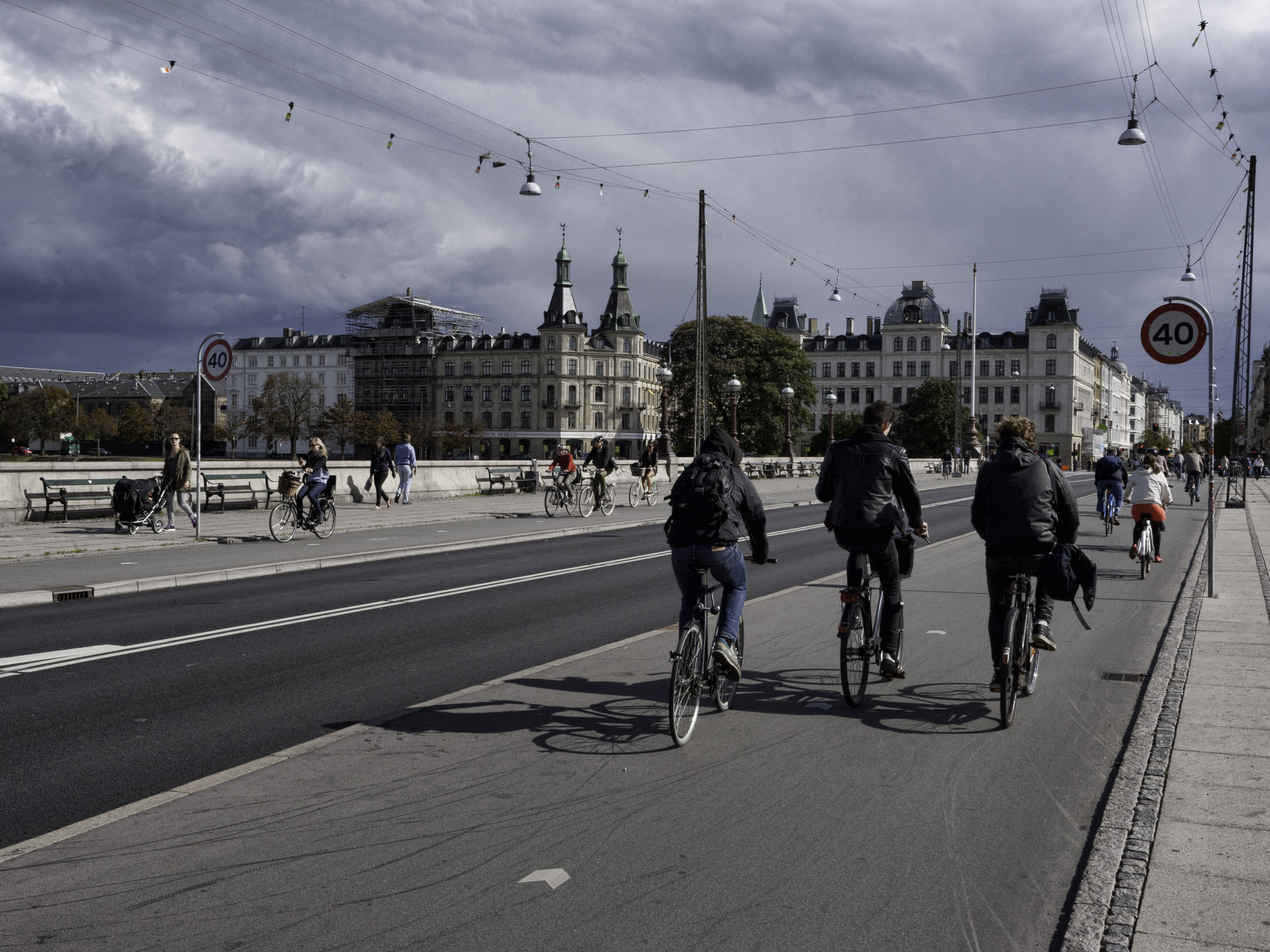
You can easily ride 3 bikes next to each other (and also four if you want). A single slow transporter won't block the traffic on wide lanes like this.
There are few things that make Copenhagen attractive to own a Christiania bike:
1- Very flat city and mild climate, although wet sometimes. 2- The city if fairly small geographically. 3- Public transit is a bit slow. 4- Very high taxes on cars. When I compare to Malmö, I have the impression most people there own cars. 5- Vast majority of people I know who live outside Copenhagen main neighborhoods own a car. Bearing in mind that outside Copenhagen isn't that far in distance but enough to degrade commute and life style without a car.
How is it done in other countries?
In the afternoon there are some special lines too, otherwise you just take a normal line with your pupil ticket.
That's at least how it worked in my time, like 20+ years ago.
Anyway schools sometimes have their own bus, parents pay a private company so the bus takes the students either from their home or very close.
In the uni there was special bus lines that went around all the city to the campus.
I know this from my university city, too. It was arranged that way so that students would not overcrowd the normal bus lines.
(Central Alps, Countryside)
Middle and high schools are usually farther away. So public bus it is. In the morning there are extra buses for students, but they just stop at the normal stops of the line.
Of course I would agree it’s necessary in the U.S., but that’s saying very little.
I’m 36 and I’ve never taken a drivers license because I’ve never needed it.
I am 36 have one little child and feel like I am missing a bit of the country because I don't have a car, even if I have made few trips by train.
Also, a lot of my decisions are now driving by whether it is a short walk distance from home or not. Public transport in Copenhagen is respectful but a bit slow in my opinion (I am from NY), specially if I want to go to the edge of the city or suburbs - which I might want when I decide to settle roots here and buy myself a home (prices in Copenhagen are all time high).
There are a lot of places where you don't need to own a car or even have a drivers license. And you constrain your activities accordingly. You may rely to some degree on friends with cars (though this tends to become less and less practical as you get older). Or you rent cars as needed if you have a license.
But you probably just tend to forgo activities that involve driving out to the country every other weekend or hauling a lot of gear around or visiting people you can't get to easily with public transit.
As a visitor, I rarely have a rental car in SF (and never if I'm solely going to be in the city) for example. But it means I am going to be pretty much staying in the city rather than taking a hike somewhere for half a day. I do know a couple that live in SF without a car but they do short-term and longer-term rentals all the time.
>As a visitor, I rarely have a rental car in SF for example. But it means I am going to be pretty much staying in the city rather than taking a hike somewhere for half a day.
I'm in DC, and I've frequently gone on hikes outside the city and seen people drive to the trailhead in a Zipcar.
Commuting to work usually involves getting on the bus/subway only a short walk away. It's more stress free than sitting in traffic.
I think people on HN seem to underestimate how small of a cross section, the fashionable opinions on HN appeal to and how unrealistic they are, once you bring into full view the jarring realities of modern life and how people cope with them.
- Public transit is publicly funded. For improvements in safety, cleanliness etc to happen, the systems need (public) money. But you will never pay fares because you're scared to take transit, and you probably would never vote in favor of a ballot measure to allocate more tax money to transit because you happen have a car and don't believe improved transit would benefit you anyway.
- The population using public transit generally reflects the fact that our culture encourages anyone with enough money/resources to purchase and use a car -- leaving behind everyone who can't (e.g. cash poor, disabled). This scares off the more sensitive potential transit users who'd rather pretend these folks don't exist.
The jarring reality is that most Americans (and their political leadership) are classist, sheltered, and have a "fuck you, I got mine" attitude.
Source: US lifelong resident of various large cities, no driver's license at the age of 31.
All you are admitting here is that the Government can't provide a compelling alternative to a more expensive form of transport.
> But you will never pay fares because you're scared to take transit, and you probably would never vote in favor of a ballot measure to allocate more tax money to transit because you happen have a car and don't believe improved transit would benefit you anyway.
Why vote to increase spending on something that doesn't benefit you? People won't and you won't convince anyone. This is an unrealistic standard you expect of other people, plus the high and mighty tone you are using won't win people over.
> The population using public transit generally reflects the fact that our culture encourages anyone with enough money/resources to purchase and use a car -- leaving behind everyone who can't (e.g. cash poor, disabled). This scares off the more sensitive potential transit users who'd rather pretend these folks don't exist.
This is such a biased representation of what the real problem is and you conveniently ignore things like violent thugs on public transport (I've experienced this several times in the UK), rowdy teenagers, drunks and the mentally ill.
I used to have a guy who stank and wore a soccer ball on his head catch the same bus, large groups of teenage boys vandalising the train coaches or playing loud music on a quiet carriage and they are far from the worst I've encountered.
No I don't want to have to deal with possibility of violence, nutcases and other general unpleasantness so I won't take the train (I am in the UK).
> The jarring reality is that most Americans (and their political leadership) are classist, sheltered, and have a "fuck you, I got mine" attitude.
I doubt they are. What they want to do is get on with their life with as little hassle as possible, like most people do.
> Source: US lifelong resident of various large cities, no driver's license at the age of 31.
So no real evidence what-so-ever other than your very biased opinion.
> All you are admitting here is that the Government can't provide a compelling alternative to a more expensive form of transport. > Why vote to increase spending on something that doesn't benefit you? People won't and you won't convince anyone. This is an unrealistic standard you expect of other people, plus the high and mighty tone you are using won't win people over.
I really don't get why so many folks insist on positioning Government as some sort of "other" entity, as if its functioning isn't directly affected by voters. Anyways, why support transit? Because it _does_ benefit you as a car user but you and your leadership refuses to see it. It's well documented that improving alternate modes of transportation helps alleviate traffic congestion by shifting some drivers to other modes, thus producing less wear and tear on the roads(and your car) and helping drivers get to where they're going faster and safer. Sorry, that's how it works.
> No I don't want to have to deal with possibility of violence, nutcases and other general unpleasantness so I won't take the train
I mean, sure. That's your right. But you _have_ an alternative, whereas many folks have no other choice but to risk the trip, so how exactly is not supporting transit not a "fuck you, I got mine" attitude?
Except these problems don't seem to exist at all on Japanese or German trains.
Maybe there's just something seriously wrong with your country.
Lets see if that is true:
https://www.telegraph.co.uk/news/2016/07/18/german-train-axe...
https://www.telegraph.co.uk/news/2018/06/10/knife-attack-jap...
https://www.theguardian.com/world/2016/jul/25/tokyo-knife-at...
https://www.scotsman.com/news/world/big-increase-in-sex-assa...
https://www.abc.net.au/news/2017-01-07/women-subjected-to-da...
Doesn't seem that much better to me.
Also it doesn't address the very valid point I was making is that until public transport is pleasant and reliable (neither is true in the UK, I dunno about anywhere else and don't claim to) people will not use it if they have an alternative.
No amount of guilting such as the comment I was originally replying to will change that.
Stop claiming that other countries suck when it's only yours that has seems to have a big problem.
The Government wherever that is will have to sort out those problems rather than just try guilty people into not using their cars.
You're the one criticizing your country, not me. You're the one who said public transit there sucks, not me. I've never been there, so I can't comment on the Underground, but I've been to Germany and Japan and the public transit there is absolutely fantastic. It's not even that bad here in DC, though the reliability isn't that great.
>ignoring the point I was making about public transport being quite unpleasant experience in general and why people quite rightly want to avoid it.
No, I'm not ignoring your point at all, I'm calling it out as ignorant, which it is, because there's plenty of other places in the world with excellent public transit.
You are right that it’s quite packed in the rush hour, but you can still read a book standing.
Regarding the other issues you cite it really depends of the line. The one I take regularly (RER A) is very calm and clean. And keep in mind that there are more than 1 million passengers every day. Touristic areas are certainly problematic but it’s a completely different issue (to put it simply a lot of touristic areas in Paris are dirty and/or in sketchy neighborhoods to start with. Parisians usually don’t go or work there).
Source: taking public transports nearly everyday since more than 15 years in the area. I love my car but for road trips and going to the countryside.
My point is that when comparing imperfect reality with perfect "grass on the other side", the "other side" will likely win. For example, given the unaffordability and small size/low quality of dwellings available in London, American perfectly manicured suburbs with plenty of space and big open highways may start to look somewhat appealing.
In the end, it all depends on the actual reality of it - how busy the roads are, how easy it is to find parking, how clean/nice/empty/reliable the public transport is etc. Idealizing one option over the others as can be seen in this thread seems silly. If there is a "silver bullet", it is probably in decentralizing work more such that more people can walk/cycle to work while living in a nice village, while also having clean/fast/efficient public transportation available as well as a great road system to reach the more remote locations / get to places when a car is just more convenient.
Even with new laws requiring buildings to provide underground parking places, it won't be enough. It's never enough.
The suburbs exist in Greater London area too, just as they do near Warsaw. They have similar style to American ones, but more nearby services and are built in clusters. That makes them much more accessible to foot traffic.
Compare it to e.g. the nearby San Jose - SF is so much better that it's not even funny. What US city would you consider more "walkable"/ tourist friendly? MAYBE NY, if we only include Manhattan and nothing else.
What are you talking about? The first time I visited SF I just stumbled upon Haight-Ashbury and Japantown by walking around.
Yep, NYC is not very walkable if you leave Manhattan island. One big difference though with NYC is the naming and the political boundaries. NYC is very unique in America because it's one really big city with different "boroughs", all very different from each other. If it were any city, it wouldn't be like this: all those places would actually be separate cities, all part of the same metro area. (NYC has this too, with Jersey City, Newark, Stamford, etc. all being part of the metro area, but it's remarkable that so much of the metro area is actually one city.) Just look at LA for instance: LA itself is a pretty small part of the metro area, with many other towns and cities comprising it.
For a week or so tourism SF, Manhattan, Seattle downtown, Boston. Cities I can think to not be very walkable are LA and DC perhaps.
Also I only mentioned Korea because I happen to be there right now, but functional transportation and not needing a car is also prevalent in Japan and much of Europe. America is pretty unique in its sprawl and car-dependence.
I was saved by Uber and Lyft many times just because both my hotel and the office were really far away from public transport.
Ability to walk to places and decent public transport is practically universal throughout Europe, though.
Different story later living in Elwood and working in Port Melbourne, not having a car to commute along the Esplanade would have been a huge time sink.
I don't want to have a karaoke bar nearby - it might be fun (I've never been to one), but at home I have my wood saws, music, computers, food, thread. Those are just the things I've used this week at home (note that it is Tuesday as I write this: the week is only three days old) to entertain myself.
As Mazoni says in one of his songs:
"Quan sortim a la nit no entrem mai en un local amb poca gent i no ho entenc perquè després només parlem entre nosaltres"
What translates to something like:
"When we go out at night we never enter a place with few people And I do not understand it because after all we talk only among us"
I prefer living in an apartment in a nice city vs. living in a big house in the suburbs. But it's totally fine to feel the opposite.
The problem is that in the U.S., the only real city of any scale that's truly carless that I've ever seen is NYC. It's fun for a year or two, but it's too "city" in all the negative ways and very expensive so not a place I'd want to live in long-term (unless I stumbled onto enough millions to buy a brownstown in Brooklyn Heights or something).
But I'm originally from Rome, where I spent most of my life, and without a car in Rome you're pretty much f*ed.
Almost colleagues owning cars don't drive on workdays because the metro is good (crowed by less crowded than driving and parking).
It's not just one city like NYC, at least all moderate to major cities in China are friendly if you don't have a car.
I've been to SF and the silicon valley, and I'm pretty annoyed I almost cannot go anywhere without driving.
The difference might be related to how do people build the city, in order to make one way to suck less than another. In Beijing, it seems to be not driving suck less than driving.
However, going up and down the coasts would make perfect sense for HSR. Traveling from LA to SanFran, for instance, would be much better on a bullet train than an airplane, and the travel time would probably be similar (airplanes have lots of wasted overhead time). The northeast corridor would also be a great place for a bullet train (no, the Acela is not a bullet train). NY-Chicago or DC-Chicago would probably be a good route too.
The problem in the US is just a total lack of political will, and an idiotic aversion on the part of the populace to using trains.
Why do trains work well in many European countries? When there's farmland between stations (or even between some bus stops in the city where I currently live), it means that because you normally want to go somewhere that's not farmland, you're very likely to want to go somewhere near a station. The density around specific points (train stations, bus/tram plazas, etc.) is particularly high which makes the last-mile or last-kilometer problem largely a non-issue.
If you build this in the LA metro area, it might serve the people who live very close to stations well, but everyone else who lives somewhere in the middle between two stations (which would be a higher percentage than people living in European farmland) would need to find a way to get home from the station.
If you imagine even fast public transport, to get from one side of LA to the other side, it would still require a lot of stops in the low population density areas. Let's say every stop would cost you 5 minutes which means that even a car could be faster than public transport.
Edit: 5 minutes would be way too much if I think about it again - you are right.
This is quite literally my commute. On the way home, I depart from a central London station and after about 20 minutes, I'm passing through farms and rolling hills. This isn't even a cherry-picked example with a new high speed line, it is a line that is about 150 years old!
But yes, accessible public transportation will generally require increased density. Most people in Korea live in apartments, so it's easier to make accessible public transportation.
I don't think that self driving cars will replace all cars immediately. That makes little sense from CAPEX perspective, cars are fine for 5, 10, maybe 15 years. You'll not replace an okay car for the latest self driving vehicle, dumping the previous car to the junkyard. Rollout may take decades. And we still don't know when are they coming to the market, that may also take a very long time.
when you are young and single. By the time you have kids this changes everything.
As for the question of how generalizable this is, the US situation is much worse than other cities around the world. Boston has very good public transit for the US, but it's still pretty minimal globally, and we could build out transit far better. It's also only expensive to live near transit, or generally to live in cities, because we've massively restricted housing construction. Allow people to construct tall dense buildings, use the tax money to build out transit, and for the price of an apartment in the cheapest part of Boston today you can have something better that's a short walk from a transit stop that will get you all over the city faster than the T does today.
But it's probably an improvement in most dimensions anyways.
In most other places you can spend your time doing interesting things all day long and never get bored. Whereas in SV you just start a business?
How many people would not have began their software ventures if there was enough comedy clubs, pubs, theaters, community centers, beaches etc a short 10mins walk from home?
Actually wondering?
For me, interactions with novel people, experiences, and ideas are a big feeder for my own ideas.
And thats not about what SV is today. I was lead to believe the so named HBO show portrays it quite accurately. I was thinking more what it was in the 70s.
Though to be honest living in the mediterranean I vastly prefer the walkable nature oriented laid back kind of places myself. Way more fun (and healthy) to live in. I was just wondering if that boredom thing was a factor
A good comparison is creativity in art. I know people who attend a ton of plays, for example, but that doesn't prevent them from creating new plays. Artists tend to cluster in space and in social networks (that is, schools of art) because they draw inspiration and ambition from other artists and their works.
I think it's not boredom, exactly, but being more interested in creation than consumption. For people inclined to consumption, we now have infinite amounts of entertainment. But plenty of people still like creating things for others, creating things with a real impact on the world. YouTube and GitHub make it clear that there are a lot of those people out there.
My least favorite thing about living in America is the dependence on cars (outside of a select few cities like NYC). Now that my parents in the suburbs sold their spare car, whenever I go back to visit, I'm stranded there during the weekdays because the nearest bus stop is like a 40 minute walk, and the nearest subway would be maybe a 90 minute walk. If I need to go anywhere, I'm dependent on Uber/Lyft. Even if I get access to a car, there's relatively much less to do as I mentioned above.