Hat tip also to China's ideological commitment to independence from external oil supplies, as nicely coupled to reducing pollution and greenwashing their image. It's their citizens who sacrifice to make solar power cheap enough.
https://www.nytimes.com/2023/08/01/business/economy/solar-xi... ("Solar Supply Chain Grows More Opaque Amid Human Rights Concerns" / "The global industry is cutting some ties to China, but its exposure to forced labor remains high and companies are less transparent, a new report found")
https://www.bbc.com/news/world-asia-china-57124636
However most of the "slave" talk these days comes from highly politicized sources, so it's hard to cut through to the truth. For example, it's not likely that there's enough Uyghur slave labor to be involved with "most" of the polysilicon even from Xinjiang, much less the entire world's supply.
IMHO, like the cobalt getting mined by children from artisanal-scale mines in Africa, it's a very serious issue that gets trotted out more as a political football against the entire technology, rather than expressed as an earnest concern to solve the underlying problem.
Not really an issue for solar battery systems as they typically use the cheaper LFP chemistry that has a much higher cycle count. The gravimetric density is a bit less, but that only really matters for high-performance mobility.
What does any of that have to do with cobalt?
LFP production is starting to pass NMC (lithium + nickel manganese cobalt oxide). Slightly lower density but a lot of advantages in lack of easily catching on fire, longer lifetime -- and lack of cobalt. LFP (LiFePo4) is the battery chemistry of choice today for solar installations, where the longer lifetime and increased safety are a big win and the slightly lower density doesn't matter, unlike mobile applications.
nice to discuss the degrees of slavery, little slavery is cool, little more perhaps not as much…
I wouldn’t call that “documentation”.
https://www.telegraph.co.uk/news/2025/11/03/bbc-report-revea...
Try it yourself.
Link rot.
As I understand it, much of the rest of the world has similar views, but I'm sure this varies a bit from country to country.
It's just that in the 21st century, we prefer to use some less-upsetting euphemism to refer to the practice domestically.
For anyone not familiar with the US Constitution, the 13th Amendment forbids slavery and involuntary servitude "except as a punishment for crime whereof the party shall have been duly convicted."
Without that "except as a punishment for [a] crime" clause, being sentenced to N hours of community service would be forbidden by the Constitution, and the second-lowest penalty judges could impose (the lowest being a fine) would be prison time. So that clause was actually necessary to include in order to allow for more lenient sentences for crimes that deserve something more severe than a fine: lowest level of sentencing is a fine, after that comes being sentenced to community service (which most people agree is less severe than prison, even though it does count as involuntary servitude), and then after that come the more severe sentences like prison.
Because while the precise definitions of servitude do vary from dictionary to dictionary, and some define it more harshly than others, in general it fits. One definition I found online (with no reference to which dictionary it came from) defines servitude as "A condition in which an individual is bound to work for another person or organization, typically without pay." Another one (Cambridge dictionary) says it's "the state of being under the control of someone else and of having no freedom". I couldn't check the Oxford English Dictionary as it requires a subscription to look up even one word. Merriam-Webster lists two meanings, one of which applies to land. the one that applies to people is "a condition in which one lacks liberty especially to determine one's course of action or way of life".
Now, being sentenced to community service is only a temporary condition of servitude, which ends as soon as a given number of hours have been served. And it might not fit the strict definition if the person being sentenced is allowed to choose the form their community service will take; I lack knowledge of what kinds of community-servitude sentences are commonly handed out. But if the person being sentenced does not get to choose the form his community service will take, but instead is told "Your community service will be served in the city clerk's office. Show up at 9:00 AM on Monday ready to make photocopies and run errands," then that counts as being under the control of another and lacking freedom during the period of community service. It's not a permanent state of servitude, but even a temporary state of servitude is forbidden by the 13th amendment (other than as a sentence for a crime), because otherwise people at the time would have argued "Oh, fifty years of involuntary servitude still counts as 'temporary', so I'm allowed to carry on with imposing debt peonage on my debtors."
(I should also mention that I am not a lawyer, so perhaps US lawyers have already reached broad consensus on whether community service counts as involuntary servitude under US law; if someone knows whether that's true, I welcome being corrected on my point).
The history of the 19th century and when slavery was abolished in each one is actually a fascinatingly complex subject, and there's tons of interesting history hiding behind your word "mostly", to the point where I can't actually tell whether "mostly" is a correct or incorrect description. Judging by https://en.wikipedia.org/wiki/Timeline_of_abolition_of_slave... I would lean towards "definitely correct in Europe and the Americas, a lot murkier in Africa and Asia". Oddly enough, a lot of Spanish colonies in South America abolished slavery before the United States did, yet Spain itself didn't pass its law ending slavery until a year after the US's 13th Amendment came into effect.
If you're at all interested in the history of that era, the film Amazing Grace, though it takes a few liberties with the historical facts, is a mostly-accurate depiction of what it took to get slavery abolished in the United Kingdom. Interestingly, the part of Prime Minister William Pitt was played by a then-unknown Benedict Cumberbatch (Amazing Grace came out in 2006, and most people first discovered Cumberbatch when Sherlock came out in 2010). I recommend the film if you enjoy historical films; it's quite fun. (I love the "I would have been bored by botany" line).
There's tons of countries with much cheaper labor.
The reasons we build in china are not related to cheap labor, this hasn't been the case from quite some time.
This allowed for China to choose industries it would dominate outside of economic forces. It chose to dominate solar and was allowed to sell panels below raw materials cost in order to kill competition.
In one hand it’s good for world solar, on the other hand this has helped cause the rise of the far right all over the west.
...and poured their savings into the sole investment available, real estate, creating the largest bubble the world has ever seen...
Just Nvidia.
Three or four decades of proven ability to deliver, trusted relationships.
Even despite all the political noise.
I don't think trust has much to do with it
They're reliable, but would you really trust them?
I think there's a bit of nuance there to differentiate the 2 though.
Maybe I'm jaded from working with overseas factories though in ways others wouldn't be.
So not really a good comparison
When you have the design it takes away alot of the need to even reverse engineer in the first place
Trust implies shared values/worldview and past experiences where outcomes match expectations. Also respect.
Trust is not possible when there are regularly incongruous outcomes, or where definition of respect / values are just aren't aligned.
Do you think your counterparts overseas believe themselves to be as trustable as you are, and it's just a cultural rift? Or is that too charitable?
It's cheap, yes. I can indeed buy 1,000 of something more locally or from other than China.
But when it comes to scale, needing vast shipments, then they are the ones who can actually ship it and do it reliably. It just also happens to be cheaper, too, which is more of a convenience or cherry on top, than the actual attractive part: vast scale.
Now that hasn't been the case for more than a decade. The cheap labor is in SE Asia and South America.
What China has is decades of process improvement, factories, infrastructure, experience, and a willingness to work. They haven't been the cheapest, by far, for a long while.
I recal, the 1980s when Japanese manufacturing was dogy as. By 2000 it was the best
The same thing is happening in China
They are very good at everything they do, and getting better. Good.
“What do you mean doc? All the best stuff is made in Japan”
“Unbelievable”
Korean manufacturing might've been considered dodgy in the 80s but great by 2000. Taiwan (ROC) went through this also (70s vs 90s, ish?). And now China.
I definitely remember the sense that Japanese cars posed a real threat to the American auto industry, and in hindsight that seems to have been well founded.
They boomed through the 80s/90s, but then lost their edge as China moved itself up the car manufacturing hierarchy, particularly in EVs.
Same with competing with South Korea, but Japan are coasting a bit.
China is at the start of that curve.
They'll end up diversifying into the rest of the world, but the 21st century will belong to China.
Didn't they lose their edge earlier and because the US togheter with some european nations forced their arm after a trade war to limit their exports, enforce an unfavourable currency regime, etc?
They were not built to last so became unreliable after ~5 years.
That was because in the Japanese market five years as a long time to run a car. Not so in the west
In any case, I literally have a cousin who's lived ten years in China building a 3d printing company, and the last reason he went to China was cheaper labor, that was borderline irrelevant.
What?
https://insights.issgovernance.com/posts/forced-labor-in-the...
Yes there is a bunch of automation in there, and still a ton of manual work and re-work. And it is done by the lowest cost labor, with a hefty government subsidy (by china) and a purchasing program.
Does the supply chain contain less-than-free labor somewhere? Likely. Most probably somewhere in the raw material production, but it's not something that is a deciding factor in anything. These materials just as well likely go into making of iPhones and Lenovo laptops.
The problem is that "Highly automated" does not mean "free of people" ... the demand for low skill labor (and a fair amount of it to keep up with automated processes) is still required.
The cost of labor in china remains so low (on the whole) that these things are still not only feasible but cost effective.
/obvious sarcasm
The only thing they've done to greenwash their image is spend money buying articles that present the false image of a green china.
The Western and Asian governments increased environmental regulations and the cost to do business rose. In China the government ignored its climate obligations and slashed environmental regulations and increased coal investment to drive energy costs down and thus the manufacturing moved there. You think Germany couldnt have cut environmental regulations slapped down a few coal plants and made solar panels?
Thats why there was climate meetings to get everyone on the same track. If everyone is aligned in their goals then the economic hurt is easier to bare. China intentionally captialised on this and I do not think they deserve any praise for it.
It's completely stupid to pretend China is going green when their emissions have continuously increased and the rate has even accelerated the richer they got.
It was all done so they could capture the business of western countries and run a silent economic war. Now most of europe is so dependent on China it's hopeless and they are not even cheaper because all kinds of costs have been added.
They are a growing economy of a billion + people.
You need to realize this is a population that was virtually 90% poor just 3 decades ago.
https://ember-energy.org/latest-insights/china-energy-transi...
https://ember-energy.org/latest-updates/wind-and-solar-gener...
https://electrek.co/2025/09/02/h1-2025-china-installs-more-s...
> Global solar installations are breaking records again in 2025. In H1 2025, the world added 380 gigawatts (GW) of new solar capacity – a staggering 64% jump compared to the same period in 2024, when 232 GW came online. China was responsible for installing a massive 256 GW of that solar capacity. For context, it took until September last year to pass the 350 GW mark. This year, the milestone was achieved in June. That pace cements solar as the fastest-growing source of new electricity generation worldwide. In 2024, global solar output rose by 28% (+469 terawatt-hours) from 2023, more growth than any other energy source. Nicolas Fulghum, senior energy analyst at independent energy think tank Ember, said, “These latest numbers on solar deployment in 2025 defy gravity, with annual solar installations continuing their sharp rise. In a world of volatile energy markets, solar offers domestically produced power that can be rolled out at record speed to meet growing demand, independent of global fossil fuel supply chains.”
https://www.eia.gov/todayinenergy/detail.php?id=65064
> Utility-scale solar power capacity in China reached more than 880 gigawatts (GW) in 2024, according to China’s National Energy Administration. China has more utility-scale solar than any other country. The 277 GW of utility-scale solar capacity installed in China in 2024 alone is more than twice as much as the 121 GW of utility-scale solar capacity installed in the United States at the end of 2024. Planned solar capacity projects will likely lead to continued growth in China’s solar capacity. More than 720 GW of solar capacity are in development: about 250 GW under construction, nearly 300 GW in pre-construction phases, and 177 GW of announced projects, according to the Global Solar Power Tracker compiled by Global Energy Monitor.
https://cleantechnica.com/2025/04/20/chinas-coal-generation-...
> China’s coal-fired electricity generation took an unexpectedly sharp turn downward in the first quarter of 2025, signaling a potentially profound shift in the world’s largest coal-consuming economy. This wasn’t merely a seasonal dip or economic distress signal; rather, it represented a clear and structural turning point. Coal generation fell by approximately 4.7% year over year, significantly outpacing the overall grid electricity supply decline of just 1.3%. However, electricity demand, a better measure, went up by 1%. What gives?
https://foreignpolicy.com/2025/08/21/china-clean-renewable-e...
> China’s Decarbonization Is So Fast Even New Coal Plants Aren’t Stopping It. In multiple sectors—transportation, renewable energy, and overall electrification—the clear trend is toward a greener energy system. In fact, in areas like renewables and electric vehicles, China is now the world’s leading player. With the United States essentially abandoning the field, it will become even more dominant.
https://www.theguardian.com/world/2025/jun/26/china-breaks-m...
> China’s installations of wind and solar in May are enough to generate as much electricity as Poland, as the world’s second-biggest economy breaks further records with its rapid buildup of renewable energy infrastructure. China installed 93 GW of solar capacity last month – almost 100 solar panels every second, according to an analysis by Lauri Myllyvirta, a senior fellow at the Asia Society Policy Institute. Wind power installations reached 26 GW, the equivalent of about 5,300 turbines.
(it is somewhat irrelevant that China has accomplished spinning up a clean tech machine of this scale out of energy security reasons, as it still accomplishes the goal of decarbonizing their economy first, and then, the rest of the world as their spun up manufacturing flywheel exports cheap clean tech to the world)
https://ember-energy.org/data/china-cleantech-exports-data-e...
We're at the point where things are changing fast. Yes, largely driven by the ginormous solar and battery production coming from China. The rest of the world better get their ducks in order if they want to compete.
Nearly 60% of the EV power is from coal which puts their emissions on par with gas powered cars.
https://www.carbonbrief.org/chinas-construction-of-new-coal-...
Because of the efficiency of the EV motor vs. the ICE motor, EVs are far cleaner than ICEVs even when fossil-fuel-powered and that's not factoring in the (slow) cleaning of the grid which will widen that gap over time, as the other comment mentioned.
China builds enough renewables and storage to both absorb grid growth and displace existing coal plants.
https://www.carbonbrief.org/chinas-construction-of-new-coal-...
In terms of actual coal burned in those and already existing plants it is declining.
https://www.realclearenergy.org/2025/08/29/china_burning_coa...
Your article is a single paragraph:
> China burned more coal at power plants between January and July of 2025 than at any time since 2016, despite massive renewable capacity, according to new environmental research report.
Then they link the source DW article:
https://www.dw.com/en/china-boosting-coal-capacity-at-record...
Which was updated due to not correctly presenting the underlying report.
> Correction: The article initially referred to China burning coal at record high levels and had other inconsistencies with the original CREA report. This has been edited to reflect that the study highlighted an increase in coal power plants, rather than burned coal, after being contacted by the research institution.
Which is what I have been telling you again and again. China is building tons of coal plants but in absolute terms the coal usage is declining.
Why is it so hard to accept that?
No. Manufacturing labor cost in China is not cheap. In fact since 2012 or so, it is more expensive than in most of Asia. Companies who want cheap labor look elsewhere.
https://www.economist.com/business/2023/02/20/global-firms-a... (Archive link: https://archive.fo/tdhXJ )
China is also the only major economy where wages have increased at the same rate as GDP in the last 40 or so years.
That is objectively dirt-cheap compared to basically all of the west.
Yes, wages might be even cheaper in neighboring countries, but those lag behind in infrastructure, education, political stability, availability of capital and network effects from existing industry (and are thus not a viable alternative to China yet for lots of things).
I agree that infrastructure, supply chains, political stability, and education are the primary drivers for attracting manufacturing to China.
This is a good point, but I think that only really the underdeveloped/underindustrialized/unstable parts really qualify, possibly Romania, Serbia, Ukraine, with similar caveats than Chinas neighbors.
Despite all this a lot of European manufacturing (e.g. cars), has shifted into the more viable low-wage countries over the last decades (despite language barriers and very high automation; talking mainly Poland, Slovenia, Hungary here).
You still need labor to build, maintain and operate factories, even if they are filled with robots; people here underestimate the benefit of cheap labor by a lot.
Does decentralized solar plus batteries give you same amount of reliability? How many days without sunny weather can you survive without having to change your energy use habits?
Each 9 of reliability for infrastructure is EXTREMELY expensive. And grid has a lot of 9s.
But having electricity 13 days every two weeks is much better than not having it at all.
This isn't about China building out their grid with an over capacity factor of 200% so they can keep everything running even if rain, sun and wind all fail for months on end. This is a developing county getting to the point they can charge mobile phones consistently.
Generally businesses are really great at balancing costs, and for highly-cost-constrained businesses if you give them 95% uptime at half the cost, the equation becomes clear. And in Africa, if the option is 95% uptime or 0% uptime, the choice is even clearer.
By comparison, global battery production is around 1,000 GWh per year.
Realize that replacing all ICE road vehicles in the US with 70 kWh BEVs would require storage equal to ~40 hours of our average grid usage. The future is going to need large numbers of batteries, which is why China has been all in on this.
Regardless, 14 hours of China's electricity demand is a whopping 40,600 GWh. By comparison, 2024's lithium ion battery production figure was 1.5 TWh [1]. Even assuming 100% of this went to EV's we're still talking about roughly 25 years worth of global battery production to fulfill only China's demand for storage in this model. As you point out, we still have loads of battery demand for EV adoption, so nowhere near 100% of production will be able to be diverted to grid storage.
The scale of storage required to make intermittent sources viable without being backed by a dispatchable energy source really is tremendous, and this often gets overlooked in pushes for a fully renewable grid.
1. https://www.argusmedia.com/ja/news-and-insights/latest-marke...
Yes, it's a lot of batteries. So what? It's not like the current battery production is some firm limit. If anything, the very large future demand ensures batteries will be driven down their experience curve, so the cost will be even lower than assumed.
The world spends something like $10T per year on energy. Any replacement energy system is going to be a big thing.
You need to make an argument that is more than you expressing fear of large numbers.
There are few things that grow this fast when it comes to manufactured things, atoms are far harder to arrange and scale than bits. But it's happening at a tremendous scale. Natural gas turbine production capacity is tapped out with long order queues, and so is battery production well into 2026, but only battery production capacity is expanding at breakneck speed.
Regardless of your confidence in battery production's continued growth, I think you'd agree that if someone is making a calculation about the required amount of overproduction required to maintain a stable grid, they should at least mention that their calculation is contingent on provisioning tens of terawatt hours worth of grid storage.
The learning rate for batteries has not been as steep as Moore's Law for ICs. But the value of being able to store mass quantities of electricity at low cost is so incredibly valuable that it's going to blow up into a huuuuge number of factories.
You look at the 6TWh of all time and see that as a limitation. I haven't seen that stat before but I trust you, because with the growth rate of battery production it has to be a tiny number, because it's exponential growth. In 2024, 1.2 TWh of batteries were produced, 20% of all storage capacity ever. That was a single year! What if, in 2024, we produced 20% of all CPU capacity every produced? That's obviously a hugely growing market.
> The nature of resource extraction is that the easiest-to-exploit reserves are exhausted first, and continued production is contingent on accessing the progressively more and more inconvenient reserves. Maybe in 2030 annual global production will be 30 TWh - we'll know in 4 years. But there's a lot of people who probably don't want to make trillion-dollar investments gambling on that possibility panning out.
If you spend a small amount of time diving into the industry, you'll see that there's a massive number of very smart people solving all these resource constraint problems, securing supply chains years in advance, and building like fucking mad. Sure, there's a lot of people that don't want to get involved, but they will be left in the dust.
We are witnessing a massive energy interchange. This is like when the PC came along, but much bigger in terms of quantity and speed. Sure, there are those who are still skeptical of energy storage, 5-10 years after it became blazingly obvious that batteries are cheap and getting cheaper and will take over the enery world. But they are the same people who saw the iPhone and said "it will never catch up to my BlackBerry."
Electricity storage in batteries is a swiss-army knife for the grid that never existed until recently. We couldn't do time arbitrage, always had to match supply and demand instantaneously, across grids spanning hundreds and thousands of miles. No more, that's all gone. We can do tiny microgrids, we can do single houses, we can do 10 TWh installs across grids, because batteries scale small, scale big, are cheap, getting cheaper, and are being produced on a growing scale that most people do not understand.
For something like 20 years, people have been looking at the exponential growth in the annual solar deployments and saying "well that's it, starting next year we're only going to deploy exactly as much as last year, plus 5%-30%". And every year these predictions are proven wrong. And every year they do the same dumb thing again:
https://pv-magazine-usa.com/2020/07/12/has-the-international...
Let's not repeat the same projection mistake with batteries that's been going on with solar for so long.
Assuming someone actually told you that, I think you need to reevaluate the credibility of that source.
I've never lived anywhere where the power didn't go down for at least a few (cumulative) days a year.
Now I live in a rural area and it's uncommon to avoid outages more than a month. We have an automatic transfer switch and fuel generator from previous owners and it saves hundreds of dollars in frozen food.
This is in the US by the way. If you're investing in a transfer switch and generator now, the cost is going to quickly approach a modest solar + battery set up with a whole house inverter, and of course, you save money all year that way, not just in outages.
Since then, none of the extended Portsmouth conurbation, Sheffield, Cambridge, rural Cambridgeshire or Berlin have had any problems big enough to even notice while I've lived in them.
I have seen at least two circuit breakers trip in that time though.
PS I don't live in the US.
In the UK, I think I can remember 3 power outages my entire life. One when there was significant flooding in my hometown as a child, which lasted around a day, once at university for a few hours (local substation failed) and recently 30 minutes overnight while they were upgrading something (with a lot of notice). I may be undercounting/misremembering but I don't think its far off.
I think the main difference is the UK in all but mostly rural areas has all the power lines underground. This is very different in eg North America where you can go a few blocks out of downtown areas and it is all overhead delivery.
I'm surprised that someone would think days of power outages are normal everywhere. My family used to get hit with 8+ hour outages every few years back in the 90s because we were at the end of a single long rural feeder line, and we thought that was an unacceptable frequency.
What city do you live in?
The cause around here is usually storm + trees + above ground power lines, plus a low enough population density that you're not top priority for the utility company.
I was surprised that the original comment said they were in a city
Consider a family with two cars instead of one. How often do they have zero working cars? The correlated failure rate squares while the cost doubles.
My home now has a grid connection, house battery and solar, a caravan with mounted solar/battery/fridge/inverter beside it, and I also have a portable “powerstation” and portable solar panel which is basically a UPS. My fridge contents and phone charging needs have a several extra 9’s now for costs that have scaled very well.
These systems are tech that is improving rapidly. In some years these African farmers with their increased yields will likely add a bigger, second solar & battery system. In a village you can run a cable next door. Etc.
https://ieeexplore.ieee.org/document/9176792/
https://dlg.colorado.gov/microgrids-101
(distributed solar and batteries are cheap; if you need more power, or longer storage, you add solar and/or batteries)
https://en.wikipedia.org/wiki/Northeast_blackout_of_2003
Not as many as you might think.
I mean, it very much depends on where you are. Three 9s would be no more than about 8 hours downtime per year. A lot of rural locations would do worse than that, realistically.
Correction: should have a lot of 9s.
But in a lot of places in the U.S., even rich states, it doesn't because a combination of regulatory capture, profiteering and straight corruption.
I can see why solar and batteries are so attractive because at least its your prerogative when the power goes out.
Oh boy.
They are incentivized to BULID but not to maintain or upgrade because that grants them guarantee rate of return.
It was enlightening to see what caused the big blackout during a big snowfall in texas a few years ago
Of course there are failure modes in any approach but "oh no! Herding cats is hard. Who could have imagined!" is funny to me
Not everybody can afford the up front costs of installing solar + battery storage, plus replacement when the PV cells and batteries inevitably reach EoL. These people will be left behind on a decaying grid nobody with political capital wants to fix or at the mercy of landlords.
I really don't like this attitude we have in America where we realize "thing is broken" and advocate throwing it away instead of trying to fix it.
Because people are too busy playing Team Politics instead of solving issues that everyone can get behind.
Fixing the power grid is one of those things that everyone could get behind, and yeah I agree, it disproportionately affects the economically disadvantaged.
Solar and wind tend to be regularly and predictably intermittent but not unreliable. That's something you can design around. Especially when you have cheap storage to handle critical loads.
It's instructive to look at California's ISO website's supply graphs over the year. Renewables follow a reliable daily cycle.
According to PVWatts, a 10kW solar system would get me very close to my average usage in December. I'd be way over in the summer, could probably get away with a 4kW system and dial back use during an outage. I can lease two Powerwall 3 batteries from my utility company for $55/mo.
Or look at: https://www.franklinwh.com/products/apower2-home-battery-bac...
Edit: this also looks like a good option: https://www.santansolar.com/product/the-homesteady-kit/
We used to lose power 3-4 days a winter in our old house. It would have been really nice to have heat. A generator or smaller system could handle that.
The trouble with relying on the weather for your electricity is that it is entirely possible that you will go five days straight with cloud cover, limited to no solar generation and then be freezing. This is the problem that the electricity grid solves with varied sources of generation.
Where I live, I only get two 9s from the utility. And I'm within commuting distance of Seattle. With my generator, I still got three nines the one year where the battery tender failed and the generator didn't start when needed, but only because that outage was less than 8 hours and I replaced the battery tender before further outages (I could have jump started the generator, but the outage started overnight and waiting it out was easier). Most years, the number of brief outages adds up, and I probably only get five 9s.
Solar + battery + generator for really bad weeks (but make sure you exercise it!) could pretty easily add up to the two nines I'd get from the utility here.
For developing countries, solar + battery alone is likely be better than many grids which often are intermittent rather than 24/7 and many places don't have any access to utility power.
I actually counted the number of outages after I got my battery unit in June -- it was six in five weeks, for anything from a couple of seconds to 30 minutes, which I noticed because the unit clicked over to running from the battery, and the clock on the oven (which is still only mains powered) flashes until I go over and hit a button.
In April I had a 40 hour outage after a storm. That's what caused me to order the brand new Pecron E3600LFP, first New Zealand model shipment in "early" June (I received mine June 19).
In February 2023 I had a 4 day outage during/after a storm.
There are even, every 2 or 3 months, scheduled and notified 9 AM - 3 PM outages for equipment maintenance, tree trimming etc. Just those alone lower the grid reliability to around 99.5%.
Six days outage in three years -- let's call it four -- drops grid reliability by another 0.4%.
So, yeah, two 9s is about right.
With the Pecron base unit (US$999 at the moment still on Halloween special, $1259 before that) I simply don't notice any outage under 4 hours, and that's even with a full winter heating load. In fact I deliberately turn the mains to it off from 7-9 AM and 5-9 PM every day.
A 4 hour outage was a little close sometimes, so in August I added a 3kWh expansion battery ($699 on pecron.com right now).
With 6kWh I can run my fridge, computers, Starlink, some LED lighting for 36 hours. Or 30 hours with typical kitchen appliance usage added (espresso machine, toaster, kettle, microwave, air fryer).
Or virtually forever now I added 6x 440W solar panels (cost me US$400 total) to it, which still generates around 200W between them in even the worse overcast and rain.
I'm running this stuff as a mini off-grid system, not connected to the house wiring at all -- except plugged into a standard socket to charge the battery if needed. I also have a $450 2kW petrol generator which I can use to charge the battery if needed, but needing that should be very rare.
Total cost: under US$3k. More like $2.3k at the current Halloween special prices.
Most places in my state you need an electrician license, permits, bonding, insurance, a special 'solar' warranty, and inspections if you want solar.
I built my house without any inspection or licensing and connected to the electric grid without anyone from the government ever even looking at it or taking money for it. If I wanted to add a solar system, it basically completely fucked everything and I would have had to gone through the normal permitting and inspection system for my house which would have made even building the house basically impossible for me.
That's... not common (perhaps more-so in rural areas).
In my area, being connected to the grid brings a lot more hassle: the utility gets a say in how much solar you can build, as well as how it's connected. Some of it makes sense (they want to make sure you're not going to backfeed during an outage and cause a hazard to linemen), but a lot of it is them protecting their bottom line.
If I added a solar system they would neither care nor have any idea. Only the government cares here.
Unless I add solar.
Where exactly do you live? I'm not saying you're lying, but this smells like a tall tale. You can easily buy solar panels and batteries, and if no government inspectors are coming by anyway, then it doesn't matter.
Maybe what you're saying is, "my power company wouldn't let me use grid-tied solar without it being permitted." ?
>"my power company wouldn't let me use grid-tied solar without it being permitted." ?
Nah they didn't give a shit what I connected it to. I literally stubbed a 200 amp service entrance on vacant land then just went wild connecting it to whatever I like. I shot the shit with their engineer when they ran secondary off the power pole and that was it, I've never seen them again.
> no government inspectors are coming by anyway, then it doesn't matter.
I don't know for certain but having an unpermitted solar panel visible via satellite would likely trigger a visit.
I wouldn't want to go to someone's home to hassle them about their DIY solar installation.
I mean, are you saying that someone sticking up a few panels+batteries to run an electric fence, gate, and camera system has to have permits?
This all seems strange.
Because its dangerous to own solar. If its guns, then its perfectly fine and safe.
How do they deal with the cost of storage for anything non trivial completely eclipsing any savings?
And many will make do without a battery, just relying on power during the day.
I mean it's several hundred fold more expensive I'd call that "eclipse" but maybe you have a higher threshold for that word?
> And many will make do without a battery, just relying on power during the day.
I mean I guess that's an option if you don't want these places to advance in quality of life or produce much of anything.
Local gangs go around and demand protection money and if you don’t pay up your solar panels will unfortunately suffer some “accidental” catastrophic damage.
https://mybroadband.co.za/news/energy/507496-knock-off-solar...
In fact many people here praise those gangs, and wish they were bigger and demand more money.
The problem with Home Solar is the same as with Heat exchanger installs... some installers price gouge, and simply don't care about the quality of the work.
Best of luck, if you plan to stay someplace 8+ years a 10kW Solar+battery install and heat exchanger are fine investments. We've also donated a few of those cheap FlexSolar 40W Foldable Solar panels + power-bank kits to people in remote areas, and they reported phone/VHF-Handy charging was reliable. =3
This is a disastrous misrepresentation of a complex case with lots of moving pieces. At no point in the history of the construction of that specific power line was there a challenge to legality of citizen initiative until after the vote. Meanwhile, as they were behind in the polls, the company rushed to build as much of it as they could knowing that the initiative was coming, so when they failed at the ballot box, they could claim a legally recognized "vested interest".
Absent the vested interest claim they would have been legally bound by the results of the ballot initiative, and the vested interest was not established until after the ballot had been voted on.
Once the EU finally gets rid of the ridiculous pricing model where spot prices are dictated by the most expensive energy source (usually, gas), we might have a situation where grid costs exceed the cost of energy itself.
Oh and what do they do with that money? Hoard it for upcoming grid updates, which they supposedly have to make to accommodate solar peaks and EV charging. And buy solar parks in Spain, apparently.
Why is it ridiculous? From a pure mathematical economics point of view it's genius I think. It means energy producers can just set their price at production price, knowing they will get the best deal that way and thus don't need to speculate on the electricity prices. It makes electricity as cheap as possible when it's abundant and expensive when it's not, also incentifying users of electricity to shift their consumption.
What's a better way of doing it?
Why should a solar generator, who has virtually zero inputs, demand the same rate as a gas or coal generator who’s costs are dominated by inputs?
Where’s the promised savings to the end user? That’s right, there aren’t any.
And people bang on about solar being cheaper.
No it isn’t.
Solar electricity is the same price as gas peaker-plant electricity. Everywhere I’ve looked, same story.
And there’s no solar power without gas.
Soon there is so much solar that you don't need the expensive gas most of the time.
Great profit to be had from solar because of expensive gas.
Let’s put aside that this isn’t good for the end user, as it openly admits the whole point of solar is great profit, rather than savings for the end user.
Soon there’s no need for the expensive gas.
Where’s your profit margin not?
The whole point of capitalism is that in a well-regulated, open, competitive market, an ecosystem of companies pursuing maximum profit drive down each other's profit margins as they compete for a limited pool of consumers. In other words, it is precisely the profit motive that creates savings for the end user.
That didn't newly become an issue for the first time once solar entered the picture. There should be a word for this type of argument where people relitigate settled principles because they're discovering them for the first time.
I just think when people say things like “solar is cheaper than gas” they should say for who.
Solar is cheaper than gas for the capitalist.
And there’s no guarantee the capitalists savings will ever be passed on to the consumer.
In my market, Australia, the energy retailers are regulated to increase prices once a year. Increase prices. Never a saving for the retail customer. They’ve worked out that can skip all that messy market bullshit and just regulate annual increases.
Good work if you can get it.
Have you actually read the regulation?
  The AEMC said the new rules were in response to requests from Australia's energy minsters. They will:

    * prevent retailers from increasing prices more than once a year
    * ban excessive charges like late-payment fees for all retail contracts
    * ensure all consumers are entitled to a fee-free payment method
    * prohibit retail fees for vulnerable consumers
    * ensure vulnerable Australians are receiving their retailer’s best offer
    * prevent retailers from charging more than the standing offer price if the customer's initial offer changes or expires. This will protect customers from paying higher prices for their loyalty.

  The rules to improve consumer confidence in retail energy plans will come into effect on 1 July 2026. Those that assist hardship customers take effect from 30 December 2026.
A) regulation that forces a price rise once a year.
and
B) regulation that stops more than one price rise (if any) in any year.
And remember what this thread is about - Solarpunk in Africa, off the grid, which is a case that has nothing to do with regulated utility grids, so it couldn't possibly have less to do with the article that this thread is about.
You're insisting you're not discovering the concept for the first time, yet even in this comment you're still doing the same thing, treating systemic regulations that apply to energy markets writ large like they somehow only apply to solar. You wouldn't be doing that if you understood beforehand that these systemic problems had nothing to do with solar in particular, you would be doing it if you were just starting to look into solar and discovered those issues for the first time, which I what I think is happening.
Now electricity wholesale markets are an artificial construct, but it has been designed to mimic other commodity markets in that the producer on the margin sets the price.
Electricity demand is price inelastic, meaning the consumer has no direct influence on prices, and will pay practically any price (well, up to a point). In the EU, the day-ahead spot prices are published every day at 2PM CEST, and it's a bidding market driven only by suppliers. If gas price goes up by x3, total electricity price average will go up by some linear factor, because gas turbines are absolutely required for surges/peaks - at least until we have enough batteries.
Calling this a market is stretching it IMO.
For starters, numbers I've seen suggest something day ahead prices are something like 10% to 30% of the overall energy supply because most of it's sold outside of that context via things like regulated utility pricing, forward and futures markets which sell weeks to years ahead, and long-term bilateral contracts such as power purchase agreements. So most energy is not purchased this way over the short term.
Moreover, for goodness sake, inelasticity at the margin doesn't make something not a market, that's simply not what inelasticity means, and none of these considerations have anything to do with whether solar power in particular can be profitably offered to customers. (Again, why would it be just applying uniquely and exclusively to solar power but not other forms of energy?)
Investments of various kind occur over horizons of days, months, and years where these market dynamics unfold. Every energy source on offer whether it be solar panel, gas turbine and storage facility is financed built and dispatched based on the expectations of cost and profit. Demand is quite elastic over the horizon of months and years, and demand inelasticity is sometimes a feature of markets not something that identifies any specific phenomena that prevents solar power in particular from entering markets.
Solar power rises and falls throughout the day in a manner that conveniently aligns with actual energy consumption patterns, and its net effect on the grid is de-stressing peaking infrastructure.
So it's certainly true that there are day ahead markets but if you think the upshot of that is that it somehow means solar can't be provided at a price point affordable to consumers that simultaneously profitable to the companies providing it, well, the phrase "missing the forest for the trees" was practically invented for moments like this.
Unless it's night. Or, possibly, unless you have enough battery capacity to store the entire nighttime supply during the day.
In the EU (winters with weak solar radiation) this only works if you can store power over multiple months. Getting rid of gas means purchasing and maintaining a giant amount of batteries. Slow storage won’t save you from outages during peaks. We do have very cheap power from solar, during the hot months. In winter, its wind and offshore turbines that are prevalent, but they are as unpredictable.
So, solar and wind power is trivial. Storage is the issue. And consumers will pay that storage, in both grid cost, and spot prices.
I don’t understand why peak producers should dictate prices for all levels of service. Make an exception for them that’s adequate, like a second peak market, and done? Why should a solar producer (who doesn’t buffer!) get 3x the price only because Russia turns up gas prices and the big producers start panic buying expensive gas futures, poisoning their whole lineup in the process? Solar producers just pump whatever’s coming out of their panels into the market, with no regard for grid stability.
I'm not sure what you mean by second peak market?
Let me turn around the question, why should a gas plant get more for its electricity when it's indistinguishable from solar electricity?
Whereas solar generators are ruining grid stability.
Eg: In your market, Australia, this was completed this year for $8 million AU
https://www.westernpower.com.au/resources-education/network-...
The battery banks in Adelaide an elsewhere are real - you can kick them.
You can price these against gas peaker turbine plants, and then compare the robustness of mini distributed storage nodes against larger single point of failure fossil fuel gas plants.
I understand the Western Power link provided looks like media hype, it was put together years back at the start of the project with minal updates in the interim.
It's well out of date now that the Walpole project has been completed and is up and running for a few months now.
Single massive peaker plants Vs. many smaller battery parks and pumped hydro nodes.
It depends upon the population distributions, topologies, power grid, etc.
Adelaide is a state capital with massive battery banks and large amounts of renewable energy, they have long periods of self suffiency and export excess power to neighbouring states.
This is dull power infrastructure engineering reality, not woo woo imaginary hype.
I already wrote it: levels of service. A gas plant powers up in minutes. A coal plant in hours. A nuclear reactor in years. Solar and wind isn’t controllable at all.
I agree there's actually an issue here, ideally the price should be set by the next seller which just didn't get to sell.
It‘s still a gamble for suppliers btw. The prices change every 15 minutes, and every cheap supplier is at the whim of more expensive suppliers.
Electricity is priced at the edge entirely because demand must match supply at all times. You either meet all electric demand or someone will go without power. This is why marginal pricing exists and this is why the most expensive generator is always the last to be accepted. This is why electricity at night is cheaper that during the day.
Please, if you do not understand what you are talking about, it's ok to just say that you don't know. Don't spread misinformation like this.
There's also more to it than just that. Supply-demand imbalance affects the frequency on the grid. Too high or too low frequency damages the turbines in the base load power plants, and they will shut down to avoid damage if the frequency goes too far out of range. Hence, too little or too much power actually causes grid collapse.
Solar actually has to be managed a lot more carefully than people realise.
In the Japanese market in summer during the day the spot price nose dives to almost nothing because of an oversupply of solar. Yet most installed solar is operating under the FIT system where all generation is guaranteed to be bought by the regional generation company for a fixed price, regardless of what the spot price is. This worked to incentivise bringing lots of solar online, but its paid for by adding a levy as a line item to everyone's electricity bill. To lower the financial burden the government is ending the FIT system and transitioning to FIP where from memory solar operators still make similar money as they did under FIT but it's sold on the spot market and then the government pays a premium on top.
The TSOs have to manage the supply-demand balance and there's things like the balancing market to help with this. However the government is also changing the regulations to put more of the burden of managing the supply-demand onto the solar operators themselves and not lump it all on the TSOs. Lots of people invested in solar under the FIT system because operation and expected revenue was straightforward. Now with shifting to FIP it's less straightforward. Additionally when the burden finally falls to the solar operators to proactively manage the supply-demand balance, there aren't good systems they can readily leverage to do so, and the average Joe with solar panels on their roof isn't necessarily going to want to be submitting 30 minute generation plans to their regional TSO, hence they'll eventually have to wind up going through aggregators and such becoming part of a virtual power plant where you may have things occur like negawatt transactions to incentivising reducing demand to help manage the supply-demand balance etc.
PPAs are also an increasingly popular option for purchasing/selling solar power. They're usually fixed price contracts, but depending on how it's setup money either changes hands directly between the generator and consumer (via a retailer) or sometimes the generator sells it all on the spot market and then settlement of the difference between the contract price occurs afterwards between the parties. Even with fixed price contacts the revenue isn't completely guaranteed because the TSO might need to issue curtailment orders to the generator in order to manage supply-demand balance when there is oversupply or grid congestion.
It's not all sold on the spot market.
Anyway, my comment was less about how it's priced more about hidden operational complexity of renewables non-industry folks aren't aware of. In particular turbines have inertia and so if you stop generating power they will still run for a while, and this helps keep the frequency on the grid stable, but solar doesn't have inertia since it isn't turbine based, so large swings in generation can have an instantaneous impact on grid frequency, which can be destabilizing, unless you do stuff with batteries and inverters to produce pseudo-inertia. TSOs need to manage fluctuations with frequency containment reserve, frequency restoration reserve, and replacement reserve. These costs all wind up as part of the wheeling charges which affect the bills in the end.
There's also things like capacity payments/capacity market which impacts solar operators, but I don't know specifics on how that stuff works.
what does drive the price of electricity is fuel cost, not grid stability.
Solar inverters do not have physical inertia but they can have fast frequency response via capacitors. Many wind turbines have this feature and at scale, it is a decent replacement for electromagnetic inertia.
- https://www.businesselectricityprices.org.uk/media/n35dlcza/...
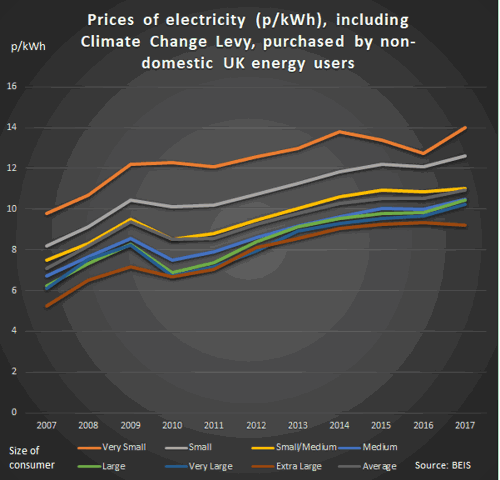
- https://www.endfuelpoverty.org.uk/energy-giants-see-457-bill...
At the time: we had no choice! Universal electricity access was (& is) vastly better than the alternative: not having universal access. But what's happening in this article isn't an alternative, not so far: it's leaving the masses behind, dropping the pretense that electricity is a utility that ought be available to society broadly.
Perhaps the private rental systems here provide pretty good access. In general though, I think society really ought to accept pretty big inefficiencies/costs (if that's what it takes) if thats what it takes to provide these base demands widely. It feels horrific to consider only the costs here, to see the inefficiency, without regarding what electrification, transport, and other base utilities enable your people to do, how much it changes lives.
Narrow, mercenary cost analysis is an awful way to run your society. For sure, I deeply hope solar maybe can reduce some of the grid maintenance costs, by decentralizing energy. Over time. But this article &b this comment broadly accept a cost-based analysis, that largely revolve around the failure of a public works, one that needs to be efficient but that also has to be more willing to lose some money, to operate no matter what in unprofitable places. States have to make utilities available, period, whatever combination of political & economic will/unprofitability is required.
I'm excited for solar! The decentralized nature is amazing! But beyond the glory of possibility, it scares the heck out of me that society might just give up on a tie that binds us, might abandon the basic sense of utility that most states have been able to keep going for around a hundred years now.
The success & market capture of the companies spotlighted here is both a success, but also an liability. Solar is plentiful but the middlemen here have enormous price control, that maybe they are not flexing on now, but over time is a capability I would far prefer states tap & use for public benefit, rather than comingling with private interest.
This is about advances in the technology allowing the people to take care of themselves in cases when the overall society is so poor that it can't provide the central electricity grid.
Having had three major transmission lines for energy (two electric one gas) come through the area I live in the last 8 years, this is just false.
In the US it's not hard to get it done as long as you have mountains of cash and a state willing to imminent domain people.
The idea that a private company should get to unilaterally change our environment for profit is gross.
I think it's funny you use this example when CMP has been utterly refusing to connect tens of solar power and community solar projects to our grid, which suffers from a lack of generation contributing to our staggeringly high electricity costs.
Meanwhile, CMP insists that they have to double our rates (again), and don't really provide justification. This despite our generation and distribution costs being entirely separated, CMP having monopoly power over most of the state for distribution buildout, CMP having one of the least reliable grids in the nation despite supposedly spending enormously within the last few years to upgrade parts of the grid, and the whole time, CMP is extracting tidy profits to an entirely different country, from my fellow Mainers who are primarily old and on fixed incomes.
Maybe, just maybe, you don't have an accurate understanding of this issue?
We have several fully built solar farms, desperately needed new generation, just sitting idle as CMP refuses to connect them, because connecting more distributed infrastructure like that would eat into their profit margins, which continue to stay high as they continue to yearly increase our rates while sending out multiple leaflets telling people that they are totally not at fault for increasing their distribution rates because oh my generation costs also went up.
You should look up how much CMP spent on playing ads about how they would totally respect our nature and it would be vaguely great for us to build a transmission line to another state, as they continue to refuse to hook up generation that could reduce our power prices, and not even their chunk of that price!
1: e.g. I saw an inspector not allow two 90deg. bend in RMC because, while the existing RMC went through a wall, and came out in a straight line on the other side, without knocking out the wall, we couldn't prove that there weren't already 3 90deg. bends. Maybe that's the right call (the electrician certainly thought it was asinine), maybe not, but things like that can significantly increase the time for project completion, since there are downstream effects to the scheduling.
The reason more than 180 degrees of bends is not allowed is because it becomes too hard to pull the wires through. If the inspector was there looking at finished work, the wires are already pulled.
If you really believe that then you need to read up on how the political system is financed. Members of congress spend a majority of their day calling "donors". That's not mom and dad, it's some corps (or rich individuals) who want to get sth done in return. And magically it gets done if the donations keep flowing. The only thing missing for "bribe" is to actually use the word.
Now imagine a world where there's tons of bribes to government officials all along the way to get a grid going (in the US you just need to bribe landowners and hold-outs). Or there's bribes to get a permit for the large centralized electriticy generator. And you have to deal with importing a whole new skill set and trades, on top of importing all the materials, fuel, etc.
Decentralized solar plus batteries is already cheaper than electricity + transmission for me at my home in the US. The only thing stopping me is the permitting hassle or the contractor hassle.
Out in greenfield, solar plus storage is so revolutionary. This is bigger than going straight to mobile phones instead of landlines.
Africa is going to get so much power, and it's all going to be clean, renewable energy. Thanks to all the entrepreneurs and engineers over the past decades that have continuously and steadily improved this technology, it's one of the bright lights of humanity these days.
[1] https://www.utilitydive.com/news/maine-jury-clears-avangrids...