I know someone who was with their partner for years, and has been engaged for years more. I've come to the understanding they'll likely never actually marry. They appear to just want some negotiated commitment. Actual marriage appears to carry strings they're reluctant to accept. (Funds appear to be kept separate as well.)
A negotiated commitment takes a specific form (the terms of the negotiation) but a marriage defines a commitment to be committed. I've heard some folks of my generation say things like "we got divorced because we fell out of love", which sharply contrasts with my view of marriage and falls more in line with a standard committed relationship.
To me, a marriage is a commitment to consistently try to fall back in love and work through things, even at those points you might otherwise quit.
Granted, I'm a religious guy and my view on marriage is flavored from that perspective, but making the marriage official was certainly key to the commitment for me personally.
Anyway, thanks for sharing, and I'd agree that a frivolous marriage sounds like a pointless exercise.
I think most people can accept this belief while still thinking that there ought to be an out for two people who find themselves deeply unhappy together for a long period of time. Committing to something should very rarely be an absolute thing, and most people (even those who accept and respect marriage as a social institution) don't think that marriage should be one of those things. That's compatible with thinking (as you say in your OP) that most romantic relationships are shallow and not ultimately very meaningful, and wanting something more.
I don't care if they love each other. I care that they're not making me pick sides and often causing me to deal with people I like moving away or quitting common hobbies so they can avoid someone they've gone from loving to loathing.
There are also selfish reasons, including boredom, finding more excitement - but not more depth - with someone else, and festering undiscussed resentment that financial and/or sexual expectations aren't being met.
If one person goes down one of those paths and refuses to even discuss it, there's not much the other person can do.
It's immature to expect a perfect glowing zero-conflict happy ever after. But it's equally immature to stay committed to something that is clearly dead and may be actively harmful to either or both partners - and perhaps the kids too, if there are any.
As you suggest at the end, this is very much your personal view.
My wife and I have been together for almost 20 years, but we've only been married for 2. Our commitment didn't change due to marriage. The only thing that changed was that things got easier from a legal perspective. We no longer need to worry about wills in the case that one of us dies, and we can make medical decisions on behalf of each other if necessary.
I suspect that for many people who don't have a religious desire to marry, marriage won't affect their level of commitment. I think this is supported by how often people get divorced.
This is the way.
When a relationship has been proven for a decade or more, then marriage can be contemplated more realistically.
This sounds good but the data seem to contradict you[0]. It's been known for a long time that people living together are more likely to get a divorce. This study is about re-evaluating if it's still true. All in all, the person you are responding to (and maybe you?) are more likely the exception rather than the norm. But to what extent the exception? 2 years is a pretty short time frame, only time will tell.
0: https://onlinelibrary.wiley.com/doi/abs/10.1111/jomf.12530?a...
What I enjoy most is a more faithful & trusting relationship than most marriages anyway.
Also depends on how much you like having a third party(s) involved in your relationship, for some people that's all they know or prefer, others not so much. Institutions can be so much bigger than any two people so the influence can still be outsized even without marriage.
"We don't need no piece of paper from the city hall . . ."
--Joni Mitchell
> No need to risk half of my current assets and future income on the whims of some potentially capricious other person
This reeks of misogyny. Your future partner wouldn't possibly have a good reason for breaking up with you except if she was "capricious"? Are you somehow the perfect man?
I never said what gender i was or what gender i was interested in. I do know that i would probably earn a higher salary than my partner, which would disfavor me in a divorce. Perhaps it is you with the prejudice, assuming that women would earn less?
Finally, people in general are capricious. People change all the time. It seems like a large gamble to make on another person, based essentially how they feel.
Either way, maybe you should examine your own self before judging others. Humility has intrinsic value in and of itself and can be found in many places.
Pretty rich to come in so hot against something and then when questioned freak out like that.
Most people see being in a position of vulnerability with respect to another human being whom they trust as a wonderful thing, which gives them a great deal of every day happiness. You see this vulnerability as merely negative, a threat to your individualistic pursuit of wealth ("assets and income"). You have a right to live however you want, of course, but maybe consider the possibility that others are getting something valuable out of this that you've missed?
From my perspective, it would be if i recommended to someone that wanted money to play roulette. Sure, you may win. But the odds don't seem to be in your favor and there are more dependable ways of achieving what you want, without relying on random factors outside of your control.
However, i won't denigrate your way of living if you won't denigrate mine. On the contrary, I'm happy that some have found happiness and meaning even in such risky and perhaps old-fashioned ways.
In your writing, however, it rather appears to me that you do not see the value in committing to another person at all - in whatever shape or form. In that case, I would say that the desire for marriage is likely to remain an enigma to you.
In rational terms, consider marriage (or another form of commitment) as a dynamic non cooperative game where a long term mutually beneficial equilibrium is reached.
Briefly, imagine you meet another person to whom you actually want to commit to: you derive utility from demonstrating vulnerability under risk.
This is the case, because the other person similarly commits to you. This mutual equilibrium is only possible with mutual trust. In turn, trust in the other person grows with mutual commitment. Trust is the driver of non ego behavior, shared understanding, and sensemaking. For evolutionary reasons, it also leads to a feeling of safety and reduces the impact of many day to day stressors.
The equilibrium is high utility not only due to the feeling of safety and partnership, but also because a high trust environment removes transaction costs.
In turn, commitment is higher in value if the choice to deviate is meaningful, if the risk is real, if your money and income are at risk. Thus demonstrated commitment leads to a higher utility equilibrium.
I hope this game theoretic analysis indicates to you some benefits of something like marriage.
Having lived both extremely independently and married, I strongly believe that my marriage equilibrium is far superior.
I also know that trying to get the same benefits without commitment, that is, without taking an inherent risk on another person, would not lead to the same outcome. After all, without risk, its not really meaningful.
While marriage is just one form, I strongly believe to know that today’s culture of risk aversion in partnership leads to lower utility and long term happiness.
People are afraid to lose or give anything up. In turn, they will gain less.
I acknowledge fully that I would not have understood the above before my marriage.
No I think his problem is putting his assets on the line in order to have a commitment to which he think is ridiculous when he could just simply, ya know, commit.
People put their time, hearts, and lives on the line when they commit to another person. The risk of losing some money is a pretty tertiary one. I'm not saying it's negligible, I'm saying that the idea that you can just do away with risk in a committed relationship is a pretty silly one. I guess for some people the financial risk is the primary one, but that attitude seems to me ... I don't know, sad? If you really worry about it that much, sign a pre-nuptial agreement and move on.
How does the other party know if the claim of committing is genuine or a lie? The sacrifice is the signaling mechanism.
It is like celebrating with a “high value” food or drink. Something that took time and effort to prepare, or cost a lot. Practically, you can share a meal from Chipotle and still obtain your calories, but the point of the exercise was not the meal, but the sacrifice.
Similarly, you can text someone “congrats” or you can sacrifice your time to go to their wedding. And on the other side, the couple can sign the documents at city hall, and text everyone a picture of it, or they can sacrifice and have a ceremony they invite people to.
Of course some people are getting something valuable. Marriage works out great for some people, and of course those people are happy to tell the world how great marriage is because it worked out so well for them.
For other people, however, it's a complete disaster.
Basically, marriage is a huge gamble. The odds are better than going to the casino, but not by that much. If you win, great, but there's a huge potential to lose, big. There's a reason the divorce rate is so high, and more recently why more people just aren't getting married in the first place. People try the "dating" process to attempt to mitigate the huge risk that comes with marriage, in an attempt to "vet" the other person before making such a huge commitment, but there's countless cases of people spending significant time dating someone before marriage, only to wind up getting divorced after a few years anyway, so clearly 1-2 years isn't really enough time to get to know someone well enough to determine if the relationship will work out, and people just don't live long enough (and more importantly, women aren't fertile long enough) for couples to spend 10-20 years dating before marriage and kids.
Divorce isn't the same thing as "losing big". The latter is a relatively rare occurrence, which can happen when the relationship is very one-sided (one spouse makes 10x the income of the other spouse), and one spouse is extremely mean and vindictive. Plenty of couples separate amicably. Plenty of couples separate and it's a long painful affair, but no one gets robbed or cheated in the process. If you really find yourself that worried about your wealth and find yourself that worried about getting cheated in a divorce, sign a pre-nuptial agreement. Most reasonable people will accept one.
My point, moreover, is that the risk itself, the state of vulnerability, is something a lot of people want in a romantic relationship. People like you and the OP of the post I replied to see this risk as pure downside. You think that everyone sees the risk this way, and that they only accept it because they think the potential winnings are worth it. Marriage, as you put it, is a huge gamble. But this is not the way everyone sees marriage. Achieving this level of intimacy with a person, where you inevitably have to trust them like this, is itself the goal. This is the "something valuable" I refer to. It means the downside (potentially getting robbed in divorce court) is offset not just by the upside (a good marriage) but also by the inherent value of the risk-taking behavior that marriage involves.
> 1-2 years isn't really enough time to get to know someone well enough to determine if the relationship will work out
Sure! I can agree with that (with the above note that getting divorced is not really the end of the world). So take 4 or 5 years. Live together for a while. Get a shared bank account when you feel you're ready for that and need to pay some bills together. You may even find that you achieve the kind of intimacy you're looking for without going up to an altar and putting a ring on their finger. I've been with my partner for over a decade, and we're not "married". I'm not old fashioned, and this isn't the 1950s anymore. But I am attached to the rather romantic notion that intimacy is inherently valuable, and that it inherently involves taking a risk.
>I've been with my partner for over a decade, and we're not "married".
That kind of long-term trial isn't feasible once you're past your 20s, if you (or the woman) wants to have kids.
Now apply this reasoning to all the other stupid and harmful shit people do.
state laws have an impact as well. a California pre-nup ain't the same as Kansas.
they're also not really useful for many people; yeah if you've got a $4MM startup and a few assets it's good to CYA, but the average household of 2 renters and middling salary might not benefit, while both sides pay out the nose for lawyers.
life is risk. marriage is a great way to de-risk many aspects of your life. 2x income for only 1.3x increased expenses. Easier debt/mortgage access. Support (financial/emotional) in case of illness or income loss.
>other person, who probably doesn't like me very much anyways
Marrying the right person is the key (hanging out with your best friend forever is cool), and that for sure is risky/not easy.
Then what happens when you get married, and your spouse soon quits their job or is fired because they're a terrible employee, and you didn't see signs of this while dating? Now you have 1.3x expenses on 1x income. Worse, what if your spouse is terrible at money management? Now you have 2-3x expenses on 1-2x income.
>Support (financial/emotional) in case of illness or income loss.
What if your spouse only seemed to be emotionally supportive before you got married, but afterwards (or when you got sick) the facade was dropped? What if they drop you like a rock when you get sick?
>Marrying the right person is the key
Of course. Similarly, if someone loses the lottery, you can just tell them, "that's your own fault: you should have picked the winning ticket".
we don't live in the 50s any more. My wife and I were living together for 8 years before we got married. That sure would have been one doozy of a long con if she turned around and suddenly became a totally different person once the ink dried on the marriage certificate.
Picking the right person is not the same as buying a lottery ticket, lol.
Honestly, if you want to have children, have them with someone you can see yourself co-parenting with, not someone you love. Children place a lot of stress on a marriage, and even if you are personally compatible but have different attitudes on child-rearing it will ruin the relationship. Having kids within a romantic relationship is a terrible idea, IMHO. Be practical about it.
Too much success can easily lead to failure, too much failure could actually lead to success if you learn.. Life is about up's and down's, I've lost so much over and over through bad circumstances (complicated deaths, parents with problems, etc) I find it mind boggling how much control people actually think they have in life. Sometimes you just get bad hands but that can be good sometimes as it can give you perspectives that others may miss out on. Empathy is something often hard earned.
So many people think if they just play life safe they will always be safe, and yeah I guess maybe. But for me, I see life has a best hope situation in general. Get lucky and good stuff might happen to you, Do your best to get lucky. I'm so used to instability in life, I personally find it amazing to realize how many people are in a blessed position to make/have friends, health, wealth and education, a happy family and such. And I'm sure so many would see my life as stable lol.
I think the best thing is to be thankful for everything you get because it might not last but is something worse because it doesn't last or is it better? A hot piece of bread is much better then one always cold because it's so short lived and a simple pleasure. Like life itself is short lived but I've been thankful for those things I've learned.
Even if bad stuff happens it's not the end of the world, because you are still alive. Though I know plenty wish that weren't alive, some being successful at getting their wish. It's understandable, a lot of life is painful and disappointing. I'm not married or anything but I can tell you from my own experience money is a tool sometimes you will have it, sometimes you won't but you can make do, health is a blessing sometimes you will have it, but when you don't you wish so much you did, friends are such a joy when you have them but they too might not last forever, family can be the same. When it comes to love, it's really a question of sacrifice. If you love someone sacrifice is much much easier. But I think it's hard for people to truly love. It's often painful and sometimes the rewards don't seem there. How much is their life really worth? But would you really leave people worse off? I think the movie A Wonderful Life is a good example of this. I think knowing people from other cultures and countries also makes you realize how wildly different life can be for people too.
I do plan to get married one day and I personally believe sharing everything is important because loss is to be expected so enjoy it while you can. Though I know many would find me a fool but everyone is a fool in their own way. I don't think of marriage as winning the lottery ticket but then again I think you are quite lucky to marry in the first place because quite a lot of people may never see the opportunity ever come up. Even though my parents marriage went up in flames and they both lost everything in it, I think I've learned a lot of what not to do lol. I don't blame marriage for their self destruction only their own expectations of what to expect out of life.
It was their attempts at control that caused such a spiral.
This feels like a straw man, or straw woman, as the case may be. Why would you even consider marrying someone who probably doesn't like you very much? And why would they consider marrying you?
(He says, fresh off watching the finale of Succession.)
I'm not sure I understand what you mean. Are you saying that nobody likes you? If so, then maybe that's a "you" problem and not a "them" problem...
> I asked those same questions before deciding that maybe dating or marriage was not for me.
Forget marriage for a second, you don't even want to date? If so, I'm not sure you're really one to be giving advice here, to people who are interested in having relationships.
In terms of dating, when I engage in that, I aim for pure companionship. It always struck me as wrong to use another person, either for intimacy or even as an emotional crutch. Relationships, when they do happen, usually last quite a while but may be a different experience for the other person involved, from their previous relationships.
However, these are personal anecdata. Is it so hard to look at the statistics and results and make your own conclusion?
I'm not sure what that means exactly? Sounds more like friendship than dating.
> It always struck me as wrong to use another person, either for intimacy or even as an emotional crutch.
Why would you frame it in term of using someone? A relationship is supposed to be mutual.
> However, these are personal anecdata. Is it so hard to look at the statistics and results and make your own conclusion?
According to your stats, >50% of first time marriages succeed. That seems pretty good for such a major life decision.
Anyway, what puzzles me is that you're asking why anyone should get married, but your starting point was with someone "who probably doesn't like me very much anyways". Shouldn't a couple be in love before they even consider marriage. If you don't love each other — or even like each other??? — then of course you shouldn't consider marriage. That would be dumb, and likely destined to fail. The question of marriage shouldn't even come up in that situation.
If you're vehemently against marriage, and moreover, nobody loves you, then congratulations, it's a rather easy decision for you. Or no decision at all. Love is why people risk it.
ITT: parent poster is an unlikable jerk. or thinks they are, anyway.
But you can marry someone you like, and courtship periods -- plus the modern "live together for a while and try it out" thing -- means you can find someone you like.
Plus they're your spouse; your job is to try to keep them (sorta) happy.
This goes down a lot as you go up the socioeconomic ladder:
https://flowingdata.com/2021/05/04/divorce-rates-and-income/
Because many people act very different during the dating stage, and don't show their true personalities and preferences. They want to marry you because it's advantageous for them.
Marriage is not for everyone because it requires dying to one's own self a bit. So it is not really a path to self actualisation. But is definitely a way of putting oneself in a position where one is no longer focused on one own's progress psychologically, emotionally, financially etc and others and their interests become more important.
So if you are looking at marriage as a way of improving oneself, you may be in for a reality shock. That may happen but it happens at some cost and isn't the point of getting married.
Does it sound masochistic? well, on the surface it does. But it is part of being a mature person for a large part of humanity and is often a hard path but there are others who have chosen celibacy - which may infact be even harder.
Having said that, having someone by your side who you genuinely care for and who cares for you and who you can grow old with is quite a treat.
This. And ultimately having kids with this person is another ego-exposing (and hopefully ego busting - but that's not guaranteed) exercise that contemporary societies gave up trying with varying excuses ranging "economical" to "climate saving" reasons.
Not saying what she says is meaningless, but she’s not really about saving the planet.
It is not exactly the same argument, but the idea that children are bad for the environment is implied (at least that's how I understand it)
But I can totally relate to the fact that raising children without future seems absurd.
As in "I think the world will such a bad place to be a human being, that not being a human at all would be preferable"?
That's a lot of fear and fragility …
[0] https://population.un.org/wpp/Graphs/1_Demographic%20Profile...
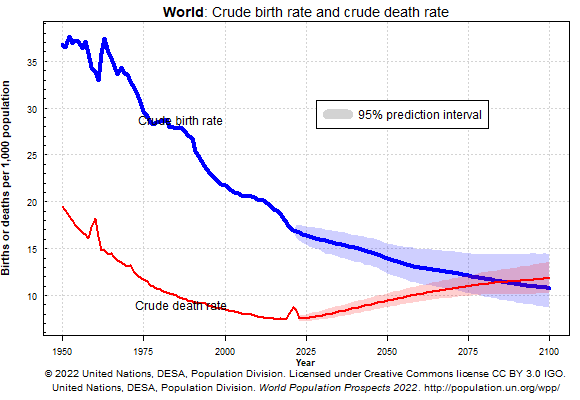
no thanks
Having children is a slight risk because custody is a bit more likely to be given to women than men, so men are a bit more likely to have to pay child support.
Having a spouse who stops working to take care of children is a large risk for both partners. One risks having to pay alimony to support the non-working spouse; the other risks losing their earning potential from time spent out of the workforce.
Having a child is also more than a slight risk to the woman whose body is put through drastic change with unpredictable consequences and are still expected to keep working the same as before.
This is how the law works on paper, but is it actually representative of the practice? There is far more sympathy for women than men, and how often does the woman outearn the man?
> Having children is a slight risk because custody is a bit more likely to be given to women than men, so men are a bit more likely to have to pay child support.
There is far more risk than that, and paying child support isn't the only issue here, having a broken home isn't fun. And why can't men opt out of child support like women can get abortions, or put kids for adoption etc.?
> Having a spouse who stops working to take care of children is a large risk for both partners. One risks having to pay alimony to support the non-working spouse; the other risks losing their earning potential from time spent out of the workforce.
Maybe women shouldn't be focused on the workforce to begin with
That mainly seems to be an issue in the west and those who follow their way.
I met my (now) wife after a long relationship that'd ended somewhat messily. I made the conscious decision to go all-in on the new relationship because it could not possibly be what I wanted it to be if I didn't.
My wife and I were married about 5 months after meeting. My friends and family were worried that I was leaving myself vulnerable to being wiped out emotionally and financially if the marriage didn't work out. They were right, in a way. But sabotaging the relationship on order to stay safe seemed a far worse risk.
We're coming up on 18 years of marriage, so I'm glad I made that call. In an alternativee timeline where this relationship had failed, I'd like to think I'd still go all-in subsequently, but I can see how it would get harder and harder with each failed attempt.
Though, of course, if you’re still thinking about gender norms, then either find someone who agrees with your expectations, or don’t be in a relationship at all because gender norms don’t actually matter to the work that goes into making a relationship or marriage work.
Figure that out and you'll get a committed partner for life. ;)
But to start, a wife is often the sole emotional support network that a man has, and in a healthy relationship his sole source of sex.
I think equality is a good thing; it's just that we haven't learn how to structure society to not squeeze as much productivity as possible out of working-age people.
Please elaborate.
Thats some next level bullshit. you're saying that because I'm scared of getting into a marriage, that she's the one "who's dodging a bullet"
Put another way, if a woman said she was scared of getting married, would you tell her that the man she would have married is "dodging a bullet?"
obviously not, it would be an incredibly messed up thing to say right?
This kind of "empathy" for men is precisely why its dangerous for men to get into marriage. I'll sit on my money and find other ways to find happiness in life thanks.
its not about fixating 50% into the bucket. its about incentives. there are plenty of good women for sure. the issue is there's a lot of predators out there too. And they will look and act like someone you'd want to marry. right up till its too late. You want to deny that most divorces are initiated by women? that women get custody (and the house) most of the time and that family courts are incentivized to do so because they GET A CUT? fine. But don't lecture me like I'm somehow being a less than moral person for pointing out the very obvious hazard.
If you meet the right person, go ahead and get married. but don't go in without knowing that its a one sided agreement that doesn't benefit men in the slightest.
Being married has been awesome. Best decision I ever made.
Some days are hard, sure, but that's part of living with someone who is not you. We come out as better people in the end.
I think this is a big thing, and one that in the end will ruin us as a society if we let it. There's something innately wrong about this constant rat-race I see in some friends where they effectively say "oh, there's something wrong with this partner that in my previous X relationships I didn't see before. let's go find another one". Modern communication methods (social media and dating apps in particular) have created a situation where you can constantly compare your partner to the rest of the world, while at the same time (theoretically, for most people I'd argue partner choice hasn't increased at all, or even decreased) widening the dating pool. The idea of commitment becomes... Alien, because it's so easy to just go and trade her in for a newer/better model, not realizing that we're all flawed in our own particular way and that part of a relationship is sticking with eachother and growing because of that.
Eventually, you start looking for the absolute best in every way, which is probably never going to exist
For me the significant markers of committed relationships were first moving in together, then perhaps buying a home together (in those places where that was still affordable), and then for those that wanted them and by far the most important having children together.
Many of my friends and family have gotten married along the way too but it never felt like a big deal because by the point they got married they'd already been together for several years. It was a nice opportunity for a celebration! But having children together seems the far greater commitment. Marriages may end but even if you split up you'll still be parents together.
I grew up in a far less religious society than the US so maybe this just reflects a different cultural background. The US has always been more religious than Europe while also having far higher rates of teen births and children living in single parent households. But US rates of religious identification and teen births have both been falling rapidly over the past couple of decades.
https://www.statista.com/statistics/464239/total-number-marr...
Interestingly, this is why I broke up with a fairly long term partner. I just wanted to do what I want when I wanted to do it. We didn't have any kids, so that was easy. But I lost a bunch of money from our shared house/possessions, I just let them have almost everything because I didn't care too much.
Maybe I did it in the wrong order, and if I spent decades doing what I wanted first, things would have been different. But right now, the ability to do what I want when I want is awesome and I couldn't be happier.
Probably, yes.
(If you never could make a relationship work because you're lousy at relationships, that is more your failure. But if you're in the first paragraph, you're probably feeling that you're in the second, and you may not be.)
It's not this crowd you should be defending against - it's the profiteers. Extraction of profits has been elevated above everything else and I feel the social contract between industry and individuals has been violated. Salaries are depressed and everything is so expensive, people need to have worked-out a decent-paying career before they consider getting married and/or kids, so people are getting married later in life, or not getting married at all because the dating pool gets shallower with age.
The societal effects of over-extracting profits are ging to be catastrophic, but short-termism is now built-in.
In your model the causation is that profiteers caused the breakdown of marriage but we shouldn't confuse correlation with causation.
It's also plausible that the decline of marriage caused the preponderance of profiteers.
Indeed given the modern day 'profit above all else mentality' that seems to pervade many businesses thoughts these days, and the length of history of marriage, I'd say the latter is more likely.
As for dual income. I'm sorry I simply don't believe it. In my conservative Catholic circle in a high cost of living area, I'm seeing many families with almost a dozen kids where only dad is working (my wife and I included). Dad is not even a software engineer making high six figures. In many families the father's are totally normal incomes and we have a fair share of people making below average. Two incomes is a choice. There is no difference in average income between the two groups yet one has different values. One difference is the mother's are very productive amongst themselves getting things done economically.
I'm guessing those families are not living the conspicuous-consumption that has been the "new-normal" for decades now.
I'll note that it's easier to have a single-income household when you're inheriting a house from grandma, or if dad will help with the deposit for buying a property. However, if both partners are from low-/no-wealth families, they will find themselves forced to get their career on track and/or live a more modest lifestyle than their peers.
As for wealth.. I can't speak to that but we look out for each other and there are several families I know who do not have that kind of support.
> live a more modest lifestyle than their peers.
you mean are less greedy than peers.
I was avoiding speculating on motivations and was aiming for objectivity.
I live between Germany and Portugal, where in both countries is similar to what you describe. It is perfectly possible to raise a large family with only the father having a salary.
Today most couples have the mindset of buying a house for hundreds of thousand euros, pay tens of thousands for a car and also afford vacation to Thailand or whatever frivolous location.
Choosing a more modest location to live, buying second-hand cars without debt, having the wife cooking and taking care of the children is already a huge difference. What is not measured if the happiness of the woman in watching her children grow, that is truly fantastic. Most media favor an "empowerment" rather than presenting as option a traditional lifestyle.
Took me decades to understand this and guide my own family towards a saner lifestyle away from frivolous consuming habits.