When he was squeezed out of management in his own company, it is not a coïncidence that he elbowed his way into Jef Raskin's Macintosh project: Raskin was also interested in building information appliances, the difference between the two men was that Raskin was coming to the notion of an information appliance from the HCI perspective, and wanted to focus on simplicity and low cost. The UX he designed was text-centric and used high-speed incremental search as its navigation paradigm.
Jobs was infatuated with what he'd seen at Xerox Parc, and also wanted to build an information appliance, but he wanted it to be powerful and flexible and centered on the WIMP paradigm.[1]
Jobs was the boss, so Raskin left the project and the company. But Jobs never lost his vision that Apple should sell appliances, and people who wanted to "wrench their own devices" should buy PCs.
Back in the beginning there was lots of talk of "toasters" as an appliance every household has and even a child can use (to the point there was a famous screensaver of flying toasters).
The Mac 512, Plus, and SE were embodiments of this. (The Apple //c with LCD attachment and carry handle was an earlier attempt.) Note that all of those included portability as a feature, while the all-in-one Macs (not the Apple //c) emphasized usability by non-tech and non-tech job people. Their spiritual successor is the last 3 years of iPad Pro w/ magnetic magic keyboard/stand.
It's pretty clear there's only a relatively short period of time the hobby shop and hackers are "changing the world", while the real shift comes when "everyone" can access and leverage the new tech (like a toaster, or fluoride in water).
---
* There's another subtle difference between "bicycles for the mind" and "a computer on every desk and in every home." One of those is vendor centric, the other is user outcome space.
http://raganwald.com/assets/images/bicycle-jobs.jpeg
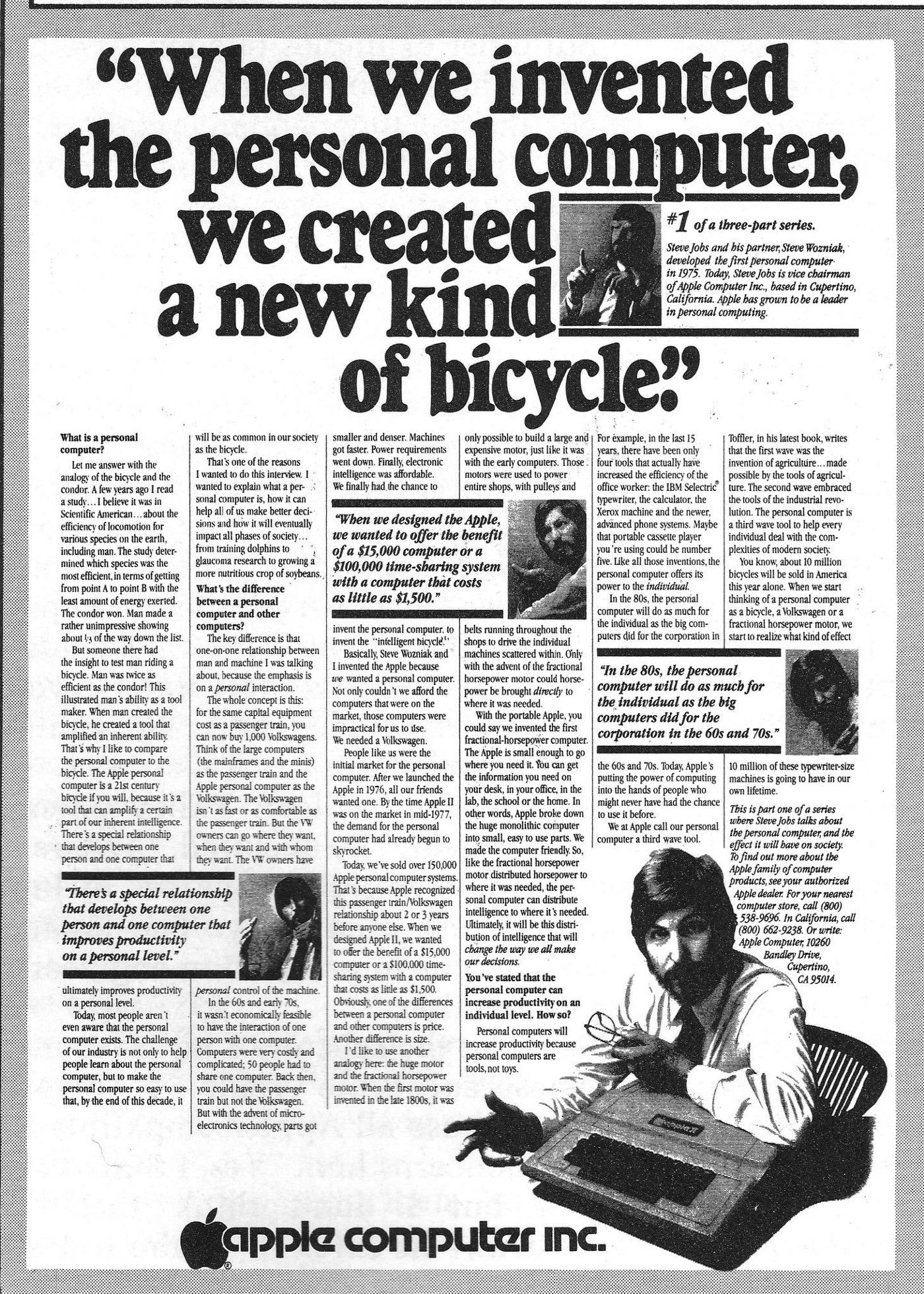
But as a metaphor, I don't think of a bicycle as an appliance. Mainstream bicycles are brutalist: The chain and gears are usually on display and user-serviceable. Parts like wheels, saddles, and handlebars are standardized in a way that allows users to mix and match components freely. In the days of steel frames you could make art bikes and trikes and all kinds of things from a bicycle.
The metaphor works well to describe a lever for the mind's own motive ability.
That's a matter of perspective. If I create a simple bike drawing in crayon, it has none of those things, but everyone knows what the drawing represents if they had it. Maintenance and extensibility concerns are incidental. Framing things to be attractive, was one of SJ's talents.
Hub gear, Marathon Plus tyres, don't store it outside, and just drop it into your local bike shop every ~2000 miles or so as the brake pads get worn out.
[1]: I bought a mid-price mountain bike, nothing fancy, in the era before rear suspension was common. It got stolen within a year. I was part of my parents' grandfathered insurance plan that had unbelievably good coverage for bicycle theft. Insurance replaced the bike with one that had all the same features. Not price matching, matching checklist features. Number of gears, etc. It ended up having some extra features, too, because that was what was in the inventory. After that bike was also stolen within a year, they replaced that with one that had all the features that were in the second one. Plus disc brakes, plus many others, because nothing else fulfilled the checklist. The price of my bike more than doubled in two years. No, you can't get that insurance anymore.
Nothing turns more people away from riding bikes than entry-level bikes. Which is unfortunate. Yes, they're constantly needing work and adjustment and never quite shift or brake well.
It doesn't have to be that way though. Mid to top tier components are very reliable and work so much better, even when old. It makes a night and day difference in how pleasant it is to ride.
And I know it's not exactly fair but I can't stop comparing bikes to cars. The amount and preciousness of the materials, the level of stress, the complexity of construction, how long it can go before service, and so on, and damnit, I can't shake the feeling that 1% of the cost of a car should get a really reliable and near-zero-maintenance bike. But no, $200 won't do it. $300 probably won't, even. Not for a new bike, anyway.
These days more like 5K to 10K+ unfortunately.
The trick is buying used. But for someone new to cycling, it's easy to get scammed into a bad deal when buying used, so that's not a great solution either.
If you're familiar enough with the components to evaluate them on a used bike, great deals can be had. My first mountain bike (which I still have) was a very expensive model when new (S-Works, which is the Specialized top of the line) that I got for cheap when it was 5-6 years old. It's almost 20 years old now and still everything works perfectly, buttery smooth shifting, etc.
Programming on an iPad? Forget it. Have you thought about doom scrolling instead?
Current 13" iPad Pro beats original Macbook Airs for dev, plenty people used them.
I'd argue toolchains readily available on iPad Pro with real keyboard and trackpad today is better than any laptop any devs did work on two decades ago.
Of course if you use Blink (mosh) you can ssh to anything, you can run VSCode or GitHub Codespaces or Cloud9 or any web IDE, you can use any VDI ... even if you don't like the Git file sync and local native Code Editor tools that are compatible-ish with Codea / Textmate / Sublime flavors of editor.
1- While VDIs can be useful options for remote development, I have found that the user experience can be negatively affected by lag or other performance issues.
2- I would not consider Cloud9 to be a recommended solution, as it might be considered outdated compared to newer solutions.
3- While Codespaces could be an alternative solution, it does not offer the same level of security as other options like VDIs.
One alternative that I would suggest exploring is the use of secure containerized environments (CDEs), such as those offered by Strong Network (https://strong.network/). I work there myself, so I may be biased. But from my experience, these environments offer a more secure and stable environment for development work, without the potential lag and other issues that can come up with VDIs or other web-based IDEs.
Of course, the choice of tool ultimately depends on your specific needs and preferences. If you're looking for personal use, GitPod handles things very well. And if you prefer to stay within the GitHub ecosystem, then Codespaces may be the way to go.
Hope that helps!
2010: Post-PC age. cURL? Why not curl up on a couch with your favourite movie instead?
And honestly, I don't think information appliances are a bad thing to have in the world. It's not the kind of device I would choose for myself, but there's a class of users for whom a general computing device isn't just overkill, it's downright dangerous.
Android is fine for my use case, and while there are specific policies I wish Apple would change, I don't begrudge them the philosophy.
I am not sure if you are trying to come off as snobby, but that's how this reads.
This 'class of users' is in many cases very technical people who just don't want their phone to be anything other than an appliance. It's quite common to love tinkering with things, while not wanting to tinker with everything.
Highly technical people may choose an information appliance as well, and that's fine! All the more reason for such a thing to exist.
[0] https://www.npr.org/2023/01/30/1152448758/an-older-persons-m...
Apple is more like a television manufacturer that only lets you watch Disney+. The extent to which they protect their walled garden is not for the benefit of the consumer.
PCs are hackable by design. It's a perfectly mainstream thing to build your own PC from parts. Hacking toasters, on the other hand, is not mainstream. Best Buy sells toasters, but not parts for toasters.
I personally wouldnt draw the line between information appliances and computers at whether the manufacturer actively blocks you (as Apple and John Deere do), but rather at some combination of what the intended purpose is, and whether hacking and customization is considered mainstream or fringe.
Hacking toasters and dishwashers and microwaves and refrigerators is possible, but fringe. Hacking cars and houses is mainstream.
Is it? Most PC (or notebook) users buy whichever one is on sale at the store, or they use one provided by their company. This does not strike me as inherently different to how people buy toasters or dishwashers.
Of course, there does exist a niche of people who like building their own PCs, but this does not imply that this is the mainstream case.
I have an espresso machine, and you need to calibrate the pressure, the temperature, clean all the parts regularly (far more than a pod machine), you need to fill the coffee grinds in a way that is distributed so the water runs evenly, you need a coffee grinder that makes less-coarse grinds, etc... its far more work, but the coffee is exactly how I like it.
"Unauthorized Bread" by Cory Doctorow
1. When Jobs left Apple, he was barred from competing with them in the general computing/appliance market. NeXT when it launched was advertised as a product for higher education.
2. Jobs had to bootstrap a company from scratch into what was by then a much more sophisticated industry than existed when the Apple // or mac were launched. Building on top of Unix and Mach was way lower risk than trying to invent an entire operating system from the ground up when your interest was really in the user experience.
You present an excellent historical case of how Apple got here, but here's where I see a dichotomy: Back in the day, tools like RezEdit, Hypercard, AppleScript came included. There were countless "apps" to reconfigure how the Mac looked and felt to create a personalized experience. Average users had developer-like tools that enabled them to become producers. Even today, things like Swift Playground send a message that Apple wants a technically-enabled user base.
Perhaps this is really an issue like centralized vs decentralized computing, states vs. federal, IE: there will always be a fundamental fight where some people within Apple want a black box appliance, and others want a fully customizable hackable device.
Inspired by a mind-expanding LSD journey in 1985, I designed the HyperCard authoring system that enabled non-programmers to make their own interactive media. HyperCard used a metaphor of stacks of cards containing graphics, text, buttons, and links that could take you to another card. The HyperTalk scripting language implemented by Dan Winkler was a gentle introduction to event-based programming. Steve Jobs wanted me to leave Apple and join him at Next, but I chose to stay with Apple to finish HyperCard. Apple published HyperCard in 1987, six years before Mosaic, the first web browser.
—Bill Atkinson https://www.folklore.org/StoryView.py?project=Macintosh&stor...
My recollection of HyperCard is that it was a grassroots success, Apple did not invest in it, Apple never made a compiler to turn stacks into Mac apps, &c. I personally did two professional HyperCard stacks. One was an internal tool used by a consulting client. The other was a configuration tool for a very successful (at the time) Java development suite. I wrote it in a weekend to meet a deadline, which is why it was written in HyperCard and compiled to run on all our supported operating systems using a third-party compiler.
My employer was aghast at this, our mantra was that if we’re selling Java tools, wherever possible we would write them in Java. I thought I was a decent programmer at the time, but no way I could bang out a robust customer-facing tool in a weekend using Swing or AWT or whatever.
It was eventually rewritten in Java by a co-op student, it took their entire work term. So eventually, everyone was happy. But HyperCard got the job done when shipping fast mattered.
> &c
for those not in the know, "etc" is an abbreviation for "et cetera" which is Latin for "and so on."
the Ampersand character itself evolved from the shape of the word "et" which alone is "and" in Latin.
what do you do with all the time you save? :D
1. Abbreviations, acronyms, and initialisms are a kind of jargon that compress long words into single tokens that communicate something in a single chunk. That is more efficient for _readers_ to parse... If they are in the know.
2. Speaking of being in the know, abbreviations, acronyms, and initialisms communicate which tribe you belong to, and this strengthens social bonds between writer and readers.
3. Some mediums have limited space available. Newspaper headlines, SMS messages, and the original Twitter tweets are examples of mediums with limited space. Abbreviations help compress longer messages to fit the medium.
I happen to be a very slow author compared to just about every professional I know. Since it takes me a while to think about what I write, I find that trying to find shortcuts is not helpful with code or the written word.
Cheers...
It's never been trivial to configure the Mac in terms of things like skinning, but third-party tools to do so have always existed for those who cared enough to look, and today, if you want to install Linux on your Mac, you can. If you want to install Windows on your Intel Mac, you can even do that. Those options were, at best, incredibly niche back in the pre-Intel days (though I remember toying with SuSE Linux for PowerPC in the early 2000s), and nearly nonexistent in the pre-MacOS X days.
So it's definitely not a simple case of "Apple in the '90s was in favor of customization; when Jobs came back, he locked them all down and made them toasters."
For a company with Apple's budget, XCode is a disgrace.
Constant crashes, unreliable and underdocumented apis. Urgh.
I’ve been doing web programming for the last decade or so. When I started web programming, it was a mess of browser incompatibilities and jquery. But now I’d take modern web development over apple’s hellscape any day. MDN, caniuse, flexbox & grid CSS, modern bundlers, svelte and solidjs - this stuff is a delight in comparison.
If it weren’t for the AppStore, it would’ve been the end of Apple. The iPhone wasn’t released with it at the outset - because this “make your own” wasn’t a part of the ethos. The Mac also suffered tremendously with no love to Final Cut, snipping Aperture, and leaving the hardware to bit rot for the longest.
iPod was a hugely profitable windfall and iPhone was too - somehow the AppStore slipped in there and became the lone remaining ember that reignited the hacker mindset - Swift I believe is that true rekindling; everything else follows M series, OSX continuities, etc
I’m starting to rethink everything I thought I knew.
Jobs resigns: September 85
HyperCard: August 87
AppleScript: October 93
NeXTStep: September 1989.
And then there's Automator: April 2005
https://support.apple.com/guide/automator/welcome/mac
Apple between 1999 and 2012 seemed to put out one banger after another. But I could smell the garbage coming with the original iPhone. It's funny because the iPhone is lovely ... until you get down to the many many desperate attempts at vendor lock-in, the "meh" quality software (NOT compared to Android software, just compared to well-written computer software), and the way everything's locked down. Mehhhhhhhh.
That sounds exactly like emacs with company-mode or ido-mode.
The iPhone is an appliance that can download "apps" that Apple permits. When I want a "computer" I open up my MacBook.
That Macs are still somewhat open is just a happy historical accident. Enjoy it while it lasts :/
Apple has publicly said that macOS is unacceptably insecure because users have the option of running unapproved software (https://www.theverge.com/2021/5/19/22444353/mac-malware-not-...). It's not unreasonable to think that they'd be interested in fixing that "problem".
Just give me a simple checkbox in the system settings that this is a "developer machine and I know what I'm doing" which disables all that stuff and it would be fine.
I assumed it would be much more frustrating than going back to Linux. Instead I've found fairly sensible documentation for solving nearly every issue I've run into, and a well stocked repo of applications.
Simply disabling it globally isn't really a good solution to the problem. Neither signed nor unsigned, notarized or un-notarized apps should ever be allowed to write to those folders, no matter if SIP is on or off.
OTH preventing an app to read/write subdirectories in the user's home folder is definitely not a useful feature.
They still haven't, haven't even made any big moves that way, but maybe eventually that crowd will be right in the same way that if you predict a recession every year, you'll eventually be right.
Everyone likes to say “but would Apple would lose the $100/yr from all those hobbyists.” How many hobbyists do you think are out there right now paying $100/year just to load some apps on their phone? Can’t be more than 1000. Even if it were 10,000 that would represent $1 million/yr in lost revenue for Apple. That’s less than a rounding error on just one quarterly report. They really don’t care about that!
Apple wants to fully control the devices they're letting people use. Allowing side loading can only be considered a reduction in control of their devices, thus it's against their main mission.
Nah, they're worried someone might sideload a software with payment method that doesn't give them cut
Get real, Apple's target demo is upper-middle class people who want a frictionless computing experience - the kind of people whose response to a massive avoidable security fail would be litigation and political/regulatory action.
Apple treats their users like a nursing home treats senile people.
They made a thing, and you bought it.
Why would anyone with a bent on free computing walk into what they know to be a closed ecosystem. Just buy an Android phone. It’s like flying to a foreign country and expecting everyone to English to you imo…
This excuse is exhausting, lacks any principles whatsoever; these are general purpose devices, browsing the web & allowing arbitrary apps to be developed & squeezed into the world, if they pass through the tyrant's gauntlet. That one company offers some modicum of un-tyranny is a poor defense for locking down & excluding general purpose computing, for withdrawing the systems we have in our pockets from our own ownership & ability to control.
Citizens should have some options. The implications that althe market is free to do whatever & citizens are free to pick from what's available seems presently somewhat tennable, but if we step back just a little bit here & look at the picture, it's horrifying. The inability to root most Android phones shows that actual freedom, real general purpose computing, is an extremely fine & narrowing little sliver, of the most important & most used general computing world.
Good luck.
It should be an absolute no brainer to protect the species, to not close the book on possibility forever, to not let the species be limited & cajoled by impersonal & vast techno-captial-ocratic enterprises, that will hedge us in. But the short term wins arent super clear. "What is the use case?" "We dont know yet." We might have to enable possibility, act on principle, to find out.
The threat of living in a post science world, where the universe around us is illegibile because we made it that way, where we cannot learn or see or work some of the most important & connective matter around us, seems like it's worth all the cards, is a no brainer to go all-in to defend against. The war against general purpose computing is a slow & creeping infernal damnation.
Android went dark long ago too. All of the open source apps are abandoned and unmaintained replaced by closed source versions. The Play Store takes a 30% cut of things like Apple. Google decides what kind of apps are available on the app store and it closely matches Apple.
Not arguing but rather expanding: You may be thinking "He just ignored sideloading get real" but tell me, are there any porn apps? No there aren't. They have no distribution channel and are banned on 100% of the computing devices people run their lives with which is their phone. "But porn works just fine in the browser" well so does pretty much anything else even on an iPhone so why are we even chatting in this thread? To end users Android sideloading does not exist.
Apple and Google control what types of software humanity gets to use and there are no viable alternatives. Apple has fully embraced 1984 as these recurring threads keep pointing out but Google follows Apple in lock step on nearly every decision. There is no third choice except the increasingly crippled web.
In terms of mainstream stuff, I think that's less of a "Apple & Google don't want you to have them" and more "society doesn't want you to have them, won't somebody please think of the childreeeeen".
Parents ignoring the fact, of course, that the 3 year old they gave a fucking tablet to with unlimited access can still end up on any of those sites via the browser.
If you want an adversarial narrative between Apple and the people, you'll find no greater supporter than me. Europe seems to disagree with Apple's philosophy though, so maybe it's time they reassess their opinions.
My phone is an appliance. I need it to provide 2 way communications and access to the information on the internet. Apple will provide security updates for the foreseeable future. That's all I want as I enter curmudgeonly old man age.
But yeah, I know I bought a locked down device and I'm ok with that. BMW is charging a subscription for heated seats. I'm not ok with that, so won't be buying one. Obviously, they expect some people still will. I agree with them.
That's the key point: I bought it. It's mine now and I have the moral the moral right to do anything I please with it that isn't immoral. Granted, there can be laws that trample that moral right or artificial technical barriers that attempt to restrict it, but both are unjust. Attempted word magic spells such as "by using this product that you just bought you agree that you didn't actually buy this product" are ridiculous, dishonest, incoherent, and not morally binding.
And ... you do? Is there some reason you can't do whatever you want with the device? This is like complaining that you can't use your xbox or television as a general purpose computing device.
You can legally hack your own iphone. Go for it. You own the device.
This is true, but only due to DMCA exemptions that Apple strongly opposed: https://www.wired.com/2010/07/feds-ok-iphone-jailbreaking/
Give it a year of lower than usual profits and some twitter complaints and they will backpedal at mach 10
Oh, wait...
For example, say I run a sketchy reseller operation that buys old or refurbished Apple equipment and load an iOS-ish/macOS-ish custom unix (and then falsely market it as an "Apple product"). For all intents and purposes, it may look exactly like an official Apple OS, but it isn't.
The untrained eye is oblivious to the differences and now, assuming the "sell" was that that person got an Apple device for cheap from some random seller, Apple now has the potential burden of supporting that. Considering their potential market is in the millions who might be duped by this, by allowing this one little change, they just introduced a support burden that nukes their profit.
I would personally just not buy an iOS device for this reason, though now they're putting M* chips in them I suspect they'll eventually be jailbroken and able to run an open source operating sysem.
That being said, the discussion goes beyond the feelings of people for and against Apple. This is directly about addressing their business practices relative to the rest of the market, and these side-effects suck. If these changes don't directly remove a feature you care about, then there is no reason to throw yourself in the line of fire. Apple, much like every other FAANG company on the ladder, is ruthless. They're a min-maxed value extraction machine with the greatest marketing team ever assembled. It's hurting the rest of the industry, to the point that regulators have to step in and tell them they're wrong. And when they do (like the Dutch antitrust ruling), they refuse to acknowledge the results as fair and ignore the fines.
That's asshole behavior. Petty arguing on the internet hurts nothing but your feelings. Apple's lack of accountability has enabled government surveillance, legitimized China's ethnic cleansing, and snuffed out anyone who would try to compete with them on their own platform. When you personally defend their mess, you look messy by association.
Nothing stops Apple to keep doing this while allowing for more freedom on the user side.
Why should your personal view obviate the devices' nature?
These are all computers. *Whose* computers is the more important question. And from a look at a lot of these 'narrow focused computer devices' have the company you bought it from still exert control years after your purchase... It's almost like you unwittingly agreed to a rental that was misclassified as a sale. How many times were features removed at a later 'update'? How many features did the device support but didn't make available? How many features were kept because it would keep you from prematurely throwing it away to get the new thing?
Or better yet, with devices that have user-reprogrammable hardware means that the ecological aspect of "obsolete" hardware is that the new feature makes it nearly good as new, all the while keeping it out of the landfills. Sure, stuff going obsolete will still happen... But with repair and upgrades as options means the "Reduce, Reuse, Repair, Recycle" will lead to better outcomes for all. But that's not good for capitalism and profit.
> The iPhone is an appliance that can download "apps" that Apple permits. When I want a "computer" I open up my MacBook.
And, why is your opinion on what a "computer" is important? What criteria are you using? I ask this because we even have "Doom played on a pregnancy test" https://www.pcmag.com/news/yes-doom-is-playable-on-a-pregnan... . Basically any justification or rubric on what a computer is sure looks to me as artificial and gatekeepy.
The obvious upside is that people who start off building hobby apps may well move into developing apps - and perhaps even associated hardware - professionally.
This is very likely to lead to increased goodwill and significant further purchases of products and other services.
Development of Xcode (not the best environment ever...) and Swift/UIKit will continue anyway. There is no sense in which a few thousand/tens of thousands of hobby developers are paying for that to any significant extent.
This does not require sideloading or loosening the security. It requires a slight relaxation of the provisioning system for single devices - something which exists already.
I don't care what the fanboi justifications are. Not doing this makes absolutely no commercial sense. Apple is gaining a somewhat imaginary $99 a year, which hobby developers won't pay anyway, and losing extra sales of hardware and apps which are potentially worth far more. It's also driving hobby coders towards competing ecosystems.
Instead of expanding the ecosystem this contracts it.
> This does not require sideloading or loosening the security. It requires a slight relaxation of the provisioning system for single devices - something which exists already.
They have always had that option. However it goes against the "You bought it, but we retain control forever" aspect that Apple exudes on every hardware line. And even though installing software outside of their "App store" is possible on the laptops, my guess is that soon will not be. Iron-fisted control is their modus operandi.
> The obvious upside is that people who start off building hobby apps may well move into developing apps - and perhaps even associated hardware - professionally.
The counter to that: by having a much of even lower class shovelware, like Android, devalues their platform. They want money developers and big name companies. And it's even better if your org is exclusive to Apple. Stay off those "green text bubble" devices.
> I don't care what the fanboi justifications are. Not doing this makes absolutely no commercial sense. Apple is gaining a somewhat imaginary $99 a year, which hobby developers won't pay anyway, and losing extra sales of hardware and apps which are potentially worth far more. It's also driving hobby coders towards competing ecosystems.
It makes commercial sense if you want to create a nearly impenetrable moat around your hardware, software, and userbase. The $100/yr dev license is also a signpost to everyone that "we mean business - we don't want riff-raff here". And combined with other anti-user and anti-developer decisions (soldered in ram; cpu; disks, and industrial glue on everything now) those devs are either biting the increasingly painful prescription of bullets, or they have already left to "lesser platforms", with low user numbers.
Look at the trackers like AirTag. A gadget to find your keys is incredibly useful, but can also turn into a device to aid criminal activity pretty readily.
What you're offering here is not an argument but a mental block to actually thinking about the issue described. You don't offer any ideas for 'correcting people's behaviors': how do you propose to address the phenomena of greed, dishonesty and so on, given that people with those qualities are just as well able to make use of technology for their selfish ends?
Our culture informs us of what is socially acceptable (theft, greed, dishonesty etc) and meters out justice through our real social networks of family and friends. For issues that raise to a level of criminality we use the legal system.
I also think it's perfectly fine to make use of technology for selfish ends. That's the real reason competitive market economies function more effectively than command economies. When we all act out of our own self interest we buy the best value good and reward the most efficient producer. (Thiel argues with this and I admit this pattern does not hold in markets with monopolies, cartels, or regulatory capture)
I love side loading apps on my oculus quest too. my quest will continue to provide me value after meta ceases support this year.
Apple does sell real computers under the Mac line.
The "only run approved software" part is a restriction imposed by Apple. It is not because of a physical limitation that makes them not real computers.
Technically there’s a real computer in my refrigerator, my printer, and my headphones but I don’t have any expectation that these are general purpose computers that are available for me to compute on. I think it’s those expectations that matter and it isn’t always black and white.
I look at my phone as being similar to a PS5. I understood that both devices were somewhat locked down when I bought and in fact that’s part of the reason I bought them. If the PS5 had an authorized mode that could run any software it would be a worse device. If I wanted something more open, those devices are available and that’s what I would have bought (and have bought in the past).
Yes, we get it, those computers are intentionally locked down by their manufacturers. That lockdown is what the problem is.
You can use this argument to justify anything companies want to lock down.
Millions of people buy cards that can only be used to specifically only play, say; 'Magic: the Gathering' (MtG).
You could probably invent some sort of new game with MtG cards, or do some sort of card magic with them (no pun intended); but MtG cards are very intentionally not designed to be 'general purpose' cards or tools to design new card games with. They have a very specific audience in mind.
Magic the Gathering cards are also much more expensive than a regular deck of playing cards I can grab from my local dollar store. They have a lot less utility than said cards I can acquire for a $1.15CDN, taxes in; and they also have a bit of a stigma from people who seem to not like MtG for various reasons.
Somehow, still; it's one of the largest and most widely played card or tabletop games in the world; easily - and it's got an enthusiastic community of passionate and fascinating people.
Is Magic: the Gathering ruining card games? It is 'an offence against the entire notion of' what card games are?
Fuck no. Apple isn't some offence to the notion of computers, either.
Maybe it's not to your taste, but just because a product is designed for a specific set of purposes or utilities that don't suit your preference doesn't mean you have to jump to the dramatic conclusion that these products are 'ruining' the entire notion of what a product is. It's just a different product. Get over it, and use a different one. Take a valium and realize people like and use different things, and that's okay.
On a side note, I develop hobbyist apps for WatchOS, iOS, MacOS, the web; and SEGA Saturn, all on my Mac; and I've never had any issues actually achieving the results I wanted.
It would be if a WOTC employee came to my table every time I tried playing, personally overseeing every turn of the game to ensure that I didn't break the rules, engage in unsportsmanlike conduct, use my imagination, taunt my opponent or profit unfairly with their platform.
The above link is nowhere near close to exhaustive. Many of the formats on it were made up by fans, and then eventually made quasi "official" once a popularity threshold was reached, like Commander.
In fact, the entire premise, from the get-go of Magic: The Gathering was incredibly flexible modularity. Every time you change your deck, you're 'changing the rules' of the game. It's Turing complete, and people have made some really wacky stuff with MTG cards.
And, there's no small amount of proxying going on. Many, if not most Commander players allow a few proxy cards. High level tournament preparation involves 100% proxies. Online platforms allow you to play with any card in Magic's history for free, if you're willing to don the pirate hat; and if not, you can play MTGO or Arena.
And people did, e.g. https://en.wikipedia.org/wiki/Magic:_The_Gathering_Commander, which is now the most popular MtG format. So yes, even in this case the freedom to explore and experiment is good.
I love that example, since I have thousands of Magic The Gathering cards, but I have never played the game ever. The cards are very useful and I don't care what game they are meant for. Like many others I use Magic cards for print'n'play card games. Print out cards on regular paper, cut out, and put in sleeves with a cheap Magic card behind as backing.
Yeah, as others are also saying, welcome to the 21st Century where they're not really computers anymore that they're selling. Your mistake is to still believe that they are.
I view the phone the way perhaps a ham (ham radio operator) viewed the transistor radio. For those of us where a computer is a tool to build with, a thing to tinker with, these new pocket devices are not for us. Too bad.
I've moved completely away from developing for "mobile". It's more of an afterthought for me at this point — "Hmmm, would this also make sense to port to mobile?" My thinking these days defaults to developing for the desktop and the web.
I hope linux phone enthusiasts can keep their spirits up for the next 5+ years it feels like it will take to make a daily driver open hardware phone happen.
Nobody sane is arguing for a vulnerable computer.
The desire is just less friction and fewer restrictions on what code can be written and executed by the owner on the device. Really this is what virtualization is for, and the only thing keeping mobile operating systems working as they do is that most consumers don't demand the same features as businesses, but in my opinion they should.
This gives all the control back to the user. Nobody should be bullied into just accepting all permissions the developer wants. The developer should be forced to gracefully degrade their UX when their dependencies are denied without preventing access to the core service and should be sued into oblivion when they violate this basic promise under accessibility laws.
From a developer perspective virtualization would also make accomplishing this much easier since they no longer have to be limited to crappy APIs that are not just sometimes vulnerable and incompatible but restricted on purpose under bogus pretense.
That level of friction is $99 :-)
Then it auto-deletes and there's nothing you can do about it.
The only class of malware that the currently-mandated friction is preventing is the kind that appears benevolent for 7 days then strikes on day 8.
For me it is just a terrible feeling to not really own a device I bought, so I avoid them wherever I can. Annoyingly, this is getting increasingly more difficult.
As a potentially interesting aside, today lack of programmability seems to be a sign of a maturing market. I recently researched e-cigarettes that I can program to time me, those that have a computer in them basically all allow for writing your own programs. Same with the smart watch market, although Apple is trying its best to ruin that as well.
In the Windows XP era, a freeware game or utility you downloaded turning out to be a virus was 100% your fault. It wasn’t a defect in Windows that your whole computer got owned, that was just how computers worked. Crazy to me that people want to go back there.
The push for containerization and sandboxing is in right direction if user have control over it.
By all means run the new app I downloaded in nice little box and ask me when it wants to access any file from outside of it, but if I want to I should have option to give it permission to whatever I want.
It's not so crazy if you understand that there are people who want to be able to have complete control over their own machines. These modern security measures trade that control for security.
But there are many circumstances where that tradeoff is undesirable. Perhaps the machine will never be connected to a network. Perhaps the owner of that machine is willing and able to take responsibility for the security. Etc.
Video game consoles are just as locked down as iPhones, but ~nobody complains about that since you can just buy a PC instead. There is no good equivalent (in terms of compatibility and privacy) to iPhone/Android, though.
Lenovo was one of the more famous abusers of its freedom [0] so sticking with popular and well known consumer brands did not save you, just as I expect it doesn’t now with Android.
You are talking about privacy from rogue app developers. I certainly laud Android (and iOS) for their approach here, and I agree that the situation is much better than on desktop operating systems.
I, on the other hand, am talking about privacy from the OS developer, i.e. from tracking that's built-in to the OS by the OS developer. The situation on Android is certainly much worse here than any other operating system.
(One could argue that the tracking is not built into the Android OS, but into Google's Play Services. Since all mainstream Android vendors ship Play Services, this is a distinction without difference.)
It is possible to make an OS which is private in both senses. De-Googled Android distributions and Flatpak/Snap prove this. So far, there has been no mainstream interest in this, though.
XP security was atrocious, and there were already better, functional models of how to structure things out there.
Even today, no file sandboxing solution I'm aware of really properly handles more complex file formats that don't consist of a single atomic file.
Only macOS goes beyond the simple "allow the user to pick a single file or directory and that's that" model, and even then according to the documentation I found it only handles simple sidecar files that only differ in the file extension from the main file, but still breaks down for anything more complicated than that.
Fortunately systems are designed for multi users, with sandboxes and access controls and heuristics now, and it's less of a problem for most people.
Our ability to sideload apps, or install pwa that are full featured doesn't need to affect your safe little bubble of protection. You'll be ok, I promise.
Yep. One of the most glaring examples of this is the complete extinction of portable backups. Back when I was carrying around a PDA I could plug it in, hit one button, and have a total backup of everything on my device. Plug a blank device in, hit one button, and everything is restored. Today if you want a bulletproof device backup you have to pay Apple for the privilege, and even then you're completely crippled by your upload and download bandwidth. It takes a long damn time to back up 512GB of data at 10mb/s upstream. Nearly five straight days, in fact.
Edit: Mac -> computer
> https://support.apple.com/guide/iphone/back-up-iphone-iph3ec....
I don't understand OPs problem with cloud backups being charged for? Many people (myself included) are storing terabytes of images/videos in their cloud backups. While I think the free tier could offer more than 5gb, its not unreasonable to charge for larger cloud backups, Android does the same thing.
Let me guess, Xfinity?
The flaw here is you're assuming that true general-purpose computing is free when it is not. You've heard the saying "constraints free, freedom constrains"? It's true. Artists often set artificial limits on themselves (such as only using one color of paint) in order to try to bring forth pure creativity without the added stress of making choices. Or perhaps you've read the classic essay "worse is better"? If not, you should. It's thought-provoking.
In high school, I had a friend who was very talented at Game Maker, and he could compile his games as executables and distribute them to us via e-mail. That's impossible on an iPhone.
But peak iPhone for me was a jailbroken device running iOS 5 or 6. Back then, everything was still Objective-C, which meant that every object could be introspected in the live system and swizzled which allowed for making tweaks to the actual system. You also had Unix underneath and could login to a bash shell and install a compiler.
But someone who learns to program Swift on an iPhone or iPad simply won't have a deep understanding of how anything works. Even if you pay the $99, it's still a rather unpleasant experience to program on iOS given all the restrictions.
YES! I feel offended in Apple's ecosystem. Consistently.
When I can't upgrade, can’t even fix my own overpriced laptop because of soldered parts.
When I can't copy MY photos out of MY device, without uploading it to Apple's cloud.
When I can't buy OEM parts for older Apple devices because Apple put a noose around independent suppliers.
When (like the OP found) I can’t run MY CODE on MY DEVICE without notarizing and authorizing.
There's a much longer tail of issues I can fix and address myself.
These are fundamental, They eclipse all other (hard) things Apple deserves credit for like hardware quality and performance and integration with other Apple products. Despite their price gouging.
I am myself pulling away from Apple. I do not buy them any more. Don’t recommend Apple to any makers and hackers. The only persona I see happy using Apple laptops are ones who don't care about these. Those that got them handed down from work. They don’t tinker with them. They use them like appliances.
They don’t have my problems. I do.
Wait, what? (Not an Apple user - genuinely curious)
On my Android phone I can just send the photos directly to my MacOS machine via Bluetooth. No app required.
You can setup a local web server and access all files using a Web browser from any device on the network. I have been using Trebleshot[0] on Android for this. Sadly the source code is archived now.
[0]: https://f-droid.org/en/packages/com.genonbeta.TrebleShot/
And a house can be painted with a toothpick.
At the end of an export, I have a folder full of randomly named files. Now What about timestamps? Image names? Location? Timezone? Edits I made on the iPhone? Image quality? Is it heic, jpeg, png?
Apple forums are loaded with frustrations as this
https://discussions.apple.com/thread/252812655
At a $1000+ price point, I am a customer and I am offended.
Whether the "owner" of a "phone" has control over it is debatable. Corporations calling themselves "tech" companies comprised of sellout nerds can not only selectively prevent the "owner" from running software but can surreptitously, remotely, without informed consent, install and run software of their choosing on the "device". WTF. Meanwhile seeking to monitor all network and computer use by the owner, doing so with a sense of entitlement as they lack viable longterm business plans.1 Hence the ridiculous schemes like developer fees and "app stores". Apple will slowly keep ramping up data collection and advertising, boiling the frog.
A "personal computer" is a computer a person owns and controls. IMHO.
"Phones" can be beautiful appliances. We can admire them for many reasons. But calling them "personal computers" is a stretch, and honestly AFAICT no one does. FWIW, people refer to "phones" by other terms, such as "device". Mobile phones today contain computers, but that is about as far as we can make the comparison to the personal computer.
Arguably every new appliance does or will eventually contain a computer. That hardly means its owner will be able to control it. It's still possible to build a PC from parts and there are more small form factor development boards than ever before.
Apple reminds me of the diamond industry. How does it manage to charge such amounts of money for something that is so readily available. It sells people a story. De Beers is apparently now entering into the synthetic diamond businesss. Apple's next move should be similarly amusing.
1. Computers are cheap and getting cheaper.
Don't even start me on the symbolism of their anti workers rights bs.
You said it better than I could.
The irony of this being Apple today. What would be the computer industry even be if the Apple ][ had existed under this twisted restrictive mindset.
I am, of course, aware that many (perhaps most) computers in the world are effectively appliances, but at some level, the great glory of this glorious, epochal machine -- the "personal computer" -- is one's ability to program it and make it do something new. It is not just a machine; it's a machine for creating machines.
Take that away, and . . . to what shall I compare it? It's like giving someone a deck of cards and telling them that these cards can only be used to play blackjack. You can't invent a card game, or change the rules, or build a house of cards, or do card magic. Putting such stipulations in place isn't just annoying or inconvenient. It's a kind of basic betrayal of the concepts and affordances that underlie the thing itself.