Back in the beginning there was lots of talk of "toasters" as an appliance every household has and even a child can use (to the point there was a famous screensaver of flying toasters).
The Mac 512, Plus, and SE were embodiments of this. (The Apple //c with LCD attachment and carry handle was an earlier attempt.) Note that all of those included portability as a feature, while the all-in-one Macs (not the Apple //c) emphasized usability by non-tech and non-tech job people. Their spiritual successor is the last 3 years of iPad Pro w/ magnetic magic keyboard/stand.
It's pretty clear there's only a relatively short period of time the hobby shop and hackers are "changing the world", while the real shift comes when "everyone" can access and leverage the new tech (like a toaster, or fluoride in water).
---
* There's another subtle difference between "bicycles for the mind" and "a computer on every desk and in every home." One of those is vendor centric, the other is user outcome space.
http://raganwald.com/assets/images/bicycle-jobs.jpeg
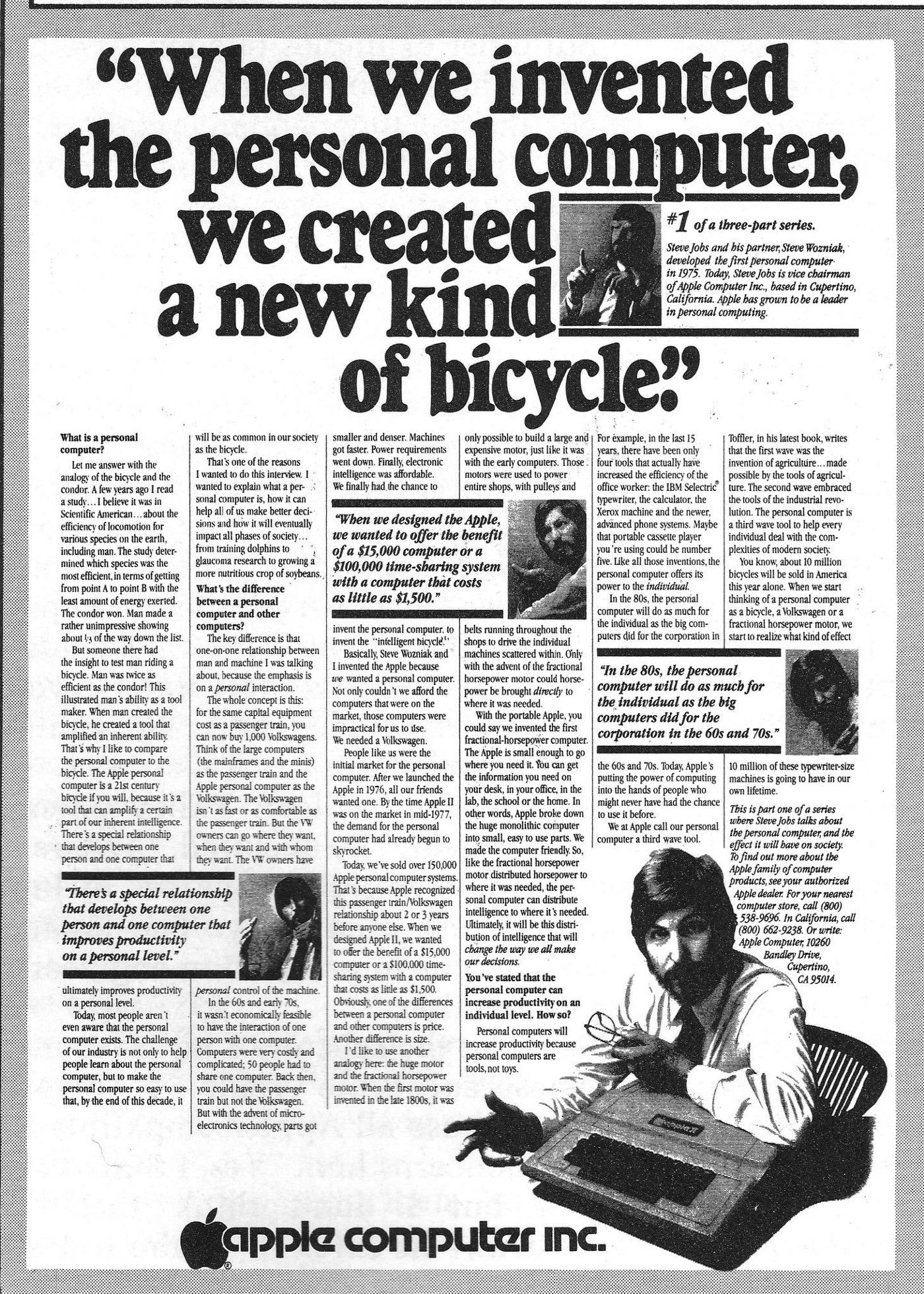
But as a metaphor, I don't think of a bicycle as an appliance. Mainstream bicycles are brutalist: The chain and gears are usually on display and user-serviceable. Parts like wheels, saddles, and handlebars are standardized in a way that allows users to mix and match components freely. In the days of steel frames you could make art bikes and trikes and all kinds of things from a bicycle.
The metaphor works well to describe a lever for the mind's own motive ability.
That's a matter of perspective. If I create a simple bike drawing in crayon, it has none of those things, but everyone knows what the drawing represents if they had it. Maintenance and extensibility concerns are incidental. Framing things to be attractive, was one of SJ's talents.
Hub gear, Marathon Plus tyres, don't store it outside, and just drop it into your local bike shop every ~2000 miles or so as the brake pads get worn out.
[1]: I bought a mid-price mountain bike, nothing fancy, in the era before rear suspension was common. It got stolen within a year. I was part of my parents' grandfathered insurance plan that had unbelievably good coverage for bicycle theft. Insurance replaced the bike with one that had all the same features. Not price matching, matching checklist features. Number of gears, etc. It ended up having some extra features, too, because that was what was in the inventory. After that bike was also stolen within a year, they replaced that with one that had all the features that were in the second one. Plus disc brakes, plus many others, because nothing else fulfilled the checklist. The price of my bike more than doubled in two years. No, you can't get that insurance anymore.
Nothing turns more people away from riding bikes than entry-level bikes. Which is unfortunate. Yes, they're constantly needing work and adjustment and never quite shift or brake well.
It doesn't have to be that way though. Mid to top tier components are very reliable and work so much better, even when old. It makes a night and day difference in how pleasant it is to ride.
And I know it's not exactly fair but I can't stop comparing bikes to cars. The amount and preciousness of the materials, the level of stress, the complexity of construction, how long it can go before service, and so on, and damnit, I can't shake the feeling that 1% of the cost of a car should get a really reliable and near-zero-maintenance bike. But no, $200 won't do it. $300 probably won't, even. Not for a new bike, anyway.
These days more like 5K to 10K+ unfortunately.
The trick is buying used. But for someone new to cycling, it's easy to get scammed into a bad deal when buying used, so that's not a great solution either.
If you're familiar enough with the components to evaluate them on a used bike, great deals can be had. My first mountain bike (which I still have) was a very expensive model when new (S-Works, which is the Specialized top of the line) that I got for cheap when it was 5-6 years old. It's almost 20 years old now and still everything works perfectly, buttery smooth shifting, etc.
Programming on an iPad? Forget it. Have you thought about doom scrolling instead?
Current 13" iPad Pro beats original Macbook Airs for dev, plenty people used them.
I'd argue toolchains readily available on iPad Pro with real keyboard and trackpad today is better than any laptop any devs did work on two decades ago.
Of course if you use Blink (mosh) you can ssh to anything, you can run VSCode or GitHub Codespaces or Cloud9 or any web IDE, you can use any VDI ... even if you don't like the Git file sync and local native Code Editor tools that are compatible-ish with Codea / Textmate / Sublime flavors of editor.
1- While VDIs can be useful options for remote development, I have found that the user experience can be negatively affected by lag or other performance issues.
2- I would not consider Cloud9 to be a recommended solution, as it might be considered outdated compared to newer solutions.
3- While Codespaces could be an alternative solution, it does not offer the same level of security as other options like VDIs.
One alternative that I would suggest exploring is the use of secure containerized environments (CDEs), such as those offered by Strong Network (https://strong.network/). I work there myself, so I may be biased. But from my experience, these environments offer a more secure and stable environment for development work, without the potential lag and other issues that can come up with VDIs or other web-based IDEs.
Of course, the choice of tool ultimately depends on your specific needs and preferences. If you're looking for personal use, GitPod handles things very well. And if you prefer to stay within the GitHub ecosystem, then Codespaces may be the way to go.
Hope that helps!
2010: Post-PC age. cURL? Why not curl up on a couch with your favourite movie instead?
And honestly, I don't think information appliances are a bad thing to have in the world. It's not the kind of device I would choose for myself, but there's a class of users for whom a general computing device isn't just overkill, it's downright dangerous.
Android is fine for my use case, and while there are specific policies I wish Apple would change, I don't begrudge them the philosophy.
I am not sure if you are trying to come off as snobby, but that's how this reads.
This 'class of users' is in many cases very technical people who just don't want their phone to be anything other than an appliance. It's quite common to love tinkering with things, while not wanting to tinker with everything.
Highly technical people may choose an information appliance as well, and that's fine! All the more reason for such a thing to exist.
[0] https://www.npr.org/2023/01/30/1152448758/an-older-persons-m...
Apple is more like a television manufacturer that only lets you watch Disney+. The extent to which they protect their walled garden is not for the benefit of the consumer.
PCs are hackable by design. It's a perfectly mainstream thing to build your own PC from parts. Hacking toasters, on the other hand, is not mainstream. Best Buy sells toasters, but not parts for toasters.
I personally wouldnt draw the line between information appliances and computers at whether the manufacturer actively blocks you (as Apple and John Deere do), but rather at some combination of what the intended purpose is, and whether hacking and customization is considered mainstream or fringe.
Hacking toasters and dishwashers and microwaves and refrigerators is possible, but fringe. Hacking cars and houses is mainstream.
Is it? Most PC (or notebook) users buy whichever one is on sale at the store, or they use one provided by their company. This does not strike me as inherently different to how people buy toasters or dishwashers.
Of course, there does exist a niche of people who like building their own PCs, but this does not imply that this is the mainstream case.
I have an espresso machine, and you need to calibrate the pressure, the temperature, clean all the parts regularly (far more than a pod machine), you need to fill the coffee grinds in a way that is distributed so the water runs evenly, you need a coffee grinder that makes less-coarse grinds, etc... its far more work, but the coffee is exactly how I like it.
"Unauthorized Bread" by Cory Doctorow
1. When Jobs left Apple, he was barred from competing with them in the general computing/appliance market. NeXT when it launched was advertised as a product for higher education.
2. Jobs had to bootstrap a company from scratch into what was by then a much more sophisticated industry than existed when the Apple // or mac were launched. Building on top of Unix and Mach was way lower risk than trying to invent an entire operating system from the ground up when your interest was really in the user experience.
You present an excellent historical case of how Apple got here, but here's where I see a dichotomy: Back in the day, tools like RezEdit, Hypercard, AppleScript came included. There were countless "apps" to reconfigure how the Mac looked and felt to create a personalized experience. Average users had developer-like tools that enabled them to become producers. Even today, things like Swift Playground send a message that Apple wants a technically-enabled user base.
Perhaps this is really an issue like centralized vs decentralized computing, states vs. federal, IE: there will always be a fundamental fight where some people within Apple want a black box appliance, and others want a fully customizable hackable device.
Inspired by a mind-expanding LSD journey in 1985, I designed the HyperCard authoring system that enabled non-programmers to make their own interactive media. HyperCard used a metaphor of stacks of cards containing graphics, text, buttons, and links that could take you to another card. The HyperTalk scripting language implemented by Dan Winkler was a gentle introduction to event-based programming. Steve Jobs wanted me to leave Apple and join him at Next, but I chose to stay with Apple to finish HyperCard. Apple published HyperCard in 1987, six years before Mosaic, the first web browser.
—Bill Atkinson https://www.folklore.org/StoryView.py?project=Macintosh&stor...
My recollection of HyperCard is that it was a grassroots success, Apple did not invest in it, Apple never made a compiler to turn stacks into Mac apps, &c. I personally did two professional HyperCard stacks. One was an internal tool used by a consulting client. The other was a configuration tool for a very successful (at the time) Java development suite. I wrote it in a weekend to meet a deadline, which is why it was written in HyperCard and compiled to run on all our supported operating systems using a third-party compiler.
My employer was aghast at this, our mantra was that if we’re selling Java tools, wherever possible we would write them in Java. I thought I was a decent programmer at the time, but no way I could bang out a robust customer-facing tool in a weekend using Swing or AWT or whatever.
It was eventually rewritten in Java by a co-op student, it took their entire work term. So eventually, everyone was happy. But HyperCard got the job done when shipping fast mattered.
> &c
for those not in the know, "etc" is an abbreviation for "et cetera" which is Latin for "and so on."
the Ampersand character itself evolved from the shape of the word "et" which alone is "and" in Latin.
what do you do with all the time you save? :D
1. Abbreviations, acronyms, and initialisms are a kind of jargon that compress long words into single tokens that communicate something in a single chunk. That is more efficient for _readers_ to parse... If they are in the know.
2. Speaking of being in the know, abbreviations, acronyms, and initialisms communicate which tribe you belong to, and this strengthens social bonds between writer and readers.
3. Some mediums have limited space available. Newspaper headlines, SMS messages, and the original Twitter tweets are examples of mediums with limited space. Abbreviations help compress longer messages to fit the medium.
I happen to be a very slow author compared to just about every professional I know. Since it takes me a while to think about what I write, I find that trying to find shortcuts is not helpful with code or the written word.
Cheers...
It's never been trivial to configure the Mac in terms of things like skinning, but third-party tools to do so have always existed for those who cared enough to look, and today, if you want to install Linux on your Mac, you can. If you want to install Windows on your Intel Mac, you can even do that. Those options were, at best, incredibly niche back in the pre-Intel days (though I remember toying with SuSE Linux for PowerPC in the early 2000s), and nearly nonexistent in the pre-MacOS X days.
So it's definitely not a simple case of "Apple in the '90s was in favor of customization; when Jobs came back, he locked them all down and made them toasters."
For a company with Apple's budget, XCode is a disgrace.
Constant crashes, unreliable and underdocumented apis. Urgh.
I’ve been doing web programming for the last decade or so. When I started web programming, it was a mess of browser incompatibilities and jquery. But now I’d take modern web development over apple’s hellscape any day. MDN, caniuse, flexbox & grid CSS, modern bundlers, svelte and solidjs - this stuff is a delight in comparison.
If it weren’t for the AppStore, it would’ve been the end of Apple. The iPhone wasn’t released with it at the outset - because this “make your own” wasn’t a part of the ethos. The Mac also suffered tremendously with no love to Final Cut, snipping Aperture, and leaving the hardware to bit rot for the longest.
iPod was a hugely profitable windfall and iPhone was too - somehow the AppStore slipped in there and became the lone remaining ember that reignited the hacker mindset - Swift I believe is that true rekindling; everything else follows M series, OSX continuities, etc
I’m starting to rethink everything I thought I knew.
Jobs resigns: September 85
HyperCard: August 87
AppleScript: October 93
NeXTStep: September 1989.
And then there's Automator: April 2005
https://support.apple.com/guide/automator/welcome/mac
Apple between 1999 and 2012 seemed to put out one banger after another. But I could smell the garbage coming with the original iPhone. It's funny because the iPhone is lovely ... until you get down to the many many desperate attempts at vendor lock-in, the "meh" quality software (NOT compared to Android software, just compared to well-written computer software), and the way everything's locked down. Mehhhhhhhh.
That sounds exactly like emacs with company-mode or ido-mode.
When he was squeezed out of management in his own company, it is not a coïncidence that he elbowed his way into Jef Raskin's Macintosh project: Raskin was also interested in building information appliances, the difference between the two men was that Raskin was coming to the notion of an information appliance from the HCI perspective, and wanted to focus on simplicity and low cost. The UX he designed was text-centric and used high-speed incremental search as its navigation paradigm.
Jobs was infatuated with what he'd seen at Xerox Parc, and also wanted to build an information appliance, but he wanted it to be powerful and flexible and centered on the WIMP paradigm.[1]
Jobs was the boss, so Raskin left the project and the company. But Jobs never lost his vision that Apple should sell appliances, and people who wanted to "wrench their own devices" should buy PCs.
[1]: https://en.wikipedia.org/wiki/WIMP_(computing)