In the U.K., you just can’t have plugs in bathrooms (aside from the shaver plug), which is probably more sensible.
The latest National Electrical Code requires both AFCI and GFCI protection only in kitchens and laundry rooms, but if you're already doing AFCI, why not do it all everywhere as it is clearly to be required at some point
Main downside is they are expensive. I've recently installed a new 24-slot subpanel and I'm using them everywhere required. At $50 a pop, that's a quick $1200.
That dramatically lowers the cost.
The only real downside is that if you accidentally put your finger in the toaster, rather than just the power to your kitchen cutting off, the power to the whole house cuts off. I think thats a fine tradeoff to save $1200.
The annoying part is when I plug in some faulty device that is not immediately dangerous and that shuts down power to the whole house.
Do you mind, re-reading that statement? I don't even understand that argument. You should not be plugging in faulty devices in the first place...
Fault-tolerance is an important and useful thing.
I would absolutely like that to be safe. And like I said, if it's immediately life-saving, then I don't mind the power to the whole house being cut. But if it's "just" a bad appliance, then, well, I do find it a bit annoying that it reset all my electronics, and I would have preferred it if only that specific outlet was effected.
But I would still very much like the protection.
You'd rather have one circuit go out instead of the whole house, and if all you have is the one AFCI breaker you're going to have a much harder time identifying what device(s) is the culprit.
The only real downside is that if your app accidentally dereferences NULL, rather than just your application crashing, the whole computer crashes.
... Sorry, somehow reminded me of the early days of the Macintosh's OS before it was "true multitasking" (as the Amiga kids would love to tell us).
The AFCI thing is a money grab.
AFCIs are a whole different thing - the plug is trying to predict when arcing is happening somewhere downstream of it and it has very little in the way of 'processing' power to do it, so generally there is a classical filter that is designed to detect the characteristic harmonics of the current waveform that are inherent to an arcing condition. When you experience a sharp upward or downward step in power draw you introduce harmonics, when you have capacitive coupling between SMPS you introduce harmonics, motors often introduce harmonics, etc.
There's like a zillion things that can create AFCI trip conditions and cause spurious trips and frustration for users, and there's very few documented cases of them doing the thing they're supposed to do. I think it's a case of someone being well intentioned but releasing regulatory guidance to use a product that isn't quite there in terms of technology maturity.
Arc detection is also basically somewhat complex RF processing, so there are multiple approaches to it and implementations vary.
Plus (detected) arcs are common with for example brushed motors.
Maybe there's something else the person you replied to would like to highlight, but I wouldn't call them a money grab, just made difficult due to some past choices.
According to the CPSC, who analyzed some 10s of thousands of fires, something like 50% of them were caused by wire arcing that could be prevented with AFCI breakers. This is the exact reason why the NFPA is moving the NEC towards eventually requiring AFCI on every circuit in the house.
Do AFCIs actually do their prescribed function effectively?
See, this is the part I hate. I bet someone patented the design, then the NEC made it mandatory, and now they just rake in the money on something that likely costs <$10 to make. If something is legally mandatory, it should not be patented.
There are definitely bad feelings about these AFCI breakers. The feeling is that the code mandate for AFCI got out front of the reliability of actually-produced AFCI's, and actually-in-use products like blenders that may have small "arcing". This results in expensive call-backs from unhappy customers who are getting nuisance trips.
You do want your refrigerator on one. What when your mom is putting a metal saucepan into the fridge of leftovers, knocks and smashes the lamp inside, and the AC lamp power supply kills her though the metal saucepan?
What when a baby puts a fork into an electrical outlet in the living room?
What when floodwater comes in and kills everyone on the ground floor of your house while you are frantically wading in the water trying to move furniture upstairs?
There are plenty of times you want a whole house GFCI.
GFCIs are notorious for tripping on certain appliances like refrigerators and freezers, and can trip due to RFI from other devices in the house.
AFCIs do not like anything with a brushed motor, especially power tools and sufficiently large vacuums.
I have personally experienced all of these just in the last couple years.
lots of info here[1]
TL;DR: The US regulations prevent small electrical faults into things like swimming pools from causing people to drown. The european regulations will stop you getting killed by electricity directly, but won't stop you drowning if you happen to be in a pool while touching some wiring.
[1]: https://diy.stackexchange.com/questions/218700/why-are-usa-c...
US electrical wiring always weirds me out. Cables run through walls without pulling them through hard plastic conduits and sockets that look like something designed seventy years ago. It's probably a matter of perspective, but it seems like such a completely different approach.
Whole-house GFCI is a good thing, but we should be careful to consider what you get for that. In order for GFCIs to coordinate the whole-house device is going to trip at a relatively high current. This is definitely on the edge of what will disrupt the heart of a person. American GFCIs are often at the device level on the outlet, so they are more error prone in terms of spurious trips but they are also much, much safer because they are substantially more sensitive.
In this case a Class C GFCI may be used to provide fibrillation protection, let-go-protection is optional.
A Class C GFCI is 20mA trip current.
This will not spuriously trip your freezer. If you're having issues with this it's because you're designing your power distribution system incorrectly.
I now make sure my fridge/freezer is NOT on a GFCI. I'll take my chances of getting a 120VAC shock from my fridge [which is attention-getting, but very unlikely to be injurious].
I’d be more quickly to find out my fridge died if the lights in the kitchen stopped working.
Not sure why fridges don’t just have a battery-powered alarm that goes off when the temperature gets too high for too long.
I upgraded them to not only a surge protector, but this little neat shut off device. It's a device that goes between the fridge and the wall outlet, and basically if for any reason this device loses power - it shuts off the power to the powered device for a minimum of 3 minutes. This way the power can blink 100 times in 3 minutes, and my fridge won't have to eat 100 surges. It will just happily sit off for 3 minutes, and then come back on.
https://www.amazon.com/gp/product/B00D7KP8S4
But am not partial to this brand or anything. But it seems to do what it says it will do.
A fridge max power draw is usually during the defrost cycle. My defrost heater measures a bit over 500W.
I don’t want whole house GFCI.
Your second claim could only be made by somebody for whom the first statement is true.
Your fridge scenario is.. fantasy. What is the path to ground? There isn’t one.. you can hold onto a live phase conductor all day and not get shocked if the circuit isn’t completed.
Refrigerator only needs a GFI if it is within a certain distance of a sink.
> What when a baby puts a fork into an electrical outlet in the living room?
The NEC requires tamper-resistant receptacles in all dwelling units.
Also re: flooding and GFIs, all basement receptacles need GFI protection due to flood risk.
Not anymore. NEC 2023 requires GFCI for every 120 or 240V outlets in the kitchen, regardless of their location or proximity to the sink. This was a big change.
It’s a negligible cost change for new construction, AFCI breakers and AFCI/GFCI breakers are the same price, at least for Square D 120v 15A 1P
My (UK) fridge is on a standard 30A breaker which itself comes off a single 80A/30mA RCD which was presumably part of the regs at one point. It's never tripped. All the RCBOs I've seen are 30mA too.
(I have some sockets on a 10A breaker downstream of this which have tripped - the house needs a total rewire, total bunch of bodge jobs from the previous owner, including a 13A socket in the bathroom)
Does a GFCI typically have a lower trip that 30mA?
Disclaimer: I'm not an electrician
My understanding is that is not entirely technically correct.
You can have standard sockets in bathrooms in the UK.
But, and it's a big BUT, 99.999% of bathrooms in the UK are not big enough to be able to place the socket 3m away from the relevant wet "zone" (shower and/or bath and/or sink, IIRC).
However, IIRC, shaver sockets are OK, as are spurs. Irrespective of bathroom size.
Shaver sockets are typically going to have ingress protection.
https://www.tapwarehouse.com/blog/how-to-guides/understandin...
Why not? Here in Belgium they are required everywhere and that works just fine.
I used to work on residential construction jobsites and the only power on-site would be a pair of GFCI duplex receptacles in the basement beside the panel. Tripping the actual overload breaker was rare (and usually only happened when multiple people were running off a single extension cord), but the damn GFCI breakers on the receptacles themselves tripped all the time, particularly when the table saw was running at full tilt for 20 minutes straight. They're just too sensitive for certain applications. Now, you can buy combined overload/GFCI circuit breakers for in the panel, but they're ridiculously overpriced so no one uses them, and they're probably just as sensitive.
But yeah, the law should probably have exception for installing safety devices, it's better to have some than zero because someone can't afford it.
No, that's not true!
A GFCI measures the current going in and the current going out and if they are not equal it trips.
OP is correct that in this case a GFCI would trip all the time.
But on the other hand, GFCI leaks are fairly easy to track down and fix, especially with the right equipment.
If I install an GFCI/AFCI on a branch and it starts tripping and I look and find that there's some iffy wiring, that seems like a problem averted.
If I install these on a branch, decide that because it's not a problem (because the old breaker never tripped) I'm just ignoring the problem.
People ignore problems all the time and aren't always caught out, but sometimes "rely on good luck" runs into bad luck and bad things happen.
What if the return current goes through a different wire that was used as a quick fix for some wiring problem someone ran into 50 years ago?
The circuit repeatedly tripped, so the electrician uninstalled it. To install the GFCI he would need to spend 1-2 days splitting circuits to find the leak(s) so instead of ~$40 + 1 hours labour it's potentially thousands of dollars
So, somewhere you have a thing, that could kill you, a firend, a loved one or whomever. And you decide to ignore it because money. Where I live, if something would happen this could land you in prison.
>> And you decide to ignore it because money. Where I live, if something would happen this could land you in prison.
Well I am glad i do not live where you live (let me Guess EU?)
Further this is an advertisement for never even attempting to install the Whole House GFCI on an older home them, if knowledge == Liability, then be ignorant.
the safety nancy's in this thread are unreal
So the results of my risk assessment might just look a little different, because I am more familiar with the matter and the potential consequences than you might be.
Best of luck to you.
Absolutely not. We will get it fixed, the electrician just didn't have the time at that point, he's coming back to find the leak
I mean...this doesn't seem to apply to the GP, but you do understand that there are many, many people in the US for whom the amount of money needed to install that whole-house GFCI would be fine...but the amount needed to track down the faulty wire and fix it to make the house genuinely safe would bankrupt them?
But if I had wiring that was leaking enough current to trip a GFCI, I'd rather find the fault in the wiring.
When I rewired an old house, the livingroom circuit kept tripping the GFCI breaker. It took a while to find, but apparently at a junction box, the bedroom circuit was connected to the livingroom neutral, so that neutral was connected to 2 circuits and was potentially overloaded.
Do you understand what this actually implies?
There is also a good reason why you would like to know.
A tripping RCD is annoying, but not as annoying as dying from electrical shock and hurt all the way till you are dead because, guess what, you don't have a device that switches off the circuit if current flows where it should not.
Ah, and it could also kill your friend and make you liable for life. It could start a fire and ruin your whole existance. But yeah duh, so annoying.
Seriously, get an RCD. If it trips find out which part of your house sinks current into the environment in potential "he was killed in his sleep"-fashion.
Where I live RCDs are mandatory in every electrical installation.
If you have one guy spending 10 mins in every house on a street, he can probably fit GFCI's to 40 houses in a day. But that's only possible if it's a government/power company scheme. Installation could be even quicker and cheaper if it's installed internal to the electricity meter by the power company, and then you don't even need the homeowner home to do it.
Power companies have an incentive to add GFCI's, because ground leakage costs them real money, and those power flows are only 50% measured by the power meter (depending on the meter design). A 100 milliamp leak at 230 volts costs ~$30/yr or so.
$150, $1000, all of these are smaller than $15,000. One is a surprise laptop breaking and needing replace. The other is a surprise car purchase and cash purchase.
IMO there should be standardized trip curves so that outlet GFCIs can coordinate with branch breaker GFCIs, which can coordinate with whole-house or other larger GFCIs, etc.
You really don’t want a 5mA GFCI on your house. You do want a 5mA GFCI somewhere involved for a regular outlet, though, especially if it’s anywhere damp or wet.
(And you probably do want a GFCI tripping at a larger leakage current on any outdoor circuit. Leakage on crappy outdoor wiring is very very common and can go undetected for years. And for some reason code allows new outdoor circuits to be run in galvanized steel conduit, and there seems to be little enforcement of the use of appropriate wire nuts and such outdoors. You can buy actual high quality submersible wire nuts, and stainless steel outdoor electrical boxes exist (at absolutely obscene prices), but they’re rare. So even nominally very fancy newish buildings do things like using regular galvanized steel outlet boxes outdoors by the ocean with predictable results.)
(A GFCI outlet does not help at all of your whole outlet box floors. A 100mA GFCI upstream would presumably trip very quickly.)
Not sure I'd want one, to be honest. There are some devices that trip GFCIs and I don't think I'd like my mains to trip that easily. I just use GFCI breakers as necessary. And certain circuits I go with AFCI instead.
IIRC, in the US, code now requires AFCI pretty much everywhere except when GFCI is required.
And AFCI is a bit of a PITA, to the point where electricians advise me against adding anything new to existing circuits in my house (because then the local inspector would require a new AFCI breaker, apparently in other areas the inspectors are less picky and would be satisfied with an AFCI outlet).
I agree on them being a PITA sometimes. They're somewhat prone to thinking that electric motors (e.g. fans) are trying to start a fire.
In Germany where I lived for the past decade I have never seen a non-faulty device trip a RCB. The ones that tripped it hat the full 230V on their metal case.
1. Deep freezers are prone (for reasons unclear to me at my level of knowledge) to tripping GFCIs. For this reason they're allowed to be on a non-GFCI outlet in the garage (must be a single outlet receptacle by itself on the circuit).
2. Downstream GFCIs are prone to messing with upstream GFCIs, so you should not put them in series. My RV has it's own power distribution panel with GFCI, so it gets plugged into a dedicated TT-30 RV outlet without GFCI protection.
3. My Tesla doesn't like GFCIs at all. It does a brief ground check before charging and trips the outlet. Known issue, solution is to find an outlet that isn't protected by a GFCI. In a pinch, when I was renting my first Tesla from Turo I stole the freezer outlet in the garage for a few hours at a time to charge the car. When I bought my own Tesla, I put in level 2 of course, problem solved.
I'm all for GFCIs on individual circuits, that makes total sense. Just not on the mains.
Weirdly enough Samsung fridges work over here without tripping RCDs.
How do telsas charge in Australia ?
My kitchen's circuits are to code (as far as I know). I've asked Vitamix themselves and on various forums (eg r/homeimprovement) about how to fix this. No joy so far.
The grid, wiring, connectors etc can also be tested.
In Germany any company is required to have external contracters carry out these tests every 24 months due to work safety laws, this test is called DGUV and I think there is an ISO equivalent. If you ever have an electrician over that is worth their money they should be able to carry out those tests.
Guess when the compressor kicks on you get sharp current spikes in units that do nothing to prevent that from hitting the grid.
> 2. Downstream GFCIs are prone to messing with upstream GFCIs, so you should not put them in series. My RV has it's own power distribution panel with GFCI, so it gets plugged into a dedicated TT-30 RV outlet without GFCI protection.
I don't know if this is an english word, but in German this known under the term selectivity. You cannot just put any RCD behind any RCD, you must select them specifically to have the downstream one trip first (otherwise, what is the use of having two in a row)?
3. My Tesla doesn't like GFCIs at all. It does a brief ground check before charging and trips the outlet. Known issue, solution is to find an outlet that isn't protected by a GFCI. In a pinch, when I was renting my first Tesla from Turo I stole the freezer outlet in the garage for a few hours at a time to charge the car. When I bought my own Tesla, I put in level 2 of course, problem solved.
Might be an issue with the wiring or the connector (some current is flowing where it should not flow), but it could also just be a broken GFCI.
Also, a GFCI install here is a simple and cheap affair. Does not require checking everything else or inspection or upgrading of fuse boxes or consumer unit.
We don’t have the fancy GFCI classes and selectivity that Europe seems to use.
GFCI, you gotta figure out which one popped. If the wiring's not great, it may well be in a totally different room from the outlet that stopped working. On top of it, they seem to outright fail (get stuck in a broken state, start tripping under even very light load, simply stop working at all) much faster than breaker-box switches (I'm... actually not sure I've ever seen one of those fail? I've had several GFCI outlets fail, across multiple houses).
I get why they're good to have, but they're really annoying. And expensive.
For example:
https://cdn.vox-cdn.com/thumbor/oGJ0LxRFZ9FNcRtpABAlXPnUApM=...

Edit 1: If you're in Europe, my apologies - I have no experience with the wiring outside of the US. It sounds genuinely annoying and a bad user experience indeed.
Edit 2: Thank you all for your replies!
> If it's even possible, such a wiring configuration seems like an obvious building code safety violation.
Norm in every house I've lived in in the US (except one so old it had knob-and-tube wiring... hahaha) is one GFCI for a set of outlets. Like, if you have a long vanity in a largish bathroom, you might end up with two or three outlets, one GFCI, the others following after it so they trip it, too. The only times I've seen a single one used with nothing hanging off it is when it's the only outlet in the room, or for under-sink outlets for dishwashers and disposals to plug into. This can turn into a real mess if anyone got "creative" with wiring at any point. We've had a garage GFCI kill a couple outlets in the house proper (in a nearby laundry room, not super distant), plus an outdoor outlet probably 30 feet away, all of which were evidently attached to it.
What OP is saying is that one of those downstream outlets can trip the GFCI and if you don't know which GFCI it tripped, then you have to go looking.
For instance, here is an 'Eaton' 3 phase breaker with integrated ground fault protection circuitry:
https://www.omnical.co/products/eaton/1742431/2259595
Note the little yellow 'test' button. That's a 30 mA fault current device, you can have higher permissible fault currents for certain gear that tends to be a bit more leaky which would otherwise cause nuisance trips. These little things are quite the work of art inside, if you ever have a faulty one I would encourage you to pick it apart to see what makes it tick.
GFCIs protect against current leaking to ground, by detecting if the current flowing on a hot and neutral leg are different. If they're different, the current must be going somewhere else: to ground, through you, etc. The GFCI breakers do this in the breaker, the outlets do it at the outlet. As someone else mentioned, you can also have other non-GFCI outlets chained to a GFCI outlet, so that upstream outlet is the one that pops if there's a fault.
TL;DR they detect and protect against different fault conditions.
In any case, new houses must use arc fault breakers which do the same thing and more for most things.
I would add that big motors will trip these every time, so they aren’t usable for every circuit.
In the UK, where ground fault interrupters can be part of the sockets it can be hassle, but then again that is strictly optional: in most other countries the ground fault interrupters are always integrated into the circuit breaker at the distribution panel. The upside of that it is that it also protects the wiring.
Did you mean US? I've never seen that, and searching 'ground fault interrupter UK' images all look like US sockets.
They're usually called RCDs (Residual Current Devices) in the UK, and they're fitted in the Consumer Unit.
https://internationalconfig.com/icc6.asp?item=72300-S-10MA
or
https://www.screwfix.com/p/british-general-900-series-13a-2-...
It's the only place where I have seen these.
Example US looking one I was seeing: https://i5.walmartimages.com/asr/e9c29ec0-5eeb-40c3-8cde-e2f...
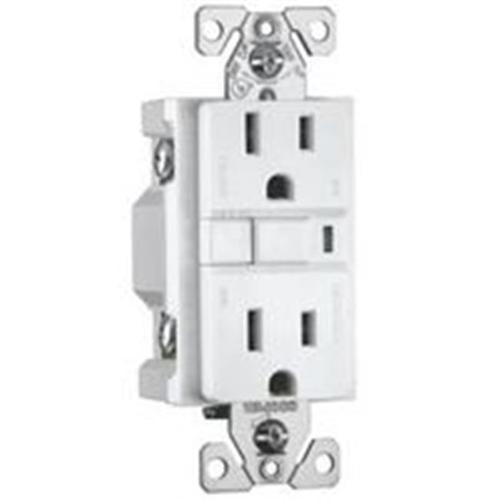
I suppose Earthed sockets are less common there anyway right, so that limits how common these could possibly be.
FWIW, you can have the same thing with GFCIs. I recently wired my garage for woodworking and installed all GFCI breakers in the breaker box, so a GFCI trip is just like a regular breaker trip (not that either of those has happened with the new circuits). The GFCI breakers cost about $50/ea [1] and protect the whole circuit.
> GFCI, you gotta figure out which one popped. If the wiring's not great, it may well be in a totally different room from the outlet that stopped working.
I once couldn't operate my garage door for a few days. There were no tripped breakers in the box. Eventually, it dawned on me that the circuit was labeled "GFCI" so maybe I should go check the GFCIs in the house, and I found that the GFCI in the upstairs bathroom had tripped. The upstairs GFCI is nowhere near the garage (and in the opposite direction from the breaker box). Since then, I've talked to several people in the area whose houses are wired the same way. I guess GFCIs must have been really expensive in the 80s, when these houses were built.
The moral of this story is that GFCI breakers can save a lot of headache. (Plus, those GFCI outlets are kinda ugly IMO).
[1]: I see they're about $60/ea now: https://www.homedepot.com/p/Square-D-Homeline-20-Amp-Single-...
A whole building GFCI sounds like a bad idea, throwing the entire house into darkness as well as cutting off the refrigerator and HVAC because a contractor plugged in a damp power tool in an outside outlet sounds like a bad idea. Worse if you were out of town when it happened.
Whole building GFCI - that is just nuts!
There are many ordinary motors that will leak just a bit to ground, enough to trip the GFCI, but no hazard exists — this would mean disabling the whole building, computers, refrigeration, water pumping, etc. just turning on that device. I've actually got one in a treadmill, and also a wood router tool - they trip the garage GFCI every time. At first I was concerned and "what's wrong with these things?". but as far as I could read, there is no issue, just an issue with certain types of motors that is no hazard, but a basic incompatibility.
And yes, being able to kill the entire power to the house merely by plugging a device into one of the outside outlets would be an insane vulnerability, not just by the contractor's accident you mentioned, but also by deliberate action - great way to start a burglary or home invasion, don't even need to find a wire to cut.
Yikes!
There are a few things that aren't practical to protect with a GFCI, such as high voltage grid power transmission cables. But people killed by those I wouldn't think are included in deaths 'at home'.
[1]: https://www.cullanlaw.com/blog/2015/may/may-is-national-elec...
It frustrates me that every year quite a lot of people are killed due to old houses not having whole-building GFCI's.
A GFCI costs only $20 and can be installed inside 10 minutes. So it seems crazy to be letting people die...
Yet typically electrical regs require that if an electrician installs a GFCI, they bring the whole house up to modern standards. Suddenly the $20+10 minute job has turned into a $15k and 3 weeks complete rewire. So most people don't have a key safety device added. And still every year people die from not having one.