This is literally the article’s point. Europe and the U.S. grew similarly. The U.S. and China produced more large companies. (The Continent’s larger companies also being older than the other two’s.)
> supposedly more investment in R&D
Not supposedly, factually. The article explicitly states this. It’s the Economist; if you need a source, they’re available on Google Scholar.
> take the global innovation index, the number of Nobel price per 100'000 habitants, the number of registered patents per year or simply the size of the economy
Nobel prizes and patents are measures of innovation, albeit not commercial ones. Leading product centres are another. The article measure the latter.
Europe has constrained its big businesses and scale-oriented entrepreneurs. America and China have not. This is a tradeoff, and we’re seeing it play out. The Economist takes one side; it’s the side of iPhones, AWS, the Falcon 9, drones and other businesses with economies of scale. It’s against social sensibilities aligned against “big business.”
Google/Facebook have displaced other ad formats, redirecting money to themselves. AWS have displaced IT technicians in other corporations, redirecting money to themselves. Apple is selling overpriced commodity hardware, redirecting money to themselves. Uber is displacing taxis, redirecting money to themselves.
In other words, it's barely above zero-sum game. And US productivity statistics are clear - the aforementioned corporations grew 500%-1000% in their profits and valuations since 2010. Meanwhile, the US productivity has grown by 4.7%. Had the SV tech been a clear net positive to the economy, the productivity growth would look different. When the tech/telecom was truly creating new value (1995-2005), the productivity growth was at 27% that decade.
(1) with notable exceptions: Microsoft really is creating value where one didn't exist before. So is Netflix, Amazon's venerable logistics and Tesla's drive to decrease battery costs
Moving to AWS from running your own data centres is vastly more cost effective for most companies, you can build systems faster, you can scale them instantly, you can move resources between regions easily, you can focus on your company's core competencies. AWS creates massive value, that's why we use it.
I used to look up the phone numbers of restaurants in a phone book, but now I use Google. That doesn't mean they are equivalent to me and they provide the same value. Looking up a restaurant on Google Maps is quicker, I can do it from anywhere, I can look at reviews and I can see exactly where it is and get routing direction. The experience now is orders of magnitude more powerful and that creates huge value for customers and businesses.
Apple hardware is highly customised, and dramatically better than anything their customers have with better performance and advanced features like machine learning and secure authentication all implemented in custom hardware. That's been true on the phones for many years, and now with their in house designed desktop processors it's true for the Mac as well. Although the Mac has had unique custom hardware like the T1 and the 5K iMac video system for a while too. You cannot buy hardware like it anywhere else, at any price.
Strange, I bought a PC with 2x the specs at the same price as a maxed out Mac…
This has no value to me as their pricing is out of my budget and I don't like the idea of being locked into a proprietary ecosystem, which is of course down to everyone's personal preference, but judging by sales numbers, it looks like Apple's ecosystem has gotten some things really on point.
Yeah, you can get a PC with more ram, more storage and a bigger GPU.
I lived in San Francisco 2013-2018, before Uber I very rarely used taxis -- to/from the airport maybe. Having moved back to Denmark, I again very rarely use taxis.
But when I lived in the US, I used Uber many times each week. Sometimes to/from work.
But taxis in Denmark is easily 5x as expensive, and generally unavailable on-demand.
So now I was forced to buy a car, and call someone if I get a drink.
Point being: Uber certainly replaced taxis, but they also grew the market dramatically. The taxi industry is just a casualty, the pie Uber created is much bigger.
From the UX perspective, Uber combines payment processing and ride ordering in an app. Obviously an improvement over calling a Taxi dispatcher and telling them when/where to pick you up. But is that billions of dollars in value? Or is the majority of that value just being scooped up from previous incumbents?
The economics of the industry haven't changed dramatically - it's expensive to pay people to be your chauffeur.
> The economics of the industry haven't changed dramatically - it's expensive to pay people to be your chauffeur.
True, and if we allowed more free competition on the market Danish chauffeurs would be out of a job real quick. Replaced by immigrants.
But the size of the market did change. And that was my point :)
I think there is more people making a living driving Uber, than there was driving taxis [citation needed] ;)
You could argue that Danish chauffeurs would loose their jobs.. but part of me thinks: so what? We have low unemployment, why not have them work more productive jobs?
> Or is the majority of that value just being scooped up from previous incumbents?
So you think the majority of riders used taxis regularly before?
I certainly didn't, and I still don't -- but ride-sharing services I would use it available.
The point of even socialism is not to push existing solutions for everything and look at everything as a threat. The point is to improve people's lives, and letting people choose might be a right-wing method of accomplishing that, but you can't deny it's effectiveness.
Why aren't we dramatically improving public transportation? The fact that people chose not to use it means people judge their quality of life better with Uber than with public transportation. Use that, don't fight it!
I'll be honest: the few times I've used a Danish taxi, they've been very good.
In general it's like hiring black car service in the US.
Pick up time 8 minutes in Aarhus as of writing. If I go to Ikast it's 24 minutes.
And a 10min ride is 25 USD. A hour ride is about 200 USD.
Might try it if I ever need a taxis, but it's still a bit pricey.
(I have a friend who uses them regularly after we meet up.)
This hasn’t been true since the 90s. And the rest of your examples are similarly ignorant of the incredible pace of innovation coming from a lot of these companies. Google ads might not be changing the world, but their peripheral technology certainly is. AWS and Amazon’s core business as well.
Want to launch a board game aimed at left-handed nerds in a specific city? Before, you’d need a big media campaign that would also reach many right-handed non-nerds, wasting a lot of money. Now, you just need a few thousand $’s worth of targeted ads.
I think the way forward is somewhere in the middle, targeted ads with restrictions and opt-outs. Polarization isn't a path to progress.
As an aside, prostitution doesn't have to be the crime magnet it is today (in medieval Europe the Church ran brothels!) And while most drugs are unambiguously bad, some are considered safe enough to be traded openly and very profitably - caffeine, alcohol, nicotine, and now marijuana.
To do a proper experiment, I suppose we'd need to compare otherwise identical individuals with differing education. Similarly, we could compare people whose only significant difference is the amount of search using Google, and assess their effects on GDP. Daunting to carry out these experiments, but possible in principle, no?
This is not necessarily true. The American economy is huge. Sections can grow slowly, sections can grow fast, all adding value while the bulk grows moderately.
> When the tech/telecom was truly creating new value (1995-2005), the productivity growth was at 27% that decade
4.7% growth accumulates to close to 60% over ten years. (EDIT: I misread the original comment.)
Sure, but I think OP meant productivity growth for the whole decade was 4.7%, not annually (though I'd like to see a source for that).
Fair enough. Real U.S. total factor productivity growth from 2009 to 2019 was 5.8%; from 1995 to 2005 12% [1].
I see your point but mostly disagree with it. The cost to advertise has dropped so while they have displaced some TV ads (still the largest) and most print ads, more people are able to advertise* so they are in a technical sense providing a different and better service to the market.
By analogy you say the same about cars, which “merely” displaced peoples’ “transportation spend” away from horses.
* I don’t think the growth of advertising has necessarily been particularly good; apart from the spying, people still only have 16 or so hours of consciousness per day so there is a zero sum and intrusive quality to ads. I’m just addressing your economic point.
> This is literally the article’s point. Europe and the U.S. grew similarly. The U.S. and China produced more large companies. (The Continent’s larger companies also being older than the other two’s.)
So Europe did a better job in distributing wealth more equally, while in the US and China you got a massive concentration of wealth? So ... fuck yeah, Europe FTW.
False. Europe did a better job at distributing income due to high taxes but not wealth.
Most Europeans are rich due to accumulation of wealth (specifically old business and real estate) inherited across generations.
Due to that, statistically, Europe does worse than the US wealth inequality as wealth has pooled to the people whose families have been here the longest, the newcomers are just burdened with high income taxes and high property prices, that's why skilled immigrants in STEM who have options and can afford to "shop around" usually avoid Europe in favor of North America.
Do you have a source for the statistic that show this?
Another comment mentioned Gini. Piketty uses the share of the top percentile (1%) or decile (10%):
* https://www.newyorker.com/news/john-cassidy/pikettys-inequal...
* https://news.harvard.edu/gazette/story/2020/03/pikettys-new-...
The US isn't the worst in the world, but it is certainly more unequal than Europe as a whole, and most (all?) EU countries.
* https://en.wikipedia.org/wiki/Capital_in_the_Twenty-First_Ce...
Wealth is harder to measure because it's not as reported in most countries. You get an 'income slip' for tax purposes (e.g., US Form W-2), but there's no official 'wealth slip'.
That's one of the things that Piketty suggests: declaring of credits and debts in an official way, which could then be used for a (net) wealth tax. Starting as little 0.1% if you're just over (e.g.) $US 10M, and having a top rate of (e.g.) 2% for those that are worth more than (say) US$ 1B.
(Or wealth stolen from others. Oops?)
I had a quick look at Wikipedia's wealth Gini figures and this isn't the case. Places like the Netherlands and Sweden score atrociously, but the three big European economies (France, Germany, and the UK) all have less wealth inequality than the US (significantly so for the first two), as do a whole host of other European countries.
* - https://en.m.wikipedia.org/wiki/List_of_countries_by_wealth_...
https://www.economist.com/graphic-detail/2018/02/14/american...
This assumes ex ante a similar quantity of wealth. Europe’s GDP per capita is lower than America’s. Where it’s higher, the growth is slower. The more-even distribution comes at the expense of quality of life or economic power. (Though not for Europe’s well-entrenched multi-generational and often legally-entitled wealthy.)
To be clear, I don’t believe in moralising this spectrum of tolerance of scale and creative destruction versus social stability and economic equality. There are multiple equilibria, and Europe and America’s are mutually compatible. The relationship does, however, require Europe take a backseat to the U.S. and China in certain matters. The Economist is protesting that arrangement. (I, as an American, am not.)
Now compare GDP per hour worked:
* https://ourworldindata.org/grapher/labor-productivity-per-ho...
* https://time.com/4621185/worker-productivity-countries/
Germany and France are basically equivalent to the US. Some of the other larger economies (UK, IT, ES) are further down.
Those 4+ weeks of vacation make a difference. :)
Also, who gets to actually keep all of that GDP?
* https://www.newyorker.com/news/john-cassidy/pikettys-inequal...
* https://voxeu.org/article/exploding-wealth-inequality-united...
European GDPs per capita have been by and large lower than the US one since at least 1900, so this doesn't tell us much.
You know, having a continental sized country with continent sized resources and a population all speaking the same language, plus the last conflict on its territory having happened 150+ years ago, seems to be paying off.
What are you talking about? We have fairer elections, better infrastructure, more social security, everyone's got health insurance, we're not getting shot in school, and also we're not on the way to be ruled by a fascist so ... how exactly are you measuring the quality of life?
I downvoted you since you're going massively off-topic with your generalizations about the US that have no place on HN.
However I don't really follow. The discussion is clearly about politics here, so it probably does not count as off-topic. Also, fascism has a massive influence on the economy, making it relevant.
If you merely dispute my view that there's fascist tendencies in the US, that is fair, but no reason for a downvote, I'd argue.
But "about to be ruled by a fascist"? Trump lost the election. Sure the diverging right is worrying, but is the country "about to be ruled" by a fascist?
And "getting shot at school/street" is pretty much just a cheap shot.
I haven't been to the U.S., but I'm willing to wager that for most Americans getting shot is not a primary concern. I'm not saying shootings don't happen or that they aren't tragic, because they do and they are, or that the U.S. don't have a problem. But when they do happen, they obviously get so much visibility and attention that their emotional effect is greater than their actual chances of affecting you in your life, in a way that's not entirely dissimilar to terrorist attacks.
That makes appealing to shootings a populist-style emotional argument: easy to throw around and force people's attention with, not entirely truthful, and much more work to argue against than the argument would substantially warrant. That also makes it pretty annoying and bothersome.
So, I kind of get why people might not like your argumentation style.
[1] Although both Europe and the U.S. are diverse enough that it's going to get tricky; I'm not sure there is such a homogenous thing as "Europe" when it comes to quality of life. But that's a digression.
Yeah. I know I should dial it down a little. But I'm actually really concerned about the US. They do have a lot of mass shootings, and not even tackling this problem does point to a larger dysfunction in the US.
And Trump does not accept is loss and 60% of republicans agree. That's why I actually fear that the next elections in the US will not be democratic.
In Chicago there are mass shootings every weekend that get no press coverage. The inner city gang warfare and similar makes up the vast majority of mass shootings in the U.S.
Mass shootings have basically nothing to do with small town and rural NRA members.
Did you already know all that?
Idunno, I don't think I'd call that particularly rare.
I really don't care about who shoots who. You know, as an European I know for a fact that if less people have guns, less shooting happens, no matter who's the shooter.
And of course your rural NRA member has a huge influence on inner city shootings, after all the NRA is also responsible for the laws leading to that many guns circulating.
So yeah, I know those things, and I know how wrong you are. Again, I actually live in a country with very few mass shootings, whatever the NRA tells you, they do exist. It seems like NRA "a good guy with a gun" propaganda works though, although I can't really believe that.
That was wrong, but just slightly.
It wasn't fascism,but nazism.
«Evidence in Trump supporter’s trial suggests he espoused Nazi ideals»
https://www.washingtonpost.com/national-security/brendan-hun...
> And "getting shot at school/street" is pretty much just a cheap shot.
It's an enormous social and political problem, caused by the way people live in US and the incentive system that rewards the stronger over the weaker and if you can't beat them, kill them.
> but I'm willing to wager that for most Americans getting shot is not a primary concern
That's the problem.
Coming from Europe I am used to not being killed in the streets, in US the risk of being shot is 10 times higher.
It's a lot!
Consider this: it is safer to go to Nigeria than to Los Angeles. Los Angeles had 300 homicides last year (they increased over 2019, during a pandemic! ) while in the comparably sized European city of Rome violent crimes went down 80% and there were "only" 19 homicides in 2020.
Also police brutality is an overlooked issue there: every year police shoot and kills around 1 thousand people in US, comparing their population to my country's, we should have 60 kills every year by the police, but in reality we have around 1 (one!) and it causes riots in the streets because we consider it unacceptable.
edit: I understand these are controversial topics and many Americans have different opinions tha mine on them, but as an European citizen and parent, what scares me the most is that these are all solvable issues, many other countries have solved them long time ago, while in US the debate hasn't even started yet. I also understand that facing the numbers is hard for some American people, it shatters the idea of "the greatest democracy in the World", but they are unfortunately real and verifiable.
For example: https://edition.cnn.com/2020/11/23/us/los-angeles-homicides-...
That's not really the point, and I'm not sure the semantics matter. I'm also not doubting that Trump would take up any "ideal" that supports his ego and power. Or that, among Trump supporters, there are people who would in fact be ready to go so far as fascism or nazism.
I just think that, in a thread about the quality of life in different economic cultures, "about to be ruled by a fascists" is kind of cheap rhetoric if you can't actually argue that the U.S. are in fact close to being ruled by one.
> Coming from Europe I am used to not being killed in the streets, in US the risk of being shot is 10 times higher.
That's continuing along nearly the same lines of rhetoric as the comment I responded to.
10 times the risk means there's some kind of a meaningful difference, but that doesn't mean it becomes a huge risk. "10 times higher" is a lot as a ratio, but it doesn't mean shootings actually happen a lot. They might, but your figure alone isn't enough to show that. That's the same as with disease: 10 times the risk of a rare disease might still be rare. It might mean an actual, substantially elevated risk, or it might not. I gets you nice headlines either way, of course.
If you wanted to argue that getting shot at is a major quality of life concern in the U.S., you would need to show that it actually is a major concern for a large proportion of Americans that affects their quality of life, not just that the ratio of occurrences compared to Europe is large.
Again, I disagree about the style of rhetoric. I don't want to argue that gun violence isn't a problem. But I'm not sure us Europeans should tell Americans how that affects their quality of life in general. It's also easy to fall into the trap of stereotypes such as school shootings being everywhere and affecting everyday life. If it's not actually like that, then it's just a stereotype. Which is exactly what ChuckNorris89 was complaining about.
on the contrary
being ruled by a fascist supporter and/or supported by fascist sympathizers has an enormous impact on the quality of life.
That's true everywhere, in Europe as in USA, that's why everybody here in Europe is preoccupied by far right extremists especially in the former eastern Europe.
> you would need to show that it actually is a major concern for a large proportion of Americans that affects their quality of life
It is, having 10 times the chances of dying shot by a stranger makes it 10 times more probable that in US I would be dead instead of alive.
Being dead it's much worse than being alive in my "quality of life" book.
One can argue that Americans don't care, but it is objectively worse as far as the quality of life goes.
Or to put it in another way: for Americans it could be irrelevant, but if we are comparing the two ways of life, it's a data point that can't be easily discarded.
Imagine having the life of a young relative taken by criminals or, worse, by the police.
Would you trade it for a better salary or a larger household, knowing that it's 10 times more probable that it could happen?
In Los Angeles in 2020 there have been 75 murders every million people (a bit more actually, closer to 76), in Rome it was 5 (a bit less, around 4.4 but rounded for easier comparison).
In NY it was 56, Kenya is 50, Egypt 25, Ghana 21, Sierra Leone 17.
Is this a meaningful difference or not?
Would you consider Los Angeles safer than Rome?
Given the choice would you rather raise your kids in Los Angeles or in Rome?
Remember: you're betting on their life or death chances.
> into the trap of stereotypes such as school shootings being everywhere
It's not a stereotype if it's true.
It's the only place were regularly school shootings end up with casaulties.
«There were, on average, 16.4 such shootings a year from 2007 to 2013, compared with an average of 6.4 shootings annually from 2000 to 2006. In the past 13 years, 486 people have been killed in such shootings, with 366 of the deaths in the past seven years. In all, the study looked at 160 shootings since 2000.Sep 24, 2014» (news from 7 years ago!)
https://www.nytimes.com/2014/09/25/us/25shooters.html
Can you name another country with similar stats?
I honestly can't.
Of course. It's the "about to be ruled by" part that's the cheap-ish rhetoric, as it implies an unsubstantiated imminent threat, not just "some of these guys are really going in the wrong direction".
> having 10 times the chances of dying shot by a stranger makes it 10 times more probable that in US I would be dead instead of alive.
No, it absolutely certainly does not, unless that's the only way you could die. That's really, really basic statistics.
I don't even need to check the statistics to assert that you're much, much more likely to die of causes other than violence, both in (at least the majority of) Europe and in (at least the majority of) the U.S.
If you have a full watermelon, and then take a small slice of the watermelon and somehow multiply the slice by ten, you don't have ten watermelons as a result.
> Would you trade it for a better salary or a larger household, knowing that it's 10 times more probable that it could happen?
Depends on what it's 10 times probable than, and what my other circumstances were. I might not want to live in the most dangerous city, and certainly not in its most dangerous areas, but that doesn't mean I wouldn't want to live in the entire country. In any of those cases, I'd probably be much more likely to die of other causes than because of being shot; it's certainly that way outside of the most dangerous places. But what I want to do is not really the point.
> 366 of the deaths in the past seven years
I'm apparently past my paywall-free articles at nytimes.com, so I'll have to make some assumptions here. 366 deaths in seven years means ~50 deaths per year. That's, of course, an astoundingly large number for a modern western country, which typically see very few of these kinds of incidents. But if that's for the entire U.S. which has ~330 million people, that means an approximately one in a million chance of getting killed in a mass shooting per year.
[edit: and of course I botched the maths -- it's more like one in ten million per year -- but the point still stands]
The numbers would make me question what's going on. The risk of violence might also make me not want to live in the most dangerous areas. But a one in a million chance of dying would not stop me from wanting to live in a country if I otherwise so desired.
You can't really just argue with numbers without putting them in some kind of a context.
You're right, but all other stats regarding mortality are worse for US than my country, so...
Homicides rates in particular are many times worse not just some % worse, that's why I mostly complain about them.
But we also have longer life expectations, better food, better healthcare, etc. etc. if that's of some interest.
we have much worse salaries on average though...
but less inequality overall.
> so I'll have to make some assumptions here. 366 deaths in seven years means ~50 deaths per year
If that was the only way people died.
It's basic statistics.
But in reality it's 50 more deaths, completely avoidable, every other developed country avoided them.
It's like saying that in USA infant mortality rate is "only" 5.7 every 1,000 newborns, while Estonia, many times poorer than US, has only 1.9 x 1,000.
In absolute numbers and as deaths per year rate is negligible, but on a human level it's a complete nightmare! and an healthcare disaster, especially for the country with the highest spending per capita on the Planet for healthcare.
I think a positive example is deaths in space flights.
Only 15 austronauts died during spaceflight, the odds of something going wrong and killing everybody in space are gigantic, but the space programs managed to keep the fatalities low by applying rigorous security checks. The fatality rate is around 3%, it's very high in absolute, it's quite low if we consider the kinds of risks involved.
It's a matter of willingness, if in USA so many people die every year for reasons that other similar countries have mostly solved or reduced drastically, IMO means that there is no political will to keep'em down.
> which has ~330 million people, that means an approximately one in a million chance of getting killed in a mass shooting per year.
still a lot worse then everywhere else in the werstern World.
And you don't really count deaths like that, 10 young students killed by another armed student destroy the fabric of entire communities forever.
Because it's not 50 deaths a year, it's 366 people that shouldn't have died that way in a developed country.
It's 366 families than won't see their kids grow old, without any logical reason.
You are counting on luck, but I personally don't trust luck.
it's a risk I would never take. For no reason.
> But a one in a million chance of dying would not stop me from wanting to live in a country if I otherwise so desired.
except that that's 1 in a million MORE, that adds up to, for example, the 1 in 13 thousands chances of being shot dead that you have in Los Angeles, that your kids have, in Rome the chances are 1 in 200 hundred thousand (assuming all other stats are similar, even though they are not and Los Angeles lags behind in all of them)
If you understand basic statistics, as I imagine you do, it's pretty clear what a responsible parent would chose, given the choice.
It's not only about how many people die every year, having lost someone for a 1 in a hundred million event, it's the mentality that also scares me: considering the chances of death kinda like a gamble is what makes me think I would never go back living in the USA, even more so after having enjoyed the peace and tranquillity of European life for a long long time.
It's easy to discard the benefits if you don't factor them into the equation.
See? this is exactly what I am talking about: when you talk about quality of life in Europe "living in a gang neighborhood" is not a concern, there is no "gang neighborhood" the like you can find in many US cities.
There are of course bad neighborhoods but the chances of being killed are still very low.
I am from a bad neighborhood, one of the most powerful criminal organizations of my country's history was from the neighborhood I grew up in.
It was bad, but far from American armed gangs bad.
You might get harassed or have to be careful who you talk to, journalist receive threats, someone is beaten, but killed? Possible, but highly improbable.
And when it happens usually the reaction from the State is quite strong.
That's generally the worst that can happen.
The only place where I've seen something similar to LA gangs (I've lived in LA) is developing countries ruled by warlords.
The rest can be easily compromised by economic stagnation, to have good social security you need a lot of wealth, and a lot of immigration from poorer countries
Right now, the social security system works, does it not? Just from the perspective of a citizen ... I have health and unemployment insurance, good public transportation, I won't get shot in public, the police will less likely kill me, etc.
I really don't get your point. Because there's stuff that could go wrong, the good things we have are irrelevant?
The second part is, well, like asking why should we sit in the lockdown and wear masks when not a lot of people are dying of covid right now. It's not something that may happen, it will happen if evething goes as it goes and no one makes anything about it
We know what happens with Covid due to science, modeling and stuff. But a virus spread is oretty easy to model compared to a society and its economy. So until now it worked really nice, haven't seen a lot of studies saying it won't in the future, rather the opposite.
Edit: or do you mean because we're getting older and hace fewer kids? Yeah that'll be a challange. Bit eventually every country will experience that, so lets figure out how to deal with this! And yeah, also let immigrants in ;)
No, not at all. But you don't have the same party ruling in U.S. for several decades. That would be legally possible, but that just doesn't happen due to how the system works.
> So until now it worked really nice
I'm not very well versed with the statistics here. But my impression is that social security is on decline. Welfare benefits sum grows much slower than inflation, and there have been studies that it's already not enough to even get the necessary nutrients. So it is a tendency that we see right now, not a prediction about some possible catastrophic event in future.
> And yeah, also let immigrants in ;)
There will be no immigrants if economy is weak, that's the thing.
Look at state/city level and you will have a different picture of United States.
And for Europe, let's take France as example. Here are the ruling party changes in the last forty years : 81,86,88,93,97,02,12,17
Do you know the average tenure of the current American senators ?
It depends on what country you're talking about, but looking at which party is the biggest/who the prime minister is and summing it up as the "ruling party" is a gross oversimplification of the power dynamics in a parliamentary democracy. The power balance shifting between smaller parties can bring about huge effects on the government and the policies that are passed.
But again, just because social security does not deliver all it promises - throw it out completely? I don't get that point. Tendencies that exist right now can be corrected.
And that wouldn't even be more expensive, but at least in Germany, the money would just have to be distributed more fairly. For example, you get the same amount of child benefits no matter what you earn. That doesn't make sense. So change that a little and lots of people won't notice while lots of people will do way better.
Americans think it's racist but actually it is just business.
how is this racist?
Wrong for Germany, those immigrants from 2015 integrated well into the workforce.
I have no horse in this race, but I'm curious about a source for this, mostly for how it's been measured.
It says that by 2020 half of them has found a job, which is way higher unemployment rate than is average in Germany though.
But even if they don't find jobs themselves, at the very least they have children which is critical for sustainability of a country with inverted population pyramid.
Half of immigrants being unemployed after half a decade is bad, especially compared with America, where immigrants are more likely to find themselves employed than the native born [1].
> if they don't find jobs themselves, at the very least they have children
Sure. But I'd hate to do the math on how much each of those children cost the German taxpayer.
[1] https://books.google.com/books?hl=en&lr=&id=LZTRCwAAQBAJ&oi=...
And it's not like refugees were allowed to look for jobs immediately, getting work permit for a refugee takes awfully long in Germany.
Cost of their children is pretty much the same as for German children. And it's a necessary expenditure, otherwise the said taxpayers are going to have a pretty rough time when they retire.
If the principal benefit of a refugee couple is their children, the the cost of accepting and maintaining that couple is part of the cost of that child.
I believe there is a moral responsibility, on the part of rich countries, to accept some refugees. But we have to be honest that it is usually charitable work. Framing it as economically beneficial can be misleading and lead to a backlash when the promised gains don't pan out.
Funny how often people start a sentence with "we got to be honest" and finish it with something that has long been debunked.
Its incredible how high maternal mortality is in the US. Like a development country.
All that the Economist is pointing out is that there are some businesses in which you have to have massive scale to be competitive. In those specific businesses, you either scale up or you can't compete at all. Europe is giving up competing in those areas.
Innovative is the real disruptor. We forget this at our peril.
I do think Europe has many advantages the US and China don't have, it's not like being able to develop massive scale enterprises is the be-all and end-all of economics, but it is self-limiting in some important ways.
Like enforcing interoperability between platforms, privacy rules etc.?
So you favor the monopolies that some American companies have in some markets?
The EU did a great job at distributing wealth eastward, the GDP per capita of Slovakia for example doubled in the last 20 years, far outpacing the growth in the US.
That's uncharitable. The EU did a great job of growing Eastern Europe by promoting good institutions. There was wealth redistribution. But it alone is insufficient to explain the growth.
For the record, I don't know what Economist you've been reading, but the Economist I know is about as factually accurate as most media publications (that is, not particularly). Not to mention, even if this was an article written by an academic expert in the field, a source would be basic table stakes.
We agree. I meant that an article appearing in the Economist doesn't need to source every detail, particularly when it's a widely-accessible and well-known statistic.
That said, as an aside, I find it a bit worrying sometimes that the basic facts of our public conversation are provided without sources, or even in many cases, particular care or diligence.
I would argue the big molochs are bad for economy and society. Apple and Google are proportionally not more innovative than a random small German or French software house, they just have more scale to market/sell/push their products.
> Leading product centres are
I disagree, leading product centres measure marketing capabilities. Why do you think EU continue growing at this pace? Because we're also producing the innovation that goes into the iPhone and are making money of the composants that goes in. How many parts do you think Siemens built for the Falcon 9?
And since you like the wow factor, don't forget where neural nets where invented, big pharma (even Pfizer Covid vaccine was invented in Germany) and Spotify for instance.
> How many parts do you think Siemens built for the Falcon 9?
Few if any Siemens parts in a rocket are irreplaceable; there's no other Falcon-9 maker though yet. It is also a separate question how would it play out for Siemens if were they starting up in Europe today.
But Themis is coming and this advantage won't last forever. SpaceX better hope Starship stops exploding and is as cheap to operate as they hope it will be.
That would be 'cos in my analysis (heavily influenced by concepts of artificial life and the genetic algorithm) concentration is devastating for innovation past local plateaus. It's not just 'the consumer', it's basically premature optimization, and it's a very serious concern.
No. About half of the European economy is the state. So having similar GDP growth while the big US companies grew faster could also just mean that the economic growth in Europe was driven by state activities (education, health care, etc.). You cannot conclude anything regarding the growth of small companies.
>large part of the US economy that consists of hurting people
Source? If you're talking about the defense sector then you should also know that the UK and France were several years in a row number 2 and 3 worldwide in arms sales, including to the Saudi regime.
Pretty much all the US tech companies are now run by immigrants of minority backgrounds while, for example, Eastern European and Turkish immigrants in Germany are still regarded as cleaners and kebab salesmen, with the only notable exception they can name being the Turkish CEO of BionTech.
So low-paying jobs in the service sector are not an immigrant thing in the US? Did you talk to enough Europeans to know we can only name the BionTech guy as an example of a successful immigrant?
Please name some for me. Especially in Germany.
A few examples as well as general recent trends but also the challenges immigrant founders are facing.
The article actually says this:
> Glaring funding gaps: A lack of access to capital -- government support, business angels and venture capital -- particularly plague first-generation migrant founders, who received €1.1 million on average, compared to €2.6 million of all startups.
> Below-average cooperation: While the average startup cooperates with seven established businesses, first-generation migrant founders only have two such firm ties. What's more, they work together with scientific institutions less often. Within the startup ecosystem, however, cooperation is well-established across the board.
My evidence? Reality.
Effectively the difference between a chance of 0.0000001% and 0.0% is not important…
And I stand by my point that the big companies that the article is about don't have too much diversity on the higher levels.
Here is a brilliant idea for you, don't try to jab complete strangers you know nothing about, keep the debate to subject matter. Then you'll skip the whole hoopla of trying to arguing yourself out from uncomfortable corner you paint yourself into.
So I'm still not following, you really gotta give more context.
This is incorrect. American social mobility is low. But not widely so, and certainly not consistently lowest among rich countries. (It is consistently among the lowest.)
If one takes "the extent to which son’s [sic] earnings levels reflect those of their fathers," Britain and Italy are worse than America while France is quite close [1]. Similarly, "after adjusting for the country-specific distribution of socio-economic status, the United States, France and Belgium are countries where parental background has the greatest influence on student achievement."
[1] http://citeseerx.ist.psu.edu/viewdoc/download?doi=10.1.1.411... Figure 2, page 9
Looking at the mean in Europe vs the US there is no contest. Other metrics in the same paper indicate that for factors that impact long term social stability, like schooling, the US is the worst.
It's possible that, since the US is such a big territory, regional differences are distorted. But I couldn't find a better source myself, with a quick search.
Compared with the cohort of European countries, America fairs poorly (though not excessively so).
The original claim, however, was that it fares "among the worst in the world." This is incorrect; it's roughly middle of the pack [1][2].
On the measure of the "number of generations it would take...those born to...the bottom 10% of the income distribution...to approach the mean in their society," America ties with Ireland, Portugal, Italy, the U.K., Italy, Austria and Switzerland. It is ahead of France, Germany and Hungary. In summary, America is good at allowing the poor to become middle class. It is less good at letting the middle class become exorbitantly rich, though not terribly so.
[1] https://www.oecd.org/social/broken-elevator-how-to-promote-s...
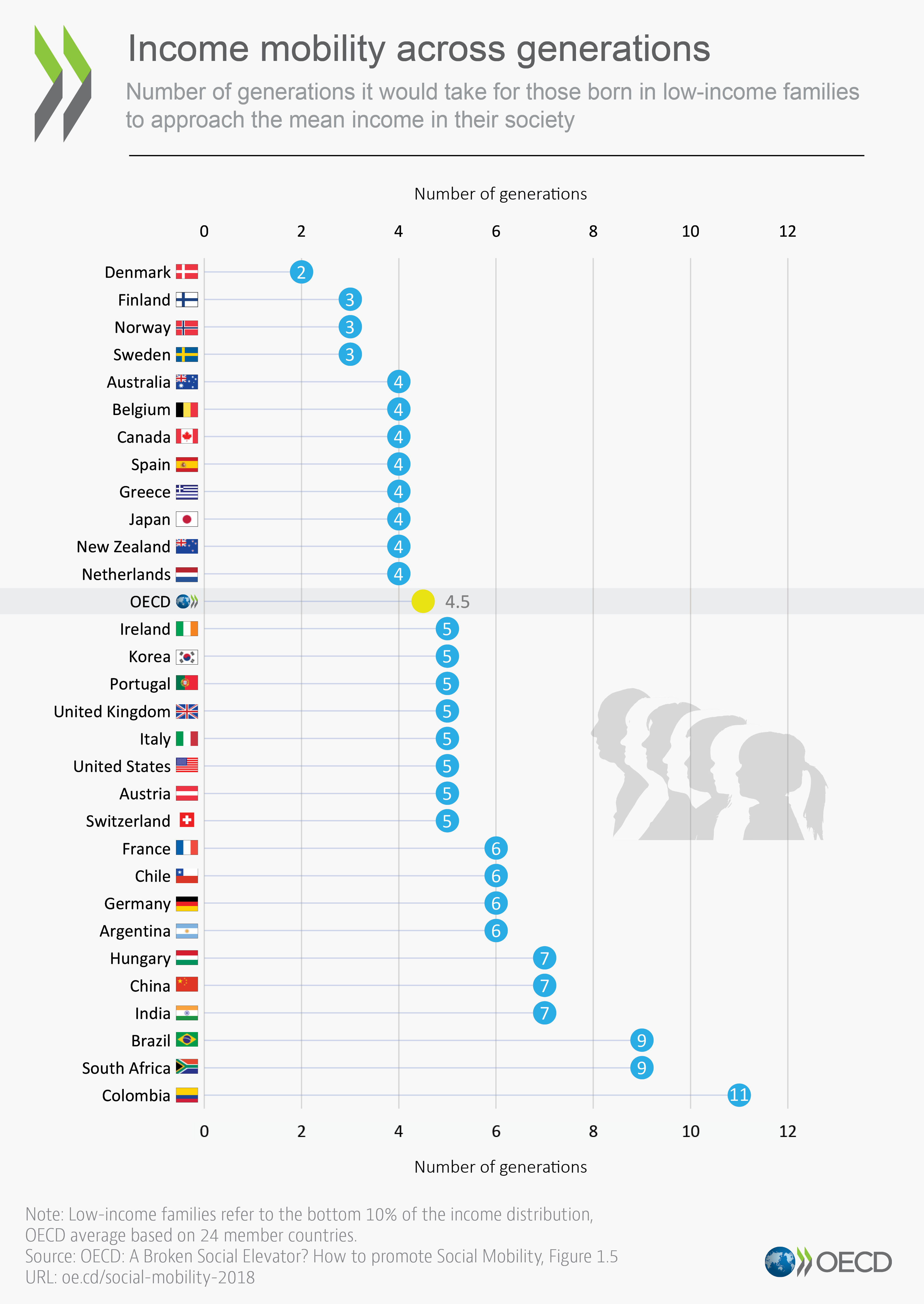
The common view is the opposite though: higher tax rates and lower entrepreneurship in Europe are assumed to put a damper on the middle class from amassing significant wealth. On the other hand, the US has significantly more billionaires per capita than most countries in Europe [1], and many of those are "self-made" (i.e. not generational wealth). What am I missing here?
[1] https://en.wikipedia.org/wiki/List_of_countries_by_number_of...
Going back to the original argument that something in the US's tax policy or job markets makes the US perform better when it comes to upwards social mobility, I think we can definitely debunk that.
If you believe that, I'm not sure where to start. My own family put several kids into tech jobs one way or another, but sure didn't start from being working class.
As to not taxing working class people so they can turn into middle class people, boy are we not speaking the same language. For starters, you are probably talking about not taxing middle class people, by leaning MORE heavily on regressive taxation that cuts middle and upper class people a break so 'they can grow'. But that's a whole other story…
BTW, Germany's also a top seller of weapons! We even delivered chemicals to Assad. So yeah, in that area we really are on par.
Like VW's cheating diesel engines who's emissions I have to breathe as I walk/bike to work?
>Social media giants?
Nobody forces you to use those social media giants whereas I can't choose to only breathe only air not contaminated by VW diesel emissions.
And the negative effects of social media affect me if I use it or not.
What kind of logic is this, that breaking rules is fine since at least we have them? Honestly, that sounds like a child who just wants something his way rather than a logical argument. What's the point of rules if you don't bother enforcing them?
Speaking of rules, do you know the ones Wirecard blatantly broke and BaFin not only ignored the but actively pursued the foreign entities who tried to expose Wirecard's fraud, basically doing BaFin's job for them?
Yeah, big German companies are such saints and the Government institutions so efficient and incoruptibile in Europe /s.
But yes of course its a difference if companies can just pollute however they want, or if you have rules that say they can't but companies break those rules. In the latter case, when they're caught, they can be punished. And under Trump, lots of rules protecting the environment were eliminated.
That simply isn’t true. Generals and civilian leaders set the objectives of the military, and typically their objectives are to minimize casualties on both sides of any military engagement.
The military does use force and does hurt people but that is not an objective.
The point was about letting working class people grow into middle class, i.e. accumulate some wealth by working at these jobs. It's much more difficult to do in Europe than in the US. First the tax system that is progressive on income, but not on net worth, that makes it increasingly hard to get richer by having good income. Second property prices are high and growing faster than income normally does. And finally as you've noticed these jobs are just not as well paid as in the US - basically it's the same grade as other office jobs (except managers and lawyers, these are paid much better)
You can't always bring the lifestyle of minimum wage employees into every single discussion just as an joker card to argue that Europe is better than the US.
Yes, minimum wage immigrants have it better in Europe and skilled immigrants have better opportunities in the US.
I expected exactly this - that people that benefit from those giant companies fail to see the downsides.
> You can't always bring the lifestyle of minimum wage employees into every single discussion just as an joker card to argue that Europe is better than the US.
Why not, if it works? Are you not just confirming that the US works for a few lucky ones whereas Europe works for most?
So in your book big companies have only downsides? What about VW, Mercedes, BMW, SAP, Bayer, Siemens, etc?
Why are big US companies evil for you and not the rest?
> Why are big US companies evil for you and not the rest?
Never said any of that, so I guess you're not really reading my comments?
Shame on you.
Because it might be irrelevant? Yes, US and EU have historically different social policies, but it might not necessarily be the reason for difference in economic performance.
For me it's not "high tech companies vs working class", rather "high tech companies vs inefficient and intrusive government and old money". The obvious difference between FAANG on one side and BMW Daimler, etc. on the other side is the time when these companies have been founded.
Europe’s entire social safety net is at risk if their private sector can’t generate enough wealth to support it. Given their declining populations and anti-immigrant tendencies inflamed by the refugee crisis in many of its member states, it doesn’t look good for the EU’s future.
Europe has a problem with aging workforce, but it can't be solved by importing people who can't find a job.
That's a lie people tell you because they do not want to sound racist.
> Rather it's about asylum seekers who often arrive here illegally
... very few ...
> and typically lack sufficient education to do well in our job markets,
Uhm. And the ones that are educated, we don't recognize their diplomas. Nice.
And also, that's what the education system is for.
Finally, poor people in poor countries can't afford to flee to Europe. So those people are actually middle class people from poor countries with often quite some education.
> leading to very high unemployment rate and other social problems.
Nope, that's our own failed policies leading to that. Don't blame our mistakes on immigrants.
> Europe has a problem with aging workforce, but it can't be solved by importing people who can't find a job.
Than thank god we're not doing that.
In a real market economy, they'd have to raise wages instead. But no, undercutting local workers and cram new arrivals into the already overheated rental market, the old money vultures get even richer.
Does not sound very American.
    I am not against immigration but I think Europe should
    be seriously reconsidering non-western immigration as
    it will simply clash.
Norway has done terrific integration of immigrants and also is in the process of shutting the gates since the 90s. It seems to be the way forward.
I am not against immigration but I think Europe should
be seriously reconsidering non-western immigration as
it will simply clash.
Fine I'll bite: draw cartoons of you-know-who, see if they still integrate so seamlessly.
Its the elephant in the room.
But that has been a problem with immigration for years. In Australia in the 50s/60s the same thing was said about Italians and other post-war immigrants.
The first generation works hard and busts their ass to get their kids a good education and into professions and business. They also have more of the attitudes of the society they left (conservative etc).
The second and then third generation adopt their local society's attitude. This leads to inter-generational clashes.
Radical propaganda leads to radicalization to the same endpoint, whether Islamist or Christianist or (in Israel for example) Judaist, or in India, Hinduist.
That radicalization is what is causing the current lack of assimilation. It is dangerous because it is driven by having an in group and an out group. It doesn't matter which religion it is, the radicalization, the precepts (male domination, female subjugation, attacking non-cis genders, non-hetero sexuality etc) are all the same.
That's how it used to be back in the day, but it doesn't seem to be how it works nowadays in countries to which migrant-smugglers explicitly recruit customers based on those countries' unconditional social benefit payments.
> The second and then third generation adopt their local society's attitude.
See the above; and thus...
> This leads to inter-generational clashes.
...thus, inter-cultural clashes, rather than inter-generational.
I really hate the term "culture" by now.
It's not surprising. It's completely obvious.
I do agree that parts of the economy are not working properly. And still we can't seem to get ourselves to vote for different politicians that might do something about it. Yeah that means stuff changes and change and new things are scary, but not fixing those things would be worse.
I said I am not against immigration, but shutting it down for a period or restricting heavily might be worth it due to the potential risks that exist long term.
There's no real harm in trying that for Germany's voters, and by doing so you will also keep the far right wingers at bay.
So that means that the people in Germany that would vote for right-wing parties are the problem, not the immigrants themselves, no matter how well they behave. I agree with that.
That's failed policy by the people that are already here, not the fault of the immigrants.
> I think Europe should be seriously reconsidering non-western immigration as it will simply clash
Yeah ... wait what? That's kinda ... what? Why? What's the problem with that?
So you don't seem to know, but it worked out very well with the middle eastern immigrants in Germany from 2015. Integration into the workforce worked better than expected, many pay taxes and stuff.
Please name me one place in the UK where police don’t go.
This is exactly the same 5 year old BS that we heard from Trump times.
Even the USA ambassador was embarrassed and grilled by the journalist in the Netherlands to provide one example of “politicians being burned” and “no-go zones” in the Netherlands.
If that doesn't qualify as a type of "no go", I don't know where to draw the line. In any case, it's shocking.
It's also bullshit (and if it isn't prove me wrong with actual facts, not apocryphal stories from "friends" ).
Its funny how I am always kind of really relieved to come back from the US to Europe. I know there's no guns around in a bar, I know all my friend can see a doctor when they feel sick, and hey, I don't need to ask someone to pick me up from the airport because there's public transportation. And I can switch on the TV and see boobs!
The flaw here is ignoring that corporate earnings are not contiguous with GDP at a country level. A country’s earnings cam grow faster than GDP, when overseas profits grow faster than domestic profits. Since most large corporates are multinationals this consideration is highly relevant.
Apple has grown very fast, but since iPhones are mostly assembled in Asia and the software is booked in tax havens like Ireland, very little of that accrues in the form of US GDP.
What’s much more likely than corporate inequality increasing is that US corporates have done a much better job at expanding overseas than large European corporates. This is also why American consumer expenditures are much higher than you’d predict from looking at GDP per capita. iPhones may count as Taiwanese and Irish GDP, but the huge profit margins wind up buying back AAPL stock that is largely held by American shareholders.
European GDP per head is about two-thirds that of America. The figure has not fallen in the past 20 years thanks mostly to poorer eastern Europeans getting closer to Western income levels.
Would suggest that as the faster GDP Growth came from Eastern European areas offsetting a stagnating GDP Growth from the rest of Europe. Am I not reading this correctly?
This is misleading. The article says the poorer (former communist) eastern European countries got richer, which brought up the average.
We want the poorer countries to get richer faster in order to close the gap. Accomplishing precisely this is a large part of EU policy. And it is working.
https://en.wikipedia.org/wiki/List_of_states_and_territories...
Lots of ways to catch up there as well.
And that doesn't change the fact that that is the actual data, nothing "misleading" about it.
The main point it makes is that the top 500 US companies grew faster than the top 500 European ones in the last decade or so.
But then it quickly mention, without any further analysis, that both their GDP actually grew at a similar pace. So the entire EU economy grew at the same speed than the US one but not its 500 bigger companies. So all else being equals it means that the smaller US companies grew more slowly and that this article is simply mesuring increasing corporate inequalities (if there is such a thing).
It then goes on to say, without much evidence, that this is actually good as economies of scale, supposedly more investment in R&D and increasing concentration should imply more innovation.
If this article actually wants to discuss innovation, why don't it use recognised tools to do so? If you take the global innovation index, the number of Nobel price per 100'000 habitants, the number of registered patents per year or simply the size of the economy, all point to a very healthy European continent.
I will even go further and say that the US should monitor much more closely increasing concentration as typically the ISPs or the energy distribution sectors show that concentration can be good for the shareholders but devastating for the consumer.