Pretty much all the US tech companies are now run by immigrants of minority backgrounds while, for example, Eastern European and Turkish immigrants in Germany are still regarded as cleaners and kebab salesmen, with the only notable exception they can name being the Turkish CEO of BionTech.
So low-paying jobs in the service sector are not an immigrant thing in the US? Did you talk to enough Europeans to know we can only name the BionTech guy as an example of a successful immigrant?
Please name some for me. Especially in Germany.
A few examples as well as general recent trends but also the challenges immigrant founders are facing.
The article actually says this:
> Glaring funding gaps: A lack of access to capital -- government support, business angels and venture capital -- particularly plague first-generation migrant founders, who received €1.1 million on average, compared to €2.6 million of all startups.
> Below-average cooperation: While the average startup cooperates with seven established businesses, first-generation migrant founders only have two such firm ties. What's more, they work together with scientific institutions less often. Within the startup ecosystem, however, cooperation is well-established across the board.
My evidence? Reality.
Effectively the difference between a chance of 0.0000001% and 0.0% is not important…
And I stand by my point that the big companies that the article is about don't have too much diversity on the higher levels.
Here is a brilliant idea for you, don't try to jab complete strangers you know nothing about, keep the debate to subject matter. Then you'll skip the whole hoopla of trying to arguing yourself out from uncomfortable corner you paint yourself into.
So I'm still not following, you really gotta give more context.
This is incorrect. American social mobility is low. But not widely so, and certainly not consistently lowest among rich countries. (It is consistently among the lowest.)
If one takes "the extent to which son’s [sic] earnings levels reflect those of their fathers," Britain and Italy are worse than America while France is quite close [1]. Similarly, "after adjusting for the country-specific distribution of socio-economic status, the United States, France and Belgium are countries where parental background has the greatest influence on student achievement."
[1] http://citeseerx.ist.psu.edu/viewdoc/download?doi=10.1.1.411... Figure 2, page 9
Looking at the mean in Europe vs the US there is no contest. Other metrics in the same paper indicate that for factors that impact long term social stability, like schooling, the US is the worst.
It's possible that, since the US is such a big territory, regional differences are distorted. But I couldn't find a better source myself, with a quick search.
Compared with the cohort of European countries, America fairs poorly (though not excessively so).
The original claim, however, was that it fares "among the worst in the world." This is incorrect; it's roughly middle of the pack [1][2].
On the measure of the "number of generations it would take...those born to...the bottom 10% of the income distribution...to approach the mean in their society," America ties with Ireland, Portugal, Italy, the U.K., Italy, Austria and Switzerland. It is ahead of France, Germany and Hungary. In summary, America is good at allowing the poor to become middle class. It is less good at letting the middle class become exorbitantly rich, though not terribly so.
[1] https://www.oecd.org/social/broken-elevator-how-to-promote-s...
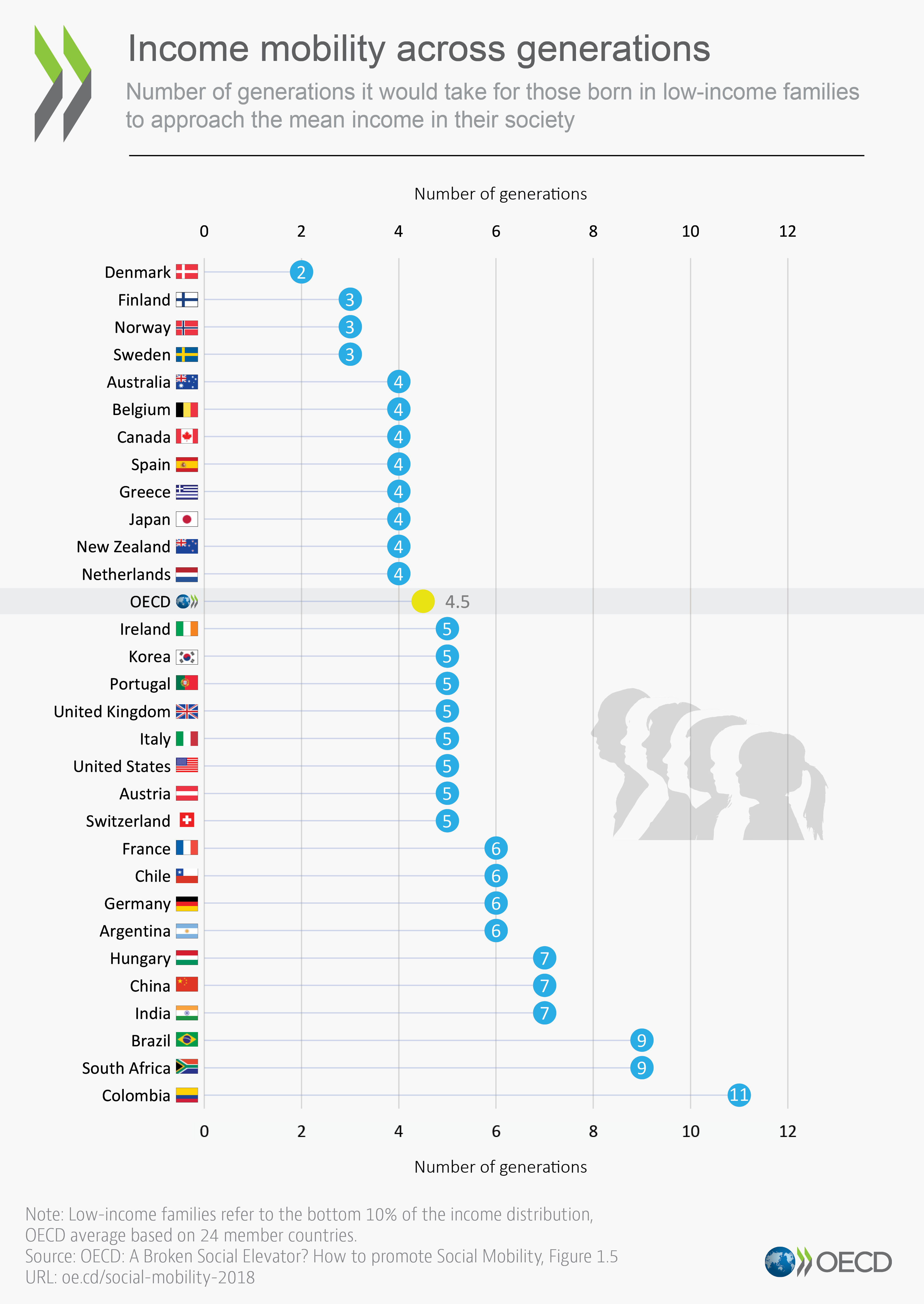
The common view is the opposite though: higher tax rates and lower entrepreneurship in Europe are assumed to put a damper on the middle class from amassing significant wealth. On the other hand, the US has significantly more billionaires per capita than most countries in Europe [1], and many of those are "self-made" (i.e. not generational wealth). What am I missing here?
[1] https://en.wikipedia.org/wiki/List_of_countries_by_number_of...
Going back to the original argument that something in the US's tax policy or job markets makes the US perform better when it comes to upwards social mobility, I think we can definitely debunk that.
If you believe that, I'm not sure where to start. My own family put several kids into tech jobs one way or another, but sure didn't start from being working class.
As to not taxing working class people so they can turn into middle class people, boy are we not speaking the same language. For starters, you are probably talking about not taxing middle class people, by leaning MORE heavily on regressive taxation that cuts middle and upper class people a break so 'they can grow'. But that's a whole other story…
BTW, Germany's also a top seller of weapons! We even delivered chemicals to Assad. So yeah, in that area we really are on par.
Like VW's cheating diesel engines who's emissions I have to breathe as I walk/bike to work?
>Social media giants?
Nobody forces you to use those social media giants whereas I can't choose to only breathe only air not contaminated by VW diesel emissions.
And the negative effects of social media affect me if I use it or not.
What kind of logic is this, that breaking rules is fine since at least we have them? Honestly, that sounds like a child who just wants something his way rather than a logical argument. What's the point of rules if you don't bother enforcing them?
Speaking of rules, do you know the ones Wirecard blatantly broke and BaFin not only ignored the but actively pursued the foreign entities who tried to expose Wirecard's fraud, basically doing BaFin's job for them?
Yeah, big German companies are such saints and the Government institutions so efficient and incoruptibile in Europe /s.
But yes of course its a difference if companies can just pollute however they want, or if you have rules that say they can't but companies break those rules. In the latter case, when they're caught, they can be punished. And under Trump, lots of rules protecting the environment were eliminated.
That simply isn’t true. Generals and civilian leaders set the objectives of the military, and typically their objectives are to minimize casualties on both sides of any military engagement.
The military does use force and does hurt people but that is not an objective.
The point was about letting working class people grow into middle class, i.e. accumulate some wealth by working at these jobs. It's much more difficult to do in Europe than in the US. First the tax system that is progressive on income, but not on net worth, that makes it increasingly hard to get richer by having good income. Second property prices are high and growing faster than income normally does. And finally as you've noticed these jobs are just not as well paid as in the US - basically it's the same grade as other office jobs (except managers and lawyers, these are paid much better)
You can't always bring the lifestyle of minimum wage employees into every single discussion just as an joker card to argue that Europe is better than the US.
Yes, minimum wage immigrants have it better in Europe and skilled immigrants have better opportunities in the US.
I expected exactly this - that people that benefit from those giant companies fail to see the downsides.
> You can't always bring the lifestyle of minimum wage employees into every single discussion just as an joker card to argue that Europe is better than the US.
Why not, if it works? Are you not just confirming that the US works for a few lucky ones whereas Europe works for most?
So in your book big companies have only downsides? What about VW, Mercedes, BMW, SAP, Bayer, Siemens, etc?
Why are big US companies evil for you and not the rest?
> Why are big US companies evil for you and not the rest?
Never said any of that, so I guess you're not really reading my comments?
Shame on you.
Because it might be irrelevant? Yes, US and EU have historically different social policies, but it might not necessarily be the reason for difference in economic performance.
For me it's not "high tech companies vs working class", rather "high tech companies vs inefficient and intrusive government and old money". The obvious difference between FAANG on one side and BMW Daimler, etc. on the other side is the time when these companies have been founded.
>large part of the US economy that consists of hurting people
Source? If you're talking about the defense sector then you should also know that the UK and France were several years in a row number 2 and 3 worldwide in arms sales, including to the Saudi regime.