In my personal experiences with psychedelics, these drugs remove mental heuristics, allowing the mind to think unimpeded by usual thought patterns, simply accepting raw data as it comes in. This was striking in sensory information, if you closed your eyes or just stared at something long enough, you observed incredibly different visual input, geometric patterns, greatly strengthened colors (a strawberry was INCREDIBLY beautiful, I almost felt bad eating such a beautiful entity). There was also an incredible inter-disciplinary thought process, I felt the musical, mathematical, computational, logical, natural, all these parts of my mind mixed together wonderfully.
LSD was much longer lasting, around 12 hours, whereas psilocybin was around 6 hours. Psilocybin enhanced my connection with nature, the flying bugs, a handful of berries, and the plants all around me caused an effusion of love and connection. Whereas with LSD, I felt an extremely powerful visual stimulation, the changing fall leaves were extremely vibrant and beautiful, it was akin to 12 hour, mentally-clear cannabis high. I didn't experience any "flashbacks" per se, there was a positive glow in my mood and thoughts for around 5 days, and the day after LSD I still had lingering effects...I also wonder if I will evermore look at the surface of ponds and lakes differently, they have an incredible dynamism and vitality that I appreciated even more on first trip.
For anyone considering psychedelics, do it thoughtfully and methodically. Read the book mentioned in the parent, practice meditation, explore your mind, and really ensure your mindset ("set") is positive and open. Further, plan to occupy a peaceful, quiet place, hopefully lacking too many strangers/social interaction ("setting"). If set and setting are good, you're in for a wonderful time.
This experience made me realize how much of our outlook on things is dominated by whatever mode of thinking we happen to be in, and that mode is more shaped by custom and habit than anything approaching logic and reason.
William James uses the analogy that our set of habits are like an irregular polyhedron resting on one of its faces. Everyday experiences may rock it up onto an edge, but it will usually come to rest where it was, or perhaps on a neighboring face.
A more singular, meaningful experience has more “push” to it, overcoming the force of habit in a way that no amount of daily prodding would, rolling the whole thing onto a new face that would take ages to land on otherwise. He was writing about religious conversions at the time, but there seems to be a lot of overlap with the effects of a psychedelic experience.
I gave up on it doing anything about an hour after eating the first cube. Got dropped off at home .. had to go skiing with best and his mom. Vaguely remember running through my neighborhood at 3am, waking up a different friend, and leaving minutes later.. being in the bathroom at my house, and being in my friends mom's car the next morning.
Later in life I returned to mature versions of this activity and found incomprehensibly beautiful visuals, patterns, self realizations about state of mind, perspective, the meaninglessness of "cool", purpose of building things(socially, as a species, not regarding myself). For me lsd is about the thoughts that result from the general "high".
While I have only done it 6 or so times and may never again. . I believe it has amazing properties for some people and not so good for others. Some old pals are from last I saw them ...quite literally fried, but perhaps due to other activities.
#dothingslikeanadult
100%. It has a reputation as a thing that weirdos do to have fun or see cool things.
If you "do it like an adult" I've found that it invokes a deeply introspective and thoughtful mode of thinking that can give you new perspective on different areas, both major and minor, in your life.
But like good advice that you might get from a wiser person, it's only useful if you use your insights to better yourself.
I've made immense progress in the areas of personal development and management due to such insights. It wasn't overnight - it inspired small changes in behavior that only years later, I can see the dramatic effects of. If it inspired even a 1 degree correction to a better direction, 10 years later the difference can be immense.
There is a also an iffy side to LSD which I only discovered the last time I did it 2 years ago. Never had a similar feeling ever. Vaguely felt like I wasnt seeing and thinking from the same brain / identity I'm used to. So I approximately said no more.
Anyway... I deeply appreciate the reply here too. Had no idea what to expect here. Thank you.
It’s kind of hard to convey just how much this particular aspect of LSD changed my outlook. I too was quite young at the time I tried it. It made me rethink my media diet, which at 15 was filled with MTV and trash TV. That has stayed with me ever since.
Not that I have made a specific effort to but thank you so much.
My key story for last is laying in a bed in close proximity to a freeway. I could not choose to unhear/see with my eyes closed as a car drove down the freeway cylinders/rods and combustion. . I on extremely rare occasion hear this type of story from other peeps.
Long lasting effect ... In the immediately following week I had the most significant behavior shift I can think of... Had been smoking since 11 years old... The LSD was approx 9th grade ..solidly solidly stopped for about a year. Pot. Everything. I'm back. I'm an idiot at heart give or take.. but what a beautiful year.
This is the best way to describe reasonable (small) doses of LSD. It's like the purest sativa possible; as if somebody removed all of the earthiness and stoniness and then amplified the psychoactive.
Sometimes if I get too high I get a decent amount of anxiety. Always wanted to try LSD or Shrooms but worried something like that may happen. Generally it comes from me feeling a strange sensation in my body which leads to a slight bit of panic. Or if I get really high I just don’t feel there entirely.
Always thought about taking LSD or Shrooms with some CBD incase I get a bit of anxiety.
Anecdotal:
I get very anxious from marijuana. Somewhat manic even. I hate the feeling. I’m generally not a stranger to anxiety in life.
I don’t get anxious from LSD. I _have_ felt anxiety on it that I had been repressing, felt it kind of wash over, but it was ... useful. Not difficult. I knew what it was. I wasn’t lost in it. It wasn’t like being swallowed by the uncomfortable anxiety from marijuana that kind of takes over or drives.
And, well, I think a low LSD dose actually helped me resolve a thread of anxiety I had had since I was a child. An permanent and obsessive safety-seeking walk down an endless tree of decisions and judgement. Kind of a background thread. I kind of ... found it again? Had forgotten it was there? And could revisit it and ... know to stop. “Just stop judging”, i.e. judging the situation. And it felt like I could. It still feels like something was let go of. But idk!; Anecdotal!
There are studies that show that when starting with low doses, then very few people get anxious. Other studies show that when people _do_ get anxious, there are still lasting benefits to well being. As I understand it. There’s a decent seeming summary of this on http://tripsafe.org
One can leave you permanently mentally scarred and the other will make you paranoid for a few hours.
I have stoner friends and lsd/mushroom friends. Some of the latter are still dealing with issues today from a single bad experience from a trip they had years ago. I cannot say the same of my stoner friends.
A mushroom trip can leave you feeling refreshed regardless but if you have a bad trip it may expose you to your deepest and darkest fears and become a terrifying nightmarish experience that weed couldnt induce if you tried.
The horror of a bad a trip didn’t necessarily teach me anything other than to respect mushrooms much more than weed.
I have had friends say the same. There is no comparison of the paranoia from weed vs the absolute horror of a bad trip.
I feel that people who say there is havent really done a lot of either to know the difference.
"At a dosage of 1.6 grams in a therapeutic clinical environment, we might expect 0% of people to experience some extreme fear, for an average of around 1 minute of strong anxiety, and we might expect around ~45% to report a persisting positive increase in mood from this dosage assuming they had first tried 0.8 grams, and then 1.6 grams5"
Via https://tripsafe.org/how-to-take-shrooms/#start-small
Based on studies: https://www.ncbi.nlm.nih.gov/pubmed/27578767 https://www.ncbi.nlm.nih.gov/pmc/articles/PMC3308357/table/T... https://www.ncbi.nlm.nih.gov/pmc/articles/PMC3308357/
I don't know why you are dismissing my experience like that, or why you think that I do not have a lot of experience. Have you ever had a panic attack? Anxiety and paranoia are something I would get consistently from weed. I never felt the same anxiety, and never felt paranoia, on mushrooms. I never had a panic attack from mushrooms. Almost every psychedelic trip I take (between 50-60 so far) has a range of negative aspects, but I am able to better control myself, something that is not the case with marijuana. I have experienced terror on both mushrooms and LSD, and I was able to keep it together and turn it around every time. FWIW, I also prefer to do relatively large doses (3-5 grams mushrooms, 2-7 hits of LSD).
Give it time. It can take a decade of reflection to untangle/parse.
A friend did have a very anxious trip - it's possible. However it was topical for him. An introspection into deep issues of security and control, and probably a too high dose for that occasion in his life, with not much experience. But he's fine after!
The psilocybin family's effect is imo a bit more "fantastically bewildering" than LSD. In a sense like old fairytales are sometimes curiously and bewildering to a child. (Comfortably bewildering!) It's hard to put into words. It's a place of beauty. It can be scary if you're an anxious type (like I am myself) and go in a bit fast. (Haven't had an anxious experience myself though.) BUT it doesn't have to be scary or uncomfortable even if bewildering - and usually isn't except in exceptional cases - and doesn't occur with low starting doses afaik, there are still lasting benefits even if you get anxious (iow it is processing), it passes, and the interesting thing is that you're somehow always fine if you let go. A kind and insightful tripsitter is all the insurance I would need I think.
It's really interesting and really hard to explain. Maybe check out the studies and study protocols. Plenty of stuff on http://maps.org – As an example, I believe it has been shown that psilocybin mushrooms strongly reduce anxiety in terminal cancer patients. In a lasting way. I cannot imagine a more trapped and anxious state than terminal cancer. So even id there is anxiety while under the influence, it seems to mean something.
LSD doesn't have this physiological effect though. It's more accurate to say that LSD will amplify whatever you're already feeling or thinking. If you take acid and feel anxious, it can spiral out of control and feel much more intense. On the flip side, if you're feeling peaceful then it will be a calm, happy journey with no feelings of anxiety whatsoever.
I'm not having high pressure or high resting pulse and it's so severe that, while not externally visible, causes for example a squeaky bed to squeak in rhythm with my heart beat.
I've had a prescription for Atomoxetin and it had some "body calming" effect but in some sense amplified the aforementioned effect.
Do shrooms not have this physiological effect as well? Or just LSD that lacks it?
Psychedelics are the same, for me, times like ten. Fortunately I handle it relatively well, and I just let it ride as "part of the experience" when I trip. Usually the uncomfortable parts go away after the peak, and then it's just awesome for hours. The peak is amazing in its own ways too, but there is (for me) no doubt a have anxiety/body buzz that is just uncomfortable as all get-out.
But they're really very different experiences.
Alcohol does accentuate psilocybin, acceptably.
But combining marijuana with either, especially LSD, can be frightening. Your short term memory drops to a few seconds, so you can forget who (or even what) you are, where you are, etc. Some people panic, and fear that they'll never be sober again.
Did you take any other drugs?
I've experienced stuff like that at high LSD dosages, but it wasn't unpleasant. In fact, I liked it. It's what I meant by "ego death".
That is, there's no awareness that an "I" exists. There's just stuff happening. Inside, outside, all the same. Just stuff.
And then gradually, there's this internal dialog that starts talking about all the stuff. That is, consciousness, what I'm calling ego aka "I".
With marijuana during LSD peaking, that happens abruptly. With sometimes considerable anxiety.
For the most part though, my small experiments (LSD, mushrooms, DMT) have had a very positive and borderline revolutional effect on my outlook on life. Only time I've had negative experiences have been on mushrooms, both LSD and DMT have always been positive.
The proper path is to wean yourself off of the antidepressants for the experience, and then only undertake the experience with an experienced sitter or guide.
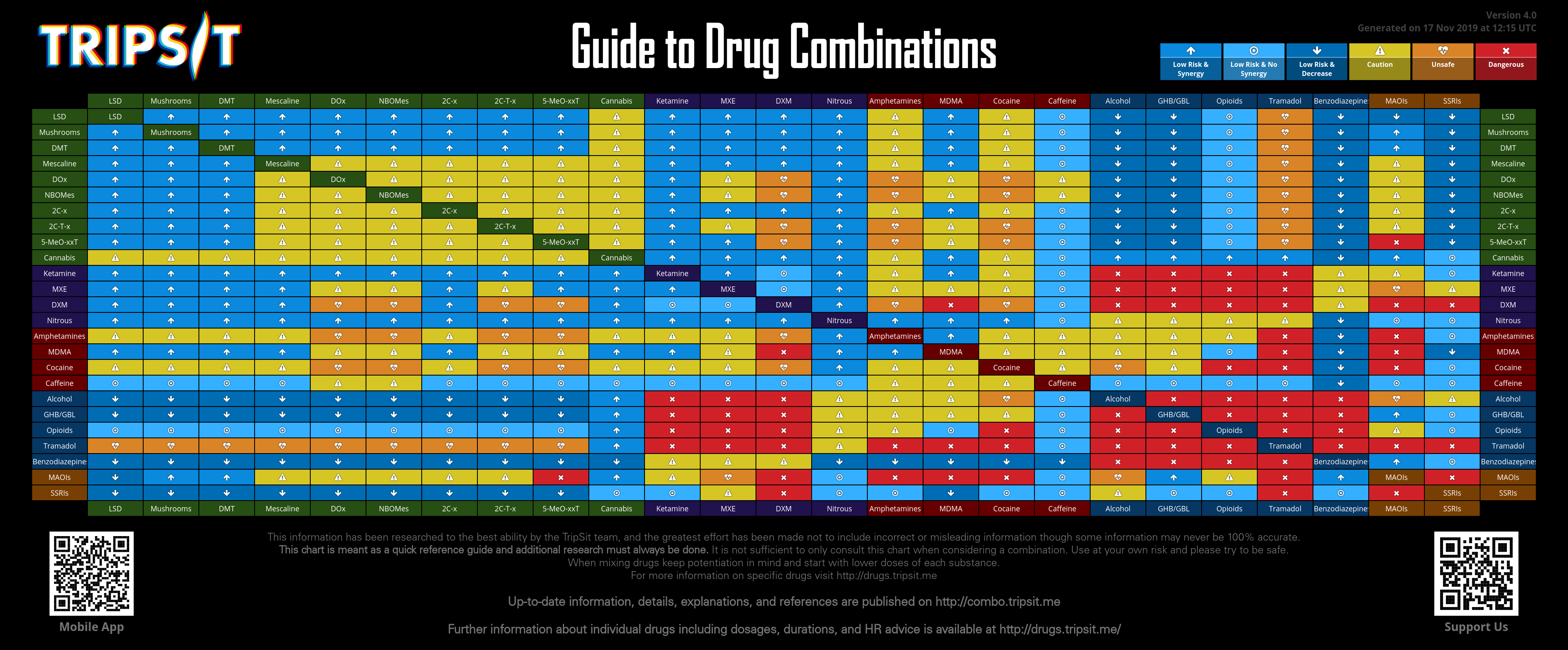
Psilocybins effect is enhanced by MAOI and decreaces by SSRIs. LSD effects are decreased by both. With other other psychedelics you have to be a bit carefull.
You probably think of MDMA and MAOIs, this would be a dangerous combination.
And indeed, that's what ayahuasca (aka yage) is.
Plus various mushrooms and other psychoactive stuff, depending on the preferences of the curandeiro/a (shaman) and the intended outcome.
SSRIs, do not mix.
NDRIs, lots of people report they're fine.
Hopefully we'll get better data on what other chemicals are okay to mix as these things slowly become permitted to be the subjects of study.
Later, I used to vacation in Amsterdam for the shrooms. But I'd go off the SSRI maybe a week or so before the trip.
I take the SSRI Fluoxetine (Prozac) and have tried numerous psychedelic drugs while on that prescription drug. Before doing so I checked with my psychiatrist who did not believe there would be a great risk.
My experience has generally been that psychedelics work (with the exception of MDMA) and there are no drawbacks to using them while on an SSRI. Of course, psychedelics do have risks and educated, responsible use is appropriate.
Asking this due to wildly different subjective experiences.
Even though this episode was decades ago, I still, kind of, experience the scent of that flower as the colour purple.
It’s possible your OP was noticing that a certain smell makes him know a thing is purple. Under normal circumstances he would just perceive PURPLE and think he was seeing. But on drugs he might perceive that his nose was also alerting him of PURPLE in the flower.
So, I've heard that people make a big deal about choosing a mantra, but my thinking was it can be anything, and somehow I got into the habit of visualizing a blank field of a particular color. The nice thing about focusing on a color was that if my visual imagination distracted me, I could concentrate on "seeing" the color, while if I was imagining words or sounds, I could focus on the name of the color too. So it was like having an object to focus on that had all the different angles available.
I'm not sure I've never experienced synaesthesia, but I'm pretty sure I haven't been perceiving smells or sounds as having color recently.
In certain settings psychedelic experiences are even possible without any chemical ingestion. For example on meditation retreats and ultramarathons.
So I don't think it's incorrect to call psychedelics a super placebo. The mental states they bring you to are entirely achievable without their use, albeit with far greater effort.
It's absolutely not a placebo. That, or the definition of the word is being stretched such that all meaning is lost.
This is not to downplay the effects of psychadelics - I've taken plenty and of course the psychoactive effects are undeniable. But the effects are from far more than just the chemicals. For example smoked DMT hallucinations are very different than Ayahuasca, despite the two being the same chemical.
I like "removing mental heuristics" as a good way of describing what is happening at the physical level. Articulating (or, communicating with high fidelity) what happens at the experiential and emotional levels is much more tricky.
An analogy I would draw is, imagine or recall how you may have felt during a major event (usually negative), say the death of a loved one, or the ending of an important romantic relationship, or imagine how you might feel if you are on your death bed, reviewing your choices and actions throughout your life....do you have any regrets, would you have done anything different if you had it to do all over again, etc. Imagine the feeling of clarity of thought, and deep intellectual and emotional appreciation of the gravity of the situation involved in such experiences.
This is how (but only in part) I would describe my experiences with psychedelics. Of course each person experiences these things in different ways, but despite such differences, extremely deep profoundness is an extremely common takeaway.
A simpler explanation, I would say that it kind of "shocks me into reality". And you may think you know what that means, but if you haven't experienced it, you really don't. Even I don't fully appreciate the meaning of what I'm saying at this very moment; I am largely going on faith, based on a very low fidelity memory of the experiences - such is the strange, ineffable nature of these medicines.
Luckily, while it seems difficult to see into (remember) one's experiences in that world, the opposite is not true - when under the influence of psychedelics, my experience is that I can experience kind of a simultaneous existence of two states of mind: that of clarity of thought (normal biases due to heuristics largely removed), but also clear (if not clearer) memory of thoughts and emotions related to specific scenarios in the normal world. This seems to facilitate for a very productive self-help scneario, the so-called "five years of therapy or psychoanalysis in a few hours" effect that some people speak of.
I should also note that I am speaking of experimentation in the medium dose range of psilocybin. While there are other things to be discovered at the higher doses, for my purposes medium dose trips seem to be much more beneficial. YMMV.
Set has so much to do with the experience--though I've had fun with it out with friends at a bar in dark of winter, its true power is sorely wasted unless I'm in nature, especially when my wife and I are taking it together.
I know with zero uncertainty that it acts as almost a forceful, powerful therapy with even a modest amount of mental input--it's as if your brain is forced into a state of deep meditation where you can't help but improve your mental station (barring the notably rare "bad trip"--though I've taken it with so many people, I do believe it happens less frequently with ALD-52 on account of its mental clarity).
Some of the best days of my life have been while tripping on ALD-52, wandering wild goat trails, exploring the vibrant innards of canyons, weaving among mountain pines.
RE your experiences with water, I've had the same experiences. One of the most memorable moments of my life was returning from a short high desert hike, to sink to the bottom of a salt water pool, look skyward, and watch the desert sun dance and play with colors on the water's surface. I've never looked at water the same since. I'm cheerfully captivated with its beauty in a way I probably haven't since I was a child.
Which brings me to my final observation. The effects of psychedelics, perhaps owning to their serotonergic effects or their disabling of the default mode network re-imbue you with a wonder in the world around you that has slowly, inconspicuously eroded little-by-ever-so-little each year into adulthood. Year by year, the world becomes more bland, less exciting, less, well, full of wonder. Remember those magical memories of childhood? Perhaps running towards the ocean, arriving at summer camp, having a picnic in the park, diving to the bottom of the pool, playing with a new toy on Christmas, the excited anticipation before a sleepover, your first crush? The magnitude of those feelings are often so muted or jaded as an adult. The right psychedelics can bring those feelings rushing back, unfettered, unadulterated, pure. Suddenly you realize how much of that you've lost, while simultaneously getting to feel them again in full force. Some of that stays with you during sober times, which is lovely. Dosing periodically keeps that magic alive in you--what a joy, a gift.
Humans have taken psychedelics as part of daily lives for tens (if not hundreds) of thousands of years. The shaman is little more than an elder trip-sitter and therapist. Our highly complex brains have evolved alongside such chemicals and experiences to help define meaning and seek happiness and it's a crying shame that waves of prohibition have stifled that nigh fundamental human experience. It makes me happy to watch that damage slowly be undone with news like this.
Urban lore has it that some of the "really good acid" in the '60s under the moniker "Orange Sunshine" was actually ALD-52. This is heavily debated and we'll probably never know for sure how much, if any, ALD-52 was circulating.
Most interesting is that even though he was incarcerated, for whatever reason, the DEA never got around to scheduling ALD-52. It's technically still legal.
In order to combat designer drugs, the government put in place the Federal Analog Act which means you could be thrown in jail if you're caught with a previously-undocumented or never-scheduled drug that the courts find is similar enough to a scheduled one. However, this has only been invoked a handful of times (only 2 I can find) and would likely only ever been used against distributors. Bottom line, a recreational user is extremely, extremely unlikely to be nailed on this law.
Lucky for you, there's this massive, above-ground lab in Europe called Lizard Labs https://lizardlabs.eu/ and produce lab grade products. They might as well be the Eli Lily of gray market psychedelic drugs. You can't buy from them directly but they openly list retailers selling their products. If you live in Canada, Europe, or the US, there's a retailer that will ship to you super discretely through the mail. No tor required.
Here's their list: https://lizardlabs.eu/retailers/
I've never had an order seized, lost, or scammed. I mean, it's paper--nearly impossible to detect. People that have lost shipments have generally just had the item quietly seized by customs with no further repercussions. I've used theindoleshop.com multiple times.
Cheers.
As for the Analog Act, the UK's version is presumably watertight (it effectively bans smelling flowers, but not poppers because gay MPs objected to that being banned), but has not been tested AFAIK.
Apparently Hoffman also did invented ALD-25, but the failed defense strategy was from Tim Scully, who operated a lab and distributed orange sunshine for california ..
The website notes that what they have are "NOT for human consumption". Is it safe or is it different than what one would use for recreational purposes?
This may hold at least some water in court.
It's akin to the age-old headshop rule of calling bongs "tobacco pipes" and kicking anyone out that calls them bongs.
"How can I have these results without loading on the mechanism?"
I can understand drug aversion but what's the aversion to breathwork, which is cheaper and shouldn't carry stigma?
> Is there a way to induce this feeling without the aid of psychedelics or breathwork?
Depends on what you means by "induce". (Usually) many, many years of practice (if ever)... https://en.wikipedia.org/wiki/Kensh%C5%8D
I can definitely report reaching an altered-state experience afterward that mirrors some of the things described here. The intensity of everything was dialed way, way up, in a way I had kind of forgotten was possible but I'm pretty sure I experienced as a kid. I don't think there's a way to put it in words that's comparable to experiencing it but it was not a subtle effect at all.
Abstractly, say everything has an "interestingness" value, and certain things would be near the top like a great movie or book. It was like there was a dial for this value that just scaled everything, and it was dialed up high enough where just the way light & shadow interacted on some things was as interesting as a great movie. Everything was super interesting. Kind of like a reverse burnout state, where maybe nothing is interesting. The effect lasted the rest of the day.
Anyway it wasn't easy at all to get in that state and I don't think I made a serious effort again. But I'd definitely recommend giving it a shot to anyone who's curious. It wasn't like there was any complex technique, it was basically just close your eyes, focus attention on breath and let go of all conscious thoughts. Personally the last part was the hard part.
I wonder if it gets easier with time so you can reach that state in 30 min or something instead of struggling hard for 3 hours. If that's the case maybe I should try seriously practicing it since having control of that dial would be pretty useful.
In my limited experience (2 trips) there was no negative aspect to psychedelics. There were things that were already negatively valenced, like riding in a car or visiting a friend's messy house briefly, however I had no inkling of a bad trip or any scary/demonic/overwhelming sensations.
That's interesting, but it sounds like a plausible description of how schizophrenia works too, maybe even one that I've read before, and yet my impression is that "natural" psychosis is different.
Y'all aren't disagreeing.
I hear ideas like this (and "In other words, you would need to use the drugs in combination with therapy to obtain good results") repeated all the time, but I'm curious where they come from.
If one spends any time whatsoever in enthusiast communities, the overwhelming sentiment is that these compounds are incredibly helpful even when used alone. This is not to say that individual results wouldn't be even better with therapy, or that there aren't some people who have negative experiences, but these being true also in no ways logically implies that significant benefits cannot be realized by independent usage.
The precise answer to these and other questions, at this current point in time, is: we don't know, with extremely high certainty. But this doesn't mean we don't know anything. Reality is independent of man's understanding (peer reviewed studies) of it - a tree falling in the forest does not require the presence of a scientist.
While it's always a good idea to exercise caution, I suspect advice like "do not use these substances except under professional guidance" is likely more harmful than helpful. It will be years if not decades before formal treatments are available, for many people that may be too late, not to mention the exorbitant price tags these treatments come at. I am more of the mind that people educate themselves on the topic, proceed with caution, work with those who have experience, and proceed slowly and with caution, starting with low dosages and working your way up over time. There is very little trustworthy evidence that I know of indicating there is any kind of substantial risk, and even then that has to be weighed against not just the benefits, but also the risk of doing nothing.
Regardless, I fail to see any evidence that supports the assertion that you also need therapy, that you cannot benefit substantially without it. Those who have literally no first hand experience with psychedelics are not exactly objective either, but it sure doesn't stop them from confidently passing out advice.
Honestly, the fact that you assumed others were talking about "have a guide or 100% failure" is disingenuous on your part.
Everyone says this and it's little more than bro science. So if you have a bad experience from the drugs, it was because you weren't in a positive headspace? Sounds like No True Scotsman.
You can always test out this hypothesis by doing a tab of LSD from the same batch twice while controlling for your headspace. One day, you do it with a positive headspace, and another day you do it with a negative one. If you had a great experience the first time and a bad experience the second time, clearly the headspace alignment made the difference.
Yes, this kind of testing isn't as rigorous as it would have been for a legitimate scientific trial (which I bet we will see in the future as the research into the area accelerates), but imo it is more than just a No True Scotsman backed by broscience.
And of course, no one says that a negative headspace is the only reason for someone to have a bad experience, there are others for sure. For example, certain people with predisposition for schizophrenia probably should abstain as well. AFAIK psychedelics won't cause a schizophrenia in an otherwise healthy person, but I heard it might kick off an early onset if you were going to get a schizophrenia in a few years without any psychedelics anyways.
Everyone knows what it means, and it is way shorter than what I have in the quotes. Pretending it isn't a legitimate word (despite it having an actual entry in the dictionary) doesn't make you look more impressive.
One of the first times we did LSD with my friends in college, in the end we all were thinking "this is why they call it a trip. we all went somewhere together and came back".
Set and setting matter a lot and it isn't bro-science. You're talking about drugs that take your mental chatter and external stimuli and allow them to flow freely. Anything bad or anxiety producing will get amplified and without the proper experience, it might spiral out of control.
I'm not sure I have the stomach to try a psychedelic to try and treat it, as I've seen some success with exposure therapy, but the curiosity is there. I also had some pretty bad experiences with marijuana when I was younger (college), that have kind of scarred my ability to relax before taking any drugs.
There's a part in the book where it was either him on one of his experimental trips or maybe it was someone he interviewed, but while tripping, they were faced with some terribly scary images.
The person tripping said to their therapist guide that they were scared of whatever they were seeing and wanted to run away. The therapist suggested instead that they turn around and face head on whatever it was that they were seeing that scared them. Stare at it, observe it, take it in.
After they did so, the thing they thought they were so afraid of ended up not being so bad, and they sort of peacefully coexisted with it for a bit longer in the trip until the thing went away.
This is how I try and frame the scary things that run through my brain, it's normal to be afraid of bad thoughts, but also learning how to peacefully coexist with them is pretty healthy.
There's absolutely nothing placebo-like whatsoever about psilocybin, any more than a surgeon's tools are placebos. It's an extremely powerful tool that can be applied in a therapeutic context.
Great book btw. I highly recommend it anyone who is curious about the subject.
> The way I think of these drugs is just that they flood your brain with toxins. That in itself will make it not work properly. But the scary part is that the more time your brain spend intoxicated the more likely you start loosing or weakening connections. If you weaken connections only for the bad memories, that would be a good thing. But what if you weaken the connections for other important things in your life ? Like self control, moral values, family love, etc.
The point is that the exact people who are well-known and respected as black-market guides would become therapists in a world where such a profession were legal!
Not entirely true, although only a few, there have been and continue to be legal studies involving psilocybin (also MDMA) in addition to the one in the OP.
Here is a smoking cessation study in Baltimore, involving a psilocybin psychedelic trip. https://www.quitsmokingbaltimore.org/
Here's an article about the findings of the 2014 pilot study on the same thing which describes the methodology to some extent. https://hub.jhu.edu/2014/09/11/magic-mushrooms-smoking/
But specifically in this context psychedelics are generally introduced to individuals who haven't had prior experience with them, and may need additional support that therapists can help with (e.g. survivors of sexual assault, deep depression, anxiety regarding terminal diagnosis, PTSD, etc) and the therapist have been trained specifically in guiding these individuals in psychedelic trips. So they are like the best trip sitters you can have if you are trying to get out of rut.
This does not mean that there is zero placebo effect involved with taking psychedelics. The latter statement would mean your experience is identical between actively taking a psychedelic and someone slipping some in your drink. I'd say this is unlikely, no?
We know for lots of other drugs, both therapeutic and recreational, that there is always a placebo component as well as a "real" one.
This is why people do placebo-controlled trials. You take 100 people and give them ibuprofen against joint pain, then you give another 100 people sugar pills against joint pain. Then you record their pain reduction on some scale, and the placebo scores 2 +/- 1 points, and the ibuprofen scores 7 +/- 1 points. So you say ibuprofen has a significantly better effect than placebo, but (probably) 2/7th of the ibuprofen effect is due to placebo.
It's not so much about how it works or why it works, it's mostly about the result.
As far as I can tell, from my own experience, lsd kind of make you see your own actions/thoughts as an observer[0], it's a very useful tool if you're into introspection. If you're not used to introspection it can be quite unsettling though.
[0] >50ug <400ug, after that you just look a the ceiling and enjoy the lights
That is a huge difference. 400ug is a big dose and 50ug barely noticable.
Anyone reading this without experience going for 400 is going to get knocked for six
Some research suggests a “30-40 microgram trip first, then a 60-80 microgram before anything larger, then a 120-140 microgram before anything larger, then either stopping there (this was the dosage that resulted in the highest increase in well-being) or doing a 170-240 microgram trip.” — https://tripsafe.org/how-to-take-lsd/#start-small
I'm just arguing that it would make more sense to start at 80-110-140-170 etc because below that is placebo.
Source: have worked directly with LSD crystal in the past. (Unfortunately anecdotes are king when it comes to illicit drugs otherwise I’d be able to cite an actual external source)
This is probably the best way to describe the therapeutic value in this situation. Hallucinogens (not just LSD), give you some distance from your headspace. It's not to the degree you feel depersonalized or have an out of body experience, but it allows you to examine your own thoughts without all those underlying assumptions that you hold yourself to subconsciously, every day.
Personally I tried it. A very low dose completely wipes out any depression or negative thought for weeks at a time. Way better than zoloft.
I'm surprised by the focus on large psychedelic trip doses and placebos in this thread. It's basically two opposing extremes.
I too have observed incredible effects of taking small below-threshold doses of psilocybin, with absolutely no negative effect whatsoever. It's tempting to incorporate half a stem into my regular morning routine like a vitamin.
So the chemicals trigger the mechanics, but the experience dictates the lasting effects.
I’ve done many trips on LSD and Psylocybin. A classic line you read about these experiences is they rank up as the most significant events in people’s lives such as the birth of a child.
However if you trip 100 times or more, how can all of those times be so incredibly meaningful? They can’t. and they won’t retain their power. and that’s a common feeing of a trip is it feels important and significant and intense in the moment, but a lot of the time you aren’t doing much on a trip. maybe you had a day at the beach. maybe you took it at a music festival. maybe you took it with friends you rarely see.
will some of those experiences have more lasting effects than others? yes. will they all feel significant at the time you’re on it? yes. but i don’t agree they don’t count as “good results” if there’s no professional therapy involved. a lot of what you get out of these trips depends on what you put into it. it’s entirely possible to go to a clinical trip and get little out of it. and as many people know you can trip without professional help and see impactful outcomes
That's essentially the case with any depression medication.
That's not what I was saying.
I disagree that psilocybin is any sort of placebo, but I think this captures the intent of the grandparent comment.
For optimal results, not good results. The compounds are fairly therapeutic on their own and can and have produced plenty of good results, in the same way that chewing on willow bark still helped with headaches before we concentrated into the convenient form of aspirin.
It's amazing how the same books get tossed around Silicon Valley, is their a book club i'm not aware of.
(just finished the above book, it's heavy on drug history which I dont care about but still well-written)
When the only thing that's changing is a state of mind, then placebo is actually the real deal.
I got good results and all I did was listen to music or walk around outside.
The one thing I'll say is that it seems like these drugs affect the brain in a way that's more akin to a super-placebo, rather than being therapeutic on their own. In other words, you would need to use the drugs in combination with therapy to obtain good results.
[1]: https://en.wikipedia.org/wiki/How_to_Change_Your_Mind