However, systemic change is possible. We have numerous counter-examples: the UN, the Montreal protocol, free trade deals, et cetera.
So why don't we have systemic change for climate change, because people like you and I let our politicians get away with it! If it was obvious to politicians that doing something about climate change was required to get re-elected, they'd do it.
It's an incredibly difficult task, which means we need to try harder, not that we should just give up on the planet.
On the other hand, recently I've been thinking about this. According to some theory it takes about 3.5% of the population to take part in active resistance to cause change (https://www.youtube.com/watch?time_continue=1&v=YJSehRlU34w). Now, 3.5% is clearly not a majority required to vote in the right politicians. Which leaves you with direct action. Something like that.
1) Confounding variables. She essentially states that she looked up resistance movements and then quantified what percent of people participated and the outcome. But there are going to be tremendous confounding factors here. While she does not offer much in the way of examples she did reference the most iconic examples - Gandhi and the US Civil Rights movement. The Civil Rights Movement has some great examples, but I think India is perhaps even more striking so let's just consider that.
The British Empire was collapsing into bankruptcy in 1946 following World War 2. They were only saved by an emergency loan from the United States. At the same time this was happening the world had become divided between two superpowers - the USSR and the USA. And neither of them looked fondly upon British imperialism. India would be granted independence in a matter of months - in 1947. And over the next 18 years so would nearly every former colony of India, regardless of the level of resistance. And indeed, our author here almost certainly also listed all of these incidents as successes of nonviolent resistance from tiny minorities, even though their independence was driven largely by outside factors.
2) The meaning of protest has changed in the age of the internet. In the 1960s organizing was extremely difficult and travel was expensive. Seriously, imagine trying to organize things when the best you have is a phone where you have to manually dial each and every number (and long distance was pricey!) or things like hanging up signs on street lights. And people getting places was costly. A one-way domestic flight could set you back nearly a thousand dollars. The net effect of this is that in times past a single person represented far more people than just themselves.
However today this has radically changed. Organizing people is completely trivial and free. Travel is still a burden but it's become much cheaper and easier than ever before. This also means that protests mean something entirely different. if there are a million people protesting something, it's entirely possible that these million people don't necessarily represent all that many people other than themselves.
This also makes me wonder about something else, but since it's a distinct point - I'll put it in another post.
If that's true, it should be made more widely known.
I think that would be cause for hope for many people who despair at democracy and collective idiocy, and it would change their behaviour because of hope and belief in the effect of personal actions.
If the 3.5% is actually true, that change of behaviour caused by knowing it might tip serious balances.
You end up in a situation where you want people you agree with to engage in disruptive behavior, but not people you disagree with. Yet messaging like this would fully motivate everybody. It seems likely to ultimately do little more than encourage fringe extremism because you have to remember everybody always seems themselves as the good guy. Let them think they can win with a negligible minority of disruption, and you're strongly motivating extreme behavior from fringe groups. For that matter you even motivate people who like to play puppeteer. Imagine you're a billionaire and you now believe you can achieve near anything you want if you can just get 3.5% of people to start misbehaving.
Getting your way by misbehavior is exactly what we aimed to move away from with democracy. And I completely agree with you on the failings of democracy which does seem to be trending towards idiocracy. At the same time, I think this is the sort of solution where the cure is far worse than the disease. You keep the same idiocracy, but now you convince them that they can get whatever they want if they start trying to break down normal civil order. And the current establishment in politics would use it, similar to 9/11, as an excuse to greatly expand domestic surveillance and further strip away privacy and various civil rights. You know, for 'your' protection.
I agree when it comes to "getting your way by misbehaviour", that democracy is designed to improve on that.
But if we generalise to "change caused by individuals' actions", which may not be the change each direct actioner demands, so much as the consequence of their applied lives, that covers more things.
For example, climate change activists who don't fly and tell others not to, are not causing a democratic catastrophe, yet they are having an effect and it's probably disproportionate and probably good.
I don't think that's chaos, I think it's a form of distributed intelligence and attention process. Albeit a messy one, without monotonic improvements.
So let's just imagine some chunk of this group starts engaging in civil disobedience and so on. You'd need less than 12% participating to hit that magic 3.5% from which it supposedly literally "never fails" according to our researcher. So now what? Clearly we're not going to now just go overturn Roe vs Wade. And even if we did it would create even more chaos. The protests themselves would also likely lead to violence due to the inevitable emergence of counter protesters. It may be the case that 3.5% works in some cases, but that's going to need to come with several asterisks after it to clarify what, when, where, why, how, and against whom.
This is something I hope people will soon recognize on a much broader scale. We should forget about fuel cells vs. batteries, wind vs. solar vs. nuclear, CO2 capture or not, etc.
We need all of the emission reduction technologies we can muster ASAP.
Even with mild assumptions about a duty to not harm future generations (say if we substantially discount the livelihood of our children and their children in favor of our own), we would need to take action that dramatically reduces our emissions.
American voters will not vote for anything even remotely of that magnitude. Most Americans would be unwilling to see their electrical bills rise $10 if it meant averting climate change.
Meanwhile, the Anglo-West is hyper-focused on the US because there's a president they don't like. This has been a blessing (now the average Anglo-Westerner at least pretends to care about the environment), but also a curse (they think the US is the only country that can save humanity).
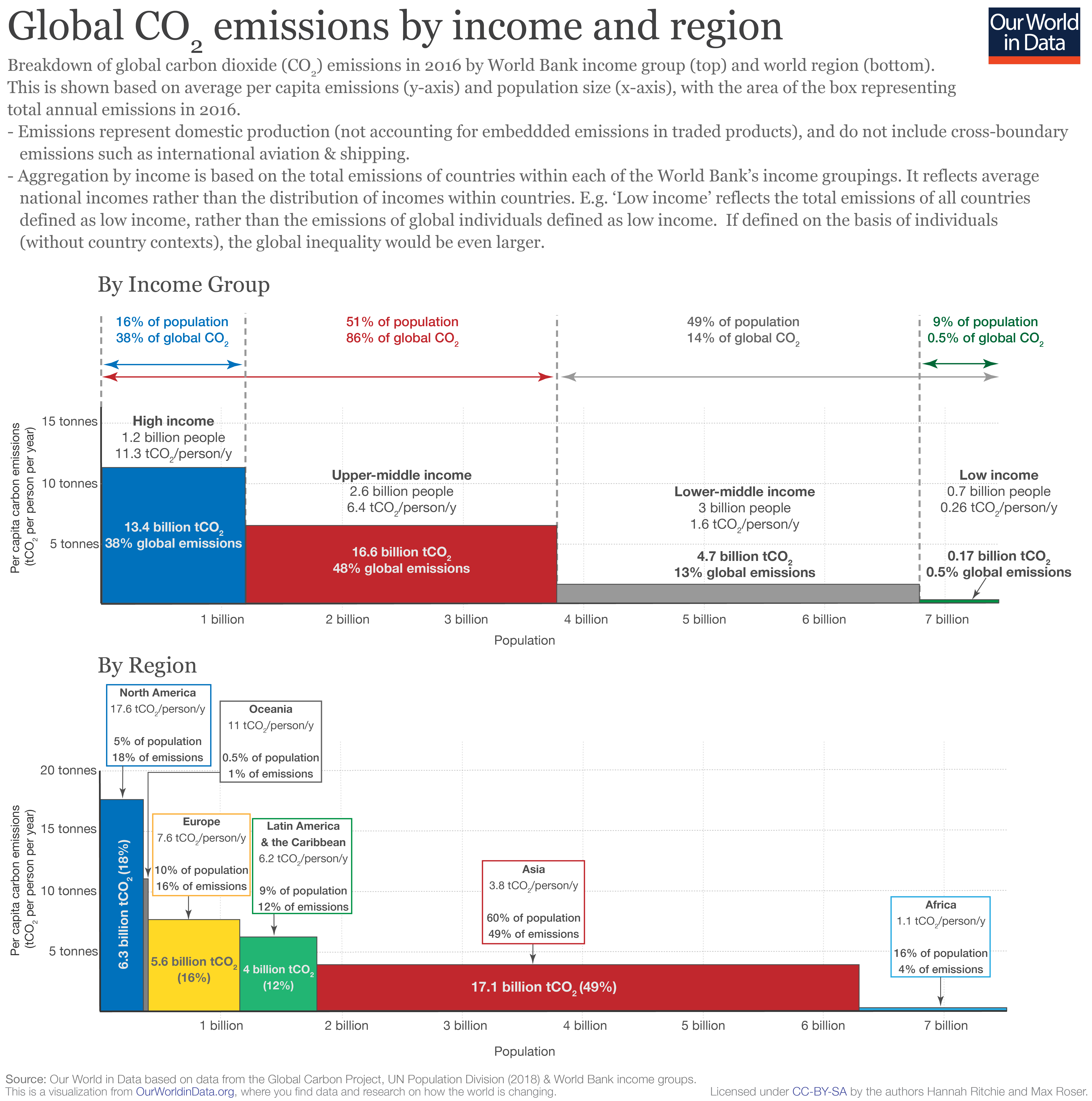
USA is doing terribly thanks to having by far the largest emissions per head, dramatically in excess of anywhere else.
Asia is doing poorly thanks to having larger populations, developing apace and being home to much of the world's manufacturing.
UK is just about world's worst for historic cumulative emissions thanks to being home of the industrial revolution.
Shall I go on? It's everyone's problem, and needs addressing everywhere, at every election. Anything else is just finger-pointing excuses not to act.
One of the primary ones is that most of the developed world has gotten to the quality of life it has today through very high historic emission levels (and continues to have higher per capita emissions). Additional emissions in the West go towards maintaining our very, very high quality of life - emissions in the developing world (like Asia) go towards bringing millions of people out of poverty.
Asia may be the largest polluter by far, it also happens to be the continent with the most people and the most people in poverty.
Nobody thinks that the US is the only country that can save humanity (even if the US cut to 0, that wouldn't be sufficient, although it'd be approaching it), but if the US, which easily emits 4-6x more than most people per capita is unwilling to cut, than we are totally FUBAR on a global scale.
It's easier to reduce 1 ton of annual CO_2 emissions when you're producing 17 tons per year and person (like in the US) than when you're at 6 tons like the Brits. In either case, it would be 1 ton saved per year but it's only a 6% reduction for someone in the US but a 17% reduction of their yearly emission for a Brit.
- China is taking concrete steps to reduce emissions: capping coal production, switching to electric buses, et cetera
- For better or worse other countries are far more likely to say "why should we reduce emissions if even the US won't" than to say "why should we reduce emissions if China won't".
Don't forget that a lot of that pollution is due to production for western consumption.
That doesn't mean that US policy can't address the problem; US policy—on climate as well as most other things—need not be limited to domestic policy.
Russia and China are not fighting against the sort of collective action we need to take?
The two-party system is a farce, it's not like past democratic leaders made any meaningful systemic changes to prevent climate change.
The market makes this easy nowadays. Unless your phone is broken/severely outdated there is next to zero benefit to upgrading at this time. Prices for flagships become prohibitive as well.
Upgrading phones every 1-2 years is a dead tradition outside of contract incentives, only relevant to hyper enthusiasts (r/android etc...). Even then I am not sure why aside from corporation benefits. The differences are marginal at best (ok, Candy Crush 4D gets 8fps more nowadays), the value of upgrading has declined for years now.
Of course these statement will have enthusiasts screaming and foaming because the newest FiveMinus 8T has 1mm less bezel while sporting 25 mAh more battery compared to last years model. Also NIGHT VISION CAMERA! All the not-quite photography-enthusiasts are salivating and throwing their money at phone makers year after year in order to participate in blog-jerk-offing and karma whoring.
People who care about photography get DSLRs, people who care about functional functions in phones haven't had to react to significant changes for several generations now, unless lack of security updates (cough Google) forced people to. WhatsApp, Instagram, Firefox, Mail, Dial, Weather, Auth Apps, ToDo, ... they all run fine on still supported iPhone 5S/SE or older supported Androids. What app that an iPhone 5S cannot run is even truly useful and missed?
Right now I'm on a OnePlus 2. It will be 4 years old this summer and doesn't seem to have any issues with the newest Android (in the form of Lineage OS), or any apps I use!
It is utterly insane that consumers and the industry are fine with battery degradation coercing them into complete $600+ device replacements (further fueled by the "I got the newest phone!" social status incentive for some folks).
Batteries should be swappable and at replacement time be properly recycled. Manufacturers need to be legally required to provide this option at all times, if they refuse to do so (do any?).
I wish Google would sort out a way of ensuring everyone could get stock android updates for a much longer time period.
Until recently there was enough to be gained from an upgrade every other year for most people. That is no longer true and the market sees that.
E.g. Going from 5S to an X is a worthy upgrade. That’s how many years of progress? You will feel the benefits every time you pick up the phone.
Turns out people are generally good judges of how to spend their own money.
Your point does stand - an X is an enormous upgrade to the 5S in usability and feel.
But barely so in function I would say. There are few truly useful things one can do on the X but not on the 5S. Portrait mode pictures? High-definition Netflix streams? 4k images?
I also really appreciate wireless charging and waterproofing.
Bluetooth and WiFi work better for me on the X than they did on the 5S.
I also opted for 128GB when in the past I always skimpt on storage, and now I really appreciate never having to think about clearing pictures off my phone or if I’ll have space before going on a trip.
Come to think about it, some of my favorite pics of my kids were taken in Portrait mode. It really is a very pleasing effect.
Back when I had the 5S daily, we occasionally pulled out the Canon DSLR. I should probably sell that thing on eBay now...
At this point I don’t know what would drive me to upgrade short of breaking or losing my current X. It would take something groundbreaking, like a phone form factor that also doubled as a laptop through an AR keyboard and AirPlaying to any screen I happened to walk up to.
In the past my phones always got sluggish after a few years. Maybe that was Apple intentionally throttling and hopefully that won’t happen this time around. I don’t do anything on the phone that ever really challenges it except maybe searching through thousands of old emails and web browsing without an ad blocker.
My wife has I think a 7 Plus (?) and has absolutely no desire to upgrade.
Not only is the battery severely degraded by now (still +-usable though), but I can't update any app for last 6 months simply because there is no space on phone anymore (that 32GB microsd card means nothing to that ancient Android 6). I can remove properly functional useful apps from phone and thus reducing its usability, but that's a bad deal. The worst part is sluggishness though - it can easily take 30 seconds just to be able to start Firefox and begin to type the URL. Or start maps and begin to type address. Everything is super slow.
Its a good tool to train my patience, but as actual usability goes, I have to upgrade. I need to keep my sanity.
Absolutely agree. It's not either/or. We need both. But hey, it's easier to advocate for systemic change if you lead by example. See e.g. https://www.theguardian.com/environment/2019/apr/26/greta-th...
Fastest move would happen if what im talking about did happen in 1st world countries.
Thats sad masses need such a strong shake up.
> - Stop flying to conferences. Go to a local meetup. It's fun. And cheaper. If you really need to get out of town, take a train.
No unnecessary hassle and stress from flying to far away places or getting stuck in traffic jams.
> - Start working part time, and part of that part time remotely.
Not sure why this is beneficial to those species or climate or anything but working less gives you time to focus on family, friends and hobbies.
> - Reduce your meat consumption as much as you can. Don't go all the way vegan, but make meat a special treat not a commodity.
Meat is unhealthy - period. It's a nice to have but it is at the end of the day just not good for you.
> - Don't upgrade your phone. Seriously.
Applied shift of focus away from materialism and unimportant fuss like whatever new feature and gadget just come out.
You are the one gaining happiness and satisfaction of those steps right now! And on top of that - you're reducing your footprint :)
"...A number of studies (e.g. Knight et al. 2012, Rosnick and Weisbrot 2006) have found that shorter work hours are associated with lower greenhouse gas emissions and therefore less global climate change. The relationship between these two variables is complex and not clearly understood, but it is understandable that lowering levels of consumption, holding everything else constant, would reduce greenhouse gas emissions.
This paper estimates the impact on climate change of reducing work hours over the rest of the century by an annual average of 0.5 percent. It finds that such a change in work hours would eliminate about one-quarter to one-half of the global warming that is not already locked in"
-- Reduced Work Hours as a Means of Slowing Climate Change. http://cepr.net/documents/publications/climate-change-worksh...
They can be grown sustainably, as well, so again, veganism isn't required. At the supermarket, just get the expensive chicken breasts - I'm guessing the vast majority of us on this website can afford it.
Observing the diets of blue zone populations, it definitely seems like meat should be consumed rarely. Although they consume different forms of meat, they seem to share in common meat consumption of roughly 1-2 servings per month. This is far rarer than the average American diet.
I need ~140g protein a day to perform in the gym, I don't really want to get that from beans and be chew through 3,500 calories of carbohydrates to get to that protein.
This is exactly why we're doomed. Everybody wants to "save the world", everybody knows what to do, nobody does it because it's incompatible with our current self destructing life style.
No you don't >need< 140g of prot a day, you can hit all the macro/micro nutrients your body needs easily even with very low amount of meat. Who cares about gym performances, we're talking about the future of an entire planet/eco system.
> At the heart of capitalism is a vast and scarcely examined assumption: you are entitled to as great a share of the world’s resources as your money can buy. You can purchase as much land, as much atmospheric space, as many minerals, as much meat and fish as you can afford, regardless of who might be deprived. If you can pay for them, you can own entire mountain ranges and fertile plains. You can burn as much fuel as you like. Every pound or dollar secures a certain right over the world’s natural wealth.
https://www.google.com/amp/s/amp.theguardian.com/commentisfr...
I listened to a podcast by Dan Harmon once, where he was talking about a fictional protest at Berkeley, with antifa on one side and nazis on the other. One of the Berkeley protesters in the skit says "While I don't support almost any Republican principles, I actually do think I should be allowed to own a gun." The Berkeley students, enraged, push him to the nazi side.
I've also heard this called "fallacy of the pure movement." There's lots of words for it, but the basic idea is someone alienates all but the True Believers from their cause.
In your mind, I must be a vegan to be a true environmentalist. There is No Good Reason to eat meat. A bit silly, there are plenty of Good Reasons to eat meat. I just named one. Another is culture - isn't a tribe of fisherman that have been fishing for 2,000 years entitled to continue to pass down their recipes for cooking fish to future generations?
Kinda moot though, because the dangerous thing you're opening yourself up to here is a retort of raw values - when was the last time you took a flight? How DARE you? Used a car? Why didn't you spend 2 hours biking instead? How DARE you not sacrifice every centimeter of your well being for the environmentalist cause?
There is no True Believer. Not even you are the True Environmentalist. Accusing me of not being True doesn't help.
Yes, but no reason to eat meat every day / multiple time a day.
> I must be a vegan to be a true environmentalist.
No, just act according to your beliefs. If you willingly do something going against what you preach then you should look into yourself, you're either lying to us or lying to yourself.
You don't have to be an extremist, if everyone was acting on the low hanging fruits [0] it would already help immensely.
[0] Eat local food, don't waste food, reduce meat consumption, don't overuse AC/heating, don't be one of these guys who take the plane every weekend, don't buy useless low quality gadgets, &c.
Also: https://en.wikisource.org/wiki/Moral_letters_to_Lucilius/Let...
[0] https://www.theguardian.com/lifeandstyle/wordofmouth/2012/ju...
Why the attacks? I don't buy pounds of factory farmed beef a week. I'm buying free range chicken and turkey, sustainable fish, free range egg and cheese. This supports the cause. We are on the same side.
I've suspected that you'll write this.
https://www.riseofthevegan.com/blog/only-male-us-weightlifte...
Why do you think that 1kg of free range chicken is more ecofriendly [0] than the factory farmed one? I'd agree free range chicken is better from the ethical stand-point, but from pure efficiency of producing 1kg of chicken from available resources, I'd speculate that free range is not more ecological.
We are talking about the fact that people are not fitting on this globe anymore and some sacrifices need to be made. Why are we destroying forests to make land to grow crops to produce meat with 10% efficiency versus if we'd use that land to feed ourselves directly? Growing animals just to slaughter them sounds extremely inefficient, land and resource consuming. 10% efficiency is pretty shitty efficiency when we are low on resources.
[0] in terms of CO2 required, in terms of land required to grow same amount of animal meat, in terms of clean water required, etc.
No definitely not you're delusional.
This is no true Scotsman or some version of it. I don't get to be an environmentalist because I'm not a vegan? Nevermind the composting, bicycling, lobbying, donations, volunteering, picking up of trash, lack of a car, love of nature.
What if I turned this argument around? What if I claimed you can't be an environmentalist if you ever purchase petroleum based products (plastics)? And then I called you delusional for thinking otherwise? How would you feel?
Many commonly eaten fish are considered too dangerous to eat frequently thanks to pollution levels.
[citation needed]
Here you go:
> The association has not always been noted with red meat, and it has been absent with white meat.
So white meat is fine. Furthermore, the protein need is so great that for those over 70, restrictive recommendations should not be applied:
> Restrictive recommendations should not be applied to subjects above about 70 years of age, as the studies quoted herein did not examine this age group, and the inclusion of sufficient protein supply (e. g. in the form of meat) is particularly important in the elderly.
So, pretty obviously shown from your own source that "meat is unhealthy - period" is a false claim.
Just think about it a little bit, man evolved over hundreds of thousands of years eating meat, there's no way that it's bad for you.
For example: one cannot simply replace air travel with trains in the US. Amtrak is wholly inadequate to act in an interstate commuter transport capacity in the vast majority of the US.
Also, I’m not at a point in my career where I can afford to work part time. Part time software engineering jobs are hard to find in the US, and part time jobs don’t provide benefits like healthcare.
Individuals are going to look at this and say “why should I make these sacrifices when I know that others aren’t going to make them?”
Also, encourage children in their activism. They are good at making complacent parents take notice at least, if only for social signalling :-) and hopefully some of it sticks when they grow up.
Voting shouldn't be seen as the basic thing, which people need to do to show they care in the world. Many people see voting as mostly pointless, and they might even be right compared with other things they can do.
In general, fix your stuff before buying new or buy used. Or at least try to extend the time between purchasing a replacement.
Better yet if You think about new startup don't just create another super smart and sneaky ad technology but try to find an idea that contributes to humanity or the environment. After all, it's not the idea but your grit and perseverance that will take you to the top so why not make it matter.
I haven't flown anywhere in three years, and certainly don't visit conferences.
"- Start working part time, and part of that part time remotely. Reduce your commute. "
Uh, what? I commute by bike and with the bus in the winter. I don't really see how stopping that would contribute.
"- If you have any investments shift them from fossil to green."
Uh, most of my investments are in index funds. I'm not going to change that, but I do hope my fund managers will.
"- Don't upgrade your phone. Seriously."
I don't upgrade. I buy replacements when the previous unit dies. I haven't seen any concrete benefits from upgrading from a top model in the past six years.
See, it gets pretty weird if you try to engage on a some sort of grass roots movement beyond a very, very specific goal. People have wildly different lives.
Your carbon footprint is much lower than theirs for sure and trying to convince someone with a higher footprint to change will be vastly more efficient than trying to squeeze the last kilogram of carbon emission reduction out of your own life.
Thanks for the effort by the way!
That might be true. But I'm under the impression that:
- Flying is often said to be the biggest individual climate-harming action by individuals.
- Most people, even in the West, are kind of poor and haven't flown anywhere in the last decade.
- Most people, even in the West, don't have "investments" unless you count a measly pension they don't have much control over anyway.
- The mobile phone market is struggling because people aren't upgrading as consistently as they used to, older handsets are good enough, and newer ones aren't special enough. People have enough spares now that they pass old ones on to their poorer friends.
If that impression is accurate, perhaps others are generally closer to the emissions levels reached by the GP commenter.
Some other areas for improvement may be car use, home energy and food, as these are all things which can be significantly improved. I imagine most people (in the West) still drive a lot, have woefully inefficient homes, and buy food based on price and appeal rather than climate impact.
I'm not into smartphones since my 12-13 year old phone still kind of works (lost battery cover so battery often disconnects, often bad contact with sim card...), but I know from behavior of some friends that there are apps which track foods and products by barcode for calorie intake etc..., in theory an app could by barcode pop up a warning or something pointing out the environmental impact of a product which relies on environmentally harmful soy, palm oil, ... it should list both impact of full consumption, and impact by "dose" or rate if it's say shampoo.
After using it for a while it could say calculate the impact of your choice of shampoo by looking at the first and last dates of buying a bottle and the total number of bottles minus one divided by the time between first and last... then the user could see a breakdown with sometimes perhaps counterintuitive results.
Users should be able to collaborate in verifying and correcting calculations, so only a minority need spend time and effort such that a majority can rely on the app more blindly...
Edit: adding that it's also not helping when geopolitical rifts induce my country to ... burn produced apples and pears, instead of letting their price fall for a year...
edit: I mean in the US. Global income vs carbon footprint is easy to find: https://ourworldindata.org/uploads/2018/10/CO2-emissions-by-...
Uh, you are welcome, but these are not choices I've made due to any environmental reason. They are the most comfortable option for me personally at the moment.
I agree it's unlikely, but if it were to happen it obviously wouldn't be initiated by 'governments and politicians'. It would come from populations, or significant portions thereof, pushing them in the right direction. Hence Extinction Rebellion, the school strike etc. I suspect though that the last century or so of corporate propaganda has captured enough people to make it all too little too late.
The environment is an awesome way for people to virtue signal how much they care. But the fact is the real world consequences of what most environmentalists ask for would seriously affect the way of life they have. Politicians know this. Any serious attempt to change anything will not get you votes and out of government.
That is not the governments fault. That is not the corporations fault. That is every individuals fault who talks the talk but doesn't walk the walk. How is a politician supposed to do anything about the environment when it WOULD make the poor poorer?
Most people don't realise that the effects of the 2008 financial crisis is nothing compared to what sort of reduction in living standards you would need to get even close to being carbon neutral. In fact, its usually environmentalists complaining about inequality and cost of living.
What would being carbon free mean for anyone individually? No flying, no cars. Buying solar panels. Insulating your home. No meat. No imported foodstuffs. How much sacrifice and cost is that for 1 person? Multiply that by everyone, it's INSANE.
And the death of our living planet isn't? So-called 'economic growth' was never much more than a global entropy increase, as high quality self-organising evolved systems were ripped out to feed crude technological ones requiring endless inputs.
This was always mere borrowing against the future. It was never 'growth' in any true sense. It ends because biology, chemistry & physics say it must, regardless of human pouting.
We could perhaps 3 or 4 decades ago have made a collective decision to gradually reduce consumption and allow our home to survive in decent enough shape to sustain us. Or maybe it was a biological fait accompli that any species evolving capacities to escape population limits and spread like a devastating weed across the world would eventually outstip the world's capacity to absorb the change. We'll probably never know which.
One thing we know about humans is that, as a species, we were never and are not currently capable of making such collective decisions or otherwise coordinating at this scale. This is probably the root of most problems we have, except death and diseases.
I'm pretty sceptical re claims of knowledge about complex systems, and human ecology is about as complex as systems get. So I think your statement is way overconfident.
Having said that, if I had to make a bet on whether or not we'll make the necessary decisions given how late in the game we've left it, I'd put a decent whack of cash on the prospects of failure. Also that the proximate cause of the collapse of our civilisation won't be global environmental collapse, but war consequent on local collapses. Look at Europe following 2015, convulsions caused by trickles of refugees that were minuscule compared to what's coming. I'd bet on nukes (another can we've kicked down the road for decades) offering the coup de grace.
Complex behaviour of systems often arises out of simple rules. Game theory is not always well applicable, but here it provides some simple models that explain this problem very well: multiple people forgoing individual gains in order to cooperate at getting bigger gains is a very unstable state that can be quickly destroyed by free-riders, who defect in order to reap both individual and group gains. The very awareness of this dynamic, which is something we all have as intuition even if we can't put it in "mathy" words, is enough to severely curtail the ability to cooperate. Looking through this lens, you can discover that of cultural customs and social pressures around individual behavior are really mechanisms that deter and punish defection and strive to establish an environment in which cooperation is easier.
Scott Alexander explored this topic far better than I ever could: https://slatestarcodex.com/2014/07/30/meditations-on-moloch/.
Your guesses happen to be guesses I share. But they're just guesses.
I still hope we can get out of this one, but I don't see the solution coming from "the people". If anything, "the people" will have to be dragged kicking and screaming into that future, by governments mandating the right moves, by public and private R&D creating solutions which companies then use to enable the governments to make the right moves.
It seems to me that only the ultra rich have the resources, independence, and arguably intelligence to lead the way to solutions that could save humanity. They might devote their talents and resources to funding research into technologies we will need when when things get so bad that governments are forced to act. Also funding powerful lobbing groups to counteract the powerful lobbing efforts of corporations that benefit from delaying action on the climate.
I sort of disagree; the governments might be (as usual) the crucial element of the solution - they're the only actors on this planet capable of forcing a decision on masses, even if it goes against the wishes of the market. But getting the government to do the right thing sooner rather than later - that's the hard part. Especially that nations are market players themselves, and doing the right thing in case of climate change means handicapping the whole country on the international market.
I think both the ultra rich and governments can be useful in funding more R&D on clean technologies. The goal here should be developing technologies that ultimately let you go carbon-neutral while sacrificing as little as possible compared to the old methods. Doing the right thing is painful for people, and by extension the governments, so whatever can be done to ease that pain increases the chance that the right things will start being done.
I challenge the ultra rich to put a substantial portion of their assets to work in funding large scale R&D on clean technologies, and simultaneously funding powerful lobbying of governments to act on climate change.
Another thought is that for better or worse we now have the tools for "social engineering" and campaigns might be funded to sway public opinion to support governments that support clean technologies.
I agree with your general point, but I'd add that the market is itself an artifact partly created by government.
I think it's about time we saw more change to the market itself, which requires cultural change among other things.
For example: Insulating homes was mentioned earlier. Yet, more and more people are renting homes and can't do much to improve home efficiency because that's controlled by the landlord, and "voting with your feet" is financially out of reach. Same with working much less, or not commuting: It's not a serious option to those at the less lucky end of the competitive market for essential life goods and services.
Both of those result from a certain style of capitalism, which is arguably in crisis already, and both of those can be greatly improved, even while retaining capital, when there is a widespread change of cultural pressures about basic expectations of owners and employers.
I need to study the details of this case more; from the little knowledge I have on it, the cynic in me would conclude that it only worked as effectively as it did because by the time of the Montreal Protocol, DuPont had figured out and patented a replacement for CFCs.
There is a quite recent amendment to the Montreal treaty, the Kigali amendment (2016), which phased out the CFC replacements with strong greenhouse effects in favour of replacements without them. This alone will save us ~0.3° warming until 2100 (if the projections are right).
This is about the only positive news I've ever seen for this topic.
https://ozone.unep.org/sites/default/files/Assessment_Panel/... (eg page ES.23 & ES.24)
(I really love those charts.)
That's far from what sustainability can mean, but it's not even that insane. It's only "insane" by the arbitrary consensus culture we've forged and grown up in.
Imagine what "insanity" we might have to adjust to if we don't do anything. Pseudomilitary lifestyles in communal arcology dwellings with (necessarily) authoritarian regimes. Striving for efficiencies that have been unnecessary since the Paleolithic but through the tools of modernity: rigid, normalized discipline, rationing, eugenics, jumpsuits, nutrient slurry.[0]
Even that would be far preferable to extinction, and it might be what space colonizers might have to endure even with a decadent, present day-style Earth civilization they can never return to.
And it might not be far from what we have to eventually endure either way; even in the best case, Earth has a shelf-life.[1]
0: https://youtu.be/6ilJcs7JL4M
1: https://en.wikipedia.org/wiki/Timeline_of_the_far_future#Fut...
That path consists of heavy, heavy investment in geo-engineering and low-cost nuclear right now. As soon as we have perfected solar geo-engineering, we need to put it in place to prevent catastrophic runaway/positive feedback loops, while we work to replace the infrastructure in developing (and developed) countries with low cost nuclear.
This is politically unpopular, but I think that irrational opposition to nuclear (and somewhat rational opposition to geo-engineering) can be overcome more easily than people's unwillingness to sacrifice their own wealth.
Everything else has the wonkiest side effects in the models, eg concerning atmosphere/ocean circulation, which heavily affects local and regional weather patterns, and the cooling is still not sufficient.
Sulfur dioxide has been shown to work in real life experiments (read: volcanic eruptions) and while t has some side effects, it’s a known quantity and the benefits generally outweigh the costs.
Additionally, the atmospheric circulation is disturbed [0]. Interaction with the ozone layer might also be highly problematic.
So this is not a solution, only a last-ditch effort if we need to buy some time. With everything else being constant, the injection needs to be repeated for basically forever, a problem for all solar radiation management techniques.
Carbon capture on the other hand allows us to stop at some point, it removes the problem instead of only treating the symptoms. There are ideas for enhanced weathering, or storing organic matter (eg as biochar), which are feasible from an energic perspective but still expensive.
Whatever we do, it needs to be done on a huge scale, like a massive war effort, with everyone involved and helping, and it will be more expensive than not emitting the carbon in the first place. Also, one method alone will not cut it, and there will be side effects, which are hopefully less severe than the alternative.
Don't rely on technology to fix the problem after the fact, push for change now.
[0] https://www.atmos-chem-phys.net/18/2769/2018/acp-18-2769-201...
Sulfur dioxide is only one part of the solution, but its a necessary one: it's the tech we have now that works, carbon capture is a far off dream that costs thousands of dollar per ton of CO2
You can fly, you can eat meat, you can import things, you can do anything you want so long as it's sustainable.
What if cargo was travelling by modern, computer controlled sailboats that used zero fuel? What if planes used fuel produced by yeast that fed on raw sewage? What if cars could be made out of mushroom-based plastic and fully recycled metal?
None of these things are impossible, but nobody will do any of them until they're forced to. Either that's by preventative regulation, or, if things get really grim, by necessity.
Individuals deciding to be vegan is a kind of voluntary collective action that should not be forced by the state. I would imagine it is not the only kind.
Realistically an entire change in our culture to reduce consumption is needed. Some of that can come from above (government decision) and some of that must come from below (genuine cultural support).
How is this a huge problem? What's wrong about feeling good about yourself when you are doing something good? It's actually great. You help the climate AND you feel good. Win-win. Just imagine what a hell the life would be if doing something good felt bad.
Stop flying? The airlines still have to amortize the cost of their airplanes and bulk fuel purchases. You've subsidized discount flights, paying with your virtue.
Work remotely, so you don't need to buy a car? That's one more car that's sold in a lot sale, or for a few hundred less on Craiglist if you buy used.
Reduce meat consumption? More for the people of the developing world, many of whom eat as much as they can afford and would like more.
Don't upgrade your phone? That's one more that gets sold next year, on sale, when the new models come out.
Demand-side reduction doesn't work. We need actual solutions.
You bet it does. I didn't say it was gonna be easy.
> We need actual solutions.
Sure. But those actual solutions will necessarily include mandated reduction in flying, driving, meat consumption etc. We might as well show that we are ready to accept it.
The US also has over 23m people living in "Food Deserts" - https://www.dosomething.org/us/facts/11-facts-about-food-des... and http://www.ers.usda.gov/data-products/food-access-research-a...
Currently, I have to go around calling myself a "lacto-pescatarian" which is far too much of a mouthful
[1] https://iopscience.iop.org/article/10.1088/1748-9326/aaa273/...
95% is obviously not a real number, but it's not far off when you actually look at the environmental impact of different foods[0]
> And cost? What makes you think being vegan is more expensive than eating animal products?
I should specify that being vegan and remaining healthy is more expensive than eating animal products. You could probably survive on lentils and be ok... for a while. But your diet will not be balanced. To eat a balanced vegan diet, you will need to buy a lot of fresh foods in comparatively higher quantities, and the cost adds up. Semi-vegetarians and pesco-vegetarians seem to have the most balanced diets[1]
[0]: https://www.nytimes.com/interactive/2019/04/30/dining/climat...
Changing to a new category of diet does not absolve you of the need to make responsible decisions. You could technically be a very wasteful vegan and have a higher carbon footprint than an omnivore. You could also be a responsible human being and eat a conservative vegetarian diet that is roughly equivalent to a vegan diet but much easier to execute.
Erm, yes, you pretty much did. We are talking in the context of certain food choices being more environmentally friendly, and you said a pesco-vegetarian is 95% of the way to being vegan.
This is not tenable for executive-level staffers.
>> Reduce your meat consumption as much as you can.
This is definitely an impactful idea, specifically red meat by quite a large difference comparative to other meats.
>> If you have any investments shift them from fossil to green.
This is not really a tenable suggestion either unless you are suggesting everyone take a giant hit to yield and also mass purge a lot of their index funds that necessarily have large investments in energy companies, especially if they are large-cap.
>> Don't upgrade your phone.
No one should be doing this anyway on a regular basis. It's ridiculous for non-environmental reasons.
Well, if we don't go (as in the entire development community) then the executive-level staffers have nothing to do there either.
This isn't exactly tenable for everyone, either. Some people [like me] need to fairly regularly eat red meat for the B12/Iron uptake benefits alongside supplementation.
Instead the industry should be pushed toward larger changes like this: https://e360.yale.edu/features/how-eating-seaweed-can-help-c...
I'm increasingly convinced the solution isn't quitting everything that looks like a vice (good luck with that), but instead to develop methods for reducing or removing and reversing the harm they cause.
I'm unclear where "conservatives" comes into play. I've never considered myself a political conservative, TBH.
Some believe divestment won't have significant impact on returns: http://www.lse.ac.uk/GranthamInstitute/news/the-mythical-per...
Why not go vegan/vegetarian? Most people who do handle it perfectly fine, unless there's another reason for suggesting this?
(Also, I'm not sure whether going from vegetarian to vegan means smaller or bigger carbon footprint.)
Even KFC are creating a vegan option.. sometimes change happens quick. I see it becoming more and more normalised.
Yeah it's not perfect, but it's a start and it's more realistic.
Here's my story and I've heard similar off others:
I went vegetarian for 2 years (leaning to vegan) and found it hard to keep in shape and get enough protein, especially if you don't have time to cook and prepare meals. The only time I felt good was when I worked remotely and really had time to invest in cooking a lot of legumes and preparing meals with a lot of spices and variety to keep tings interesting.
Eventually I moved overseas and worked full-time again and felt depressed because I was missing out on a lot of nice foods and was surviving off only Tofu (readily available protein source), the lack of variety got me down.
I felt hungry quite often and often ended up supplementing with things like whey protein (probably has high Co2 footprint) anyway.
Eventually I slipped into some kind of extreme depression and was quite unwell mentally, I pondered a lot for why this might be. I'm not sure if my body was deprived of something and then I thought back to when it all started and it seemed like a correlation with my diet changing. I hate saying (because I think the ethics of vegetarianism/veganism is superior) but my mental state improved quickly once I started consuming more animal products higher in protein with more variety of amino acids (whey protein, cheese and milk combined with lots of nuts and legumes).
Eventually I went back to eating some chicken and fish and took some whey supplements and things continued improved for me and now I'm really quite content and working out / lifting a lot and feeling good physically and mentall. I eventually I just realized that I need to eat. I care a lot about climate change so I felt insane guilt for a while but it went away eventually.
Like someone else said, maybe it's enough not to treat meat like a commodity, more like something we're lucky to have an eat it as necessary and sparingly.
I think it's unfortunate and unhealthy to have to give up food and feel guilty for eating because people choose to drive their cars, have too many kids, drive to work, fly unnecessarily and burn fossil fuels to generate power. I'd prefer to see those issues addressed before going hungry and having health issues.
I know people live vegetarian fine, maybe it's easier if you have a low body mass etc; However in the end my contribution has been to move very close to my office and ride to work every day and I eat vegetarian for breakfast and most evening meals, consume less stuff I don't need, repair things and only fly once or twice a year (maybe it's too much).
I still admire the fact that you are trying - who am I to dismiss it?
And yet, unfortunately I am more and more convinced that individuals won't change history. For a brief moment in my life (~2 years), I naively tried to do something to better the world, and of course didn't go anywhere.
It's sad.
Don't buy beef from places that burn down rain forests in order to raise cattle. Don't buy fish from trawling. Be extra careful with net caught fish and farmed fish, both which has higher risk of causing problem in the eco system.
Similar with vegetables. Oils from rain forest is to be avoided. Food from farms next to lakes that suffer from eutrophication is a major problem. Signs of overpopulation in lakes is a final indication of harm.
Sustainable fishing and wild game is one of few places where I know you can get some advice from governing bodies that tries to manage bio diversity. They are imperfect but at least they discuss the topic. Sadly there isn't much for other kind of food and ecological standards don't cover bio diversity or sustainability as criteria.
Being reasonable and consistent works infinitely better than doing something to "make a statement".
I say this as someone who has met lots of vegans in my life (and also is not one). The vast majority are not very pushy at all. The pushy ones exist, but seem to be much more common in the collective imagination of meat-eaters.
- Stop churning through overpowered smartphones
- Give up on "agile" project management ideas with daily standups in-person, fiddling with stories written on paper cards, and similar childish approaches
I do hold similar opinions on some agile practices as you do btw.
With the number of people currently having to work more than one job, it's hard to see how they can switch to part-time.
I know some people who pay >50% of their income towards rent, and their rent isn't especially high. It's that their income per job isn't very high, and housing is set by competitive demand in areas with jobs, not by cost of provision.
We're going to have to solve the cost-of-basics problem somehow, before many people can reduce their work hours to part time.
But that doesn't stop people who can do it from doing it, and maybe that's enough to turn the tide for everyone.
"I don't know the circumstances of every person on the planet and therefor don't know what they can do. But I think I know what HN crowd could do."
My point was that switching to part-time seems unachievable to me for the majority of people, without changing other factors at the same time, and so we should simultaneously enquire how you recommend to deal with those other factors, for the advice to be most effective. I don't wish to dismiss the advice; I wish to understand how to solve the obstacles to actioning it.
Is your point that HN crowd are relatively well off, so part-time and remote work is available to many of the HN crowd?
(I'm pretty sure we're on the same side of the general debate, in favour of individuals taking actions that they can to improve their footprint.)
That is not how humanity solved it’s previous major challenges.
The challenges we did mostly overcome (many horrific diseases, feeding more people, reducing lives lost to war) were all because of active actions taken towards outcomes we wished for.
On an individual level, if you can afford it, get solar panels, drive electric cars, buy food grown on the certified farms, etc.
That's just disingenuous.
Climate change has been a major point for numerous governments, there have been huge pushes towards renewable energy sources through subsidies, legislation, international treaties, etc.
Yes, much more could be done, but claiming that nothing has been done is just polemics. It's disingenuous to claim that 2019 is basically 1989.
2019 isn't 1989. We'll do vastly more environmental damage this year than we did in 1989.
Yes, it's much worth. Sorry, the governments might be doing something, but I just look at the PPM and global emissions charts and they just keep going up.
Yes, the PPM and global emissions charts keep going up. However, they are doing so at a much smaller rate than would be the case if governments would be doing today what they were doing in 1989.
Especially in Europe, we have see dramatic pushes towards renewable energy on the one side, and energy efficiency on the other.
A headline such as "Germany produces enough renewable energy in six months to power country's households for an entire year" [2] would have been unthinkable 30 years ago, and to claim that this is not a major development is just BS.
[1] https://en.wikipedia.org/wiki/World_population_estimates
[2] https://www.independent.co.uk/environment/renewable-energy-g...
Because on a global scale I disagree. As an example, google "china and india planting trees".
Edit: Just to clarify: I think that we need both systematic and personal change. And in a democracy, a good way to make politicians care about a subject, is to make sure that they know that you won't vote for someone who doesn't care.
That's because politicians are bound to follow roughly the public opinion, or they risk being not re-elected.
Therefore (sadly), this proves that individual actions will not make much of a dent.
Why? How will this help the environment? Real sources please.
But really, it's common sense. Do you think it's more efficient to eat grain or to feed grain to a cow, wait until it matures and then eat the cow?
(Worst case is eating what were apex predators like e.g. tuna fish)
About trophic levels:
Level 1 are producers like plants. Herbivores are level 2, carnivores eating herbivores are level 3, carnivores eating carnivores are level 4 and then there's the apex predator that is not eaten by anything, usually.
Some links:
https://en.wikipedia.org/wiki/Trophic_level#Biomass_transfer... https://en.wikipedia.org/wiki/Ecological_efficiency#Ten_perc...
So - no need to graze.
Don’t have kids.
You forgot to add "figure out how to live on 95% less income" to your list.
No thank you.
I know vegans have an anti-meat agenda and have been promoting this idea, however industrial agriculture as a whole is not sustainable, not just meat, and switching to a plants-based diet won’t save the planet.
The elephant in the room is that sustainable farming needs to be local, it needs natural fertilizers and it needs grazing animals. Sustainable farming also needs to do away with pesticides because we are killing the insects.
Also you have to take the cost to healthcare into account. The vegan diet is not sustainable and we already have a huge health issue on it hands, not from meat, but from all the cheap corn, wheat and sugar ;-)
Sorry, but most vegans have serious nutrient deficiencies, like proteins, vitamin B12 or K2. Humans are meant to be omnivores, we do not have the digestive tract of herbivores to synthesize proteins or the ability to synthesize vitamin C like carnivores for that matter.
If you want policy, ask the lawmakers to stop subsidizing corn and wheat. Making corn more expensive will make CAFO operations and thus meat more expensive, which will in turn increase demand for animals raised using more sustainable practices.
Let's please not go round after round of this. That we get dreadful sub-threads is one thing, but that they're so predictable is the kicker.
> industrial agriculture as a whole is not sustainable, not just meat, and switching to a plants-based diet won’t save the planet.
Just because two things both cause emissions doesn't mean one isn't much, much worse than the other. The emissions impact of meat is far worse than the alternatives - beef emits a factor of 17x as much GHG than tofu.
Industrial farming at scale can oftentimes lower the GHG emissions per unit of food (that's how scaling works, actually). The problem with factory farms is when it is applied to (you guessed it) the mass production of meat.
> Sorry, but most vegans have serious nutrient deficiencies, like proteins, vitamin B12 or K2. Humans are meant to be omnivores
First, this is just not true and nutrient deficiencies can be easily substituted for. None of this is a reason to not "reduce your meat consumption," specifically when humans today consume substantially more meat than they ever did pre-agriculture (despite being "meant" to be omnivores).
> The vegan diet is not sustainable
Based on what? It's more resource sustainable than our current level of meat consumption, for sure.
Look, you're free to make the choices you want - but don't pretend that they're more environmentally sustainable or rational than reducing your meat intake. You like meat and are putting your preference for meat above the associated environmental concerns. Be honest with yourself.
Wasn't there a story posted recently where a study found that nutritional supplements don't work?
Do you fly less? Drive less or carpool? Recycle? Live in a small home? Did you decide to not to have children? Wear only used clothing? Do you track your trash and food waste? Do you eat less? Shower less? Do you donate money to environmental causes?
The militant "your opinion is bullshit" on individual issues is precisely why the majority of people don't take climate change seriously. I'll continue to enjoy my meat and do my part in many other ways, thanks.
None of your arguments justify continued high meat consumption. I don't own a car, I recycle, I live in an apartment, don't have children, thrift, compost, ??eat less?? (no - I eat sustainably, and it more than makes up for the amount I eat).
> The militant "your opinion is bullshit" on individual issues
Thinking you're wrong isn't "militant" - it's just thinking that you're wrong. Learn to have a discussion.
People don't take climate change seriously because they're able to hide behind moral excuses for their own behavior, not because they're turned off because a vegan was mean to them once.
I listed plenty of things I do that contribute at the margins. But unless I follow your rules, it will never be good enough.
>None of your arguments justify continued high meat consumption.
I don't need to justify a single thing to you or anyone else.
>Learn to have a discussion.
Rich, coming from a person who opened up the conversation with "what a bunch of bullshit".
Now lets say we could possibly mitigate the grimness of that outcome with our actions...wouldn't it make sense for all of us to do everything in our power? What would we lose? A burger tastes good, sure, but who gives a flying fuck if the planet is essentially uninhabitable?
Under the assumption of utilitarianism, it does seem like we ought do everything in our power.
The former is honest, the latter is a bunch of BS.
I will never understand why Americans are personally affronted by the idea that they should eat less meat. What makes it such an insulting proposition?
People are bred and raised with this axiomatic, individualist "you against the world" attitude from birth. There's a huge cultural divide.
"Why the fuck should I have to ever give anything up that I don't want to, to help you? And fuck you for guilt-tripping me" is pretty much the standard fare.
I'm not American, nor can you have any possible idea what amount I eat, nor "should" be eating.
Your four examples are anecdotal, much like mine, but we also see this sort of defensiveness around other topics where the conventional morality has some problems that conventional folks don't conventionally want to grapple with. I like Ian Danskin's work in general, but the way he looks at this in particular has resonated with me: https://www.youtube.com/watch?v=ExEHuNrC8yU
Or you can look at the way that many Americans (for the purposes of this discussion; I am one, and I don't have sufficient insight into other folks) react to anybody suggesting anything is wrong with the status quo. America has not a conservative problem but a reactionary one, even outside of what is generally considered "political". This is part of the American hypocrisy about "leaving politics out of it"; most folks with a political education understand that life among other people is inherently and inescapably political, but it's only those who want to change things who are accused of "bringing politics into it", while the nature of the status quo is taken as implicitly apolitical.
To this end, I often see people react as if somebody else being a vegan is translated into being an implicit threat to a non-vegan's way of life. Similarly, you see this with those "normal people" finding gay marriage to be a threat to the "sanctity of marriage" or whatever (gay people are gonna make heterosexual marriages worse, are they?) and you see it with the completely bent way that Americans have and historically have reacted to the notion of somebody being "a feminist"--well before the internet's even more bent notion of some kind of "SJW menace" arose. I tend to think that that has transmuted into this reputation as much as any "bad apple"/obnoxious jerk has been, if not more.
Were I black or gay or trans or a woman and American reactionaries are threatened by me for existing, it is not a choice. When your existence is a political question and a political threat, it is not so easy to simply "take it easy".
Everyone else is at risk, but white men are some homogeneous group that bands together to hold everyone else back. Do I have that right?
edit: I'm trying to get away from arguing with anecdotes, but let me share a more extreme illustration of how a Christian might also feel "threatened" since you clearly already empathize with the gay community and why they feel threatened. A while ago the library in the next town over hosted a "drag queen story hour". They explicitly advertized this as being an event for children ages 2-8, where kids could come and read with a drag queen. The library said this was to promote diversity and understanding. Obviously the bible thumpers lost their minds, and the library then pulled one of the performers from the event, citing concerns about that performer being bullied. I googled that performer's name as part of trying to figure out what this was all about. The first thing I found was a video of that person, outside, in public, in a major city, masturbating with a toothbrush. The second thing I found was that person in lingerie kneeling before a Christian statue with what I assume to be simulated ejaculate on their face. This person, using the same stage name, was being promoted by the local government for a children's event. And objections about the appropriateness were labelled as bullying. If you're an otherwise peaceful, church-going person who has not previously been much of a party to any LGBT discussions, do you see why these people might feel like there's a threat to their way of life as well? And why they feel disrespected? There's not a lot of openly gay people in this town. This, and media, are all the exposure any of them gets to alternative sexual lifestyles. I don't know how you come back from something like to a reasonable discussion about the real bullying that happens.
We have these ethical giants among us, screaming "bullshit" and making assumptions about the rest of us based on their personal values.
Meat, especially beef production produces an order of magnitude more emissions than crops do. Rice is quite bad among the crops because of the methane produced but even that is far better than meat. [0]
You can even cut 80% of CO_2 equiv. emissions of beef by replacing it with pork. It's THAT bad.
Half of all people depend on crops produced with artifical fertilizer, so there's no way around that at the moment. But: you could reduce a lot of the production of crops if you hadn't to feed that many cows for meat for dairy products.
I'm not a vegan or vegetarian by the way but have reduced my meat consumption by at least 50-75% without actually missing anything. Don't go into the sacrifice area, nobody likes to be there. Just cut what you won't miss anyways.
[0] https://ourworldindata.org/meat-and-seafood-production-consu...
Sure, except meat is an order of magnitude less sustainable than plant, because you extract ~10% of the energy from the meat you eat, and the animals the meat comes from extract only ~10% from the plant they eat: https://en.wikipedia.org/wiki/Ecological_efficiency.
> "Also you have to take the cost to healthcare into account. The vegan diet is not sustainable [...]"
Initial comment talked about reducing consumption, not stopping it altogether, you don't need to have a steak in your plate every day to get enough vitamins/proteins.
Regarding the cost to healthcare, assuming you are in a country similar to the US, if everyone went vegan tomorrow, paying for the cost of a few pills of vitamin/protein per person compared to the disaster that is US (and most western countries for that matter) diet currently, it would be a massive reduction in cost.
If you don't want to stop eating meat because you like it so much, that's fine, but it seems like you are throwing pseudo-scientific arguments at plant-based diet to make you feel less bad about your choices.
The best diet for health and the environment[0] is high in whole grains, vegetables, fruit, nuts, seeds, with small amounts of meat and sugar. Making meat a treat (as written above) is absolutely right.
[0] https://www.theguardian.com/environment/2019/jan/16/new-plan...
The goal of the digestion is not to synthesize proteins. Quite the opposite actually: it's supposed to break down proteins into amino acids. Amino acids are then recombined into proteins inside cells, according to the DNA.
Here is the DNA codon table that gives the DNA <-> amino acid translation: https://en.wikipedia.org/wiki/DNA_codon_table
I suspect that the "sustainable farming" you're describing, if applied at scale (= enough to feed 7 billion people) would require so much land as to completely devastate and replace every natural environment still left on earth. Little crops and pastures, as pleasing as they are to the eye, are not a natural environment.
Inuit is probably used as a living reference to what other cultures did in the past.
"Sustainable" is just a label, it doesn't in itself prove
a) that the methods it describes are sustainable;
b) that the conventional, industrial methods are not sustainable.
However, I agree that nothing natural can sustain a population of 7 billion. But we can try to concentrate the necessary unnatural food production on the smallest possible area, or use less technology and spread it over a much wider area.
This is largely an overconsumption problem, not an overpopulation problem. Most of the people born today will emit less than you or I ever will.
I don't want to stop doing any of these things, they make my life great. I could radically change my entire lifestyle to something much more limited and uncomfortable, only for the gains to be eaten up because my neighbor refuses to use contraception, and refuses to teach his 5 kids to use contraception.
The onus of climate change falls on people whose carbon footprint is exponential. Not me, mine is finite. I'm not going to move mountains in my life to make a difference that's fractional compared to other people's careless reproduction.
It's true, and it's enraging. But at the same time, are you wishing for the people in the developing world to keep producing so few emissions per capita? Because they would emit as much as we do if they could, and I'm sure they dream they'll be able to do it one day. And it's fair: but then we need to think of a recipe for sustainability that factors in much higher consumption levels for the now developing countries- instead of much lower ones for the developed world.
First, absolutely right that the big problem with agriculture is its industrialization. It uses a ton of petrochemicals and relies on shipping things all over the world. And monocrops are terrible for the planet in all sorts of ways.
Second, grazing is actually good for soil, which in turn is quite effective for sequestering carbon. Potentially rivaling forests if we’re talking about replacing industrial monocrop acreage.
And I like what you say about the cost being more realistic if we switch to smaller, local farms. Beef would cost more, because it would reflect the price of growing it sustainably.
Where I disagree is the attitude against veganism. This idea that you can’t be vegan and healthy is ridiculous. If we’re talking anecdotes, then my wife and kids (who are vegan because of allergies) are a good example because they have regular annual checkups and are thriving on a vegan diet. I have a friend who lifts and went vegan, and got before and after bloodwork and is remarkably healthier now. Most of the research I’ve seen over the past several years suggests that not only is veganism a totally healthy way to live, it might actually be the healthier way to live.
Hi, I went to high school too.
Unfortunately for you this isn't true. Humans are quite capable to adapt to a meatless diet and remain healthy. You don't need the levels of protein suggested by many government adopted food guides or athletic trainers. We actually consume far more protein than is necessary for the average person.
I haven't eaten meat in years. I run 5k twice a week, cycle everywhere when the weather is good, and my doctor says I'm in good health. It's definitely possible to be healthy and not eat meat.
There are exceptions! I have friends who are allergic to complex plant-based proteins. There are people from ethnic and cultural groups who are also not able to switch to an entirely plant-based diet. That's fine! There will always be exceptions.
However the majority of us are able to reduce our meat consumption and given the current climate and indications of where it's heading I think it's great that this is finally coming to light.
> If you want policy, ask the lawmakers to stop subsidizing corn and wheat.
As far as I know, in my limited knowledge of the matter, a large part of the produce from those subsidies goes to feeding cattle. The backtracking of the Brazilian rain forest seems to be in large due to soy crops to feed cattle. (It appeared as though the campaigning to save the rain forest in the 90's was working until about the mid-aughts when it started to revert... fast).
The majority of crops are going to feed the meat industry to feed an even smaller population of humans. If enough of the human population adapted to a plant based diet we wouldn't even need most of those crops.
I used to hold the, "humans are omnivores," opinion but.. it was just an opinion. There have been some eye-opening documentaries in recent years shedding light on the data and political forces used to ensure the survival and growth of the meat industry. That's what tipped me over... being lied to that meat was such a critical part of my health when it's not... and that such campaigning has been harming the environment and hurting the climate -- something that does affect me more than missing bacon. I can live without bacon if it means my kids and their kids have a chance at making it through the next 100 years of damage coming their way.
Do some research.
Meat takes a lot of energy to produce. It makes sense intuitively: think about how much energy was spent to raise you. That energy has to come from somewhere, and producing it has environmental side effects. Enormous ones. Don't underestimate the harm done by meat production to the environment.
Sustainably farmed eggs and fish are much more environmentally responsible, and provide the vitamins you mention. In the future all the essential nutrients will also be available via bacterial cultures.
Grazing animals do seem like the better solution. They can eat natural grasses and foliage, no herbicides, pesticides, or fertilizers required.
- Stop flying to conferences. Go to a local meetup. It's fun. And cheaper. If you really need to get out of town, take a train.
- Start working part time, and part of that part time remotely. Reduce your commute. If your boss won't let you, find a job that will. In the current job market you can negotiate almost anything, and remote work must be the easiest thing to negotiate.
- Reduce your meat consumption as much as you can. Don't go all the way vegan, but make meat a special treat not a commodity.
- If you have any investments shift them from fossil to green.
- Don't upgrade your phone. Seriously.