Just like a an abusive relationship, the car love affair still produces some good things. It's not all dark and dreary.
"I hate that he comes home drunk and hits me, but he's so loving and apologetic the next morning."
"I hate that I get so stressed from my daily commute, but being able to drive to the countryside on the weekend is so nice."
You can be in a relationship without dealing with abuse, and you can get to work less stressfully and still have the freedom to explore the world.
That's what makes the relationship so sinister; it's Stockholm syndrome.
"How could I ever live without him, even though he hits me sometimes?"
"How could I ever live without driving everywhere, even though the country on the whole is getting more unhealthy, we continue to use up our limited resources, and the ability to walk around and individuals' quality of life is reduced?"
Of course you can live without those negatives. There are ways out. There is a better life possible.
btw, I live in a place that definitely is an urban sprawl, and is in danger of getting worse as more and more people move here (Orlando, FL). So, I'm in the same place as it sounds like you are ... and I wish _more_ people would bang on
It's not going to change anyway. The car haters on HN are in the minority of Americans.
So, if a minority, then a very under-served one. Those cities are going to stay expensive unless the supply of walkable cities increases.
I generally agree though, but to think that SF in particular is anti-car isn't exactly true. Much better than the rest of the country, but not as public transit friendly as it could/should be.
https://www.theatlantic.com/technology/archive/2016/01/the-d...
>By year-end 2016 road travel had hit an all-time high, north of 3.2 trillion vehicle-miles. Gasoline demand has followed apace, also hitting new highs. So much for peak driving.
http://www.realclearenergy.org/articles/2017/05/29/millennia...
Now look at that list of used cars.
No, seriously. Just look. Then come back here, because I want your upvote. Now here's s 3 of them to refresh your memory. 3 out of 10. That's 30%. Nearly a third.
    3. Subaru WRX — 26.4% share
    5. Volkswagen R32 — 25.7% share
    7. Nissan GT-R — 25.4% share
These are not normal people cars. Practicality? Is that what millenials like? That's what the article claims! But judging by this list, all I can say is: my arse. The R32 has a fucking V6. In a hatchback. Are we mocking millenials here? Because if so, let me join the queue. If you want practical, you can find something better. Or are we mocking the article? Well, am I allowed to join two queues? Because count me in if so! These are not practical cars.
Or are we mocking the theory that millenials are buying cars. Well, let me join that queue as well, and frankly I don't care if that's not permitted. Because if the VW R32 is the 5th most popular car sold to millenials, and the 3rd is the Subaru WRX, and the 7th is the Nissan GT-R, then I'll bet that your average ordinary normal millenial is probably not, on average, buying a car. Because these are stupid cars that car people buy. They are not cars that average ordinary normal people go for.
Also: check carsalesbase.com! Total USA sales for WRX+STi were around 100,000 since 2010. The market for second hand examples is probably not very large. The Nissan GT-R? Never sold more than 2,000 per year. There's, like, less than 20,000 in the entire country. And that's the 7th most popular second hand car buy for millenials.
The explanation of course may just be that the snake people are buying a huge amount of Dodge Magna and Chrysler Pacificas. That would make sense - these two cars do indeed look relatively practical. Or maybe that they're buying a lot of new cars, since this is a table of used car purchases. And that would make sense too, since new cars, while a bit expensive, do probably have good fuel economy, good in-car functionality (iPod, Bluetooth, etc.), and don't require much in the way of upkeep.
But as evidence that millenials are buying a lot of SUVs, I do dare to claim that this is bullshit.
(And if you call me out on that, then I will downgrade that to merely saying that it does not follow from the evidence provided - which, in my opinion, is the same thing.)
(One of the other links - http://www.autonews.com/article/20170227/RETAIL/302279963/th... - has a section entitled "Need, not want", which fits better with what seems to me to be the general trend. And over time this will probably result in greater sales for SUVs and family-friendly cars and the like, I suppose, for obvious reasons. But I still suspect there's something of a change here, and that people will be purchasing what 15-20 years ago might have been an aspirational-type vehicle with a minivan-/estate-type mindset. Which, of course, just as how you today think nothing of having the equivalent of a 1980s Cray supercomputer in your pocket, running off battery power, is evidence of progress.)
Still, I stand by my conclusion...
What is not useful is going into vaguely related threads on Hacker News and posting extended analogies between cars and abusive boyfriends.
Seriously, look at this entire sprawling "I like cars"/"I don't like cars" subthread that has derailed discussion of the actual article and tell me: Has it brought America one iota closer to a solution?
Unlike complaining about what people choose to talk about, which has a long track record of success.
I changed jobs (twice) to move closer to home. I used to have a job with a 45 - 60 minute car commute (the train was over 2 hours due to the need to make 2 connections), then took a job that was only about 10 miles away (just under an hour by bike, 12 - 30 minutes by car depending on traffic). I took a bit of a pay cut for that job, but it was worth it for saving about an hour/day commuting.
Then I moved to a job that was 2 miles away (10 minutes by bike or by car). My job also happens to be close to shops, restaurants, etc -- everything I need for daily living. And I get around 1.5 hours/day of my life back compared to when I had the original, longer commute.
But I didn't just "happen" to end up living where I don't need a car, I actively sought it out.
Many people say that they don't have the option to change jobs, yet when they get laid off or the factory where they work shuts down, they find a way to survive even if they have to make sacrifices to do so.
FWIW, people living in poor rural areas, the rust belt, Reservations, etc. are surviving, true, but doing so in conditions that aren't quite first-world.
People for whom the American dream of a car for everyone has left them stuck in one place when they can't afford that car. People that need an expensive car because it's the only way to get to their far-flung job, or get groceries, or go a doctor's appointment? Where even if there's a bus, it only runs a few times a day and may require long transfers to go across town.
https://www.theatlantic.com/business/archive/2015/01/suburbs...
https://www.wired.com/2016/07/cash-strapped-towns-un-paving-...
MORE people need to be making a stink. If this annoys you...sorry not sorry.
Advocating for something means thinking it's a good idea. That's all.
I have a car and driving it can be fun, but saving many lives and accidents would be even better.
We're on the cusp of autonomous self-driving cars! A transport revolution, lives saved, traffic optimized, pollution reduced, etc, etc. Why all the drip-drip-drip poison words about cars?
Does GP and our numerous sibling commenters have a case of the premature sour grapes? Are they wrong even after all the pot banging?
Consider cars today: polluting, wasteful in time/money/energy/lives, loud, dangerous killers ... transformed into cars tomorrow: a nimble, safe, convenient, "zero-carbon" (battery-powered), direct and fast conveyance! The old arguments evaporate in a cloud of red smoke!
We who are so blessed to own (or hire) cars can all feel GREAT about avoiding the urban density, travel villages, inconvenient bus routes, foul smelling light rail cars with their stabby/gropey fellow passengers, etc! Soon, we'll travel in comfort, productive and safe in our cars, as we merrily scoot from our far-flung, clean, beautiful, sprawling suburbs to our glittering commute destinations on the other side of the map forever! Smiles everywhere you look!
The above is all just theory. I mean, who knows what is really behind peoples' complaints these days.
Only if you exclude traffic congestion as a problem. Self-driving cars can help with some optimization (i.e. closer following distance on freeways, less traffic disruption due to erratic drivers), but they aren't going solve the overriding problem of too much traffic in the city.
San Francisco is already experiencing extra congestion from the precursor to self-driving cars, car sharing [1]
And wide-spread use of self driving cars may make congestion even worse. Instead of the office worker driving to work and parking in the garage all day long, his car will drop him off, then will go drive around and look for someone else to pick up (or will seek cheap parking outside of the city center), so that's an extra car on the road.
And anyone that's tried to drive past a school in the morning or afternoon knows that traffic is going to be a nightmare during commute hours when every office building is surrounded by cars that are dropping off/picking up the 1000+ workers in each building.
Not to mention that your "zero-carbon" (battery-powered)" cars don't exist, even if powered by solar cells (that were created by non-carbon fuel sources), the processes that go into mining materials and manufacturing a car still emit tons of CO2 and we are a long way away from making all manufacturing carbon neutral.
Single occpancy cars are just not very efficient at moving people. A single train can carry 2000+ passengers and deliver them every few minutes. In comparison, car freeway lane carries around 1000 cars/hour.
I have truly never understood this line of thinking. These two are not tied together.
I grew up in a car-centric city, but moved away in my teens. I've never personally owned a car and haven't had one in the household since I was 17. I hear this supposed "upside" of cars from my friends who are still stuck in LA, and what no one has ever been able to answer is:
What prevents you from renting a car when you want to drive out to the countryside? I drive out somewhere beautiful on a sunny weekend probably 3x as much as any of my friends who own cars, and I'm still paying less for total transportation than they do (let alone the occasional hassle that owning a car exposes you to). The only actual negative I can think of is the mental friction of having to pay each time, and this is just an irrational speedbump that really isn't that difficult to surmount.
I live in US now, in an area that is the edge of suburban sprawl, and I can tell you this: owning a car is very liberating on an emotional level. You can go wherever you want, when you want it, without making plans around it or having to share your space with strangers. For the first couple of years, I would go driving entirely on a whim. On a few occasions, my weekends became spontaneous multi-day road trips. It was very enjoyable, and I still rather enjoy driving in general.
I wouldn't switch back.
Yes, I know, cars come with a lot of externalities. That's not my point, though. I just wanted to show that not everyone is in a "love/hate relationship" with cars. Some of us actually do find it all genuinely enjoyable to the point where any associated inconveniences are minor, while the benefits are major. So when your solution involves taking those benefits away, don't be surprised if you get pushback.
Most of all, if you go around telling people that they don't really derive any benefit from their cars, and if only they could surrender their preconceived notions and listen to the voice of reason, it would be better for them in all or most respects - don't be surprised if your argument is dismissed out of hand.
It may well be that we need to give up cars for some important reason. But you'll have to convince me that the reason is important enough on its own merits - not because I don't have anything to lose. I know better.
Nothing, but it is a barrier. When you own a car, you just get in, make sure you've got gas, and go. When you don't, you need to go out and find a rental place, get there, find a car you want/like, etc.
It's a small barrier, and mostly psychological, but it's there and it affects decisions.
I own a car but I've considered renting cars for trips multiple times (you don't have to care as much about a rental car, you don't mind if other people are driving it, it's normal to split rental car expenses but weird to split, say, the depreciation on your car) etc. But it's often a hassle.
Most rental car centers in the city do not open before say 9 am (the best I have seen is 8 am) and close by 5-6 pm. After you do all the paper work and blah blah it's typically 9-10 am before you can leave for your trip. This is just not practical for a lot of weekend trips. The other option is to rent it on Friday (which means you pay for a day more), but since they close by 5 pm you need to rent it on Friday morning at 9 am which means you have to now plan it along with your work day.
The other option is to rent from the airport where the centers are generally open 24/7 but charge more and the airport is far so now you have to take that into account.
The other problem is when you rent for a long trip and have to pay per day when you know you'll actually be driving only on a few of those days.
* Most US car rental price comparison sites let you book a car months in advance to lock in the price, but you don't pay till pick up. There's almost never a penalty for booking and not picking up, so I used to just block book the weekends months in advance, whether I needed the car or not.
* I just used the big rental firms - at the time services like ZipCar were priced to heavily incentivise you to only drive between ZipCar areas and drop off, e.g. use a different car for the outbound journey and the return one. Using them for all-day tripping often ended up being significantly more expensive than a traditional rental. I've no idea if this has improved. Car sharing services appeared to really rely on both your start and end destinations being in their 'coverage' areas though.
* Once I got to know staff at my local rental place, I started getting 'free' upgrades a lot.
However, after four or five months I ended up buying a modest low mileage 3 year old Honda. The cost of running isn't actually all that much more, and now I don't have to factor in travel time to rental place, having to refill the rental before return, clock-watching etc. This is entirely selfish of me of course, but very much caused by the small 'barrier' you mention.
Hell, I live in Manhattan and I now don't do a lot of things I used to do when I lived out in the suburbs and had a car, for precisely this reason. Instead I do a lot more things on my bicycle, including long weekend trips -- it's basically become to me what my car used to be to me when I lived in the suburbs. Except using it actually improves my health.
The difference between the magnitude of the two ways of stating this "downside" are vast, and I hear people conflate them constantly.
- I drive my car only on weekends, so Friday - Sunday
- It tends to break down every 3 months, at around $1000 a repair each time(BMWs have expensive repairs.) That's $4000 a year
- Insurance is about $1750 for a year
- Looking at rates at www.enterprise.com for my city, it's about $100 CAD for a rental car for 3 days (pick up at 7:00AM Friday and drop off at 4:00PM on Sunday.)
- $100 CAD * 4 is about $400 a month for a rental
- $4000 (repairs) + $1750 (insurance) + $120 (stickers) is about $489 for owning
It looks like using rental cars on weekends is not a great investment still and that makes me sad. I only save $89 a month and have to deal with picking up and dropping off the car and also not using it through the week. $1068 in yearly savings is not worth it!
Note: Gas is not included because I have to pay for gas for both cars, I guess it might be a little cheaper for the rental cars since they tend to be gas efficient, but I still don't think it's huge savings.
That's really not good. Even BMW's are not that expensive to maintain, something is really wrong with your vehicle. Unless it's a classic and you're using it as a daily driver.
I also don't think it's a given that you'd need a rental car every single weekend. If you need a car every single weekend then owning one yourself clearly makes the most sense. It's when you only need the car occasionally that it would make more sense.
Don't underestimate this. People will pay a large premium for unlimited internet, for example, just to relieve themselves of the mental burden of maybe, possibly, once a year going over and getting hit with $5 or $10 in overage fees. Companies know this. They exploit the hell out of it!
Public transport is a good thing overall, but I do get tired of people talking about it like it's heaven 'if only it were more available'.
It's pretty much impossible to leave this relationship unless you live in one of the larger US cities. If you live in a suburb, rural area, or city that's not in the top 10-15 in terms of size there's literally no other option that exists or that could easily exist.
Cars are more useful when people need to go to random places at indeterminate times.
Yes, and in a sane nation, this would mean that people could live in small cities, take transit to work, then take transit back. But there are many, many places where this is not the case.
I lived on the outskirts of Dallas; it took ages for the rail system to approach usefulness, and individual cities along the route could opt out of having stations (and therefore, opt out of paying for them.)
The only way to fix the problem is to encourage people to move out of the suburbs and small towns and live in denser regions.
I like cars, but I'd never want to use one for commuting. Random places at indiscriminate times — this is what cars are for indeed.
https://likewise.am/2017/05/19/in-response-to-the-cult-of-re...
But that's a far cry from, "Why do information workers need company offices at all, ever?"
I agree that it might be a transitional phase, or something necessary to acquire the skills needed, but it needs to be rid of at the first sight of an opportunity.
For what it's worth, I have zero tolerance for long commutes, and always lived close to my jobs. It took considerable expense, and relied on life situation flexibility I no longer have, but my patience for driving is maybe ten minutes.
Public transit only works when people live in high density areas. It makes no sense to have a transit stop where very few people live in walking distance of it. People with cars don't really want to drive to the bus stop and then catch a ride downtown, though some do. But most companies are spread out just as much as peoples homes, so business isn't even high enough density to warrant public transit in most cases.
And for a few things it IS better. But there are a whole lotta costs, too, with the top 3 being being actual financial cost, grinding on the faces of the poor, and making us fat.
If U.S. launched its missiles while all these people just came home from jobs say at 11pm ET/8pm PT, and people in the Soviet Union were on the way or at their factory jobs during Moscow morning on Siberia mid-day, it would be a slaughter for the Soviet Union and an easy win for the U.S.
Sounds like a completely made-up justification after the fact.
Surely someone would have raised the point that the soviet union could just launch it's missiles in the middle of the work day.
Also, Moscow is tremendously sprawled out.
"... While it is true that various factors contributed to phenomenal growth of the suburbs between 1945 and 1960, historians have thus far paid little attention to policymakers' fears of atomic attack as a significant factor in population dispersal. ..."
The Reduction of Urban Vulnerability: Revisiting 1950s American Suburbanization as Civil Defence K. Tobin, Pages 1-32 | Published online: 06 Sep 2010
I work in tech/finance. I am old enough to remember that, after the 9/11 attack in 2001, banks were required to set up their datacenter/DR sites at least 50 miles away from their main offices to avoid a complete wipe-out in case of nuke attack.
Which doesn't mean that building sprawling subdivisions is a great idea, but space is a pretty easy thing to sell.
http://images.e-flux-systems.com/2014_04_Bric-III-Yugo-Zapad...
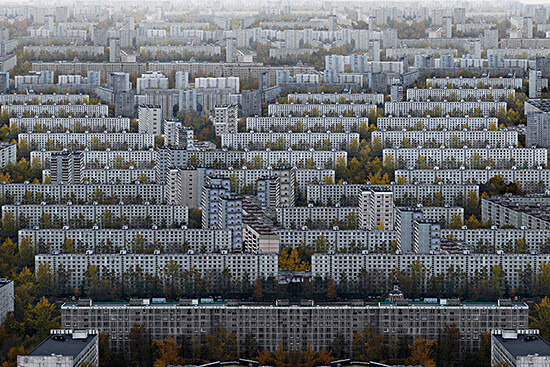
Now imagine an airburst nuclear explosion over this, just low enough to maximize the blast wave.
There's a reason why Soviets heavily invested into protecting the populace from such attacks - the entire Moscow Metro system doubles as a nuclear bomb shelter, complete with blast doors.
But likewise, I have no references either.
It doesn't explain the bridge blowing up thing, however.
And you cannot utter their names or locations because?
It also explains the "white flight" of the time. What we now call the "inner city" was allowed to remain black and brown with the expectation that the country would be alright if they were incinerated while the more -valuable- people had been relocated to the suburbs.
The Soviets would be able to get their retaliatory body count while eliminating people that the US didn't really value in the first place.
Given that sprawl is not a new phenomenon but obesity is I don't see how you can claim this is responsible for making us fat.
Remember, we're talking about relative density within a metro area, not how close each metro area is to the others. If you look at cities that were more or less fully developed prior to WW2, like Boston, you find that they're more compact, as opposed to, say, LA or Phoenix.
That said, I don't think it's the only thing making us fat. But I do think it's one contributing factor.
To be fair about the 'single small bridge', it seems like smaller projects suffer proportionately larger delays due to being considered low priority, ridiculously lax work scheduling, etc. Although the financial scales are completely different, it takes my city (Toronto) approximately the same time to build a subway extension as to renovate the bike trail that runs near my house.
The difference is networks of buses and trains that the countries and cities invested in over decades.
America went in another direction, and looks no closer to changing it's mind.
Suburbs now spread for miles around towns and even former villages, for ten or twenty miles around major cities.
And small towns and villages lost their railways and stations 40 to 80 years ago.
New developments havebeen getting more sprawl in China though, as cars have become more popular.
New York, sure. Everyone's heard of their subway.
The first time I'd ever heard of BART was when I visited briefly, and in doing so I learnt 2 things:
1) BART is pretty bad: noisy and a small network 2) Talking to people during my short stay made it pretty clear San-Fran and the bay area was considered 99% car territory, and traffic/congestion/commuting around SF was a significant problem commensurate with that fact.
Edit: understand this is a genuine question asked as a foreigner who has only formed an impression from short visits.
I couldn't see myself ever wanting to take that mode of transportation.
From what I have read, Millenials are putting noteworthy pressure on this aspect of American culture.
Also, I gave up my car years ago. With the magic of the internet, I work online. I mostly walk everywhere and occasionally take public transit.
I think we can change this substantially.
Since then, I haven't driven a single day. I walk, take the metro or get an Uber.
I haven't been happier. Driving was easily the worst part of my day.
Humorously, we have had occasion to put me on a bus for some reason while they walked to the destination in question. I would get ahead of them, then the bus would get stuck in traffic and they would get ahead of me. We all arrived at the spot in question within a couple of minutes of each other.
Unless you are driving quite a long distance and/or on the open highway, car travel is not as much faster than foot travel as some people seem to believe. Short local trips don't see as much gain in speed as Americans seem to imagine. I think this belief persists in part because so many people just don't walk anywhere at all. They drive everywhere, even if they are only going 1/4 mile or something silly like that.
I'm going to have to disagree on this one.
I can drive to my local Wal-Mart in about 5 minutes. It would take me 30 minutes to walk there. I can drive there. Do my shopping, wait in line, pay, cart my stuff back out to my vehicle and drive home in less than the amount of time it would take to walk there.
The closest WalMart to me (checking...) is 13 miles away.
The average speed limit on municipal roads in Ontario is 50 km/h, which means that anywhere within 5km will take 6 minutes and, within 10km, 12 minutes.
Running 5km takes me 18 minutes, and running 10km takes me closer to 40 minutes. Humans walk at about 5km/h, which means that 5km would take about 1 hour, and 10km would be 2 hours or more, since exhaustion starts to factor in.
Car travel is unimaginably faster than walking. I don't know anybody who wants to spend 2 hours on a round-trip to a grocery store 5km away when they could do it in 10 minutes in a car.
https://www.nytimes.com/interactive/2016/05/19/upshot/forty-...
I do groceries by walk and it never took 2 hours. The store is not 5km away pretty much from anywhere. You have to be out of city or in the middle of night for it to be that far. Unless there is some kind of law to prevent it, stores with what you need daily pop up around cities everywhere.
In any case, 5km is still nothing on bicycle which I might take for that distance. Just to kill two birds with one stone and get a bit of exercise.
* Slowdowns, sure, but many drivers also exceed the limit, and the walking:driving ratio is still massively lopsided.
* Pedestrians are not immune to red lights.
* While there are certainly pedestrian shortcuts that are faster than driving, this is definitely not the case for most combinations of start and end points. Far more often, while the pedestrian might gain distance, the car is still literally 10x faster.
* In fact, unless you live in an extremely dense city, it's highly unlikely that there will be a grocery shop, book store, electronics retailer, Italian restaurant, furniture store, etc. less than 5km from your house. Plus all of the people who you might want to visit, your school, place of work, and so on.
* A bike is not walking. Most bikes are for one person, so if you're in a group they're not much use.
* Carrying purchases home is a pain. I should know, I did this for two years.
My favourite part of visiting Amsterdam was the excessive bike usage. Pretty much everyone has 1 or more of them, you just ride together in a group or catch a tram, even out of the city everyone would either catch a train or simply ride on the side of the highway between villages.
I actually got to test this. My office was about 8km from my house. If I was to leave around my usual time, it would take me about 55-65 mins minimum to reach home.
One day I hadn't taken my car and couldn't find a cab. So I said screw it and decided to walk home.
Reached home in flat 71 minutes. Would have been faster had I taken detours that cut the distance by a kilometer or so.
Which is great for us developers, but not so much for most service industry workers.
I am a writer. I am quite poor. In fact, I am currently homeless. I have been bitching via blog here recently about my frustrations with the widespread attitudes that writers don't deserve to be paid dirt, never mind that people online expect good quality writing to be readily available on the internet. Somehow, that high quality writing should magically appear without paying anyone for it in any way.
I don't make much money. I wish I had a better income.
I am really glad I can make money online at all, but, no, I am not part of some privileged elite with money, power, mobility, etc. I do have mobility. I do cherish it and it enormously enhances my life.
But life is a great deal more complicated than those who have ALL the bennies and those who are nothing but crapped on in every way imaginable. This isn't even a case of shades of grey. Life is incredibly Technicolor and varied.
I think it is completely legitimate to give some push back against the enormous amount of assumption in both that reply and yours.
I would like to see us come up with better solutions than we currently have. That will not happen if we blithely tolerate what amounts to classist assumptions dominating any and every supposed intelligent discussion.
> most service industry workers
Those are folks that predominantly need to be physically present. We weren't assuming anything about your membership in a privileged elite, just pointing out that lots of people still need to transport themselves to work.
Good luck with your writing! I agree that we need better business models to reward it.
I know there are a lot of options for basic online work that isn't developer based, but I'm not sure what is available that truly pays a decent living wage.
I can make better than minimum wage in fits and spurts, but I currently don't have much earned income. A large part of this is rooted in my medical situation. The details probably aren't really of interest to you.
Due to the societal and environmental effects, I think it's pretty clear roads should be in no way subsidized like they currently are. If the "suburbs" had to carry their full economic costs, they would be unaffordable.
It is a combination of population density being artificially lowered through cheap road subsidies, constant pressure to eliminate taxes, and gutting alternative transport meaning roads need to satiate all human mobility and thus need huge capacity.
The light rail lines in my state (MN) don't even make enough from fares to cover their day-to-day operating costs, much less maintenance, and of course tax payers were 100% on the hook for initial construction - with a large chunk of the money coming from automobile taxes.
So yes, I would be fine with the costs of roads coming more directly from the people using them, but then we are going to do the same with transit. Deal?
Building to support multiple modes of transportation is the freedom-loving thing to do. Want to walk? Go for it! Transit? Sure! Biking? Why not? Driving? Works for me!
Want walkable, bikeable, mass transit, etc? Live downtown. Want bigger homes, yards, quite, etc? Live in the suburbs.
Obviously there's a limit to how reasonable multimodal transportation is. Nobody's expecting decent transit among rural farmland. But we could do better than we're doing now -- MUCH better.
> Want bigger homes, yards, quite, etc? Live in the suburbs.
The biggest problem with this is that in the US you usually have to choose between one of two extremes which dovetail with your examples. You're either in a big ugly apartment block downtown (or in a downtown-ish area) or you're in a super low density suburb where Cars Are Law.
Plenty of countries manage to have more of a gradient, where you can have, say, suburbs of middling density, where driving is easy, but so is walking, biking, and taking the train to the city. I live in Munich at the moment and the suburbs nearby fit this mold perfectly, but in the US such towns are extremely rare.
There are still plenty of cars in Munich proper, for that matter. There are just lots of other options too.
* Also in most American cities even the downtown still isn't very walkable, definitely isn't bikable, and has crappy transit. There really are only a handful of cities in the US where these things all work reasonably well.
But really really really, biking is not incredibly dangerous.
Everyone I know has been in an accident of some sort. Hit & runs, side swipes, doored, pushed (deliberately), etc.
After better infrastructure, the most effective way to improve safety is to have more cyclists. I think we're in a rough transition period, but things are definitely getting better.
One of my bike buddies thinks things will really change once moms start cycling en masse. That'd change the perception from gonzo bike dudes to totally uncool in a heartbeat, evoking much less hostility.
These are both avid riders with professional-grade equipment taking a short Mission-FiDi route.
Regardless of its "project zero" marketing, SFMTA has bikes last on its priority list. It has to be pushed by guerrilla infrastructure groups to do anything meaningful.
I used to ride bikes all the time as a kid but I would not make a habit of riding on our roads. It's too much of a gamble.
I am talking about opening up options, not putting a gun to anyone's head and forcing them to give up their car. We currently have many people who feel they have a gun to their head in terms of being forced into needing a car they don't want. Where is your sympathy for their right to choose?
Only one of us wants to "change this substantially."
Urban cores are often insanely expensive and not necessarily where someone wants to live just because they don't want a car. I am wholly unimpressed with your hypocritical comments here that boil down to "Don't tread on ME or interfere with my right to own a car and drive all over the place while the world bends over backwards to make that convenient, but your lifestyle preferences? Oh, fuck you."
This is dismissive, insulting of my preference to live without a car and rather hostile. If you were intending to say that you support my right to choose, you failed to communicate that. It came across as contemptuous and is in no way sympathetic to the fact that walkable neighborhoods and public transit are not hostile to drivers the way the current car centric American landscape is hostile to pedestrians.
And before you say, "well then just move to the city center!" perhaps you should consider that we're talking about a very common urban form across the world that is strikingly uncommon in the US due to government forces? Not exactly "people making their lifestyle preferences", more like "government imposing lifestyle preferences", and it's mostly just due to cultural momentum at this point.
As opposed to being completely dependent on public roads for transportation? Or out away from the "urban core" do you just get around on four-wheelers and snowmobiles? If so, maybe we can stop spending so much of our taxes building roads out to wherever you want to live.
After I moved to Kansas, I ran into a soldier I did not remember, but he clearly remembered me. The soldiers who knew what it was like to carry a 60 pound ruck sack had all kinds of respect for me.
It can be done. Not by everyone and I am not saying you are required to live that way. But giving other people options doesn't preclude you from driving everywhere. And that's the entire fucking point here.
Feel free to drive. But I like walking. I liked walking even when I was carrying groceries home in a backpack with an infant strapped to my chest and a toddler sitting on my shoulders.
It can be done, but most of us want to progress.
Preferring to walk in no way makes me some undeveloped savage. Maybe you haven't noticed, but I am online. I spend a lot of time online. I make my earned income online.
For the last time: My desire to see more walkable environments and better public transit in the U.S. in no way bars people from driving. Busses use the same roads that cars use. This is in no way whatsoever a situation where we must choose one or the other.
If I walk down the street and there is a group of workers excavating a road, there's a lot more of a relaxed attitude about fencing, walking underneath construction equipment, etc.
After all - use your common sense - don't fall into the hole. If you do, isn't it kind of your own fault? Nobody's going to sue anybody.
Additionally, it's not a big deal to close or severely impact a road due to construction - just shift around the fantastic public transit infrastructure, and everyone carries along. A bus only needs one lane in both directions. Another thing that would never fly in North America.
Both of these problems are deeply cultural. Lawsuits have become a form of welfare. Sure, you might not have government healthcare if you get hurt or sick, but maybe you can sue somebody and get paid for your suffering?
And America's love affair with the automobile is a well-known abusive relationship that America will never have the courage to leave.