Cars are more useful when people need to go to random places at indeterminate times.
Yes, and in a sane nation, this would mean that people could live in small cities, take transit to work, then take transit back. But there are many, many places where this is not the case.
I lived on the outskirts of Dallas; it took ages for the rail system to approach usefulness, and individual cities along the route could opt out of having stations (and therefore, opt out of paying for them.)
The only way to fix the problem is to encourage people to move out of the suburbs and small towns and live in denser regions.
I like cars, but I'd never want to use one for commuting. Random places at indiscriminate times — this is what cars are for indeed.
https://likewise.am/2017/05/19/in-response-to-the-cult-of-re...
But that's a far cry from, "Why do information workers need company offices at all, ever?"
I agree that it might be a transitional phase, or something necessary to acquire the skills needed, but it needs to be rid of at the first sight of an opportunity.
For what it's worth, I have zero tolerance for long commutes, and always lived close to my jobs. It took considerable expense, and relied on life situation flexibility I no longer have, but my patience for driving is maybe ten minutes.
Public transit only works when people live in high density areas. It makes no sense to have a transit stop where very few people live in walking distance of it. People with cars don't really want to drive to the bus stop and then catch a ride downtown, though some do. But most companies are spread out just as much as peoples homes, so business isn't even high enough density to warrant public transit in most cases.
And for a few things it IS better. But there are a whole lotta costs, too, with the top 3 being being actual financial cost, grinding on the faces of the poor, and making us fat.
If U.S. launched its missiles while all these people just came home from jobs say at 11pm ET/8pm PT, and people in the Soviet Union were on the way or at their factory jobs during Moscow morning on Siberia mid-day, it would be a slaughter for the Soviet Union and an easy win for the U.S.
Sounds like a completely made-up justification after the fact.
Surely someone would have raised the point that the soviet union could just launch it's missiles in the middle of the work day.
Also, Moscow is tremendously sprawled out.
"... While it is true that various factors contributed to phenomenal growth of the suburbs between 1945 and 1960, historians have thus far paid little attention to policymakers' fears of atomic attack as a significant factor in population dispersal. ..."
The Reduction of Urban Vulnerability: Revisiting 1950s American Suburbanization as Civil Defence K. Tobin, Pages 1-32 | Published online: 06 Sep 2010
I work in tech/finance. I am old enough to remember that, after the 9/11 attack in 2001, banks were required to set up their datacenter/DR sites at least 50 miles away from their main offices to avoid a complete wipe-out in case of nuke attack.
Which doesn't mean that building sprawling subdivisions is a great idea, but space is a pretty easy thing to sell.
http://images.e-flux-systems.com/2014_04_Bric-III-Yugo-Zapad...
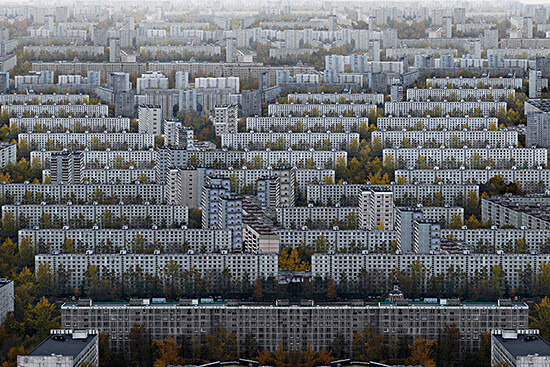
Now imagine an airburst nuclear explosion over this, just low enough to maximize the blast wave.
There's a reason why Soviets heavily invested into protecting the populace from such attacks - the entire Moscow Metro system doubles as a nuclear bomb shelter, complete with blast doors.
But likewise, I have no references either.
It doesn't explain the bridge blowing up thing, however.
And you cannot utter their names or locations because?
It also explains the "white flight" of the time. What we now call the "inner city" was allowed to remain black and brown with the expectation that the country would be alright if they were incinerated while the more -valuable- people had been relocated to the suburbs.
The Soviets would be able to get their retaliatory body count while eliminating people that the US didn't really value in the first place.
Given that sprawl is not a new phenomenon but obesity is I don't see how you can claim this is responsible for making us fat.
Remember, we're talking about relative density within a metro area, not how close each metro area is to the others. If you look at cities that were more or less fully developed prior to WW2, like Boston, you find that they're more compact, as opposed to, say, LA or Phoenix.
That said, I don't think it's the only thing making us fat. But I do think it's one contributing factor.
To be fair about the 'single small bridge', it seems like smaller projects suffer proportionately larger delays due to being considered low priority, ridiculously lax work scheduling, etc. Although the financial scales are completely different, it takes my city (Toronto) approximately the same time to build a subway extension as to renovate the bike trail that runs near my house.
The difference is networks of buses and trains that the countries and cities invested in over decades.
America went in another direction, and looks no closer to changing it's mind.
Suburbs now spread for miles around towns and even former villages, for ten or twenty miles around major cities.
And small towns and villages lost their railways and stations 40 to 80 years ago.
New developments havebeen getting more sprawl in China though, as cars have become more popular.
New York, sure. Everyone's heard of their subway.
The first time I'd ever heard of BART was when I visited briefly, and in doing so I learnt 2 things:
1) BART is pretty bad: noisy and a small network 2) Talking to people during my short stay made it pretty clear San-Fran and the bay area was considered 99% car territory, and traffic/congestion/commuting around SF was a significant problem commensurate with that fact.
Edit: understand this is a genuine question asked as a foreigner who has only formed an impression from short visits.
I couldn't see myself ever wanting to take that mode of transportation.
It's pretty much impossible to leave this relationship unless you live in one of the larger US cities. If you live in a suburb, rural area, or city that's not in the top 10-15 in terms of size there's literally no other option that exists or that could easily exist.