News for hackers. Stuff that matters.
Re:The US has forgotten how to do infrastructure by anovikov on Wednesday May 31, 2017 @03:51PM (#14455373)
It was done for a very rational reason: making country more immune to a nuclear attack, especially the retaliation to its own nuclear attack (i.e. a nuclear attack that is coming in convenient time of day and week because you chose the time). It works perfectly to that purpose: it is whole lot better to keep all relevant population in separate houses with basements, with little combustible material around, than in multimillion cities with no way out of them.

If U.S. launched its missiles while all these people just came home from jobs say at 11pm ET/8pm PT, and people in the Soviet Union were on the way or at their factory jobs during Moscow morning on Siberia mid-day, it would be a slaughter for the Soviet Union and an easy win for the U.S.

Re:The US has forgotten how to do infrastructure by deanCommie on Wednesday May 31, 2017 @04:26PM (#14455624)
Have a source for any of that?

Sounds like a completely made-up justification after the fact.

Surely someone would have raised the point that the soviet union could just launch it's missiles in the middle of the work day.

Also, Moscow is tremendously sprawled out.

Re:The US has forgotten how to do infrastructure by tooltalk on Wednesday May 31, 2017 @06:30PM (#14456453)
Ah, I just did Google on it, and lo and behold:

"... While it is true that various factors contributed to phenomenal growth of the suburbs between 1945 and 1960, historians have thus far paid little attention to policymakers' fears of atomic attack as a significant factor in population dispersal. ..."

The Reduction of Urban Vulnerability: Revisiting 1950s American Suburbanization as Civil Defence K. Tobin, Pages 1-32 | Published online: 06 Sep 2010

I work in tech/finance. I am old enough to remember that, after the 9/11 attack in 2001, banks were required to set up their datacenter/DR sites at least 50 miles away from their main offices to avoid a complete wipe-out in case of nuke attack.

Re:The US has forgotten how to do infrastructure by ianai on Thursday June 01, 2017 @12:02AM (#14457922)
I'm going to recount this in person someday and get the "he's a nutter" response.
Re:The US has forgotten how to do infrastructure by maxerickson on Wednesday May 31, 2017 @04:58PM (#14455855)
To me the simpler theory is that the US has been quite wealthy since World War 2 and has lots and lots of space.

Which doesn't mean that building sprawling subdivisions is a great idea, but space is a pretty easy thing to sell.

Re:The US has forgotten how to do infrastructure by TulliusCicero on Thursday June 01, 2017 @04:34AM (#14458780)
Those things enable sprawl, but they don't force it.
Re:The US has forgotten how to do infrastructure by int_19h on Wednesday May 31, 2017 @09:31PM (#14457291)
Moscow is also tremendously dense. It's sprawled out because it has so many people in it, but the vast majority of those people are packed into apartment buildings. The same goes for all other major urban centers. A typical Russian (or rather, ex-Soviet) cityscape looks like this, and can go for miles:

http://images.e-flux-systems.com/2014_04_Bric-III-Yugo-Zapad...
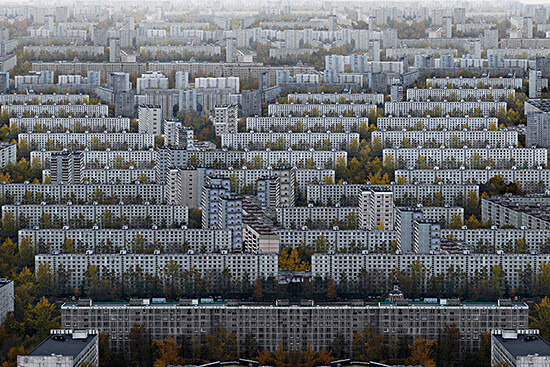
Now imagine an airburst nuclear explosion over this, just low enough to maximize the blast wave.

There's a reason why Soviets heavily invested into protecting the populace from such attacks - the entire Moscow Metro system doubles as a nuclear bomb shelter, complete with blast doors.

Re:The US has forgotten how to do infrastructure by equalunique on Wednesday May 31, 2017 @05:00PM (#14455880)
Federal Highways in the US are designed to increase national security. The best example is certain bridges are in certain places so that their destruction would cut off the easy path for mobilized enemy armor. They're designed to be easily blown up on purpose.
Re:The US has forgotten how to do infrastructure by CydeWeys on Wednesday May 31, 2017 @06:07PM (#14456313)
You got any credible sources on that? It sounds like one of those urban legends that people like to repeat. The Eisenhower interstate system was built in a post-nuclear world, and in a post-nuclear world it's hard to imagine there ever being a mainland invasion of the United States. The bombs would be flying before that, and there wouldn't be anything left worth invading (on any side in the conflict). Being able to utterly destroy the other nation and its military forces within minutes by launching thousands of ICBMs is a much more credible plan of war than blowing up some random bridges on your own turf, and indeed that is the logical course of action that we did go down.
Re:The US has forgotten how to do infrastructure by int_19h on Wednesday May 31, 2017 @09:20PM (#14457239)
I don't know about the bridges specifically, but that the interstate system had an explicit national security purpose is not just well-documented, it's literally right there in the name of the law that created it: National Interstate and Defense Highways Act.
Re:The US has forgotten how to do infrastructure by CydeWeys on Thursday June 01, 2017 @05:20AM (#14458933)
My issue with the bridge thing is that it's easy enough to blow up bridges, especially as you're retreating from the territory they're in, regardless of their location or construction. It could cost billions of extra construction dollars to unnecessarily site a bridge in anything but its obvious ideal location (e.g. the shortest possible span).
Re:The US has forgotten how to do infrastructure by lawpoop on Wednesday May 31, 2017 @10:37PM (#14457568)
My understanding was that it was created to mobilize the military and transport resources across the continent, not to make it easy to cut off enemy routes.

But likewise, I have no references either.

Re:The US has forgotten how to do infrastructure by rangibaby on Wednesday May 31, 2017 @08:04PM (#14456888)
The military purpose of the interstate is moving friendly troops around (logistics).
Re:The US has forgotten how to do infrastructure by CydeWeys on Thursday June 01, 2017 @05:22AM (#14458936)
Now this is a lot more true, and the military value of having good transportation within the boundaries of your own land has been known since at least Roman times, and likely much farther back.

It doesn't explain the bridge blowing up thing, however.

Re:The US has forgotten how to do infrastructure by wfunction on Wednesday May 31, 2017 @05:51PM (#14456217)
> The best example is certain bridges are in certain places

And you cannot utter their names or locations because?

Re:The US has forgotten how to do infrastructure by LordKano on Wednesday May 31, 2017 @04:39PM (#14455725)
I had never considered this and something else about it makes perfect sense to me.

It also explains the "white flight" of the time. What we now call the "inner city" was allowed to remain black and brown with the expectation that the country would be alright if they were incinerated while the more -valuable- people had been relocated to the suburbs.

The Soviets would be able to get their retaliatory body count while eliminating people that the US didn't really value in the first place.

Re:The US has forgotten how to do infrastructure by Animats on Wednesday May 31, 2017 @05:39PM (#14456153)
There was a serious attempt to do that in the 1950s, although it didn't have great impact. It is, however, why IBM corporate headquarters moved from Manhattan to Armonk, NY.
Re:The US has forgotten how to do infrastructure by vacri on Wednesday May 31, 2017 @05:45PM (#14456188)
'easy win' = the people in the area die more slowly rather than in the initial blast? Apart from the now-radioactive work centers (that are the wealth of your country), take out your city centers and industry, and you also take out your transportation network. Hello, famine.
Re:The US has forgotten how to do infrastructure by chrischen on Wednesday May 31, 2017 @06:29PM (#14456445)
Seems like Japan didn't get that memo having been bombed twice.
Re:The US has forgotten how to do infrastructure by TulliusCicero on Wednesday May 31, 2017 @03:59PM (#14455441)
Ah, that's a good point. Still, it seems the design pattern has outlasted the attitude that created it.