You are mistaken. The good parts, like covering pre-existing conditions is exactly what causes your insurance to go up. It's basic economics. The Republicans do not have a plan to fix that.
If there was a way to fix it, don't you think it would already be implemented? You think they're purposefully keeping your rates high just to fuck with you? Not to mention suffer all the political fallout of it?
Don't forget. Obamacare is the Republican plan. This repeal and objection to Obamacare is all politics, not an attempt to fix a broken system.
"MLR measures the share of health care premium dollars spent on medical benefits, as opposed to company expenses such as overhead or profits. For example, if an insurer collects $100,000 in premiums and spends $85,000 on medical care, the MLR is 85%. In general, the higher the MLR, the more value a policyholder receives for his or her premium dollar. The ACA requires an annual, minimum 80% MLR for individual and small group insurance plans, and an annual, minimum 85% MLR for large group plans." [1]
Sunlight is an amazing disinfectant and it is my hope that our government mandates every doctor and facility publish the total cost of every prescription and procedure they employ. We will collect that data and disinfect the high cost of health care.
[1] https://www.fisherbroyles.com/marketers-for-compounded-pain-...
By comparison, Bush's Medicare Part D prevented the Feds from even negotiating drug prices. Its author, Billy Tauzin, is now a Big Pharma lobbyist.
I mean, this is a constant joke in professional circles. If you are hourly billing and you can use your shitty talent to create something in 8 hours that your good talent would create in 1 - it's usually economically beneficial to have the worse employees do the work as it's more profitable overall. Up until the point where you lose the customer - but in this case that's not a concern.
Why? It seems that if premiums are rising relentlessly for one company that the insured will seek out other companies, and hence that one company will "lose the customer".
Or am I missing something?
You may be mishearing the term "excise tax". An excise tax is a tax on any specific good, such as tobacco or gasoline. Those taxes are included in the cost of the good (it just costs more at the pump or on the shelf). Yes, they are typically used to reduce consumption, or to pay for costs associated with consumption (eg roads).
An alternative income source might be luxury taxes. There are a number of luxuries where consumption correlates positively with price - but it would be politically difficult to implement a tax on extravagance.
They're defence contractors now! :joy:
Unfortunately, I think it's percentage cap, not an absolute cap. So, if you're an insurer and want to increase profits by a dollar, you need to increase costs by a few dollars.
[1] http://www.factcheck.org/UploadedFiles/2015/02/kff-chart.png [2] http://data.worldbank.org/indicator/SH.XPD.PCAP?end=2014&loc...
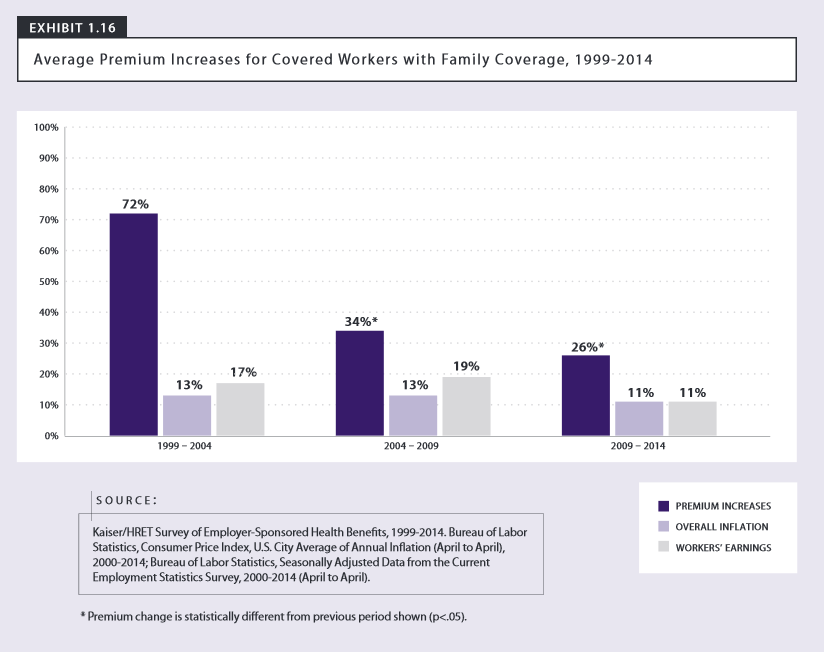
Before ACA, our premiums went up ~5% per year - 8% one year - every year was under 10%. Since ACA, I've seen increases of 25%, 20%, 20%, 25%, then 11% then 13%. This is in NC with Blue Cross - the numbers possibly were different elsewhere (was in Michigan before that but wasn't paying as much attention, unfortunately).
The price increases I was seeing seemed primarily in line with inflationary numbers pre-ACA; post-ACA they seem to have no correlation to inflation, and seem to have more to do with a much larger overall cost for the insurance company covering more people, no lifetime caps, more services covered, etc.
EDIT: On, that factcheck chart - that looks to be showing premium increases for employer-provided health insurance. Employers cutting back their contributions to the premium would account for much/most of those increases. Effectively, it doesn't say anything about the actual insurance premium increases, only what employer-covered workers were having to pay - in my view, that's a big difference.
http://blogs-images.forbes.com/theapothecary/files/2016/04/S...

It was the recession.
Seriously, something is wrong with the whole setup. ACA does address some of it but it has jacked my premiums sky high. Single Payer is the answer in my estimation. The sooner we come to this and stop fiddling around trying to make people we shouldn't happy the better off we will be.
Some business (like insurance) have a fair bit of tail risk they need to take into account.
Some are seasonal (like a ski resort) and need to make sure the profits they make in their high season can carry them in the low season.
Some are cyclical (like furniture stores) where people buy one piece and don't buy anything else for years.
Grocery stores have consistent customers and can generally predict their income and expenses day-to-day for the foreseeable future.
The personal auto insurance combined ratio rose by 1.4 percentage points in 2015 to 97.3 percent for a group of 10 publicly traded insurers.
http://www.insurancejournal.com/magazines/features/2016/03/0...
When interest rates are higher car insurance runs > 100% loss ratio. They stay profitable by earning short term interest on premiums before paying out claims.
In a different insurance vertical fixing loss ratios at 80% would be called a cartel, and would put involved executives into prison for a good long time.
In healthcare the government forms the cartel, fixes the prices, gives money to poor to become consumers, and then fines everybody who won't become the consumer.
said Brer Rabbit. "Only please, Brer Fox, please don't throw me into the briar patch."
Second, a profit margin will take into account risk. So for the ski resort or the furniture store that includes the overhead of keeping the store open while you have no customers.
Third, if the risk is so insanely high why are these firms so consistently profitable? Shouldn't we expect to see them coming in and out of existence regularly? Restaurants are a truly high risk business venture, the majority fail to exist after the first year. Perhaps they have longer runways but it's rare to hear of an insurance firm shutting its doors. The large and consistent profit seen on their end of year reports belies the risk claim.
I don't think you can deny there are cost risks for insurance companies that a lot of other markets don't have. However, to back you up a bit, their profits are extremely good which probably means they are largely overstating the risk in order to gouge their customers.
It is really as simple as that. Could you imagine a system in which car insurance wasn't mandated but car insurance companies were required to repair your car regardless of its preexisting condition? No smart person would preemptively buy insurance. You just wait until your get into an accident and then bring the already damaged car to the insurance company and demand a policy to repair it. No insurance company can work like that.
Insurance only works when the costs of the most expensive customers are shared among the cheapest customers. You need incentives to encourage the cheap customers to sign up or the whole system falls apart. Rejecting preexisting conditions is the old capitalist way of incentivizing people, but as soon as that is prohibited nearly all incentives disappear for a healthy person to buy into the system.
Our failure to find a non-insurance 'hammer' with which to hit all of the health 'nails' is a larger issue.
You can offer insurance against an event that has already occurred, but the insured price will always be slightly higher than the uninsured price. One could call that insurance, but it'd be a degenerate case, so at that point it's more of a word puzzle than a real question.
> Our failure to find a non-insurance 'hammer' with which to hit all of the health 'nails' is a larger issue.
Exactly - the problem is that people talk about health insurance like it's supposed to solve the problems that a wealth redistribution program would. Except, insurance is not a wealth redistribution mechanism - it has a completely different goal - and trying to turn it into one just results into the worst of all worlds (expensive and ineffective at achieving either goal).
Pretend for a moment that everyone receives their annual physical, as medical guidelines recommend. (They don't, but it makes our example simpler.) And let's say that the fair-market price of providing the physical, accounting for all costs borne by the provider and their practice, is $100. (That is an arbitrary number I have chosen, also to make our lives easier). What will be the co-pay for the annual physical for an insured patient?
The answer is that it will be $100 - there is absolutely no risk involved in this situation, so the expected payouts of the insurance company will be $100, and therefore they will incorporate that into their price. (The consumer will actually pay a bit more than $100 in total, because the insurance company has overhead costs, which are ultimately paid by the consumers as well). But of course, that's not the case, because the expectation is that health insurance will reduce these costs, and that people who can't necessarily afford $100 will still be able to have their physical. That's why health insurance isn't really insurance, except in name - we talk about it as insurance, but in reality, it's a wealth redistribution program tacked onto a risk smoothing product.
By definition, insurance is literally not intended to save the insured person money, in expectation. The expected value of all claims will always be less than the expected value of all money paid to the insurer by the insured entity. (This does not hold for every individual, but it does hold in the aggregate - that's where the risk smoothing comes in). The insured person pays the insurer a premium[0] in order to reduce the uncertainty in how much they would have to pay on any given month without insurance.
[0] Not as in "monthly premium", but as in "a premium on top of the expected value"
You fundamentally misunderstand the concept of insurance. Group insurance is, by definition, a way to spread the cost of rare catastrophes around the group so that the affected individuals don't bear the full brunt. There is the full expectation that in the event of a major medical event you will save money.
Try reworking your example around major medical events (e.g. a $500K hospitalization) rather than preventive care (the function of which is to reduce the risk of certain controllable medical events).
> The answer is that it will be $100 - there is absolutely no risk involved in this situation, so the expected payouts of the insurance company will be $100, and therefore they will incorporate that into their price.
No. Even pre-ACA, insurance companies offered low co-pays. How did they do that? Because your monthly fees will over the course of a year add up to far more than the cost of an annual physical. The purpose of insurance is to protect yourself against rare, but catastrophic events: you will probably not experience a wide variety of expensive medical ailments, but if you do they will likely leave you in financial ruin if you're uninsured, so you pay an insurance company money to protect yourself against that risk.
(Or, alternatively, your employer pays a health insurance company money to protect you against that risk, and offers that benefit to you as part of your total compensation package. Which is essentially the same as you paying for it, with some amount of risk differences and thus potentially lower costs due to the pooled employee health insurance policies, but that's outside of the scope of this discussion. TL;DR: it's still regular market economics.)
You might wonder why insurance companies offered low co-pays at all — was it just some marketing gimmick? But no, you can explain that with regular economics too: insurance companies are incentivized to make annual physicals affordable and attractive, because they can catch potentially-expensive medical issues when they're still much less expensive, thus lowering costs for the insurance company.
Yes, this is what I am saying. However, that has nothing to do with the price of co-pays for routine care, which is by definition predictable.
> But no, you can explain that with regular economics too: insurance companies are incentivized to make annual physicals affordable and attractive, because they can catch potentially-expensive medical issues when they're still much less expensive, thus lowering costs for the insurance company.
See, this is another pervasive myth. For healthy individuals, the annual physical is not cost-effective - it is very unlikely to result in long-term benefits to the patient, and it is far more likely to result in unnecessary care (such as follow-up tests and differential diagnoses for false positives): https://sciencebasedmedicine.org/re-thinking-the-annual-phys...
Also, I don't know why you're drawing a dichotomy between what I'm saying and "regular market economics". Everything I have said is standard, textbook economic theory. There's nothing obscure or even controversial about it about economists.
> Everything I have said is standard, textbook economic theory. There's nothing obscure or even controversial about it about economists.
Claiming that "health insurance isn't really insurance, except in name - we talk about it as insurance, but in reality, it's a wealth redistribution program tacked onto a risk smoothing product" is definitely non-mainstream. An insurance company takes in payments to insure you against high-risk events, and that's exactly what a health insurance company does: you pay them a monthly fee regardless of whether you need medical care (or your employer pays them for you as part of your compensation package), and when you do need expensive medical care, they pay for it. In fact, many plans explicitly only pay for expensive medical care: anything under your deductible, aka inexpensive medical care, you're required to pay for. You might be able to make some sort of weaker claim about wealth redistribution post-ACA, but — co-payments existed pre-ACA.
Actually, some of the largest insurance companies and the vast majority of risk-bearing providers (hospitals that act as insurers) are non-profits. Though I never said that their pricing was based on charity; I said it was based on the fact that the product they offer is not really insurance (and that it exists in a marketplace in which prices are incredibly distorted by the existence of other factors, which would have been too long to explain in that simple example).
> Claiming that "health insurance isn't really insurance, except in name"... is definitely non-mainstream
On the contrary, that's the overwhelming consensus among economists. Which isn't surprising, because the economics of insurance are generally covered even at the undergraduate level, and the ways in which health insurance differs from a true insurance program are pretty glaring.
Equating risk-bearing providers and health insurance companies for the purposes of arguing that health insurance isn't insurance might as well be tautological. Sure, blueberry pancakes aren't really pancakes if you include blueberry muffins in the category of blueberry pancakes, but who cares?
It also ignores a number of other selection criteria and behavioral issues, which you are honest enough to note in your pretend for a moment intros.
However, people who proactively care for their health carry "upside risk" as well as downside, which your scenario does not account for.
And they screwed that part up. As a healthy young person, there is no incentive to buy massively overpriced, shitty high-deductible ACA plans, when one month of coverage costs more than the IRS penalty.
True. And the ACA now levies a tax penalty for those that don't sign up for insurance (2.5% of income, max ~$2K).[1]
[1] https://www.nerdwallet.com/blog/health/how-much-is-the-obama...
What are you going to do? Not let me die?
That is not insurance. That is a wealth redistribution. Those are not the same thing, although the current discourse around health insurance conflates those two concepts, for obvious political reasons.
> Could you imagine a system in which car insurance wasn't mandated but car insurance companies were required to repair your car regardless of its preexisting condition? No smart person would preemptively buy insurance. You just wait until your get into an accident and then bring the already damaged car to the insurance company and demand a policy to repair it. No insurance company can work like that.
Actually, this would be completely feasible to implement. The insurance company would price you based on your risk. In this case, P(risky event | all available information) = 1), so there wouldn't be much of a point to buying the insurance, but it absolutely would work.
The problem is that the ACA also forbids insurers from underwriting plans based on anything other than age, income, zip code, and whether or not they smoke. That's guaranteed to increase the cost both for healthy and for unhealthy patients, because they have to make overly conservative estimates when evaluating the risk level of their patient pool.
Yes, they are the same thing. Insurance is fundamentally a redistribution of risk with money being shifted from those who have not fallen victim to that risk to those who have. If you have a problem with that aspect of the ACA, you have a problem with the general idea of insurance.
>The insurance company would price you based on your risk (in this case, it would be 100%), so there wouldn't be much of a point to buying the insurance, but it absolutely would work.
You do realize that this is functionally the same as getting rid of the preexisting conditions protection, right? Whether someone pays tens of thousands to a doctor for care or to an insurance company for coverage are in practice exactly the same. The whole point is that many of us think that is a fundamentally unfair system to force someone to face in that situation.
This comment is so profoundly misguided that I have to comment.
Insurance does not work the way you describe. When companies do a fundraiser where someone gets to take a half-court shot with a basketball and win $1M if they make the shot, an insurance policy sells the company doing the fundraiser a policy that reflects the odds that a person chosen at random from the audience will sink the shot. That policy might cost $7K, since the shot will very likely be missed.
The insurance company makes a profit by charging a bit more than the actual odds reflect, so that over time if 200 shots are taken, it pays the $1M once and profits $400K. In a competitive market, the price of insurance will approach the probability.
Similarly, an insurance company might offer insurance that it will not rain on the last weekend in July. Perhaps an outdoor wedding facility wishes to buy that policy, but a farmer wishes to buy the other side of that risk. In such cases, the insurance company can charge less because there is a market for both sides of the uncertain event. Futures markets are also used for this purpose.
Most of our modern health care is not really risk-driven, it's based on markets that are highly regulated and prices that are influenced by lobbyists from various industries etc.
The key problem with your assertion is that at the time insurance is purchased, nobody knows who will be the victim or whether there will be a victim. Purchasers of insurance would rather spend a little bit of money just in case a bad outcome occurs, so they don't bear the full brunt of that bad outcome. Those who don't end up with a bad outcome don't get their money back, which is why the system works.
We all know there is a need for social services to provide healthcare for those who can't afford it or who have really bad luck. That's not insurance, however, it's social services.
You say that my comment was profoundly misguided, but your comment right here is just a rephrasing of mine Someone with risk spends a little bit of money to help absolve themselves of that risk. If a bad outcome occurs and they fall victim to that risk, they don't bear the full brunt of that bad outcome because money is shifted from people who didn't fall victim to that risk.
Regarding you point about probability based pricing of insurance, we have collectively decided that we don't want health insurance to function that way. If it did, it would lead to the preexisting condition problem in which a person cannot afford insurance because they have a condition that requires expensive care. We instead subsidize their policy with a price increase on everyone else's policy.
> we have collectively decided that we don't want health insurance to function that way.
I agree this is the case, the problem is that it's not really insurance any more it's a bundle of insurance, prepayment, etc.
No, they are not the same thing. The fact that a transfer of money happens is not a sufficient criterion for defining insurance.
Take two people with different risk profiles but who are both insured. If you can tell a priori which one is expected to have lifetime claims that exceed their lifetime premiums, then you don't have insurance - you have a wealth redistribution scheme[0].
Note that I didn't specify which person had the greater risk profile, or whether they both purchased the same "tier" of plan, or even whether they purchased their insurance from the same insurer. This property of insurance still holds even if the two people have completely different risk profiles, if one purchases a gold plan and the other a bronze, and if one person purchases from MegaInsurance in New York and the other purchases from AcmeInsurance in California - as long as they are both insured at risk-adjusted rates.
> You do realize that this is functionally the same as getting rid of the preexisting conditions protection, right? Whether someone pays tens of thousands to a doctor for care or to an insurance company for coverage are in practice exactly the same. The whole point is that many of us think that is a fundamentally unfair system to force someone to face in that situation.
First, nobody is paying tens of thousands of dollars to a doctor, because there's an out-of-pocket maximum cap. (And that cap could still exist under a risk-based pricing world.)
Second, it's not, functionally the same, because that doesn't mean that you can't separately provide income- or wealth-based subsidies if you're aiming to redistribute wealth. But that happens at a completely different layer from the risk underwriting - and because the underwriting process is allowed to properly account for a person's risk profile, you end up with lower aggregate premiums (pre-subsidy). Lower unsubsidized premiums means that you don't need to subsidize as much money in order to achieve the same sticker-price premiums that consumers see - in other words, the entire process is significantly cheaper for what appears to be the same result to the patient.
The reason we don't do this, even though it would be significantly cheaper, is because it's politically infeasible.
[0] Which, you may note, is currently the case - and that's because health insurance as it stands is a mishmash of two completely unrelated products ("insurance" and "wealth redistribution") that we happen to try to stuff into the same box.
>The reason we don't do this, even though it would be significantly cheaper, is because it's politically infeasible.
I agree with your point here, but it is the whole perfect being the enemy of the good thing. Like the original article states, this system isn't perfect. Even Obama admits this. I do however believe the current system is unquestionably better than the system we had previously. I therefore think it is a bad idea to return to the previous system while we hope to eventually come up with a better one. It is not hyperbolic to say lives literally depend on it.
Probably more than anyone, Obama understands that politics is the art of the possible. The fact that the ACA was passed by a margin of one vote is some evidence that, in the face of raging blind opposition, they didn't leave anything on the table. If congress weren't in thrall to gerrymandered hyperpartisanism and effectively unlimited donor money, the law would have had at least some bipartisan support, been revised numerous times, had bad parts improved, good parts enhanced, and concerns of both parties and various constituencies addressed in light of the empirical evidence gathered over the last seven years. I don't think there will be a return to the previous system. Instead, for several million Americans, they'll try to demolish the first four floors of a building and disingenuously point to the doctor's office on the fifth.
If they have insurance. Without guaranteed issue they may not. With guaranteed issue they may have "access" to insurance but can't afford it, or the insurance they can afford may exclude the procedure they need. Retroactively. And even with insurance they may pay 25K a year in premiums plus that 10K max. Then 28K and 15K the next year... It's a system designed for optimal profit, not efficient (or moral) distribution of resources that every person will require. Debating whether it's insurance or insurance-like, or how the underwriting works, begs the question. Insurance companies should not be involved.
It sounds like you are trying to respond to a different sort of discussion altogether.
This whole subthread is in reference to the (implied) statement "requiring insurers to cover pre-existing conditions requires a mandate [and it will necessarily increase premiums to the extent that we have seen]"
Your responses is tangential to that, addressing either (a) what would happen if we didn't require insurers to cover pre-existing conditions, or (b) other potential failure modes which could potentially occur, and which already occur under the ACA.
Some context for people who don't know about this:
http://www.npr.org/sections/itsallpolitics/2015/10/23/451200...
Now think about who is buying ACA plans off the marketplace. First, it's almost entirely people eligible for subsidies (86%) since the plans are cost prohibitive without them. Second, it's people who didn't previously have or couldn't get insurance, unemployed, or who aren't offered insurance through work.
You can see immediately the problem... ACA subscribers will overwhelmingly be high-cost subscribers. There aren't any healthy subscribers to ACA because healthy Americans are working and get their insurance through their employer and therefore aren't eligible for subsidies and have no reason to look at the high-cost exchanges.
The ACA is effectively cornering the market for super-high risk pool, and premiums on ACA markets will continue to rise to reflect it.
If the subsidies were available regardless of availability of a so-called "affordable" employer sponsored plan, and if they employer's contribution could be taken by an employee and applied to an ACA plan in addition to subsidies, it would fix this all in an instant. Suddenly healthy Americans would be shopping on the exchanges, fundamentally altering the risk pool and drive down premiums for everyone.
(This just to counteract my overly weighty response as sibling to this)
It's not nearly enough to counter-balance to huge influx of high risk subscribers. You're being hung out to dry with the high risk pool, which is why your costs have skyrocketed.
"Most people are healthy most of the time, and as a consequence, health care expenditures are heavily concentrated in a small share of the population: about 50 percent of the health care spending in a given year by those below age 65 is attributable to just 5 percent of the nonelderly population. The lowest spending half of the population accounts for only about 3.5 percent of health care spending in a year." [2]
If you want to fix ACA, you have to fix the risk pool. So what's the best way to get healthy people signing up for ACA in droves?
Imagine if you could take your employer contribution, and legally apply it to any plan of your choosing. As-in, sure the employer could arrange a group plan for the office, and you could take it or leave it, but you got to apply the exact same employer-contributed dollars to any plan you chose if you wanted.
Then on top of that, if you could get ACA income-based subsidies, regardless of the amount of the employer cost-share. Because, why on earth should you get less subsidy at the exact same income level, just because you have an employer who is also good enough to contribute?! That's just penalizing employers for contributing. Employer contributions would be an add-back to MAGI for purpose of calculating the subsidy, but nothing more. Currently, today, the meagerest employee contribution will disqualify an employee from all subsidies altogether, almost regardless of income. So-called "affordable" employer-sponsored coverage disqualifies an employee from all subsidies, is defined as an employee share of less than ~10% of household income for an individual plan. WTF?!)
What you would end up with is some extremely cheap plans which a lot of very health workers would flock to. The Fed would pay out significantly more in overall subsidies, but the payment of subsidies would be significantly more fair because it would not penalize an employee for working for an employer who is actually willing to contribute to a share of health costs.
In practice, it would in quick order eviscerate the group market for employer-chosen plans, and see employees taking proper responsibility for choosing their own plans for themselves, while still preserving the ability for employers to share in health care costs with tax-advantaged dollars. It would save millions of small/medium sized businesses the arduous task of trying to negotiate group health plans for their employers evey single year. But most of all, it would fix the risk pool by getting everyone across America actually buying through the marketplace, and not the skewed microcosm we have now.
Early on after ACA passing, I think it was Zenefits was actually trying to sell employers on paying employees to purchased their own plans on ACA marketplaces years ago, until the IRS shut it down. But it was an extremely appealing model at the time.
[1] - http://kff.org/other/state-indicator/total-population/?curre...
[2] - http://healthaffairs.org/blog/2016/03/15/dont-let-the-talkin...
Pre-ACA a non-group plan that wasn't some government mandated high risk pool would typically be much cheaper than group coverage, simply because of the fact that it went through underwriting and you could be denied.
It was priced similar to life insurance where a healthy young subscriber could get a very cheap premium because the expected value was so low.
Back when it was legal to charge 10x more for a 55yr olds plan than a 25yr old, people paid more in line with their expected utilization. Flattening the rate curve shifted massive costs to young middle class families, which IMO is shit policy. When you're 55 you are generally done raising the kids and saving for their college, so it's actually not a bad time for your health care premiums to skyrocket.
I know that adding infirmed people increases costs. The trouble is that the health insurance system of the US is not focused on individuals managing their own health insurance costs. Most Americans get their health insurance from their employers. This makes the ACA markets problematic because the limited risk pools above are further limited by the people utilizing the markets.
Does this mean that the US should ban company sponsored health insurance? Maybe. I don't know. What I do know is that the Democrats tried to stifle debate and thought on the bill. It went so far as Pelosi saying you can only know what's in the bill once you pass it [2].
Overhauling the risk pool will be huge. That's probably in the realm of repeal and replace. What I doubt we'll see, since it would probably destroy the Republicans in two years, is the total gutting of the ACA and the meaningful, unstable gap. The people wouldn't like it, nor would the business community.
1 - http://www.npr.org/sections/health-shots/2014/05/05/30982695...
I think this is a justifiably correct presumption if you assume that costs are normally distributed. Are healthcare costs and risks normally distributed?
We had this problem where the cost of financial risk was assumed to be normally distributed and we built a lot of policy on that, including pooling financial entities into bigger and bigger codependent pools, but everyone seemed to have forgotten the known-for-centuries-fact that financial risk has infinite variance. Of course it turned out okay after we bailed out a bunch of rich people.
True story:
Pre-ACA, I had never been without insurance. I also have asthma. Never been a problem. No pre-existing condition issues. Then, I became a contractor and had to pay for my own insurance. The insurance refused to pay for anything asthma related. Fine; I was making enough to pay for the hideously expensive inhalers (think an epi-pen ever couple of months), but with those, the asthma was well controlled. Then I left that position and became a regular employee with employer provided insurance. Suddenly, no pre-existing condition limit. Weird.
Kinda, sorta, not really [1].
1 - http://www.politifact.com/punditfact/statements/2013/nov/15/...
This was the Republican proposal until Obama took them up on it. Anyone who remembers poor Mitt Romney having to bend himself into logical contortions during the presidential campaign knows that: it was his signature achievement as governor, previously praised by many in his party when advocating against single-payer systems, and suddenly so politically incorrect within his own party that he felt obligated to attack it or invent incredibly fine distinctions to say the ACA was different.
Here's one with 8 million members:
The real behind-the-scenes debate in DC this month is about, first, the best mechanism to transfer funds (direct subsidies, state subsidies, Federal reinsurance pool for the sickest cases, etc ... each of which create distinct winners and losers whose lobbyists are currently out in force), and second, how much of an annual budget deficit the fiscal-hawk Republicans (now led by Rand Paul) are willing to tolerate.
The longer-term solutions have much more to do with diet, lifestyle management, and other behavioral health issues than with access to providers and drugs (e.g. look up how much of last year's medicaid/medicare budget was spent on type 2 diabetes treatment alone). Unfortunately it doesn't seem like we can tackle these issues at scale until after the current debate on affordable universal access to care is settled.
Excuse me? What money? The government does not generate net positive economic benefit, and therefore has no [real] money. You might be confused and talking about "taxpayer money" — but then why bother with the gov't at all, why not just say your plan amounts to "we should increase healthcare costs so we're, you know, throwing more money at the problem".
If you look at the Federal budget it's clear that the Federal Government, beyond national defense, is simply becoming a giant healthcare and pension fund administrator, re-distributing wealth via social security, medicaid, and medicare. All other expenses are dwarfed by these. I'd expect this trend to continue until the singularity occurs and we enter our long-awaited post-capitalist utopia.
Furthermore, there's an enormous information asymmetry in healthcare, so it's hard for it to function as a market.
Because we already have "free" healthcare in the form of emergency rooms, this is ultimately a conversation about how to best allocate health spending. Emergency care is the absolute most expensive form of non end of life care, so we should focus on minimizing that send. There's a well known path for doing so, regular check ups, vaccinations, preventative care, and chronic disease management. All of which cost money now, but reduce future expenditure. And if we already pay for sick broke people in the emergency room, why not optimize the expenditure of those tax dollars by shifting it to more effective health interventions?
You yourself admit that end of life care is incredibly expensive. Why are we pushing people to live longer, when it incurs a much much greater cost to keep people alive? Why not just let them die young?
In part, this is a huge reason (the other reason is pregnancy cost) why pre-ACA healthcare prices were much much cheaper for <30 men than women - most things that seriously hurt men under 30 just completely off them, and dead boys don't incur major medical cost.
I don't know about your characterization that "Basically all research..."
Healthcare is different because consumers often don't know what anything ought to cost, rarely in a position to shop around, and will never be able to afford some big ticket items without insurance regardless.
And the economic consequences are non-obvious. For example, many conditions are much cheaper to treat if caught early; if access to a doctor has an inconvenient cost attached, overall costs go up. The ability to see a doctor for cheap – ideally free – is the most effective way to lower the risk of expensive procedures in the future.
But if I get pregnant or cancer, I have no choice - I have to get treatment or die.
I've been through chemo and radiation once, if I ever am told I need to do it again, to scrape and cling to another few months of life, I'm going to laugh in their faces, put my affairs in order, go on a hell of a vacation, and Old Yeller myself.
If it happens, it'll be interesting to see how my resolve holds up as I stare into the face of mortality.
Which is why it's named after Reagan.
No...
The way to "fix" the exorbitant cost of healthcare is to allow young and/or healthy people to sign up for the bare minimum: a dirt-cheap catastrophic plan that covers the absolute basics and prevents personal bankruptcy. Unfortunately, this hasn't been done.
No, that's just the way to transfer the costs back to older/sicker people, it doesn't do anything to fix the overall costs (and might drive them up by delaying care.)
The first is because the administrative costs are much higher than in other developed countries (about 25 percent). The second is because the U.S. spends much more than other developed countries for the same things (e.g., drugs, doctors, medical equipment, services). The third is because people in the U.S. receive more medical care than people do in other developed countries (for example, they're much more likely to get expensive surgeries).
A cheap, catastrophic insurance coverage plan for young, healthy people addresses all three of these reasons.
No it doesn't. This is insurance, if the young healthy people aren't paying more than a bare minimum, there isn't enough money to cover the sick. You can't mandate care must be given and allow those unlikely to get sick to barely contribute, that's not the purpose of insurance which is to spread the cost and risk across the whole pool. What you propose does nothing to solve the actual problem, providing care for those who actually need it.
Insurance companies did not know the health, and thereby the cost, of previously uninsured people buying coverage under ACA. To reduce risk of the unknown, the government committed to reimbursing money lost due to underestimating risk (conversely, insurance companies would pay into a pool if they earned above certain thresholds). Over time, prices would meet an equilibrium as policy costs stayed low, allowing more healthy people to join the pool, which lowers coverage costs, which then lowers policy costs. Prices could be raised modestly to account for the difference, and government payments to insurers would ultimately end.
However, Congress rejected payment into the risk pool and ultimately paid out only 12.6% of the promised funds. Many co-op insurance groups had to fold, others needed to dramatically increase premium costs to account for (a) the lost money, (b) the increased cost of the uninsured, and (c) the increased risk that the government wouldn't fulfill its obligations.[1]
The current situation - limited choices, high premium costs, and resultant lower healthy person participation potentially leading to a "death spiral" collapse - is a direct consequence of these actions, not an inherent failure of the ACA.
However, Obamacare gets the blame and Republicans can point to a failing market that they can repeal and, perhaps, replace. Very effective politics indeed. Just ignore the human cost, which certain politicians seem to have no trouble doing.
[1] https://www.nytimes.com/2015/12/10/us/politics/marco-rubio-o...
On the inverse, I see many people on the left pointing to the number of people who have signed up as the primary indication of it's success as well. Which contains it's own notes of ignorance.
Was the government not handing out fines to people who didn't sign-up? So they were basically forcing people onto the program? How could the numbers of sign-ups be meaningful then?
Also, I couldn't imagine going without health care. You have to take what you can get otherwise the risks are significant. So considering it's an essential service, saying "look at the number of people using it" as an success indicator is like saying "plenty of people are calling the firemen, clearly they are doing a good job".
There is a serious human cost here when people have their health plans doubling in cost... while the rest of the world has worked out far more functional systems. So those cost calculations should be relative to this high level reality, not some internal benchmarks between stages of mediocrity.
It seems by not deciding to be free market nor socialized that the US is getting the worst of both worlds. It's easy to blame the republicans for this but the half baked socialized system that the democrats put forward was hardly a good solution.
> Far too few people realize that much of the ACA plans' cost increases is due to Congress reneging on a government promise
Have you considered that maybe the entire Democrat plan of getting to a socialized system via cuts and slivers in one direction, knowing full well that cuts and slivers will be done in the other direction is a terrible idea?
Stop pretending that private companies can function efficiently in an ever more legislated environment, as if only more thousand page bills get passed that it will finally start working well... history has continued to indicate otherwise. Either a) embrace markets or b) go hard on selling the public on the idea of single payer public insurance.
(I should note I'm in favour of public health insurance after living with it in Canada, despite typically being in favour of markets elsewhere)
If you do want my personal opinion, I'll give it here:
1. From an economic standpoint, single-payer healthcare fundamentally makes sense. Put everyone in a single pool to reduce risk, drive efficiency, and maximize negotiating power.
2. From a free market standpoint, the current model of tying healthcare coverage to your employer hurts both employers and employees. As an employer, why am I responsible for paying this "benefit"? If too many of my employees get horribly ill, my premiums go up to the point that I can't provide a competitive benefit; my costs increase, my employees' contribution increases, and my ability to recruit talent suffers. As an employee, why must I forego an entrepreneurial opportunity because I can no longer afford healthcare for my children without an employer footing the majority of the bill?
3. From an efficiency standpoint, the current model wastes tremendous medical resources (bureaucracy, physician time, lack of cost transparency, treatment limits, etc.). I have friends in the medical industry (doctors, executives, med tech providers), all of whom dream of a single-payer system.
4. From a constitutional standpoint, I believe healthcare falls under "promote the general welfare" and "secure the blessings of liberty to ourselves and our posterity." A national, taxpayer-funded health program is no different than any number of other government-funded programs that free us to maximize our potential as citizens. And yes, we pay taxes to fund those services whether we use them or not.
So yes, I'm a believer in a single-payer model. Yes, I believe the ACA is essentially a handout to insurance companies. And yes, I was very disappointed when Obama took single payer "off the table."
However, I also think it's better than pre-ACA, despite its flaws. And at this point, it's certainly better than the chaos that will arise from simply abandoning it. Understanding its compromises, I can't really envision a "replacement ACA" that will pass a Republican congress that can be better.
If Congress delivers a better ACA, I'll happily embrace it. Heck, I'd even give credit to the Republicans if they just tweaked the ACA, renamed it "Winningest Solid Gold Trumpcare" and fully backed the result to make it successful. But I see no positive outcome if they go down the "repeal and delay" path.
The flaws of ACA are not inherent to a privatised system, they are the result of this specific implementation.
Like the U.S. military has maximum negotiating power with its contractors? I mean, who else is going to pay for the F-35?
Monopsonies aren't inherently more efficient than monopolies.
Do you truly feel military procurement is equivalent to healthcare delivery?
Have you ever sold products to the US government?
Do you believe the primary financial gains would come from negotiating power? (Hint, the list I provided is in order of impact.)
Are you familiar with the impact Medicare Part D had on prescription drug prices? (Spoiler alert: it "substantially lowered the average price and increased the total utilization of prescription drugs by Medicare recipients" [1].)
Do you believe the decisions behind funding defense are in any way influenced by non-economic factors? (Hint: defense budgets increase even when the military itself requests lower funding. Does government healthcare funding follow the same pattern? Why not?)
Are you familiar with the many estimates of the cost of a single payer program in the US? [2]
I could go on, but won't. This is not Reddit. Sound-bite caliber anecdotal arguments are a problem, not a solution.
[1] http://faculty.som.yale.edu/FionaScottMorton/documents/TheEf...
"Less efficient" is actually a nonsensical term to economists[0], but monopsonies are inherently inefficient, and it's rather straightforward to demonstrate that economically, the same way it's straightforward to demonstrate that a monopoly is always inefficient, even in cases of so-called "natural monopolies".
> Are you familiar with the impact Medicare Part D had on prescription drug prices? It "substantially lowered the average price and increased the total utilization of prescription drugs by Medicare recipients
You can't use Medicare Part D as an example of the impact that negotiating power would or would not have, because Medicare doesn't "negotiate" (read: unilaterally determine by fiat) the prices it pays for drugs, which it does do for providers.
> Are you familiar with the many estimates of the cost of a single payer program in the US? [2]
Yes, and most of those (including the ones you linked) are based on Medicare's reimbursements as a baseline. But that's totally baseless, because according to Medicare's own financial reports, they pay below-sustainable reimbursement rates to providers[1], which means that they are essentially subsidized by the premiums paid by privately insured patients. If Medicare were expanded to include everyone, they would have to massively increase their reimbursement rates, because the private insurance market wouldn't exist.
[0] Efficiency is best explained to a non-economist as a binary property; there does not exist a total (or even partial) ordering of inefficient states.
[1] They pay below COGS, which means that even if all doctors, nurses, and staff worked for free, they would still make a loss on Medicare patients in the aggregate, if they were not able to charge the difference to private insurers. Incidentally, that's why uninsured patients see such high bills - those are the prices that are used as a starting point when negotiating with insurers, and they're massively inflated to cover the gap.
It would politically unpopular to "throw out" the parts you spoke of. But the question is can we keep those parts and not keep the insurance mandate?
The state of Washington tried that in the '90s. Passed an ACA-like system. Republicans repealed the mandate, kept the preexisting conditions. Result: within a few years every single insurance company stopped selling individual health insurance in Washington.
Seattle Times article from yesterday about this: http://www.seattletimes.com/seattle-news/politics/dismantlin...
HN submission for discussion: https://news.ycombinator.com/item?id=13393537
You do that by requiring everyone to have insurance when they're well to help cover those that are sick. That's the mandate. If you try to separate them, the system collapses under the weight of even more cost.
You weight until you have cancer to sign up? Well then you have to pay for the cancer treatment, but if you break your leg tomorrow, the insurance company has to pay.
Again previous conditions are not an issue, because they won't cost the next insurance company anything. If you get diagnosed with, say, aids and need treatment for the rest of your life, then it should be the company you were with at the time of your illness that has to paid, even if you are no longer with them.
Couple this with payment in cash for treatment, so that you can shop for the best/cheapest/whatever doctor (just as you would with car work), a mandatory disclosure of prizes and untangle health insurance from your employer and the system should be much more manageable.
Unless you're rich, you either die from lack of treatment, or declare bankruptcy and let the rest of us pay for your treatment. Neither option is particularly good for any of us.
That bankruptcy is not a magic free moment - it simply means someone else pays. Depending on the case, this might be the state through medicare/medicaid, it might be the health care provider, or it might be third party creditors.
Eventually, though, those defaults are all factored into operating costs of hospitals, the government, banks and so on - meaning you and I pay for them.
So, in the old system, we were all forced to pay for health coverage, whether we liked it or not. In the new system, we're all forced to pay for health coverage, whether we like it or not. ACA is explicit and, with extreme certainty, cheaper, since it expands preventative care on a systemic level.
But, of course, since people didn't realize they were paying for it previously, they now throw fits because the cost is made explicit.
But, as with many things, the politics around this issue is all about feels over reals.
Which, of course, is the most expensive way to go. You have people who can't pay visiting the emergency room for an ear infection or the flu. And that cost gets passed on to everyone else, which is why that single Tylenol tablet in your hospital room costs $10.
Are you even remotely aware of what something like that would typically cost?
Most people develop many pre-existing conditions as they get older. By the time you're 70 you'll have 5 different insurance companies all treating different conditions that you developed at various times in your life.
Not to mention what happens when companies go out of business. This plan isn't workable at all.
American's don't follow the actual machinations of the senate much so it's not "politically unpopular" to do this. We think electing a President every 4 years who's a radical departure from what we had before will fix all our problems and prevent us from actually having to pay attention to the details.
They can remove funding for subsidies through budget reconciliation, and let the system collapse on its own, but they don't have the votes to overcome the filibusterer they'd get if they tried to remove those protections directly.
1 of 2 things will likely happen.
1. They will repeal and delay. Meaning they will remove funding through reconciliation, but delay implementation until 2020. Then depending on what happens in 2018 who knows what might happen. This is the bad option because it could cause the collapses of the individual market even before it takes effect.
2. They will repeal and replace. Most likely they will replace it with the new Health and Human Services Secretary's plan to keep the preexisting conditions protection plan, as long as you maintain coverage. If you don't maintain coverage you'll go into a high risk pool with higher rates until you maintain coverage for 18 months.
Plan 2 is very similar to what we currently have, but it replaces the punishment for not maintain coverage with higher premiums instead of a tax penalty.
What they should do is to increase the tax penalty to force more people into the pool and simultaneously add a public option, but that's not going to happen.
That's a repeal of the pre-existing condition protection, because it goes back to how pre-existing conditions worked pre-ACA (HIPAA -- remember the "P" is for "Portability", not "Privacy" -- guarantees you can avoid denial of pre-existing conditions so long as you maintain coverage continuously or with no break longer than 63 days).
For the most part, the insurance companies are huge, and they operate nationally already. There's really not any economies of scale that are going to produce direct savings. The savings come by slashing everyones coverage.
Going to the doctor for an annual physical is not something that should be insured. It's a known cost. You, as the individual, should pay that out of pocket, or get another extended coverage policy or rider to covert that. It's like my auto insurance paying for oil changes.
As a result, our costs are too high.
A health disaster is several orders of magnitude more expensive than an automotive disaster, and you can't just total out a human being and pick up a new one at the local dealership if it's too expensive.
Preventative maintenance is a money saver long term.
https://sciencebasedmedicine.org/re-thinking-the-annual-phys...
But that plan was only available to healthy people without any pre-existing conditions.
Now, the $780 version of that plan is available to everyone.
You are a healthy person who could get healthcare before and still can for roughly the same price. The ACA wasn't meant to change things much for you: it was meant to increase coverage. Now people who are older or who have a chronic condition or a bad family history can get the same health insurance as you. That's what your tax dollars are paying-for.
> Now, the $780 version of that plan is available to everyone
But you're making a political statement that the government should ensure sick people should have access to health care (which is fine, e.g., I support welfare). It's just odd that you think this program should be paid for primarily by middle class Americans, unlike most other government safety nets which come from taxes which mostly target higher income individuals.
The ACA lowered the costs of people with insurance by reducing the pool of people without insurance adn thus the free rider costs. Free markets however continued to raise prices just like they have for the last 30 years. http://www.motherjones.com/files/blog_premium_growth_2014.jp...

HSA require a deductible of at least $1,300 for one person, so people have starting calling that a 'high' deductible from 2003 or so.
Before ACA you could by health insurance with a 15,000$ deductible as an individual. After, ACA the individual out of pocket maximum is $7,150 per year for an individual. So, now legally the maximum is below the old pre HSA threshold for 'high' deductible.
It is certainly insane to expect people who are incapable of paying for their own health care to be capable of paying for their own health care. But the health insurance market is not there for people who are incapable of paying for their own health care.
They need an effective government and socialized medicine. Charity is not a workable solution.
> It is certainly insane to expect people who are incapable of paying for their own health care to be capable of paying for their own health care. But the health insurance market is not there for people who are incapable of paying for their own health care.
Sure it is, that's exactly why it's there, hence the subsidies. It's a shitty system, better than it was, but still crap that needs to be replaced with socialized medicine.
Whether the charity comes through government or private organizations is not relevant to my point. The point is that they need someone else to pay for it, and not via a normal market transaction.
>Sure it is, that's exactly why it's there, hence the subsidies.
Allow me to rephrase: The health insurance market is not there to ensure everyone is able to afford to pay for their own health care needs. It is not broken because some people are not able to afford to participate in it. That is not its purpose. Judging it to be 'broken' or 'insane' because it doesn't do something that it's not intended to do is ridiculous.
The HSA-tied minimum was the old threshold for "high-deductible" since the HSA/HDHP pairing was created, which was several years before Obama was elected.
This also added a lot of confusion as what was considered normal was suddenly called high.
It's not 'people', it's the government, for what that's worth.
https://www.irs.gov/publications/p969/ar02.html#en_US_2015_p...
That depends on how you define "high deductible".
For example, let's start at https://secure.marylandhealthconnection.gov/AHCT/LoadExplore... then click "Get an Estimate". Put in a family of 3, ages 63, 61, 21, no pregnancies, no dental. Income $100k. You get a list of 21 plans. The very first one on the list has a $12,400 deductible and a $13,100 out of pocket max.
In fact, there is not a single option on this list with an annual out of pocket max below $9000.
Granted, these are family plans. Your cited number is for an individual; the number is $14,300 for a family. But note that there are plans on this list that have out of pocket maximums larger than $14,300 (e.g. "BluePreferred PPO HSA Bronze $6,550" has a $26,200 out-of-pocket max). How to reconcile that with your link, I don't know: the theory says they should not exist, but experiment says they do.
Note that I picked on Maryland because they allow you to get this data without creating an account.
In any case, most of the plans on this list would have been considered "high deductible" before the advent of the ACA.
Anyway, what's the definition of "high deductible"? The standard definition used for HSAs is $1300 for an individual or $2600 for a family, which is almost hilariously low in today's marketplace. And the maxium out-of-pocket max for HSAs is actually _lower_ than the overall caps. I have no idea how that $26,200 out-of-pocket plan is "HSA-qualified", as it's claimed to be....
> The ACA lowered the costs of people with insurance by reducing the pool of people without insurance.
That's not true. The ACA raised the costs of people with insurance by pooling them together with people who used to be uninsurable because their estimated care cost so much. This effect completely dominated the effect of adding healthy people to the pool. One reason for that is that for healthy people paying the penalties is way cheaper than actually getting insurance, so a lot of them stayed uninsured, but even that is not the full story. The main upshot is that caring for some people is _really_ expensive and the cost has to come out somewhere.
We can proceed to an argument about whether the tradeoffs were worth it, of course, whether there were other ways of achieving the laudable goal of getting rid of the preexisting condition problem, etc. But let's not pretend that the reason prices went up is just "gouging". Prices went up to a large extent because the risk structure of the insured pool skewed towards more risk.
Now there is certainly _some_ gouging going on, largely abetted by the restrictions on interstate sale of health insurance, which leads many states to have a very small number of companies providing insurance. For the Maryland case above, there are precisely 3 companies represented in the list. And only one of those companies offers PPOs. Which is why the price of the PPOs in Maryland about doubled in the last two years: no competition, why not? This is hardly a "free market" behavior, though; it's a highly regulated, in a dumb way, market, that encourages monopolist behavior. Which is what we get.
The cost to collect and the collection rates themselves are abysmal and the increase in deductibles has amplified the problem to the point that many hospitals are closing due to patients' inability to pay their bills.
Consider the percent of Americans who don't have ready access to $5000 (or even $500) for an unexpected medical event that causes them to hit their deductible. I work in patient payment technology and this is an all too common situation that providers are forced to accommodate.
So yea, for a tiny slice of the population ACA did make things worse, but frankly the tiny minority that where negatively affected don't really care about the new premiums either. Because, for most families having a 30k deductible is approximately the same thing as not having insurance.
PS: The ACA allowed some people without insurance because of health issues to get insurance. But, it also added a lot of young healthy people that would not have had insurance. The net gains and losses depended significantly on age. https://www.valuepenguin.com/how-age-affects-health-insuranc... So, people looking back on cheap insurance also look back when they where younger. New York and Vermont do not permit any use of age as a factor when determining health insurance rates, so younger workers do significantly subsidize older workers. Masschusetts limits cost increases to 2x so there is a significant subsidy.
For my hypothetical family with the ages I listed, insurance cost about doubled in the last two years in the state of Maryland for an equivalent (PPO) plan. Deductibles also rose significantly. I know a specific family like that, and they are _very_ unhappy about it.
> but frankly the tiny minority that where negatively affected don't really care about the new premiums either
Really? You think people don't care about $25k/year in premiums instead of $12k/year in premiums?
What makes you think this is a tiny minority? What I listed is a basic baby boomer family with one child still in college.
> The net gains and losses depended significantly on age.
Sure. I'm aware of all that. The upshot of the ACA is that people with preexisting conditions are _much_ better off (which is good), but people who are relatively healthy, independent of age, are generally worse off. This is almost a tautology, of course.
I should note that the price cited at your link is way too low for the states I know of, in the "64" age range, assuming you want a PPO. For an HMO, it's perhaps doable.
HSAs are from 2003 and it's overloading a reasonable definition with a new a silly one. You can see people in the mid 90's talking about high deductible and meaning something very different. ACA also capped out of pocket so you need to compare everything about a plan not just it's deductible.
PS: Find me a family plan with a 50k deductible under ACA. They used to exist.
We may be violently agreeing here. ;)
The limits are more sane than they used to be, but a lot of people that are getting subsidies aren't going to have an easy time coming up with $10,000 more in a given year. It's high enough.
And the cost is being borne by everyone else.The art of economics consists in looking not merely at the immediate but at the longer effects of any act or policy; it consists in tracing the consequences of that policy not merely for one group but for all groups.
I do not understand why the US can't join most of the western world in instituting single-payer public healthcare. It would be a huge boon for small business and startups, who would no longer have to factor in medical benefits into their compensation structure and whose owners would no longer have to risk being uninsured for an extended period when they start the business.
Moreover, it's the morally right thing to do. It's shameful that the world's premier economic superpower does such a poor job of looking after its most vulnerable citizens.
Until and unless we can get people to examine the facts, this will continue.
http://www.gallup.com/poll/191504/majority-support-idea-fed-...
Opposition comes from the wealthy, whose taxes would go up, and insurance company execs (and employees) since it keeps them in business.
Maybe we could, I dunno, create a government run health care system to show everyone just how super-awesome healthcare can be when DC runs it. We need a demographic... hummm, how about retired military? We'll create a healthcare system for ex-military and their families, show everyone how well these things work, and then the public will be convinced that... oh, wait!
/sarcasm
So, no, you can't just walk into a hospital and get the same care you would if you actually had insurance, and then just stiff them with the bill later.
People without insurance don't go to hospitals. They don't go to doctors for routine checkups. They don't go to doctors to deal with chronic conditions. They go to ERs because they can't afford healthcare, but they know that the hospitals can afford their emergencies.
the hospitals can afford their emergencies
For example, Kaiser's huge new Santa Clara (CA) complex kept its ER from opening until the very day they closed the ER at the prior site on Kiely. There are fewer ERs in the San Jose area than there were 200,000 people ago.
> [...]
>this same plan today is $780 a month without subsidies
The problem with your comment is that your prices are very exact but the consumed goods (insurances) are described only vaguely.
The country I live in, introduced obligatory health insurance 1996. The first proposition by our Democratic Party goes back to 1960. After 30 years of intense political fight we now have a system that is supported by all of the parties. So I think our system is as balanced as it gets. Plus we have a highly competitive system between insurence companies, and you are allowed to switch the insurance company every year, which then is done by lot of people.
The absolute most important thing is a rock-solid legal description of the minimun that every insurance company has to deliver.
Here are the + and - after 10 years of practical experience with obligatory healthcare:
+ High competition, disciplines insurance companies to work efficiently, and allows new, small and innovative companies to enter the market.
+ It's a pretty fair non-discriminatory system, nationwide and across all insurance companies
+ Simple system once it is established
+ Vulnerable persons are well protected.
+ The common health of the people is rising.
- The costs are rising every year because the is no direct interest in keeping the costs down
- The insurance companies get more powerful every year due intense lobbying, this not in our interest.
- There is explosion of special health services, very expensive treatments, rising salaries in the health economy
TLDR: Obligatory healthcare is good and you live longer. But it comes with a price.
I don't see how Republicans could not throw out the good parts. When you boil it down, the good parts of the ACA are the requirement to cover pre-existing conditions, and the individual mandate. The former is what's needed to ensure people aren't completely fucked over at the slightest opportunity, and the latter is needed to avoid destroying the insurance industry in the presence of the former. Republicans appear to be fundamentally opposed to both of those. Without them, what's left?
- a cap on profits on insurance companies, enforcing that a certain amount of revenue is going towards client coverage
- Allowing people up to the age of 26 to stay on their parents plan
There's a couple other bits like this as well.
Those private plans you researched had crap coverage compared to the standards that the ACA set for all health insurance.
By raising the standard, premiums have gone up on some private plans and overall healthcare costs have been reduced for all Americans.
Costs have gone way up; they've just re-arranged where the money comes from, and punish you for not putting more money into the system.
Ensuring everyone is covered by making it illegal to not be covered is not an acceptable solution.
http://obamacarefacts.com/health-insurance/deductible/
> The maximum deductible is equal to the maximum-out-of-pocket limit each year ($7,150 for an individual and $14,300 for a family for 2017).
That's the theory. As I noted in https://news.ycombinator.com/item?id=13393287 experiment suggests otherwise for the out-of-pocket limit, at least....
https://content.carefirst.com/sbc/APHMMN5DRXCMMN5MN012017.pd...
The explanation is "it's a typo".
Medical and Prescription Drug combined: $6,550 individual/$13,100 family for In-Network Providers; $13,100 individual/$26,200 family for Out-of-Network Providers.
Eliminating networks is certainly something the US should do if it wants to do more than pretend that people have good access to healthcare.
But the out-of-network deductible can still apply, as far as I can tell. So can the out-of-network out-of-pocket maximum.
You've also confused deductible with out of pocket in your original post, on top of rounding up by 15%.
Maximum out of pocket for a family on an ACA bronze plan is $14,300, including drug costs.
So it works as a totality but not in pieces
> Sure it had more bells and whistles, but I didn't want nor need them.
Like FREE preventative care. That's not a bell and whistle. That's worth more than your $20/month right there. Go to the doctor already.
And more importantly, that premium is identical regardless of what condition you were in. Without ACA, if you had cancer, you would die and/or be financially ruined. Worse yet, if you just had something like depression, or high blood pressure, or diabetes, then you'd be screwed out getting affordable insurance even in the event you got cancer or something unrelated but deadly.
My taxes, and everyone else's taxes go to pay this $500 dollar difference. The Federal government didn't some how magically create the gap funds. They have to increase taxes through fines and other sources to pay this.
They've effectively hidden these costs for the subsidized individuals. I'm not paying $780 per month with a large refund at the end of the year. I'm paying a few hundred. Most people don't think about the revenue impact this has on the country. We now have to fund these subsidies. We now remove even more money from people that could have go into stocks, local economies, or services.
The plan should be $280. That's it. Not $280 + subsidies. Just $280.
Maybe, maybe not. Here's a case of a death that cost $250k for want of a $80 tooth extraction: http://www.washingtonpost.com/wp-dyn/content/article/2007/02...
We were already paying for uninsured folks via bankruptcies etc.
It didn't "cost" $250,000. That's the sticker price of what they billed for the services, but that's not what they expected to be paid by insurance. That's a crucial distinction.
Just as you don't pay sticker price for a new car, the insurance company doesn't pay what the provider bills them for; they pay some agreed-upon rate, which is specified as a multiple of what Medicare pays.
> We were already paying for uninsured folks via bankruptcies etc.
Not exactly. Contrary to public misconception, it's well known in the medical world that preventive care is not cheaper in the long-run. (It generally results in better care, but not always, and it always results in greater utilization either way, so the end result is more expensive).
You can make the argument in favor of routine and preventive care on the grounds that it's the right thing to do, medically or morally. But it does result in greater costs overall, and that still has to be paid for.
But it didn't and doesn't provide care. It provides free or low-cost health care insurance to people that couldn't afford the insurance. They still have to pay for their actual health care with high, up front deductibles. Which many probably still can't afford. But the insurance companies are running to the bank with the mandated policy coverage and flow of federal tax dollars (via subsidies).
Do you have evidence that the government is the main cause of the increase of the price of the plan? It could have merely been the companies using the ACA as an excuse to raise prices.
Second, I can't figure out what your insurance was that was only $250 before the ACA. The only people I know who pay that little were on catastrophic plans. Insurance for me in NY state as a healthy (I was never without insurance so the kidney donation didn't count against me) single male in my 30s on a private insurer was creeping up to nearly $10,000 a year for complete coverage under an HMO like I used to get when I worked for a Fortune 500. Under the ACA, I pay half that for similar coverage.
I was born and raised in a single payer country where healthcare is free (or close to it) and we are seriously considering a move back there. If we lose our jobs here in the US we would be screwed due to my wife's ongoing mental health needs.
I ended up taking a job at a start-up when I turned 30 because I figured at 30 I should probably start going to the doctor more often and it was the only way I could afford health insurance.
I was finally able to go back to freelance a little over a year ago because a decent plan only cost about $700 total per month for both me AND my wife, and She has pre-existing conditions, which is to say she had gone even longer without insurance before we'd met. I was merely hedging bets according to my age. She actually needs it.
Of course, BCBS-IL keep cancelling our plans as is their apparent loophole to raise rates. Because even though the non-profit had a surplus of 14B in early 2016, the absolutely perfect plan we were on wasn't making enough money for them, so they killed it. That's twice in a row, so we switched to Cigna this year, which I don't assume will be much better.
It's expensive,. They're all expensive, whether I use the marketplace or not. But they're nowhere near as expensive as they were four years ago. Especially for my wife who literally could not be insured before the ACA.
Like, I don't have mental issues so I don't need the mental health parts. I don't have cancer so I don't need the cancer coverage.
Previous to the ACA people would buy "health insurance" with a deductible so high they realistically couldn't use it anyway. I'm talking working class people with $10k deductibles and $2000 in actual savings. And they were freely sending insurance companies $100-200/month knowing there is no way they could actually use it.
I talked to the CEO of a small rural non-profit hospital and asked if ACA had helped since they traditionally wrote off a lot of the care they provided. I figured that everyone being required to have insurance would really help them stay afloat.
She said it actually hurt them because they had an influx of people coming in with subsidized insurance that never paid any portion of the deductible. So the hospital was now struggling even worse than before because they were writing off more than previously.
For me, this was a counter-intuitive result of ACA that I hadn't expected.
If the patient doesn't pay the deductible, does the insurance company not pay anything at all?
My assumption would be that the insurance company has to pay, and then has to work out the deductible payment with the patient. What's the point of asking for an insurance card if the patient can simply not pay anyways?
I fail to see how the amount uncollected could go up from this interaction. Before, uninsured people would have to pay full price (hospitals tend to charge uninsured people more), now they only have to pay a deductible...
Though chances are any time the uninsured rate goes down, the default rates of insured people will go up. Newer insured people are less likely to have their finances intact after all. So anything that lowers the uninsured rate will cause this issue I suppose
Maybe new healthcare revisions should offer FDIC-style insurance for deductibles for hospitals. Wouldn't want people refused from hospitals despite having insurance.
As a sidebar, it's awesome when you have a situation as described, and then never go to the doctor again for the rest of the year, and so get no cost reductions on anything, despite paying out-of-pocket for the services you did use, plus whatever your premiums are.
I understand that this saves people who go way over, but if the deductible is $2500, what's to stop a $25000 operation from becoming a $35000 one?
There's the hospital-insurance relation but given how flexible hospitals end up being on pricing it sure doesn't feel like enough
Insurance, as a product, was highly customizable. You could get riders and other policies to cover various risks. You see this all the time with fleet insurance. Health insurance use to be the same.
The ACA set a floor on the offerings. If you don't those features, you can get a non ACA approved plan. You then have to pay the tax penalty. Now the penalty is an oddity. There is no lean. The government removes from your refund $X until you either pay the penalty or have no refund.
I looked at such a plan. Best I found was $438. Assuming an income of > $100,000 (I thought that 2017 insurance rates were set using 2016 actual income, I was wrong), the penalty was north of $3.5k total for my wife and I. This made the ACA plan cheaper since I didn't have to worry about filing quarterly estimates since I always have a refund (I'm giving a price to the time and effort required to file).
So the subsidies make the ACA plan cheaper that the non-ACA plan. I went with that. The question I pose to society is "Should we require government, funded through taxes, handout to make medical costs affordable?"
I don't buy that "I won't ever use" thing. People change their minds, and sometimes you're not capable or competent to decide for yourself.
> People change their minds, and sometimes you're not capable or competent to decide for yourself.
This means one of two things. 1st, I should be able to upgrade my policy or pickup a secondary one. 2nd, my family will have to live with the results of my earlier decision to not include mental health in my coverage. Decisions have consequences. The government shouldn't force me to pickup coverage just because they think it might be a bad decision to forgo it.
So, one of a few things will happen. You may forego treatment and recover, in which case great. You may forego treatment and remain ill, meaning we all lose out due to the loss of a productive member of society. (Or, worse, you hurt a bunch of people.) You may seek treatment and be able to afford it, in which case great. Or you may seek treatment and be unable to afford it, meaning the rest of us get to pay for it for you.
That last one in particular is why we like to force people to have insurance. It's basically the same as forcing you to have liability insurance for your car. You can end up costing others a bunch of money, so we want to make sure you're able to pay it back.
Decisions have consequences. So long as the consequences remain confined to the person making the decision, I don't care much. But once they start impacting others, there's trouble.
You do a disservice by calling everything you don't agree with cadillac coverage. Clearly you've never had it.
You must be wonderful to have as a family member.
Mother: Hey, crazy cousin virmundi is coming to stay with you because he does not have mental health insurance and there is no government social safety net!
Me: Uh, what!?
Mother: Can you clear the guns and knives out of your house?
Me: Uh, what!?
You are ignorant and heartless.
In the worst and most expensive cases, patients do not even have a choice.
And your subtext is completely clear here.
No, you should not get to pick and choose what conditions are worthy of treatment because you don't have them and don't think they are legitimate, and therefore make coverage more expensive or unobtainable for others.
I thought brain tumors were for old people and people who didn't take care of themselves. If you asked me at the time I got the tumor my odds of a brain tumor were zero.
It's not a "personal choice" to get sick. You can only prevent illness to an extent.
>Why should I be forced to purchase something I have no intention of using?
I don't intend to ever use the liability coverage I purchase. In fact, I hope I never have to use it. I don't mind I have to purchase it though because it makes society better off as a whole. I would hope if someone caused me injury they would be insured just the same.
I find your attitude extremely disturbing.
And yes mild to moderate depression can often be treated on your own with lifestyle changes. I'm glad that worked for you (honestly) but not all mental health issues are mild depression.
From what I've seen in my volunteer work I doubt you had severe depression,as rarely can severe depression be treated soley with diet and prayer (unless substance abuse was the underlining cause). Let me ask you, were you able to sleep? Eat? Get out of bed? Shower? Dress yourself? Go to work? Leave the house? Brush your teeth? Get through the day? If so your depression was mild to moderate.
Not that dietary change and prayer aren't useful in treating depression, they absolutely are! Depending on the patient we would encourage both as part of recovery. It's just very few severely depressed patients are able to "pull themselves up by their own bootstraps."
I don't blame you there, it's probably a wise decision. I don't think I would ever want to have that listed in my medical records, for fear that it would be used against me in some circumstance down the road.
A healthcare plan where you get dumped the second you have a preexisting condition removes the de-risking benefit of insurance. The only benefit then left is the negotiating leverage of an insurance company able to pay $50k for a surgery that would out of pocket be $100k, lower ambulance bills, etc.
[0] http://www.pbs.org/newshour/rundown/new-peak-us-health-care-...
Similarly, if you want to avoid the problem of expensive drugs that sell for significantly less in Canada, legally require Big Pharma to sell in the US for the lowest 'negotiated' price among all the national healthcare systems.
Premiums in states which refused federal money to expand Medicaid generally rose much, much more than states (like CA) which did not[1].
Cynically, this was likely a designed play by Republicans to kneecap the effectiveness of the ACA by skewing the risk pool towards the elderly (who require more medical care, in general).
[1] https://www.consumeraffairs.com/news/health-insurance-indust...
In the linked article most of their profit would be coming from the large group market. The individual exchange is a separate segment and where they would be suffering those loses. So the desire to not remain in an unprofitable segment is not really negated by being profitable in a completely different segment.
It's a second-order effect; there was minimal cost control in the ACA, and plenty of room for companies to raise their prices. In a lot of ways, it was a sweetheart deal to insurance companies: they had essentially a mandate for people to buy their insurance, demand was through the roof, so they could charge more.
My evidence is that the premiums for my insurance went up even before ACA passed just in anticipation. That is exactly what the health insurance representative told us.
It was pretty clear why it happened. After ACA passed it kept going up a higher rate for us than in previous years (I have data for 3 years before).
> What evidence is there that the government itself doubled the price of the plan? The government doesn't collect the money, and it certainly goes somewhere...
Isn't it a bit disingenuous to suggest that the increase in health insurance is unrelated to legislation regulating health insurance. Or to put it another way is there evidence that government regulation didn't affect the prices and something else did?
http://blogs-images.forbes.com/mikepatton/files/2015/06/Heal...

Now, if one were to claim that the government failed to do anything that had the effect of reducing the cost of health care or health insurance, then I would completely agree.
For example, there is nothing to prevent someone from signing up for insurance, having some expensive medical procedures performed, and subsequently dropping the insurance. I have personally heard reports from insurance agencies that some people do in fact do this. And I can't say I'm surprised, either; even after factoring in the tax penalties, it's probably a completely economically rational thing to do in a lot of cases.
https://www.cms.gov/CCIIO/Programs-and-Initiatives/Health-In...
But there aren't any real cost controls on providers, drug companies, medical device companies, and other suppliers.
That's not a cost control. That's a price inflater!
If the only way for them to make more money is to have the price of things go up, what do you expect they're going to be in favor of? In a perfect world (from the perspective of the insurance company), everything from premiums to procedures goes up X% so that their profits go up X%.
That's a seriously messed up system and may be the most egregious part of the entire ACA.
That's what I said.
Oh yeah? Where do they get their money from?
The Senate has already voted to remove provisions that your praise in your post...
From the NYT: "Senate Republicans took their first major step toward repealing the Affordable Care Act on Thursday, approving a budget blueprint that would allow them to (gut the health care law) without the threat of a Democratic filibuster."
So take out the editorial "gut the healthcare law" and replace with "repeal and replace" and you have a clear reporting of what actually happened.
Two paragraphs down the actual non-editorialized reporting states the real truth; "The action by the Senate is essentially procedural"
Here's one: http://www.cnn.com/2016/01/08/politics/obama-vetoes-obamacar...
Now that the vote counts just see what actually happens.
The GOP has been talking about repeal for year(s) now and has nothing to show for a replacement plan. Meanwhile, as part of the resolution passed, they took aim at specific provisions that, again, were things praised in the grandparent comment.
In case you're not familiar with the details -- the cost sharing subsidies are payments which reduce co-pays and deductibles for low-income subscribers. These are a step beyond the subsidies, this doesn't reduce the premiums, but rather siginificantly reduces out-of-pocket expenses. The law is written in a way which requires insurers to grant these cost reductions to low income subscribers, regardless of whether the funds to reimburse the insurers are actually appropriated by Congress and paid out to the insurance companies. In other words, every year if the money isn't voted in to fund it, the ACA would immediately collapse because companies would be allowed to flea the marketplaces mid-year, and they certainly would, because they would be facing additional billions of losses due to the now unfunded discounts to low-income subscribers.
To work around this fatal flaw in ACA (one of many) Obama has been using executive orders to "appropriate" the money to pay the subsidies. This is of course an obvious violation of separation of powers (power of the purse is for Congress alone). And the House took the incredible step of suing the Executive branch, and they won. The ruling in the Federal Circuit court would immediately end the $9 billion of cost-sharing payments which Obama has been ordering the DHHS to make to insurance companues... was stayed upon appeal to the Supreme Court. If Trump decides to drop the appeal on January 21st, the payments cease, and ACA self destructs.
So, no, the Senate didn't vote to repeal anything, nor would they have to if anyone wanted to watch the ACA crash and burn. Of course very few elected representatives actually want to see a lot of very needy people lose their health insurance mid-year, as much as they didn't cause this dumpster fire, they will need to try to put it out. So we're likely to see more votes to prop up the failing ACA over the coming months until the replacement can be made ready.
You don't want them now but you might want or need them later.
> The ACA helped many people. It helped people under 26. It helped people with pre-existing conditions. It helped give free or low-cost health care to people that couldn't afford it because now the government is picking up the lion's share of the tab.
There are a few important things it did that you missed. It ended lifetime maximum caps and it capped the difference in what you can charge the based on age to 3x. That last one in particular is greatly under appreciated. Yes, the young are now paying more than before but they will also pay less than otherwise when they get older. Everyone gets older so everyone eventually benefits from it.
> I think they will look at the industrial recommendations such as expanding risk pools across states
Nothing prevented them from passing this since they were in control of Congress. My guess is this is much harder to accomplish than it sounds.
Can you provide any proof of that? According to Obama, an average insurance will be as affordable as a cellphone bill. Perhaps your plan had some perks in it, no?
Also there was a lot of fake stories about people getting tripled their insurance cost, all have been pretty much debunked as not real. Even Harry Reed was mentioning that in his speech.
For those that don't know, in an hmo, you have to go see your gp for a referral for everything. In grown tonail, go to gp when you know he will refer you to a podiatrist. With a ppo, you can go directly to the specialist. But ppo under aca are the "premium" plans.
I personally prefer HSA backed plans since I have a real asset. We've saved heavily over the years. Now I can't really do that. I think there is only one such program in Florida. It was a high premium and high deductible.
We are now on an ACA plan. $270 with subsidies. Think about that. The government doubled the price of the plan or more, and is paying with our tax dollars the difference between my $270 and $780.
The ACA helped many people. It helped people under 26. It helped people with pre-existing conditions. It helped give free or low-cost health care to people that couldn't afford it because now the government is picking up the lion's share of the tab.
As much as people like to rag on the Republicans, and they deserve it, I don't think they will throw out the good parts. I think they will look at the industrial recommendations such as expanding risk pools across states (Commerce Clause allows this regulation), and other rational plans. Will it be perfect? No. Will it be better than the current ACA? Maybe.