"MLR measures the share of health care premium dollars spent on medical benefits, as opposed to company expenses such as overhead or profits. For example, if an insurer collects $100,000 in premiums and spends $85,000 on medical care, the MLR is 85%. In general, the higher the MLR, the more value a policyholder receives for his or her premium dollar. The ACA requires an annual, minimum 80% MLR for individual and small group insurance plans, and an annual, minimum 85% MLR for large group plans." [1]
Sunlight is an amazing disinfectant and it is my hope that our government mandates every doctor and facility publish the total cost of every prescription and procedure they employ. We will collect that data and disinfect the high cost of health care.
[1] https://www.fisherbroyles.com/marketers-for-compounded-pain-...
By comparison, Bush's Medicare Part D prevented the Feds from even negotiating drug prices. Its author, Billy Tauzin, is now a Big Pharma lobbyist.
I mean, this is a constant joke in professional circles. If you are hourly billing and you can use your shitty talent to create something in 8 hours that your good talent would create in 1 - it's usually economically beneficial to have the worse employees do the work as it's more profitable overall. Up until the point where you lose the customer - but in this case that's not a concern.
Why? It seems that if premiums are rising relentlessly for one company that the insured will seek out other companies, and hence that one company will "lose the customer".
Or am I missing something?
You may be mishearing the term "excise tax". An excise tax is a tax on any specific good, such as tobacco or gasoline. Those taxes are included in the cost of the good (it just costs more at the pump or on the shelf). Yes, they are typically used to reduce consumption, or to pay for costs associated with consumption (eg roads).
An alternative income source might be luxury taxes. There are a number of luxuries where consumption correlates positively with price - but it would be politically difficult to implement a tax on extravagance.
They're defence contractors now! :joy:
Unfortunately, I think it's percentage cap, not an absolute cap. So, if you're an insurer and want to increase profits by a dollar, you need to increase costs by a few dollars.
[1] http://www.factcheck.org/UploadedFiles/2015/02/kff-chart.png [2] http://data.worldbank.org/indicator/SH.XPD.PCAP?end=2014&loc...
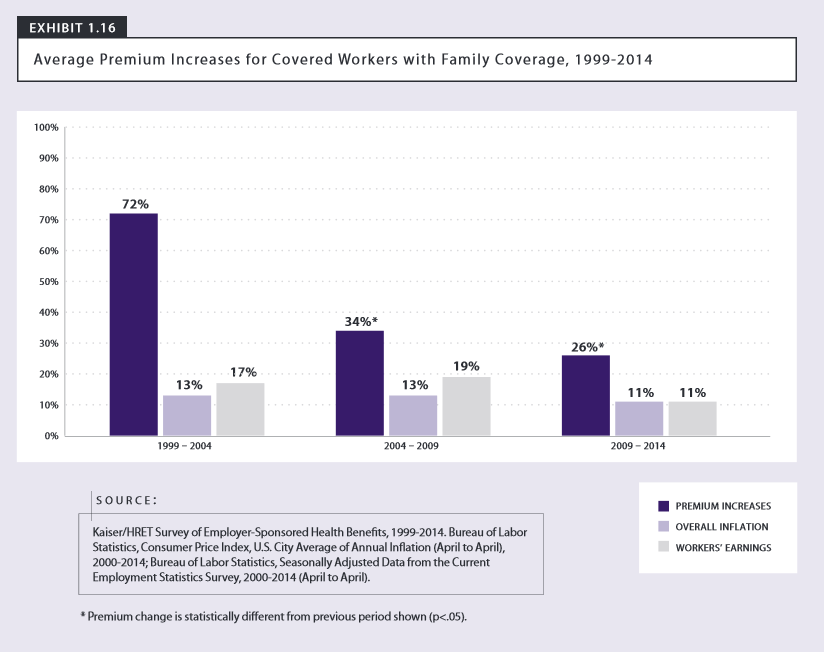
Before ACA, our premiums went up ~5% per year - 8% one year - every year was under 10%. Since ACA, I've seen increases of 25%, 20%, 20%, 25%, then 11% then 13%. This is in NC with Blue Cross - the numbers possibly were different elsewhere (was in Michigan before that but wasn't paying as much attention, unfortunately).
The price increases I was seeing seemed primarily in line with inflationary numbers pre-ACA; post-ACA they seem to have no correlation to inflation, and seem to have more to do with a much larger overall cost for the insurance company covering more people, no lifetime caps, more services covered, etc.
EDIT: On, that factcheck chart - that looks to be showing premium increases for employer-provided health insurance. Employers cutting back their contributions to the premium would account for much/most of those increases. Effectively, it doesn't say anything about the actual insurance premium increases, only what employer-covered workers were having to pay - in my view, that's a big difference.
http://blogs-images.forbes.com/theapothecary/files/2016/04/S...

It was the recession.
Seriously, something is wrong with the whole setup. ACA does address some of it but it has jacked my premiums sky high. Single Payer is the answer in my estimation. The sooner we come to this and stop fiddling around trying to make people we shouldn't happy the better off we will be.
Some business (like insurance) have a fair bit of tail risk they need to take into account.
Some are seasonal (like a ski resort) and need to make sure the profits they make in their high season can carry them in the low season.
Some are cyclical (like furniture stores) where people buy one piece and don't buy anything else for years.
Grocery stores have consistent customers and can generally predict their income and expenses day-to-day for the foreseeable future.
The personal auto insurance combined ratio rose by 1.4 percentage points in 2015 to 97.3 percent for a group of 10 publicly traded insurers.
http://www.insurancejournal.com/magazines/features/2016/03/0...
When interest rates are higher car insurance runs > 100% loss ratio. They stay profitable by earning short term interest on premiums before paying out claims.
In a different insurance vertical fixing loss ratios at 80% would be called a cartel, and would put involved executives into prison for a good long time.
In healthcare the government forms the cartel, fixes the prices, gives money to poor to become consumers, and then fines everybody who won't become the consumer.
said Brer Rabbit. "Only please, Brer Fox, please don't throw me into the briar patch."
Second, a profit margin will take into account risk. So for the ski resort or the furniture store that includes the overhead of keeping the store open while you have no customers.
Third, if the risk is so insanely high why are these firms so consistently profitable? Shouldn't we expect to see them coming in and out of existence regularly? Restaurants are a truly high risk business venture, the majority fail to exist after the first year. Perhaps they have longer runways but it's rare to hear of an insurance firm shutting its doors. The large and consistent profit seen on their end of year reports belies the risk claim.
I don't think you can deny there are cost risks for insurance companies that a lot of other markets don't have. However, to back you up a bit, their profits are extremely good which probably means they are largely overstating the risk in order to gouge their customers.
It is really as simple as that. Could you imagine a system in which car insurance wasn't mandated but car insurance companies were required to repair your car regardless of its preexisting condition? No smart person would preemptively buy insurance. You just wait until your get into an accident and then bring the already damaged car to the insurance company and demand a policy to repair it. No insurance company can work like that.
Insurance only works when the costs of the most expensive customers are shared among the cheapest customers. You need incentives to encourage the cheap customers to sign up or the whole system falls apart. Rejecting preexisting conditions is the old capitalist way of incentivizing people, but as soon as that is prohibited nearly all incentives disappear for a healthy person to buy into the system.
Our failure to find a non-insurance 'hammer' with which to hit all of the health 'nails' is a larger issue.
You can offer insurance against an event that has already occurred, but the insured price will always be slightly higher than the uninsured price. One could call that insurance, but it'd be a degenerate case, so at that point it's more of a word puzzle than a real question.
> Our failure to find a non-insurance 'hammer' with which to hit all of the health 'nails' is a larger issue.
Exactly - the problem is that people talk about health insurance like it's supposed to solve the problems that a wealth redistribution program would. Except, insurance is not a wealth redistribution mechanism - it has a completely different goal - and trying to turn it into one just results into the worst of all worlds (expensive and ineffective at achieving either goal).
Pretend for a moment that everyone receives their annual physical, as medical guidelines recommend. (They don't, but it makes our example simpler.) And let's say that the fair-market price of providing the physical, accounting for all costs borne by the provider and their practice, is $100. (That is an arbitrary number I have chosen, also to make our lives easier). What will be the co-pay for the annual physical for an insured patient?
The answer is that it will be $100 - there is absolutely no risk involved in this situation, so the expected payouts of the insurance company will be $100, and therefore they will incorporate that into their price. (The consumer will actually pay a bit more than $100 in total, because the insurance company has overhead costs, which are ultimately paid by the consumers as well). But of course, that's not the case, because the expectation is that health insurance will reduce these costs, and that people who can't necessarily afford $100 will still be able to have their physical. That's why health insurance isn't really insurance, except in name - we talk about it as insurance, but in reality, it's a wealth redistribution program tacked onto a risk smoothing product.
By definition, insurance is literally not intended to save the insured person money, in expectation. The expected value of all claims will always be less than the expected value of all money paid to the insurer by the insured entity. (This does not hold for every individual, but it does hold in the aggregate - that's where the risk smoothing comes in). The insured person pays the insurer a premium[0] in order to reduce the uncertainty in how much they would have to pay on any given month without insurance.
[0] Not as in "monthly premium", but as in "a premium on top of the expected value"
You fundamentally misunderstand the concept of insurance. Group insurance is, by definition, a way to spread the cost of rare catastrophes around the group so that the affected individuals don't bear the full brunt. There is the full expectation that in the event of a major medical event you will save money.
Try reworking your example around major medical events (e.g. a $500K hospitalization) rather than preventive care (the function of which is to reduce the risk of certain controllable medical events).
> The answer is that it will be $100 - there is absolutely no risk involved in this situation, so the expected payouts of the insurance company will be $100, and therefore they will incorporate that into their price.
No. Even pre-ACA, insurance companies offered low co-pays. How did they do that? Because your monthly fees will over the course of a year add up to far more than the cost of an annual physical. The purpose of insurance is to protect yourself against rare, but catastrophic events: you will probably not experience a wide variety of expensive medical ailments, but if you do they will likely leave you in financial ruin if you're uninsured, so you pay an insurance company money to protect yourself against that risk.
(Or, alternatively, your employer pays a health insurance company money to protect you against that risk, and offers that benefit to you as part of your total compensation package. Which is essentially the same as you paying for it, with some amount of risk differences and thus potentially lower costs due to the pooled employee health insurance policies, but that's outside of the scope of this discussion. TL;DR: it's still regular market economics.)
You might wonder why insurance companies offered low co-pays at all — was it just some marketing gimmick? But no, you can explain that with regular economics too: insurance companies are incentivized to make annual physicals affordable and attractive, because they can catch potentially-expensive medical issues when they're still much less expensive, thus lowering costs for the insurance company.
Yes, this is what I am saying. However, that has nothing to do with the price of co-pays for routine care, which is by definition predictable.
> But no, you can explain that with regular economics too: insurance companies are incentivized to make annual physicals affordable and attractive, because they can catch potentially-expensive medical issues when they're still much less expensive, thus lowering costs for the insurance company.
See, this is another pervasive myth. For healthy individuals, the annual physical is not cost-effective - it is very unlikely to result in long-term benefits to the patient, and it is far more likely to result in unnecessary care (such as follow-up tests and differential diagnoses for false positives): https://sciencebasedmedicine.org/re-thinking-the-annual-phys...
Also, I don't know why you're drawing a dichotomy between what I'm saying and "regular market economics". Everything I have said is standard, textbook economic theory. There's nothing obscure or even controversial about it about economists.
> Everything I have said is standard, textbook economic theory. There's nothing obscure or even controversial about it about economists.
Claiming that "health insurance isn't really insurance, except in name - we talk about it as insurance, but in reality, it's a wealth redistribution program tacked onto a risk smoothing product" is definitely non-mainstream. An insurance company takes in payments to insure you against high-risk events, and that's exactly what a health insurance company does: you pay them a monthly fee regardless of whether you need medical care (or your employer pays them for you as part of your compensation package), and when you do need expensive medical care, they pay for it. In fact, many plans explicitly only pay for expensive medical care: anything under your deductible, aka inexpensive medical care, you're required to pay for. You might be able to make some sort of weaker claim about wealth redistribution post-ACA, but — co-payments existed pre-ACA.
Actually, some of the largest insurance companies and the vast majority of risk-bearing providers (hospitals that act as insurers) are non-profits. Though I never said that their pricing was based on charity; I said it was based on the fact that the product they offer is not really insurance (and that it exists in a marketplace in which prices are incredibly distorted by the existence of other factors, which would have been too long to explain in that simple example).
> Claiming that "health insurance isn't really insurance, except in name"... is definitely non-mainstream
On the contrary, that's the overwhelming consensus among economists. Which isn't surprising, because the economics of insurance are generally covered even at the undergraduate level, and the ways in which health insurance differs from a true insurance program are pretty glaring.
Equating risk-bearing providers and health insurance companies for the purposes of arguing that health insurance isn't insurance might as well be tautological. Sure, blueberry pancakes aren't really pancakes if you include blueberry muffins in the category of blueberry pancakes, but who cares?
It also ignores a number of other selection criteria and behavioral issues, which you are honest enough to note in your pretend for a moment intros.
However, people who proactively care for their health carry "upside risk" as well as downside, which your scenario does not account for.
And they screwed that part up. As a healthy young person, there is no incentive to buy massively overpriced, shitty high-deductible ACA plans, when one month of coverage costs more than the IRS penalty.
True. And the ACA now levies a tax penalty for those that don't sign up for insurance (2.5% of income, max ~$2K).[1]
[1] https://www.nerdwallet.com/blog/health/how-much-is-the-obama...
What are you going to do? Not let me die?
That is not insurance. That is a wealth redistribution. Those are not the same thing, although the current discourse around health insurance conflates those two concepts, for obvious political reasons.
> Could you imagine a system in which car insurance wasn't mandated but car insurance companies were required to repair your car regardless of its preexisting condition? No smart person would preemptively buy insurance. You just wait until your get into an accident and then bring the already damaged car to the insurance company and demand a policy to repair it. No insurance company can work like that.
Actually, this would be completely feasible to implement. The insurance company would price you based on your risk. In this case, P(risky event | all available information) = 1), so there wouldn't be much of a point to buying the insurance, but it absolutely would work.
The problem is that the ACA also forbids insurers from underwriting plans based on anything other than age, income, zip code, and whether or not they smoke. That's guaranteed to increase the cost both for healthy and for unhealthy patients, because they have to make overly conservative estimates when evaluating the risk level of their patient pool.
Yes, they are the same thing. Insurance is fundamentally a redistribution of risk with money being shifted from those who have not fallen victim to that risk to those who have. If you have a problem with that aspect of the ACA, you have a problem with the general idea of insurance.
>The insurance company would price you based on your risk (in this case, it would be 100%), so there wouldn't be much of a point to buying the insurance, but it absolutely would work.
You do realize that this is functionally the same as getting rid of the preexisting conditions protection, right? Whether someone pays tens of thousands to a doctor for care or to an insurance company for coverage are in practice exactly the same. The whole point is that many of us think that is a fundamentally unfair system to force someone to face in that situation.
This comment is so profoundly misguided that I have to comment.
Insurance does not work the way you describe. When companies do a fundraiser where someone gets to take a half-court shot with a basketball and win $1M if they make the shot, an insurance policy sells the company doing the fundraiser a policy that reflects the odds that a person chosen at random from the audience will sink the shot. That policy might cost $7K, since the shot will very likely be missed.
The insurance company makes a profit by charging a bit more than the actual odds reflect, so that over time if 200 shots are taken, it pays the $1M once and profits $400K. In a competitive market, the price of insurance will approach the probability.
Similarly, an insurance company might offer insurance that it will not rain on the last weekend in July. Perhaps an outdoor wedding facility wishes to buy that policy, but a farmer wishes to buy the other side of that risk. In such cases, the insurance company can charge less because there is a market for both sides of the uncertain event. Futures markets are also used for this purpose.
Most of our modern health care is not really risk-driven, it's based on markets that are highly regulated and prices that are influenced by lobbyists from various industries etc.
The key problem with your assertion is that at the time insurance is purchased, nobody knows who will be the victim or whether there will be a victim. Purchasers of insurance would rather spend a little bit of money just in case a bad outcome occurs, so they don't bear the full brunt of that bad outcome. Those who don't end up with a bad outcome don't get their money back, which is why the system works.
We all know there is a need for social services to provide healthcare for those who can't afford it or who have really bad luck. That's not insurance, however, it's social services.
You say that my comment was profoundly misguided, but your comment right here is just a rephrasing of mine Someone with risk spends a little bit of money to help absolve themselves of that risk. If a bad outcome occurs and they fall victim to that risk, they don't bear the full brunt of that bad outcome because money is shifted from people who didn't fall victim to that risk.
Regarding you point about probability based pricing of insurance, we have collectively decided that we don't want health insurance to function that way. If it did, it would lead to the preexisting condition problem in which a person cannot afford insurance because they have a condition that requires expensive care. We instead subsidize their policy with a price increase on everyone else's policy.
> we have collectively decided that we don't want health insurance to function that way.
I agree this is the case, the problem is that it's not really insurance any more it's a bundle of insurance, prepayment, etc.
No, they are not the same thing. The fact that a transfer of money happens is not a sufficient criterion for defining insurance.
Take two people with different risk profiles but who are both insured. If you can tell a priori which one is expected to have lifetime claims that exceed their lifetime premiums, then you don't have insurance - you have a wealth redistribution scheme[0].
Note that I didn't specify which person had the greater risk profile, or whether they both purchased the same "tier" of plan, or even whether they purchased their insurance from the same insurer. This property of insurance still holds even if the two people have completely different risk profiles, if one purchases a gold plan and the other a bronze, and if one person purchases from MegaInsurance in New York and the other purchases from AcmeInsurance in California - as long as they are both insured at risk-adjusted rates.
> You do realize that this is functionally the same as getting rid of the preexisting conditions protection, right? Whether someone pays tens of thousands to a doctor for care or to an insurance company for coverage are in practice exactly the same. The whole point is that many of us think that is a fundamentally unfair system to force someone to face in that situation.
First, nobody is paying tens of thousands of dollars to a doctor, because there's an out-of-pocket maximum cap. (And that cap could still exist under a risk-based pricing world.)
Second, it's not, functionally the same, because that doesn't mean that you can't separately provide income- or wealth-based subsidies if you're aiming to redistribute wealth. But that happens at a completely different layer from the risk underwriting - and because the underwriting process is allowed to properly account for a person's risk profile, you end up with lower aggregate premiums (pre-subsidy). Lower unsubsidized premiums means that you don't need to subsidize as much money in order to achieve the same sticker-price premiums that consumers see - in other words, the entire process is significantly cheaper for what appears to be the same result to the patient.
The reason we don't do this, even though it would be significantly cheaper, is because it's politically infeasible.
[0] Which, you may note, is currently the case - and that's because health insurance as it stands is a mishmash of two completely unrelated products ("insurance" and "wealth redistribution") that we happen to try to stuff into the same box.
>The reason we don't do this, even though it would be significantly cheaper, is because it's politically infeasible.
I agree with your point here, but it is the whole perfect being the enemy of the good thing. Like the original article states, this system isn't perfect. Even Obama admits this. I do however believe the current system is unquestionably better than the system we had previously. I therefore think it is a bad idea to return to the previous system while we hope to eventually come up with a better one. It is not hyperbolic to say lives literally depend on it.
Probably more than anyone, Obama understands that politics is the art of the possible. The fact that the ACA was passed by a margin of one vote is some evidence that, in the face of raging blind opposition, they didn't leave anything on the table. If congress weren't in thrall to gerrymandered hyperpartisanism and effectively unlimited donor money, the law would have had at least some bipartisan support, been revised numerous times, had bad parts improved, good parts enhanced, and concerns of both parties and various constituencies addressed in light of the empirical evidence gathered over the last seven years. I don't think there will be a return to the previous system. Instead, for several million Americans, they'll try to demolish the first four floors of a building and disingenuously point to the doctor's office on the fifth.
If they have insurance. Without guaranteed issue they may not. With guaranteed issue they may have "access" to insurance but can't afford it, or the insurance they can afford may exclude the procedure they need. Retroactively. And even with insurance they may pay 25K a year in premiums plus that 10K max. Then 28K and 15K the next year... It's a system designed for optimal profit, not efficient (or moral) distribution of resources that every person will require. Debating whether it's insurance or insurance-like, or how the underwriting works, begs the question. Insurance companies should not be involved.
It sounds like you are trying to respond to a different sort of discussion altogether.
This whole subthread is in reference to the (implied) statement "requiring insurers to cover pre-existing conditions requires a mandate [and it will necessarily increase premiums to the extent that we have seen]"
Your responses is tangential to that, addressing either (a) what would happen if we didn't require insurers to cover pre-existing conditions, or (b) other potential failure modes which could potentially occur, and which already occur under the ACA.
Some context for people who don't know about this:
http://www.npr.org/sections/itsallpolitics/2015/10/23/451200...
Now think about who is buying ACA plans off the marketplace. First, it's almost entirely people eligible for subsidies (86%) since the plans are cost prohibitive without them. Second, it's people who didn't previously have or couldn't get insurance, unemployed, or who aren't offered insurance through work.
You can see immediately the problem... ACA subscribers will overwhelmingly be high-cost subscribers. There aren't any healthy subscribers to ACA because healthy Americans are working and get their insurance through their employer and therefore aren't eligible for subsidies and have no reason to look at the high-cost exchanges.
The ACA is effectively cornering the market for super-high risk pool, and premiums on ACA markets will continue to rise to reflect it.
If the subsidies were available regardless of availability of a so-called "affordable" employer sponsored plan, and if they employer's contribution could be taken by an employee and applied to an ACA plan in addition to subsidies, it would fix this all in an instant. Suddenly healthy Americans would be shopping on the exchanges, fundamentally altering the risk pool and drive down premiums for everyone.
(This just to counteract my overly weighty response as sibling to this)
It's not nearly enough to counter-balance to huge influx of high risk subscribers. You're being hung out to dry with the high risk pool, which is why your costs have skyrocketed.
"Most people are healthy most of the time, and as a consequence, health care expenditures are heavily concentrated in a small share of the population: about 50 percent of the health care spending in a given year by those below age 65 is attributable to just 5 percent of the nonelderly population. The lowest spending half of the population accounts for only about 3.5 percent of health care spending in a year." [2]
If you want to fix ACA, you have to fix the risk pool. So what's the best way to get healthy people signing up for ACA in droves?
Imagine if you could take your employer contribution, and legally apply it to any plan of your choosing. As-in, sure the employer could arrange a group plan for the office, and you could take it or leave it, but you got to apply the exact same employer-contributed dollars to any plan you chose if you wanted.
Then on top of that, if you could get ACA income-based subsidies, regardless of the amount of the employer cost-share. Because, why on earth should you get less subsidy at the exact same income level, just because you have an employer who is also good enough to contribute?! That's just penalizing employers for contributing. Employer contributions would be an add-back to MAGI for purpose of calculating the subsidy, but nothing more. Currently, today, the meagerest employee contribution will disqualify an employee from all subsidies altogether, almost regardless of income. So-called "affordable" employer-sponsored coverage disqualifies an employee from all subsidies, is defined as an employee share of less than ~10% of household income for an individual plan. WTF?!)
What you would end up with is some extremely cheap plans which a lot of very health workers would flock to. The Fed would pay out significantly more in overall subsidies, but the payment of subsidies would be significantly more fair because it would not penalize an employee for working for an employer who is actually willing to contribute to a share of health costs.
In practice, it would in quick order eviscerate the group market for employer-chosen plans, and see employees taking proper responsibility for choosing their own plans for themselves, while still preserving the ability for employers to share in health care costs with tax-advantaged dollars. It would save millions of small/medium sized businesses the arduous task of trying to negotiate group health plans for their employers evey single year. But most of all, it would fix the risk pool by getting everyone across America actually buying through the marketplace, and not the skewed microcosm we have now.
Early on after ACA passing, I think it was Zenefits was actually trying to sell employers on paying employees to purchased their own plans on ACA marketplaces years ago, until the IRS shut it down. But it was an extremely appealing model at the time.
[1] - http://kff.org/other/state-indicator/total-population/?curre...
[2] - http://healthaffairs.org/blog/2016/03/15/dont-let-the-talkin...
Pre-ACA a non-group plan that wasn't some government mandated high risk pool would typically be much cheaper than group coverage, simply because of the fact that it went through underwriting and you could be denied.
It was priced similar to life insurance where a healthy young subscriber could get a very cheap premium because the expected value was so low.
Back when it was legal to charge 10x more for a 55yr olds plan than a 25yr old, people paid more in line with their expected utilization. Flattening the rate curve shifted massive costs to young middle class families, which IMO is shit policy. When you're 55 you are generally done raising the kids and saving for their college, so it's actually not a bad time for your health care premiums to skyrocket.
I know that adding infirmed people increases costs. The trouble is that the health insurance system of the US is not focused on individuals managing their own health insurance costs. Most Americans get their health insurance from their employers. This makes the ACA markets problematic because the limited risk pools above are further limited by the people utilizing the markets.
Does this mean that the US should ban company sponsored health insurance? Maybe. I don't know. What I do know is that the Democrats tried to stifle debate and thought on the bill. It went so far as Pelosi saying you can only know what's in the bill once you pass it [2].
Overhauling the risk pool will be huge. That's probably in the realm of repeal and replace. What I doubt we'll see, since it would probably destroy the Republicans in two years, is the total gutting of the ACA and the meaningful, unstable gap. The people wouldn't like it, nor would the business community.
1 - http://www.npr.org/sections/health-shots/2014/05/05/30982695...
I think this is a justifiably correct presumption if you assume that costs are normally distributed. Are healthcare costs and risks normally distributed?
We had this problem where the cost of financial risk was assumed to be normally distributed and we built a lot of policy on that, including pooling financial entities into bigger and bigger codependent pools, but everyone seemed to have forgotten the known-for-centuries-fact that financial risk has infinite variance. Of course it turned out okay after we bailed out a bunch of rich people.
True story:
Pre-ACA, I had never been without insurance. I also have asthma. Never been a problem. No pre-existing condition issues. Then, I became a contractor and had to pay for my own insurance. The insurance refused to pay for anything asthma related. Fine; I was making enough to pay for the hideously expensive inhalers (think an epi-pen ever couple of months), but with those, the asthma was well controlled. Then I left that position and became a regular employee with employer provided insurance. Suddenly, no pre-existing condition limit. Weird.
Kinda, sorta, not really [1].
1 - http://www.politifact.com/punditfact/statements/2013/nov/15/...
This was the Republican proposal until Obama took them up on it. Anyone who remembers poor Mitt Romney having to bend himself into logical contortions during the presidential campaign knows that: it was his signature achievement as governor, previously praised by many in his party when advocating against single-payer systems, and suddenly so politically incorrect within his own party that he felt obligated to attack it or invent incredibly fine distinctions to say the ACA was different.
Here's one with 8 million members:
The real behind-the-scenes debate in DC this month is about, first, the best mechanism to transfer funds (direct subsidies, state subsidies, Federal reinsurance pool for the sickest cases, etc ... each of which create distinct winners and losers whose lobbyists are currently out in force), and second, how much of an annual budget deficit the fiscal-hawk Republicans (now led by Rand Paul) are willing to tolerate.
The longer-term solutions have much more to do with diet, lifestyle management, and other behavioral health issues than with access to providers and drugs (e.g. look up how much of last year's medicaid/medicare budget was spent on type 2 diabetes treatment alone). Unfortunately it doesn't seem like we can tackle these issues at scale until after the current debate on affordable universal access to care is settled.
Excuse me? What money? The government does not generate net positive economic benefit, and therefore has no [real] money. You might be confused and talking about "taxpayer money" — but then why bother with the gov't at all, why not just say your plan amounts to "we should increase healthcare costs so we're, you know, throwing more money at the problem".
If you look at the Federal budget it's clear that the Federal Government, beyond national defense, is simply becoming a giant healthcare and pension fund administrator, re-distributing wealth via social security, medicaid, and medicare. All other expenses are dwarfed by these. I'd expect this trend to continue until the singularity occurs and we enter our long-awaited post-capitalist utopia.
Furthermore, there's an enormous information asymmetry in healthcare, so it's hard for it to function as a market.
Because we already have "free" healthcare in the form of emergency rooms, this is ultimately a conversation about how to best allocate health spending. Emergency care is the absolute most expensive form of non end of life care, so we should focus on minimizing that send. There's a well known path for doing so, regular check ups, vaccinations, preventative care, and chronic disease management. All of which cost money now, but reduce future expenditure. And if we already pay for sick broke people in the emergency room, why not optimize the expenditure of those tax dollars by shifting it to more effective health interventions?
You yourself admit that end of life care is incredibly expensive. Why are we pushing people to live longer, when it incurs a much much greater cost to keep people alive? Why not just let them die young?
In part, this is a huge reason (the other reason is pregnancy cost) why pre-ACA healthcare prices were much much cheaper for <30 men than women - most things that seriously hurt men under 30 just completely off them, and dead boys don't incur major medical cost.
I don't know about your characterization that "Basically all research..."
Healthcare is different because consumers often don't know what anything ought to cost, rarely in a position to shop around, and will never be able to afford some big ticket items without insurance regardless.
And the economic consequences are non-obvious. For example, many conditions are much cheaper to treat if caught early; if access to a doctor has an inconvenient cost attached, overall costs go up. The ability to see a doctor for cheap – ideally free – is the most effective way to lower the risk of expensive procedures in the future.
But if I get pregnant or cancer, I have no choice - I have to get treatment or die.
I've been through chemo and radiation once, if I ever am told I need to do it again, to scrape and cling to another few months of life, I'm going to laugh in their faces, put my affairs in order, go on a hell of a vacation, and Old Yeller myself.
If it happens, it'll be interesting to see how my resolve holds up as I stare into the face of mortality.
Which is why it's named after Reagan.
No...
The way to "fix" the exorbitant cost of healthcare is to allow young and/or healthy people to sign up for the bare minimum: a dirt-cheap catastrophic plan that covers the absolute basics and prevents personal bankruptcy. Unfortunately, this hasn't been done.
No, that's just the way to transfer the costs back to older/sicker people, it doesn't do anything to fix the overall costs (and might drive them up by delaying care.)
The first is because the administrative costs are much higher than in other developed countries (about 25 percent). The second is because the U.S. spends much more than other developed countries for the same things (e.g., drugs, doctors, medical equipment, services). The third is because people in the U.S. receive more medical care than people do in other developed countries (for example, they're much more likely to get expensive surgeries).
A cheap, catastrophic insurance coverage plan for young, healthy people addresses all three of these reasons.
No it doesn't. This is insurance, if the young healthy people aren't paying more than a bare minimum, there isn't enough money to cover the sick. You can't mandate care must be given and allow those unlikely to get sick to barely contribute, that's not the purpose of insurance which is to spread the cost and risk across the whole pool. What you propose does nothing to solve the actual problem, providing care for those who actually need it.
You are mistaken. The good parts, like covering pre-existing conditions is exactly what causes your insurance to go up. It's basic economics. The Republicans do not have a plan to fix that.
If there was a way to fix it, don't you think it would already be implemented? You think they're purposefully keeping your rates high just to fuck with you? Not to mention suffer all the political fallout of it?
Don't forget. Obamacare is the Republican plan. This repeal and objection to Obamacare is all politics, not an attempt to fix a broken system.