Lmgtfy was a passive-aggressive (but not really passive) way to say “hey, are you too dumb to google this?”. Sending somebody ai output feels the same to me - the message you’re sending to the recipient is “here, you’re obviously too dumb to ask an LLM about this yourself”. Except some people don’t seem to realize that’s the message they’re sending
This is the root frustration spreading across workplaces everywhere. Before AI the only way for someone to generate a design document, Jira ticket, or pull request without investing a lot of their own time and effort into producing what you saw.
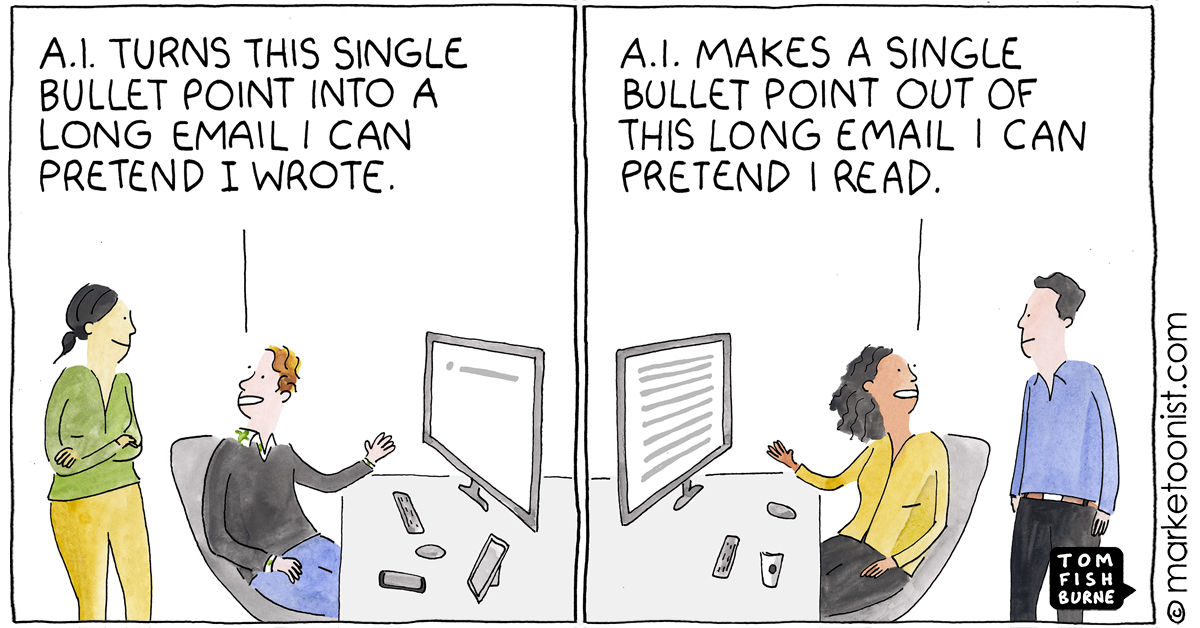
LLMs came along and erased that assumption. Now you don't know if that e-mail, that 12-page design document, the 100 or 1000 line PR, or those 10 Jira tickets were written by someone who invested a lot of their own time into producing something, or if they had their AI subscription generate something that looked plausible. You have to actually read and process the work, which takes 100 times more effort than it took them to make it.
For people in the working world who saw the workplace as a game of min-maxing their effort against the appearance of being a valuable contributor, LLMs are the perfect shortcut: They can now generate the appearance of doing a lot of work with no more than a few lines of asking an LLM to produce documents.
If anyone spends the 30 minutes to review the AI slop from their 15-second prompt, they'll copy your feedback into ChatGPT and send another document over with the fixes. Now they've even captured you into doing their work for them!
For teams or even entire companies that were relying on appearances of activity as a proxy for contributions, this is going to be a difficult transition. Everyone e-mail job worker in the world just received a tool that will generate the appearance of doing their job for them and even possibly be plausibly correct most of the time. One person can generate volumes of design documents, Jira tickets, and even copy and paste witty responses into the company Slack and appear to be the most engaged and dedicated employee by volume while doing less actual work than ever before.
I think teams that already had good review cultures with managers who cared about the output rather than the metrics are doing fine because anyone even a little bit engaged can spot the AI copy-and-paste employees with even a little inspection. The lazy managers who relied on skimming documents and plotting number of PRs or lines of code changed are in for a rude awakening when they discover the employees dominating their little games are the ones doing the most damage to the team.
Oh, we know. It's pretty clear in many cases.
And frankly the best signal now is: the shorter it is the greater the likelihood it was at least expensive for the human to produce. Said in another way - a shorter thing is easier to make sense of completely and if its garbage - its garbage. At least the cost borne on you was minimised!
If in doubt, treat it as a bad writing and give that feedback. It is a bad writing.
That’s not really the point. Engineering has always operated on trust networks, not just artifacts.
Your review naturally adapts based on the level of trust you have in the author. If someone has consistently produced high-quality work, whether they used AI or not becomes mostly irrelevant.
What’s funny to me is your last paragraph. A lot of companies are so gung-ho about “AI ALL the things!” that I’m not sure as a manager if I’d get in trouble for “spotting the AI copy paste” junk. I’m supposed to make sure everyone is using AI as much as possible, after all. So, rejecting someone’s output for being low-effort AI slop and asking for a “less AI” version of it might mark me as a silly old fashioned guy who doesn’t believe in AI.
The world is turning stupid and the tech world is at the forefront of it.
I think this is a reasonable standard to hold, otherwise, like many before have said...send me the prompt. It's actually more interesting/better I know a coworker is struggling to communicate about something.
Likewise, I often used literary flourish and pleasantries like that above article about email decompression; I’m from the south so I think structured formality comes with territory.
I do think using LLM to turn notes and bullets into narratives should be considered no different than rendering CSV text into an excel format, just making it more digestible by recipient.
I often send out the LLM version, but still check if it contains the original thoughts correctly.
It's not a bad way to extend your vocabulary & catch spelling mistakes
I keep the LLM close to the original text content wise, but feedback was/is fantastic
Please don’t do this. You probably aren’t aware of how bad this can land. It’s not just about containing your original thoughts, it’s about the verbosity, repetitiveness, and absurdity of it all.
Grammarly is a much better tool for these kinds of purposes, and it actually guides and teaches you to improve your writing along the way.
A Google search didn’t reveal anything specific other than them using famous author names for expert review.
“keylogger mode” is optional, and to my understanding, you always see a visual indicator in the text area.
it doesn’t take every input as far as I know, and security firms don’t consider it a threat.
but point taken, it’s not for people with privacy concerns.
Regarding "honeypot" -- that's also what a honeypot is. They provide a service you want, then collect data. We have to take their word that they're only using this data to train their AI (which, btw, they are upfront about -- they log everything and feed it into their training. it's in their TOS).
Eg FBI putting up fake “buy drugs online” sites and logging your info once you place the (fake) order.
Tell it that you want a succinct professional email and it will do that. Give it examples of your own writing and it will match that style. If there's something you don't like, tell it to rewrite the part differently.
Theses are literally the things language models are best at.
This is not what the parent I replied to indicated, nor what people usually do.
The problem is that you lose your voice and adopt one that your audience knows all too well (and knows it isn’t yours). It makes your audience feel like you aren’t listening to them (even though you are!), because they feel like they’re talking to an LLM.
So there's a clear separation, a reply from me which I stand by and then some interesting chatbot stuff if you're into that.
I will generate an LLM output that organizes scattered information and thoughts, resulting in 1.25x the text. I then read and edit it, generate executive summaries, and send it.
It saves effort for me in organizing, formatting and summarizing, and the LLM is producing more structure than content.
Most people know when they are doing it. If you feel the need to obscure your LLM usage, it means you didn’t put enough of your own voice and work into the final draft and you need to do something about that.
The Nash equilibrium here is that the market has to find a way for the people producing things with LLMs to pay people to consume them, and the market always finds a way.
Firms are only going to pay out to model producers if they are getting more in excess of the cost of financing projects over time. If a firm does not see this happen, they reduce their spend on tokens. Simple.
Its a whole lot more nuanced than some shitty game theory.
Firms waste literally billions on some bullshit that gets them nothing.
That may be the case but every day LLM’s feel less like the next big thing and more like 3D printing. Here to stay, but not nearly as ubiquitous and earth shattering as people made it out to be.
If I had to guess right now, I would say LLM’s are more significant than 3D printers, but less significant than the Internet.
Certainly seems like the advantages of 3D printing came in clutch exactly when they were needed.
Everything was theorized and it all was a variation of “nothing will be the same for anyone ever again,” not “some specific areas will be really different.”
Agentic coding is a bit different, particularly if a great deal of effort and intelligence goes into it, but that's a quite different thing than just cranking out slop apps.
The closest acceptable thing to share is the full chat, including your prompts. If the output is useful enough to share, then the human thought process that led to the ai output is almost always more useful than the output itself.
If I want the LLM answer I freaking ask it myself
That’s a huge assumption! And I care a lot, because I want to know a person looked at the result and decided it was correct. If you don’t do that, you’re dumping that work on to me and ignoring that I asked you for a reason.
Anyone can open up ChatGPT and ask for a quick answer. What on earth makes people think I want them to just do that for me when I ask them a question?
What the fuck are we even doing anymore?
And either that person won't be employed anymore, of the thing they were asking for in the first place will be automated for them.
I've already got my agent building a dossier for everyone we interact with. I haven't started training it on their writing style so I can mirror back to them... yet.
It seems like no one responding to this understands scoped context retrieval.
An essay states a hypothesis and then uses first and second party sources to validate it. I'm not conflating anything, it's just a good abstract example of the type of knowledge synthesis work, which is why we make kids do them.
A business strategy proposal is nothing more than a specific type of essay where the research sources are internal research results, market trend analysis, etc.
A technical design doc is an essay about the best way to implement a feature.
An "executive summary" is just an abstract, and the MBR puts the latest research citations and raw results in bullet points.
So send me the prompt and the three extra paragraphs that you wrote. The improved LLM will generate the additional context for me if I need it. But heck, maybe I wrote that context myself or have read it many times and don't need it parroted back to me.
have you asked these people how they feel about this? have you asked them for permission, for their consent to do this with their communications to you?
what you’re doing sounds incredibly creepy. like, meta/facebook kinda of creepy. granted, it’s at a more limited scale, but it’s still creepy af dude.
fwiw, if i was your colleague and you asked me how i felt about you doing this with me, i’d be seeing about getting HR involved.
like, jfc, these are fucking people were talking about building “dossiers” of. people the person works with where a degree of trust and bonding is necessary. people they probably spend at least a quarter of their waking hours interacting with.
and your defence for it is “well, google does it”.
the best engineers know what not to build. they don’t build every single thing under the sun because they can.
also, don’t you have to explicitly agree to google’s terms for that stuff to use their services?
Do you think you are not constantly being "influenced" to do what people want from you?
What do think happens during a peer review or promotion decision?
What do you think the pile of data in SharePoint / GDrive represents?
I did phrase my comment in an glib way to draw out this type of reaction. But this type of stuff is what "intelligence augmentation" will include, and the corporate panopticon is already alive and well anyway.
just because the corporations do this to us doesn’t make it okay to do it to each other. just because your employer does it doesn’t mean it’s okay to do to your co-workers. like, there has to be a degree of trust between colleagues dude.
compiling a record of every single thing anyone has ever said to you, an individual human being who is not a corporation or a machine, all for the purposes of “it makes my emails better” is just plain fucking creepy.
i think you might need some time away from the screen. seriously.
> i did phrase my comment in a glib way to draw out this type of reaction.
maybe, just maybe, it would be a good idea to take a bit of time to seriously think about why being glib about this super creepy thing you’re doing is not a good thing.
bit of self-reflection. the thing us humans are supposedly still capable of doing and the machines are not.
Giving the AI knowledge of the org chart, who works on what, how they prefer to communicate, what their goals/biases are, is no different than what every ape implicitly collects in their own head.
The disease has spread to six figure enterprise contracts hallucinating about their own APIs.
1) >I simply run it through an LLM,
2) >paste the summary,
3) >and ask them "Is this an accurate summary?"
4) >and then I ask the for their original prompt.
Agreed that just step 1 or step 1 and 2 would be depressingly pointless, but step 3 and 4 make this the equivalent of sending someone a let-me-google-that-for-you kind of link, does it not?
Caught out like this I imagine many people will kind of get the fact that you'd rather have their direct inputs..
(Or just get mad at you, but that's fair I guess)
I simply ask for a positive affirmation of the summary so that I can act on that, instead of other things.
midwit meme template
guy on left: katie u want meet 3pm discuss project
midwit: Hi Katie, I hope this message finds you well and that your week has been off to a productive start. I wanted to reach out and proactively touch base regarding an opportunity to align on some of the ongoing project-related workstream...
guy on right: katie u want meet 3pm discuss project
[1] https://jabde.com/2026/02/02/utilizing-llms-as-a-data-decomp...
https://www.vaines.org/posts/2026-01-26-jpeg-compression-for...
Original prompt: "Please rewrite this information in a nice format for my insufferable asshole colleague".
<prompt text> -> [PROVIDER] -> <lots of output text> -> [PROVIDER] -> <prompt text, mangled>
"Hey, thanks! This is a great overview, and I actually asked ChatGPT before asking here and got a lot of the same information, but what I'm really looking for is..."
They are at high risk.
Employees using ChatGPT to renegotiate their salary are showing a serious lack of cognitive awareness.
You reminded me of American colleagues that lie and say things are good when they are bad lol. Unable to be straight to the point. You're upset at the waste of time yet you thank them?
The parent is right. The reason society as a whole is way too comfortable with overstepping social boundaries, is because people think it’s somehow rude to confront others. It makes no sense. Sometimes you gotta say it how it is, because quite frankly the real rude person is the one copy and pasting a ton of AI output into your communication so you have to parse that and then try and figure out the original intent between the lines. How is that acceptable but saying “don’t do that to me?” is not?
I got better at it, but I can’t say I ever got to like the pervasive hypocrisy. To my understanding the American/West Coast is even more fake on this aspect.
"Thanks. I have access to ChatGPT as well. But I ask people for help when it fails. Your thoughts are smarter than GPT's, please provide those, next time."
Though, I'd like to be more succinct/terse.
Meanwhile, I was absolutely using AI, but not to write documents but to do first pass critical reviews, the "what am I missing here, what haven't I accounted for here?" but the writing was all my own.
Sometimes I wonder if we're letting people graduate from school with no real grasp of the purpose of written communication. School strips writing of purpose, and creates artificial purposes such as using AI to combine words in order for AI to assign it a good grade. Even before the AI era, most human generated text was not worth reading.
What you are seeing is a seed of the future of communication.
Communication is one of the hardest things people do. The goal it to pass idea from the sender to recipient in a manner that is least lossy. Look at how many things need to be aligned for that to even barely succeed. You have to speak the same language, dialect, have similar enough personal vocabulary, have sufficiently aligned mindsets in the domain you are communicating about, have the same current context and ability to convey context update, then the sender must serialize their ideas into actual words with correct enough spelling and in correct order to get the idea into recipients mind. All that while knowing only very little about recipients mind and having to predict what effect the words will have on it, assuming they don't misread the text.
In the future barely anyone will produce raw text themselves. At least not in professional contexts. World will be way more mixed. People will come from very different cultures and use very different languages. Most people you will encounter in professional setting will not be sufficiently aligned with you to communicate anything beyond the simplest ideas. And neither you nor them are going to be willing to align with others.
You know what will align with you? Your AI. So any message from a human will go through your AI and any message crafted by you for a human will go through your AI as well. And when it's received, through theirs. Messages will not be written. They will be constructed in a dialog with senders AI. And they won't be read. They will be interrogated in a dialog between recipient and their AI.
The future is going to be way more diverse. People will use their own communication styles they were taught when they grew up. But the bulk of out-of-family communication will be done through AI. And the AI language will be verbose. Not really fit for routine human consumption. Because words are cheap for AI and not losing details is a communication priority. It's starting as a corporatese English. But I think it will evolve rapidly to increase signal to noise ratio (while still being impractically voluminous for humans).
They issue now is just that you are trying to read rudimentary machine code of future human communication directly.
Only 30 minutes? You have it good! ^_^
This person is creating more work for an FTE who now has both a) the original job, and b) the additional load of purging corruption from the inputs for (a). This is happening at scale.
Your tolerance for this depends on how close to capacity you are for (a). It's a tale as old as corporate time, well-documented by Office Space and Dilbert.
Work is Work. Pantomime is Pantomime , whether it's with "frontier" or low-tier LoLMs.
> There is zero understanding or consensus of acceptable practices around that sort of thing baked into societal norms right now.
What is acceptable right now is to believe that corrupting the inputs to the work of serious FTEs is somehow beneficial. You are expected to sing the revised words of the corporate anthem with your customary passion and obedience. Layoffs will continue until the morale of data centres has improved.
Someone forwarded an enormous amount of text over teams the other day at work. From someone (bless her) that always means well but usually averages about one spelling mistake per word and rarely goes over 20 words per message. Clearly copy paste chatgpt.
For say hn gang that thinks in terms of context shifts, information load and things on THAT wave length the problem with that situation is obvious but I realised then that is not at all obvious to the average public. She genuinely seemed to think she's helping me by spending 15 seconds typing in a prompt and having me spend the next 30 minutes untangling the AI slop.
There is zero understanding or consensus of acceptable practices around that sort of thing baked into societal norms right now.