Unfortunately the Oil industry won over the politicians in the USA with donations, legal bribes, and they prevent the building of quality train travel. Bet that if majority of the USA left and spent time in countries with quality rail system, they attitudes would change dramatically and push for better. They would experience how much time they waste in traffic and queuing for boarding and de-bordering.
The PNW has been unable to build it from Portland to Vancouver.
The US is many times larger than any European country or Japan. There are US states similar in size to EU countries with comparable rail networks.
The US literally invented air travel, which made traveling long distances by train largely obsolete.
Aircraft aren't limited to where they can go by rails.
So please explain with all these concrete examples of failure how it's a corporate conspiracy and not general purpose government ineptitude?
Can you cite the reasons that these large countries are capable of building high speed rail while the US is not?
Where is the recent innovation in US air travel? It has gotten considerably worse over the last 30 years. Supersonic passenger flights stopped in 2003 around the same time that TSA added hours to every flight.
China's rail does not operate at enough profit to pay off the original construction let alone for future maintenance.
What you are referring to for flight is government policy around it, not the capabilities of flight. Supersonic was not feasible because nations didn't allow breaking the sound barrier over populated areas. Again government restriction, not a limit of the technology. Air flight does not require eminent domaining peoples land to add new destination. In fact new air travel destinations/destination changes/capacity gain growth over the last 30 years occurred in ways that rail never could.
It's almost as if the development of technology and politics are interrelated. Half the cost of building US airports were subsidized by the government when they added them.
Path of development and real estate prices are related to accessibility. Most of the US is not accessible, there are an equal number of paved and unpaved roads in miles. Consider receiving mail in a rural area where it's going to be 3-5 days for an amazon prime package and the closest store is 30+ miles. If you randomly sample locations in the US you'll find that is actually really common, it's just not experienced by many people. Rail networks aren't about going on vacation, it's about developing real national infrastructure that creates efficiencies that boost multiple parts of the economy.
No, not possible at all.
Intentional investments in R&D led to more fuel-efficient and long-range aircraft technology such as the B787 and A350 which allowed new point-to-point routes between cities that were never before possible, abandoning the hub-and-spoke model of the past.
Like Auckland-NYC nonstop.
Imagine if they had to build rails between those two.
Because for some reasons, loud explosion noises causes stress in people and they don't want that.
It is not a arbitary government regulation.
"China's rail does not operate at enough profit "
And when you add in the global cost of flying, (climate change) maybe public infrastructure does not need to generate profit, to be beneficial?
Should Acela be faster? Probably! But people should be clear-eyed about what the reality of the situation is.
Where's the logical argument against high speed rail that is based on physical limitations of reality and not simply uh its infeasible because policy?
If there was HSR between Houston and Dallas, sure I'd take that. Same for Dallas to Kansas City or something similar to that I'd love that. But that's about the distance where even the extra wait and commute time for the airport balances out the fact the plane is going to be flying straighter and faster. In the end I'm not going to take HSR to go to Orlando or Montreal from Dallas, I'm going to fly.
Why not? Include comfortable, silenced sleeper cabins and I rather take spend a night in a bed and wake up the next morning rested and fresh, than going through the stress of flying.
So the top destinations out of Dallas are Atlanta, Denver, Los Angeles, Las Vegas, Austin, Phoenix, Houston, Orlando, Chicago, and New York.
So HSR would potentially be competitive with maybe two of the top 10 destinations when comparing to air travel for DFW. I'm a proponent for the Texas HSR projects, but I don't think it's going to really radically change how most North Texans travel.
Partially because of the above (only 2 of the top 10 flights), but also because while it'll be nice to just take a train instead of driving to Houston, I'm probably going to have to rent a car or do a lot of ride hailing once I get there. Outside of a small section of a lot of these cities downtown areas you practically need a car to get around or be willing to make a lot of sacrifices.
So I'd love to take HSR to visit family in Clear Lake. I could take DART from my home, HSR to Houston, take METRO to the Bay Area Park and Ride, and then...walk several miles with my family's luggage a few miles on maybe paved sidewalks with a few kids under 3. Ride hailing is pretty much out of the question with little kids, good luck on them having adequate child seats available.
But I'll still champion and argue for the Texas HSR projects, even though I might personally not use it a lot. Maybe transit will improve where I want to go. I hope so. And even then I'll still probably take it to watch a Silver Boot series sometime. But there will be others who will be able to leverage it, and that means fewer cars on the road for me for these trips I'm somewhat forced to choose the car.
But I don't like people acting like there's no logical reason for HSR to be the dominant way for people to travel in the US. As we both agree, trips like DFW-NYC don't make much sense taking a train for most travellers.
> from Dallas-Fort Worth International Airport (known by airport code "DFW") and Dallas Love Field Airport ("DAL")
Intellectually honest debaters, which should be what we're striving for. This is a really disappointing response.
This could be the greatest rebuttal to an argument I've ever seen on this site.
One was colonised by wankers for nearly 100 years who built the railways, and they have been in maintenance mode ever since. The infrastructure is decrepit and people still ride on the outside of the trains in some cases.
China has basically no safety standards. They can crash a train, hose it off without a care, and build a new one in its place with no improvements. They continue to have construction-related industrial accidents equivalent to the 1800s in the West.
Russia is currently under embargo because they started a war and can't import parts to properly maintain their fleet of modern Western aircraft.
The irony is two of the three countries you mentioned are in the top 5 fastest growing aviation markets (India being #2).
Everyone should be mad that we dug this hole and then climbed out of it, but people shouldn't pretend that we're still in the hole.
Train stations and airports are where they are. Lots of them are quite close to downtowns. Others aren't. Nobody's changing their locations in existing large cities.
There are plenty of cities where the nearest airport is closer than the nearest long distance rail station. There are plenty of cities where they aren't.
Billy Bishop is pretty convenient, I think it's quite unusual in that respect. But for the same reason, it's rather controversial and limited in the airplanes it can take, and its future is often in doubt.
The US has many areas with suitable population density to be served by high speed rail, and with more accomodative geography than Japan. It's just that in the US, it was considered fine to use government funds and authority to bulldoze land for the interstate system, but not for high speed rail.
It costs money and time to build HSR. Fine. The J(N)R director who ran the shinkansen project literally lied to multiple levels of government to shield the (2x+) budget overruns. He resigned and then within a year of it opening he was given a medal for extraordinary contributions to Japan.
> Because nationwide high speed rail isn't as easy - or practical - as you think.
Who is claiming that it is easy? However, it is practical! It takes 6 hours to drive Tokyo to Osaka; it's 2hr by train. Trains leave every 5 minutes.
A west coast HSR network is just obviously practical! Beijing-Shanghai HSR is 1300km; SF to Seattle would be the same. It'd be 4-5h on a train. Right now it's 2.5 hours on a plane plus a recommended 1.5 hours for security and boarding plus transfers on each side--I'd rather take a high speed train If I could! SF to LA could be ~3h. 90 minutes on a plane plus lead time and transfer times and it's competitive. Again.
> There are US states similar in size to EU countries with comparable rail networks.
Oh, which ones?
So just to be clear you are saying at best the time difference between flight and HSR would be minimal - so where is the payoff for the billions the infrastructure would take to build. If it's purely capacity couldn't you spend a fraction of the billions you'd spend on the new infrastructure to bolster the existing system?
Spain, outside of the lines connecting Vigo, Barcelona, Madrid, Malaga, axis.
Greece, anything outside Athens - Thessaloniki.
For example, the Shinkansen in Japan (which I totally recommend!) is usually over $100 USD. Which is pretty similar to a flight price. This pattern repeats in Europe as well.
My friend just traveled London -> Edinburgh in the last few weeks, and found the train 2x the cost compared to RyanAir or EasyJet.
Even in the US, this pattern holds. Seattle -> LA costs $50-150 by plane, depending on the airline (3hrs). By train, it's 35hrs and $150. Its a lovely train ride, if you have a weekend to dedicate.
I went by train to Germany during the autumn of last year and oh man, what a pleasure it was. I got there about 5 minutes before the train, got in, dumped my suitcase and had room to spare.
During the trip I sauntered between carriages, bought some (mediocre) food to scoff down in the restaurant carriage, which I opted to do at my seat rather than right there because I felt like some quiet time rather than the buzz.
Later I traveled by plane to Spain in the spring and as nice as Barcelona was, I couldn't say the same about the plane trip, which was a necessity rather than a pleasure.
Sure, the automotive industry stood to benefit from the decline of rail travel in the US. But they didn’t really need to do anything for that to happen on its own. Reality is far less interesting than that. Turns out when you have tons of fertile land, even pre-industrialization your population tends to spread out a bit (the vast majority of Americans used to be farmers). Today the US has 3-5X less population density than any country with high speed rail. Autos saw massive success in the US due to this fact, and their prevalence reduced the demand for rail travel as a side effect, it wasn’t some top down evil conspiracy.
It’s fun to blame everything on evil big business or evil big government, but it’s also important to look at the first principles and base properties of the issue at hand first.
    At the time, it seemed that Musk had dished out the Hyperloop proposal just to make the public and legislators rethink the high-speed train.

He didn’t actually intend to build the thing. It was more that he wanted to show people that more creative ideas were out there for things that might actually solve problems and push the state forward. With any luck, the high-speed rail would be canceled. Musk said as much to me [Ashlee Vance] during a series of e-mails and phone calls leading up to the announcement.Trying to convince internet leftists that a cabal of Evil Capitalists are not behind all of the worlds ills is like trying to convince internet right wingers that most vaccines work.
An influential person admitted that he had interfered the development of the high-speed railway at US with a vaporware project, which reported to him juicy economic revenues generated by investments and subsidies from all over the world. Just with vaporware.
Should people think that this kind of interference does not happen with influential pockets because you call it a conspiracy, while they call it just business?
https://en.wikipedia.org/wiki/General_Motors_streetcar_consp...
"Between 1938 and 1950, National City Lines and its subsidiaries, American City Lines and Pacific City Lines—with investment from GM, Firestone Tire, Standard Oil of California (through a subsidiary), Federal Engineering, Phillips Petroleum, and Mack Trucks—gained control of additional transit systems in about 25 cities.[a] Systems included St. Louis, Baltimore, Los Angeles, and Oakland. NCL often converted streetcars to bus operations in that period, although electric traction was preserved or expanded in some locations. Other systems, such as San Diego's, were converted by outgrowths of the City Lines. Most of the companies involved were convicted in 1949 of conspiracy to monopolize interstate commerce in the sale of buses, fuel, and supplies to NCL subsidiaries, but were acquitted of conspiring to monopolize the transit industry."
This history also plays a large role in "Who Framed Roger Rabbit," as a bit of fun bonus lore...
Manhattan may have high population density, and the public transit that goes with it; but building passenger rail thousands of miles to the other side of a sparsely populated continent just doesn’t add up in the same way.
Also I'd argue street cars are way worse than busses which have route flexibility.
The bigger problem is Americans don't like being around other Americans and really don't like public transit.
It's not some giant conspiracy.
I don't like bad public transit either.
"Americans don't like being around other Americans "
There could be the option of having personal cabins for yourself.
No, but the two feed into each other. Intercity rail loses most of its advantages if you have to hire a car at the destination.
> Also I'd argue street cars are way worse than busses which have route flexibility.
They're better for that very reason. You can move somewhere with a decent commute and know that the streetcar isn't going to disappear at the stroke of a pen.
There is a different section in Oslo where the streetcar and metro share a stretch of track using a clever interlocking.
Buses are a joke. We cannot have public transit here without security to match, like at airports.
Quite unsurprisingly Americans end up isolating from each other in suburbs, often gated neighborhoods with private schools, cars and live overall miserable and unhappy lives.
This may be true when averaged across the entire country (or even just the lower 48).
But it is absolutely not true if you consider various zones of the country as candidates for good rail service.
Several such zones exist, among them:
1. the north east corridor, perhaps one of the largest and densest conurbations in the world
2. the roughly rectangular shape formed with the NW corner in Minneapolis, the NW corner in Milwaukee, the SE corner in Detroit and SW corner in <wherever the hell that is>
3. The triangle in Texas formed by Dallas/Ft. Worth, Austin and San Antonio
All 3 have higher population densities than those found in non-urban parts of Europe; the latter have good to excellent train service, but none of these 3 do.
When you factor in that you need a car in both your departing city and destination city (except for NYC), AND the fact that nearly every household in those regions owns one or multiple cars (which is not true in higher density/higher urbanization countries)...it begins to not make sense especially given the massive upfront cost of construction.
Rail is not going to happen until you don't need a car in those cities. Chicago you could do, but the others are not pedestrian friendly. Anyone traveling within that region will have a 95% chance of already owning a car. Unless the train gets you from Chicago to Minneapolis in an hour, people are just going to drive. The risk with car rental and money spent on Uber's isn't worth it.
I feel like these types of comments come from people that live in NYC or LA. The rest of the country is so fuckin sparse. Your "walkable cities" idea doesn't make any sense and is completely unfeasible outside of major metro areas which land wise in the US is like 99%.
Also for the record, the overwhelming majority of the US population lives in metropolitan areas, not rural ones.
I've done Chicago -> Madison by bus, and honestly prefer it to the plane at least (even from the airport). More comfortable seats and I get out just at a station. High frequency bus lines feel like good indicators of where some trains could work, and it's not like bus services are dead.
(Similarly, I did Portland -> Eugene on Amtrak and it was nice and chill! I roadshared to my final destination but I had to get from A to B somehow)
- For France, rural areas don't really have that good of a rail network. Instead there are several trunk lines that are reliable. But it means that east-west stuff is nearly non-existent. Lots of "drive me to the station and drop me off please". Good enough to put France at number 2 in numbers of km ridden per passenger!
- For Germany, the network is much more evenly spread out. But ever German I've met complaints constantly about the unreliability of the trains, combined with the low rate of service. So you end up with stations everywhere, but if a train gets cancelled you could be stranded for hours.
Anyways I do think the French model makes a hell of a lot of sense (prioritizing train frequency over coverage), but it might not be what people are expecting if they just look at a map of trains.
Instead you build rails between major hubs (those that got the biggest airports usually) and add stops on some medium cities that happen to be on the way. It serves those living close enough of the connected cities that want to go close enough to another connected city. _close enough_ depends on the local connection options like regional trains, bus, bikes, trams… and if there’s nothing you just grab a cab or rental car. The city of departure can be reached with your own personal car which is usually a bit cheaper and faster (therefore more range). Most travels destination are big cities or close enough (business, tourism…).
Rail planing is a Pareto game.
I know we have a lot of rail enthusiasts here, but the average person tends not to like being stuck in a tube for 14 hours...even if that tube is substantially nicer and more roomy than an airplane.
Let's not even talk about the cost of constructing that route.
The vast majority of every agricultural society used to be farmers.
A decent high-speed rail system would be cool!
But a decadent high speed rail system would be awesome!
Since Europe has a liberalized market in the rail sector, some startups are trying to fill the gap.
European sleeper operates a night train on the route Brussel-Amsterdam-Berlin-Prague, using old rented rolling stock.
I’m involved with Luna Rail (in Berlin), which is trying a more technical approach around rolling stock design to improve unit economics to make Night trains profitable.
There’s also a startup in the US, dreamstar, whose primary effort appears to be about getting track rights for now (something that’s not such a big concern in Europe - here the barrier is rolling stock).
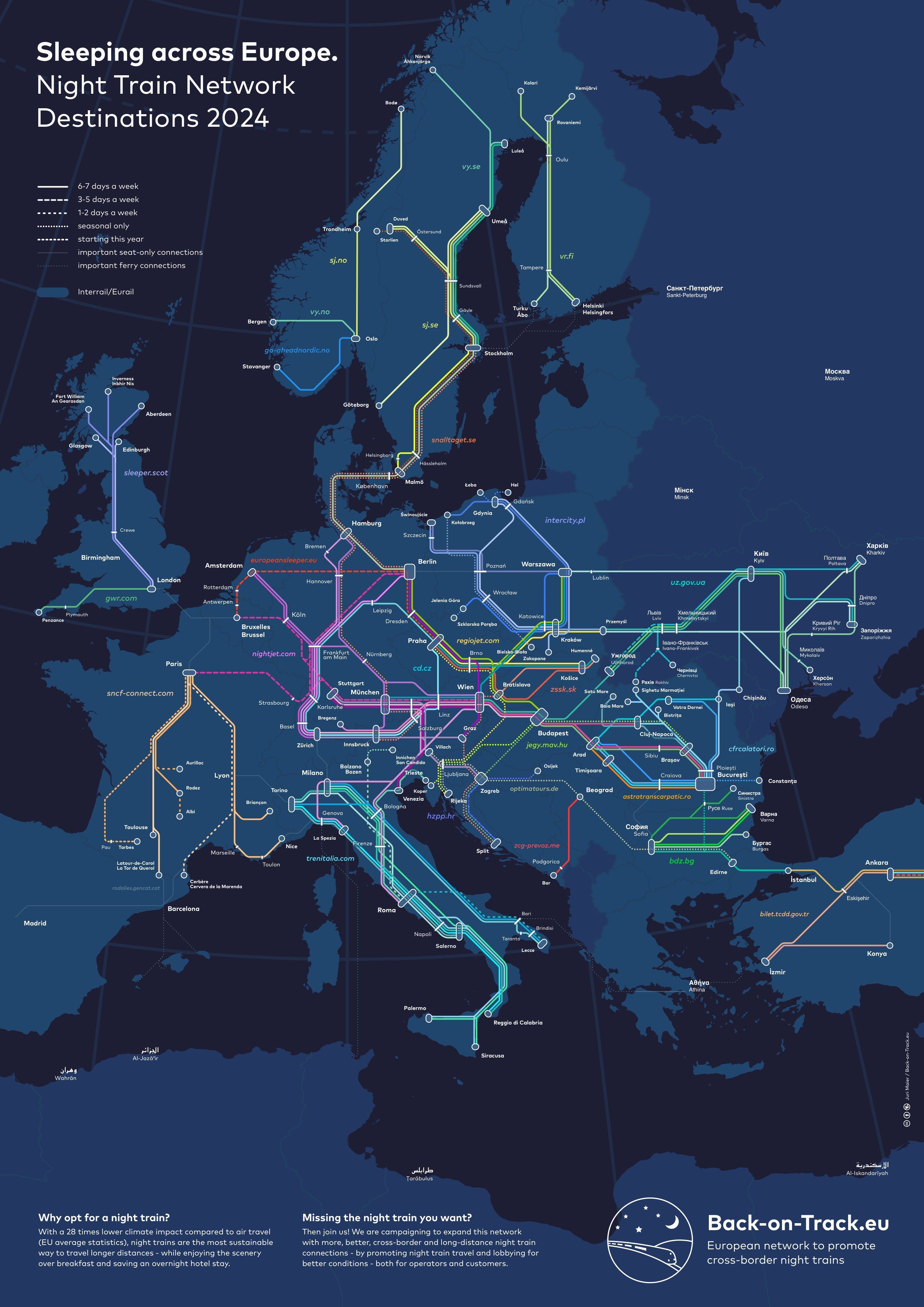
The situation is a lot better today than 10 years ago or so, largely thanks to ÖBB Nightjet. But yep, it's not only state railway companies anymore, as can be seen on the map
Night trains are not like normal trains. They carry far fewer passengers per car. That doesn't make them as bad as flying on pure CO2 emissions, but night trains are not as efficient as "trains" generally. They are more comparable to luxury busses. But ... if the other option is an electric car, or even an electric aircraft, then even an electric night trains will likely no longer win on CO2 emissions.
The comparison is more complicated though isn’t it? It isn’t a comparison with a plane, it’s a variable comparison with a plane, a taxi, and a hotel etc.
Flying has around 10x the co2eq emissions of trains (300g/km, including infrastructure, occupancy). Cars are still pretty bad, but also don’t compete well for 1000km trips in Europe. It’s basically only aviation at those distances.
Electric airplanes that can do 1000km trips don’t exist. They may exist one day in significant quantities… but perhaps only after we’ve used up all our carbon budget on the path to a 2-3C increase.
It also helps if you're generally going city center to city center and aren't lugging large suitcases around. (Which you might think would be a better fit for trains but really aren't for the most part.)
It’s difficult to just do a startup on general in this space (it’s sustainable mobility, but involves hardware, an old industry, old tech).
The state railways can afford rolling stock, but it’s extensive and takes a long time. They are not too innovative either, so may not solve the economics issues with new approaches, because they are too conservative.
As to finance, it does suck that we throw billions at economically, socially, and/or globally destructive, unprofitable startups and yet something that is a net good for society and environment can't get that funding. I guess that's where government steps in or private/public partnerships.
Good luck though!
That trip is 1h 15m by air with 30 flights a day each way. That train doesn't exist anymore because it's impractical and people's time is valuable. We stopped taking Conestoga wagons from New York to California for the same reason.
It was called iDNight, by iDTGV, a former low cost high speed train operator in France. The idea was to run high speed trains at a slow speed during the night, turning a 3 hour trip into an 8 hour trip so that you can get a full night, and also so it can leave as the departure station is closing and arrive as the destination station is opening, therefore exploiting downtime, I guess.
These were not sleeper cars but regular high-speed train cars, not ideal for sleeping, but since most seats were vacant, at least in my experience, you could easily get two seats for yourself.
Maybe you can but none will recommend that you do, for example Paris recommends at least 2 hours [0]. And if you need to check luggage you have no chance if you're only 20 minutes early, on a train you just carry it onto the carriage.
[0] - https://www.parisaeroport.fr/en/passengers/flight-preparatio...
Aeh, where were you travelling? Many countries did not have sleeper trains. Don't get me wrong. I did the same, travelling at night in trains, and it saved me a night in a hotel. But I did not arrive well rested, I arrived train wrecked.
If you were just sleeping in a seat then yes I can believe you felt awful the next day.
The closest I've been to a sleeper in recent decades has been five hours on a cold station because cancellations & delays have meant missing the last onward connection of the day so waiting for the first morning service (there are supposed to be provisions for that by way of providing accommodation or replacement taxi service, which do sometimes work, but at that time of night there isn't always someone available & reachable to enact such policies).
In the case you couldn’t reach someone, doesn’t every platform have a phone as well?
So I go for couchettes. One time in Sweden I found that the sleepers were only 10 euro more than the couchettes, so then I took one.
But then again some sleepers (Shiki-Shima in Japan) are like being in a luxury hotel. Rather enjoyed having a soak in the tub in my suite.
Both times I'd say well rested would be a stretch. The first time felt a bit like a magic carpet in that I got somewhere while using up no useful hours but it still wasn't perfect.
I suppose it’s the novelty of sleeping in a moving vehicle, my flight attendant friend said it took them a while to start sleeping well on long haul flights.
Perhaps with a lot of benzodiazepines or drowsy anti-histamines I could attempt to sleep well in a sleeper train, but not normally. Happy for those who can of course.
Do you think it's the noise for you, the movement, or something else (like lack of privacy)? I started taking earplugs with me for any kind of trip now, they are a godsend.
Most sleepers also offer cabins with proper beds (for a premium).
So as an individual traveling alone, you know your limits and can pretty much figure out if that way of travelling works for you. For a family, you are pretty sure at least one member of the family will have a rough night and complain in the morning.
A sure way to spend good night while travelling is to be very active during the day. You sleep much better if you have walked for 15 to 20km around a city to visit it than if you have been idle most of the time and taken taxis and buses whenever you could. Most lazy people don't understand that rest has to be earned.
And, yes, especially when time zones are involved, sticking to a schedule and getting exercise helps.
The definitely ran between Germany and the Netherlands in the 00s because I took at least one trip that way.
* couchette (6 couchettes per cabin, less comfort)
* 2nd class bed (3 beds per cabin)
* 1st class bed (same as 2nd class, but 2 beds per cabin)
* 1st class private bed (same as above, but without roommate)
You don't have to be younger than 26 to buy one, not anymore, but it is cheaper if you are. If you are a EU citizen, it gets you free, unlimited travel by train in most European countries. If you are not a EU citizen, there is the Eurail pass that is similar.
But that's the theory. In practice there are important limitations:
- You can't use it in your home country, except for a single round trip: in and out.
- If you make a reservation, you will have to pay reservation fees, and many long-distance and high-speed trains only have reserved seats.
- Not all seats are available to pass owners, if you want to travel in these seats, you will have to pay full price.
And considering that the pass itself is not that cheap, you really have some planning to do to see if it is worth it. In many cases, it isn't.
Last summer Spain’s Renfe offered huge discount for a pass for people under 31. Only for paper version though which is slightly less convenient but worth it anyway. I guess other eu countries could have similar seasonal discounts.
There are some home country limitations for Interrail, but I’m not really sure why the passes are still kept separate beyond that. It seems Eurail and Interrail are mostly identical beyond the residency/anti-residency requirements.
No mobiles, only lifeline home being a pay phone call every week.
Not the same stores in every city as it is today.
Life was beautiful back then and we did not know it.
Times have changed, and now like it or not, we are in the internet and smartphone age. The best travel deals are online, the cheapest accommodations are also found online. The Interrail pass is a bit of a relic, it can still be useful, but if you have no plan and limited cash, you are probably better off chasing last minute deals on your trusty smartphone.
And yes, I think we have lost something, disconnecting is hard, and stores tend to be all the same these days, and finding something interesting to bring back home is becoming a difficult task now that you can order everything online.
But I also think we gained something. The language barrier is breaking down. More and more people speak decent English as a secondary language, smartphones come with pretty decent translators, plane tickets are ridiculously cheap if you are not too picky. Getting in touch or keeping contact with people on the other side of the planet is almost too easy, great for exchange. When travelling in a group (even a temporary group), having mobile phones cuts down on the time waiting for people to gather, and offers more freedom than "let's meet at a precise place at a precise time", which is one of the most annoying parts of travelling in a group.
Now, I talked a lot about "cheap". That's because while travelling, I consider using money to be like cheating. You can do everything (well, almost) with money. Want to do a smartphone-less trip, randomly hopping into trains? You can, with money. Finding a ho(s)tel without price-checking online first? Sure, with money. Cheapening out is a good way to keep a "no plan" travel unplanned. But yeah, now there are smartphones involved.
And life is still beautiful. In my opinion, more beautiful than it has ever been, but in different ways.
Is that really something that was gained? As we lose more and more languages we start to lose unique cultural features right? It’s like “we gained McDonald’s in every city - my comforting home food is available everywhere”.
> When travelling in a group (even a temporary group), having mobile phones cuts down on the time waiting for people to gather
Kind of the same thing. It’s a focus on efficiency. Speed run through life experiences. Why even go to the Louvre when you can throw on your Meta headset and do it from your couch?
I’m not a travel elitist or anything like that, I just think these “benefits” come with a lot of drawbacks too. As the world gets smaller and more efficient it becomes homogenized and travel starts to become pointless.
Connectivity/smartphones do make things "easier" but they also tend to make them less spontaneous and serendipitous. And, yes, while a lot of it is that I'm trying to declutter my house and I like to travel light, I also find that I have pretty much zero interest in shopping abroad.
Not really a gain if you ask me.. The melting glaciers are agreeing with me and they are not impressed by the downvotes I'll receive for this opinion.
And even on the cheap, let's keep in mind that money is central to the luxury that any tourism is. In my 90's youth, I figuratively littered the map with pushpins in countries off the path beaten by Westerners, impressing family and friends. But really, I just happened to have the privilege of taking a few months for clueless wandering with no worries about means and the knowledge that if the affair turned sour I could at any point arrange a safety net. Sure, I was a fairly cheap backpacker, but still there was no glory in such adventuring - just money. I still recommend it to anyone who can, and that experience has shaped a large part of my later life in unforeseen ways, but I have long stopped gloating about it.
If I follow the link there, it costs 239E for a 5-day pass, where each of the 5 days must be used in a 1 month period. That's not "gratis", that's 47.8E per day the train is used?
I've not heard of any age requirements.
I ordered one to my parents' house in the US and had them FexEx it to me in Europe.
Actually Spain seems to have more to offer according to this map http://www.night-trains.com/europe/
edit: Nope, Spain is pretty almost void of night trains https://en.wikipedia.org/wiki/Trenhotel
I did a similar trip in the late 90s. Not 20 stays in train, but well above 10. Paris-Madrid, Rome-Paris, Bordeaux-Paris, to name a few.
It wasn't threatening or anything, just a wild experience and insightful lesson in cultural differences
Indian railways changed the base sleeper cars into free-for-alls by changing sleeper cabin classifications and stopping verifying tickets. Now you have people buying the cheapest tickets (unreserved general) and swarming the "reserved" sleeper cabin berths. [0] They're just over-cramming the trains.
[0] https://www.tripsavvy.com/indian-railways-trains-travel-clas...
Oh man this has definitely not been my experience! Last I tried this I booked a "VIP" sleeper car with a private bathroom/shower, and it was anything but. The constant shaking of the train side to side coupled with a bunch of young American girls running up and down the halls screaming to each other all night meant I didn't get any sleep at all. To make things worse, the same girls making noise all night used up all the water, leaving me covered in soap with no way to rinse it off, and still 8+ hours until my hotel check-in. I can usually sleep anywhere regardless of noise or light or mattress quality, but sleeping a train is a new category of difficulty.
Likely a bit more. Also there is maintainance, the extra weight, the extra cost of buying more waggons .. but still I agree, thay this should be the direction.
Still, a 5 mile train will have problems at most train station ..
And you're right, you'd probably have to designate a section of the train as the "getting on and off" bit, and make it easy for people to move from car to car.
   1. It appears Amtrak sleeper cars accommodate between 30 and 50 people.
   2. An Amtrak coach car seats up to 80 people (fewer than I expected).
   3. So to switch everything to sleeper cars would require trains to be 2-3 times as long.
   4. A typical Amtrak train is 11-12 cars long, and each car is about 85 feet long.
   5. So Amtrak trains are currently about 1,000 feet long, which means they could be 2-3x as long and still be *well* under a mile long.
There used to be a similar service between Toronto and Montreal (both directions), where the train would pause for several hours midway so passengers would arrive at around 7:30 a.m. well-rested.
I’ve taken that route as well, and it’s remarkable how much you see while traveling by train. You pass through countless towns, villages, and beautiful scenery—experiences you simply can’t get from flying.