Our high energy, water-loving, labradoodle is only motivated by one thing: frisbee.
Labradoodles are loopy, like most of the bred-for-instagram breeds. Got to expect the abnormal
I have two purebred poodles (not bred for Instagram) and one is highly motivated by food, the other will decline treats pretty often, even treats we know he really loves. This is not super atypical of poodles.
And to put another layer of complication on your dismissal of other people's challenges training dogs: the not food-motivated one is way easier to train.
(Yes I'm annoyed by those who buy a dog to be an accessory and don't bother training them. There are loads of them where I live and they are annoying at best and menaces at worst)
Don’t assume your experience is universal, especially when there’s a lot of people telling you it isn’t.
Spend some time training dogs and you'll also find both that food motivation can vary quite a bit (some dogs are more interested in toys than food, for instance) and also that it's quite possible to train dogs without always relying on a food reward.
Generally the deeper you go with understanding and training dog behavior, the more you realize how the same learning theory that informs scientific dog training also describes human behavior. (Imo it also reveals deficiencies in thinking in terms of learning theory/behaviorism alone; idk how you could work closely with animals and seriously believe they lack cognition.)
Of course sharing food is a way to build social bonding and positively motivate social conformance. It is with people too, which is why it's so natural for us to carry it over to our relationship with dogs.
How or why is that depressing?
It's good that we crave what helps us thrive and that we can recognize who makes it easy for us to have more, and there's a beautiful elegance to that fact that so many creatures share the trait, across such diverse lineages as birds, reptiles, fish, arthropods, mammals, etc
Isn't that inspiring, rather than depressing?
Then there are those who just don't care to train their dogs.
There is a worse option.
The thin extending dog lead at maximum extension while walking the dog in twilight on a cycle path. What could go wrong?
Got some doubts about the value of those leads in general; surely it just means the dog has no gauge at all in how far they can go in any direction?
It wasn't a dog, it was a skunk. Fortunately it didn't seem threatened and just waddled away.
But for the 80% case, yeah, grab some string cheese and a clicker.[0]
The first one was stupid easy to train. Food motivated and could be refocused in every situation with food. Picked up commands quickly. Would do training basically any time of day.
Second dog just stares at me if she doesn’t want to be trained or feels the task is too hard. When she gets distracted, it doesn’t matter how high of a reward I give, she won’t take it if she doesn’t want it.
Anyhow, my favorite of the dogs from my childhood was generally uninterested in what certain people wanted from her. She was more motivated by praise and the sheer joy of teamwork with her favorite people than by food.
So one day my mom (not one of this dog's favorites, through no fault of her own) sets her up to do the trick: she asks the dog to sit and places a treat on the dog's nose. The dog slowly decides she'd actually rather do something else. She tilts her head down towards the ground, the treat slides off her nose, and she leisurely walks away.
But humans want obedient dogs not ones that have their own opinions :)
Independent, great explorer and hiker, hated clear objects like she had an intifada against them and never got into trouble or destroyed stuff.
She was a good dude and would have been less fun if she was more obsequious or eager to please and predictable.
My mom had a boxer who was absolutely obsessed with her for his entire life. He was so eager to please her that she would often cue certain (benign) behaviors by accident, because he was always watching her to see if there was anything for him to do with her. He was so invested in figuring out what she wanted and in impressing her that the gentlest scolding would crush him— it could easily ruin a whole training session.
The things my mom (who is legally blind) got that dog to do were amazing. She (just a hobbyist) did dog sports with him (competitive obedience and rally) and got titles in advanced and intermediate levels. He did some 'American trick dog' stuff where he would do really gimmicky but pretty cute and impressive multi-step tricks, like going outside to fetch the mail and bring it back, or hopping into a suitcase, closing it on his own head, and lying down. He had some routine tricks that were pretty cool, like searching the house to collect all of his toys and put them away. He worked as a therapy dog in hospitals, where he was especially beloved by children, who were invariably amused and pleased that they could get a big, strange dog to do many tricks for them. He'd also do some little assistance things for my mom, like pick things up off the floor (if asked) so she didn't have to get down on her hands and knees and pat around to find them.
Unrelated to his training career, I'll never forget his watchfulness and sweetness toward my tiny old chihuahua. As you likely know, boxers can be extremely energetic dogs, but he was a calm soul as far as boxers go. While they didn't meet often, he had a special connection with my little < 5lbs Chihuahua: she trusted his gentle nature and he sympathized with her frustration with the antics of my mom's younger boxer. When the young energetic one wouldn't stop following my little one around, he'd trot in between them and quietly create some distance for her. My little old lady evidently appreciated this quite a bit, so much so that it once caused my family a scare. We always kept the big dogs and small dogs separated if the big dogs were playing, or if we were out of the house, or if no one was committed to supervising them. One day after an outing my mom panicked a little when she couldn't find my little old lady, and it turned out that she, not wanting to be alone for the long duration of a shopping trip and dinner, walked a couple steps down (at her age and size she was quite apprehensive about stairs, and typically would not cross even one or two steps) and then squeezed through the bars of a baby gate in order to nestle into a dog bed with my mom's dog. He was really an incredible dog, and his gentle, agreeable, social, other-oriented nature was certainly a big part of that.
On the other hand, that little old lady of a Chihuahua, when I met her, didn't know how to walk on a leash, resource guarded laps and bit about it, and didn't respond to my stupid attempts to scold her except by mistrusting me and avoiding me. Learning how to communicate her and win her over was one of the most rewarding experiences of my life. By the end of her life she was a dog I could trust around strangers, dog and human, of all sizes and personalities, whom I could take offleash anywhere, who would wait for my signal at a crosswalk, who I could have lie down on some blankets on a table where I was eating and trust her when I walked out of the room, and whom I learned to read for the tiniest signals: eye contact, pointing at what she wanted with her eyes, inaudible growls/whines I could only feel because she was in my lap, the 10 kinds of trembling that comprise key terms in the Chihuahua language... and I probably wouldn't have learned much of anything from her if she hadn't demanded that I come to her and understand her perspective and needs and wants first.
That's a smart dog, while I can imagine someone observing such occurence calling the dog dumb.
High stress or emotional arousal or a distracting environment will supersede this but it's a decent starting point which people often miss. Luckily our second dog likes play and praise so that gives us more options.
Dog #2 just doesn't care. She eats the recommended daily amount, but will take hours to finish a meal. Walking away and coming back later. She just doesn't care about food.
I have heard trainers who suggest meal time is meal time, the food is taken if it is not eaten, it's not a self-serve grazing buffet. I think part of it is about making it clear who is in charge, especially if a dog is not listening during training, but there are other reasons I forget like resource guarding and predictable toileting. But we all decide how much we let them express their personalities :)
The former, I'm not sure they'd remember toy names from 10 years ago but I've been impressed time after time after time at her ability to understand the world around her.
THe latter, he's just lucky to remember how to walk down the hall.
Sometimes it is the luck of the draw.
We have a time frame of roughly 3 hours in which we feed the dog.
That way we can have a nice dinner too, go to a musical etc. pp.
A friend of ours made the same mistake as you. His dog becomes a real diva after 6pm, if she hasn't eaten
So I switched to using a phone alarm that marks when it's time to feed the dogs. I can easily change the time it rings to adjust their meal times, and they remain patient because they know that they won't be fed until they hear that sound.
Out of curiosity we've tried to figure out if there's some external cue he's relying on outside of a very accurate internal 'clock', and haven't found any. He's consistent even in the face of timezone changes and travel across the country (and other mundane tricks that'd eliminate stimulus like daylight cues), different environments / homes (ruling out equipment / building / neighbourhood noises), and different humans (in case his usual companions unwittingly broadcast hints).
I'm forced to the conclusion he swallowed a Rolex at some point.
My own schedule isn't particularly routine otherwise, so it's actually not an unwelcome anchor. He does understand and give up after a couple attempts if you tell him 'later' or have an obvious reason for the delay. He's intent, but not impolite.
We left him with a friend once for a few days who feeds their own dog an hour earlier. The discovery that 5 o'clock dinnertime can be a thing completely rocked his world. He tried to share this revolutionary breakthrough with us but with limited success.
In many cases it's the owners fault, not being able to train well
Anyhow, like many of her kind she is NOT into food. That made training her in the beginning very difficult, because we knew no other way back than. Even today, I always have to chuckle when I try to give her a treat and she takes the treat very gently from my hand and puts it down on the floor, like saying "let me put it there for you." Of course, sometimes she just eats it but you never know.
Eventually I realized she also loves to please - and reason things out herself - and the food was completely unnecessary! No specific "dominance" training necessary.
https://allcreatureslargeandsmall.wordpress.com/2011/09/09/t...
"As time passes without survivors found, search-and-rescue dogs — especially those trained to find living people — experience increased stress and depression. One way this is mitigated is for handlers and trainers to stage mock “finds” so that the dogs can feel successful."
in deference to 082349872349872’s curiosity, human beings can, in principle, train dogs (in this very limited context) to walk the fine line between bad faith (not exhibiting distress) and good faith (exhibiting distress).
Can they, in reality?
*or, maybe like Athena, born fully salvated from a crack in Zeus (athenogenesis)
"Sometimes you find live people, which is sweet, and sometimes you find dead people[1], which is a bummer, but I am a good boi no matter which because I search thoroughly and report immediately."
[0] take the above with a grain of salt; almost all my canine experience is second-hand, with scent and herding breeds, so that "ideal" is a cross between a short conversation with a neighbour who trained avalanche dogs and a friend who is a ski instructor, and believes:
"Sometimes it's sunny and the clients are talented and resilient, which is sweet, and sometimes it's snowing hard and the clients have no talent and no nerves, which is a bummer, but I am a good ski instructor no matter which because I bring them to at least 80% of the improvements which could have been possible given the conditions and clients of that particular session."
[1] unsolicited moralising: there are weather reports. use them. there are beacon/pole/shovel avalanche sets. buy them. there are guides. hire them. So many of the deaths reported in the local papers are because people are not good bois: they go off piste, without a guide, without self-rescue equipment, on days when there were already avalanche warnings given in the morning.
(advice on choosing a hunting prospect which I've run across: put something startling [alarm clock, etc.] next to the litter, and see how they react. Your best prospects should be among those puppies which first investigate, then ignore, the novelty. Those who never investigate probably won't be curious enough to easily train; those who never ignore probably won't be able to focus enough to easily train)
EDIT: maybe that wasn't what you were asking. Dogs obviously engage or disengage with other people based on whether or not they believe their person approves. But I don't think dogs ever (like someone asking a leading question of a third party not because they wanted to hear the answer but because they want their so to hear it yet are unwilling to say it directly) instigate a dyadic transaction explicitly for the effect it has on third parties. Horses for sure don't. (there is "dogpiling", but I think for dogs and am pretty sure for horses that that's a side effect of dyadic jockeying, not the social game monkeys make of it) What say the dog people?
2024-09-06 Dogs with prior experience of a task still overimitate their caregiver https://www.nature.com/articles/s41598-024-70700-3
(With suggested related content)
However, a direct comparison of overimitation timing with humans is necessary to understand if this approach is indeed partly what differentiates dog overimitation from that of humans.
Yes, will consider the 3-way communication styles at some point (and the Rao talk chart) but right now exploring what a purely dyadic interaction can bring us, e.g. how to model the occasions on which Sir Humphrey/Hacker considered rewriting their firmwares post-startle (with or without npc intervention from Annie or Woolley)
There were 5 seasons of Yes, [Prime] Minister so even if things were pretty episodic intraseasonally IIRC Sir H "wins" all their initial dual duels but by the final seasons, in addition to having climbed the greasy pole, PM H even comes out ahead in direct conflicts with Sir H from time to time.
Oh, I believe my wife is saying there's a message for me: about a Criollo horse, from a Señor Modelo. Sorry, so sorry.
I don't have anything further to contribute to this discussion, so if not for that bemusing remark of yours, I wouldn't have engaged.
If I'm being honest, I don't understand the middle two paragraphs, either. (Why "bad faith" and "good faith"? Why do you say it can be done in principle, while leaving "in reality" an open question? and how does what's essentially a theory defer to anyone's curiosity? Surely I'm missing context.)
The bad vs good faith is a theoretical curiosity of mine, which i can unpack later if either of you are so interested. This theory, as well as the inaccurate epithets, can be said to originate from my reading of 2 comments by you!
https://news.ycombinator.com/item?id=41205833
So clearly, you’re not middle management, even if you claim you are clueless, but your uh, soul, was “salvated” — by virtue of working on something the experts dismissed. [If we take seriously your claim that you weren’t being clever, then that’s good faith in my book. I will say no further about my theory except that it could be a “dial” for scientists to consider.] If nothing else, i would like (quixotically?) to condense your chain of thoughts in that situation into something worth propagating, into science-curious folks’ realities.
As to the curiosity i was deferring to.. (it could also be related to the revolutionary approach of yours, if i’m being very presumptuous — and wrong???) 082349872349872 expressed his inspirational feelings on the matter here https://news.ycombinator.com/item?id=40600845. Mariatta, child of beauty)
[PDF] A representation of antimatroids by Horn rules and its application to educational systems http://arxiv.org/pdf/1508.05465
Specifically, i wonder if anybody has tried to apply these supposedly efficient algorithms, which model states of teacher+learner, in “real life”.
So in this model, scientists are the avalanche dogs who report "nope, no people over there" and thereby help narrow down the rescuers' efforts?
So, if i understood ww4 correctly, it is more like,
dog reports correctly that theres no person, but the rescuers are actually looking for a horse.
Here is a real life (albeit informal) example: when I was still in the Old Country, a professional trainer told me the following (translated here to the notation of [Yoshikawa et al 2018]) about his process of "tuning up" horses that someone else (usually the client themself) has messed up:
1. Be an expert: this means (at least implicitly) knowing R*
2. Ask the horse to do a task involving Q. If the horse does it perfectly, the owner needs work. (if you like dealing with humans and also know R'*, start over by teaching the owner at step 1 and Q'; if you don't like dealing with humans or don't know R'*, pass the buck to a colleague who does both)
3. At this point determine if the horse either (a) doesn't realise you wanted Q, (b) can't do Q because they're insufficiently fit, (c) can't do Q because they don't know how, or (d) could have done Q but doesn't want to. In the cases of (a) or (d), the remedy is (for the purposes of this example) straightforward. In the cases of (b) or (c) it's more complex, leading to:
4. Walk the antimatroid A(R*) to determine which subsets Q_p the horse can physically do and Q_m the horse knows how to do; in the generic case this will give you a task Q_1 which can be trained having some subset of Q_p ⋃ Q_m as prereqs with a single novel q (unit inference?) to work on.
5. Until the owner says "good enough" (common) or can't ask for Q_n (common, see step 2) or you reach Q (rare), train the other steps of a minimal path Q_2...Q [Exercise: does such a path exist?]
https://en.wikipedia.org/wiki/Transactional_analysis#Outline
...are grown-up children, utterly irresponsible; not immoral but unmoral; they “please to live and live to please” themselves. They do not realise that their actions may prove costly to others and therefore do not count the cost. They are children of impulse not of calculation. [1]
then TA would be completely dandy, but I kind of thought the initial ideal, at least, was that people would attempt to stay in A<->A Straight Talk modes. Should we judge Transactional Analysis by what Berne wrote (TA as antimeme), or by what everyone read or claimed to have read (TA as meme)?
"...your real dandy is not an ordinary man and must not be judged by common standards. He stands outside and above the ordinary rules of life and conduct; he has not any conscience, and questions of morality do not affect him. All that is for us to do in viewing such a one as D’Orsay is to weigh his physical and mental gifts, and to examine the uses to which he put them, to look to the opportunities which were given to him and the advantage which he took of them." [1]
Dandyism as sociopathy? It certainly has a pocketbook-dependent valence: poor dandies are trashy; rich ones, classy.
> I don't play accurately —any one can play accurately— but I play with wonderful expression. —AM
[0] cf the Xenophobe's Guide to the Americans, which claims this behaviour wasn't just the 1970s, it's the national character.
[1] https://www.gutenberg.org/files/56581/56581-h/56581-h.htm
EDIT: I prefer https://www.gutenberg.org/files/56581/56581-h/images/illus5.... (who needs a marshall's baton when you have a hunting crop?), but have to admit D'O---y may even have inspired a predecessor of our age's bobbleheads: https://www.nationaltrustcollections.org.uk/object/1221047

as a contrived example to argue that point, the advantage has been adapted into YC’s metric for equity transferees.
https://news.ycombinator.com/item?id=9239203
In order to keep things simple, lets forget abt memes, because i’m more interested in the failure modes of Straight Talk no BS OG TA.
attributes - things you were born with
accomplishments - things you have via practice (paid the time)
acquisitions - things you have via purchase (paid the cash)
[and I'm calling Altman's anecdote weak sauce; I agree it's hustle not hack. Lagniappe: https://www.youtube.com/watch?v=c412hqucHKw ]
EDIT: showing up on the client's doorstep has been done by salescritters since the day after commission was invented. A hack involves exploiting a property of a system that no one had previously realised exploitable. (Note here that despite popular usage, I only consider most computer crackers to be airquote "hackers".)
> The somber picture presented in Parts I and II of this book, in which human life is mainly a process of filling in time until the arrival of death, or Santa Claus, with very little choice, if any, of what kind of business one is going to transact during the long wait, is a commonplace but not the final answer. For certain fortunate people there is something which transcends all classifications of behavior, and that is awareness; something which rises above the programming of the past, and that is spontaneity; and something that is more rewarding than games, and that is intimacy. But all three of these may be frightening and even perilous to the unprepared. Perhaps they are better off as they are, seeking their solutions in popular techniques of social action, such as "togetherness." This may mean that there is no hope for the human race, but there is hope for individual members of it.
(IIUC after hearing "all three of these may be frightening and even perilous to the unprepared", Michael Scott would be likely to retort "that's what she said")
https://news.ycombinator.com/item?id=41481141
insanity-inducing games are very intriguing! for the purposes of formalization
I'll be low on bandwidth for the next few days, but will try to think of insanity inducing games. The glass bead game being good for pareidolia, I could imagine that if one played it to the point of seeing everything connected to everything else might lead to institutionalisation about as often as to enlightenment?
(Mark Vonnegut's experience as detailed in The Eden Express (1975) suggest that mixing psychedelics with stress is an insanity-inducing game)
(background: https://en.wikipedia.org/wiki/Imam_Shamil#Musical_compositio... )
People screening luggage for bombs/knives/etc do significantly better if you show them a picture of a bad bag every now and then. Often these systems are used to monitor screener performance, but even if you just show them the picture now and then with "this is a test, no action is required" they do better.
Being primed with things relative to the task improves human performance, and I'd expect it would work in smarter animals, too.
That makes me think of a managerial strategy that involves feeding a low performing employee softball tasks and praising them for completing them. Once they are convinced they are highly competent slowly start ramping up the complexity.
It's just people talking about (a screenshot of) a Twitter post, quote:
> "A month ago Dusty found half a pie in this bush, so every day until the end of time we must closely inspect the Magic Pie Bush."
Mostly Reddit and one or two blog posts.
Years later after everything was fixed, going to walk in this area the dog would always look up at this exact spot and bark a few times. Like "heck don't you dare coming low again I'm watching you".
Bread rolls with bits of glass or metal in them, found in parks or along other pedestrian paths. They caught one woman doing it, but it is believed the news might have inspired other nutjobs.
But this isn't even about this particular half eaten sausage. A dog doesn't know the difference between a pristine sausage and a half eaten one, to them it's just meat. And the point is that dogs should be taught to never eat any meat on the street - because they can't think "uh, looks half eaten, probably fine".
All food must go to the lab for testing!
We know how place memories work quite well, Place and Grid cells specifically. There is a natural and almost physical level of 1:1 mapping at various scales[1] from location (based on different tracking systems - point integration, landmarks, your own steps) to activating cells in your brain. Simple co-activation alongside reward, like a literal map, sets down "good stuff here" signs in your brain.
Once attenuated and activated by Dopamine, the place cells to triangulate (at different "distances") that position have basically fewer mechanims and binding opportunities for neurotransmitters to change upon other interaction(they have little input beside place + pleasure + pain), so they do not result in loss of their attenuation or association (part of why place stays longest in Alhzeimers patients association).
Memory of sounds however, isn't so clearly mappable, there is no obvious grid/comparable formulation of sound memories in any kind of "order" like there is with location and places in Place Cells. And clearly we humans forget many of the sounds we have heard (e.g. songs, lyrics). That's why it's quite interesting that dogs remember toys names for a long time. It makes you ask questions like "If we had less sounds/named things to remember, could we remember the ones we do remember for much longer, with less forgetting?". "What is the difference between permanent, event and temporal memories?", "Could we resolve neurodegenerative diseases by modifying neurons to be longer lasting or impervious to future modification in strategic areas of the brain? Could be retain some learning?"
[1] http://www.rsb.org.uk/images/biologist/Features/Grid_mouse_d...
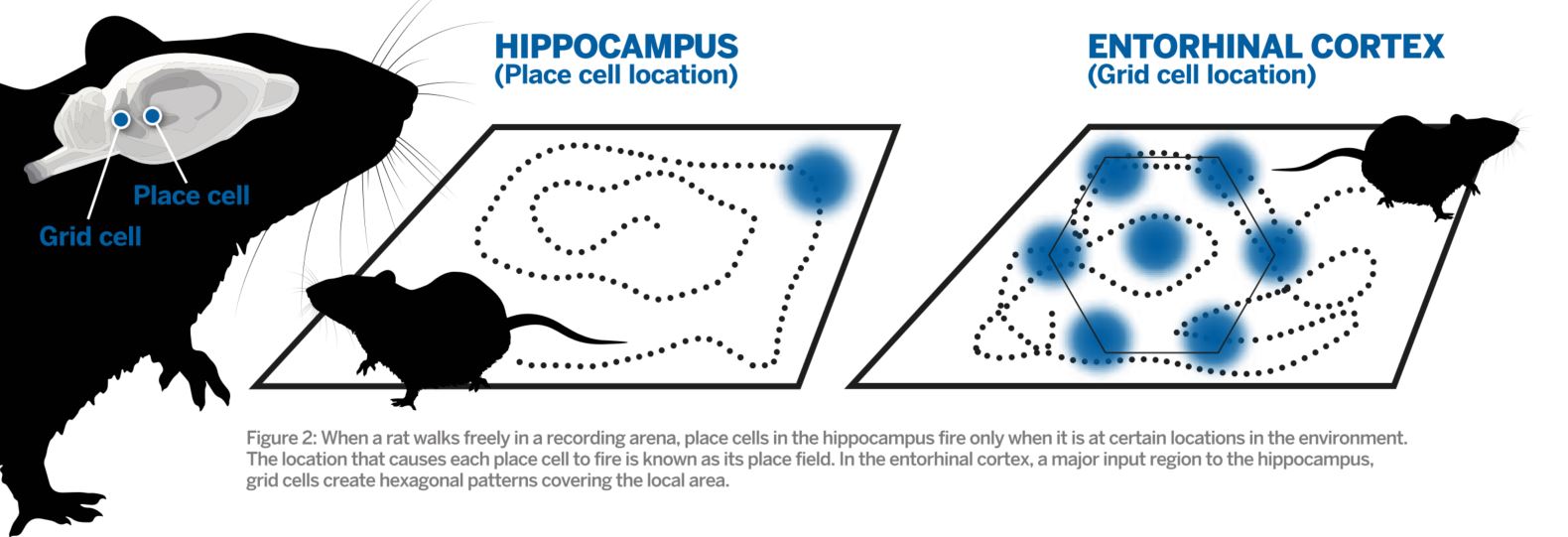
> And clearly we humans forget many of the sounds we have heard (e.g. songs, lyrics).>
It's true we forget many sounds, but songs and lyrics is a curious example. I'd guess those were high on the list of things humans are good at remembering… maybe #4 behind places, faces, and language in general? I've had pop lyrics and commercial jingles and theme songs rattling around in my head for decades, and I can easily sing them word for word. Something about a sequence of words put to a beat and a melody just seems to stick.
https://artofmemory.com/blog/how-to-build-a-memory-palace/
https://en.m.wikipedia.org/wiki/Dominic_O%27Brien
https://www.goodreads.com/book/show/9684328-you-can-have-an-...
I could probably make better use of my neurons than storing all the obsolete advertising jingles that still come to mind half a century later.
Lagniappe: https://www.youtube.com/watch?v=djMjYgqFrrQ
In the first week I was walking her and passed a bus stop mainly used by school kids. There's a small wall behind it and she dashed around and emerged with half a sausage roll hanging out of her mouth.
To this day, every time we pass that spot she enthusiastically pulls and goes round to inspect.