M2 pro: 8 performance cores + 4 efficiency cores.
M3 pro: 6 performance cores + 6 efficiency cores.
Not a great trade... I'm not sure the M3 pro can be considered an upgrade
Has the CPU industry really managed to pull off it's attempt at a bs coup that more cores always === better?
I thought we'd learned our lesson with the silly Mhz Myth already?
<< Depends. Is it faster? Then it's an upgrade. Has the CPU industry really managed to pull off it's attempt at a bs coup that more MHz always === better?
I thought we'd learned our lesson with the silly cores Myth already? >>
I agree with GP that we should rely on real measures like "is it faster", but maybe the goal of exchanging performance cores for efficiency was to decrease power consumption, not be faster?
Your reading comprehension needs work, no wonder you're unconvinced when you don't even understand what is being said.
The devil tends to be in the details. More precisely, in the benchmark details. I think Apple provided none other than the marketing blurb. In the meantime, embarrassingly parallel applications do benefit from having more performant cores.
It's one thing to argue that some real-world data might not be representative all on itself.
It's an entirely different thing to present no proof at all, and just claim "trust me, bro" on marketing brochures.
That's only rendering speed, and M3 Max vs M1 Max (not Pro). M3 Pro is only 30 percent faster:
> The 12-core CPU design has six performance cores and six efficiency cores, offering single-threaded performance that is up to 30 percent faster than M1 Pro.
Apple's PR release for M2 pro: "up to 20 percent greater performance over M1 Pro"
Apple's announcement for M3 pro: "up to 20 percent faster than M1 Pro" (they didn't bother to compare it to M2 pro)
Presumably it makes more marketing sense to compare to the M1 family up front because most people that bought an M2 last year are probably not going to be upgrading to M3. They are speaking to the people most likely to upgrade.
I’m currently at 4 to 5 years on laptops and 3 to 4 years on phones, and even then I hand them over to kids/friends/family who get a bit more use out of them.
Apple always comes from a position of strength. Again, they're saying as much as they're not saying.
Also, if they really cared about long lasting machines: slotted ram and flash please, thanks!
Expandable internal storage would be nice, yeah. But I get the sealed, very tightly packed chassis they’re going for.
Soldered memory allows higher bus frequency much, much easier. From a high frequency perspective, the slots are a nightmare.
Needless to say it has batshit insane implications for memory bandwidth.
I've got an M1, and the load time for apps is absolutely fucking insane by comparison to my iMac; there's at least one AAA game whose loading time dropped from about 5 minutes on my quad-core intel, to 5 seconds on my mac studio.
There's just a shitload of text-processing and compiling going on any time a large game gets launched. It's been incredibly good for compiling C++ and Node apps, as well.
The Dell XPS 17 is only 0.1 inch thicker yet has fully replaceable RAM and 2(!) m2 slots. I’m pretty sure what Apple is going for is maximized profit margins over anything else..
I understand the desire for slotted RAM, but the major limiting factor for nearly 10 years was CPU support for more than 16G of RAM. I had 16G of ram in 2011 and it was only 2019 when Intels 9th Gen laptop CPUs started supporting more.
The Dell XPS 17 itself has so many issues that if it was a Macbook people would be chomping at the bit, including not having a reliable suspend and memory issues causing BSOD's. -- reliability of these devices, at least when it comes to memory, might actually be worse and cause a shorter lifespan than if it had been soldered.
Of course it always feels good to buy an underspecced machine and upgrade it a year later, which is what we're trading off.
But it's interesting that we don't seem to have taken issue with BGA CPU mounts in laptops but we did for memory, I think this might be because Apple was one of the first to do it - and we feel a certain way when Apple limits us but not when other companies do.
On top of that, the higher-power laptop SKUs have supported 64gb or more since that time as well.
Secondly, it’s silly to claim that having RAM slots somehow makes a computer inherently more unstable. Typically these types of issues are the result of the manufacturer of the machine having bugs in the BIOS/EFI implementation, which are exacerbated by certain brands/types of memory. If you don’t want to mess around with figuring that stuff out, most manufacturers publish a list of officially-tested RAM modules which are not always the cheapest in absolute terms, but are always night-and-day cheaper than Apple’s ridiculous memory pricing.
[1] https://www.intel.com/content/www/us/en/products/sku/88190/i...
No Dell Latitude, Elitebook, Thinkpad X/T-series or even Fujitsu lifebook supported a CPU that was permitting greater than 16GiB of memory.
I know this because it was something I was looking at intently at the time and was very happy when the restrictions were lifted for commercially viable laptop SKUs.
Citing that something exists predisposes the notion of availability and functionality. No sane person is going to be rocking into the room with a Precision 7520 and calling it portable. The thing could be used as a weapon and not much else if you had no power source for more than 2hrs.
Also, socketed anything definitely increases material reliability. I ship desktop PC's internationally pretty often and the movement of shipping unseats components quite easily even with good packing.
I'm talking as if I'm against socketed components, I'm not, but don't pretend there's no downsides and infinite upgrade as an upside, it's disingenuous, in my experience there are some minor reliability issues (XPS17 being an exceptional case and one I was using to illustrate that sometimes we cherry pick what one manufacturer is doing with the belief that there were no trade offs to get there) and some limitations on the hardware side that limit your upgrade potential outside of being soldered.
> No Dell Latitude, Elitebook, Thinkpad X/T-series or even Fujitsu lifebook supported a CPU that was permitting greater than 16GiB of memory.
Here are the Lenovo PSRef specs for the Thinkpad T470, which clearly states 32GB as the officially-supported maximum, using a 6th or 7th gen CPU:
https://psref.lenovo.com/syspool/Sys/PDF/ThinkPad/ThinkPad_T...
This is not a behemoth of a laptop; I'm writing this on a T480 right now, which supports 32GB officially and 64GB unofficially, and it weighs 4lbs with the high-capacity battery (the same as the T470).
I can't tell if you're trolling or what, but if you're serious, you clearly didn't look hard enough.
Edit: since you mentioned Latitudes, Elitebooks, and Fujitsu lifebooks:
- Dell Latitude 7480 (7th gen) officially supports 32GB: https://www.dell.com/support/manuals/en-us/latitude-14-7480-...
- HP Elitebook 840 G3 (6th gen) officially supports 32GB: https://support.hp.com/us-en/document/c05259054
- For Lifebooks, I couldn't find an older one that supported 32GB, but this U937 has 4GB soldered and one DIMM slot which supports up to 16GB, for a total of 20GB, again, breaking the 16GB barrier: https://www.fujitsu.com/tw/Images/ds-LIFEBOOK%20U937.pdf
Any laptop which used LPDDR3 (soldered) typically maxed out at 16GB, but as far as I'm aware, this was due to capacity limitations of the RAM chips, not anything to do with the CPUs. For example, the Lenovo X1 Carbon had a 16GB upper limit for a while due to this. I believe the 15" MacBook Pro had the same limitation until moving to DDR4. But this is entirely the result of a design decision on the part of the laptop manufacturer, not the CPU, and as I've shown there were plenty of laptops out there in the ~2014-2016 timeframe which supported 32GB or more.
DDR4 support was introduced with the 6th gen Core (except Core m) in 2016, LPDDR4 support didn't show up until (half of) the 10th gen lineup in 2019. It's just another aspect of their post-Skylake disaster, wherein they kept shipping the same stuff under new names for years on end before finally getting 10nm usable enough for some laptop processors, then a few years later getting it working well enough for desktop processors. In the meantime, they spent years not even trying to design a new memory PHY for the 14nm process that actually worked.
The problem with Apple, however, is that their hardware will long outlive their software support. So if they really want to save natural resources by making long-lasting machines, they should put much more effort into sustained software support.
But, drivers are only available for win 7 and macOS High Sierra was the last supported version.
Luckily Linux still works great.
When my first Macbook lasted for more than 3 or 4 years I was surprised that I was upgrading before it died. I went through many upgrades with almost zero issues(one HDD failure, one battery failure). I still have a 2012 Macbook Pro that I've since installed Linux on.
When I bought the first touchbar Macbook (late 2015?) I spent around $6k maxing out the options, and I was surprised at how totally trash it was. Hardware QC issues were shocking: particles under the screen from manufacturing, keys stuck within the first hour of usage, external monitor issues, touchbar issues...
I haven't bought a laptop since.
They don't, but the difference is that Windows users generally don't know or care about processor generations. In contrast, it's common for Mac users to know they have an "old" Intel-based Pro, an M1 Air, etc., and to use that knowledge to help determine when it might be time to upgrade.
You can test this by asking Windows users what CPU they have. For the few who know and who have an Intel CPU, you can ask what their Brand Modifier¹ (i3/i5/i7) is. If they know that, you can ask what the 5-digit number following the Brand Modifier is — the first two digits are the Generation Indicator¹. I'd be surprised if more than 0.01% of Windows users know this.
¹ Intel's name
My interpretation while watching the event is that this is a company persuading x86 holdouts to upgrade to Apple Silicon, and maybe some M1 users as well.
Not at all. I've worked with FANG developers with brand new M1 MBPs that had no idea what 'm1' meant until something broke.
Apple likes doing that quite frequently while dumping their "up to X% better" stats on you for minutes.
I find it interesting how people respond to this. On one side, it’s marketing so it should be taken critically. OTOH, if they stress the improvements over the last generation, people say they create artificial demand and things about sheeple; if they compare to generations before people say that it’s deceptive and that they lost their edge. It seems that some vocal people are going to complain regardless.
> The 12-core CPU design has six performance cores and six efficiency cores, offering single-threaded performance that is up to 30 percent faster than M1 Pro.
I've got an M1 Max 64GB and I'm not even tempted to upgrade yet, maybe they'll still be comparing to M1 when the M10 comes out though.
https://images.macrumors.com/t/wMtonfH5PZT9yjQhYNv0uHbpIlM=/...
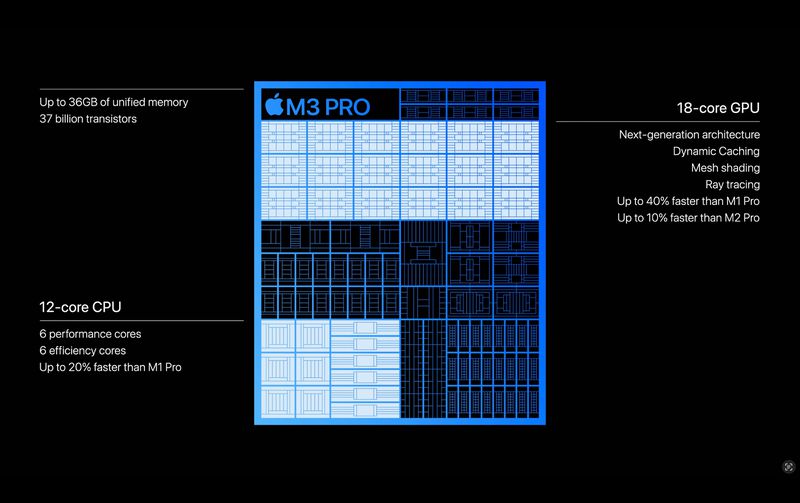
I thought this at first then I realized the cost-performance benefit gained from adding more cores often outweighs just improving the performance of single cores. I think this is what led AMD to create their Ryzen 9 line of CPUs with 12 cores in 2019.
That being said, I abhor the deceptive marketing which says 50% more performance when in reality, it's at most 50% more performance specifically on perfectly parallel tasks which is not the general performance that the consumer expects.
Apple's E cores take up ~1/4 the die space of their P core. If the M3 pro lost 2 performance cores but gained 4-8 efficiency cores it'd be a much more reasonable trade.
If you bought a $2k M2 machine and traded it for a $2k M3 machine, you may gain better battery life with no concessions, except for benchmark measurements (that don't affect your daily work).
$2K-3K is what my 3090/7800x3D sff desktop cost (depending on whether you include the price of the TV/peripherals I already own).
Minimum 8GB RAM is more universally egregious but I’m not going to sit here and justify my own exception whilst discounting the possibility that 8GB works for others.
To be fair– While 8GB is annoying– I've bought the M1 MacBook Air when it came out and it's remarkably resilient. I've only had it freeze a few times due to too little RAM.
I've also been using many different programs. I just have to be a tad mindful about closing tabs (especially Google tabs) and programs.
We've seen the same with Nvidia's GPUs going from the 10 to 20 series. If people don't perceive higher gains without compromises, they won't buy it.
Rather, some possible configurations effectively disappeared, so yes you get to pay a lot more if you only care about CPU performance and could have gotten away without the minimum 36/48GB RAM required to upgrade to the Max. But the full M3 Pro upgrade is now unbundled from the 1TB SSD upgrade, so maybe that SKU is interesting to someone.
    M2: 8 + 4

    M3: 6*1.2 + 6*1.3 =
        7.2 + 7.8
They do say the system overall is up to 65% faster, and has lower power consumption at the same performance level.
  M2 pro = 8*3 + 4 =28 (the *3 representing that the performance cores contribute ~3x more to total system performance than the efficiency cores)

  M3 pro = 6*3*1.15 + 6*1.3 =28 (apple claims 15% more performance for the p cores not 20%)
They don't claim either of those things. They claim the performance is 20% faster than the M1 pro. Interestingly, they made that exact same claim when they announced the M2 pro.
Energy efficiency might be better, but I'm skeptical till I see tests. I suspect at least some of the performance gains on the p+e cores are driven by running at higher clock rates and less efficiently. That may end up being more significant to total energy consumption than the change in the mix of p/e cores. To put it another way, they have more e cores, but their new e cores may be less efficient due to higher clock speeds. Total energy efficiency could go down. We'll just have to wait and see but given that apple isn't claiming an increase in battery life for the M3 pro products compared to their M2 pro counterparts, I don't think we should expect an improvement.
In summary, there is supposedly improvement in all areas so the reduced P core count doesn't seem to be a downgrade in any form as the OP suggested.
I believe this is due to the TB4 spec requiring support for two external displays on a single port. The base spec M series SoCs only support one external display.
I’d expect the ports to work identically to a TB4 port in all other aspects.
I'm sure there is some kind of technical explanation but both Intel and NVIDIA seemed to managed 3+ scanouts even on low end parts for a long time.
I mean, it almost certainly is? I would guess a majority of the low-end SKUs are rarely if ever attached to one external display. Two would be rarer still.
I can pick areas where Apple is beating Intel. Different products have different feature matrices, news at 11.
It does seem like a shame, though—Intel’s IOT department seems to try lots of things, but not get many hits.
they operate 100% on profitability, not what's technically feasible. They are extremely focused on making money. Yes, there is a reason after all.
Almost always it’s maximizing profit margins rather than anything else.
I recently went on a 5-day trip and forgot to bring the charger for my M2. The first day I thought I'd have to rush around and find one. By the fourth day I still had 8% and then finally realized I could charge it via USB-C instead of magsafe.
Just 2 would be enough. Which seems like a basic feature their competitors are are capable of supporting for a very low costs.
They in fact are competing on checkboxes, specifically they are probably using this limitation to upsell theirs more expensive models.
Some of them were trying out Apple Silicon replacements, though I'm not aware of what they did monitor wise. Probably used the excuse to buy a single large ultrawide each instead, though I don't actually know. ;)
MacBook Air is a world-leading form factor for travel, it's not "low-end". MBA can be ordered with enough storage and RAM to exceed the price of base MacBook Pro.
The travel form factor of MBA is not available for MBP, for any price.
Heh, that's not how I would describe MacBook Pros. ;)
Honestly, I'm an accountant and everyone in my office uses 2-3 monitors with $1,200 business ultrabook.
you're saying they're low-end because Intel? if you've got your macbook connected to two monitors, you're not very concerned about battery performance.
So isn't Intel silicon competitive speedwise? I thought the M[0-4]s were OK but sort of hypey as to being better in all regards.
I’d seriously consider not taking a job if they were still on Intel MacBooks. I appreciate that an arch switch isn’t a piece of cake for many many workloads, and it isn’t just a sign of employers cheaping out. But for me it’s just been such a significant improvement.
And even if you do not care about battery, you still care about throttling.
Real world, the M series chips are by far the best I’ve ever used as a software engineer and it’s not even close.
What dev shop immediately buys all developers the newest and shiniest thing as soon as its released without trialing it first?
At least at the time, things worked a bit easier having the entire pipeline (dev -> prod) use a single architecture.
(Overall the transition was super smooth, but it wasn't instant or without bumps)
If the company bought Pro or Max chips and not base models, it wouldn’t be a problem.
But with the general power of the base model Apple Silicon I don't think most dev shops really need the higher end models, honestly.
Those are harder questions to answer. We could assume Apple crunched the numbers. Or perhaps they just stuck to the status quo.
Only an insider or decision maker (maybe that’s you) knows.
But it’s a frustrating limitation and remains one of the only areas their old intel based laptops were better at.
I think it's weird though how far people go to defend Apple. It's objectively making (some) users worse off. Apple clearly doesn't care and the people defending them also clearly don't. But the affected users do care and "but money" isn't really a good excuse for them. It also doesn't solve their problem of not being able to use two external monitors anymore without spending significantly more money.
On the MacBook Air one output is connected to the internal display leaving one output for an external display.
(The Mac Mini that uses the same SoC is limited to 2 external displays for the same reason)
To support more displays they would have to add support for a second Thunderbolt bus to the base SoC.
The base-tier chips are designed as high-volume tablet chips first and foremost, with ultramobility crossover capability.
Using DisplayLink or certain kinds of thunderbolt multimonitor are possible while running outside the pixel pipe or running multiple monitors on a single pixel pipe (this is not MST which is multiple pixel pipes on a single stream). But yeah it's ugly especially on a base-tier processor with this eating cycles/dumping heat. You're running the hardware encoder at least.
Discord had this weird error if you tried to enable the screen/audio capture, it tries to launch something and fails and the solution is you need to manually install "airfoil" because it's an audio capture module that discord licensed. you don't have to fully install it but the audio driver is the part that discord uses and that goes first (has to be allowed as a kext, ie non-secure mode). theoretically a kernel-level capture like that could be a ton faster than userland, I think that's the on-label use of airfoil.
And to not support industry standard NVIDIA GPU on ARM Macs, too. 1 GPU typically supports 5 output over as little bandwidth as PCIe x1.
AMD is 6 displays. You see this rarely on consumer boards but the ASRock 5700 XT Taichi for some inexplicable reason did expose all six -- with four DisplayPorts to boot, too. I do not think there has been 4 DP or six output customer cards since.
I'm sure it's a marketing explanation: they make bigger margins on more expensive machines, and they need some feature differentiators to nudge people to move up. 2 extra displays is a poweruser/pro feature.
They make their own silicon, it's not like they're shy about designing hardware, if they wanted to stuff features into the lower end books they easily could.
Llama.cpp is a pretty extreme cpu ram bus saturator, but I dunno how close it is (and its kind of irrelevant because why wouldn't you use a Metal backend).
If you want to run larger models, then CPU inference is your only choice.
Also, not many implementations can even use it.
Is this because they are not populating all the memory channels, or just using lesser memory ICs?
If its the former... thats annoying. It just makes their products worse for artificial segmentation and very little cost savings.
Given that there has never been any public incidents about it and what we know about similar defaults I would be surprised if Apple is getting less than 95% opt-in rate.
But I suspect at high-end they only really care about the performance of a few dozen professional apps e.g. Logic or Final Cut. And at the low-end it's likely just efficiency.
A 95% opt-in rate is INSANELY high for any type of usage-stat opt-in, everything above 50% is usually outstanding.
What is known about "similar defaults"?
So there are people who were opted-in that change their minds. My friends and family opt-in rate is <50%. And most of them are non-technical.
To someone with experience in that area of UX, a 95% opt-IN rate is ridiculously high.
A 95% consent-rate would already be hard to achieve as opt-OUT.
For opt-in a 95% rate would require both attention AND consent from 95% of the audience at this stage in the setup wizard.
I highly doubt that it can achieve 95% attention, let alone 95% consent.
Anonymized stats from your machine? Most normal people (who don't use computers like we do) do not care and just click the most affirmative option so that they can move forward.
Every college kid has a Mac Book Pro, yet they are by definition not Pros
My dad can't tell apart Windows and Linux, but he makes sure to uncheck any kind of data collection, tracking, and clicks 'reject all' on every cookie warning
Normal people don't even give a second of thought to this. My partner knows the difference between windows and Mac, and is perfectly content to browse the internet without an ad blocker and to read in between all the cookie dialogs. The only time she clicks on one is when it's required to proceed, and she'll click whichever one is the most obvious button.
> But it's not quite opt in our opt out in this case. The user is required to opt for something. Apple literally has 100% attention, because otherwise the user can't move past the screen.
Thing is, you don't even have 100% of the users' attention in this case. The user wants to use the device, you're just standing in the way.
The scenario is this: You force the user to take a decision between option A and B. Regardless of his decision he will achieve his immediately desired outcome (move to the next screen / use the device).
Getting 95% to vote for 'A' would require some quite aggressive dark pattern, to the point that option 'B' would need to be almost invisible and actively discouraged.
Even if the UI would be a pre-checked check-box and the user would just have to select "Next" to Continue (=opt-out), your rate of consent would not be 95%. As mentioned, everything beyond 50% is already outstanding
Or, let's rephrase: If Apple would have 95% opt-in rate, they wouldn't bother chasing for consent again on every SW-update
And I've never heard people complain?
Genuinely surprised as it seems to be quite a commonly controversial thing amongst devs.
This calls out some soft spots that were exposed during the Hong Kong riots: https://www.youtube.com/watch?v=nQ9LR8homt4
It's not like it's enabled by default and you have to know to go and find the setting to turn it off or anything..
IMO that’s quite different to something that’s just silently on by default, and requires you to set an environment variable or run a command to opt out.
so you like them enough to pay them thousands for the premium product, but not enough to tell them how much CPU you use?
Could be “how much CPU does this user use?” but could also be “when prompted with a notification that a user’s iCloud backup storage is low, how long did they hesitate on the prompt before dismissing? How can we increase their odds of upgrading?”
Also, my willingness to provide information does not correlate to how much I “like” a company’s products. If I buy a sandwich from a deli, and they ask for my email for their newsletter or something, I won’t give it. That doesn’t mean I don’t like their company or their sandwich. Could be the best sandwich in the world, they don’t need my email.
That's not super surprising to me. Apple loves to charge stupid prices for storage and memory. Maybe it's worth it for lots of people to have the convenience of built in storage at the lower levels, but I have to imagine that most people would want 8TB of SSD would rather just get an external solution for... much less.
Wouldn’t do what? Intel has more E-cores than P-cores on most of their range, and especially on the higher end e.g. on raptor lake S the i9 all have 16 E and 8 P, the i7s have 8:8, only the lower end of the i5 (below 13500) have more P than E cores. And the i3 have no E cores.
The story is somewhat similar on mobile (H and HX), a minority of SKUs have more P than E, and none of them in P and U.
In fact that was one of the things which surprised me when Intel started releasing asymmetric SMT, they seemed to bank heavily on E cores when mobile and Apple had mostly been 1:1 or biased towards P cores.
Although that’s not quite true either e.g. on raptor lake H, the upper i5 (13600H) has 8 E cores while the low range i7 (13620H) has 4, but the i7 has 6 P-cores versus 4. The base frequencies also get lower as you move from i5 to i7. And you have less GPU EU (80 -> 64).
just contrasting this with the recent TR4 announcements from AMD, apparently their PRO variants top (theoretically at least) at around 325GB/s (non-pro versions are half of this), so just from that perspective alone M3 Max's might be better ?
i always have the naive assumption here that keeping the-beast i.e. the cpu fed with data is much better for overall performance than just clock-rates etc.
There's a reason they didn't just stick an A series chip in their laptops and call it a day - they want more performance even if it comes at the cost of efficiency. It's probably better to say that Apple is pushing performance within a relatively restricted power envelope.
Just to illustrate my point - if m3 had exactly the same performance as m1, but with 1/2 the power draw, I don't think many people would have been happy even if it would have been an amazing increase in computing efficiency.
I dream of a world where instead of a marketing company becoming a top 3 tech company, a tech company would have. Wonder what they would have done for their laptop...
Or maybe this is just an inevitable outcome of capitalism/human biology where a veblen goods company will become a top player in a market.
(I have my own Google and M$ complaints too)
I dunno, if a there was marketing company that could design the likes of the M series chips along with the mobile versions, develop a full technology stack from programming language and compiler, custom chips, through to shipping whole devices at unimaginable scale would make me wonder what technology companies were doing.
What other “tech” company really compares from a hardware perspective? Samsung? Dell? AMD? Love them or hate them, there’s no denying that Apple has serious technical chops. One day people will only hate Apple for reasonable things, today’s not that day apparently.
Obviously, other people care.
There are very few companies that have as much first party Tech in their products from start to finish.
I think Apple under prioritizes sdvanced functionality but if they’re not a Tech company than it’s hard to see what is.
I think Apple plays the "niche" very well, not only regarding marketing, but also from a techs view.
Of course I have no idea why am I taking the effort to respond to an edgy single word comment…
An obvious rule of thumb is for "Pro"-branded laptops to only use "Pro"-branded chips. It's what they follow for the iPhone lineup, but I suppose iPad Pros also use non-Pro chips. Just seems like a very confusing SKU to create, and definitely something Steve wouldn't approve of.
And yet, the MBA's screen in comparison is serviceable and nice, but nothing outstanding. That's the case for the MBP 14 (when the 16 is just too large and bulky).
absolutely not... working for 10 years on 13/14 and never _felt_ that way I get this is personal ;)
Look, I'm a 16" guy myself, I even carried one of the 17" cafeteria trays back in the day… but it's clearly the sweet spot for _most_ people.
I'm more confused about the "M3 Pro" variant. Its performance either seems to be overkill or not enough. A more sensible lineup to me would be:
M3 - 2 thunderbolt ports, dual monitor support, memory up to 8-24gb (2x4, 2x6, 2x8, 2x12, 2x16). In the MacBook Pro, always comes equipped with second tier upgrades.
M3 Max - 3 thunderbolt ports, quad monitor support, 32-128gb (8x4, 8x6, 8x8, 8x12, 8x16).
Then again this wouldn't let Apple upsell people on basic functionality like dual monitor support so they'll never do this.
Now it’s clearly, if you really need perf you get an M3 max.
- Note that memory bandwidth is down. M2 Pro had 200GB/s, M3 Pro only has 150GB/s. M3 Max only has 400GB/s on the higher binned part.
- Just like the low-spec M3 14" has one fewer Thunderbolt port, it also doesn't officially support Thunderbolt 4 (like M1/M2 before it)
- The M3 Pro loses the option for an 8TB SSD. Likely because it was a low volume part for that spec.
- The M3 Pro actually has more E-cores than the Max (6 vs 4). Interesting to see them take this away on a higher-specced part; seems like Intel wouldn't do this