In high school (gawd, 30 years ago now), we had to memorize the opening of Canterbury Tales in Old English. I can still recite the first few lines. Why? What was the point of forcing students to do that? It's taking up precious space in the very limited memory banks. Instead, I can't remember if the arguments for the explode function has the string then the separator or the separator and then the string.
Some schooling focuses way too much on rote, memorization, etc. But........
IMO, we often get the main point of education wrong. It's not so much direct transfer of useful skills or a body of information-- though these are still important. Instead, I think the ability to be disciplined, systemic, and learning how to learn things and accept challenge should be the main goals.
On a limited basis, practicing the skill of memorizing poetry and reciting it to a class can be a useful exercise. Now you know you can do that, how to do it, and about how long it's going to take. You were also forced to engage with that particular content in a deeper way than a casual, unmotivated reading by a high school student would have resulted in: the overall cadence and structure is cemented in your head as much as the very words.
Education used to be very memorization and recitation heavy. Leaving a little bit in seems useful, even though it was the kind of thing I hated most as a kid.
The thing that I appreciate most about the teachers and the curriculums taught was that they taught me (I would say us refering to all students, but don't want to presume) was how to learn. I should say, the math/science classes did this. The history/literature classes were all rote memorization BS. I did not like those classes an did not do well in them. However, the other classes where I learned how to learn allowed me to become what has been labeled "a self-learner". I can read subject material a few times, experiment, and then "know" it well enough to function. Practice and continued use makes for much better retention than rote memorization. I used to ask teachers for anything that was still unclear, now it essentially is replaced with SO searches.
One learns how to learn. New material is learned faster and more accurately. One also learns what parts to focus on, and what parts can be dismissed, which helps learn more efficiently.
A thousand times this! School is obsolete by construction if we only learn specific skills, which might not stay relevant for long. Learning how to learn is the truly useful thing that a good school should provide.
I am baffled by all the comments about how children should learn <specific skill someone think is important>. How useful would have been an education where arithmetics would have been focused on how to use slide rules? And yet, that was a practical, critical professional skill for quite some time.
It also gives one an appreciation for calculators. It's like learning to use hand tools before machine tools. Hand tools impart a feel for the material being cut that pays off when using machine tools.
Would you teach kids today to use a slide rule? It seems hard to justify for the benefit in intuition about exponents/logarithms.
Yes, I'd teach kids to use a slide rule. It's not necessary for them to become expert at it, just get comfortable with it.
Why learn exponents? People will never learn compound interest without getting comfortable with exponents. Not learning compound interest will forever financially cripple them. Hell yes, it's worth while.
My accounting class was taught by a former used car salesman. He'd tell me stories about how poor people made very bad choices in financing, and when he'd explain how compound interest worked, they'd assume he was trying to cheat them.
For me personally, knowing math and trig, etc., has provided me a lifetime of payback. Very, very worth it, in dollars and cents.
I don't think you cultivate the kind of intuitive understanding of exponents and logarithms you're describing with a few minutes of casual practice with a slide rule.
My first semester at Caltech had slide rules in the bookstore for $125 (mebbe close to a grand today). By the end of the semester, they were $5, and disappeared by the 2nd. I've never seen a tech revolution hit so hard and so fast.
The trouble with calculators is they impart no feel whatsoever for the math behind it. You get a string of 10 digits that is "The Answer". People get led astray by that all the time, including professionals. It's amazing how these people defend obviously wrong results because the calculator gives "The Answer".
Graphing calculators used to be nice to occasionally use to help build an intuitive sense of the "shape" of a function. Now I often use Desmos for the same thing.
I was a long term sub for 8th grade science a couple years ago. It was fun to use Desmos for linear regression as they collected data points-- to see how each point changed the line of best fit before these students had learned L.R. in any rigorous way themselves. It made students excited to get each next point in our experiment and make predictions about whether they believe the line, etc. (And whether we can safely extrapolate past the data we have...)
In the competitive math series I coach, one of the 3 rounds allows calculator usage. Usually using the calculator is a trap instead of doing something clever, but sometimes the calculator is the best way. I think it's kind of neat that they built it this way, because it requires building the intuition to realize whether you're really facing a problem that is purely calculation.
Over in microeconomics... we draw budget curves, and all the operations on budget curves are a whole lot like operations on production possibility curves, so there's a lot of skill transfer.
We spent 2 class periods on PPCs, and 10 minutes on budget curves. My students better understand how to learn economic concepts, and they have a closely related skill that they can adjust for the new task.
Every lesson, we're accelerating.
Me, I had a good chuckle over that. I kept all my college textbooks except the econ one, which went in the trash.
I would rather be teaching this material with calculus and not just handwaving and saying "the marginal revenue curve is twice as steep as the demand curve!"
But they're going to pass an examination where it's all done algebraically and visually.
[I DO THINK there's some value in taking these algebraic and visual approaches, but there comes a point in the class where they get rather awkward].
I've already told students many times we're going to find the area of shapes on this graph, where I'd actually just subtract the curves and take a definite integral.
And the graphs are a really, really nice visual for the subject matter. Being able to point to consumer surplus, producer surplus, tax revenue, and deadweight loss as regions on the graph means you know how all these curves relate. But then we end up doing all this awkward not-quite-calculus stuff.
Maxima and minima were certainly one issue because that required calculus, however simple a form thereof. I'm not sure even the simplest formulaic version ever got through. But we're taking about totally not getting solving simultaneous algebraic equations and one student told me I needed to explain "graphs" so it was all mostly a hopeless project.
Yup-- College Board's preferred approach here is memorization. You get -this- maxima when MC=MR. You get this -other- maxima when MU=0. You get this -other- one when Ed = -1.
Don't even get me started on "this number is always negative, so we'll just pretend it's positive sometimes-- though when you do a related calculation, make sure you preserve the sign!" (elasticity of demand vs. other elasticities).
MBA programs have changed a lot since I did one. But math was definitely the real killer for a lot of first-years. STEM undergrads had it a lot easier.
I agree, but if they go to my room learning a bunch of rules-of-thumb for maximizing economic functions... and then go down the hall to math class and are learning how to optimize by finding places where the derivative is 0... it's kinda silly.
I also found it gave us a more 'self learner'/ 'figure it out' attitude. Contrasting with a lot of my peers and younger, it seems like 90% of what they ask is just a google away... Also, being able to reason about unknown error messages or system behavior seems to be a challenge for a lot of them.
In between stuff is weird, it’s where people complain about ‘politicizing science’ and ‘being fed up with experts’, etc. It’s where the wavefront of known facts changes too quickly for any kind of mass education to catch up.
Although, especially in high school but to a more limited degree in intro level college courses as well, you still end up memorizing a lot of formulas in a course like physics--one issue being that you probably haven't taken the calculus yet that you need to derive those formulas. Of course, you often end up knowing formulas you use all the time off the top of your head anyway. But you presumably could derive a lot of them if you had to.
https://www.google.com/url?sa=t&source=web&rct=j&url=https:/...
So, for background, I am now a teacher. This year, I'm teaching:
* Middle School: Competitive math (MathCounts), Competitive robotics (FTC), Intro to Circuits (undergraduate EE curriculum slightly simplified and slowed down), Mechatronics Lab (3D design, embedded software, and controls).
* High School: AP Microeconomics (College level economics course), Competitive robotics (FTC), Spacecraft Systems Engineering (hoping to get a launch grant to put a small satellite in orbit).
* Clubs: HS Investment club, HS Space club, upper elementary math and robotics clubs.
I'm all about things being student led and student owned; this is especially true in my team classes (robotics and math). Even the others, I try to attain this to the extent possible.
On the other hand... Look, we've got a few hundred bodies around. We need a bell and to know where students should be. And my students do need to learn to work on things that are not necessarily their first choice of what to do, because for a lot of students this would be Fortnite 24/7. And for a lot of subject, there are pieces of information that are useless on their own until you've built a whole conceptual loop around them.
The piece makes an argument for market forces. Unfortunately, market forces often push things in the "wrong" direction. Parents want their kids to take lots of AP classes because it is helpful to get into college and also saves college tuition. But I feel like the microeconomics course I'm teaching is a lot worse than the one I'd teach on my own... I dare not stray too much from the dictates of the College Board, though, because students need to pass that test. Parents also like "rigor" of students working meekly and quietly because it seems like it's a quality signal (and it often is, but too much of anything is crap!).
What we really need is:
* Rigorous, controlled educational research so that we can know what works and what doesn't in what populations. Spoiler: everyone is just making it all up as they go along or, at best, following new educational trends with very little research support for them
* An educational system that actually respects and implements that research.
* Respect, safety, and adequate resources for teachers. (I do extraordinary things with my classes in large part I teach in a very easy environment-- from class sizes, organizational support, resourcing, and student behavior).
is a two way street. Teachers routinely blame the parents for any failures in the classroom.
> safety
absolutely.
> adequate resources
I never learned more than at Caltech where the material was taught with blackboard and chalk, and the students used pen and paper.
> is a two way street. Teachers routinely blame the parents for any failures in the classroom.
I teach in a great environment, but my public school peers are frequently berated by parents of students that complete no work.
Even in my environment, I am pretty constantly "talked down to" by parents-- there's the implicit assumption they're better than me. I have enough confidence from past successes in industry and life to shrug it off, but I could easily see it becoming demotivating. Someone with my skills can easily find more lucrative and less challenging work.
> > adequate resources
> I never learned more than at Caltech where the material was taught with blackboard and chalk, and the students used pen and paper.
I teach computer engineering with pen and paper.
I mean things like "a living wage", "time to prepare for your classes and go to the bathroom", "not sticking 40 middle school students, including many with severe behavioral problems, in one room", and "not having to buy pencils and other necessities for your students with your own money".
There's also a whole lot of nice-to-haves that make a difference. The $15 set of refillable whiteboard pens that have a very wide nib and make huge dark lines are very useful, but ain't no public school teacher going to get those over worn-out Expo markers. Candy bribes and stickers used judiciously as prizes to fuel classroom competition make a difference. Etc, etc, etc.
Sure, there are rotten parents. No excuse for them. But I'm talking about a general disrespect teachers have for parents. This is manifested in not wanting any input from parents, not wanting to hear from them at PTA meetings, not consulting parents in any way shape or form about the curriculum. Teachers do want parents to volunteer, but only at their direction. No collaboration.
As for pencils and paper, pencils cost a few cents each, and the playgrounds of the schools I attended were littered with pencils. Paper is so cheap people throw away reams of unused paper all the time.
Me, I prefer the more expensive $5 gel pens, but they'll last me a couple months each.
P.S. My dad taught at university for years. He grew up in the Depression, and his thrifty ways followed for the rest of his life. He'd bring home used paper - such as exams printed on one side of the sheet, and blank the other side. His notes and drafts and accounts and tax records were done on the blank side. I have many boxes filled with those papers. When they were inadequate, he'd buy boxes of newsprint, the cheapest paper possible, and write from edge to edge in tiny script. Nobody could get more out of a piece of paper than my dad :-)
It's easy to blame teachers for this, but in public schools generally greater than 100% of instructional time is already spoken for. Administrators and regulators are heaping requirements upon teachers to cover material. Then, because not enough time is allotted, the only option is to cover it badly and quickly.
Also, because many teachers have inadequate planning and grading time, it gets really tempting to do what you did last year; veteran teachers tend to work >125% of contract hours already.
I'm open to collaboration. Unlike most teachers, I have a lot of flexibility in how I run most of my classes. But AP Microeconomics? Pfft. I don't have the luxury of caring what your suggestions are about how I run that class. I have 34.5 equivalent-block-periods of material to cover in 35.5 equivalent-block-periods, and I'm sure there will be a fire drill or something that I need to reteach that will claim that buffer.
This is just a snippet of the high level plan (lesson plans go into greater detail), showing how I'm forced to think about a class where there's explicit heavy curriculum requirements: https://i.imgur.com/YQk5LBP.png

> As for pencils and paper, pencils cost a few cents each, and the playgrounds of the schools I attended were littered with pencils.
That's nice. You are still trying to shame someone who is making below a living wage to purchase it, and many other things, for other peoples' children.
You can't expect respect for that. (BTW, other teachers have told me their reason for not caring about parental input is they were trained professionals and parents were ignorant fools.)
> You are still trying to shame someone who is making below a living wage to purchase it
$4 to supply all your students with pencils. You brought up the pencil thing. Besides, you should move to Seattle where public schoolteachers make 6 figure salaries, have a pension for life, gold plated health insurance, and 2 months off per year.
> You can't expect respect for that.
Rock vs. hard place? If I go off track in one of these classes where curriculum is tightly specified, quantitative indicators nosedive and I get crucified by parents.
> Besides, you should move to Seattle where public schoolteachers make 6 figure salaries, have a pension for life, gold plated health insurance, and 2 months off per year.
I make ~$59k/year for a 104% teaching load in the San Francisco Bay Area.
Teaching my circuits class, I've bought a few hundred dollars in soldering irons and integrated circuits and breadboards for my classroom. The school borrows my old digital storage oscilloscope and other tools. I also end up pitying the robotics teams and buying them lots of stuff.
I got rich in industry so this works OK for me, but...
And yes, if I went and got a master's degree, I could make a bit more in public education, in exchange for a much worse classroom environment and lower level of respect. Still would be nowhere near the pay I could get elsewhere.
I see that pencil trope all the time. In Seattle, they run a school supplies drive every year and pencils figure prominently on the donation list. This is a school system that spends $16,941 per student, and yet begs for $.05 pencils.
"San Francisco Unified School District spends $17,464 per student each year" sez google. I infer your complaint is misdirected at the taxpayers, and should be with mis-spending by the school administrators.
Read actual teacher accounts of what they spend kitting out their classrooms.
And yes, public school systems spend massive amounts per student, and then still expect charity from everyone: employees, parents, the community, etc, to fund normal operations and provide normal supplies.
Your digs at mandated curriculum, how cheap the supplies are, etc... are really beside the point. They're like yelling at the front-line customer service rep who has no power to affect the things that concern you.
Public school systems are often kafkaesque. Classrooms with 40 students; administration that externalize all problems to the teachers and refuse to address behavior problems; IEPs for 20 of those students mandating "preferential seating" and individualized teaching interventions. Curriculum that is garbage and overspends classroom time. Asking teachers to develop massive amounts of materials themselves. Or alternatively to only use provided material with no enrichment. Sometimes alternating between opposing harsh policy lines every few months.
Yes, there's some moderately high comp'd teaching jobs out there (lol not mine) and some situations which fare better on respect and autonomy (like mine). But if it were such a sweet gig, we'd not have teachers leaving the field in droves and a shortage.
[And the intrinsics of the job itself are wonderful-- teaching successfully feels great. You really have to try hard to screw it up to make teachers miserable, and that's what our society does].
> Asking teachers to develop massive amounts of materials themselves.
Another thing I cannot comprehend. How many 5th grade teachers are there in the US? 10,000? How many lesson plans have to be developed? 10,000? This is absurd. Any other industry would share lesson plans. Teachers also tell me that each summer for their grade, they have to develop the 5th grade lesson plans all over again. I asked why not reuse last year's? One teacher told me she had to customize them for each student. I asked her how she could customize them over the summer when students weren't assigned to classes until school started. She didn't reply.
> You really have to try hard to screw it up to make teachers miserable, and that's what our society does
More like that's what socialism does. The public schools are a service provided by the government, and exhibits all aspects of socialism. Your observation that the public schools are Kafkaesque is right on target. More money will not fix them.
Something doesn't add up.
The school is perfectly capable of getting pencils. The local public school teachers get $150/year for supplies and classroom decorations for ~30 kids. And they get yelled at if their room ends up looking spartan.
> Any other industry would share lesson plans.
Yup! We have things like teachers-pay-teachers where you can make a few bucks sharing lesson plans. We have some districts that give teachers a small amount of funds to use this.
We have other districts forbid teachers using any resources not provided by the district or the teacher themselves. Often "quality concerns" are really code for "we want someone local to blame if there's something in the material we don't like".
> Teachers also tell me that each summer for their grade, they have to develop the 5th grade lesson plans all over again.
The main reason you need to do this is if there's a major schedule change or upstream curriculum requirement change. Though, it's reasonable to plan to throw away 20-25% each year for other reasons.
For my classes, there's a lot of drift. I don't need to teach as much basic material in the robotics programs because I have veteran students and a lot of the knowledge spreads by osmosis. In turn, I need to e.g. figure out how to tell a bunch of 7th and 8th graders who haven't had linear algebra yet about state estimation filters this year.
Also, ... cookie cutter using common curriculum isn't great. My school purchased me the "best" set of economics slides. There's a lot of stuff I can get across clearly in a fraction of the time. There's other stuff that I feel I need to hammer harder, and have to cobble together other materials and my own creations to fill that in. I'm adjusting things for the specific class that I have (e.g. a very math-strong econ class this year), and I'm adjusting things for my specific strengths and weaknesses in lecturing to the class.
Finally, if you just try to duplicate last year's class, it's probable that you won't have the energy of presentation and excitement and effectiveness. You need to have new lessons to look forward to and some degree of discomfort / newness that you're experiencing with the class to be the best possible educator, I think.
> More like that's what socialism does. The public schools are a service provided by the government, and exhibits all aspects of socialism. Your observation that the public schools are Kafkaesque is right on target. More money will not fix them.
Again, you're not arguing with what I'm saying. I've already acknowledged we spend lots of money on schools for the most part. On the other hand, teachers from other countries with public education mostly shake their heads at what public school teachers in the US need to deal with.
The grass is always greener effect, and who knows what really is happening in foreign schools without being there. They may be just telling Americans what they want to be true. A more interesting comparison is with local charter schools.
> We have other districts forbid teachers using any resources not provided by the district or the teacher themselves.
Haha, just use them anyway. It's not like they're going to check. Besides, the teacher can reuse what he used last year, or copy one from a fellow teacher. There ought to be quite a surfeit of materials from other 5th grade teachers in the same district. There ought to be lesson plans coming out of their ears if each teacher was redoing them every year.
Most teachers I had just followed the Teacher's Edition of the textbook. I didn't see any evidence of lesson plans.
Perhaps in high school things change from year to year, but they can't be changing that much, and why would 5th grade math change?
Personally, I rarely reuse lectures I give. This is because the technology changes constantly, my old lectures are available online, and when I get invited to speak and the conference is paying the bill I think it's disrespectful to use old material. Also I just get bored with what I did before :-)
I never directed a complaint at the taxpayers-- though it should be directed at the voters. Society expecting/normalizing teachers to pay for supplies out of their own pocket is the problem.
Education keeps getting more and more expensive and lower and lower quality across the board. Especially in universities, but also in K12. Administration and waste gobble up more and more.
It seems like your responses expect teachers to paper over all the systemic problems. Their employer demands they teach excessive amounts of curriculum? Well, they'd better listen to parents, too, even if this is impossible, or else get no respect! School districts don't actually buy supplies or resource classrooms sufficiently? Well, teachers had better fix that!
The solution is, and you know this is coming (!), free market schools.
A half-step in that direction are charter schools, which the teachers unions fight tooth and nail.
I've never talked with a public school teacher who had anything positive to say about charter schools.
If teachers are shamed into buying supplies for their room, it's not propaganda.
> A half-step in that direction are charter schools, which the teachers unions fight tooth and nail.
Charter schools are pretty complicated from a policy perspective. We're not talking about the same thing in different states. Some of the for-profit charter schools are much worse than public schools. Other areas have sane regulatory regimes that result in an OK product.
Even there, though, students in charter schools do not do better than students who applied for the school but didn't win "lotteries" to get in. That is, the performance benefit seems to mostly be tied to selection effects relating to parental involvement.
> I've never talked with a public school teacher who had anything positive to say about charter schools.
Welp, I'm not a public school teacher, but there is a decent charter school in town.
If you don't want to give up on special education, this is difficult to do.
I favor policies like vouchers for ~33% of public educational cost to be used at private institutions. This is enough to make private education more affordable to many more families (especially with institution financial aid), but could possibly increase resources-per-student for the remaining students in public schools.
If you want to do this at a public school, you're going to need to go get a specialized master's degree and teaching credential. Of course, there's some value in what's taught in these programs (pedagogy, classroom management, practical experience, etc). I've studied rather intensely on my own.
Feynman, perhaps the greatest physics teacher ever, had 0 teaching credentials. I attended one of his lectures long ago, a privilege I didn't realize until much later.
I highly respect you, and we seem to talk here a lot. But you have this habit of holding up various edge cases that don't quite directly relate to what we're talking about as "gotchas".
I have 0 teaching credentials, too, and think I'm pretty great. The current systems we have for younger students require teaching credentials, and there's some good reasons to require some education-in-education before letting someone teach kids.
::: It's easier to pick a good teacher than to train one: Familiar and new results on the correlates of teacher effectiveness
Neither holding a college major in education nor acquiring a master's degree is correlated with elementary and middle school teaching effectiveness, regardless of the university at which the degree was earned. Teachers generally do become more effective with a few years of teaching experience, but we also find evidence that teachers may become less effective with experience, particularly later in their careers. These and other findings with respect to the correlates of teacher effectiveness are obtained from estimations using value-added models that control for student characteristics as well as school and (where appropriate teacher) fixed effects in order to measure teacher effectiveness in reading and math for Florida students in fourth through eighth grades for eight school years, 2001–2002 through 2008–2009.
Research highlights ▶ Majoring in education is not associated with teacher effectiveness. ▶ University attended for college is not associated with teacher effectiveness. ▶ Acquiring a master's degree is not associated with teacher effectiveness. ▶ Teachers become more effective with a few years of teaching experience. ▶ Teachers may become less effective later in their careers.
https://www.sciencedirect.com/science/article/abs/pii/S02727...
It doesn't mean taking more people without teaching credentials results in an equal or greater quality of education.
e.g. I am a high school dropout who's doing pretty-damn-well at teaching. I do not think this means we need more high school dropouts teaching, though.
I've learned a whole lot reading the pedagogy literature and reading about the kinds of strategies that credentialed teachers are required to learn during their practicum and student teaching. It's difficult to imagine that these courses of study are not useful.
(The research does probably mean that programs intended to incentivize existing teachers to get graduate degrees are probably flawed, except for some special cases in e.g. secondary math education)
I agree that specialized techniques help with specific learning disabilities, I've seen it in action. But for ordinary kids (the vast majority), the teacher just walks through the textbook for the class. The smarter kids just read the textbook and learn it themselves, as the teacher is moving too ssllooooooowwllyy.
Frankly, the teachers didn't know what to do with me. Some wanted to be rid of me. Some liked me. I don't recall learning much from any of them.
My history teacher would show Mr Magoo movies. I'm not kidding. My auto shop teacher would show drag racing newsreels. I did like my wood shop teacher. He taught me how to use machine tools and not cut my fingers off (he'd lost his in a table saw). That's paid off dividends for me my whole life since. But I don't think that required special teaching training. I learned how to use metal working machine tools in college from the head machinist, who simply enjoyed showing me how to run them.
IMO: This is a terrible way to teach. Even for very highly curriculum-driven classes like the microeconomics class I'm teaching.
My block periods are 1 hour 16 minutes. This is a long, long time to be giving dry lecture or popcorn-reading a textbook.
Bell-ringer activities and exit tickets. Gimkit to break up long lectures and get an instant reading of mastery. Appropriate strategies towards looping and unit construction. Pacing, formative vs. summative assessments.
Just how to effectively create discussions is tricky. Everyone looked a bit zoned out when we're talking about consumer surplus. "EVERY SINGLE ONE OF YOU HAS EXPERIENCED CONSUMER SURPLUS." Huh? "EVERY SINGLE ONE OF YOU HAS EXPERIENCED CONSUMER SURPLUS. Tell me when!" a few seconds of silence... eventually "Uhm.. there was a thing of candy and it had 4 pieces, and said 25 cents on it. I thought it was 25 cents apiece and I brought a dollar to the counter, but I got 75 cents back..." "Boom! That's 75 cents of consumer surplus!" Cue everyone sharing their concept of it and internalizing it when I had been losing the whole class.
I didn't have training. But I did have a year where I didn't have many classes to teach and I had a very masterful teacher on the other side of the wall and I could listen to him and learn some of what he did. And I've read a whole lot about pedagogy and research from the National Training Laboratories about what are best practices.
> My history teacher would show Mr Magoo movies.
lol. I'm about to show a 2 minute clip from a cartoon where a shopkeeper says that it's Christmas Eve and that they're going to "jack the prices to the moon" because the customer has no other choice to illustrate elasticity of supply and demand.
> He taught me how to use machine tools and not cut my fingers off
I teach robotics, and that means teaching the use of machine tools to middle school and high school students that have no common sense. It is stressful. I agree no one trains you for that :D
Clearly, some teachers are better at it than others. But if anyone did a study and found that Masters in Ed teachers did a better job than Bachelors in Ed teachers, I'd be genuinely surprised.
That depends on what you mean by teaching. Explicit formal instruction with at least some attention to abstract principles is basically unknown in non-literate societies. People are generally terrible at it without experience. Observational learning is something people are amazingly good at, and language helps a lot but teaching isn’t even a universal in human societies. Watching and learning with occasional, minimal correction is.
Anyone who wants to learn more should read The Anthropology of Childhood by David F. Lance.
Many parents teach their preschoolers the basics of reading before they enter school. Those parents have no special skills. My parents taught me arithmetic as a preschooler. My 8th grade teachers were still trying to teach the kids the multiplication tables.
(Personally, I suspected those kids knew the tables, they had just figured out that they could keep the teachers stuck in a loop by pretending to fail all the tests. This way they would not have to learn any more advanced material like fractions AAAAAIIIIIEEEEEEEE!!!!! This looping business was made abundantly clear to me later, when other students bragged to me how they snookered the teacher into failing to advance.)
I've spent my whole career "teaching" in that sense. Explaining things, mentoring junior engineers, etc.
There's definitely skill transfer from that, but it's a bit different of a thing to try and take 25 12-year olds of vastly different backgrounds and ability for a year and get most of them to master a given curriculum.
I missed the first 3 months of 4th grade. The teacher told my mom that they had advanced very quickly, and I could never catch up. I would have to be put back in 3rd grade. My mom said nope, Walter is going in 4th grade.
It was as if I wasn't gone a day. 4th grade had not advanced one iota. Not much to show for 30 hours of instruction per week for three months.
College was a bit different. They blew through 2 years of high school physics in a couple of lectures. This was a tremendous shock to me, and frankly terrifying. I learned I could not afford to miss one lecture, or even be late, let alone 3 months of them.
Three things:
* The normal pace anywhere -- even most colleges that are not CalTech or MIT -- is for chumps. It's slow so that everyone can keep up.
* On the other hand, I don't think your experience is representative of current middle class (and above) schools. Students complete a whole lot of what was previously considered college curriculum before graduating. Many of the students at my school graduate with >1 year of college credit, and this is despite the non-remedial curriculum floor in colleges moving up from decades ago.
* I don't think you can generalize your experience. You are very intelligent. Your experience (and mine) are not representative of overall student performance or problems.
What also made it fun was the interaction with the audience and I'd just go where those interactions led.
I don't do this normally, because everyone expects slides, and the conference organizer provides no mechanism for blackboards.
Also, blackboards are problematic for a larger venue, they work best in a normal sized classroom.
It should be a little unpredictable what class will be like each day.
when i studied engineering i also memorized commom values to speed up problem solving. I think everyone does it to some degree. Some deliberate practice while you're developing basic skills isn't a bad thing imho.
"What college degrees teach you mostly is how to think." "We miss the actual point which was learning to memorize." "Playing chess teaches you how to plan and think."
Well no. These were never mentioned as the goal. If the goal is to learn how to study, how to memorize, how to learn, then present it a so, focus on it.
The goal of memorizing the opening of Canterbury Tales in Old English, definitely wasn't to learn how to memorize. Maybe that was a secondary or tertiary goal. It definitely would never be mentioned as a goal in itself.
It seems like now that we had to invest our time in close to useless things, we try to find reasons why it wasn't so useless. School is extremely inefficient. I studied way, but WAY more things I'll never use, or want to use in my life again than the opposite. Education nowadays is like using a shotgun to kill an insect. One thing that's good in software engineering, as opposed to other engineering fields is that it's maybe more focused and applied. But in Mechanical, I studied so much stuff, and now I use less than 5% of it. And the argument that I hear from my colleagues "Oh but you learned how to do complicated math, how to study hard, and understand difficult concepts" just doesn't stick. It's been shown that this kind of training helps you at that task, and little else.
From a 2016 review by Simons et al:
“We find extensive evidence that brain-training interventions improve performance on the trained tasks, less evidence that such interventions improve performance on closely related tasks, and little evidence that training enhances performance on distantly related tasks or that training improves everyday cognitive performance.”
See https://www.scotthyoung.com/blog/2022/09/13/brain-training-d...
I teach, among other things, robotics classes. I'm rather explicit that students will learn things about kinematics and mechanical construction, programming, etc. But that these are also the easy parts. The class is really about organization, project management, dispute resolution, and time management. It's about being systematic and making small changes and figuring out where to pitch in to improve the team's progress.
And yah, there's a lot of time spent studying and memorizing rules in a rulebook. Because it helps our performance in our season... and because learning and juggling lots of requirements is stuff students will likely have to do later.
Most of these students will never use inverse kinematics again. It's the "hook" that interests them right now and gets them to practice the other things. They definitely will not use the FIRST rulebook again. But I feel like the students are learning a lot of the things that helped me solve real world engineering problems and complete large projects successfully.
> From a 2016 review by Simons et al:
Why do you link a review about the effects of brain-training on adults? It's very well documented that practice in memorization improves performance at memorization tasks (both similar and unrelated) in children and young adults. This is some of the earliest rigorous ed-psych material we have that is also some of the most durable and well-reproduced.. e.g. this paper from 1932. https://www.jstor.org/stable/1416195
It's a bit silly of an argument here. Do you understand just how much humans develop ability to e.g. memorize musical passages and texts by memorization practice?
I don't think it should be a primary thing we "train" in youth, but it's probably not great to neglect it completely, either.
Here, memorizing poetry is all about building an efficient encoding for its structure. Learning the poetry's structure is a primary aim. Getting good at memorizing small passages of text to be able to recite them is a secondary goal (and a useful one).
I was taught obedience and how to follow instructions in school (and didn't learn it very well). Being discliplined, systemic, learning new things, and challenging myself are what I was always getting in shit for.
Prior to Chaucer educated people in Europe considered English unsuitable for poetry. His work is part of the story of how English came to be an important global language.
That's all to say that going deep on literary classics is valuable in a way that cursive is not.
On the contrary from all we know it probably made you better at memorising.
Similarly being able to write cursive gives you better fine motor control in your writing hand.
I learnt cursive at school, as well as use of a slide rule and log tables. They were obsolete by many decades when I was learning to use them. But are my arithmetic skills worse than the average zoomer who has a smartphone practically cemented into their hand?
No, I'm fact I'm probably more efficient at using the calculator app on their phone.
In theory computer algebra systems have obsoleted junior maths courses let alone times tables (multiplication tables). But good luck using one if you didn't do the wax-on wax-off leg work of memorising seemingly useless data.
In my current job I oversee trainees who have to sit 3 exams (at great cost totalling about 10k). The recommended reading for those those exams is about £25 question bank. Everyone who does it comes away feeling it was useless. The vast majority will pass and tell their more junior friends not to bother with it. And invariably the group that doesn't use it has more fails. There is bias here, those that are willing to work are more motivated and more likely to pass. But this always reminds me that 1) you don't even know what you're gaining when you do any kind of training 2) we rarely remember how we know something or why we came up with a particular idea. Usually the reason is some boring combination of seemingly unrelated grunt work.
Cursive helps with fine motor control. Chess helps you with memorization. Using an abacus might help with both.
That’s not the point. The point is kids have a limited time. I don’t want my kids to learn cursive or the abacus because that will take time off from stuff that’s almost surely more relevant. Perhaps I’m wrong and learning with an abacus is the best use of their time.
I hated cursive with a passion and some of my teachers forced me to use it at different points of my primary education. It was falling out of fashion then and only the hardcore old-timers thought it should be forced upon children. I wrote a perfectly legible print, but for them I just HAD to do it their way
Kids are stupid. Like really dumb, not even just not well informed (they are entirely uninformed) but also wildly illogical and without strategy. They do by brute force. Unable to appraise tasks and split them into smaller pieces.
I don't think many get to use an abacus these days but if you do you'll see an abacus makes visual the way numbers can be split into digits for addition and subtraction.
Believe it or not at one point in your life that wasn't so deeply rooted into your soul that it seems alien and a colossal insight.
To kids the sums of numbers might as well have been plucked from thin air.
Every time there is an attempt to teach kids "useful" maths there's a backlash that it's too hard. That parents can't manage it. New Maths, Common Core.
Add to that 50% have IQ below the mean ( of course).
It wasn't until this team (I had coached older kids prior) that I immediately understood why people became coaches/teachers. The look on their faces when they realized they could do something. It was the pride of a parent multiplied by each player.
Clearly I need to hit the abacas harder to bone up on my averages!
I also want my kids to learn how to appreciate things that have no tangible purpose other than be beautiful.
I think it's a shame though that you were forced to use cursive when you hated it. Although where I grew up writing cursive used to be the norm. But it's not anymore apparently, as my son is learning non-cursive first.
Is non-cursive different than print? Didn't everyone learn to print before learning cursive?
And no, I never learned print at school, only cursive. I started writing in print as a teenager because I thought it looked cooler, but it took me some time to get used to it.
"It's not really the case that memorising those lines have taken up useful brain space. On the contrary from all we know it probably made you better at memorising."
I have heard of no study that indicates that rote memorization is some kind of magically distinct musculature in your brain that lets you memorize more rote information - the few studies that I have seen about improving your ability to memorize talk about that it's more important how you memorize information and the means and effort in which you used to encode it, for example creating highly vivid mnemonics.
I will concede that if you take the time when memorizing information to consciously connect it to other information particularly seemingly disparate unrelated information, that this can help significantly with retention. But most people don't make an effort to do this, they just repeat the information and ad nauseum until it "sticks".
"Similarly being able to write cursive gives you better fine motor control in your writing hand."
One could just as easily apply the same logic to the fact that more kids play video games, and said video games require fine dexterity and control.
"I learnt cursive at school, as well as use of a slide rule and log tables. They were obsolete by many decades when I was learning to use them. But are my arithmetic skills worse than the average zoomer who has a smartphone practically cemented into their hand? No, I'm fact I'm probably more efficient at using the calculator app on their phone."
I don't even know how to respond to this seemingly wild conjecture. Every generation makes these exact same set of arguments (like learning To read and write Latin and Greek, the list goes on and on) and apparently you've fallen into the same trap.
The bottom line is that we have a finite number of hours in which to cram an exponentially increasing amount of information to distill the entirety of the experiences and knowledge of mankind.
Old English/Anglo-Saxon is the language of Beowulf and a modern English speaker would be effectively memorizing a northern European language like German. (It's pre-Norman invasion and therefore pre-Romance language influence.)
It probably works the other way around even. The more you know (and understand), the easier it gets to remember (and understand) new things.
Probably right, but that's why we just need to be equiped with an M.2 port so we can upgrade our memory. Or maybe a bit of "better living through chemistry" will come up with a better swapping routine for memory
As in verb(subject, predicate, preposition)
Think of it as a sentence, you would say "Separator exploded the string"
The verb is exploded, so that's the function, Seperator would be first, then the string, and any modifiers which would be equivalent to prepositions, as in "Separator exploded the string at the first occurrence".
Anyhow that's what used to be taught as best practice if you were developing a new language.
I wonder why that is? Fear of failure produces a stronger memory response than simple desire?
Building a culture.
Not all points are related to the raw utility of doing some task.
On the flip side, having a conversation with someone who *only* memorized those kinds of things would be rather dull.
Here is a counterpoint. The US foundational documents (Declaration, Constitution) are written in cursive/script. Public education certainly has something to do with creating citizens capable of participating in US democracy and reading these docs is one significant part of that. Obviously they can be transcribed so I don’t think this is super compelling but perhaps it is not anachronistic as it seems.
I’ve read most of the constitution on each 4th of July for a decade now. I’ve never read the cursive version.
You don’t need to learn to read cursive in order to learn the history, importance, or context of our founding documents. I promise that the script is NOT the most important thing about those documents, and someone who was unable to read cursive is still fully able to participate fully in our democracy.
Many of the world's young democracies exist because of America; notably those formed out of the collapse of USSR. All of Europe's democracies exist because of the US role in WW2. Same as the current governments in Japan and Taiwan. Don't get me wrong I am not arguing America is perfect, there have been plenty of egregiously harmful moves, including what's currently happening in Iran, Afghanistan and Iraq. Although Iraq is technically a young democracy now because of the United States.
Can you explain what you mean by this? Continental Europe's relationship with republicanism and democracy dates back to the same roots as what spawned the ideas that led to the US's formation, and that is the European Enlightenment.
The US constitution was objectively very far ahead of its time, and it still is a far better attempt at a constitutional order than most.
Very rarely can a country's problems be blamed on its constitution. The UK doesn't even have one and it's still one of the world's most advanced democracies.
Consider for instance John Jay, who thought that Christian rulers guided by Christian principles were necessary to maintain order and freedom, and thought the Republic would be doomed if it ever forgot this. A far cry from Jefferson's deism.
Actually, the usually trace back to the constitution, one way or another.
> The UK doesn't even have one
Yes, it does. [0]
It's not an explicitly separate written document, but that's not required of a constitution. The idea of a constitution predates the spread of the practice of having them as distinct documents.
[0] https://en.m.wikipedia.org/wiki/Constitution_of_the_United_K...
It's not, but it helps.
It remains to be seen but I have my doubts esp. in a future socio-political context where post-modernism and cyberpunk ideals reign supreme.
Even more excitingly, some of the documents we consider constitutional aren't even statutes. My favourite is a pseudonymous letter to The Times sent in 1950, which authoritatively established a constitutional convention for when the monarch can refuse his Prime Minister a dissolution of Parliament[1]. (The writer, 'Senex', was the King's private secretary Sir Alan Lascelles).
Also:
> Neither side stood behind their commitments, and the charter was annulled by Pope Innocent III, leading to the First Barons' War.
OP was discussing constitutions, structure of government. We haven't made that much fundamental progress on design of government compared with the eighteenth century.
Are there housekeeping fixes the Constitutions needs? Yes. Do they reveal glaring, fundamental errors in the system's design? No.
This segment is widely called the "Three-fifths Compromise" in American English. It refers to the fact that enslaved people would be counted as 3/5 of a person for the purpose of determining gov't representation.
From a modern perspective, this section is wholly demented and supports the institution of slavery. This support for the institution of slavery in the founding document of the United States is a terrible stain upon its reputation.
The biggest issue I have with the US Constitution in a modern society: It is too hard to change. (When is the last time the US had a serious effort to pass a new amendment? 1970s / 1980s-ish: Women's equality, but still it failed!) Many successful, younger democracies have found ways to allow non-extremist changes to their constitution, to support "futurism" (my own term) -- the progression of society. Personally, I am a big supporter of regular (frequent), small changes to a country's constitution to support, and facilitate, social change.
Sure. But that's a preference, nothing more. We don't have strong evidence one way or another, nor over-arching theories supporting or rejecting seldom-messed-with versus frequently-adapted constitutions.
That's my point: we haven't made progress beyond preferences. As such, denigrating the Constitution on account of its age falls flat. Modern concepts of governance were largely already in place at its drafting.
1. Modern gerrymandering is probably the Achilles heel that'll bring the US to its knees.
2. Judicial capture is the standard playbook for autocratic take-overs of democracies — there needs to be a reaffirmation process & it needs to be a "yes - no > 1/2*senators".
3. The electoral college is particularly vulnerable to bad actors at the state level, and the opportunity cost to capture the college is higher than the capture cost.
4. The Senate, itself, was a known-to-be-bad compromise to build a confederation, rather than a formal union into a single, sovereign State.
I'm not entirely convinced of the last one: I kinda like the idea if 50 separate competing democracies all trying to come up with great ways to be a state, with a fairly low barrier-to-migrate.
From here: http://hrlibrary.umn.edu/education/all_amendments_usconst.ht...
I see the final amendment: << AMENDMENT XXVII - Originally proposed Sept. 25, 1789. Ratified May 7, 1992.
No law, varying the compensation for the services of the Senators and Representatives, shall take effect, until an election of representatives shall have intervened. >>
First: Holy Sh-t: This is a long time between propsal and passage / acceptance!
Second: Do I misunderstand? Do you consider this amendment academic? It sounds like reps cannot increase compenstation during their term.
> The proposed congressional pay amendment was largely forgotten until 1982, when Gregory Watson, a 19-year-old sophomore at the University of Texas at Austin, wrote a paper for a government class in which he claimed that the amendment could still be ratified. He later launched a nationwide campaign to complete its ratification.[2][3]
https://en.m.wikipedia.org/wiki/Twenty-seventh_Amendment_to_...
Other than a single world government, or treaties with similar effect, I don't see how to achieve what I think we both agree would be a good outcome.
As a whole, it doesn't, both the major parties have elements of it that they are strongly attached to, but each have also made amendments to it, and hacks around parts of it, key parts of their agenda.
> where it would be sacrilegious to even change the font, let alone bring it up to speed with almost 250 years of progress in ethics, political practice and technology,
Um, it's been updated quite a lot since initially adopted (and I’m not talking about the font or other presentational issues.)
Under most viable definitions of democracy, the US isn't the oldest. If you restrict to non-aristocratic (i.e., not limiting franchise by ancestry) representative democracy, Finland and New Zealand, among others, achieved that first; if you accept participatory democracies, the Iroquois Confederacy has it beat by even more; you need to tightly define “democracy” around exactly the US model at a particular time to make it first.
> It's also the legal foundation for the establishment of the country
No, it's not, the country was established before the Constitution.
OP mentioned the Declaration and the Constitution in the same sentence, but for the record, both are revered and held to high regard and do provide the legal foundation for the nation in its current iteration (Articles of Confederation were older than Constitution but have been cast aside due to their ineffective results).
didn't exist until 1918
>New Zealand
didn't exist until a century after the US was founded
>Iroquois Confederacy
extinguished utterly, nowadays an object of idle revisionism
This is a misunderstanding of the actual concern there. The way I've heard it explained is, once it's all online in printed form and people can't read the original physical document, the online versions can be tweaked by the platforms and no one would be able to read the original to prove it's been changed.
This is an extremely common trope in sci-fi, where only a small group of people understand the language of the "sacred texts" and have been claiming it says something different than it actually does and no one is able to challenge it.
I think both versions stem from real-world religions where the translations have to make adjustments because the source language has concepts that don't quite fit in the new language.
I guess your analogy still checks out. Neither Old nor New Testament are written in English. And thus English-speakers rely on translations.
The fact is that you can't teach everything and, as I recall my grade school, learning Palmer script actually occupied quite a bit of time at one point in school. (And it was always my lowest grade.) You can just as easily argue for required music classes, typing classes, cooking classes, or any number of classes appropriate for early elementary school.
Yes, I can attest to that. But it rapidly becomes easier if I stick with it for more than a few minutes. If you can read it at all, with effort, it's something you can acclimatize to.
Myself I've lost the ability to write cursive. Obviously I could get it back with a little practice but I see zero point in doing so. I barely even write anything vs type these days.
I hold my pen so that it's pointing to the right, so that my hand trails the path of the pen tip. Do you...hold the pen so that it is pointing to the left so as to avoid smearing? Thus the pen tip is trailing the path of your hand?
If so, that's an ingenious solution to an annoying problem, don't know why I never thought of it before, but yeah that would make it impossible to write meticulously.
Me as well, to the point that when I do write, it's a lot slower and less legible than it used to be. Most of that muscle memory has left in the last 30 years since I've been heavily using keyboards and writing less and less each year.
https://www.oldfonts.com/antiquepenman/wp-content/uploads/20...
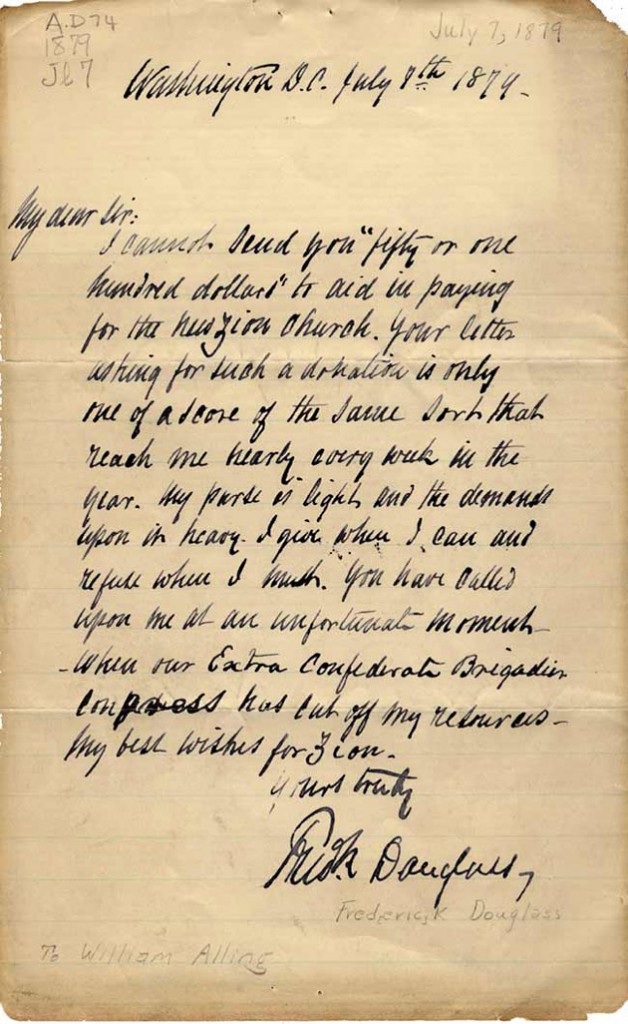
I can read this, but mostly I'm doing it through context and word recognition, not letter recognition. It's a struggle. This means there are some words that take a while to get.
That's how most people read printed text as well. You're not sounding out every word, are you?
If someone's not familiar with 1800s cursive they're going to struggle and they're going to resort to trying to decipher individual letters - they will end up sounding out not only every individual word, but every individual letter.
With something that I only know well enough to sound out even when printed (e.g., Cyrillic), I have a hard time making head or tail of it in cursive form.
I'm not arguing you have to be 100% self sufficient, but learning to read what amounts to a specific font shouldn't be too much to ask.
Spending time learning how to read a font optimized for hand writing that you might need to read a handful of times in your life seems like it would fall into the same category of work that’s not worth the time
Because of this, I learned to read them.
Because of this, I got slightly more out of the maps (and cover) of The Hobbit than most normal people — Tolkien used runes as merely a font for Dwarfish, which was really just English.
I wouldn't say that this is any more useful than cursive.
I don't know about that - writing something out is still the best way to learn and retain something long-term.
On the other hand, I don't think the difference is huge, so the value of it depends a lot on how much time it actually takes to teach cursive vs teaching non-cursive.
From the Boomers, Gen-X, and Millennials I know who were taught cursive in school very few use it for note-taking. It seems like a huge waste if the only reason for teaching it has failed multiple generations already.
American “cursive” is what is known in other countries as script. It’s the kind of thing you might learn on a calligraphy course. Although there is overlap, it’s not the same as e.g. what in the UK is known as “handwriting” which is writing with the letters joined together explicitly for the purpose of comfort and efficiency with zero aesthetic intent.
At least for me, though I believe the majority of the UK would agree, handwriting (“cursive”) is what I use in daily life, e.g. writing a shopping list, and that print is reserved for whenever I want to be neat and formal and have others understand my handwriting - but it’s kind of a chore to write.
Now, in later classes, especially in middle and high-school, developing your own handwriting style was common and not problematic - and many, including myself, adopted some print letters while still using many cursive ones as well.
[0] https://www.suntparinte.ro/uploads/resource/59/23/12//litere...
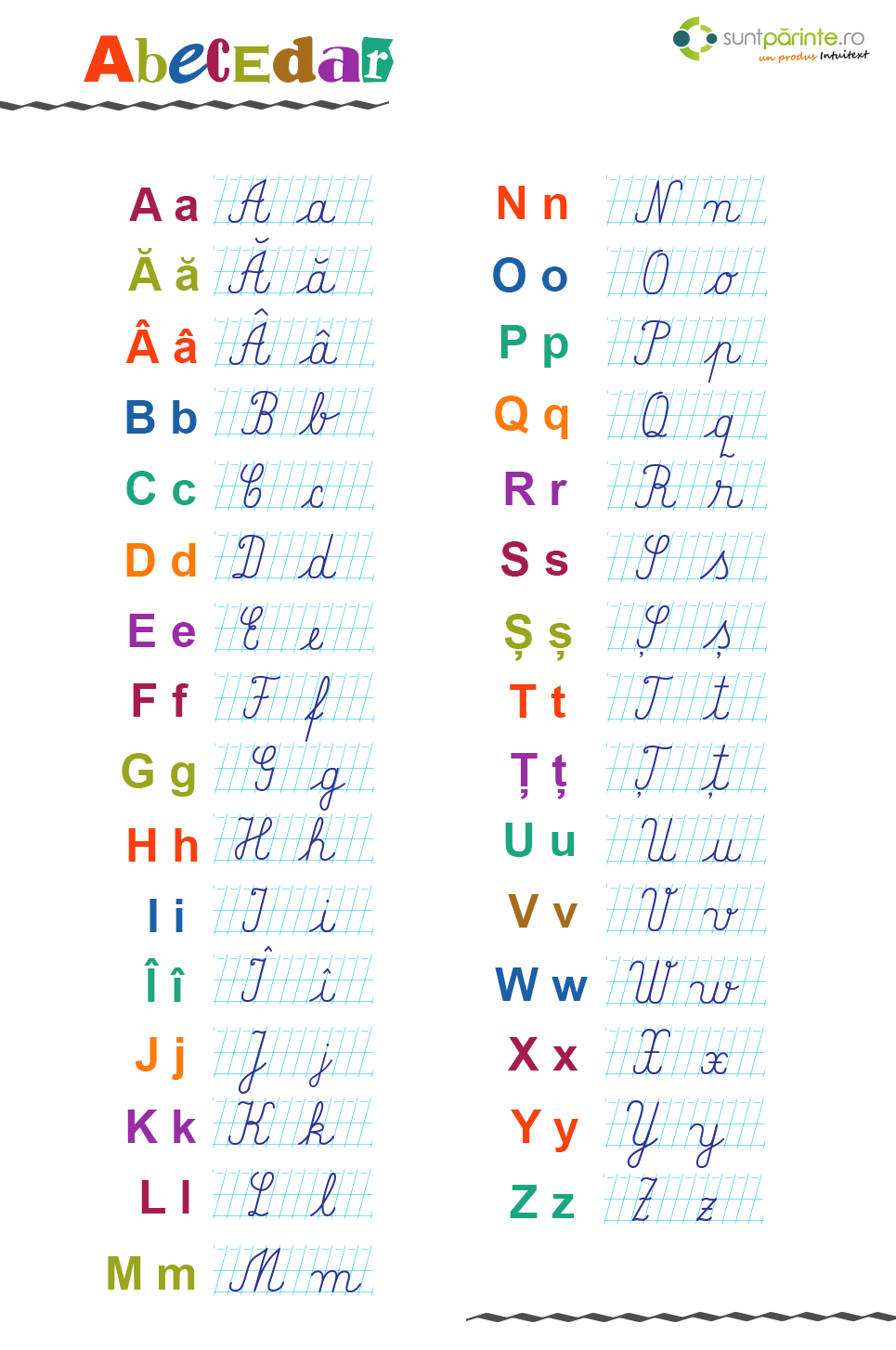
After leaving college and not needing to write much after a decade or two, its jarring enough to get used to writing in block script.
I can at least understand the idea of writing printed characters by hand - the difference between that and cursive isn't that large, and is non-existent for the above. But to forego handwriting entirely doesn't seem plausible to me, in these subjects at least.
I don't think I've heard anyone advocate for getting rid of handwriting. All I'm saying is I got very out of practice after leaving school. In school handwriting was almost exclusively for personal use. I toyed with digital note-taking at the time and realized it was terrible.
> the difference between that and cursive isn't that large
:shrug: Like I said above, the three or so generations I've seen in the US got a couple years of cursive, never saw the value in maintaining it on their own and got very out of practice. The distinction is strong enough that decades old references stick around in my head [1]. A lot of people live with terrible block handwriting. I took an online class and started handwriting notices and realized how out of practice I was with block writing because of how illegible it was and how soon my hand started cramping. I never got comfortable enough with cursive to be faster and/or more legible than block handwriting.
Rather, cursive evolved because it was faster to scrawl words onto paper without lifting up the pen, and the formal version taught in schools was essentially a prescriptivist version of a quick scrawl. It was invented to help you write faster.
In particular, I've heard the myth that if you lift a fountain pen up, it might drip on the paper, so it's better to write in one continuous motion. Fountain pens haven't been leaky for the last few hundred years (when well-maintained). By contrast, ballpoints used to leak tons of ink before precision manufacturing and plastics became cheap.
I have watched this in a different context in China: The government mandated the teaching of Mandarin (which is simply the Beijing dialect) but did not object to also teaching the local dialect. Kids learned the local dialects to communicate with those who only spoke the local dialect. However, at least in the cities the people who don't speak Mandarin have pretty much died out and if alive they aren't very active in society. The young generation sees no reason to learn the local dialects and the schools don't teach them anymore.
For those who don't know the situation: The grammar and the like are identical, all that varies is what is said. Unlike an accent, however, they are not mutually intelligible. I have seen my wife (Shanghai-born, speaks half a dozen of the dialects from nearby cities) switch dialects to something she knew the person she was speaking to would understand but the eavesdropper she was trying to avoid would not. The written form was standardized (at least on the mainland, Taiwan still uses the old ways) earlier, even when two people can't understand each other they can communicate by writing. This results in the apparently nonsensical subtitling of Chinese movies in Chinese. It also results in what I call fingerwriting: when faced with a word the other person doesn't understand you will often see them take a finger and write the character on the palm of the other hand.
The few people alive today who actively still use cursive to write are just as equally capable of handwriting in a block or printed format, it's not a language or even a dialect.
And nothing of import today is written in cursive. (Not books, or literature, or legal texts, or contracts, nothing)
Many studies are done on students typing notes in class, but I've seen nothing on people proactively learning something by themselves on a computer for instance (like if we were summarizing learnings from a video with no time pressure to write it down)
I was all for "maximum personal cyborg-ness" at an earlier stage of life, but I now feel the urge to be away from the screen+keyboard for some time, and pen-and-paper is a good fit for that, and ... cursive writing is just a good way of _using_ pen and paper.
As long as you are physically embodied, you're going to feel some satisfaction in "doing things with your hands" (i.e. other than typing or pointing).
Making marks on a writing medium in a quick, _flowing_ way, using a writing instrument ... is a form of communication, or even a form of expression, that you can do quite well if you try a little bit.
Still probably don't teach it in school because who in their right mind is going to bother with the hassle of a fountain pen in this day and age? Typing is wildly faster than either print or cursive for the same amount of practice.
Actually, your failover system makes me feel anxious inside.
What if this proprietary tech gone missing or disappeared completely?
What if this proprietary tech gone rogue and just refused to cooperate and render the service for end users for any given reason?
I just can't trust one single vendor or corporation with such a critical part of our life but your main point remains salient though.
If this went wrong, you'd either not read the letters, or have fun figuring out how to translate them by hanx
We need more decentralization and redundancy in these services lest we see our future turn hostage to corporate financial or political interests.
English customary units for mass, length and volume. I went to American public schools and I was never taught any of these, except I think a single quiz about them in the cooking portion of my home economics class (which was also cut from the curriculum a few years ago.) All the science classes were taught with metric, and no other classes taught units for these things at all. The only customary units I have an intuitive understanding of are pounds, miles, and Fahrenheit. Off the top of my head I can't even tell you how many feet are in a mile, and to me a yard is 'about a meter.' I estimate small distances in meters and multiply by 3 to give other Americans an estimate in feet.
It's not enough to teach things in school without support outside the school.
Where customary units seem strongest is in civil/mechanical engineering and adjacent trades, road signs (all in miles), and weather reports in Fahrenheit.
How embarrassing not knowing that
Definitely impressed by cooms, quarters and weys!
And nobody will recognize the errors Google Lens makes
Nothing of value was lost. Over-complex communication usually was a attempt to keep others with less time to learn and practice out of the communication stream. Similar to kanji, who a peasant would not learn at scale and couldn't even improvise phonetically to written form.
Good thing the rest of the world uses this amazing system where a kilothing is a thousand of a thing eh.
We've had fairly robust speech to text for a few years now and the only places its seen real penetration in is basic personal assistant stuff involving short and simple queries, so I find it hard to imagine that anyone thinks that speech can replace keyboards as an input method.
Even with people I know who've tried to switch to using speech to text due to injuries, it's been a nightmare because there are no easy ways to use it for anything that isn't plain format-less dictionary language. For casual communication it sucks because people use a lot of slang, often even slang exclusive to their friend group, and for serious communication it doesn't work because "delete last word" or "cut sentence X and paste here" is objectively not as convenient/fast for say, the average western highschool student as doing the same via keyboard.
Not even considering how unrealistic it is to edit/format text via speech.
As a way to reason about this, look at some code (assuming you're a programmer) and try to think of how you would input it without a keyboard.
The only place it works is if you have your own private office (e.g. doctors dictating their notes), or at home.
Ah yeah I hate it when I go to the supermarket and get asked interview questions like "convert that number to binary". Such a useful skill to have for the general population
Just because something is relevant to the HN readership doesn't mean that it is to everyone.
The tricky thing here is while we're transitioning away from some of these things, they still often serve as signals of class and overall quality of education.
Yup. So the main places that are still teaching cursive:
* Wealthier public schools (to keep upper class parents happy, even if it doesn't tie to a state requirement).
* Private schools (I teach at one of these).
* Various "traditionalist" / "conservative" states.
While cursive is still teached at schools where I live,print letters are the ones used the most
I guess there is be a difference between the way public schools and private schools teach handwriting.
I can usually figure at by looking at someone’s handwriting whether they went to private or public school.
Asimov makes the case that rather than teaching old information, we should be forgetting more obsolete facts to make room for more modern and efficient material. We're never going back to a world where cursive is in widespread use. Nor will we need to. By the time the last generation of cursive readers has died out, people will likely have available a "Google Lens" type augmented-reality translation on the fly of great-great-grandma Edith's old love letters.