All to say, the roads being safe as a core assumption is completely false. I'd gladly share the road with beta AI versus other drivers like this. Being an occupant in beta AI is completely optional.
UK car insurance feels more like US health insurance. High premiums, and heaven forbid if you get into an accident.
Why they keep insuring him with no sense of the danger he imposes to others is an interesting question and it’s because their financial exposure is all that matters. They are betting that he won’t kill anyone and if he causes some property damage they feel protected from a risk adjusted perspective. But no larger corporate responsibility / citizenship is in place.
Most of those are lacking or at least inconsistent, for AI driving.
This is a complete aside, but not having a license doesn't really prevent you from getting in a car and driving it. I was just reminded of this when a buddy's parked car was struck by a drunk driver who was not legally licensed to drive because their license was revoked from having many prior DUI's. Luckily they didn't kill anyone.
Hopefully it will be easier to enforce shutting down unsafe driverless cars.
I've also known teens without licenses who had to drive their irresponsible buddies' cars home after the licensed driver drove somewhere and got drunk. It's not like there's a biometric scanner in each car that verifies the person behind the wheel is a licensed driver...
Such as?
I had a great bar that was less than a mile from where I used to live. I rarely went because there was no way to walk there. No sidewalks in the neighborhood, no traffic lights, no bus that stopped near it. It's a shame. It closed shortly after I moved away after away. In the paper they said they just didn't get a lot of people coming in.
A great idea that I am in support of, but it's not a "realistic alternative", public transportation is politically fraught, expensive, and slow to build in the U.S. I'm not saying we shouldn't continue to strive towards it, but it's not happening any time soon in the U.S.
> ride sharing
This is the status quo.
> making streets more pedestrian friendly
Same issue as public transportation - slow, expensive, politically fraught, but also of dubious ROI in terms of preventing DUIs; nobody is going to walk 5 miles home from the bar because of streets that are friendlier to pedestrians. Of course, there are other worthy reasons to create pedestrian friendly streets, but they don't really represent a realistic alternative to someone prone to intoxicated driving.
> denser zoning
Again, not really a realistic alternative, zoning issues are politically and economically contentious at a level that transcends concerns about drunk driving and yet the needle on that issue barley moves due to NIMBYism and entrenched special interests.
If, however, I were to send the certification authority a film of a driverless car doing the same, my guess is that the vendor would be required to investigate and solve that, even if the film were just a single incident and noone harmed. I base that guess on the authority's past behaviour.
Speaking as someone who's often in harm's way, I find the possibility of getting rid of conscious rule violations very attractive, even if that doesn't affect the number or effect of software bugs at all.
Also, didn't the entire Uber fleet get grounded after the Tempe death, with a huge months-long NHTSA investigation?
No way. Yes, the driver education in the USA is appalling. It should be much more thorough and cover a lot more ground, particularly emergency manouvers and car control.
Nonetheless, a human driver has self-preservation instincts which are very deeply hardwired into the brain. Software has nothing like it, if it has a bug it will crash and take out whatever and whoever is in the way since it doesn't have, can't have, any emotion or self-preservation.
The first footage that comes out of a felony traffic stop on an AI driver will be amusing!
Did anyone else spit out their morning coffee at this hilarious one-liner?
More consistency would be better, but it's a California bureaucracy. You get what you get.
She recently passed away ... sad, but the streets around here are definitely safer now.
(This was in Germany just for reference)
[1] The child was fine it was a low speed collision ... but still ...
It won't be this way forever, and I'm under no illusion that she is the norm for her age, but I'd hazard she's a better drive R than most people on the road.
I would like to see a move toward more frequent driver testing for all drivers in the USA, decreasing in frequency after the first few years of driving and increasing in frequency for older drivers. Testing after initial licensing is not the norm in any state I've inhabited, so this would probably require a significant uphill battle on both the individual and government fronts.
https://www.dps.texas.gov/section/driver-license/drivers-age...
https://www.dmv.com/md/maryland/senior-drivers?tg1=DVA&utm_c...
Florida has vision requirements, and accepts reports of medical issues making driving unsafe: https://www.flhsmv.gov/driver-licenses-id-cards/medical-revi...
In that context Florida’s standards are lax, but still exist.
Luckily she basically never drives anyway [edit: because my dad who's still a decent driver drivers her around when she needs it because they both know she's not safe on the road, not because she can get by without a car], but I doubt that was an isolated incident. Because of how we've designed our cities, not being able to drive can represent a huge loss of freedom. In the moment, it seems some (and I'm guessing many) DMV workers take pity on the vulnerable elderly person in front of them rather than some hypothetical future victim of that driver.
I feel like if driver licensing required re-certification, everyone would hate that, but it would have the added value of making sure to reinforce that people knew what the law _was_. Maybe it'd be less painful if our insurance already subsidized the cost. I feel bad even advocating for such a thing.
Or perhaps since laws have changed or new laws were made that you were unaware of (through no fault of your own - these things are hard to keep track of!). I agree people would hate it, but I think there's value in, like you say giving people a refresher about the law.
I also think there's value in reminding people that driving is not an inalienable right and also inviting a person to re-evaluate their situation every so often to think if they still really need a car.
[0] https://www.local10.com/news/local/2022/02/25/recalling-trag...
Of course
I'm also really happy about the continued advances in auto safety technology.
I guess I'm skeptical that having some more classroom time and a more rigorous testing improves young person driving a lot--much less makes much of any difference to how people with a few years of driving under their belt drive.
I don't think teenagers are any less safe than an person with equivalently little experience in normal traffic situations but they are definitively more likely to be less conservative when they do decide to push the limits. There's a difference between navigating a complex intersection and knowing how fast you can/should go on an empty highway.
The commuting structure of those cities is just awful and begging for road rage.
Maryland (and, to a lesser degree, New Jersey) drivers are legitimately terrible whenever you find them.
Of course, after years of practice this is how you should be driving. But almost nobody who doesn't explicitly practice for the test can actually pass.
Whether a license is accepted reciprocally is more a political decision than based on test stringency.
All of my friends were doing these driver's ed classes after school and a bit jealous that I got my license without a single test.
https://transportation.ky.gov/HighwaySafety/Documents/2006_k...
Like sure, per-kilometre fatalities may be down, but that says nothing of:
1. The number of non-fatal crashes
2. How much of this incorporates driving on large highways
3. When not on a highway, the degree of traffic in which fatal crashes can't occur (can't get in a high-speed accident in high traffic in New York, for example)
Needless to say, the roads of Japan and New Zealand are so different from the US that it isn't exactly clear that this statistic is really informing us of much, really.
Basically we could do a better job engendering concern from teenagers, its not some kind of inherent mental lack of capability.
Female teenagers are way less likely to have wrecks (1) and if we assume its not driven by one's genitalia and rather by their conditioning - an assumption I hold, its something that can be taught.
"In 2019, the motor vehicle death rate for male drivers aged 16–19 was over two times higher than the death rate for female drivers of the same age."
1. https://www.cdc.gov/transportationsafety/teen_drivers/teendr...
Besides, I had thousands of HN karma (the most important metric of maturity of course) when I was a teenager not very long ago.
every accident is a hit to their profits and pr.
At the extreme end, picture a company that manages to get an okay from the city of SF for public testing, but whose internal tests show there is a small but significant risk of serious accidents and the product needs another two years of development to be safe. Their funding runs out in one year.
What do you think they would do?
It takes a hit if there isnt' a very solid marketing/pr/charismatic leader to distract
https://aaafoundation.org/wp-content/uploads/2017/06/aaa_fig...
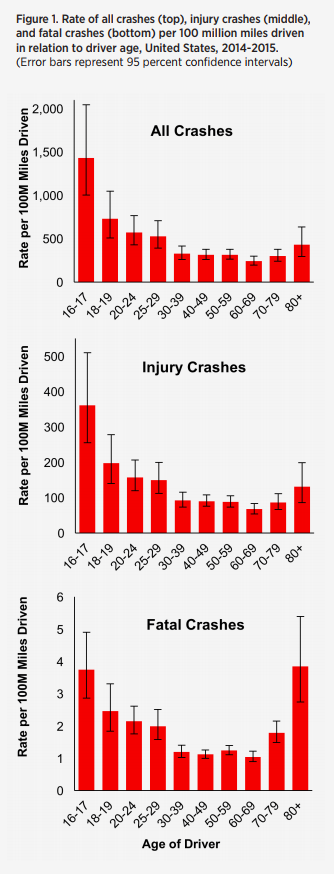
Teens are roughly 3x worse than a 20 year old, and 10x worse than a 50 year old.
There are plenty of things that come with experience vs book learning that makes a safer driver. A freshly licensed teen comes with none of that. They also have the natural tendency of having high risk tolerance which makes decision making different than an older/exeprienced driver that is more risk averse.
I'm in North Texas, so I have a personal rule that if the temps are forecasted to be below freezing with any form of precipitation, I do not leave the house. People make moronic decisions on how to drive in those conditions because it doesn't happen enough and as a collective, proper ability to drive is forgotten every single time.
It's a trick question. You don't should be the response.
For those that do, my first question is what is so damn important that you have to be driving in icy conditions in the first place? Schools are closed. Most businesses are closed. If my business isn't closed, I use a personal day. This isn't Chicago/Minneapolis where the snow lasts for 3 months. This is N. Texas. It's typically only cold enough for these conditions for a couple of days and typically only at night. Which actually makes it worse as it melts in the day, refreezes overnight, and people forget about the refreeze and drive as if things are normal.
Why would you assume that a driver's education is a matter of book learning? Is that how you were taught?
We had book(lets) that we had to read from to learn the rules/laws of the road. There were quizzes/tests to be taken during those classes in order to pass the class. Once the class was passed, I then had to take a written exam issued by the state. That was followed by an actual driving test with a state official in the car.
So assuming based on my personal experience. I know the times have changed, and you no longer have to do silly things like learn how to drive or be required to wear shoes while driving in today's world.
Luckily for me I had been driving for a while and I was tested initially in a more rigorous country, I was just getting my license after I moved to the US, but it explains a lot of what I see in the streets.
You put your faith in myriad bureaucracies and trust networks that you have no hope of understanding. Driverless cars are just one more added to the list.
As a example, just look at the 737 MAX, a airplane viewed as a literal deathtrap and a complete indictment of airplane software development, which had 2 crashes in 400,000 flights. At a average flight distance of ~500 miles, the 737 MAX, a airplane literally multiple orders of magnitude worse than any other and a complete failure of the approval process, only resulted in 1 fatality per 100 million person-miles. That is safer than the driving average of 1.1 fatalities per 100 million person-miles. What is viewed as by far the most atrocious outcome in the airplane sector, a system literally hundreds or thousands of times more dangerous than the average, is above average in the car sector; that is how far the gap is.
And this is ignoring driverless car software which is being developed to even lower standards than regular car software and which has no actual independent quality requirements. In contrast, far more lives are at risk with respect to driverless cars, so they should be developed to standards probably around 1000x better than airplane software which puts them around 0.0001% of the way there to a acceptable level of quality even if the software was already as reliable as regular car software.
You mean the standards set by the FAA, which regularly defers to the private industry to regulate itself, due to complexity that it can't afford to keep up with? Those standards?
As you note, unfortunately the standards as employed in practice have recently regressed dramatically to allow a system as unsafe as the 737 MAX to fly. So it seems only prudent to go back to the historical, far more rigorous, process which did result in the amazing historical safety regime. And, since self driving cars are a even harder and more dangerous technology with far more downside risk, they should use a standard even more rigorous than the historical airplane standards which are still by far better, from a safety perspective, than any other consistently applied software process, such as cars, by multiple orders of magnitude.
So these were all miles where people were unwilling testers as well. The difference being airplane auto-pilot is primarily focused on keeping the plane in the air, not dodging pedestrians. I think it does a lot of warnings for the pilots as well, but I'm not in the industry.
It's really comparing apples to oranges, isn't it?
> since self driving cars are a even harder and more dangerous technology with far more downside risk, they should use a standard even more rigorous than the historical airplane standards
So this is on The United States Department of Transportation to be far more involved in regulating the software that governs self driving. But the question is, was the FAA as relaxed in governing the aerospace industry 60 some odd years ago as USDT is now, and did they just get lucky that flying planes is actually easier than driving cars? Or is there actually some negligence involved?
The FDA just wants there to be standards, and the companies have a vested interest in making sure those standards ensure safe medical devices.
It seems that you're trying to suggest either 1) that the standards as mentioned necessarily aren't True Standards - as a blanket statement - because they're set by the industry or 2) that these standards aren't True Standards - specific to this particular discussion - because there is no reason to think they're necessarily more rigorous than the standards for driverless car software. If you're trying to suggest something else, please understand that it is unclear.
I'm all for a dissenting opinion, but when it is not presented in an understandable way the discussion becomes hard to follow.
(I don't mean to suggest that the argument is wrong when I call out the True Scotsman vibes; just that it is the argument I see.)
From the person you're responding to:
> Yes, those standards that produced a safety regime of 20 years of flights without software being even implicated in a single fatality. ...
> As you note, unfortunately the standards as employed in practice have recently regressed dramatically to allow a system as unsafe as the 737 MAX to fly. ...
Your point, if I'm not mistaken, being that the FAA has clearly allowed for less stringent regulations in recent years. (Please correct me if I'm wrong. You can ask questions but it does not seem that they lead so immediately to the answers you expect.)
That being said, please consider that I am genuinely trying to understand you:
> I'm all for a dissenting opinion, but when it is not presented in an understandable way the discussion becomes hard to follow.
Now they are. This regulations are a result of several tragedies culminating in a big disaster:
Imagine a thousand employees, half your HQ staff, that leave. There are several possible reasons:
- they're older -> more corporate knowledge and knew the "magic recipes"
- skill based mobility -> they're so good they can go anywhere, and Chicago isn't Seattle
- etc
https://hbr.org/2001/10/inside-boeings-big-move
This was widely thought on ... what was I browsing back then? Reddit? as a fore-warner of bad stuff to come
The fore-warning came to fruition when the issues at various Boeing plants started developing over the next ten years (insider videos talking with an employee about being on drugs during crucial assembly work and shift mates being similarly high, "get it through your station" attitudes) and the Dreamliner issues that were hand-waved away (no training, 1-hour tablet self directed training, certification delays, and eventually crashes).
I remember it being discussed on SlashDot back then.
(Of course this had some substantial downsides.)
It's estimated 31,720 people died in car crashes, in the US, in 2021[2].
[1] https://en.wikipedia.org/wiki/Category:Aviation_accidents_an...
[2] https://www.transportation.gov/briefing-room/nhtsa-estimates...
Before an airplane goes into circulation, it has gone through extremely rigorous testing. An airplane also always has a pilot.
The same can't be said for driverless cars. They don't go through extreme rigorous testing, they don't have a driver, and they're controlled by software that is most likely a far cry from aviation standards.
Apparently there is ZERO learning or forethought about risks that can be anticipated or suggested from other technologies!
As others have pointed out, aircraft certification (while it has its problems) is very rigorous. Driverless car certification, up to date, is basically nothing.
But the other aspect is that aircraft autopilots are solving a far easier problem. Developing a car autopilot for busy streets is many orders of magnitude more difficult than an airplane (or boat) autopilot.
It's a qualitatively different change than any of the above (driven by a messianic view that AI is here and now and about to change everything), plus an instance of the
https://en.wikipedia.org/wiki/Boiling_frog
apologue.
> Even the walker’s freedom is now greatly restricted. In the city he continually has to stop to wait for traffic lights that are designed mainly to serve auto traffic. In the country, motor traffic makes it dangerous and unpleasant to walk along the highway. (Note this important point that we have just illustrated with the case of motorized transport: When a new item of technology is introduced as an option that an individual can accept or not as he chooses, it does not necessarily REMAIN optional. In many cases the new technology changes society in such a way that people eventually find themselves FORCED to use it.)
Your problem is the same as the walker's. The walker has opted out of the automobile, but still has to breathe its pollution and risk being hit by it.
There's simple road design concepts that mitigate danger, as well.
If it is not actually that, and if there are safety measures that can be taken, he doesn't care.
I'm not a pro car person actually. And that's the vibe I'm getting from Kaczynski in this instance. Words of an out of touch person.
That's not my point though, my point is that quoting his manifesto validates his violence. If his ideas are valid, there should be other sources to quote/promote.
Why is that so sure? Do you have an equivalent quote to substitute?
This is why saying "but he's a murderer" isn't an ad hominem. His murders are the working-out of his ideas; his ideas are worth rejecting just on that basis.
>His murders are the working-out of his ideas; his ideas are worth rejecting just on that basis.
This is simply saying "if he is right, I would rather be wrong". It also completely ignores that arguments can be valid in part, but not in combination.
Your question makes me wonder what your definition of "right" is.
Replace "murder" with 'killing" and most people will have the opposite reaction.
- colinmhayes (the original post I responded to).
And, for your point to be relevant to this discussion, you would have to claim that what the Unabomber did was "killing" rather than "murder". If you claim that, I'd like to see your definitions and where you think the line between killing and murder is.
And if that isn't your claim, it looks like you're just arguing in order to argue.
I did feel that you were using the tautology of murder to ignore my actual point.
>You: His murders are the working-out of his ideas; his ideas are worth rejecting just on that basis.
>Me: That doesn't mean they are wrong in part or in whole.
If the unabomber said as part of the manifesto that the sky is blue, would you now reject that the sky is blue?
There is nothing about murder that invalidates the logic, truth, or accuracy of an argument, and especially not the individual components of an argument.
It is fine and fair if you don't personally want to learn or engage with an argument that has lead to violence. But that does not mean that it is internally inconsistent, or devoid of accurate observations about the world (e.g. new technologies can impose externalities on the unwilling).
These judgments ("wrong" and "better") presuppose some definition of "good". But the guy was deliberately killing people. Am I supposed to believe his definition of what "good" is? No, I'm supposed to suspect that it's seriously skewed. (In fact, he's giving me evidence that it's seriously skewed.)
There's something about murder that invalidates the moral truth of an argument.
Could his argument still be internally consistent? Sure. Could it have accurate observations? Also sure. But should his manifesto be regarded as having any overall validity? No. (Recall that the original point I was replying to was whether his murders invalidated his manifesto.)
Nearly every great thinker and writer you can name from before a certain year owned slaves or wanted to.
I feel that you view his acts of murder as inseparably linked to the manifesto, and that people can not accept manifesto to be true, while condemning the murders.
This ignores the possibility of a completely pacifist implementation of the manifesto's ideals.
My understanding is that a significant portion of it is not necessarily a call to violence, as much as a call to action. It states the technology and collectivism should be rejected, and this could be either a violent or non-violent process.
There may be similar ideas expressed by those who don't share his pathology, but his version of it is extreme and fringe.
Both could have to pass a driving test that includes challenging, difficult situations. Day, night, rain, snow, fog, heavy traffic, missing lane lines, simulated pedestrians (including small children) leaping out between parked cars, and more.
For further difficulty, both kinds of drivers could have to pass this within a x% margin of the fastest safe speed at which the maneuvers can be completed; no cheating by slowing down to traffic-disrupting speeds.
The majority of fatal crashes involve drugs and alcohol and not people with "untested skills in challenging situations."
Pedestrians and motorcyclists account for a little less than 1/3 of all fatalities.
Young men are 8x more likely to die in a car accident than their female counterparts.
This "user-hostile" mode of thinking about driving serves no one.
Though there are systematic flaws in human drivers they're reasonably well known given the level of experience we have, there are many mitigations in place in both our cars and road designs, and many of these flaws are intuitively modeled by the other humans on the road as well as pedestrians allowing for real-time compensation.
The driverless cars, on the other hand-- we have radically less experience with as a class and there are many reasons to believe that vendor to vendor (e.g. due to sensor modalities) or even version to version will behave less self-consistently than human drivers do as a class. We know of some systematic faults in their operation which cause them to behave in ways that are highly surprising to humans, and we should expect to find many more as we gain experience.
To the extent that the properties of self driving cars have been formally studied at all it's been primarily by their creators which are obviously self interested. Some of the practices used in early supervised self-driving also actively undermined understanding their safety (e.g. executing a hand over to the human once the car was already in an nonrecoverable unsafe state and then attributing the accident to human driving since at the time of the collision the human was back in charge, but maybe only by a hundred milliseconds; or companies committing perjury to use the DMCA to force down unfavorable videos created by others)
This isn't an argument that we might not benefit from more rigorous driver testing or even from testing ideas that originated from self-driving car testing... but parity between driverless car tests and human testing shouldn't be a goal, particularly not when so many orders of magnitude separate our human driving experience from driverless experience.
Curiously, autonomous car technology also makes it feasible for us to rate drivers -- it's like having a professional watching over your shoulder all the time. IIRC, Tesla used something similar to determine rollout of new FSD capabilities.
I guess the question is: how much higher should the bar be set? And if we set it substantially higher then how much longer will it take to improve the performance and safety of these systems?
Cybernetics is* ~insertion of a governance layer into our social contract that we didn't agree to relinquish our agency to... It just sort of happened, and we deal with the outcomes. The more disconcerting aspect to me is the latter. Suddenly, QR codes everywhere, good luck getting around without a smart phone, if that driverless car sideswipes you and doesn't stop, call someone I guess?
If this area/trend interests you, there is a lot of reading available from the weird (CCRU, early Nick Land) to the fairly mechanical/academic (MIT, Norbert Wiener), to the openly behavioral governance-themed (Stanford Persuasive Technology Lab, B.J. Fogg), to adversarial-to-tech (The Cybernetic Hypothesis).
* so-so definition of the space, but its the best I can sum it up.
You’re basically an non-consenting tester for every piece of innovation that society every has/ever will come up with, in one way or another. It’s an unavoidable feature of living on the same planet as 8 billion other people. Perhaps the safety of this technology does need to improve, or perhaps not. But there’s no level of improvement that would ever be able to satisfy this outrage you’ve expressed at something new existing in the same place as you.
Why do you say it's unavoidable? Regulations could certainly keep these tests off of public roads.
Personally, I would much rather we slowly develop and deploy these cars in the wild rather than continue testing in some controlled environments. At least this way we can monitor progress and judge their readiness as a society. Plus, the sooner they happen, the better for everyone.
The point is not the exact numbers. It’s to demonstrate that even if we do suffer accidents and deaths from testing self-driving cars on the road, the end result will be many more saved lives (just based on the fact of how many people die from traffic accidents today) Of course this hinges on many other factors to be true, but that’s the case with all kinds of technological advances.
It's a simple fact of life that you test things without explicitly consenting. The driverless cars are no different.
I can easily imagine a similar campaign to label pedestrians as irresponsible for walking outside without an ultrasonic emitter, or a lidar reflector, or whatever integrates with the self-driving system. Whatever shifts the responsibility away from the car and onto the deceased.
1. Do you have any sources?
2. You don't think that roads should be a car only domain? What do you think roads are for?
2. Roads existed before cars. This is an extremely American view to think that roads should be exclusively for cars. Roads should be for PEOPLE, regardless of which mode of transport they are using.
Okay, but now cars do exist. Do you think it's reasonable for cars capable of traveling 40mph should be stuck behind pedestrians at walking speed? Our modern transportation infrastructure exists for a reason, and that reason is speed/effeciency. Most areas with heavy pedestrian traffic have sidewalks. If I'm going 60mph down the highway then the presumption that I should be subjected to pedestrians casually strolling across is absurd.
If you try to compromise, you end up with stroads... which turn out to be just as bad as highways for pedestrians in practice, thanks in no small part to people like you who believe that all of the compromises of street design and urban planning should be borne not by vehicular drivers but by pedestrians.
(I'll add a side note here: a lot of efficiency depends on what you're trying to make efficient. Many people--including you, apparently--define efficiency as moving cars with as high throughput as possible. If you instead want to move people with high throughput, usually step one is to ditch cars, since single-occupant vehicles occupy vastly more space than any other form of transportation.)
In the few places with high 100% walking commutes, I don't see cars being more efficient either. Do you want every college student to drive from their dorm to class? How about poor countries without the money to maintain good road networks?
This entire discussion started as whether pedestrians should/shouldn't be on roads. No, they shouldn't. They should be on a sidewalk, best of both worlds.
For 2, I'd make a distinction between paths built for long-distance travel (roads) and paths built for connecting to destinations (streets). The two have fundamentally different goals that cannot be safely achieved at the same time. To allow for high-speed travel, a road should be as predictable as possible, with limited entrances and exits and barriers to prevent people and animals from wandering onto the road, and should be restricted to vehicles that can maintain a high speed. To allow streets to connect to destinations; such as homes, shops, and workplaces; there should be many entrances and exits to the street. The destinations should be packed as tightly as possible, so that they can be reached with a minimal distance traveled. It's not just that these goals require tradeoffs, but that they are fundamentally antithetical to each other.
The best way to satisfy these two goals is by having separate designs for streets and roads. The roads are pathed around pedestrian areas, and allow branching off into them at limited locations. The streets are mixed use, with rougher surfaces (e.g. brick/cobblestone) to prevent high-speed travel. This doesn't exclude motor vehicles from using roads altogether, allowing for use cases such as delivering food to cornershops or dropping off somebody with limited mobility, but does steer motorized traffic off of the streets and onto the roads wherever possible.
As for the later, why is that any better than just sidewalks and crosswalks, which the majority of areas with heavy pedestrian traffic already have? It'd be incredibly eco-unfriendly, expensive, and impractical to have two different types of roads for cars and pedestrians when we already have a solution that works just fine - sidewalks.
* "Most areas with heavy pedestrian traffic have sidewalks." I am uncertain on this one, as heavy pedestrian traffic is more frequent on mixed-use streets. Sidewalks are only used in places with car-centric design, which discourages walking.
* "Even with cars taking up much more space, a bunch of cars traveling at 25 mph are able to carry a many more people through a distance X in a period of time T than the equivalent walking would be able to." I am uncertain on this, because cars require very large amounts of space both for the physical size of the car, the spacing between cars, and the spacing between groups of cars at an intersection.
* "It'd be incredibly eco-unfriendly, expensive, and impractical to have two different types of roads" I'd be interested in a source for this, as I've generally heard that separating out usage improves the efficiency of each. Cars go faster because there are fewer stops requires. Pedestrians die less often because there are fewer cars nearby.
* "Bike lanes are less common than sidewalks" This is correct by my experience, but I've only lived in places with car-centric city planning. Can you provide a source?
I'm interested in continuing this conversation, but not if it is a conversation between sourced comments and unsourced assertions.
2: Roads are also for bicyclists, motorcyclists, and even pedestrians. It's true though that car drivers often think that roads are a car only domain and behave aggressively towards the other mentioned groups
But I refuse the popular notion that roads (as in larger streets, or any street between villages/towns/cities) should be for cars only. The usual examples of Copenhagen, Amsterdam or recently Paris show that shared roads lead to a higher quality of living. I personally appreciate this, and I'd prefer a world where this sharing would be more common.
You've clearly never had a UPS driver scream "Use the bike lane!" at you after parking his truck in that same bike lane. Drivers have bizarre reflexes for how to use roads.
For example for my messanger on my horse so he doesn't get stuck in the mutt on it's voyage to the next city. ... or maybe my zenturie to support my legion?
What makes you think (or suggest) that roads where invented for cars?
stay inside in front of FANNG. You'll be safe there ( yet still an unwilling tester ).
Indeed. The minimum before any self driving car can be put on the road is that the developers, managers, executives, and major investors and their immediate families have to spend 8 hours running back and forth across a track on which 40 self driving cars per mile of track are running laps at a minimum of 50 MPH. Additionally there need to be things like rains of nails on the road, suddenly floods of water, packs of dogs, tumbling tumbleweeds, and other hazards. If at any point the average speed drops below 50 MPH or if the cars hit anyone or hit each other, the car can't go on public roads.
Do you have any more info on this? It's a fascinating fact.
These robots are massive and fast, they are killers. Yet as long as they look like cars we let them run loose on public streets. It's kinda nuts. (Arguably car traffic as it's set up now is kinds nuts too, but that's a different argument.)
The obvious thing to do is start with something like a golf cart that is limited to, say, 5mph top speed, and work your way up.
When the device is a giant robot arm or a laser cutter, there are huge amounts of regulation-- you may have to get permission from your municipality to operate it even within the confines of your own facility.
Make it look like a car, however, ...
Cars and roads are kind of nuts, but they're established lunacy at least.
R.I.P. Elaine Herzberg.
Drunk drivers are killers. People that text and drive are killers. People that get kicked by their kid and turn around for a second to yell at them are killers.
I'll take an unfatigable, indistractable, computer that literally has eyes in the back of its head, and on the side of its head, and the front, and can bounce radar under cars, etc over the pitiful example of a "safe (human) driver" we have now.
Yes, friend, and when we have those so will I.
Those (as yet still fictional) robot cars (and can we PLEASE call them "auto-autos"!?) are not the problem.
- - - -
> Drunk drivers are killers. People that text and drive are killers. ...
Yes, and it's arguably fucking crazy that we let them do that. The whole reason is a deliberate campaign to normalize the carnage: "speed demons" were replaced by "jay walkers" and now more people (in the USA) have been killed by cars than by all the wars we've fought.
"The Real Reason Jaywalking Is A Crime (Adam Ruins Everything)" https://www.youtube.com/watch?v=vxopfjXkArM
Anyhow, "people kill people so my robots should be allowed to kill people too." Is not a valid argument IMO.
memory leaks, priority inversions, dropped packets / data. Lots of ways systems can act strangely.
Welcome to America, where you are an unwitting tester of many private ventures that have been signed off on by the American government on your behalf.
Remember that complaining about these tests and demanding more control means that you are communist. Unless of course you don't mind waiting around to be harmed by such tests, and are either able to sue, or told that you had no reasonable expectation of safety.
Not that I'm an impartial judge... At the end of the autonomous car rainbow waits more parking, more driving, and fences to keep people out of streets.
Tradition has it that when you load-test a new bridge, you put the architect underneath. I feel like this, except I didn't design those driverless cars, somebody else did. Being an experienced software engineer, my trust in the software in these cars is pretty low. And yet they are testing them on me, because I can be the one getting killed.
I think we should set a much higher bar for allowing those cars on the streets, rather than "it kinda works, so let's roll with it".