https://www.lazard.com/perspective/levelized-cost-of-energy-... (Lazard’s latest annual Levelized Cost of Energy Analysis (LCOE 15.0) shows the continued cost-competitiveness of certain renewable energy technologies on a subsidized basis and the marginal cost of coal, nuclear and combined cycle gas generation.)
When probed on how to address intermittency, many wind and solar advocates propose things like hydrogen storage, giant flywheels, compressed air, or other solutions that are currently in the prototyping stage and have yet to actually be deployed to a grid and demonstrate viability.
This is the chief advantage of nuclear power: it works and we have over half a century of production experience with it. Betting on one of those storage solutions panning out is betting on a big unknown.
The next level is using residential HVAC systems the same way. Comfortable temperatures are a range, so heating/cooling can push the temps to one end of the range, and when there is less electricity available, they can drift to the other end.
The charger for your electric car is another very practical sink for cheap electricity.
This is accomplished by having a spot price for electricity, and then people buying thermostats that query the spot price and turn HVAC, hot water heater, car battery chargers, etc., on and off.
This can be extended EVEN FURTHER by heating/cooling a pile of rocks to later use to heat/cool the house.
A battery consisting of a pile of rocks can't be expensive.
The idea is to not only adjust supply to the demand, but to shape the demand to the supply.
I am utterly astonished that this is never, ever discussed when talking about solutions to fluctuating supply. Having fixed electricity rates 24/7 is simply madness in today's electricity generation situation.
As the poster above you pointed out the capacity of LI batteries is tiny. Yet you tout car batteries as though that were a new idea and a meaningful solution. And you ignore the fact that if you use car batteries as storage for the grid, that detracts from their use to, you know, run cars.
You also ignore the losses from your solutions. What is the round trip loss from heating up rocks and getting the energy back? It is huge. And you artfully forgot to mention all the equipment needed to get the energy back out in usable form such as electricity.
All the books and studies talk about load shaping, contrary to your "astonishment" that no-one is considering this "brilliant idea". The problems with load shaping are many. If you shut a factory down to spare the grid, then it is not producing. So all else being equal, you need more factories for the same production. Building and maintaining those extra factories takes labor, management, and energy.
Getting people to turn off air conditioning means that they are less comfortable, or perhaps unable to sleep, or unable to work. The South of the US more or less became viable economically due to air conditioning.
This is not unique to you, but I am really fed up with people spouting half-assed ideas and thinking that they constitute a solution.
As they said in the dot.com era - ideas are cheap.
If you store the energy by heating the rocks, you can recover it to heat your house by simply blowing air over the rocks. No need to convert it to electricity, which would indeed be silly.
The same goes for air conditioning. Excess electricity could be used to cool the rocks, which then can be used to cool your house when electricity is expensive.
The detour through the rocks (or anything with thermal mass) costs next to nothing.
I am not talking about using the EV battery to run the house. I am talking about using the EV battery to run the EV. Simply charge it when electricity rates are cheaper. It's shifting the demand.
> thinking that they constitute a solution
They are perfectly and cheaply implementable, and are part of the solution.
> half-assed
I actually have a degree in mechanical engineering. You shouldn't be so hasty in your inferences.
I don't think that's the right way to phrase it. The South was clearly economically viable before A/C. It's kinda like saying that New York City wasn't economically viable until the invention of the safety elevator.
Overall I agree with your views on "half-assed ideas". I want to elaborate on this one topic a bit more, because it presses a button of mine.
On thing A/C did was make it possible to build cheap homes following northern tastes and styles, on the assumption power would remain cheap. Northerners could move in without having to adapt their customs and practices much.
Southern vernacular architecture includes high ceilings (so the heat rises above the people), lots of windows (to let the air go through and heat escape), and with the house raised off the ground (so cooling air flows underneath). This describes the A/C-less Florida house I grew up in. An even more traditional design would have a wraparound porch, to provide extra shade and let the windows stay open even when it rains.
OTOH, A/C encouraged house designs which require A/C to be comfortable - a sort of co-dependency. These vernacular features make the A/C bill higher, so they weren't included in newer homes. I tried living in a Florida home designed for A/C, but without using the A/C. Not only was it much less comfortable, as you write, but we started getting mold because of the humidity. A house made for A/C doesn't have much air flow.
So I don't think the argument is simply 'getting people to turn off air conditioning', but 'getting people to design houses which are a better fit for the local climate and have better long-term sustainability.'
That's of course hard, and expensive.
It's also hard to change lifestyles to fit the climate. Eg, the dominant US culture doesn't appreciate or tolerate siestas, even if it's locally more appropriate.
Oh, and this isn't unique to the South. It's cheaper to build a frame house in Arizona, which requires A/C to be livable, than to build an house (like an adobe house) with thick walls that moderate the temperature fluctuations.
Nor is it just A/C. Earthship designs, for example, show what is possible ... for people who are willing to put more work into daily maintenance. Which is part of the lifestyle change that's hard to do.
Okay, depressing button. :)
No he didn't, the rocks are for asynchronous heating/air conditioning, all you need to get the energy back is a water pump or air blower and tubes.
Your reply is unnecessarily dismissive and snarky. All of those ideas are easy to do projects for individuals.
The only thing you need to implement on a global/national/regional scales is a spot market for electricity accessible for everyone. Then you can lean back and watch people implement all those simple ideas and many more.
All in all, your reply is unnecessarily dismissive and snarky. Those ideas are not "brilliant ideas" (btw you should learn about correct quoting). Of course those won't solve the problem all at once, but they will have a huge impact.
That said, the parent comment's ideas are bad and ignorant, for the reasons you mentioned and more.
The parents comments are neither bad nor ignorant. They can be summarized as demand management.
Utilities hate demand management. If they run an efficient market with incentives to shift demand, profits drop. Their profits are based on cost, increasing costs is how they improve their margins. Same as healthcare, band-aids cost $1400 at a hospital. When profits are capped by regulation, this is the workaround.
Don't get suckered into fossil fuel narrative. All the narrative against any kind of progress comes from industry that benefits from status quo and regurgitated by media.
You also just bolstered my point about the OC's ideas being bad, because you admitted that the utility providers aren't motivated to do such a thing, which was the entire foundation of his argument -- that some imaginarily ethical regulatory organization is going to force utilities to be equally ethical, efficient and technologically progressive.
And just to be perfectly clear, using a pile of heated rocks as primary energy storage is beyond ridiculous and entirely ignorant of thermodynamics and physics in general.
So, yes, the ideas were both bad and ignorant.
edit to add more specific link: https://en.wikipedia.org/wiki/Storage_heater
Also, you just made the exact opposite point of the OC in regards to rates, and then provided a link about thermal energy storage that proves the only point I made, which is its inefficiency[1] at small scale -- and at large scale it is not a pile of rocks inside every home.
[1] https://en.wikipedia.org/wiki/Thermal_energy_storage#Heat_st...
Except there are many examples of such in common use. For example, passive solar houses use this technique.
> some imaginarily ethical regulatory organization is going to force utilities to be equally ethical, efficient and technologically progressive.
Current(1) regulatory organizations fix electricity rates. Electric utilities are already heavily regulated.
And again, you're making a sweeping generalization about regulatory organizations that isn't even remotely true, and you have nothing to base it on. In the US alone, the majority of states have systems that combine both regulated and unregulated rates, and even in the states where the regulators decide on the rate, a utility can request rate increases at any time.
Your entire premise is based around some mystical altruism that doesn't actually exist in government or business.
https://content.next.westlaw.com/Document/Ieb49d7b91cb511e38...
Please elaborate how heating a rock, putting it in an insulated box, and taking it out of that box later to release it's heat to the air is "incredibly inefficient" compared to heating the air directly.
https://en.wikipedia.org/wiki/Heat_capacity
https://theengineeringmindset.com/specific-heat-capacity-of-...
https://en.wikipedia.org/wiki/Thermal_energy_storage#Heat_st...
You're going to be tempted to reference the last link as evidence in your favor, but it's very much the opposite. It's saying the advantage concrete has is its ability to be heated to higher temperatures than water. Except it doesn't get to break the laws of physics and still requires 3-5x as much energy input, which is why it's really only practical for large scale operations that can safely heat the concrete to extreme temperatures, using massive amounts of electricity that would otherwise be wasted due to low grid demand. They are still losing at least 75% efficiency in that process, but it's slightly better than losing 100%, as long as you pretend there aren't any environmental impacts of producing all that extra concrete.
You'll notice the first installation referenced in this section actually uses 1,000 cubic feet of additional reinforced concrete and an entire home's worth of additional electricity to supply a single home with 50% of its heating and hot water. That's a second foundation's worth of concrete, for perspective.
And moreover, as we've already established, this concept isn't new at all. If it were legitimately more efficient and more practical than alternatives, every home would already be using its foundation as heat storage. But they don't, because it's not.
I suggest you read up on laws of conservation. If you want to be less than 100% efficient, you have to lose energy somehow, somewhere.
I don't know where you're getting efficiency numbers from, but quoting from your reference, storage in Sorø will double as electricity storage while beating your numbers on electricity alone.
"A similar system is scheduled for Sorø, Denmark, with 41–58% of the stored 18 MWh heat returned for the town's district heating, and 30–41% returned as electricity."
BTW, when you switch rocks for concrete, of course it's expensive and makes no sense - people don't add tons of concrete for thermal storage. Though they do use it, if it's there, and add rocks, brick walls, water tanks, phase change materials etc, if they want more.
> And you ignore the fact that if you use car batteries as storage for the grid, that detracts from their use to, you know, run cars.
well, actually car are parked and not used most of the time, even more during nights when there is no solar energy. And TBH this is my mid-term plan: solar panels to charge it by day and use its battery by night for lights and electric appliances (moving to an electric cold/heat pump for heating it's out of my budget currently, I'm on natural gas)
> And you ignore the fact that if you use car batteries as storage for the grid, that detracts from their use to, you know, run cars.
Most people drive about 20 - 40 minutes per day. In large cities, it is 2+ hours. The remaining 22 hours, EV is an energy sponge. Take the current peak load, produce more renewables than the peak, turn renewables to 11, absorb all the excess free energy. EV is primarily an energy storage device, some people take trips on them once in a while. None of this energy is wasted. There is no need to think of a round trip for this scenario. All energy for transportation can be free and clean, we are capturing excess production. Utilities are curtailing renewable production, this is a shame, we have built solar/wind farms, but not using free energy! This is a huge barrier for new renewables, producers have to consider growing curtailment.
> All the books and studies talk about load shaping, contrary to your "astonishment" that no-one is considering this "brilliant idea". The problems with load shaping are many.
Utilities are a monopoly, guaranteed a cost + profit formula. Utilities increase their costs to increase the profit. We see the same formula play out in health care, hospitals charge $1,400 for a band-aid. Energy can be a lot cheaper, and zero. It is entirely possible for Utilities to pay us for using our electric cars storage, they provide the best grid stabilization and smooth out demand and supply curve, flattening the peak rates. Instead of paying 10 - 20x for peaker gas plants, why can’t Americans be paid? There is a nexus of Utilities (generators, producers, distributors) and jacking up capital costs.
> All the books and studies talk about load shaping, contrary to your "astonishment" that no-one is considering this "brilliant idea".
Because these are produced by the utilities. Economists and scientists are funded by the industry to write their view. This happened and continues to happen. [1]
Lead is a gift of God. [2], this view was supported by scientists, surgeon general, AMA, public health and nearly all Govt bodies. Industry sets the rules for all of us so they can continue to extract profits for as long as possible. With this rule, we are all poisoned by lead for ~100 years. Lead poisoning is permanent! "lead does not break down over time. It does not vaporize, and it never disappears. modern man’s lead exposure is 300 to 500 times" [4]. We not only have polluted ourselves, but made a permanent toxic change for all of humanity. For what? To make the richest people a little bit richer?
Koheo's rule (put in place by the industry) was used and continues to be used for thousands of other toxins.
"Using the Kehoe Rule, Ethyl Corporation was a winner in either situation: if its product was actually safe, Ethyl would be seen as a responsible party. If, however, its product was unsafe, it would take decades to demonstrate that with certainty. The process of getting to certainty could be prolonged by challenging the methods and results and calling for more data, and while it was going on the product would continue to generate profits. Kitman indicates that the strategy taken by the lead industry, referring to use of the Kehoe Rule, similarly "provided a model for the asbestos, tobacco, pesticide and nuclear power industries, and other(s)... for evading clear evidence that their products are harmful by hiding behind the mantle of scientific uncertainty."[4] Kettering Laboratories under Kehoe's leadership also certified the safety of the fluorinated refrigerant, Freon, "another environmentally insensitive GM patent that would earn hundreds of millions before it was outlawed."" [3]
Innocent until proven guilty is for people. Should we use the same rule for stuff that harms us? How can we prove this harm when all the studies on harm are done only by the insiders?
The internet that we see today, all the things that are happening in the tech space directly result from the breaking up of AT&T monopoly. We went from circuit switched to packet switched networks, built the underlying networks to throw packets at each other."AT&T, a powerful gatekeeper, controlled innovation by controlling access to the resources needed to innovate – the wires – the physical layer of the telephone network. AT&T's view of Paul Baran's packet-switching design was: ‘It can't possibly work, and if it did, damned if we are going to allow the creation of a competitor to ourselves.’ [5]
The current configuration of the grid is a creation of this utility nexus. We must break this monopoly. If we can figure out how to sling IP packets at each other, surely we can imagine a reconfiguration of the grid that will let us throw electrons at each other. This will result in upto a thousand dollars/month saved for all of us (residential use), as well as making all the energy clean and renewable. Forever.
---
[1] https://thereader.mitpress.mit.edu/industry-weaponizing-scie... [2] https://ajph.aphapublications.org/doi/pdf/10.2105/AJPH.75.4.... https://en.wikipedia.org/wiki/Robert_A._Kehoe [3] https://www.edf.org/sites/default/files/the-hour-of-lead.pdf [5] ATT and packet switched networks: https://www.open.edu/openlearncreate/mod/oucontent/view.php?...
[4] https://www.typeinvestigations.org/investigation/2000/03/02/... "Lead is poison, a potent neurotoxin whose sickening and deadly effects have been known for nearly 3,000 years and written about by historical figures from the Greek poet and physician Nikander and the Roman architect Vitruvius to Benjamin Franklin. Odorless, colorless and tasteless, lead can be detected only through chemical analysis. Unlike such carcinogens and killers as pesticides, most chemicals, waste oils and even radioactive materials, lead does not break down over time. It does not vaporize, and it never disappears.
For this reason, most of the estimated 7 million tons of lead burned in gasoline in the United States in the twentieth century remains–in the soil, air and water and in the bodies of living organisms. Worldwide, it is estimated that modern man’s lead exposure is 300 to 500 times greater than background or natural levels. Indeed, a 1983 report by Britain’s Royal Commission on Environmental Pollution concluded that lead was dispersed so widely by man in the twentieth century that “it is doubtful whether any part of the earth’s surface or any form of life remains uncontaminated by anthropogenic [man-made] lead.”
(edit: formatting)
Ridicule and condemnation was heaped upon me, all explaining how it simply must take 2 years at least.
And yet it was released 6 months later, more or less doing what I suggested.
I'm going to be proven right on this one, too :-)
Nothing will work in 100% of the world.
The point is, do it where it does make sense.
Most homes don't have enough free space for a big pile of rocks to increase thermal mass. My home has pretty good insulation but on hot days we're going to be miserable without AC in the evening regardless of how much we chilled the house down earlier.
Linky is an electric meter connected to the grid through PLC but it embeds the required hardware to eventually drive appliances consumption.
It provides a dry contact which can be open or closed remotely via the grid’s PLC. So it can be open or closed even without internet.
You can imagine to use this contact to drive a power line dedicated to your water boiler, electric car …
IIRC, atm, the only provided possibility is to open/close the contact via a web API / a smartphone app. But in the future, it may become controllable by the electricity provider to be automatically opened / closed based on the grid’s state (and the electricity price)
https://www.imdb.com/title/tt11470588/ https://next-episode.net/blackout-2021 https://www.themoviedb.org/tv/136365-blackout
And before anyone replies that it won't come that far, please consider three things:
- We are using an AC power network, not a DC one.
- The power grid is the backbone of modern society.
- Try to find one big technology deployment which was deemed "safe" and actually kept that promise. Because I can easily find countless counter examples reaching from the Titanic to your latest game console.
So the surface attack of this feature is that an hacker could stop you water boiler to heat or your car to charge, but you'd just have to plug them to the rest of your (still working) network.
And yes, the electricity provider could probably switch off your provisioning remotely. But that's not a novelty. That was always possible. Now it can be done safely.
And I'd like to add that the Linky is NOT connected to the internet. It's connected to the electricity provider network so you need to control the electricity provider in order to hack the meter. But at this point, if you gain control of the network, there is no interest in hacking the meters.
A binary solution is far less efficient than one where the consumer decides if he's willing to pay the spot price or not. Especially if that is controlled from afar.
Shaping demand with prices is how free markets work. Shaping demand via some remote bureaucrat's decision to randomly cut people off is socialism.
I call something socialist when government regulators set the price, or otherwise interfere with the price.
That’s a matter of forced mixing. The temp coming out of the hot water heater itself should have very little to do with the faucet temp in 2021. (Yes I realize it still does)
Again, we're just talking the thermostat for it.
> I don't think there are even any widely available on the market today which will automatically increase the temperature at mid day in anticipation of an electricity shortage later.
Why should there be? Electric rates are fixed 24/7. All the power company has to do is provide an API to get the spot price, and start varying the electric rates according to supply. The market will adapt.
> Most homes don't have enough free space for a big pile of rocks to increase thermal mass.
Criminy. Do I have to design it, too? Most homes have a basement or a crawl space.
I can't imagine anyone wanting to start a business strictly based around a last-mile solution, when other solutions already exist and are substantially more efficient and scalable.
You're also assuming that the regulatory bodies for each municipality inherently want things to be efficient and customer-friendly, but that's just not how it works. In the US alone, all you need is to look at the disaster in Texas this past winter, where prices jumped to 180x their usual rates -- and for brazenly nefarious reasons.
Want me to show you my electric bill? Fixed rate, 24/7, in every place I've lived, for my entire long life. California, land of the rolling blackouts because they can't match demand with supply, also has fixed electric rates.
> is a solution that works for some homes, in some municipalities, under very specific circumstances.
Oh come on.
> I can't imagine anyone wanting to start a business strictly based around a last-mile solution, when other solutions already exist and are substantially more efficient and scalable.
Look at the endless variety of thermostat innovation for your HVAC system. Even internet connected ones. Why would you suggest that simply automatically adjusting the thermostat based on spot prices for electricity is inefficient and unscalable?
> You're also assuming that the regulatory bodies for each municipality inherently want things to be efficient and customer-friendly
I infer no such thing. I suggested making changes.
> where prices jumped to 180x their usual rates
And I bet none of those customers had thermostats connected to the spot price of the electricity.
Do you know that the pump price of gas varies every day? That's demand shaping. And it works.
If you really think your ideas are unique and revolutionary and "correct," then I recommend going down to your local utility and pitching them heated rocks, instead of trying to convince the internet that you're right about everything -- see how long it takes for them to stop laughing.
As an aside, my father invented, developed and sold a heated rocks system over 40 years ago. It definitely worked, but the concept itself proved to be too inefficient, impractical and non-scalable, and because of that it never got adopted beyond a few off-the-grid folks. So, when I say that your ideas would only work in very specific circumstances, that's based on actual historical information, not some imagined universe where the entire world is exactly the same as you, personally, have experienced.
So, the 5 states and 2 foreign countries I've lived in are a self-centered bubble? I'll turn that around. Where in the US are variable, minute by minute electricity pricing which can be remotely queried?
> see how long it takes for them to stop laughing
First they ignore you, then they laugh, then they race to implement it. What I see in this thread is "electricity rates are fixed 24/7, that's the way they've always been, anything else is inconceivable".
Frankly, why should the utility care? They'd probably profit quite a bit from massive government money to develop grid storage batteries.
It is typical for solar heated homes to use rocks/concrete for heat storage. Traditional adobe homes with thick earthen walls also are very, very good at being a heat sink and source, making the home comfortable. As mentioned elsewhere, I have a Swedish masonry fireplace which uses masonry to store the heat and slowly release it. It's a simple heated rock system. The Swedes have used that design for centuries.
As for your father's invention, I have no idea what went wrong with it. Perhaps a couple manufacturing engineers having a look could improve it quite a bit. After all, rarely does the first iteration of a concept be very practical.
As for my father's invention, the reason it didn't catch on was for the same reason that piles of rocks don't actually scale -- it's incredibly inefficient, as is every other rock-based thermal storage. Just because it's a functional method of accomplishing a task, doesn't mean it's the best method, and what you've repeatedly asserted is that YOUR idea should be the best method simply because you say so.
Explain.
> what a utility SHOULD care about as opposed to what they ACTUALLY do.
Obviously, as the grid supply dynamics change, what they traditionally did no longer works.
https://i.redd.it/5bgjdbyj08sz.jpg
https://i.redd.it/hu4ljikj0ej31.jpg

https://i.redd.it/gonyuxg5cr401.jpg

Most people on this planet don't live in HVACed single family houses. That's what the grandparent meant by your "bubble".
That still leaves billions of people. What's your solution? Rolling blackouts?
> those places
Many multi-unit buildings have central heating. Which means central thermal mass "batteries" are more cost-effective on a per-unit basis.
It also means more thermal losses and huge thermal masses required to make any difference.
And 100% of that energy gets recovered as it slowly returns to ambient temperature.
You're confusing heat with temperature.
> you are making up science in your head that does not actually exist
You should be careful about making such statements. You're quite wrong. The heat going into the rock will be 100% returned. All of it. Where do you imagine it will go?
I'm done trying to explain 6th grade Earth science to you. You're either trolling or extremely unwilling to accept reality, so unless you have actual evidence for any of your claims, please stop pretending that you're some super genius who knows better than every scientist and engineer on the planet.
The energy comes back out of the rocks in the form of heat. 100% of it. No losses. Energy in equals energy out. If you heat the rock by 1 degree, in cooling off 1 degree it will release 100% of the heat absorbed.
> you're some super genius who knows better than every scientist and engineer on the planet
I suggest you ask an actual thermodynamicist, not a 6th grader. I don't need to present evidence that conservation of energy applies. After all, it's the law.
As I've explained multiple times now, it's a matter of where the heat originally came from, and it requires 3-5x MORE ENERGY to impart the THE SAME AMOUNT OF HEAT to a rock as it does water. That's the entire point, and is the portion of thermodynamics that you keep pretending doesn't exist. I'm not sure how many more times or ways I can explain this to you, because you clearly don't want to accept that the original heat input doesn't magically manifest itself.
I've provided you with evidence for all of this, but you're still making the same baseless argument. Your ignorance of the subject is exhausting to engage with, so if that was your intent, I guess you win today's Troll Award. But you're still completely wrong about the science, you're unwilling to provide any evidence to back up your claims (because the evidence doesn't exist), you have no basis for your argument at all, and you should be ashamed of yourself for insisting otherwise in such an aggressively arrogant manner.
Yet you said it was only 20% efficient. Where did the 80% of the energy go?
> it requires 3-5x MORE ENERGY to impart the THE SAME AMOUNT OF HEAT to a rock as it does water
No, it doesn't. It's the same. Unless you've confused heat with temperature. Or you didn't try to heat the rock in an enclosed, insulated box, and the rocks were radiating the heat away almost as fast as it was applied.
"Heat is a form of energy that can be transferred from one object to another or even created at the expense of the loss of other forms of energy."
https://www.physicsclassroom.com/Class/thermalP/u18l1d.cfm
QED.
> No, it doesn't. It's the same.
This statement is the entire premise of your argument, but is directly refuted by the source you provided, and is so ridiculously absurd that I can't take you seriously anymore. You have to be trolling.
Then it should be no trouble for you to present a literal quote of what I said and a literal quote that says the opposite.
Your gaslighting continues, and I'm beyond tired of it.
If you need evidence of that, feel free to read any of the provided materials, especially the concrete heat storage systems that have already been built which, unsurprisingly, use 2x as much electricity to store 50% as much heat.
So, unless you have actual information to provide, you saying I'm wrong doesn't add anything to the conversation.
What does it matter that Y kg of rocks stores that energy at a lower temperature than Y kg of water? Or, conversely, that if you insist on having your energy-storage temperature set at some specific Z' degrees, you can store that amount of heat energy in much fewer kg of rocks than of water?
You're mixing up temperature and energy. They're not the same thing.
They aren’t for some people in some countries.
In Europe at least, the vast majority of people live in high-rise blocks, which barely have adequate parking space, never mind any room for electricity storage. None of your solutions are even close to practical from this point of view alone.
Not to mention, relying on the market to be rational really can't be the solution to keeping the grid functional. Blackouts are massively disruptive and potentially life threatening.
If you have a hot water heater, you already have a heat storage device that can be used to shift demand.
Not sure if this is true or not in total, but in the Southern US, the vast majority of houses have neither.
Attics are another place to put it.
Since 2000 most homes have been slab construction 60/40 by 2013 78/32.
It is cheaper and quicker to build slab and the way the housing market works means that developers choose what to build.
In Arizona, everything was slab-on-grade because the ground was very, very dry. That's not so in most other areas.
The crawl space keeps the wood off the ground where it wicks up moisture and quickly rots. Cement wicks up moisture, too. Try a slab in Seattle, for instance, and your house will soon be uninhabitable from mildew.
> 30 percent of new single-family homes started in 2013 have a full or partial basement, 54 percent are built on slabs, and 15 percent have a crawl space.
https://eyeonhousing.org/2014/10/what-foundations-are-built-...
I think you are looking at a small subset of data.
Our house built 7 years ago has an Enefarm fuel cell/hot water heater. Every house in our neighborhood and every house I’ve seen by the same builder has one. It approaches things a little bit differently but to the same effect. It learns your energy use patterns and turns on the fuel cell (using LP gas) when you usually use electricity, generating hot water as a side effect. The future is already here, it’s just not evenly distributed yet.
https://www.j-lpgas.gr.jp/en/appliances/index.html#ENE-FARM
> it's a safety hazard in homes with small children; hot water temperature should never be hot enough to cause burns when someone turns on the faucet.
Internally it stores water at 65 degrees C but mixes it with cold water to to supply all water to the house at a certain temp. We have ours set to 40C but you can change it on a control panel. Of course, there are mixing taps at the sinks/showers. It’s very common for shower temp controls here to have a extra stop at 40C that requires pressing a button to exceed.
> Most homes don't have enough free space for a big pile of rocks to increase thermal mass
I don’t know about cooling but the ones that take advantage of cheap electricity at night to store up heat and release slowly over the day are not massive.
https://catforehead.com/2014/02/17/getting-warm/ https://www.sanica.co.jp/aldy/products/rdf40.html
(Disclosure: I work for this company, although not on these products.)
In many areas wholesale markets work on a spot price basis (although players in the market can of course hedge against low/high prices), but consumers have been very reluctant to go with spot price contracts.
This will probably not be helped by the experience of those consumers in Texas who got $10000 electricity bills during last winter's storm, as the prices skyrocketed.
I suppose this could be handled with some kind of roof price (with the lost money being inserted as some kind of fixed surcharge on the bill or something like that). That would allow reaping most of the benefits of spot pricing without risking bankruptcy during a crisis.
There's a name for it: "rolling blackouts". Texas had them, they're also popular in California.
Another name for it is "shortages". Shortages happen when prices are fixed. Having fixed prices does not at all mean there's enough for everyone. Someone's gonna do without.
Of the two states you mentioned, California is also faceing a housing shortage. I would hazard that the same factors that are causing that shortage are in play for their power problems as well.
No they don't.
> See most of what is happening durring the pandemic. I can assure you the price of containers and wood have not been fixed.
The price of car batteries has doubled. But they're readily available. Why do you think all those prices have gone up?
Same as ECM for cars. You think that Ford, GM or Toyota would not pay a bit extra to be able to sell cars?
Wood saw a huge price increase but also ran out.
Right now try to source tires. Distributors don't have them, you might be able to find 1 or 2 if you are lucky but you could offer double or triple and you still couldn't buy in volume. Material is not available.
You could buy them from someone who has them. There's a price at which anyone will sell. The problem then becomes the price you'd have to charge for the cars is too much, but someone who is willing to pay that price could still buy them.
Which is why new car prices are up substantially.
If prices were set by law, this couldn't happen (legally). So then the shortages are real.
Or another example: So if I am willing to pay anything, I can get the Mona Lisa? and if you are willing to pay anything, you can get the Mona Lisa as well? There is only one.
But to bring this back to the original topic of the thread, since we have determined that money is no object, why not spend that money to build nuclear power plants.
Also, in any cold climate, 'surplus of energy' is generally associated with the presence of sunlight, i.e. at times when heating the house is typically not a great priority. You want that heating on when it is coldest, which typically coincides with the lowest renewable energy production as well.
Charging and decharging your car sounds great, but it means your battery is deteriorating while you aren't even driving.
Criminy. Of course it isn't. It's a storage device for HOT WATER.
I have an experiment you can try. Unplug your hot water heater. See how long the hot water lasts. (For me, it remains hot enough to shower for TWO DAYS.) That suggests, to ignorant me, that one does not need to heat the water in it at a moment's notice, but it can be deferred to the cheaper times of the day.
Furthermore, water doesn't have to be heated to a precise temperature. The temp of your shower is controlled by mixing it with cold water. Hence, one can heat the water to a much higher temp when electricity is cheap, further extending the "battery" effect of storing hot water.
I'd be very surprised if France didn't do things like this. edit: googled it:
https://thegoodlifefrance.com/french-hot-water-tanks-tarrifs...
So, one of the "unacceptable" solutions to fighting climate change, is something that countries with the highest nuclear mix have been doing for ages.
>The simplest energy storage solution is your hot water heater. Turning on everyone's hot water heater when there is surplus electricity, and turning them off when there's a deficit, is a very low cost solution.
People want a storage solution, not a surplus use solution. Using peak sunlight or wind to heat water isn't going to be useful for a factory or server farm. The only thing that sort of load shifting helps is to diminish peak load.
Yeah, it is probably a great idea to charge your electric car during the day at work as opposed to at night. Maybe a good idea for hot water too, until you have company or teenagers who manage to use up your water in the afternoon.
The pile of rocks to store heat sounds like a nonstarter to me, unless you plan to retrofit a bunch of houses and hope that the heat stored isn't depleted faster for any reason. Otherwise broken pipes at best and deaths at the worst. Not sure how much space you would need for something like that but seems like a problem for small apartments, either the heat leakage would overheat the place or you wouldn't store enough to keep warm.
I said it was a next step. Besides, the government building code constantly adds new requirements for energy efficiency. That's why we have double pane windows today. It was mandated for new construction.
> Otherwise broken pipes at best and deaths at the worst
??? It's a pile of rocks in a box.
Then you didn't do the engineering properly.
Example of a proof of concept for electricity to heat and reverse via rock heating is the Siemens Gamesas Hamburg plant: https://www.siemensgamesa.com/explore/innovations/energy-sto...
Additionally, I would add that there electricity for generation of hydrogen or synth fuels for airline or seafaring industries:
https://www.offshorewind.biz/2021/05/17/construction-starts-...
https://fuelcellsworks.com/news/major-green-hydrogen-facilit...
And electric cars actually tend to get charged at night, while people sleep, when solar isn't generating.
Because there's no incentive to do otherwise. Of course people don't time shift their electric use when there's no incentive to.
People talk about "demand management" as if it's free. Not much power available, just shut down some factories. But if you're running your factories only half the time, you need to build twice as many factories to make the same stuff. You're making renewables look artificially cheap by externalizing costs to their customers.
Instead, "you can charge it while you work". Not many people drive more than an hour a day - that's 23 hours where it sits. I see lots of cars parked in residential streets during the day. Paid parking lots catering to commuters can also offer charging services.
> just shut down some factories
That's your strawman. I didn't propose that.
Same principle applies to most things. If electricity stops being readily available all the time, then you're introducing a new constraint that people have to optimize for. If that means they change their behavior, then they're doing something more expensive than whatever they were doing before, when they optimized without that constraint.
That extra cost generally isn't figured into the optimistic estimates of how cheap renewables are, but it's still a cost that society pays.
Building lots of charging stations at employer parking lots is also a new cost, that doesn't get counted against renewables.
> Building lots of charging stations at employer parking lots is also a new cost, that doesn't get counted against renewables.
The cost needs to be compared with building grid storage batteries.
Many factories don't run 24/7. And yet more factories don't run their most energy intensive processes continuously even when they factory is "running".
If every parking space had a 7 kW connection (230 V, 30 A single phase) almost all cars could be fully charged while their owners were at work. In fact even an ordinary 3 kW connection would be enough for most people; even my 2015 Tesla Model S adds more than 12 km per hour at 3 kW.
If car owners aren't paying for the power, then who is?
And either way, what does it cost to wire up all the parking spaces?
Paid parking lots solved that problem eons ago.
> what does it cost to wire up all the parking spaces?
I wonder how people ever managed to electrify street lamps, any exterior powered things, even the per-stall electric parking meters I've encountered.
All I'm saying is, the costs of these sorts of demand management measures for renewables should not be overlooked in comparisons with the cost of nuclear, which doesn't need them.
True, you'll need a heavier wire. And the cost of installing wire far exceeds the cost of the wire. When my house was wired up, the cost of the installation was 40 times the cost of the reels of wire.
This is available in the UK, using a thing called the Economy 7 tariff on electricity [1]. You have two sets of circuits on this plan. One set is the normal set that provides electricity 24/7, so you get expensive electricity when the rate is high and cheap electricity when the rate is low. The other only provides electricity when the rate is lower, such as at night (the 7 in "Economy 7" refers to 7 hours of cheap electricity at night).
There are water heaters designed specifically to work with this [2]. They have a main heating element that does most of the work, which you connect to a circuit that only provides power when the rate is low. These tanks also have a boost heating element that is on a 24/7 circuit meant to just provide any extra heating you need for hot water use during the day.
They also have tariffs that provide a fixed rate 24/7, which should be cheaper than Economy 7 during the day but more expensive at night, so whether Economy 7 saves you money depends on how much of your electricity use is at night.
[1] https://en.wikipedia.org/wiki/Economy_7
[2] https://www.cse.org.uk/advice/advice-and-support/economy-7
I'm not surprised to be honest. On a forum like this, you'll get a bunch of very smart people talking about something they don't know a lot about, but authoritatively. (Just look at the incredibly snarky and dismissive responses you've received)
It's certainly talked about in industry and work is going into implementing it.
I work in the electricity-tech industry but I've given up on trying to talk about things like demand response as I'm always shouted down
Never mind that the pump price of gas changes every day, especially when there's an oil refinery explosion, or glut, or whatever. It's a classic example of demand shaping via price. And it works because demand for gas is elastic.
The only time this did not work was when the government regulated oil prices and which stations got a gas allocation. Older folks like me might remember this - long gas lines in the 1970s. Gas lines that disappeared literally overnight when Reagan repealed the price and allocation controls.
All that shows is that supply is elastic and that market price varies. For the most part, demand is inelastic. You require the same amount of fuel to go to work/school and return. Now you could vary your shopping habits, go to a shopping center with several stores as opposed to the stores you like. You could put off a road trip or vacation but it isn't like either of those things are the bulk of gasoline usage.
Refinery and pipeline problems are relatively short-term events. Something like an embargo which caused the oil crisis would definitely change behavior and demand.
When you talk about allowing prices to determine who gets and doesn't get a good that is fine when it is a luxury item like graphics cards. But when you talk about the same thing for a necessity like food, water and electricity then getting priced out of the market means death.
Sorry, but that is obviously untrue. If it was true, gas prices would just go up and stay up.
> But when you talk about the same thing for a necessity like food, water and electricity then getting priced out of the market means death.
Then you'll have to accept that the inevitable shortages also mean death. Anti-gouging laws not only produce shortages, they make for less supply overall being available. (This is because high prices motivate increased supply.)
P.S. For just one example, when gas prices are low, people will drive to the store to pick up a loaf of bread. When they're high, people will combine errands and buy more items on fewer trips to the store.
Only if there was a monopoly or collusion, otherwise the competition would cause prices to fall to a point just above break even. Well, more complicated than that, prices would fall to a point where it is profitable enough for the companies involved to keep producing the goods and not switch to making something else.
>Then you'll have to accept that the inevitable shortages also mean death. Anti-gouging laws not only produce shortages, they make for less supply overall being available. (This is because high prices motivate increased supply.)
No, you can also over produce something and pay for the over production. We do that with food. That is why you hear a lot about paying farmers to not farm or dumping excess grain in the ocean as opposed to selling it.
>P.S. For just one example, when gas prices are low, people will drive to the store to pick up a loaf of bread. When they're high, people will combine errands and buy more items on fewer trips to the store.
I literally used that as one of my examples: "Now you could vary your shopping habits, go to a shopping center with several stores as opposed to the stores you like. You could put off a road trip or vacation but it isn't like either of those things are the bulk of gasoline usage."
But again, that is not the bulk of gasoline use. Most people are not going to the store for a loaf of bread, going back the next day for hamburger meat and going a third day for salad. Or even making 2 or three trips in a day. Most people don't like to spend their time in cars driving places.
https://www.bls.gov/opub/btn/volume-5/using-gasoline-data-to...
How do you explain the fact that when a refinery blows up, the gas stations still have gas to sell, though at higher prices?
And frankly, gas prices haven't changed that much. You see much different behaviors in Europe with the far more expensive gas.
Geographically independent power, no carbon emissions, and no intermittency. It fulfills anything we'd get from fusion, except we have 70 years of experience using it in our power grids.
The problem is humanity needs to get it's act together and stop allowing politics, NIMBY and a severe lack of understanding of science from getting in the way of saving itself.
Nuclear proliferation is the least of our problems if we can't grow our food outside anymore and half our cities are underwater.
Is building nuclear power faster than building Lithium Battery Factories?
Nuclear power is still kind of fossil fuels though, so it’s just kicking the can down the road… but it’s a big kick.
> The idea is to not only adjust supply to the demand, but to shape the demand to the supply.
> I am utterly astonished that this is never, ever discussed when talking about solutions to fluctuating supply. Having fixed electricity rates 24/7 is simply madness in today's electricity generation situation.
It might not be the same everywhere but in France and Belgium at least, it is very common to have two rates: peak and off-peak. A signal is sent by the provider to your electrical meter (basically 220V when off-peak, 0V when peak) that can pilot a switch that turns the hot water heater on only during off-peak hours.
Some electric heaters also work on that principle, they are filled with bricks and heat up during off-peak hours then release the stored heat later, when it is needed. That's your "battery consisting of a pile of rock". However, I have lived with those things and it doesn't work at all because storing heat in anything else than water just doesn't work well. Basically at the end of the day, when you come back from work and need the heat that was stored during the night, it's already gone (and totally wasted as the house was empty). The most modern designs don't work much better. I think these only still exist because the idea seems good enough to convince people to buy them, but it's not actually technically feasible.
Anyway, everything you say is already possible in western Europe, and already done (except for HVAC, but that's mostly because HVAC in private homes isn't very common in the first place). What could be improved is to have more dynamic off-peak hours, but that's not a technical problem, everything would already work as is.
However, that doesn't help during period when there is hardly any wind. It is not as if you can stop heating your house for a couple of weeks.
I'm curious have this will play out. On a bright summer day, there is plenty of solar power. So it make sense to do everything during the day. During winter, it is better to distribute the load and move load to the night. That requires quite a bit of signaling to get right.
Also wind is the main renewable in western europe, not solar.
Having no wind for weeks basically doesn't happen, at least in the north sea.
I have a Swedish fireplace. The firebox is very small, and the masonry is rather massive. The idea is for the masonry to soak up the heat, then slowly release it long after the fire dies down. Apparently the Swedes have used this design for centuries. I don't imagine the Swedes are such fools that they wouldn't notice for centuries that it doesn't work (it does!).
People also used to put rocks in the fireplace, then pull them out to put in their beds to warm them at night. This is just a primitive method of doing the same thing.
https://www.eeca.govt.nz/assets/EECA-Resources/Research-pape...
Besides, if you could buy an electric water heater that runs when electricity is mostly free, wouldn't you replace your gas heater? I would.
You're taking some level of risk regardless of which choice you make or the government makes for you.
It's more strict for oil based heating. Even replacing an existing system is not allowed anymore from 2022.
This is completely backwards. Demand is highly price inelastic and inversely correlated with the supply of renewables. People usually eat at night. They heat their homes overnight. None of these things will change based on energy prices.
What you're proposing is a tax on the poor, and no practical benefit to boot.
> The charger for your electric car is another very practical sink for cheap electricity.
I don't have an electric car. I do not know anybody with an electric car. And wouldn't the surplus show up specifically when those cars aren't at the home?
> A battery consisting of a pile of rocks can't be expensive.
No, but the labor cost of hooking up your pile of rocks battery will be impractical for almost everyone.
> The next level is using residential HVAC systems the same way.
Again, I don't know anybody with an HVAC system. Everything here in the UK is based on natural gas and would cost an unbelievable amount of money to replace with electric.
There's no evidence of that. The only evidence is that when the price is exactly the same 24/7, no elasticity is observed.
> and would cost an unbelievable amount of money to replace with electric
I've had to replace gas furnaces and gas water heaters now and then. They don't last more than 10 years or so.
BTW, everybody in Arizona has A/C. Amazingly, A/C demand peaks when the sun is high in the sky.
> I do not know anybody with an electric car
You will.
Here in California, peak AC demand is late afternoon. Environmental thermal mass means peak outdoor temperature happens a fair bit after peak insolation. Structures take even more time to heat up and add additional delay. Finally, people arriving home from work means increased AC use, too.
Demand stays fairly high after it gets dark.
(And it's my understanding most other places keep daytime heat later than here).
This particular one is only mildly effective; precooling can lower later demand somewhat.
My house is very well insulated, but I still cannot coast from 5:30pm to 9:30pm (when windows are sufficient for comfort and demand really starts to slope off) without an excessive amount of prechilling. My structure, insulation, and attic are all preheated by the day's heat and so there is a big warm thermal mass next to my living space.
Also, opening windows overnight increases indoor humidity, which in turn requires more air conditioning the next day.
If it'll save you 10% on your electric bill, would you do it? I would. And reducing peak demand by 10% can really reduce the cost and need for grid battery storage.
Best of all, doing this sort of management of your HVAC system costs you essentially nothing. It's picking money off the ground.
It is not useless but it does have its price in terms of complexity and usability. With off peak at night you tend to run out of hot water during the day at times e.g. if you have visitors.
It is not a new idea and it is no panacea.
I've never seen it mentioned in any articles about baseline and peak power needs, and all that talk about grid batteries.
> and it is no panacea.
Nobody said it was. If it would, say, reduce the need for grid batteries by 10%, that would be an enormous savings. All by changing a new thermostat.
I remember in the 70s energy crisis the appearance of programmable thermostats what would automatically lower the temp at night. My proposal just extends that.
Magically when solar production is at it's peak!
The first is dubious, the second is... highly location dependent.
Peak demand in California matches peak solar output pretty well; before solar was big, supply concerns focused on peak demand hours, in the afternoon; now they are in the evening because solar has made the highest gross demand time the time where there is the least concern for supply.
> No, but the labor cost of hooking up your pile of rocks battery will be impractical for almost everyone.
The labor cost of hooking it up isn't that bad, geothermal heat pumps aren't that costly.
Insulating the pile of rocks battery is probably the hard part.
He basically shared that some costly energy consumption (such as water heating) can be easily shaped to the supply.
Total costs will be low if you can also find a perfectly spherical plumber (& electrician (& WiFi/4G-technician)) that charges less than $1 per hour for installation.
Obviously, nobody buys them.
Perhaps the laws and insurance rules are less strict where you are?
I also think that very few people feel comfortable working on household wiring, and very few people are comfortable with fixing plumbed in appliances.
I will add that the law is good, because houses get sold, and wiring is invisible, and no future owner wants to find out their wiring is bodged up by some clueless software engineer.
There is some truely terrifyingly dangerous wiring done by amateurs.
If we're dealing with rural areas reliable internet isn't always a given. The UK had an interesting solution for this for older electricity meters which encodes data in the BBC Radio 4 LW (198 kHz AM) radio station. Most of the country is covered by a single transmitter because of how efficiently LF waves propagate and it doesn't require an internet connection to work. Sadly I think the rise of smart meters will probably be the death knell for Radio 4 LW too.
I think it's easy to forget how flakey the internet can be outside of major cities in some places. Having lived in places that are fairly off the beaten track I wouldn't want my electricity bill to depend on always having a reliable WiFi connection for example.
Yes, since my proposed solution is not 100% it's useless.
Will have them subsidized in units they own (not that poor people generally own) and mandated in units they rent
It's not that no one talks about this stuff, it's just that it's as with all things in the utility space projects take time and a lot of the work being done is still exploratory.
No one I work with seems to think this stuff is a magic bullet either, just part of the solution (of which nuclear is another important part).
I should also note that these DERMS projects are very software reliant and I think all of us here on HN know quite well that reliability can be an issue in the software space...
Also, for shops, mall, offices, there is a prolongued pic during the day, and you can't offset that.
Also, your solution assume:
- a lot of smart connected systems (for the heating, the washing machines, etc)
- massive EV parks
- rétrofit buildings to fit those big rocks, heat them, and get heat from them
This is not trivial and would add to the cost to sell renewable energies, which are already not easy to market.
I've lived somewhere with storage heaters. They are horrible, practically indistinguishable from no heating at all. A large enough thermal mass would require a complete rebuild.
You, the consumer, can override it. You get to decide between donning a sweater or paying more. Isn't that objectively better than some bureaucrat simply turning off the power to your neighborhood (rolling blackouts)?
A missing link is indeed a cinder block energy storage pile that could be set to preheat water going into the hot water boiler, or to cycle through water going into heating.
I already do this manually. I unplug it before taking a shower and plug it again at night. Of course, doing it automatically is the only way is going to be done at scale.
NIMBY as in NOT IN MY BATTERY! :-)
The rich can afford to either pay extra or replace batteries.
Even if it is only 10%, that's 10% less grid storage batteries needed.
Ya know, car engine efficiency has improved dramatically over the last 50 years. Each specific improvement was small - but the aggregate adds up.
One plant should not be judged on its intermittency alone. Its just not how the system works at a connected-grid scale.
So we can store our storage centers closer to population centers, but we can't generate it close by. We now have lots of transmission losses and opportunities for failures.
The problem with all this is that it is exceedingly complicated and most people are trying to simplify the problem. But here even including second order factors doesn't give you good approximations of the solution.
While costs of transmission infrastructure required for country scale (larger distances for lower correlation) energy dispatch are recognized, its more abstract challenges are less well acknowledged. Dispatch at this level is not just about developments in grid integration or hardware like solid state "transformers", it also has a complex routing coordination aspect requiring research in control and even game theory [1].
A lack in wind and solar can sometimes occur simultaneously. Analysis of German wind turbines data observed that experiencing a stretch of almost a week with generation as low as 10% installed capacity was likely within a given year [2]. Surprising/extreme weather events like Europe's recent "wind drought" are rare but there remains a large amount of uncertainty in how changes in climate will affect the tail of this distribution. Tools such as coordinating distributed generation and improvements in storage tech will surely help smooth generation, nuclear is another powerful tool in that toolbox.
[1] https://www.nrel.gov/docs/fy15osti/63037.pdf
[2] https://iopscience.iop.org/article/10.1088/1748-9326/ab91e9/...
https://www.sciencedirect.com/science/article/pii/S096014812...
The problem is that Nuclear may not be economical if it is only used when both solar and wind run out. Nuclear has large fixed costs. And almost zero marginal costs. So the average costs -- what needs to be charged in order to avoid bankruptcy, increase as you use it less.
That means every solar panel you add makes the nuclear power a bit more expensive. And that incentivizes adding more solar. Up until you drive the nuclear out of business, and then suddenly you don't have reliable power anymore.
Then you are faced with a situation of
a) only having nuclear power which can provide for all of your needs, in which case adding solar is an unnecessary expense
b) only having solar+wind and an unreliable grid, which means you need to add batteries to cover solar+wind. And the price of those batteries may be more than the price of the nuclear plant.
c) having nuclear and solar both, with enough subsidies given to the nuclear plant to keep it in business so that the total solution is more costly than just going with nuclear.
So yeah, there really is a tension between nuclear and solar.
This is not the situation, however, with solar and coal. Because coal plants are damn cheap, and they have higher marginal costs. Thus solar can coexist with coal or with gas much better than with nuclear.
Therefore the economics is such that as people promote solar the result is a decrease in nuclear and an increase in coal and gas.
Current electricity demand is heavily biased to daytime use even with cheap nighttime prices causing people to shift demand to use that. Start to ramp up solar to the point where daytime demand is higher and a great deal of nighttime demand drops off.
Grid storage isn’t cheap enough to store energy at current nighttime rates, but it’s cheap enough to have a balanced grid backed by hydro, wind, and solar even with zero fossil fuels. The tipping point to cheap daytime rates and expensive nighttime rates isn’t inherently better or worse, it just reflecting the future economic reality.
You are correct that my model is simplified. I ignore the issue that demand isn't really stable, and you need some peaker plants.
The problem is that Solar isn't really a good solution for peaker plants, because those need to be reliable. So I don't think this simplification undermines the tradeoffs I was describing, although I agree that in the space of peaker plants, there can be some combination of solar and gas to handle peaks when it is sunny and also when it is not sunny. Just be prepared that you need enough gas and coal to cover all the generating capacity you are getting from solar and wind, which is again very expensive.
> grid backed by hydro, wind, and solar even with zero fossil fuels
This requires a lot of hydro, more than most nations have together with really punitive electric rates when there is an absence of wind or solar. I mean, massively punitive rates, because demand for electricity is highly price inelastic. So be prepared for rates to go up 10x or 20x or even 100x when there is a stretch of windless days with weak sun. I think there is a reason why no nation has gone this route except oddballs like Iceland with their reliable geothermal.
At that point you are still going to get multiple day stretches where wind and solar only cover ~1/2 of daily demand but hydro can make up the difference on such occasions even if it’s only supplying 6.6% of annual US demand. Basically you get 1-2% hydro on most days and on 5% of days you a lot of energy stored.
As to high costs, because of the excess solar you’re generally filling batteries with nearly free electricity. Average nighttime wholesale prices therefore end up at ~10c/kWh or whatever the battery storage costs settle on, but daytime rates when most demand actually takes place are going to tank. That’s a net reduction in average prices. Trying to make a grid from Nuclear + batteries on the other hand means your paying Nuclear prices at night, but nuclear + battery prices in the daytime which is the opposite of what you want. Nuclear + fossil fuels on the other hand simply doesn’t go far enough.
Now in a mostly solar world a very low percentage of electricity may end up generated by fossil fuels, but a 99.X% solution is success by any reasonable metric.
PS: As a sanity check you can look at what people are paying when their off grid and then realize that’s very much a worst case.
Also, be careful when looking at wind and solar minimal percentages. It’s the difference between median output and minimum output that matters not maximum output. Long term it’s likely something like 30 to 50% of all solar generation is going to be wasted simply because it’s just that cheap.
In terms of fish, large dams are needed for flood control and water. But rivers and streams often have huge numbers of small dams that are equally problematic and far less useful.
Likewise we could make power stations that could withstand hurricanes, or earthquakes, or tsunamis, and so on. We don't usually though, it's too expensive (not to defend the decision not to weather proof more in this case, it wasn't really that far outside of the expected operating conditions as I understand the situation).
I’m not an energy grid expert but I guess it’s hard to have nuclear, gas wind and solar playing together because if it weren’t, people would just get on with it?
Long way of saying I agree with you; to make a reasonable comparison, you need to include an over-building factor to account for the variable nature of renewables. I'm not sure what that factor is (obviously it depends on a lot of variables), but I know it's been studied.
This estimation is a depressing reading:
https://www.mdpi.com/1996-1073/13/12/3036/htm
Estimated energy return on energy invested:
onshore wind 2.9:1 offshore wind 2.3:1 photovoltaic 1.8:1 concentrated solar power <1:1
What's the uptime for fission plants? I recall that our "local" nuclear power plant (Trojan https://en.wikipedia.org/wiki/Trojan_Nuclear_Power_Plant ) being down more often than it was up. Maybe it's because it was an old design or something, but it went online in 1975 which doesn't seem that old. It operated from 1975 to 1992.
1. https://www.statista.com/statistics/183680/us-average-capaci...
One may argue that was an overreaction, but the people of Japan beg to differ.
Regardless, those shut down reactors ought to drag down capacity factor for the nuclear industry, if the figures are to be credible.
Wind doesn't always blow and people react badly to melt-down. These are both facts of life.
Cryogenic energy storage ("liquid air") plants have been deployed - a 15 MWh (5 MW peak) grid-scale demonstration plant has been operating in Greater Manchester near where I live since 2018, and there's a permanent 250 MWh (50 MW peak) plant under construction on the opposite side of the city region.
Granted that peak energy usage in the UK today was around 42 GW, so it's a small fraction (OTOO a tenth of a percent at peak) of what's needed, but... it's coming.
I fully agree with you, though, that nuclear is needed. Renewables + storage can't be the complete answer. I'm a wind, solar and nuclear advocate.
https://www.solarpowerportal.co.uk/news/uk_to_host_europes_l...
The EU would need about 10k Cerro Dominador's (which would cover about 1% of the surface area of the EU) to supply its energy needs at worst case (using ~1kwh/m2/day seen during dec/jan).
In fact, for some weird reasons, I see cost reports in France factoring in wiring for wind energy, but not for nuclear.
Also nuclear assume good relationship with nations providing the fuel, which is costly: see Mali war for my country.
Getting your hands on objective calculations to compare cost for all energy types it something I seem to never be able to do.
If we don't have a viable and economically well understood solution for nuclear waste handling , any cost calculations for nuclear is a waste of time .
It's plutonium.
There are treaties that say you can't use spent fuel from civilian power reactors to make nuclear weapons, so nobody admits to doing this, but they probably are. That's where it goes. But since nobody can admit to it, the representative from coal country gets to say 'what about nuclear waste' whenever somebody wants to replace coal with nuclear and nobody can tell them the answer because they're not allowed to admit it. But it's not a bug, it's a feature.
There are also newer reactor designs that can run on plutonium (permanently eliminating it) and also intentionally produce Plutonium-240 in amounts that make it impossible to use for weapons. If that's what we actually wanted to do with it.
We currently do not have a viable economically well understood solution, not hypothetical plans which may work to use plutonium effectively [1] at costs we have no idea about or disposal facility for which costs are not really known yet for all types (HLW/ILW and LLW) waste products we cannot talk costs of ownership.[2]
That doesn't mean we shouldn't do nuclear or not build new plants, but without knowing these costs any estimate of cost of ownership is useless numbers in the air as nobody knows what it is going to actually cost yet.
[1] Again engineering and economics, engineering maybe well understood, costs are not, we don't know the costs until we build a few, nuclear is notorious for widely over running cost estimates compared to any other power generation method.
[2] We don't need to measure thousand years of disposal to know the costs, we just need to run an actual disposal site for few years to really estimate the costs .
There's plenty of chemical waste from fossil fuel use and petrochemicals that may be very long lived and cause actual health impacts if inadequately stored, too... with basically no efforts made to apply the same sorts of criteria of quality and longevity of disposal of waste.
So effectively, we compare the (not fully known) costs of really mitigating the long term impacts of nuclear with outstanding storage ... to doing nothing about greater impacts from fossil fuels (both short term impacts and long-lived waste).
A enforced storage/cleanup would be ideal yes, U.S. has never agreed to any standards, even know while Kerry talking about shutting down Coal by 2030 from nowhere, the U.S. government explicitly did not join the pledge to shutdown coal in 2030s like some countries did last week in COP26, and has always refused to get into any international binding agreement.
From a economic perspective what you are mandated to pay for [1] today is how you model costs of the project. Running a nuclear plant today means you have to keep spent in fuel on premise with no horizon for that status quo to change. Economic model for actual money going to be spent now ( not environmental or social costs models of indirect costs) has to factor that in the cost of ownership of a plant.
Is that unfair because fossil fuels has indirect costs ? yes it is, but that does not matter from an economic decision making point of view when financing a new power plant today. Carbon tax is not a solution either as currently being envisioned [1]
---
[1] The carbon tax that is being discussed in the U.S. would be a disaster .
    a) The tax rate is quite low which will supposedly increase over the years. The political pendulum in the U.S. almost guarantees that when republicans come to power in 2024 or later they are going repeal/relax a carbon tax like with Paris Agreement. U.S. is not currently in position to make serious long term commitments on any policy.

    b) The polluters want limits *relaxed* as part of the tax deal. That means they want to be able to pollute as much as they want and just pay a small tax to do so ,which is why it is actually supported by some republicans I suppose.

c) Finally there is no plans on how to use the money to *remove* CO2 from the atmosphere, reducing emissions with that money with green investments is not good enough as polluters are in theory paying the government to take care of the problem and will pollute as they wish so government needs to clean the CO2 up. CCS is not viable economically today certainly not at the tax rate being proposed.My comment isn't talking about CO2. I'm talking about e.g. benzene.
Nuclear waste disposal is concerned/stymied by the possibility that the water table in remote areas where no one lives currently may be moderately contaminated in thousands of years if it fails, and this contamination may last thousands of years.
Whereas we have contaminated the water table in populated areas with benzene and aromatics -- where they will remain contaminated for thousands of tens of thousands of years.
That is, we're trying to prevent theoretical harms in the distant future, and in so doing, we're accepting much larger present harms.
If there are no other(clean) options having equivalent characteristics (consistent base load, scalability, location etc) to augment solar/wind etc ( whose costs are very well understood now including end of life costs) , then we are not choosing because it is cheaper, we are doing it because there is no choice.
[1] All plants will have some cost deviations, but nuclear has much higher both time and cost deviation from plan estimates.
See this graph for the spread based on Z number (Protons + Neutrons).
https://en.m.wikipedia.org/wiki/Nuclear_fission#/media/File%...

Parker Solar probe launched in 2018 will take 7 years and multiple gravity assits to slow down enough to get close orbit to the sun.
It is also why BepiColombo will take 6-7 years to reach mercury orbit with similar steep delta-v costs.
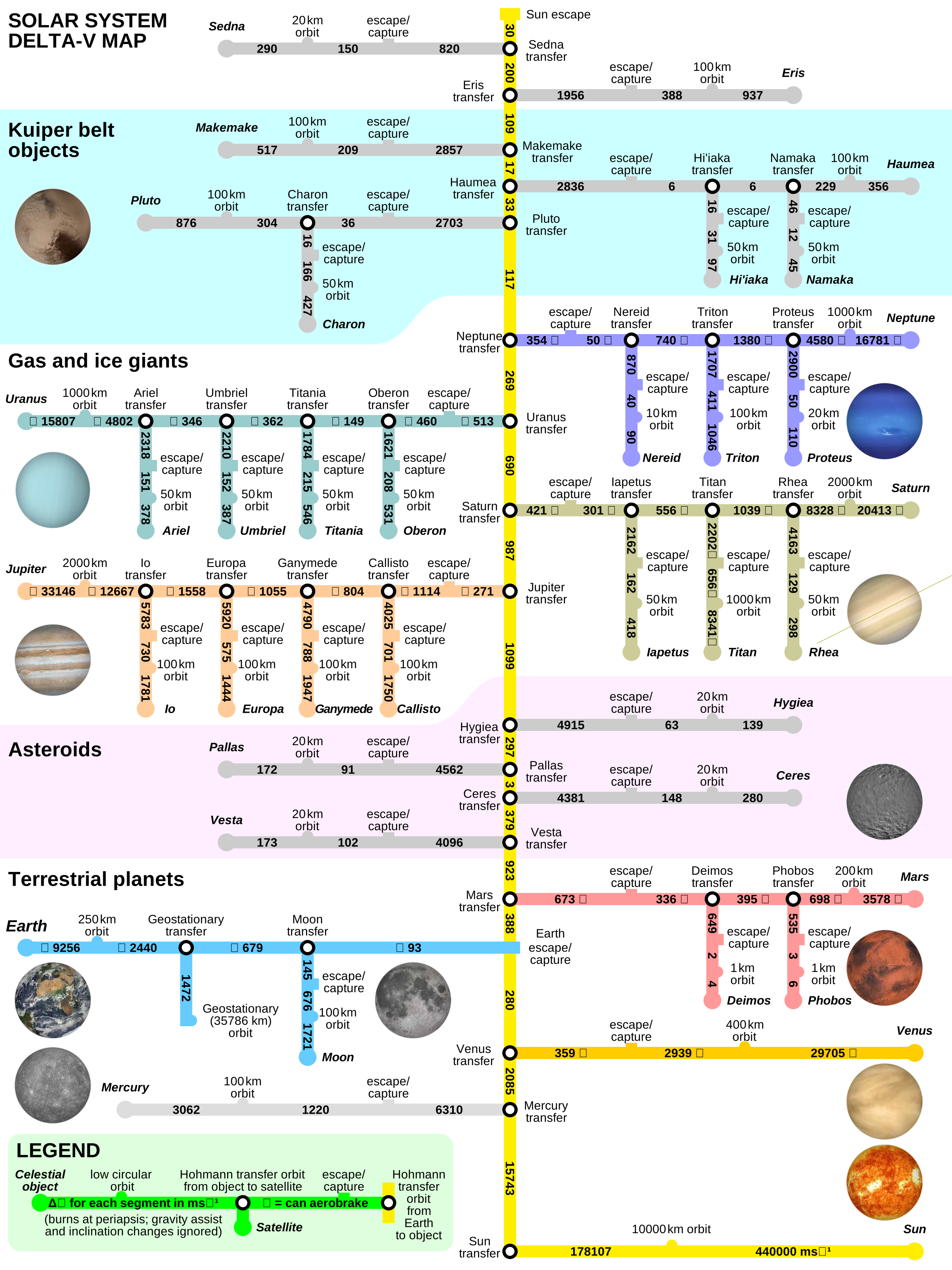
Here is a delta V map [1] for the solar system. It would be easier to launch our trash to escape the solar system rather than land it in the sun.
Either way we generate nuclear waste in the millions of pounds per year , launch costs with everything spaceX is doing is nowhere cheap enough to even get the waste in significant quantities to even LEO.
[1]https://upload.wikimedia.org/wikipedia/commons/9/93/Solar_sy...
I don't have the exact numbers but roughly 9.08 μN/m2 is the radiation pressure @ 1 AU and depending on sail configuration (Square/Lattice etc) we can expect a λ ~ 0.25 , with a 800m2 and 5g/m2 density sail we can get effective acceleration around 1 mm/sec2, so you can reach near the sun in few(<10) years ignoring efficiency losses due to quartering and any payload weight etc.
In a real system you could speed this up a bit by using powerful lasers to improve acceleration and orbital methods like a cycler, but meaningful payload size would make it slower too.
The basic metric is that escape velocity of solar system is 30km/s earth starts you at 18km/s : it is easier to add 12 than drop by 18. You can do the same things at 2/3 delta-v budget and push your payload out of the solar system than into the sun.
[1] All orbits decay and eventually(10^150+ years) even the Earth will fall into sun ( or equivalent mass white drawf) so yes it is always possible
> Since breeder reactors on a closed fuel cycle would use nearly all of the actinides fed into them as fuel, [the] volume of waste they generate would be reduced by a factor of about 100
> In addition, the waste from a breeder reactor has a different decay behavior, because it is made up of different materials. [Its] fission products have a peculiar 'gap' in their aggregate half-lives, such that no fission products have a half-life between 91 years and two hundred thousand years. As a result of this physical oddity, after several hundred years in storage, the activity of the radioactive waste from a Fast Breeder Reactor would quickly drop to the low level of the long-lived fission products.
> ". In 2010 the International Panel on Fissile Materials said "After six decades and the expenditure of the equivalent of tens of billions of dollars, the promise of breeder reactors remains largely unfulfilled and efforts to commercialize them have been steadily cut back in most countries"."
I have been following FBR progress especially thorium based ones, as it was considered to be India's path to energy independence since the 1950's. The progress has been slow and expensive and still a lot of research is left to do, so to say meaningfully that waste will reduce is not a viable plan today or next 20 years.
Between dying in next 100-200 years because of climate change or risking nuclear contamination problems 100's of years in the future in concentrated locations the later is always preferable yes.
I am not saying there is no good reason to move to nuclear, but cost is not one of them, as literally we don't know what it will cost yet.
https://www.forbes.com/sites/jeffmcmahon/2019/07/01/new-sola...
https://pv-magazine-usa.com/2019/06/28/los-angeles-seeks-rec...
https://www.science.org/doi/10.1126/science.365.6449.108
https://e360.yale.edu/features/in-boost-for-renewables-grid-...
https://www.nrdc.org/experts/kevin-steinberger/debunking-thr...
Lithium ion battery production is at only ~400 GWh per year. By comparison, the US uses 12,500 TWh of electricity daily, or just over 500 GWh per hour. And this is only electricity, not total energy usage. Attempting to provision widespread lithium ion storage would lead to demand shock and skyrocketing prices. Not to mention it would involve delaying transition from ICE vehicles to EVs.
You're right in some scenarios: if a country has extensive dam networks, then yes renewables + storage could be cheaper. Dams provide immense energy storage capacity. Close the turbines when solar and wind are producing, open them when they're not. If a country is blessed with extensive hydroelectric potential then great.
But hydroelectricity is a matter of geography, and plenty of regions do not have the right geography to construct dams. Lithium ion battery storage is not cheaper than nuclear, and is not produced at sufficient scale to be viable for grid storage. Other proposals like hydrogen storage, flywheels, etc. have not actually been deployed to the grid so we have no real-world cost history for these systems. Somebody writing a white paper claiming $X/KWh of storage and actually building a system are two very different things.
I was suspicious of your numbers so I did a bunch of math and then realized you're using the European comma rather than a decimal. So 12,500 means 12.5, not 12500.
(EIA.gov says the U.S. used about 3.8 trillion kilowatt hours in 2020 [1]. 3.8 trillion kilowatt hours equals 3.8 billion megawatt hours, equals 3.8 million gigawatt hours, equals 3.8 thousand terawatt hours per year or 10.4 twh per day. If we figure the U.S. has about a hundred million households and divide 3,800 twh by that, we get 38 megawatt hours per household per year. This is a very rough estimate, as it doesn't include industrial/commercial/government users. If we divide by 365*24 to cancel out the time units, we get an average consumption of .004338 MW or 4.338 kilowatts per household. That sounds about right.)
Current battery production is only just barely getting started. China dominates production of LFP cells (which are ideal for grid storage) because of patents which are expiring, so hopefully we'll see more production outside of china in the near future.
LFP cells aren't bottlenecked by nickel or cobalt, and so the main resource constraints I believe are lithium, aluminum, and copper which are all quite a bit cheaper and available in bigger quantities. I think prices are expected to eventually settle somewhere around $80 per kwh of capacity for the cells, and I don't think we're that far off that now. (LFP may eventually be displaced by something else, like lithium sulfur or solid state batteries or something, but I think LFP is probably good enough.)
Maybe lithium or copper will become bottlenecks and prices will rise. Let's say prices do hold at about $80 per kwh. Maybe we'll round up to $120 per kwh to account for pack construction, a building to store the batteries, inverters, chargers, and so on. If the average U.S. adult-aged person uses about 2kw on average, then they need 48kwh of storage for 24 hours. That would be about $5760. If we amortize that over ten years, it's about $48 a month. That's kind of expensive, but it's within the realm of what can be done without assuming any major technological breakthroughs. We probably don't need 24 hours of storage, though, if we have enough renewable energy over-production and backup fossil fuel plants to use in extreme situations.
[1] https://www.eia.gov/energyexplained/electricity/use-of-elect...
If we imagine a near-future scenario - a battery powered house heated with heat pumps, driving an electric car, during central European foggy winter, which tends to last for about a week at a time. Let's say they use 60kWh/day. We're looking at $100k just for the batteries and installation, even assuming electricity comes free. In ~15-20 years, the batteries reach their recommended cycle life, requiring a choice of another $100k or accepting that what used to be a 3-day storage becomes 2-day
This is not some "extreme situation". It's a completely predictable scenario that recurs with near 100% probability every single year. Then there are places like Ganges river, Bangladesh or Indonesia, home to hundreds of millions of people, where neither solar, nor wind is viable (and land is scarce)
I think it's useful to think in terms of cars. I'm actually doing an EV conversion right now, and I have a motor controller that puts out about 100 kilowatts of 3-phase AC. It came with the motor so I don't have an exact price, but fair market value is probably around $1500. (That's retail cost in quantities of one. Wholesale cost is presumably somewhat less.) It weighs maybe ten pounds or so. That's adequate to power probably about a dozen houses. I don't know if it puts out a sine wave or a square wave. Even if it's the latter, you could imagine a hundred of these things putting out square waves with, say, randomly-varying pulse width and having it average out to a sine wave. There's probably better ways to do that, but anyways the point is that we do have the capacity to switch enormous amounts of power in a very small package for pretty low cost. It's actually kind of amazing.
Maybe if the batteries feed into an HVDC line or they're co-located with a solar plant, then you don't even need to deploy more inverters.
A battery management system for my conversion is a little over a thousand dollars for a setup with about 48 cells. In a big installation you could amortize BMS costs by using bigger cells, or placing them in parallel groups -- the downside being that it might take longer to notice if a cell is going bad. My BMS is made by a company that caters to EV conversions; they're doing low-volume sales. A major utility ordering the equivalent for hundreds of thousands of cells probably can get a nice volume discount.
As far as foggy winters go: renewable energy needs to be traded over a wide geographical area. Purely local generation doesn't really make sense, unless you have some useful purpose for unpredictable amounts of surplus energy. Wind power would need to be a part of it. Even fossil fuels are a reasonable option as long as they're not used very often. Running natural gas plants for a week or two in the dead of winter or in case of grid disruptions seems like a reasonable use of fossil fuels. Indonesia has a lot of land outside of Java. Even Java is pretty sparsely populated outside of cities. Most of it is jungle which we'd like them to keep and farms, but solar doesn't need to take up a huge percentage of available land. Even solar panels on roofs can go a long way.
I personally feel that in 10 years in India it will be cheaper to rent an electric car running on LFP for trips < 300 km along with a driver (cheaper here) than buy your own car.
It may not be so now, but in 7 years, or in other words, by the time a nuclear power plant commissioned today starts producing power, it definitely will.
Global li-ion manufacturing capacity is poised to triple by 2024:
https://www.luxresearchinc.com/blog/li-ion-manufacturing-in-...
Without a sudden, disruptive change in the cost and rate of deployment of nuclear there doesn't exist a path for it become a significantly larger part of the energy mix.
It's also ignoring that electricity usage is predicted to increase substantially worldwide as countries develop, and that these predictions of lithium ion battery production might not pan out. It'd also severely delay adoption of electric vehicles, as battery capacity is being diverted to grid storage away from EVs.
1. https://pv-magazine-usa.com/2018/03/01/12-hours-energy-stora...
Still nuclear can be useful if some country are able to build them fast enough and cheap enough.
Your Storage does only need to be for 1-2 days (or more precisely until your renewables come online again to recharge them).
I don't see a massive shift to battery manufacturing any more crazy than building a crazy amount of nuclear power plants.
Even the much vaunted France doesn't have 80% nuclear on their grid.
Plus, energy storage production capacity is growing at an exponential rate. It's doubtful that we could grow our nuclear construction crews at that pace.
It's going to be very hard to nuclear to scale as fast as renewables and storage are, if there's even an economic case to be made for nuclear construction, and somebody finally solves the logistic problems of large construction projects in the modern Western world.
We know we can build storage and renewables, but we don't know how to build nuclear anymore, and none, absolutely none, of the nuclear proponents have any proposals to fix it. The best is an entirely new type of small reactor that has been rejects in the past because of its high per unit cost. Perhaps it will work, but who knows? It's a big risk, whereas storage and renewables are a sure bet.
It really isn't. For reference, across Europe we're currently having a meteorological phenomenon with bad weather, clouds, little wind, and low temperatures. It has been ongoing since ~october and is projected to continue into the winter. When Texas was hit with terrible weather last year, it lasted a few days. Multi-day storms, which take out solar and wind, aren't unheard of. 3 hours of storage is OK to even out things, but isn't nowhere near close enough to guarantee reliable electricity.
Personally I think small mass manufacturable fission reactors are the best bet but why are we hung up on either/or? We should aggressively pursue both nuclear and solar/wind generation.
Millions of lives are at stake.
I agree that we should invest in both. But it is not as easy as waving a magic wand. Energy project development is a complicated dance between local power market regulators, local and federal incentives, private investors, and shovel ready/cost-effective technology. And in the rare occasions when congress opens up the wallet, it is a small pie that everyone is fighting over, so the lobbyists start slinging arrows.
The fact is, nuclear can and will be a really great addition to the energy mix. But there are models out there that show that we can build a carbon free grid without it. The big question mark is on the future cost of storage. The consensus is that those costs are going to come down considerably. If so, then going all in on renewables likely gets us to a carbon free grid faster. But this is also a very US centric take. For example China likely has much easier road to rolling out nuclear (less regulatory hurdles, less local interference/input). Where as in the US, I am sure we can build a big national pro-nuclear movement, but the second someone proposes a real life project, the NIMBY's will come out of the woodwork.
This is not the current hurdle when it comes to more nuclear in the US or Europe. Nuclear is very welcome where it is currently under construction, and there's no regulatory reason that these sites have all become construction disasters, it's just bad execution of the reactors.
Even China's attempts to build the French EPR design took twice as long to build as they had estimated initially, and we don't really know how much more in cost.
Nuclear's path to new reactors begins with being able to build on a reliable schedule without exorbitant cost. There are many sites that would welcome more nuclear that would not have NIMBY problems, there's just no one willing to bear all the risk of finding that unicorn contractor that can actually build.
This same problem was also evident during the late 1970s and early 1980s nuclear projects. There was NIMBYism back then affecting projects, but there was also lots of construction malpractice that resulted in big cost overruns. US utilities can not bear the construction risk of a $10B project. Few entities can.
But we need all of that to electrify transportation, so where do you get the ones for the power grid?
Also, what happens to the price of batteries if you get rid of baseload and cause demand for batteries to spike much higher than even the increased amount of battery production capacity?
Maybe, maybe not. We know nuclear works so why not also make nuclear in case something happens and we can't build enough storage.
Adjusted for capacity factor this is maybe going to keep up with solar deployment, but definitely not with wind capacity growth in the same country. And China has been the world leader in nuclear deployment for a while now.
Renewables win on a "worse is better" basis - yes, they're intermittent, but they're cheap and deploy in a matter of months without too many specialists involved.
You're simplifying out that electric consumption varies during the day.
Browsing the last day's energy usage yields peaks at:
Eastern: 8pm
Central: 7pm
Mountain 6pm
Pacific: 5pm
Look at the chart in your last link:
https://www.nrdc.org/experts/kevin-steinberger/debunking-thr...
They match up demand with load by using a buttload of hydro and and even larger amount of natural gas. We can't use natural gas if we're trying to get rid of fossil fuels and we can't use hydro in places without appropriate geography, so then what?
To say nothing of what happens when solar and wind are "it's cloudy and there's no wind right now" intermittent rather than time-of-day intermittent.
https://www.factcheck.org/2019/11/what-does-science-say-abou...
> To start, we’ll consider Sanders’ claim that “scientists tell us” that it’s possible to get to a zero-carbon electrical grid without nuclear power.
> “The shortest answer is yes, that’s true. Scientists do tell us that we can,” said Drew Shindell, a climate scientist at Duke University’s Nicholas School of the Environment.
> Ryan Jones, an expert in electricity systems and a co-founder of Evolved Energy Research, a consulting company that models low-carbon transitions, agreed. “Anyone who says that nuclear is 100% necessary on a technical basis, I would claim, just hasn’t looked at the alternatives in enough detail,” he said in an email.
> Most experts FactCheck.org contacted, including those who think nuclear power should remain an option, said that from a technical perspective, nuclear is not needed to decarbonize the grid.
> Most experts agree that Sanders is correct that it’s technologically possible to decarbonize the grid without using nuclear power. But many researchers also say keeping nuclear on the table makes decarbonization easier and more likely.
> But technically possible is not the same as practically feasible, or the most cost-effective. In that regard, many, although not all, researchers say nuclear — or something like it — is likely to be necessary to some degree. And even if nuclear is ultimately not needed, they say, the safer strategy is not to exclude it.
But what does "technically" mean?
> “All the evidence says it is possible to decarbonize the energy system in the U.S. without using nuclear power,” said Jones. But, he added, there are cases, such as places that don’t have good wind resources, in which building new nuclear plants can reduce the cost of decarbonizing. Depending on the region, he said, “getting to 100% renewable energy is either very expensive or necessitates significant new transmission to import resources from elsewhere.”
> That’s where nuclear can be helpful. It doesn’t have to be nuclear — Jones said carbon capture and sequestration, or CCS, for example, would also work. Sanders’ plan, notably, specifically excludes CCS.
> A large number of scenarios expanded nuclear power, Shindell said, to around double today’s level. He estimated that 90% of the scenarios included nuclear capacity above today’s level, and just one or two scenarios phased out nuclear entirely by 2100.
And the article, that YOU LINKED, goes on like this. I feel like you are being very disingenuous. I don't think anyone (or at least anyone that is informed, but then again that's probably too much to expect here given comments), is saying that nuclear is _absolutely_ necessary. I do think people are saying that it is much easier and cheaper if it is included within the solution. I do think people mischaracterize the arguments though and frame it as "all nuclear" vs "all renewables" but the truth is that both those solutions are absurd. We want a mixture and what that mixture is is going to depend on the region and country that is producing power. It is rather complicated and nuanced and the conversations typically don't acknowledge this.
Maybe part of the problem here is scientific lingo. We say "technically" and "possible" a lot of times, even if our confidence intervals are pretty small. This is something we can work on, but it is often to avoid infighting because someone else will argue "but 'technically' it is possible, just really unlikely/difficult" and you'll have to concede. You'll see this in any "nerd debate".
Either way, I'm going to call you out for misrepresenting your source.
[0] https://www.factcheck.org/2019/11/what-does-science-say-abou...
I’m not splitting hairs, I’m arguing very clearly that nuclear won’t get built, it won’t be needed, alternatives will meet demand, and that energy consumption and generation modeling by a variety of energy analysts (across commercial and academic institutions) supports my thesis.
FTFY
But yes, I think you are more accurately capturing my response. And thanks for the defense.
That's his thing. He makes broad to the point of indefensible claims, backs them up with a laundry list of tangentially related links, almost always from the news (and we all know how much the news loves to report "the whole truth"), and then when he gets called out he moves goalposts around muddies the waters and does all sorts of tricks that are SOP when arguing in bad faith. If he were not constantly arguing for viewpoints that more or less correlate with the net average HN user his posts would have been defaulted to dead long ago. I think he believes his own BS so it's debatable whether he is technically arguing in bad faith but it sure fails the duck test.
The only way to win is to not engage.
To be frank, it sounds more like you are disgruntled and are unhappy when the facts presented (as well as the general consensus of the forum, as you mention in the comment I'm replying to) don't align with your belief system. I don't mean to be rude by any means, but I'm unable to come to any other conclusion based on my (imho, polite) interactions with you. I do believe my conclusions based on the data I present. Why would I comment and participate if I didn't? I don't take issue if you choose to not engage, but I'd appreciate if you'd tone down the libel and attacks on my character in a public forum if you choose to not bring facts and argue ideas.
If they can beat France on cost then here is a political win to be made. Be it using lithium batteries to store up 3-4 weeks worth of the nations energy consumption, or the more likely green hydrogen which is commonly suggested as being more likely choice for wind energy.
The current commercial viable lithium battery solution, that which solar farms has written articles about, is around 4 hours of 80% capacity. Not bad. Every day the batteries get charged when the sun is at its peak and powers prices is at its lowest point, and every day when the sun goes down they can utilize the highest price point as demand exceed supply of cheap energy.
For wind it is a bit more complicated. You can have a few weeks of good weather, followed by a long period of low wind conditions and high demand. A few hours won't cut it, and the more capacity you add the slower the discharge cycle will be. Green hydrogen would be a more economical storage medium, but right now the technology is having a hard time to be economical viable. That said it would benefit the world if Germany made a run for it so we can compare the cost to nuclear.
Unlike pledges, which can be produced instantly, actually bringing reliable power online takes more than 3 years.
It's these types of pledges that make the public view these replacement efforts as fundamentally unserious.
Don't get me wrong, I'm a big fan of nuclear and think the industrialized west should follow in France's footsteps. But we will not get there by 2025. We may never get there as long as we approach this problem in such an unserious manner.
I agree with you however that it will take much longer than 3 years. Lithium batteries can be done today for the kind of storage solution which they are suitable, but not for wind. The green hydrogen might work, but we have yet to see large scale production and we are nowhere near to have it operate as an alternative to natural gas on a nation scale. Germany should really make an attempt if they wish to take a different path from France, but it will likely take a few decades if its successful.
Solar and wind often overproduce (leading to negative prices). This (otherwise useless energy) will be used to produce dihydrogen (water electrolysis), which will be stored, then used to produce electricity (fuel cell).
Canadian politicians are pledging to develop blue hydrogen in Alberta. That means transforming hydrocarbons into hydrogen.
Yep, it is as stupid as it sounds. Consume fossil fuels to produce hydrogen and label it blue energy.
- able to store otherwise is wasted energy
- affordable (the total price of this storing-then-reconversion into electricity is OK) is adequate
- storing in adequate volumes
is adequate, even if its total efficiency is below .01
Blue hydrogen isn't good (emission-wise), but may be used as a way to evaluate and enhance what will ultimately be a green (electric energy only produced by renewable used to obtain dihydrogen) system.
Moreover there are quick and decisive progress towards better efficiency.
Salt cavern storage doesn’t change the math.
As for efficiency: https://www.vicat.com/news/vicat-schlumberger-new-energy-cea...
https://www.sciencedirect.com/science/article/pii/S187661021...
> Salt cavern storage doesn’t change the math
"Total on- and offshore European hydrogen storage potential estimated at 84.8 PWhH2." is pretty significant and pertinent.
It's as simple as that. They are an exporter.
At that price nuclear is already dramatically cheaper than coal - about half as expensive based on the analysis you linked.
The thing is, it's not clear which externalities are priced into renewables. For instance, is the cost of cleaning up this disaster where rare earth metals are mined/refined priced into wind power? [1] Burying the turbine blades forever? [2] How about the cost of the global scale e-waste problem yielded by covering the earth in solar panels which last 30 years? [3] How about power storage - all that lithium?
I'm fine with nuclear, I'm fine with wind, I'm fine with solar. There's no such thing as "green" just shades of black.
Whatever gets us off carbon fuels - yesterday. I strongly doubt the pricing is what's reflected in those charts - they tend to underprice the externalities of everything non-Nuclear. Even if they don't though, I don't really care, at this point decarbonizing is worth paying double for power. I'm not sure how good a deal we're getting is going to matter when we live on Waterworld.
[1] https://www.bbc.com/future/article/20150402-the-worst-place-...
[2] https://www.bloomberg.com/news/features/2020-02-05/wind-turb...
[3] https://www.wired.com/story/solar-panels-are-starting-to-die...
> It pointed to an Electric Power Research Institute study that estimates all blade waste through 2050 would equal roughly .015% of all the municipal solid waste going to landfills in 2015 alone.
While it'd be better to do something useful with them it's not a problem to put them in a landfill.
I’m not against nuclear for geographies that need district heat or don’t get enough sun or wind for reasonable renewable generation, but I do take issue that it gets put forth as a silver bullet that we’re going to scale up in a reasonable amount of time when all signs point to that being objectively false. I’m violently allergic to platitudes and snake oil.
The article I linked (titled "Wind Turbine Blades Can’t Be Recycled, So They’re Piling Up in Landfills", haha) indicates that turbine blades are not recyclable. They are fiberglass, which is a mix of glass and plastic - it's long been known as one of the hardest things to recycle. They are currently buried - or burned. The latest scuttlebutt on that is Semens Gamesa has a recyclable prototype. [1] I suspect it will come, but is it priced in?
> "At the end of their working life, most blades are buried underground or burned." [1]
As for solar panels, I agree they could be recycled - up to some 90% based on some digging - but it's super expensive to do so, and I suspect it's also not priced in. 91% of the plastic you throw into the recycle bin makes its way to the landfill anyways. [2]
I don't think there is a silver bullet per se, which is why I want them all deployed ASAP.
My comment was more that I don't think the prices as reflected in your link represent the true cost of the electricity due to the varying degree to which externalities are priced in. Even if accurate, price (probably to your point) isn't really the be all and end all here. The switchover needs to happen, and in time, whatever that looks like. All this hand-wringing around nuclear taking forever to deploy a few decades ago is part of why we're here, now, without nuclear.
[1] https://www.fastcompany.com/90674645/this-giant-wind-turbine...
[2] https://www.nationalgeographic.com/science/article/plastic-p...
the first link is basically your second link [2]. the rest are mostly links about that the problem from non recyclable is mostly a problem that only exists, because these fiberglass blades are dirt cheap compared to alternatives and it's cheaper to dump them in landfills. in fact in 4 european countries it's forbidden to put them into landfills. in fact a spain company _can_ recycle fiber to fiber glass to 100% (reciclalia) and they do it even for differnt uses cases (formula 1 and aerospace). of course if landfills are accepted in a country it's cheaper than to recycle. dumping is always cheaper than recycling thats why we dump so much (not just wind turbines...) in fact in germany a lot of our "recycling process" is asically thermal recycling which is not "real" recycling. we basically cheat the stats. a shit ton of stuff can be recycled if somebody wants to, which is often not the case, not even on a governement level and sometimes it's just stupid to even create non recycable waste for no reason (which happens often in the food industry because the non recycable case is often cheaper)
In France recycling is mandatory (by law).
The concrete is recyclable, and appreciated: https://archinect.com/news/article/150240752/recycled-concre...
[1] https://en.wikipedia.org/wiki/Vogtle_Electric_Generating_Pla...
[2] https://en.wikipedia.org/wiki/Virgil_C._Summer_Nuclear_Gener...
If you look for example, the nuclear reactor built in France in the 70ies and 80ies took generally between 5 and 9 years to build, with the newer and greater capacity reactors taking significantly more time.
https://en.wikipedia.org/wiki/List_of_commercial_nuclear_rea...
Keep in mind that it was at the pick of Nuclear reactor construction. These are really large projects with tons of suppliers and contractors to coordinate. There is a lot of experience and institutional knowledge needed, but which has been unfortunately partially lost with the significant slowing down of new constructions in the late 80ies/90ies.
Also, this slowing down also had a significant effect on the supply chains, often leaving very few companies key components/sub-systems.
Flamanville 3 is definitely a poorly lead project and a big outlier, but, a country re-starting its nuclear construction, the first units would probably take ~10 years to come online.
The EPR projects weren't such successes, they were overbudget and overschedule. Then an incident lead to a shutdown for examination.
See https://en.wikipedia.org/wiki/EPR_(nuclear_reactor)#Taishan_...
https://edition.cnn.com/2021/07/31/asia/taishan-nuclear-plan...
The price being very low often reflects the fact that, at that time, this energy is basically worthless/useless. And in fact, prices have even gone negative, meaning "please stop feeding this useless energy into the grid".
So low renewable prices are not necessarily a good sign, and can in fact just be the economic indicator for the limited usefulness of renewable energy.
In 2019, China had a new target of 200 GWe of nuclear generating capacity by 2035, which is 7.7% out of predicted total electricity generating capacity of 2600 GWe.
https://en.wikipedia.org/wiki/Nuclear_power_in_China
So with about 50 GWe from 50 reactors today adding another 150 gives you the same goal of about 200 GWe. Unless we're talking SMRs because then the goal just got reduced to a fraction of the original.
This may be more complicated than that, see https://news.ycombinator.com/item?id=29159944
> Japan reactivating nuclear reactors:
Japan invested on nuclear then nowadays don't want it anymore but now needs energy. One has to see them canceling their planned phase-out, as "in March 2021, only 11 percent of Japanese said they wanted that nuclear energy generation be discontinued immediately. Another 49 percent was asking for a gradual exit from nuclear energy" ( https://en.wikipedia.org/wiki/Nuclear_power_in_Japan#Post-Fu... )
> UK. Rolls-Royce gets funding
"£195m cash injection from private firms and a £210m grant" are ridiculous sums. In France Macron announced 1 billion €: given that nuclear research already burnt ~900 millions € per year (public research), a fair part of the 2.2 billions allocated to the CEA's civilian programs, this isn't decisive.
> Japan invested on nuclear then nowadays don't want it anymore but now needs energy. One has to see them canceling their planned phase-out, as "in March 2021, only 11 percent of Japanese said they wanted that nuclear energy generation be discontinued immediately. Another 49 percent was asking for a gradual exit from nuclear energy" ( https://en.wikipedia.org/wiki/Nuclear_power_in_Japan#Post-Fu... )
Wow. To have even ~40% of the population not opposing nuclear after a national trauma like Fukushima, shows their sophistication as a people.
https://www.nhk.or.jp/politics/articles/lastweek/54794.html
It also should be considered that stopped nuclear plants (its pool filled by nuclear fuels) aren't safe like no plants but similar to running plants (but I doubt majority of people know that).
60% want "the nuclear power to be discontinued" either right now or gradually, and ~27% "don't know". IMHO there is a large majority of citizens wanting a phase-out.
Hang on, China also announced a couple of months ago to build 43 new coal-fired power plants.
It's not that long ago - perhaps a decade - that China was building a new coal-fired power plant every 10 days or so. Not small ones, but on the same scale as the largest coal-fired power plant we had in Australia at the time.
I mention this as a counterpoint to any 'If China's doing it, it must make sense' fallacy.
It makes sense if you realize
1. China pledges to peak carbon emission by 2030
2. Any increase in emission before 2030 will increase China's peak carbon allowance afterward.
3. Coal plants are cheap to build. Who cares if you only run them at 30% load factor for their entire lifespan.
4. Cap and trade between countries mean the carbon credit will worth a lot in the near future.
China pledged to peak Carbon emissions as a share of GDP by 2030. Not the same thing, given that GDP is increasing by 6-8% each year. Most Western nations already have had emissions per GDP declining for a long time.
> 2030 will increase China's peak carbon allowance afterward
China has rejected abiding by any Carbon "allowance", nor will it adopt any cap and trade system for carbon.
Outrage is what identifies a problem, but to solve the problem requires state capacity to deploy infrastructure cost effectively and at scale.
Now we have no shortage of outrage. We've got activists blocking traffic and having "die-ins" in which they lie down on the grass and sob. We have endless moaning about 'climate collapse'.
But none of that increases nuclear generating capacity. None of that deploys any reliable battery storage at scale.
So then you have the neoliberal free-marketeers thinking that if they impose taxes on oil then magically these nuclear plants will be built, just out of the free market. This is faith-based infrastructure.
But that doesn't happen, so you have the public being burdened by high taxes, then they kick the politicians out of office to lower their taxes, and nothing gets done.
Is that because the public has an emotional attachment to fossil fuels? That they love coal? No, people don't care where they get their energy. Making them care -- e.g. promoting outrage -- does nothing to deploy nuclear power at scale. Lecturing end users about how they are "destroying the plant" also does nothing. That's also just more outrage.
This lack of effective action and the substitution of outrage for engineering competency is why we still need fossil fuels for baseload and will continue to need them.
In fact we are so paralyzed by emotion and irreality that I predict that we will never recover the state capacity we had in the postwar period and instead will just end up buying nuclear plants from China and battery storage infrastructure from China, because we don't have the competency to deploy this infrastructure at scale by ourselves.
But China has state capacity. They do not have the outrage, which is why people who only value outrage think that China is doing nothing. But China will leapfrog the West in things like Nuclear power and even in the area of battery storage at scale.
It may not be according some 2030 timeline, which is again a political deadline rather than a deadline arising from a sober assessment of engineering roadmaps, but China will eventually do it because it has state capacity to act in this area and we do not. When it comes to solving big infrastructure challenges, we have only outrage.
The world wont stop warming at 2 degrees, thats just projection for 2100, it will keep warming after that.
The next generation will have to pay for pulling carbon out od the air to actually stop warming, and that's going to cost $2 for every $1 the oil industry has ever made.
China seems to be adding ~30GW of coal, 70GW of wind, ~50GW of solar, and ~6 GW of nuclear power/year to its grid.
I do like there is a large market to this startup. Hopefully that will result in a somewhat price-competitive reactor design. But I doubt that will happen for another 10 years.
I think solar/wind/battery will eat the lunch of any new nuclear plant in cost once it goes online.
Hoping for the best!
I am wondering what Germany is going to do. They have bet heavily on wind & solar (apparently they haven't check how many sunny days Germany has...) with the backup from Russian gas from Nord Stream 1/2 (for some reason this gas is "clean" although burning it produces CO2). If everyone around will switch to nuclear, what I hope will happen, they can end up with the very expensive setup that is still producing a lot of CO2.
I am afraid that Germany will try to enforce ban on nuclear by European Union (what they can do, since Brexit Germany is in fact ruling UE), as the wrong investment might hurt their economy. I hope France will oppose.
It seems this is the biggest energy story of the year. The comeback of nuclear energy.
https://smallcaps.com.au/china-supercharge-uranium-race-150-...
The HN discussion on the China story:
https://news.ycombinator.com/item?id=29151741
Japan reactivating nuclear reactors:
https://mainichi.jp/english/articles/20210501/p2a/00m/0op/00...
UK. Rolls-Royce gets funding to develop mini nuclear reactors:
https://www.bbc.com/news/business-59212983