It's plutonium.
There are treaties that say you can't use spent fuel from civilian power reactors to make nuclear weapons, so nobody admits to doing this, but they probably are. That's where it goes. But since nobody can admit to it, the representative from coal country gets to say 'what about nuclear waste' whenever somebody wants to replace coal with nuclear and nobody can tell them the answer because they're not allowed to admit it. But it's not a bug, it's a feature.
There are also newer reactor designs that can run on plutonium (permanently eliminating it) and also intentionally produce Plutonium-240 in amounts that make it impossible to use for weapons. If that's what we actually wanted to do with it.
We currently do not have a viable economically well understood solution, not hypothetical plans which may work to use plutonium effectively [1] at costs we have no idea about or disposal facility for which costs are not really known yet for all types (HLW/ILW and LLW) waste products we cannot talk costs of ownership.[2]
That doesn't mean we shouldn't do nuclear or not build new plants, but without knowing these costs any estimate of cost of ownership is useless numbers in the air as nobody knows what it is going to actually cost yet.
[1] Again engineering and economics, engineering maybe well understood, costs are not, we don't know the costs until we build a few, nuclear is notorious for widely over running cost estimates compared to any other power generation method.
[2] We don't need to measure thousand years of disposal to know the costs, we just need to run an actual disposal site for few years to really estimate the costs .
There's plenty of chemical waste from fossil fuel use and petrochemicals that may be very long lived and cause actual health impacts if inadequately stored, too... with basically no efforts made to apply the same sorts of criteria of quality and longevity of disposal of waste.
So effectively, we compare the (not fully known) costs of really mitigating the long term impacts of nuclear with outstanding storage ... to doing nothing about greater impacts from fossil fuels (both short term impacts and long-lived waste).
A enforced storage/cleanup would be ideal yes, U.S. has never agreed to any standards, even know while Kerry talking about shutting down Coal by 2030 from nowhere, the U.S. government explicitly did not join the pledge to shutdown coal in 2030s like some countries did last week in COP26, and has always refused to get into any international binding agreement.
From a economic perspective what you are mandated to pay for [1] today is how you model costs of the project. Running a nuclear plant today means you have to keep spent in fuel on premise with no horizon for that status quo to change. Economic model for actual money going to be spent now ( not environmental or social costs models of indirect costs) has to factor that in the cost of ownership of a plant.
Is that unfair because fossil fuels has indirect costs ? yes it is, but that does not matter from an economic decision making point of view when financing a new power plant today. Carbon tax is not a solution either as currently being envisioned [1]
---
[1] The carbon tax that is being discussed in the U.S. would be a disaster .
    a) The tax rate is quite low which will supposedly increase over the years. The political pendulum in the U.S. almost guarantees that when republicans come to power in 2024 or later they are going repeal/relax a carbon tax like with Paris Agreement. U.S. is not currently in position to make serious long term commitments on any policy.

    b) The polluters want limits *relaxed* as part of the tax deal. That means they want to be able to pollute as much as they want and just pay a small tax to do so ,which is why it is actually supported by some republicans I suppose.

c) Finally there is no plans on how to use the money to *remove* CO2 from the atmosphere, reducing emissions with that money with green investments is not good enough as polluters are in theory paying the government to take care of the problem and will pollute as they wish so government needs to clean the CO2 up. CCS is not viable economically today certainly not at the tax rate being proposed.My comment isn't talking about CO2. I'm talking about e.g. benzene.
Nuclear waste disposal is concerned/stymied by the possibility that the water table in remote areas where no one lives currently may be moderately contaminated in thousands of years if it fails, and this contamination may last thousands of years.
Whereas we have contaminated the water table in populated areas with benzene and aromatics -- where they will remain contaminated for thousands of tens of thousands of years.
That is, we're trying to prevent theoretical harms in the distant future, and in so doing, we're accepting much larger present harms.
If there are no other(clean) options having equivalent characteristics (consistent base load, scalability, location etc) to augment solar/wind etc ( whose costs are very well understood now including end of life costs) , then we are not choosing because it is cheaper, we are doing it because there is no choice.
[1] All plants will have some cost deviations, but nuclear has much higher both time and cost deviation from plan estimates.
See this graph for the spread based on Z number (Protons + Neutrons).
https://en.m.wikipedia.org/wiki/Nuclear_fission#/media/File%...

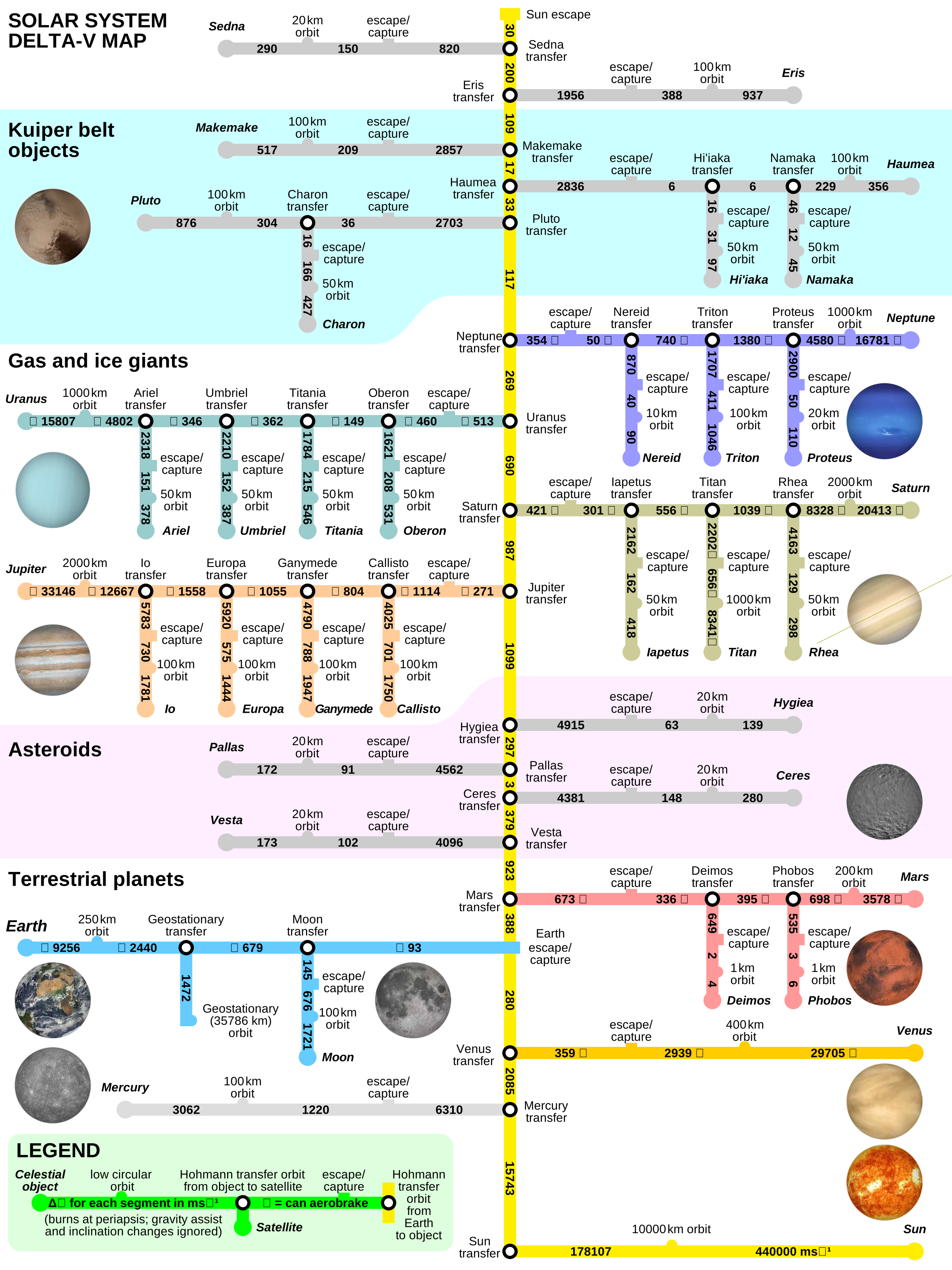
Parker Solar probe launched in 2018 will take 7 years and multiple gravity assits to slow down enough to get close orbit to the sun.
It is also why BepiColombo will take 6-7 years to reach mercury orbit with similar steep delta-v costs.
Here is a delta V map [1] for the solar system. It would be easier to launch our trash to escape the solar system rather than land it in the sun.
Either way we generate nuclear waste in the millions of pounds per year , launch costs with everything spaceX is doing is nowhere cheap enough to even get the waste in significant quantities to even LEO.
[1]https://upload.wikimedia.org/wikipedia/commons/9/93/Solar_sy...
I don't have the exact numbers but roughly 9.08 μN/m2 is the radiation pressure @ 1 AU and depending on sail configuration (Square/Lattice etc) we can expect a λ ~ 0.25 , with a 800m2 and 5g/m2 density sail we can get effective acceleration around 1 mm/sec2, so you can reach near the sun in few(<10) years ignoring efficiency losses due to quartering and any payload weight etc.
In a real system you could speed this up a bit by using powerful lasers to improve acceleration and orbital methods like a cycler, but meaningful payload size would make it slower too.
The basic metric is that escape velocity of solar system is 30km/s earth starts you at 18km/s : it is easier to add 12 than drop by 18. You can do the same things at 2/3 delta-v budget and push your payload out of the solar system than into the sun.
[1] All orbits decay and eventually(10^150+ years) even the Earth will fall into sun ( or equivalent mass white drawf) so yes it is always possible
> Since breeder reactors on a closed fuel cycle would use nearly all of the actinides fed into them as fuel, [the] volume of waste they generate would be reduced by a factor of about 100
> In addition, the waste from a breeder reactor has a different decay behavior, because it is made up of different materials. [Its] fission products have a peculiar 'gap' in their aggregate half-lives, such that no fission products have a half-life between 91 years and two hundred thousand years. As a result of this physical oddity, after several hundred years in storage, the activity of the radioactive waste from a Fast Breeder Reactor would quickly drop to the low level of the long-lived fission products.
> ". In 2010 the International Panel on Fissile Materials said "After six decades and the expenditure of the equivalent of tens of billions of dollars, the promise of breeder reactors remains largely unfulfilled and efforts to commercialize them have been steadily cut back in most countries"."
I have been following FBR progress especially thorium based ones, as it was considered to be India's path to energy independence since the 1950's. The progress has been slow and expensive and still a lot of research is left to do, so to say meaningfully that waste will reduce is not a viable plan today or next 20 years.
Between dying in next 100-200 years because of climate change or risking nuclear contamination problems 100's of years in the future in concentrated locations the later is always preferable yes.
I am not saying there is no good reason to move to nuclear, but cost is not one of them, as literally we don't know what it will cost yet.
If we don't have a viable and economically well understood solution for nuclear waste handling , any cost calculations for nuclear is a waste of time .