We couldn't trust the media already, Bloomberg will just be another example making this clearer.
On the other hand, MSNBC, ABC would ask questions like "Some people say you make fun of asian sterotypes, what do you have to say to that ? " or "Some white supremacists are coming out in support of your campaign - why do you think that is the case ?", "When you lose, are you going to support whoever is the democratic nominee?"
The media bias was frustrating to watch. The best sources for information in this cycle seem to be youtube podcasts like Joe Rogan or the Breakfast club.
I'd love to see long form become the dominant format in future cycles. It's so much better, allowing for nuance and depth. It's more real and human.
The format of TV interviews and debates are truly terrible. Largely devoid of substance, they reward/incentivize soundbites, shallow quips and drama. Yang wasn't playing that game and not well suited for it (perhaps part of why he was consistently given the least time), whereas he really shined in long form.
I would love to see a debate that had no live audience, and took place around a table rather than a row of podiums.
There's always a bunch of candidates who seem credible but can't get enough support, and others who do.
Compare Yang, Williamson, Klobuchar and Buttigieg and a bunch of other candidates. Buttigieg started polling well, which justified coverage. Klobuchar didn't get any coverage until her outstanding debate performance and then her polls picked up.
The others just never polled high enough for anyone to consider them credibly able to be nominated.
[1] https://www.politico.com/magazine/story/2019/04/29/lis-smith...
Klobuchar was getting lots of coverage, including major media endorsements (like the NY Times, which did a weird split endorsement of her and Warren), before the debate performance, and even after she's still barely registering in the polls nationally, polling at around 5% on average
And why do voters feel as they do? Because his weirdness is possibly the result of underlying genius, while for her weirdness it’s more likely to be mental illness.
He also made enough political changes so that Sanders went from "open borders are a Koch brothers idea , bad for the nation", to "free healthcare for illegals"
He got into the debates, which is far more than anyone without any party credentials could have had hoped for in previous primaries. The debates were already too large. Far too much money is spent on the primary. And whoever the nominee will be, they won’t have gotten much use out of this time of being one voice among too many.
So this primary is arguably not within the typical parameters of optimizing chances in the general. That’s because it’s basically mob rule, now: they are completely paranoid of a repeat of the collective pettiness of Bernie supporters, mistaking the slightest advantage HRC may have gotten out of 40 years of laughing at the unfunny jokes made by the Democratic mayor of East Westnowhere.
Yang had enough presence that he could have caught on. Buttigeg shows it’s possible for an unknown, Bernie has shown it’s possible for an outsider, and that guy from Texas has shown it’s possible for a weirdo. Also Trump.
It’s perfectly fine to afford the 5%-candidate less time than the 25%-candidates in a debate. And the print media would love to have a coming-from-behind story-arc. He just didn’t catch on.
Logically why do we think they have our best interest at heart. Why do we think they are neutral and what they say is a fact? Why do we divide them into news and fake news (the labels change based on the view as to who is who)?
There are facts in this world. And our collective belief in them is what holds the world together. Reckless and intellectually lazy comments like yours are what is responsible for so many of the problems in politics in the last decade or so.
Seek out facts instead of pretending they don't exist.
Yes, what a given news organization chooses to cover is often as important as how they cover what they do.
We saw it in 2016 when Rand Paul and Bernie were repeatedly left out of discussion of the polls - despite ranking higher than others that were covered - and we're seeing it again with Bernie and Yang this time around.
The memory hole is a real thing.
And it has been taught to many kids for years how to deal with bias in media. You simply consume many different types. The problem is most people don't do this.
https://en.wikipedia.org/wiki/Jimmy_Savile_sexual_abuse_scan...
I guess that depends on if you think making one of the worst pedophiles in history a network star for decades is "better" than FOX. I don't think it is, both networks are not trustworthy.
One of the publications I trust the most (WSJ) is one that is editorially least aligned with my own biases. It doesn't make me doubt their factual reporting.
The trick is to only select certain facts that support your point of view and omit facts that don’t. Lying by omission isn’t really a detectable or punishable offense. It gets even more complex when “the facts” are based on a previous narrative which itself isn’t investigated for truthfulness.
This phenomenon is easy to see if you compare two ideologically opposite media websites, like Vox and Fox. I’m not sure if there is any solution other than to read multiple news sources, which unfortunately just feeds the media machine even more.
The editorials are sometimes right-leaning, but mostly fiscally so.
If you believe that every media organization has an agenda and a biased point of view, you may be listening to people on the internet who wear tinfoil hats and agree with your worldview.
I've worked in over a dozen newsrooms from coast to coast, in big markets and small. I know how they operate.
A big part of the problem is that the people consuming the product don't know the difference between news and opinion. Many newspaper readers don't know the Opinion section is not the same as the National section. And I've heard more than once people who don't know the difference between Wendy Williams and their local news.
There are problems on the production side of the media, but the problem is just as big on the consumer side.
It is media theory and philosophy 101 that people, and by extension organizations, are not some kind of objective entities that exist outside of the real world. The media is not a mirror that accurately reflects reality. Everyone has a viewpoint and a worldview. This is not some controversial tin-foil hat opinion, it’s a basic description of human psychology.
You believe this because of your bias. There are a significant amount of people with another set of biases who think Fox News, The Sun, etc are presenting facts. Both you of guys are wrong.
> There are facts in this world.
Yes. And the job of the news industry is to spin facts for their employers'/elites' interests. If you think the news industry is in the business of facts and truth then you really have fallen prey to their marketing. Every major newspaper was created to push a political agenda - including the oldest newspaper ( The NY Post ) which was founded by alexander hamilton to push his federalist agenda.
> Reckless and intellectually lazy comments like yours are what is responsible for so many of the problems in politics in the last decade or so.
You need to expand your view. The news industry has been lying forever. Problems of politics has existed forever.
"Nothing can now be believed which is seen in a newspaper. Truth itself becomes suspicious by being put into that polluted vehicle. The real extent of this state of misinformation is known only to those who are in situations to confront facts within their knowledge with the lies of the day."
-- Thomas Jefferson ( one of the people who gave us free press )
> Seek out facts instead of pretending they don't exist.
Agreed. But I'll add an addendum. Stop pretending the news is about facts and not politics/opinion/agenda/etc. I'll add a second addendum - "fact" checking organizations are even more biased.
Try this. Ask a fox news fan why they like fox news and what will they say? They'll say that it is because fox news is factual and accurate. I know because I've asked. But we aren't idiots, we know that's bullshit and they like fox news because they like fox news' opinions.
Now ask a "NPR, PBS, DV, BBC, ABC AU" fan why they like "NPR, PBS, DV, BBC, ABC AU". You know what they will say? The exact same thing as fox news watchers. I know because I've asked.
On the other hand if you listen to them, there are large quality differences between average reporting quality of different news sources, and painting them with a broad brush and treating them like they are all equivalent I don't think is helpful.
While the GP post picked left-leaning/right-leaning examples, it's still probably not an accident that they left out MSNBC/CNN from their "good" examples and the WSJ from their "bad" ones.
I find the better reporting, like a good documentary, tends to focus on getting access to highly knowledgeable original sources from a variety of perspectives (ideally including people directly involved), letting them speak to the audience directly without filtering much (except to condense down the length and provide background), and is comfortable with presenting conflicting narratives.
Low quality reporting, which seems to be most of it, is often a non-expert providing their own interpretation of the facts (with their chosen emphasis) in a way that matches their target audience's desired ideological bias (and maybe with some extra sensationalism to get clicks).
I think low quality is more common because that's what most people want (at least, as determined by their purchasing behavior). It's also probably much quicker and easier to produce. But IMO there is definitely a quality axis in addition to a right/left bias axis, and I'd rather read high quality stuff that leans away from my own ideological viewpoint than low quality stuff (which I don't think is helpful much for being informed, although maybe it is delivering entertainment value).
Sadly HN for all its intellectual brow beating is just as susceptible to basic psychological manipulation as everyone else.
For example, "racist" and "deplorable"
You say this like there's someone in charge. As if the chaotic nature of evolution isn't the sole reason for our tribal monkey brains. Instead of acknowledging that facts can be misleading (clickbait anyone?) you double down on your tribal tendencies of trusting those who are similar to you. Instead of seeking facts seek understanding. I don't think understanding and comprehending is very easy. If it is easy maybe you could write a script and I'll unit test it :P
The commenter didn't say our collective belief in something holds the world together – they said our collective being in facts (i.e. not fictions). You're failing to comprehend, yourself, and writing as though the comment endorsed tribalism when it did the opposite.
Bloomberg pushed a story about Apple/Supermicro that was entirely not true and pushed a conspiracy theory that heavily impacted stock.
None of these "responsible actors" have issued retractions for their stories that were later held to be factually untrue.
I think you may have inadvertently bolstered OPs claim.
The lack of willingness to value good journalism by paying for it and therefore reinforcing the already opportunistic selection of topics blessed with media coverage fueled by ad revenue will drive us all into the ground, combined with a select few big media corps controlling public opinion.
That being said regarding your snarky comments on being intellectually lazy I'd personally recommend to go through life in a humble fashion, since it might turn out at some point that your supposedly intellectually superior ways had flaws as well...
https://nypost.com/2017/10/21/the-other-half-of-america-that...
Where's the line?
Recent history shows otherwise. All you have to do is look at the many hoaxes and lies that have been allowed to dominate the airwaves on... any... major news site. CNN? Check. Smollett, Covington, etc. Fox? Check. tons of examples exists there.
You brag of accountability when, if you pick a news source, we can find more than a handful of examples of bias, lies and misinformation.
If we are gonna judge the news that harshly, then we should actually talk about how horrific a job they’re doing at their whole world order controlling thing. Because they’re leaving a lot of better opportunities to waste out there.
Should we also not trust doctors, pilots, engineers, programmers etc because they also are infallible. What exactly do you want here ?
“The media” is incentivized to either have the largest amount of traffic (ad revenue) or the most amount of money coming in from subscriptions.
Both those incentive models encourage sensationalized media, since that causes people to feel they “need to keep tabs on what’s going on”
It's important to note what outlets classify themselves as entertainment versus journalism when pressed on an inaccuracy.
Editorial doesn’t live in a hole where metrics are unknown to them, but their primary focus is the content.
I had a look at your linked paper. It was a lot of opinion and questionable experience.
There is an enormous amount of context missing and the paper seems to have been written looking for a problem and attempting to prove it versus an observation that was derived purely out of experience.
It’s my birthday this weekend and I’m meeting family soon so I don’t have the time to do a deep dive right now, but there are many factors I’d like to point out that may help provide context for that paper.
One is the consolidation of media in Canada. The National Post is an outlet founded by the infamous Conrad Black after the Financial Post to legitimize his further right-wing viewpoints as well as provide a national voice for them. It’s traditionally been known for being factually accurate in its news reporting, but has increasingly become polarizing and filled with shock writers and hardline opinion columns as one of its early goals was to insert a new, further right political voice in Canadian media and to convert readership to that viewpoint.
As part of that mission the Postmedia group (National Post’s parent organization) has been purchasing small town and city news outlets including the Hamilton Spectator central to the paper. The purchased newsrooms have been reduced in size and much of the papers’ content is syndicated from the parent source. The approach is eerily similar to that of Sinclair Media in the United States.the parent company is also known for its less scrupulous business practices.
One outlets practices does not make an industry or profession, no matter the country or region that the article focuses on.
The article you linked also contains this:
> “Journalists in the past were far removed from what was happening on sales etc. but now a journalist’s story is linked to things like Google links, social media platforms – and when there is no readership a journalist would have failed the organization” (interviewee, Tiso Black Star Group, 11 April 2017)
The first part of that seeming crucible is exactly what I noted. The second has never been untrue. Those journalists are not typically fired for their stories not driving readership, they’d be reassigned. Publishing has always been about readership. I’m not sure where the shock comes from there. Journalists still don’t sit staring at the monitors.
At least in my experience they have too bloody much to do because they’re short-staffed as corporate holders are looking to save money because owning a media outlet isn’t the hot “asset de la mode” it was in the 90s.
Either people are capable of independent thought, in which case this doesn't matter. Or they are too stupid to form their own decisions, in which case democracy is a sham anyway.
It's like the people claiming the Brexit vote was illegitimate because people didn't know what they were voting for. If that's the case, why not put Elizabeth in charge and save on admin?
Democracy exists because voters are too stupid to form their own decisions. It relies on the hope that stupid decisions are largely random, while informed decisions will all tend in the same direction. It takes only a small minority of people to know what they're doing, if the uninformed ones can be counted on to mostly cancel each other out.
That's obviously a fraught assumption, but mass media puts an increasingly large wrinkle in it. It takes only a small thumb on the scale of uninformed votes to overpower a minority of informed voters, and new techniques increasingly enable people with a lot of money to apply that thumb. If only 1% of voters are informed, and a misinformation campaign can sway 2% of otherwise evenly-divided voters, it becomes the dominant factor -- even if the informed voters are unswayed.
Why attract the signal when you can attract the noise?
Mass media has been with us for a long time though. What's different about it now? Are people focusing on fewer media sources as time passes, or more media sources? If we're focusing on more media sources, wouldn't that play well in your idea that dumb votes will cancel out?
This changed in the 90s with the 24 hour news cycle, which shifted the news from a duty you performed as a citizen, to entertainment for hours a day. Then social media meant you could argue about it all day long -- again, for entertainment. People have always been susceptible to media manipulation, but they've never spent as much time willingly exposing themselves to it and reinforcing it on each other.
I don't believe the number of media sources is an issue. The truth is readily accessible. It's hard to be genuinely informed on a matter involving expertise, but that just leads to the conventional dumb votes. Now, people are seeking out misinformation, which is different from ordinary ignorance. It used to be hard to target people for actively disinforming them, but techniques for that have been improving for decades.
The only reason people are concerned now is because Trump manipulated the electorate in a different way than politicians usually do, and this is a great violation of tradition.
It's true that this ratcheted up to 11 in the last major election, and was co-opted by somebody outside of the establishment. In the end, the establishment pivoted, and are getting nearly all of their goals met. More, in fact, than under their own plans. So they're pretty happy about it, and see it more as an innovation for their benefit than as a violation.
I don't mean to be picking sides here. In theory, the same tools are available to their opponents, and I'm sure they're trying to. In practice, I suspect that they will not fare as well using the same techniques. They'll continue to develop others, just as they had used social media innovatively in the past two.
It's a smaller harm if I buy diet products that don't work than if I vote for a politician who does the exact opposite of what he promised. Yet only the former is illegal.
Here we have Donald Trump's 'Contract with the American Voter': https://assets.donaldjtrump.com/_landings/contract/O-TRU-102.... How much of this did he accomplish?
Lying, especially when Politicians do it, isn't a binary. There are varying degrees of truth, deliberate omissions, and a difficult to discern intent. So it would be incredibly difficult to enforce.
That is generally how laws work, yes. You explicitly define the exact boundaries within which people/organizations/smaller governments may operate. And they operate exactly within those boundaries.
This is why law is complicated and good lawyers make good money. Not because the system is corrupt (it might be) but because you need to draw these explicit boundaries, and then you will have people/organizations/smaller governments try to get around the spirit but follow the letter.
I don't think this is a legitimate concern, we've solved it elsewhere - even in extremely sensitive areas. And, at worst, it'll force Ads to be more indirect and, if that proliferates, we can expand the powers of the law as needed.
Uneven application of the law is certainly an issue, and an overly wide application of the law usually falls under ex post facto laws which are seen as illegal by pretty much everyone. There are very sane people who can judge challenges to the law - we can lean on these people heavily.
A real loophole is something that gets closed once noticed, and there are accountants that thread the needle on these - a good, and rather widespread, example might be SUVs qualifying as farm equipment. This combined with loose agricultural qualifications in some states (like florida) led to widespread claims against luxury auto taxes for some pretty bizarre cases - then that loophole was closed.
The US has the absolute authority to solve the loophole, other countries can't do much about it but since the US is the ultimate destination for these goods the government can demand that manufacturing steps have paid proper minimums on VAT taxes and force tariffs on goods equivalent to the lost tax potential when goods enter the US - since the US is a huge consumer market that'll cover a whole lot of items... Additionally, as soon as the US starts collecting the taxes that the Bahamas voluntarily let go unpaid people won't ship goods there to dodge the VAT - then the Bahamas will have no continued reason to decline to charge VAT and likely institute a sane VAT just to acquire what income they can (since not doing so is essentially leaving money on the table).
Honestly, corporate tax laws are how they are because corporations hold a lot of political power - not because nobody notices what's going on or because no one can actually address the situation.
But aside from that, what happens if my spouse runs and ad naming my opponent?
Or my neighbor does?
Or CNN does - perhaps in an ad for a personal interview to be televised in prime time ?
There is no practical way to stop this. There will always be ways around it.
But first, that Amendment thing...
If you lock down political speech, you no longer have a democracy (yes, I know we are a republic). Because then the government gets to control what is or is not allowed. And I guarantee that whichever party is in power at the moment will use that to try to stay in power. And it's dominoes falling after that.
In order to amend the Canadian constitution, Parliament must amend it. On the other hand, Congress can become subject to changes in the constitution even without its consent, as was seen in the passage of the most recent amendment.
In the 1980s a university student decided to change the constitution against Congress's wishes and was able to do so, by getting the states to change the laws to which Congress is subject. Try doing that in Canada.
The BCRA (McCain–Feingold) was a fairly balanced piece of legislation with reasonable and practical limits that was passed in a bipartisan manner.
https://en.wikipedia.org/wiki/Bipartisan_Campaign_Reform_Act
I see no reason why limiting corporate financing of electioneering means we are on a slippery slope to a loss of individual political speech.
Farenheit 9/11 was released 4 months prior to the 2004 election and is thus outside the 60 day window and not prohibited by Mcain-Feingold.
I would have wholeheartedly supported that movie being blocked as electioneering inside the 60 day window.
Edit: Specifically, Citizens United was prohibited for paying to show or advertise within 30 days of the democratic primaries.
> The United States District Court for the District of Columbia held that §203 of BCRA applied and prohibited Citizens United from advertising the film Hillary: The Movie in broadcasts or paying to have it shown on television within 30 days of the 2008 Democratic primaries. [0]
What you have said is akin to saying that if the government banned the publishing of certain books that wouldn't be an impairment on the written word because people would still be free to write whatever they wanted down in their own personal notebooks.
> Reducing the ability of someone to broadcast their speech is an impairment.
Not necessarily; it all depends on perspective. Campaign finance restrictions would (relatively) enhance the ability of a not-so-wealthy person to broadcast their speech, because their message wouldn't be so drowned out by the broadcasts of the wealthy.
The amendment says that the government has to stay out of the way.
The First Amendment isn't the sum total of American law. I'm not a constitutional lawyer, but I'm pretty sure there are constitutional powers meant to provide effective democratic elections.
The tension here is between those two interests. I think it's worth considering the idea that a too-absolutist interpretation of the First Amendment (in regards to spending) may interfere with the nation's ability to provide effective democratic elections. Both are important priorities.
Also, it's not like the Constitution is perfect, timeless document. If it doesn't do enough to ensure effective democratic elections in light of its other provisions, then changes should be considered to fix that oversight.
Political speech is already locked down in many ways by the government. For instance: neither you nor I can go to a polling station and harangue the people waiting to vote. We're also not permitted to force our way into schools or private homes to do the same. If we violate those rules, some people in blue uniforms will come and haul us away.
No one has an unrestricted right to go out and literally speak, as that right to do that is balanced against other rights and considerations. What's so different about the right to spend? Why can't that right be balanced against other rights and considerations, too?
> No one has an unrestricted right to go out and literally speak, as that right to do that is balanced against other rights and considerations. What's so different about the right to spend? Why can't that right be balanced against other rights and considerations, too?
You're right: spending is not treated very much differently than speech. Can a state pass a law that says people are limited to 30 political posts on social media per week? Can the government enforce a rule saying "people are limited to 30 hours of political activity per month"?
Campaign spending - that is, money that is being given directly to candidates - is already limited. Citizens United did not change this. What is unlimited is spending on activism unrelated to any particular campaign. Say you and some of your friends are worried about climate change, and put together some money to run ads or billboards not promoting any politician in particular but encouraging more work on preventing climate change. Can the government swoop in and say, "sorry you've reached your spending limit for climate activism"?
The courts decided no. Putting caps on this sort of activity is an infringement on people's right to free speech.
Actually, you are allowed to protest on public property within earshot of private homes.
You cannot enter a private home because someone else's property and liberty trump your right to free speech on their property. In so far as their property includes the sidewalk (typically). You have every right to speak there. You can even protest there if you want.
> No one has an unrestricted right to go out and literally speak,
Yes, you do have every right to go out on public property and literally speak. That is literally the right you have that many have died for and the ACLU and other orgs have fought for. Try it right now! Have fun. There is literally no restriction as long as you are not physically harassing or verbally abusing someone, and you are not physically preventing anyone from passing you.
> Yes, you do have every right to go out on public property and literally speak.
No, you don't. Most states have laws that prevent you from doing that at a polling place on election day:
For example:
https://www.nass.org/sites/default/files/surveys/2020-01/sta...
> During the hours the polls are open, a person who is in the polling place or within 200 feet of any entrance to the polling place may not attempt to persuade a person to vote for or against a candidate, proposition, or question.
This is like saying laws meant to keep stairways clear are restricting your free speech. You are absolutely allowed to protest near an election center within reasonable limits.
To point out how ridiculous these selections of laws are as a proof that free speech is being abridged, I'll point out that Alabama restricts protests to be at least 30 feet away from the site. If 30 feet means you can't get your message across in a public enough forum, I'm not sure what to say.
Also, a lot of those laws are subject to pending legislation.
That's kinda my point. You're not allowed to trespass in order to exercise free speech rights, because private property rights are balanced against free speech rights.
The to quote the First Amendment:
> Congress shall make no law ... abridging the freedom of speech...
> Interfering with someone voting [is] not speech.
That's true, but you could still harangue voters waiting in line at the polls without interfering with any aspect of the voting procedures. Yet that exercise of free speech still isn't permitted, because its balanced against needs for running elections.
There's very little you can do without spending, whether directly or indirectly. How would pro-choice advocates like it if abortion was explicitly legal, but it was illegal to spend money to obtain or provide abortion procedures?
Someone did a pretty good job of cataloging this phenomenon for Yang. Bear in mind, this is just the most blatant visual removal of him from conversation and doesn't include the way they frame discussions verbally.
https://vocal.media/theSwamp/a-visual-history-of-the-yang-me...
If you're going to restrict campaigns, you must also control corporate press lest they just be given all the power to choose our leaders.
Ideally, journalists would cover the topics they think are important to their audiences. We know this doesn't play out in practice. But even in an ideal world, I don't see Yang getting more coverage.
Overall, he isn't entitled to a place in the conversation, but omitting him from certain parts of the conversation seems very disingenuous.
For a real life example, if they show a list of "all" candidates on screen (including 7 that poll lower than Yang), but exclude Yang from that list, this is not cool at all (which is exactly what happened multiple times, as evidenced by the article the parent comment linked). Same goes for debates, where some candidates got a ton of questions asked, while Andrew got way fewer questions.
Consider the economic value to the Trump campaign that comes from how Fox News talks about him. Consider the economic value the Dem candidate will get based on how MSNBC talks about them compared to Trump. It's a huge campaign contributions that aren't accounted for by the FEC but are surely an important part of campaigns.
I do think Sanders was shortchanged of some press coverage in this primary. I think that's changing as his chances of winning go up. I hope he's covered extensively, because I don't think most people are aware of some of his negatives, and as a front funner, his candidacy deserves our scrutiny.
You make a good point that there is an oligopoly of corporate press. I think that's something harmful to our democracy, and something we should be concerned about. I'm not sure what the solution is. For now, I just donate to public radio.
So only the top candidate should get any coverage?!
If no/few ads are allowed we’d likely get famous or infamous people running and winning on name recognition mostly.
The problem with paid advertising is that this breaks down. Now it's not the "people" we trust that are telling us this stuff, it's the "places" we go to find those people. There's a difference between Zukerberg telling us who to vote for and Facebook taking money to plaster our feed with Bloomberg ads. So people who are likely to "trust" their Facebook feed (which is most people) are now at the mercy of whoever is willing to pay Facebook the most money.

And there's a cynical response that they are gaining influence in other ways, but it's not like we usually model corporations as agents of great restraint, so why wouldn't they also do way more political spending?
[0] - https://www.forbes.com/profile/elon-musk/#44fcf3a7999b
No more so than anyone else running targeted ad campaigns. How can you argue that targeted ads for a politician are evil but not think the same way about targeted ads for, say, highly addictive junk food, optimizing ad spend for those most likely to overeat? Either you approve of targeting or you don't. I've never seen any argument for treating political ads specially.
> Without campaign finance regulation majority of the billions donated to campaigns is going directly into pockets of Google, Facebook and cable monopolies. We're letting billionaires buy the election.
People made the same arguments decades ago, except without the "Google" and "Facebook" parts. The world didn't end. Why would it now?
* Private property
* Preventing small interest groups from having outsized influence
Choose two. Or maybe 2.5 at the most. But the problem is there's no clear delineation between "money" and "speech". At some point you either impose restrictions on free speech, prevent the unlimited accumulation of wealth, or accept that billionaires are just always going to have more political influence than Joe Sixpack.
For as much as people like to shit on it, very few people have actually read the body of Citizens United. If you haven't, I highly suggest doing so. Because it really brings up deep paradoxes that suggest that the First Amendment is fundamentally incompatible with campaign finance restrictions. European countries manage to keep money out of politics, simply by not sharing America's Constitutional guarantee of absolute free speech.
There's no logically consistent way to regulate "money in politics" in a way that doesn't also restrict "speech in politics". Consider all of the below scenarios and tell me at what point "money" ends and "speech" begins:
* A wealthy person makes huge campaign donations to his favored candidate.
* A wealthy person runs for office, and uses his personal wealth to buy campaign ads.
* A wealthy person buys a media conglomerate, and uses his editorial control to favor his preferred positions.
* A wealthy person buys a media conglomerate, doesn't exert direct editorial control, but only hires journalists who share his opinion.
* A wealthy person uses his money to fund movies with no political message. However he becomes famous from starring in his own subsidized movies. He uses his fame to spread his message without directly buying access.
* A wealthy person hires people to attend protests in favor of his position.
* A wealthy person finds people who genuinely wants to attend his protests, but subsidizes their transportation, signs, organization, etc.
* A wealthy person buys nice clothes and speaking lessons for people that share his positions so they become more persuasive.
* A wealthy person buys a chain of sports bars and makes sure that the TVs only play his preferred cable news channel.
* A wealthy person biases hiring to favor like-minded people. On net that raises the status and influence of people like him.
* A wealthy person biases his firm to doing business with firms run by ideologically like-minded CEOs. That makes people who share his views wealthier, and hence gives them more influence.
* A wealthy person is unbiased when hiring, but locates all his offices in areas that share his views so that hiring naturally biases towards like-minded people.
* A wealthy person uses his money to attract a very famous and attractive movie star. Once married he influences her to his political positions, then that movie star uses her famous and status to influence her fans.
* A wealthy person uses his money to throw big, fancy parties. He invites anyone regardless of views. However at the beginning of the party, when people are enjoying the free cocktails and hours d'oevrues his always gives a toast that gently nudges the partygoers in favor of his views.
Here's another one for you:
Bloomberg is hiring campaign workers at a reported $6K a month with three catered meals a day. As a result, other campaigns are having trouble hiring enough people in every state, because there are only so many idealists in the world.
Individual citizens banding together in a non profit to express their political point of view is at the very heart of what it means to have a democratic process. You can't just say "well they could have done the same thing as individuals" because in many cases this isn't possible. You need the organization of a corporation to do projects like this at scale.
Before Citizens United, "individual citizens banding together in a non profit to express their political point of view" could absolutely do so. When I say that stakeholders can spend their own money, this includes giving money to PACs. Citizens United was just a PAC that didn't want to obey a particular restriction on PAC spending. Namely, they wanted to run ads within 30 days of the election. Quoting from the beginning of Stevens's dissent[1, p.80 of the PDF]:
Under the Bipartisan Campaign Reform Act of 2002 (BCRA), it could have used those assets to televise and promote Hillary: The Movie wherever and whenever it wanted to. It also could have spent unrestricted sums to broadcast Hillary at any time other than the 30 days before the last primary election. Neither Citizens United’s nor any other corporation’s speech has been “banned,” ante, at 1. All that the parties dispute is whether Citizens United had a right to use the funds in its general treasury to pay for broadcasts during the 30-day period.
I think this also indicates just how broad the ruling was. At first, Citizens United wasn't even asking for such a ruling. They posed much narrower questions to the Supreme Court, who then asked them to brief on the broader question. This goes against their usual principle on deciding cases on the narrowest possible grounds.
[1]https://www.supremecourt.gov/opinions/09pdf/08-205.pdf
(edited to add link to decision)
Citizens United is a non-profit that produces documentaries, and sought to distribute a documentary about Hillary Clinton during the 2008 primaries. It was sharply critical of her.
Fahrenheit 9/11 was a documentary produced and distributed by a for profit company called Dog Eat Dog Films, sharply critical of George Bush, and released in the summer preceding the 2004 election. The director, Michael Moore, was open about his hope that this film would impact the election.
You can watch both documentaries online now if you want to judge them on their merits and whether you consider each to be good political speech, or bad political speech. The idea that the FEC should be able to decide on your behalf is what the Citizens United decision was about.
It has nothing to do with "god" or "bad" political speech. Before their court challenge, Citizens United was free to make their documentary. They were free to show and distribute their documentary. They were free to advertise their documentary. What they weren't free to do was to spend money to advertise it within 30 days of the primary election. Citizens United asked for that part of McCain-Feingold to be overturned. They didn't even ask for anything nearly as broad as what the court ended up doing.
The choice between completely forbidding or completely allowing the government to put restrictions on political speech is a false dichotomy. The slippery slope argument here is not a serious one. It's not even the one made by the majority in Citizens United.
https://ballotpedia.org/2008_Primary_Elections_Calendar
And it is relevant, because the right to advertise Fahrenheit 9/11 was never restricted in this way, because the FEC decided that it was a different sort of documentary. Citizens United even sought to clarify this in 2004.
https://www.rcfp.org/fec-dismisses-fahrenheit-911-complaint/
The majority did decide on broader free speech grounds, on the urging of civil liberty groups like the ACLU, because they recognized that officials in the legislative and executive branches should not have the power to decide that some corporations (like Moore’s) were engaged in legitimate speech while others should be restricted. Or to decide which organizations were legitimate media orgs, and which were political activists, essentially making an artistic determination. Summarized in Wikipedia:
In Citizens United v. Federal Election Commission, however, the majority argued that the First Amendment purposefully keeps the government from interfering in the "marketplace of ideas" and "rationing" speech, and it is not up to the legislatures or the courts to create a sense of "fairness" by restricting speech.
The facts I referenced about the distinction in treatment of the two films are referenced in the annotation of the decision from the court here:
https://supreme.justia.com/cases/federal/us/558/310/#tab-opi...
Of note from Kennedy's decision:
Yet, the FEC has created a regime that allows it to select what political speech is safe for public consumption by applying ambiguous tests. If parties want to avoid litigation and the possibility of civil and criminal penalties, they must either refrain from speaking or ask the FEC to issue an advisory opinion approving of the political speech in question. Government officials pore over each word of a text to see if, in their judgment, it accords with the 11-factor test they have promulgated. This is an unprecedented governmental intervention into the realm of speech.
...
The law before us is an outright ban, backed by criminal sanctions. Section 441b makes it a felony for all corporations—including nonprofit advocacy corporations—either to expressly advocate the election or defeat of candidates or to broadcast electioneering communications within 30 days of a primary election and 60 days of a general election. Thus, the following acts would all be felonies under §441b: The Sierra Club runs an ad, within the crucial phase of 60 days before the general election, that exhorts the public to disapprove of a Congressman who favors logging in national forests; the National Rifle Association publishes a book urging the public to vote for the challenger because the incumbent U. S. Senator supports a handgun ban; and the American Civil Liberties Union creates a Web site telling the public to vote for a Presidential candidate in light of that candidate’s defense of free speech. These prohibitions are classic examples of censorship.
edit: noted the 60-day rule for general election, and added reference to decision.
1. Name recognition, if nobody knows who you are nobody will vote for you - this can be countered (or effectively reduced) by just super charging public information sources on all candidates, and some of the equal airtime laws (repealed under clinton urgh) helped with this issue.
2. Policy clarity, reduction of misinformation allowing publicly funded debates for candidates to self-advocate for positions and making sure the media is subsidized for covering those debates and fact checking helps inform the public.
If we move over to public funded elections, reinstate equal airtime and subsidize national debates we'll be in a good place - then arm the FEC and let them come down on a hammer on anyone trying to skirt the rules by trying to utilize either their own or their friends assets to give that person a bump. I think there is an assumption in the US that telephoning for a candidate is a valid and natural donation of time and support, and we need to break that because telephoning is already well onto the slippery slope. Lastly, Canada has an advantage here that the season is intensely short for campaigning, so it limits how much shady stuff you can actually pull off.
They never applied to the Internet, cable TV, or cell phone bandwidth. And those have become the dominant forms of communication. Only around 15% of people get over-the-air TV. And while the numbers for radio are somewhat higher, it's competing against much more targeted messaging on social media and web advertising -- both of which are unregulated.
So even if you reinstated airtime laws, and actually enforced them, I don't think it would make much difference. It's not the loss of equal time that allows obviously-biased mass media TV "news" channels to exist, but the fact that they're not broadcast over the air.
Amending the laws to cover those would almost certainly run you afoul of the first amendment, since the equal time doctrines were only legal because the bandwidth was so restricted. The unrestricted bandwidth of the Internet will make it much harder to justify.
Bear in mind, it's not like we have no control over debate platforms now - the rule enforcement has been lacking but foreign money in campaigns is strictly verbotten, free speech has some limits.
But these sorts of fuzzy lines have to be drawn in other areas in relation to the First Amendment. Libel, illegal images, threats to assassinate the President, etc. etc. Just because there's no logically compelling cut off point doesn't mean that a court can't draw the line somewhere. The First Amendment isn't absolute.
In fact, any disanalogy only lends further support to my point. If the First Amendment doesn't even permit you to say anything you like, then it surely doesn't permit you to spend money any way you like!
If it were really impossible to draw a line between money and speech, then the First Amendment would protect all kinds of dubious financial schemes. It doesn't.
...
* A wealthy person is unbiased when hiring, but locates all his offices in buildings owned by a senator to make him/her vote in his favor.
Bloomberg is self funding. There is no "campaign finance" involved. It's personal finance.
https://globalnews.ca/news/3984252/kevin-oleary-conservative...
One would assume that any comprehensive campaign finance rule would have similar provisions.
It's one contributing reason why it often takes a self-funded millionaire/billionaire to unseat them - or get real traction in a campaign.
If anything, I think Bloomberg may prove you can’t literally buy an election.
apologies for this comment which is completely unrelated to your post - was just trying to figure out a way to get in touch with you.
I just moved to Durham from NYC for work, and was looking through HN to see if there were any ongoing meetups, etc. in the area. Saw your comment about an RTP meetup (https://news.ycombinator.com/item?id=1512702) here, so figured you might still be in the area.
Would love any tips you might have for meeting new people / getting involved in the tech community around here. Or even meeting up in person just to chat!
It takes money to broadcast, print, and distribute anything, so if you believe in free speech you'd necessarily have to agree there should be no limit on distribution, as well as no public subsidy of it. And therefore no limit on the private expenditure that enables its distribution.
This is a massive oversimplification. There are still set limits on donating money to candidates, and to political parties. The "money is free speech" phrase comes from Citizens United, which removed limits on spending unrelated to electioneering.
So you can't just go donate a million dollars to your favored candidate or political party. You can, however, run ads broadly advocating e.g. for or against gun control, climate change, etc.
It's clearly not that simple, because there are a lot of laws about campaign finance in the United States. The court ruling that money is speech obviously doesn't mean that there are no restrictions on how money can be used in campaigns, and it doesn't mean those restrictions can't be changed with laws.
You aren't supposed to trust it. You are supposed to learn to read between the lines like we read Pravda in the Soviet Union.
Most of the "free" press in this country is owned by 5 billionaires. Most of it is also losing money hand over fist, so they have other motivations for keeping it around. It's just that this time these motivations are becoming obvious even to the democrats - the beneficiaries of the media bias. The reason for this are independent channels the "free" press can't control. If there was no FB or Twitter, you wouldn't even know Yang existed. Now imagine what Republicans, and Trump supporters especially think of this propaganda machine and how little trust they have in it.
The press in this country (or in any other country, really) exists for one reason only: to manufacture consent for whatever the ruling class wants to shove down your throat next. FB and Twitter get in the way of that in a pretty fatal way, if they aren't controlled by the same cabal.
I'm really not sure this statement holds. They don't trust certain parts of the media propaganda machine, but they place unwavering faith in other propaganda outlets which are arguably far worse in pushing conspiracy. FB and Twitter are both far from free channels and the fact that people think they're somehow better than another propaganda machine just means you agree with that bias, not that they're somehow more trustworthy.
A healthy dose of skepticism is always a good thing, but when you go too far you fall prey to things that slip between the cracks of skepticism to feed fears.
Litmus test for you: do you believe that "both sides" comment by Trump was referring to neo-nazis? If you do, you've been lied to, and you need to read the full transcript. If you read it, you will see that he was referring to people for and against taking down the statues, and condemned the nazis immediately thereafter.
To this day the articles have not been retracted, and are routinely used by the likes of Nancy Pelosi and Joe Biden to attack the president. They know full well it's a lie, but keep using it anyway.
https://threadreaderapp.com/thread/1110531572275396609.html
And this is just one example. You wouldn't believe how quickly Yang would become a depraved maniac and literally Hitler if he had any chance of winning the nomination, instead of the "preferred" candidate. Don't believe me? Watch some interviews with Trump before he ran - they're still on YouTube. Beloved public persona, national icon, can do no wrong.
I've read the transcript and watched it live. it was obvious what he said. I'll leave the argument at that.
https://pbs.twimg.com/media/D2lhepaU4AAXemG.jpg
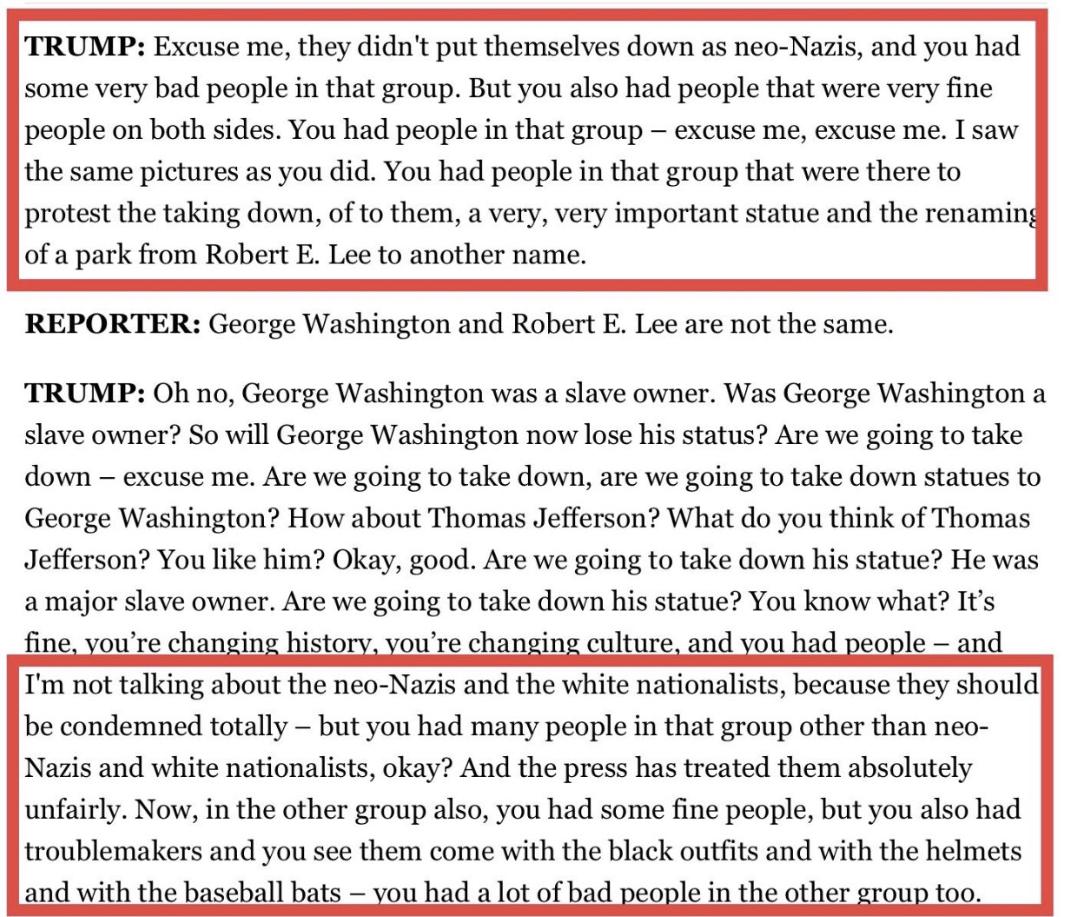
There's no room for ambiguity in it at all. Anyone who calls Trump a Nazi apologist based on this lie is either deliberately misled by the "free press", or a liar him/herself. You get to pick which one of these you are.
We're not, but unfortunately there are extremely few reliable sources or institutions to accurately frame this problem for people. The Trumpites were CORRECT in that there's an inherent bias in the media. They're just incorrect in what that bias is, which is the status quo/pro corporate/pro "stability" line.
Bernie Sander's supporters are sitting watching MSNBC wondering what the hell all of their anchors and commentators are doing - he, like Trump (at least when Trump was running for election), is a true anti-corporate candidate in the race.
That we have several full on billionaires literally buying their way to 2nd place in a primary is the largest example of the wealth inequality gap being used in full force of the public. Its going to be quite a show.
Bloomberg will spend a considerable amount of money, but will not get very far. It's a lot of money to burn. But it won't net him anything.
Trump, to the extent that one can consider him a billionaire, did not spend his way into winning. Like it or not, he crafted a message that resonated with many voters while also receiving a substantial amount of of free air time in the form of endless ridicule from national pundits.
Perhaps Coca-Cola shouldn't be permitted to spend so much money on advertising an unhealthy product...
A more innocuous example would be Proctor & Gamble promoting soap.
My mother-in-law was shocked to learn that the Facebook ads she sees are different than the ones we see. She got us this mop for Christmas and couldn't understand how we had never heard of the brand before.
- You can't selectively turn it off for a certain page
- You have to root the phone
- It's easier just to never install apps with in app ads.
Allow me to introduce you to Blokada: https://f-droid.org/en/packages/org.blokada.alarm/
I should know if you’re telling ____ he can have X before I vote for you to represent me.
That being said, so many people are adverse to critical thinking (on both sides of the American political split) that this feels like a non issue to begin with. So whatever.
I randomly looked up Andrew Yang on good a few days ago on my phone and had ads from two billionaires take up my whole screen.
https://imgur.com/a/Ke3aWBH
Without campaign finance regulation majority of the billions donated to campaigns is going directly into pockets of Google, Facebook and cable monopolies. We're letting billionaires buy the election.
> What has Bloomberg been spending on? Per the Federal Elections Commission data through the end of 2019, the two biggest costs have been television advertising ($132 million) and digital outreach ($20 million). Some of the costs reflect a late entry to the campaign—buying lists of voters to contact ($3.2 million), hiring people to gather signatures to get his name on the ballot ($373,441), and hiring recruiters to bring onboard staff ($107,000).
https://qz.com/1802367/detailing-mike-bloombergs-unprecedent...
How are we supposed to trust the media when they're on track to get a billion dollars from a single candidate?