News for hackers. Stuff that matters.
Re:After rising for 100 years, electricity demand is flat by martinald on Tuesday February 27, 2018 @10:15AM (#16474017)
"TVA will sell less electricity in 10 years than it did 10 years ago. That is bonkers."

Why is this so crazy to imagine? There are so many drivers to increased energy efficiency. LED lightbulbs, LCD TVs instead of monitors, vastly improved efficiency standards/technologies for various appliances, fact you can do loads of stuff with a smartphone instead of watching a giant TV, etc etc, huge fall in heavy industry, small scale solar/wind generation actually appearing as a reduction in demand on the grid instead of 'increase of supply and corresponding increase in demand'.

I'd actually say it was more crazy if we expected it to continue increasing thinking about current trends, and I've heard this story of the utility death spiral for about 5 years so I don't think it is a sudden problem.

Re:After rising for 100 years, electricity demand is flat by bryanlarsen on Tuesday February 27, 2018 @10:20AM (#16474076)
But energy efficiency has been increasing at a fairly steady rate for much longer than the last 10 years.

Jevons paradox(1) has previously ensured that increased efficiency resulted in increased demand. What has changed now?

1: https://en.wikipedia.org/wiki/Jevons_paradox

Re:After rising for 100 years, electricity demand is flat by rsynnott on Tuesday February 27, 2018 @11:59AM (#16475349)
I'm not sure that's entirely true, especially for domestic energy consumption. 10 years ago, I had a CRT TV, incandescent bulbs, and a washing machine that was probably about an F on the EC's ratings. At work, I used a computer with a big CRT screen (actually, maybe just an LCD by then) and a processor that used about 40W just sitting there. And 20 years before that, my parents also had a CRT TV, incandescent bulbs, and a similarly inefficient washing machine. These were likely a LITTLE more inefficient, but nothing much.

Now I have an LCD TV that uses well under half the power of a CRT, LED bulbs which use about 5% the power of incandescents, and an A-rated washing machine that uses about a half the power of the old-fashioned ones. At work I use a computer with an LED-backlit LCD monitor and a modern processor that idles at practically nothing.

For most people who had "all mod cons" 20 years ago, they're using less electricity today than they were then.

Electric cars are the one wrinkle, and I think they will drive electricity usage upwards. Other than that, though, domestic use is declining for the middle class, and commercial and industrial use are too in many cases. An awful lot of electricity usage 20 years ago was essentially waste, and we're getting quite good at eliminating that.

Re:After rising for 100 years, electricity demand is flat by gowld on Tuesday February 27, 2018 @12:44PM (#16475848)
Electric cars create synthetic electrical demand, since they displace oil demand. It's still energy demand. (The switch from oil to coal vs solar vs hydro vs wind is interesting, but the top-line "electricity demand" number means very little.)
Re:After rising for 100 years, electricity demand is flat by floatrock on Wednesday February 28, 2018 @12:47PM (#16484951)
You're right that it is still energy demand, and you're right that it's substituting oil for electricity.

But I don't know what you mean by "synthetic" since charging an EV is very much a real load, which is exactly why utilities should be the biggest fans of EV's. It's a no-brainer... "hey utilities, you know how demand for your product has been stagnant or falling? Well here's a product that can steal gasoline's market share, makes up about a third of your consumers' consumption, AND is cheaper to operate for your consumers."

Utilities should be the biggest champions of EV's.

Re:After rising for 100 years, electricity demand is flat by cptskippy on Tuesday February 27, 2018 @12:57PM (#16476028)
Home appliances have made tremendous advances in the last 50 years in terms of efficiency. A lot of this drive was simply to cut manufacturing costs. Refrigerators in particular have made considerable advances almost every decade.

In the last 30 years the regulations around water consumption have driven rapid development in dish and clothes washer technology which has also improved their electrical efficiency.

The efficiencies we see today in desktop and server CPUs were less intentional and more a bi-product of the performance goals. Modern Intel CPUs have their origins in the Centrino mobile platform of the early 2000s, a variant of the P3. The Netburst CPUs of the time eschewed efficiency for speed and so P4 chips were very hot and inefficient, when Intel hit a ceiling with TDP and clockspeeds they had to reevaluate the situation. With Centrino, Intel's mobile CPU, they were trying to make the most power efficient CPU they could and concluded that the faster the CPU could complete it's workload and power down, the more battery could be saved. The end result was a very powerful and power efficient CPU. Intel found that with a few tweaks Centrino could outperform Netburst at a lower clockspeed and with far less power consumption.

Re:After rising for 100 years, electricity demand is flat by adventured on Tuesday February 27, 2018 @12:21PM (#16475587)
Just the switch to smartphones alone is incredibly impressive on efficiency. For average users + average US electricity rates, you're looking at $0.05 to $0.10 per month in cost.

Nationally, every hour people are using their phones, instead of watching TV, playing a gaming console, or using a traditional computer, is a big savings.

Re:After rising for 100 years, electricity demand is flat by nkoren on Tuesday February 27, 2018 @12:39PM (#16475784)
Simple explanation: Jevons paradox is an observed correlation that has held true for certain notable industries at certain periods of history, but is not a law of nature. Demand for anything is neither infinite nor infinitely elastic.

But more specifically in the case of electricity: there is no demand for electricity, and never has been. The actual demand is for what electricity can do. If the slope of the energy efficiency gains of electrical goods is steeper than the slope of the induced demand for those goods, there's no reason why more goods demand (in accordance with Jevons) shuldn't result in less electrical demand (seemingly contrary to Jevons).

Re:After rising for 100 years, electricity demand is flat by SilasX on Tuesday February 27, 2018 @01:23PM (#16476323)
But (manifestations of easily usable) energy should be the most vulnerable to Jevons effects, because it has so many potential uses that that any increase in efficiency will flip some marginal case into profitability. Ditto for lower prices.
Re:After rising for 100 years, electricity demand is flat by nkoren on Tuesday February 27, 2018 @02:02PM (#16476707)
The problem is that energy as energy gets cheaper, it becomes an increasingly marginal part of cost of what uses energy.

Eg., let's say you've got some good/service, of which energy is 10% of its lifetime operating cost. If you drop the cost of energy by 50%, then that's only a 5% cost decrease for the good. In order to generate a Jevons rebound from the perspective of the energy supplier, that 5% decrease in price would have to increase demand by more than 100%. Seems unlikely.

It was a different story back in Jevons' day, when energy was a genuinely significant component of the overall cost structure of a LOT of things. But in how many goods and services is that still the case? As the cost of energy decreases relative to other cost components (like labour), you'd expect the Jevons effect to produce diminishing and eventually negative returns, no?

Re:After rising for 100 years, electricity demand is flat by roenxi on Tuesday February 27, 2018 @02:30PM (#16476992)
You might want to reflect a bit more closely on what Jevron's paradox actually is. It is not related to the cost of the final product.

Take air; it is essentially infinite and free. We use vast quantities of air in every aspect of our life. We use it in cars, in households, in computing, we breath it, we rely on their being a few km of the stuff above us to maintain pressure, etc. It is so abundant it gets a bit silly to talk about how essential it is to our way of life. Use of the stuff is almost certainly growing exponentially with population.

Believe it or not, but raw electricity is more useful than air. Humans would happily use vast amounts of electricity 24x7x365 our entire lives if it is available. As price goes down, usage should be spiking. Rather than Jevron's paradox being broken it is much more likely that some combination of

* Supply is tightening

* Real prices rising

* Something is badly wrong with the economy

is affoot.

Re:After rising for 100 years, electricity demand is flat by nkoren on Tuesday February 27, 2018 @02:59PM (#16477251)
> [Jevons Paradox] It is not related to the cost of the final product.

I don't believe that's correct. From the Wikipedia article:

"Goods and services generally use more than one type of input (e.g. fuel, labour, machinery), and other factors besides input cost may also affect price. These factors tend to reduce the rebound effect, making the Jevons paradox less likely to occur."

So the rebound effect is explicitly related to price elasticity, with the critical term being "price". If the cost of an input contributes less and less to the price of the final output, why would one expect it to have any effect?

> Humans would happily use vast amounts of electricity 24x7x365 our entire lives if it is available.

I really don't see any evidence for that statement (and indeed the parent article is providing clear evidence to the contrary). Humans want their needs attended to, and to the degree that electricity correlates to that, they'll have an appetite for electricity. To the degree that it doesn't, they won't. Nobody actually wants to use vast amounts of electricity simply for its own sake. Moreover, there are human desires that are inversely correlated with electricity usage, such as quiet, dark skies, etc. One would expect those desires to exert a downward pressure on electricity demand even if it were completely free.

It seems obvious to me that what is happening here is that in essentially any good or service you can name, non-energy costs (labour, materials, land, etc.) are becoming a much more significant component of price, both due to decreasing energy costs and increasing energy efficiency, as well as intrinsic rises in the cost of labour and materials. This in turn limits the ability for the cost of electricity to significantly stimulate or repress demand. Seems pretty straightforward.

Re:After rising for 100 years, electricity demand is flat by nopriorarrests on Tuesday February 27, 2018 @09:49PM (#16480282)
Lack of breakthru innovation, IMHO.

The last device invented which is used by almost any household and consumes non-negligible amount of electricity is home PC. Which will turn 40 years soon.

In the meantime, even older devices, invented earlier, such as fridges, washing machines, etc. became much more efficient.

Naturally, the average amount of consumed electricity goes down.

If someone invents a a robot which will clean my apartment, do dishes and iron my shirts, and double my electricity bill, I will buy this device tomorrow.

Unforunately, for the last 30 years we made no progress in inventing something that can consume non-trivial amount of electricty and bring non-trivial value to an average household.

Re:After rising for 100 years, electricity demand is flat by nkoren on Wednesday February 28, 2018 @12:00PM (#16484446)
This is a good point.

There are however a number of innovations that are poised, or could potentially be poised, to increase electrical demand, from electric vehicles to interstellar laser propulsion. But in every case I can think of -- with one exception -- the cost of electricity isn't a significant barrier to their mass adoption. Which is why in addition to falling electricity prices not stimulating the consumption of existing goods, they also aren't stimulating the production of new goods.

The one exceptional use-case is crypto mining, which obviously does elastically respond to falling energy prices. But it's an unusual kind of demand in that in places where the electricity is higher than some threshold value, demand for this will be zero. Also, fucking hell, what a stupid use-case. Can we think of nothing better to do with our resources than come up with new ways to put a price on scarcity?

Re:After rising for 100 years, electricity demand is flat by opportune on Tuesday February 27, 2018 @11:13PM (#16480621)
I think cloud computing deserves a mention. An increasingly large part of each person's demand for computation is satisfied by servers in AWS, Azure, Google, etc. due to the increase in popularity and complexity of online services. Depending on whether the technology sticks, Blockchain (PoW) could also drive a significant increase in energy.
Re:After rising for 100 years, electricity demand is flat by animal531 on Wednesday February 28, 2018 @07:39AM (#16482562)
Good point. For a number of years every few years there have been something that requires a lot more power. Offhand I can think of e.g. heating, fridges, televisions, microwaves, cooling, PC desktops and consoles (over many generations).
Re:After rising for 100 years, electricity demand is flat by volkl48 on Wednesday February 28, 2018 @11:56AM (#16484386)
If you could drive the unit costs of electricity low enough for it to be cheaper than natural gas for heating, you could see major growth from that.

Obviously, not likely to happen anytime soon, but if the cost-reduction progression of renewables continues, it could become viable in the medium-term.

Currently it's far more expensive to heat with electric than natural gas, so most people with access to it don't use electric.

Re:After rising for 100 years, electricity demand is flat by notriddle on Tuesday February 27, 2018 @05:00PM (#16478390)
> Humans would happily use vast amounts of electricity 24x7x365 our entire lives if it is available.

That assumption could be false, though.

I only want to fill my house with a certain amount of lumens before it starts hurting my eyes, and it only takes a certain amount of electricity to produce those many lumens. Maybe I could get a bigger house, but that ends up being limited by housing costs instead of electricity costs, so the cost of houses limits how much electricity I burn on lights.

Or maybe TV's? Sure, a bigger TV would eat more electricity, but I can't afford an infinitely large TV, so the price of TV's limits how much electricity I use. Computers are the same way TV's are.

I guess your second bullet point is true? Electricity costs are falling, but the total cost of doing stuff with electricity is going up because the gadgets are getting more expensive relative to how much power they pull.

Re:After rising for 100 years, electricity demand is flat by martinald on Tuesday February 27, 2018 @10:28AM (#16474165)
Good point; perhaps it is not efficiency then but outsourcing of light/heavy industry (simply meaning while TVA et al demand is falling, Chinese power demand is growing even more rapidly), and the fact there is more supply in the form of unmetered local solar/wind generation which looks like a fall in demand on the grid but actually isn't. Interesting.
Re:After rising for 100 years, electricity demand is flat by SerLava on Tuesday February 27, 2018 @10:33AM (#16474218)
Intuitively, that only applies when there's actually some pent up demand. At some point, availability of teacups really won't drive more demand.
Re:After rising for 100 years, electricity demand is flat by bryanlarsen on Tuesday February 27, 2018 @11:04AM (#16474634)
Energy is the principal or a major secondary input into food, transportation, housing, consumer and industrial goods, et cetera. In other words, just about everything we spend money on. So unless we start seeing a major drop in the demand for currency, I don't buy this argument.
Re:After rising for 100 years, electricity demand is flat by hrie282 on Tuesday February 27, 2018 @11:15AM (#16474793)
Everything we spend money on is being manufactured more power efficiently, is more power efficient on its own, and grid demand drops as adoption of new efficient gadgets and individual solar expands?

At home we went all LED lights. My office followed suit. Even my city swapped the night time street lights

Sadly we had almost every appliance in the house die in the first 4 yrs we owned it. But they’re all new efficient models now

Fewer desktops, more tablets and phones. Our big TV is only on 3-4 hrs a week (but it too is a more power efficient model)

A lot of effort has gone into battery storage and efficiency this last decade.

Little numbers add up to big ones real fast

Re:After rising for 100 years, electricity demand is flat by IkmoIkmo on Tuesday February 27, 2018 @01:00PM (#16476058)
A lot of energy is spent on things like transportation and heating though.

At some point, the rooms you occupy and the time you occupy them hits a ceiling. I'm not going to heat my room above room temperature, I'm not going to be in my room more than 24 hours in a day, even if energy efficiency made it as cheap as my current pattern of heating.

Similarly, there is a ceiling as to the amount of time I spend traveling in a certain day, I wouldn't drive to another country on a 5 hour trip on a daily basis for a better job, even if energy efficiency made it as cheap as my current travel pattern (1 hour a day).

That probably wasn't always the case, but there are indeed diminishing returns to spending money. Just look at Bill Gates' energy expenditure. It's waaaay higher than any of us in absolute terms, but relatively speaking a fraction of ours.

So I think the intuition you responded to is probably pretty solid. The other intuition I have, which is very much related, is that our gdp growth is increasingly service-oriented. i.e. it's not just that industries get more efficient, thereby seeing gdp growth and energy consumption decouple. It's also that the relative share of our gdp is possibly moving away from energy-intensive industries, which aren't really growing much at all, to low-energy intensive industries. With agriculture and manufacturing being quite energy-intensive compared to services industries like education, legal services, finance (ignoring proof of work) etc, a deindustrializing economy should also fuel a decoupling of energy consumption and gdp growth.
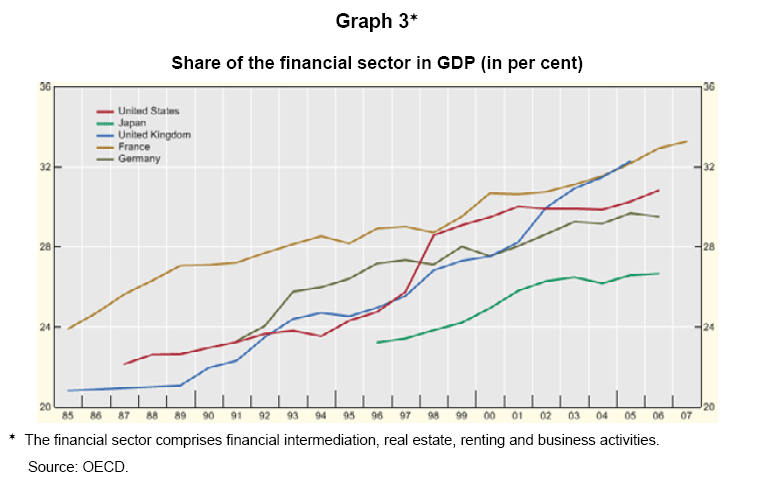
Re:After rising for 100 years, electricity demand is flat by crdoconnor on Tuesday February 27, 2018 @12:22PM (#16475594)
Finance consuming ever greater proportions of our GDP probably helped keep that in check https://www.bis.org/img/speeches/sp081119_g3.gif (if your rent doubles and home insurance goes up, your electricity consumption does not go up).

Similarly, offshoring of manufacturing likely muted the demand for electricity too.

Re:After rising for 100 years, electricity demand is flat by galago on Tuesday February 27, 2018 @01:04PM (#16476107)
I intuitively agree with you. However, the decoupling that's observed can partly be explained by lag. For example, a farm might have diesel powered equipment, tractors, etc. that last 10 years. Eventually they might switch to electric equipment. However, the innovation isn't stagnate, so its holding consumption constant. What the electricity is used for is actually changing as new uses become economically viable.
Re:After rising for 100 years, electricity demand is flat by gowld on Tuesday February 27, 2018 @12:49PM (#16475923)
Economic inequality means that the average person can't afford to keep consuming as much energy as in the past, meanwhile the wealthiest people have saturated demand, they have everything they can imagine wishing for.
Re:After rising for 100 years, electricity demand is flat by marcosdumay on Tuesday February 27, 2018 @11:47AM (#16475191)
> What has changed now?

Jevons Paradox is not an immutable natural law. It's does not even have any predictive power. It's just a notice of an interesting thing that can happen but the naivest interpretation of microeconomics assumes it's impossible.

Re:After rising for 100 years, electricity demand is flat by jtuente on Tuesday February 27, 2018 @12:35PM (#16475737)
Just like Moore's law, which is also hitting a wall.
Re:After rising for 100 years, electricity demand is flat by ctdonath on Tuesday February 27, 2018 @01:09PM (#16476161)
Moore's Law has been hitting - and going through - walls for the last 30 years.
Re:After rising for 100 years, electricity demand is flat by delecti on Tuesday February 27, 2018 @02:23PM (#16476916)
True, but you can only handwave away the size of atoms for so long.
Re:After rising for 100 years, electricity demand is flat by fooker on Wednesday February 28, 2018 @06:04AM (#16482157)
We are somewhat far away from being restricted by the size of single atoms.

A silicon atom is 0.2 nanometers and the smallest single transistors used in recent chips is in the order of 5-10 nanometers.

Also, using photons instead of electrons does allow you, almost literally to handwave away he size of atoms. How exactly, is unknown today.

Re:After rising for 100 years, electricity demand is flat by marcosdumay on Wednesday February 28, 2018 @01:45PM (#16485530)
Silicon lithography has to hit a wall way before single atom sizes. For a start, silicon semiconducting is a probabilistic effect and only happen on populations.

Photons at usable frequencies are much larger than atoms. Just notice that lithography is currently moving into what they call "extreme UV" (and most people call X-rays) because the UV photons are much larger than the features of current top of line chips.

Re:After rising for 100 years, electricity demand is flat by fooker on Friday March 02, 2018 @07:11AM (#16500829)
>For a start, silicon semiconducting is a probabilistic effect and only happen on populations

Is that a fundamental theoretical limit like the uncertainty principles or is it a matter of engineering advancements to figure out how these forces work? I can imagine carefully positioning two atoms (maybe moving?) to obtain similar effects.

Re:After rising for 100 years, electricity demand is flat by madengr on Wednesday February 28, 2018 @07:09AM (#16482416)
That leaves about 13 years left until Moore’s Law hits that 0.2 nm feature. Will be interesting to see how it pans out.
Re:After rising for 100 years, electricity demand is flat by amluto on Tuesday February 27, 2018 @10:27AM (#16474156)
I would guess that Jevon's paradox doesn't exist for many domestic applications. Most people have all the lights, washing machines, etc that they need. Making lights more efficient won't make people buy more of them.
Re:After rising for 100 years, electricity demand is flat by moccachino on Tuesday February 27, 2018 @10:34AM (#16474224)
I would argue LED lighting does increase the demand for all sorts of lights rather a lot. It is due to increased efficiency, but that is not directly what creates the demand. The increased efficiency means light bulbs are no longer a fire hazard, allowing lights to be strewn just about anywhere and left on indefinitely.
Re:After rising for 100 years, electricity demand is flat by manyxcxi on Tuesday February 27, 2018 @10:49AM (#16474433)
Just because it’s LED doesn’t mean it doesn’t use any power at all, so it’s still a waste of energy.

Every light in our house is LED and I still teach my kids about not wasting energy and turning things off when not in use.

Maybe it’s because I grew up with incandescent bulbs, but I can’t stand the thought of random lights being left on for no good reason, even if it costs 40 cents a year to keep lit.

EDIT- ADDITIONAL THOUGHT

I was going to add that it’s not like I went around my house adding lights that didn’t exist, but as I think about it... The house I grew up in was built in the early 70’s and every room had a single ceiling light that had two bulbs in it. The hallways had 1 or two ceiling lights.

My current house, built two years ago has 8 can lights in the living room, 6 cans in the kitchen and 3 pendants over the island, 8 in the dining room, etc... So maybe you’re on to something with the thought of putting in a lot more lights than we used to.

Re:After rising for 100 years, electricity demand is flat by tbyehl on Tuesday February 27, 2018 @12:57PM (#16476022)
> Maybe it’s because I grew up with incandescent bulbs

It is soooo that. When I bought my house 8 years ago I immediately had to replace some incandescent bulbs that shared a circuit with the microwave because the power consumption was tripping the breaker. And then I had to do the math to figure out when it was cost-effective to replace everything with LEDs. So I've become extremely cognizant of what things consume, and exactly what that costs...

Now I've got everything automated with LEDs and presence detection and schedules to turn things off when people aren't around or shouldn't be awake. Yet, lights needlessly being left on still bothers me.

Re:After rising for 100 years, electricity demand is flat by user5994461 on Tuesday February 27, 2018 @05:48PM (#16478786)
> In the early 70's.

There were less lights in poor homes. The more affluent homes had suspended lights with multiple bulbs. (I am not sure how it is called in English). I recall that a lot of homes got more light bulbs and ornaments through the century, as they become more affordable and more hype.

The increase in count came with a decrease in power. The typical 100-150W bulb got replaced by multiple 30-50W bulbs, they do not consume significantly more in aggregate.

Re:After rising for 100 years, electricity demand is flat by mateo411 on Tuesday February 27, 2018 @07:30PM (#16479565)
> The more affluent homes had suspended lights with multiple bulbs.

I think these are called chandeliers. The etymology of chandelier is French.

Re:After rising for 100 years, electricity demand is flat by eadmund on Tuesday February 27, 2018 @11:18AM (#16474824)
> Every light in our house is LED and I still teach my kids about not wasting energy and turning things off when not in use.

Are you certain that it's wasting energy, though? You have to account for the time spent actually turning the light off, as well as for the psychic cost of having to think about whether to turn it off or on.

I'm reminded of one of my old offices, where some office busybody turned off the lights in the bathroom. They were fluorescent and took awhile to brighten up, so of course this meant that one would enter a darkened room, turn them on, and then slowly get some light. Was it a huge deal? No. Did it make our lives worse than just leaving the lights on? Yes.

> Maybe it’s because I grew up with incandescent bulbs, but I can’t stand the thought of random lights being left on for no good reason, even if it costs 40 cents a year to keep lit.

At 40¢/year, leaving it lit costs .11¢/day, or .0046¢/hour. At any reasonable rate for your time & mental energy, it makes sense to just leave it lit.

Re:After rising for 100 years, electricity demand is flat by rsynnott on Tuesday February 27, 2018 @12:05PM (#16475410)
> They were fluorescent and took awhile to brighten up, so of course this meant that one would enter a darkened room, turn them on, and then slowly get some light. Was it a huge deal? No. Did it make our lives worse than just leaving the lights on? Yes.

LEDs don't do this. At absolute worst, you'll have a fraction of a second before they light up at all, but once they light up, they light up immediately.

Re:After rising for 100 years, electricity demand is flat by pfdietz on Tuesday February 27, 2018 @04:18PM (#16478005)
LEDs also work much better outdoors at low temperature.
Re:After rising for 100 years, electricity demand is flat by rsynnott on Tuesday February 27, 2018 @12:02PM (#16475391)
That's true to an extent, but if you had 16000 lumens previously, using about 1000W, you probably don't _want_ ~100,000 lumens now, just because it uses the same amount of power. That's far too much light.
Re:After rising for 100 years, electricity demand is flat by wickawic on Tuesday February 27, 2018 @10:45AM (#16474383)
Ageeed. Also seeing as LED bulbs are ~10x more efficient per lumen than incandescent, people are not installing 10x as much brightness in their homes
Re:After rising for 100 years, electricity demand is flat by pouetpouet on Tuesday February 27, 2018 @10:52AM (#16474481)
Perception of brightness is not linear. The human eye response is not linear. So x10 the luminous flux (power output) will be perceived as brighter but far from x10.
Re:After rising for 100 years, electricity demand is flat by Dylan16807 on Tuesday February 27, 2018 @11:50AM (#16475220)
k.

People are still not installing 10x as much light.

Re:After rising for 100 years, electricity demand is flat by pouetpouet on Tuesday February 27, 2018 @01:35PM (#16476433)
not in their home, but I can see many more historical and institutionnal buildings being illuminated, commercial use also. It may still not amount to 10x though.
Re:After rising for 100 years, electricity demand is flat by lozenge on Tuesday February 27, 2018 @10:57AM (#16474543)
Streets, offices and shops are now better lit.
Re:After rising for 100 years, electricity demand is flat by user5994461 on Tuesday February 27, 2018 @05:52PM (#16478819)
Offices and shops used neon lights. It lits as well as LED or better, but consumes a lot of power.
Re:After rising for 100 years, electricity demand is flat by pfdietz on Wednesday February 28, 2018 @08:56AM (#16482961)
Do you mean fluorescent bulbs? They do not use neon, but rather use mercury vapor. The UV light from the mercury excites a fluorescent layer on the inside of the tube, causing broadband emission of visible light.
Re:After rising for 100 years, electricity demand is flat by gascan on Tuesday February 27, 2018 @12:51PM (#16475950)
In support of your argument, just about every damn device these days is covered in LEDs that run 24/7. Look around your house at night. Microwave, electric kettle, stove, phone chargers, smoke detectors, routers, modems, electric toothbrushes, and that's just what I remember off the top of my head.

Yes, not exactly the same as LED light bulbs, but illustrates the point. LED's are cheap and the power is a rounding error, so they go in everywhere.

(This is infuriating to me because I would like my house to be dark at night)

Re:After rising for 100 years, electricity demand is flat by CJefferson on Tuesday February 27, 2018 @11:16AM (#16474804)
Electricity is not the only cost -- LED light bulbs are quite expensive, which puts a natural limit on how many I want to fit in my house.
Re:After rising for 100 years, electricity demand is flat by skrap on Tuesday February 27, 2018 @11:31AM (#16474999)
I'm gonna have to call you on that one. Even high-end brand LED bulbs are so much more cost efficient than incandescent bulbs, it's the rational act to immediately replace nearly every single incandescent.

Whether you're interested in saving energy or saving money, you should remove and smash your incandescents.

Here's a blog entry I wrote with some of the simple math: https://blog.sense.com/articles/smash-incandescent-bulb-swit...

Re:After rising for 100 years, electricity demand is flat by tialaramex on Tuesday February 27, 2018 @11:55AM (#16475298)
A bit less than two decades ago, when I was still living with other (post-graduate) students we got a flyer which announced a low price for Compact Fluorescent Lighting compatible with our rented house. We went into the living room where there was a whiteboard, and worked out the TCO of these more efficient lamps over their lifetime compared to just the ongoing cost of our incandescents (since we had these already we didn't need a total cost).

We then immediately set out to purchase an entire house full of CFLs. They were still going years later when we split up and each took our share, I still have one somewhere, maybe in my living room.

Re:After rising for 100 years, electricity demand is flat by burntwater on Tuesday February 27, 2018 @01:51PM (#16476591)
Personally, the reason I don't run out and replace all my existing incandescents is because I don't want to waste perfectly good bulbs; I would rather for them to reach EOL and then replace. The energy used to create a good is usually significantly more than the energy the good itself uses. I'm OK paying a little more for the energy used by the incandescents when it's overall less wasteful.
Re:After rising for 100 years, electricity demand is flat by skrap on Tuesday February 27, 2018 @10:04PM (#16480360)
More than 99% of the total lifecycle energy of a incandescent is in its use.

Let's just repeat that.

More than 99 percent of the total lifecycle energy of a typical incandescent bulb is in its use. That includes raw materials, manufacturing, and transport.

Source: https://energy.gov/sites/prod/files/2015/10/f27/lca_factshee...

Re:After rising for 100 years, electricity demand is flat by tbyehl on Tuesday February 27, 2018 @02:58PM (#16477243)
> The energy used to create a good is usually significantly more than the energy the good itself uses.

Not when you're talking about a cheap consumable product which mostly converts power into heat. A 75W bulb is about $2.50/yr worth of energy consumption per hour of daily use at $0.09/kWh. An LED equivalent is +/- $0.35/yr at a cost of $3-$6.

Maybe 5%-10% of my home's bulbs weren't worth replacing out of cycle, but LEDs are so cheap and the overall savings so high that it's not even worth thinking about.

Re:After rising for 100 years, electricity demand is flat by burntwater on Tuesday February 27, 2018 @08:17PM (#16479847)
But I'm not concerned about the money, I'm concerned about the wastefulness. The existing bulbs are completely functional until they reach EOL, at which point they will be discarded into landfill. The less frequently things are replaced, the less waste ends up in landfill (and is consumed in initial production).
Re:After rising for 100 years, electricity demand is flat by tbyehl on Tuesday February 27, 2018 @09:52PM (#16480295)
We can readily quantify how 'perfectly good' incandescent bulbs are no longer perfectly good in terms of energy consumption costs, to which you might also factor the environmental and health impacts of consuming more energy than you could be.

But quantifying the wastefulness of prematurely sending them to the landfill is much more difficult. We can suggest that LEDs longer expected lifetime is another benefit to the environment but that is equally challenging to quantify for the premature replacement scenario.

Re:After rising for 100 years, electricity demand is flat by amluto on Tuesday February 27, 2018 @09:24PM (#16480170)
I think you're looking at this wrong. Using an incandescent lamp until it burns out consumes far more resources than making that lamp did.
Re:After rising for 100 years, electricity demand is flat by fl0wenol on Tuesday February 27, 2018 @12:12PM (#16475476)
I think the grandparent is saying there's a limit to the number of additional efficient light fixtures one would add with promise of low runtime costs because of higher initial fixture, bulb, and dimmer costs for LED.
Re:After rising for 100 years, electricity demand is flat by sgustard on Tuesday February 27, 2018 @12:29PM (#16475679)
I haven't found an LED yet that works in my dimmable ceiling fixture, where I can dim it to the lowest possible level and get a pleasing light. The incandescent gives a very dim, warm orange glow which is great for movie watching or other mood-setting purposes. The LED still emits a rather harsh and not-as-dim light even if it's rated in the warm spectrum. Have you seen a solution for that?
Re:After rising for 100 years, electricity demand is flat by kalleboo on Wednesday February 28, 2018 @12:42AM (#16480950)
For our hallway, rather than buying an LED lamp that's compatible with a dimmer, we bought one with built-in dimming. You flip the wall switch twice and it goes into a dim warm orange "nightlight" mode. Flip it twice again and it goes into full brightness daytime mode.
Re:After rising for 100 years, electricity demand is flat by burntwater on Tuesday February 27, 2018 @01:47PM (#16476535)
I believe some fixtures solve this by having two sets of LEDs; as you dim down the standard LEDs, the low-level LEDs kick in.

I've seen that in a few theatrical/architectural lights, no idea if it's available in the consumer market yet.

Re:After rising for 100 years, electricity demand is flat by gowld on Tuesday February 27, 2018 @12:53PM (#16475965)
LEDs are terrible with dimmers. They flicker, and they have bad response curves to the dim-level. Yes, there exist properly dimmable LEDs, but buying 5 different bulbs to find one that works negates the savings.
Re:After rising for 100 years, electricity demand is flat by amluto on Tuesday February 27, 2018 @08:55PM (#16480026)
This isn't the LED's fault. It's the fault of the fact that dimmers are awful designs. They feed a nasty chopped-up waveform to the fixture that has RMS voltage proportional to the desired power output. Aside from the fact that it has a bad power factor, it's more or less okay for plain old line voltage incandescent lights. For LEDs, several things go wrong. First, LEDs want DC or high frequency PWM. The driver is given a nasty waveform at 60 Hz. So the driver needs to rectify that waveform to DC, filter it, and then decode the waveform to dim the LED as the user requested. This is a big hack and doesn't work all that well. Second, modern power supplies aren't resistors. Supplying them with input power with rapid voltage swings is not so great. Third, the dimmers themselves are usually wired in series with the bulb without access to a neutral wire, and incandescent dimmers expect to draw their own power using current through the bulb. Given that LED drivers are highly nonlinear, this makes it very awkward for the dimmer to power itself. "Dimmable" LEDs will intentionally leak some current to power their dimmers. High-end dimmers in newer homes will have a neutral connection.

If you can find a "ELV" or "reverse phase" dimmer and you have the wiring for it, you can at least avoid the inrush current problem.

An anecdote: I have a fancy computer power supply that buzzes rather loudly when the lights are on. This is presumably because the lights are drawing a big inrush current spike 120 times per seconds due to dimming.

To top it off, LEDs have much higher frequency response than incandescent bulbs. This means that, unless you drive them with clean DC or with a very high-frequency PWM input, they'll flicker. (Not the kind of flicker you're talking about -- the kind you're seeing is the system malfunctioning. I'm talking about the kind where it flickers as designed and someone waved their fingers and decided it was hard to notice.) There's a new standard called IEEE 1789 that describes what levels of flicker are likely to be harmful (causing low productivity, headaches, general crappy feelings, etc.) and what levels are very likely to be safe. Very few LED drivers meet this standard so far. At least California has imposed a less stringent but still helpful for Title 24 compliance [1] for the last couple of years.

(This is extra nasty given that incandescent bulbs don't actually produce light proportional to the power with which they're driven.)

[1] It's Title 24 JA8.

Re:After rising for 100 years, electricity demand is flat by gowld on Wednesday February 28, 2018 @07:48PM (#16488744)
Ok, but the dimmers worked fine with the incandescents. Your post gives a lot of reasons why the high-efficiency of LEDs comes at a cost of lower flexibility to adapt to important use cases.
Re:After rising for 100 years, electricity demand is flat by azeotropic on Tuesday February 27, 2018 @12:19PM (#16475562)
Where do you find 100 watt equivalent LED bulbs in 2700K for $1/bulb?
Re:After rising for 100 years, electricity demand is flat by lodi on Tuesday February 27, 2018 @01:19PM (#16476288)
You won't find LED's for $1/bulb, but the total cost of ownership over X years is massively in favor of the LED.

Also I simply find it convenient that LED's just. don't. die. I haven't had to change a single bulb since I upgraded ~4 years ago.

Re:After rising for 100 years, electricity demand is flat by tbyehl on Tuesday February 27, 2018 @01:52PM (#16476604)
I had one out of around 50 die over ~3 years, which I'm sure is much better than I experienced with incandescents and CFLs.

Smart bulbs are so cheap now that I've obsoleted nearly all of my "dumb" LEDs.

Re:After rising for 100 years, electricity demand is flat by user5994461 on Tuesday February 27, 2018 @05:57PM (#16478876)
Note that the lifetime of a bulb is quadratic, if not exponential, with its wattage.

The 100W bulb always lit in the living room will last 6 months but a 30W will do a decade.

Re:After rising for 100 years, electricity demand is flat by ben_w on Wednesday February 28, 2018 @10:06AM (#16483418)
I just saw some 2700K bulbs in Poundland (£1~=$1.38), at a selection of power levels. Not sure what the brightest was, might have been 60W equivalent?

I deliberately got a dimmer model because I wanted something to encourage my mum to sleep more; due to Alzheimer’s she has no idea what the time of day is any more, and has developed a fear of the dark and only sleeps with the light on.

Re:After rising for 100 years, electricity demand is flat by tbyehl on Tuesday February 27, 2018 @01:46PM (#16476534)
You don't, not yet anyways. But if that 100w bulb is on 3-hours per day and you want a 1-year ROI, your replacement budget is probably in the $8-12 range.
Re:After rising for 100 years, electricity demand is flat by skrap on Tuesday February 27, 2018 @10:07PM (#16480376)
I usually go to Ocean State Job Lot or Home Depot. There's a wide selection for $1-2/bulb. I like Cree or Philips as brands.
Re:After rising for 100 years, electricity demand is flat by rsynnott on Tuesday February 27, 2018 @12:06PM (#16475417)
They certainly _were_ expensive, but these days reasonable quality LEDs seem to be a similar price to reasonable quality incandescents. You can still get very cheap incandescents for less than any LED, but you probably don't want them; they won't last.
Re:After rising for 100 years, electricity demand is flat by matwood on Tuesday February 27, 2018 @11:31AM (#16474995)
My local utility has an online store for customers with amazing deals on LED lightbulbs (not as cheap as normal bulbs, but not as high as you see at a Home Depot). I've replaced every bulb in my house.
Re:After rising for 100 years, electricity demand is flat by mark-r on Tuesday February 27, 2018 @12:16PM (#16475526)
I've seen utility subsidized bulbs at Costco.
Re:After rising for 100 years, electricity demand is flat by ctdonath on Tuesday February 27, 2018 @01:12PM (#16476198)
Prices are plummeting though. I can get a software-dimmable app-controlled LED (Philips Hue) bulb for cheaper ($10) than the serial-replacement incandescents it replaces. It's to the point that I'm bummed I can't find any more standard-size bulbs to replace, and they're not making candelabra etc type Hue bulbs yet.
Re:After rising for 100 years, electricity demand is flat by tbyehl on Tuesday February 27, 2018 @02:03PM (#16476725)
Hue and IKEA have E12s. The Hue E12s are available as white or color, but they're terribly expensive and never seem to go on sale. The IKEA E12 is only $7, dimmable but not color temp, and will pair directly to a Hue hub.
Re:After rising for 100 years, electricity demand is flat by jharger on Tuesday February 27, 2018 @01:55PM (#16476634)
Philips does make Hue E12 bulbs in both white ambiance and color versions.
Re:After rising for 100 years, electricity demand is flat by nopriorarrests on Tuesday February 27, 2018 @10:01PM (#16480341)
As I commented in other thread, your argument about people having all they need could be re-phrased as a "lack of innovation".

Last thing we have invented which consume electricity is home PC. And it was 40 years ago. Without this invention we probably observed the declining demand much sooner, but hey, large monitor and good graphic card and latest 3D shooter, this stuff rocks. But before we invented home PC, people "had everything they need", they were just unaware of 3D shooters, and your argument was as valid as today.

For the last 20-30 years we had no other inventions which can convert electricity into value. And older inventions, such as fridges, got more efficient.

Re:After rising for 100 years, electricity demand is flat by ars on Tuesday February 27, 2018 @12:12PM (#16475480)
> Making lights more efficient won't make people buy more of them.

Yes it does. I personally added a bunch of lights I would never have added if they were inefficient. But because lights are so cheap (it's barely worth my time to turn it off, although I still do it), I added a bunch of them.

I'm still spending less on lighting power than before though.

Re:After rising for 100 years, electricity demand is flat by georgeecollins on Wednesday February 28, 2018 @10:55AM (#16483771)
>> Most people have all the lights, washing machines, etc that they need.

If you think that you need to visit an American suburb two weeks before Christmas.

Re:After rising for 100 years, electricity demand is flat by dragonwriter on Tuesday February 27, 2018 @12:53PM (#16475964)
> Jevons paradox(1) has previously ensured that increased efficiency resulted in increased demand.

I've always been confused with the labelling of the observation that the common shape of demand curves means lower price (all else being equal) leads to greater market clearing quantity as a “paradox”; what else would you expect?

That being said, all else has not been equal over time. Note that what has dropped is consumption of utility-supplied electricity; part of this may be drop in demand for electricity (use efficiency would seem to spur demand with more utility for each unit consumed, but it may suppress it if it means that the point where you hit steeply diminishing returns is hit faster), but an important part is the deployment of customer-owned generation capacity that is a direct substitute for utility-supplied electricity can be expected to hit consumption of utility-supplied electricity hard. And no one has ever labelled the effect “new perfect substitutes reduce consumption of the substituted good” a paradox.

Re:After rising for 100 years, electricity demand is flat by andylei on Tuesday February 27, 2018 @03:21PM (#16477470)
Jevon's paradox isn't really a paradox, its just a description of differing results for differently shaped demand curves. If you have a relatively flat demand curve, then a small shift in price yields a lot change in quantity demanded.

I think price has gone down far enough that the shape of the demand curve has steepened. As consumers, there just isn't much we can do with a lot of extra electricity, so even if the price drops a lot, we're not going to consume that much more.

Re:After rising for 100 years, electricity demand is flat by graeme on Tuesday February 27, 2018 @01:01PM (#16476067)
The article only refers to electricity demand in the US. World demand is stil growing, and I think the energy system is most properly viewed as a global one.

I would be interested to know whether the embedded energy consumed by the US has been growing or shrinking. (To calculate this you would add in the energy used to make American imports.)

Re:After rising for 100 years, electricity demand is flat by sremani on Tuesday February 27, 2018 @11:55AM (#16475307)
The Great Recession.

The current demand flatness is only temporary, esp. when we are ushering into the world of Electric Cars and 3D printers.

There is a hungry beast lurking its called "The Data Center". As the Data Center count increases over the future, we will also see raise in demand.

Over all, my bet is Jevons paradox will stand the test of time.

Re:After rising for 100 years, electricity demand is flat by Analemma_ on Tuesday February 27, 2018 @12:07PM (#16475438)
- Data centers are ridiculously efficient. The latest generation of data centers from the big cloud providers have PUE in 1.07 territory, which would've seemed like pie-in-the-sky ludicrousness even 10 years ago. Every CPU cycle that's done in a data center instead of on someone's client machine or on-prem server is a decrease in power consumption.

- 3D printers don't use very much power, and in any case, while 3D printing is going to be an ever-bigger deal in manufacturing, the 3D printing at home fad has already crested and is fading away, like 3D televisions. There's not going to be one in every home.

- Electric cars will indeed increase power consumption, but mainly when they are plugged in for the night, where there is already a lot of wasted power from e.g. nuclear plants that can't scale down at night. The total increase in necessary generating capacity and infrastructure upgrades won't be as big as you think.

Re:After rising for 100 years, electricity demand is flat by erikpukinskis on Tuesday February 27, 2018 @12:34PM (#16475724)
> the 3D printing at home fad has already crested and is fading away, like 3D televisions

I too am skeptical of 3d printing but I don’t think you can write it off just yet.

It may be true that we’re seeing the crest of the 3d dot matrix thing. But if you include all “arbitrarily programmable assembly robots” then I think we’re just in the prelude.

The data structure for 3d printing is the “thingiverse” and I don’t think we’ve seen the end of that yet. I can imagine for example a small kitchen robot with reservoirs for some staple foods, and an app where you browse dishes that can be cooked for you. Or write your own.

I would consider that 3d printing.

Similarly 3d TV is alive and well in mobile VR. And it will see huge growth this year with the advent of $200 high quality stand-alone headsets.

You can argue these things are “not the same” but the vision is the same, only the form factor is different.

Re:After rising for 100 years, electricity demand is flat by sremani on Tuesday February 27, 2018 @12:22PM (#16475602)
>>

Data centers are ridiculously efficient. The latest generation of data centers from the big cloud providers have PUE in 1.07 territory, which would've seemed like pie-in-the-sky ludicrousness even 10 years ago. Every CPU cycle that's done in a data center instead of on someone's client machine or on-prem server is a decrease in power consumption.

<<

Do you know what is the global consumption of energy of data centers in 2016 ? It is same as consumption of energy of global aviation. Think about it, the energy consumed by Data Centers is equal to all commerical planes world wide flying. (source: realclearnergy podcast)

They may very well be efficient, that is shit load of energy and that is point.

Re:After rising for 100 years, electricity demand is flat by InspiredIdiot on Tuesday February 27, 2018 @12:42PM (#16475829)
Energy consumption of data centers as of 2016 shows they are a major component of total energy consumption and therefore worth watching. It doesn't imply how that will affect _growth_ in energy usage over time. You have to look at change over time taking into account demand, supply and efficiency together in an analysis like this http://www.datacenterknowledge.com/archives/2016/06/27/heres...
Re:After rising for 100 years, electricity demand is flat by neuromantik8086 on Tuesday February 27, 2018 @12:42PM (#16475825)
> Do you know what is the global consumption of energy of data centers in 2016 ? It is same as consumption of energy of global aviation. Think about it, the energy consumed by Data Centers is equal to all commerical planes world wide flying.

Does the global aviation cost comprise just the cost of flying planes, or does it include the cost of maintaining mainframes for flight bookings?

Also, how does the consumption of power by data centers compare to the consumption of power by all consumer PCs/workstations? That's kind of the comparison we're looking at here.

Re:After rising for 100 years, electricity demand is flat by Caveman_Coder on Tuesday February 27, 2018 @03:13PM (#16477381)
> "Data centers are ridiculously efficient. The latest generation of data centers from the big cloud providers have PUE in 1.07 territory, which would've seemed like pie-in-the-sky ludicrousness even 10 years ago. Every CPU cycle that's done in a data center instead of on someone's client machine or on-prem server is a decrease in power consumption."

Those PUE statistics are self reported and aren't very accurate. I've seen them done and they are more marketing/PR fluff than actual conditions of energy conversion efficiency. Nobody in the actual field treats them as being accurate.

Re:After rising for 100 years, electricity demand is flat by mattnewton on Tuesday February 27, 2018 @11:50AM (#16475226)
Maybe the new things that people would spend electricity on now that it’s cheaper haven’t reached the mass market yet. I’m thinking mostly electric cars, because I live near Tesla, but I am sure there are other opporunities for greater electricity usage around the corner.
Re:After rising for 100 years, electricity demand is flat by Shivetya on Tuesday February 27, 2018 @12:36PM (#16475755)
Are we doing less though? Because of efficiency gains we may be doing more work with less electricity so while the outward demand numbers are less that amount of work being done is increased.

I do know on a personal scale that LED lighting lets me have far more light hours for an incredibly lower bill. If anything I leave lights on more now. I even ran over a thousand feet of Christmas lights because their cost was so much less than before (like 12/15 to 1)

Re:After rising for 100 years, electricity demand is flat by saas_co_de on Tuesday February 27, 2018 @12:01PM (#16475372)
The efficiency of the devices people use has been increasing but the prices of electricity have been rising during the same period so efficiency from the perspective of the consumer is not increasing.

The mechanism by which increasing efficiency would increase consumption is lower prices and if that is missing then consumption won't increase.

Re:After rising for 100 years, electricity demand is flat by nitwit005 on Tuesday February 27, 2018 @10:14PM (#16480405)
Jevon's paradox probably only applies to some types of power usage. Industrial consumers will certainly consume more if its cheap, but a more efficient toaster doesn't mean I'll get two toasters, or toast more often. I already have more toaster capacity than I'd ever need.
Re:After rising for 100 years, electricity demand is flat by toomuchtodo on Tuesday February 27, 2018 @10:22AM (#16474095)
People are getting older, and use less resources overall as they age. Drive less as well.
Re:After rising for 100 years, electricity demand is flat by hn_throwaway_99 on Tuesday February 27, 2018 @10:24AM (#16474117)
This is interesting, especially in the areas TVA covers. Would be cool to correlate this usage by average age of the customer base.
Re:After rising for 100 years, electricity demand is flat by lawlessone on Tuesday February 27, 2018 @10:56AM (#16474528)
>Jevons paradox(1) has previously ensured that increased efficiency resulted in increased demand.

you can only have so many devices and appliances.

Re:After rising for 100 years, electricity demand is flat by masklinn on Tuesday February 27, 2018 @10:34AM (#16474227)
And once again fucked incentives are at risk of screwing us over. In fact the article notes exactly that two-thirds down:

> To be clear: For both economic and environmental reasons, it is good that US power demand has decoupled from GDP growth. As long as we’re getting the energy services we need, we want overall demand to decline. It saves money, reduces pollution, and avoids the need for expensive infrastructure.

> But the way we’ve set up utilities, they must fight that trend. Every time they are forced to invest in energy efficiency or make some allowance for distributed generation (and they must always be forced), demand for their product declines, and with it their justification to make new investments.

> Only when the utility model fundamentally changes — when utilities begin to see themselves primarily as architects and managers of high-efficiency, low-emissions, multidirectional electricity systems rather than just investors in infrastructure growth — can utilities turn in earnest to the kind planning they need to be doing.

edit: replaced expectations by incentives which is what I meant

Re:After rising for 100 years, electricity demand is flat by gowld on Tuesday February 27, 2018 @12:41PM (#16475810)
That's a bizarre gripe. Everywhere I live, utility companies beg subscribers to use less power, because they want to keep output within the hard limit of their current (ha!) capital outlay, in the face of population growth.
Re:After rising for 100 years, electricity demand is flat by Rebelgecko on Tuesday February 27, 2018 @01:46PM (#16476528)
When the drought was at its worst here in CA, there was a concern that LADWP would have to jack up their rates because people were doing such a good job conserving water. They have lots of fixed costs (salaries, pensions, infrastructure improvements) but their incoming $ is tied pretty tightly to consumption
Re:After rising for 100 years, electricity demand is flat by pmiller2 on Tuesday February 27, 2018 @05:39PM (#16478727)
My water bill is always something like $50 for various "service fees" and surcharges, and $30 for water. EBMUD even charged me $36 to set up an online account with them, so I could have the privilege of using autopay.
Re:After rising for 100 years, electricity demand is flat by djrogers on Tuesday February 27, 2018 @05:59PM (#16478887)
When I moved to LA in 1990, we were in a drought and DWP did raise it's rates to both accommodate for and encourage lower usage. After the drought though, oddly enough they didn't go back down...

My local water district here in NorCal raised it's rates 2 years ago during the height of the last drought as well...

Re:After rising for 100 years, electricity demand is flat by martin-adams on Tuesday February 27, 2018 @06:31PM (#16479174)
From a consumer point of view, it's probably easier to take a price hike when you're forced to use less water, than if you were using a lot of water.
Re:After rising for 100 years, electricity demand is flat by driverdan on Tuesday February 27, 2018 @01:07PM (#16476128)
They want to reduce peak power demand but see overall use grow at a steady, predictable rate.
Re:After rising for 100 years, electricity demand is flat by nnain on Wednesday February 28, 2018 @02:36AM (#16481379)
Don't know about US or the developed countries, but these times are a boon for the African nations, India and several others. Energy-efficient electricals alongwith improved Solar facilities are going to have a significant impact on the economy for these countries. It's still gonna take years, but I can't wait to see the world getting over the oil/coal economy!
Re:After rising for 100 years, electricity demand is flat by tajen on Tuesday February 27, 2018 @05:45PM (#16478762)
I don’t get it. If they have fixed production, why not increasing the prices instead of lowering the demand by begging?
Re:After rising for 100 years, electricity demand is flat by calebegg on Tuesday February 27, 2018 @07:54PM (#16479738)
The biggest problem isn't really lowering overall consumption but lowering peak consumption. There's typically enough capacity during the night, but not on summer afternoons. Some power companies will pay you to install a device to cut off your AC for ~15 minutes during peaks (controlled by them, of course).

Nest has a program that gives the power company a small amount of control, in return for which you get a bill credit (and a free or discounted Nest).

https://nest.com/energy-partners/#rush-hour

And, of course, there's peak pricing, which is more what you're suggesting. But power companies are a regulated monopoly, so there are typically restrictions on how much they can increase the price. If they can lower peak consumption within their regulated prices, they can defer on infrastructure investments and thus save money.

Re:After rising for 100 years, electricity demand is flat by gwbas1c on Tuesday February 27, 2018 @09:51PM (#16480293)
That's the biggest load of bull I've heard. (From the power companies.) They need to invest in batteries and diesels, not tell us what to do.

Diesels are the industry term for small generators that can start within a few seconds during high load. They can run on diesel or natural gas.

Re:After rising for 100 years, electricity demand is flat by aianus on Tuesday February 27, 2018 @10:18PM (#16480422)
Paying to turn people's A/C off for 15 min is more efficient than having a bank of generators used for 15 min, 2 days a year. If it works, it's much preferable.
Re:After rising for 100 years, electricity demand is flat by foota on Tuesday February 27, 2018 @05:48PM (#16478785)
There are various and somewhat complicated electricity regulatory systems in the US, it's not so simple as just raise the price.
Re:After rising for 100 years, electricity demand is flat by mseebach on Tuesday February 27, 2018 @12:36PM (#16475748)
We'll see about getting screwed. It seems to me the most effective way to get households to use a lot more electricity is to encourage them to get electrical/plugin hybrid cars.
Re:After rising for 100 years, electricity demand is flat by eppp on Tuesday February 27, 2018 @01:35PM (#16476426)
TVA has essentially made home solar financially untenable in the areas they serve. If you want to use grid tie solar, you must sell all the electricity you generate to TVA at wholesale cost and buy it back at retail.

https://www.knoxmercury.com/2017/03/15/tvas-resistance-net-m...

Re:After rising for 100 years, electricity demand is flat by logfromblammo on Tuesday February 27, 2018 @01:54PM (#16476624)
And that just encourages development of an automatic switching system such that power generated on site is always used on site. It never goes out to the grid until after 100% of local demand is met, and all local storage devices are topped up.

And that, in turn, would encourage those customers to just go completely independent from the grid and either find some other flexible use for excess power or shut down excess production.

Pretending that local power is using grid infrastructure does not make it so. People can and will disconnect from the grid to disprove that lie.

Re:After rising for 100 years, electricity demand is flat by jonnycoder on Tuesday February 27, 2018 @02:22PM (#16476902)
I'm surprised this area of smart switches aren't more available or popular.

I've done a small amount of research because I could not find a smart charge controller with AC inputs and I was considering making one with a Raspberry pi.

I did however find a smart air conditioning split system that uses solar panels directly and gets any extra power from 120v ac plug: https://www.practicalpreppers.com/air-conditioning/ac-dc-air...

It's quite effective because when the sun is shining, that's when indoor cooling is needed the most.

Re:After rising for 100 years, electricity demand is flat by jedberg on Tuesday February 27, 2018 @02:17PM (#16476863)
> People can and will disconnect from the grid to disprove that lie.

More and more municipalities are making this illegal. To protect their utilities, they require that you tie to the grid and sell all electricity you generate to the grid and then buy it back for more.

Re:After rising for 100 years, electricity demand is flat by Caveman_Coder on Tuesday February 27, 2018 @03:02PM (#16477277)
Can confirm...when I was living in AZ the main argument against net metering is that the Utility company would suffer...nevermind the fact that solar users would benefit, the state legislators and ACC (Arizona Corporation Commission) always sides with the utility company.
Re:After rising for 100 years, electricity demand is flat by Johnny555 on Tuesday February 27, 2018 @05:37PM (#16478711)
Well.... they've made grid-tie solar untenable, but off-grid solar is becoming more viable with products like the Tesla Powerwall. Costs aren't low enough to make it financially viable for most people, but for new construction that faces high costs to run utility power, it can already be cheaper.

By discouraging grid-tie solar, utilities may be shooting themselves in the foot as off-grid becomes more affordable.

Re:After rising for 100 years, electricity demand is flat by gwbas1c on Tuesday February 27, 2018 @09:59PM (#16480331)
Assuming a normal electric consumption, an off grid solar system costs $30-40k more than grid tied. Furthermore, the batteries won't last forever. (That's assuming electric cars, heat pump, basically an all electric household.)

You gotta be far in the woods to save money!

Re:After rising for 100 years, electricity demand is flat by mseebach on Tuesday February 27, 2018 @02:00PM (#16476682)
Yes, if you're selling product to a wholesaler, you should expect to be paid wholesale prices. The alternative is just a subsidy.
Re:After rising for 100 years, electricity demand is flat by derefr on Tuesday February 27, 2018 @02:24PM (#16476925)
To be clear, the law is such that you can't use any of the electricity you generate while it's still "yours." You have to first sell it to TVA (and get paid X) and then buy it back from TVA (and pay X+Y.) In other words, you have to pay $Y to use your own electricity.
Re:After rising for 100 years, electricity demand is flat by wahern on Tuesday February 27, 2018 @06:20PM (#16479087)
That's not what the linked article says. The linked articles says that if you want to feed the grid, you're only going to get wholesale prices, while having to pay retail for the energy you consume from the grid. It's a rule of accounting.

If you don't want to eat the premium, don't feed the grid. That is, consume your electricity before it ever hits the meter(s). Presumably the real issue is that typical consumer systems aren't designed to function the way you'd want to avoid the TVA accounting rules.

Re:After rising for 100 years, electricity demand is flat by nil_is_me on Tuesday February 27, 2018 @09:36PM (#16480233)
As Tesla Powerwalls and similar home battery systems become widespread, it will be easier than ever to self-consume the majority of your energy needs.
Re:After rising for 100 years, electricity demand is flat by chii on Tuesday February 27, 2018 @05:28PM (#16478618)
how can they possibly prevent you from using the current from a solar panel?! are you legally obligated to tie a meter to it that you can't control?
Re:After rising for 100 years, electricity demand is flat by djrogers on Tuesday February 27, 2018 @06:23PM (#16479110)
Those regulations (99% sure they're regulations, not laws) apply if you want a grid-tied system. If you are off-grid, you can do whatever you want.
Re:After rising for 100 years, electricity demand is flat by redblacktree on Tuesday February 27, 2018 @02:10PM (#16476793)
On the other hand, wheat you grow for use on your own farm should offset the cost you pay at retail to buy supplemental wheat.
Re:After rising for 100 years, electricity demand is flat by dbjacobs on Tuesday February 27, 2018 @02:24PM (#16476927)
If you are generating 5kw and using 4kw only 1kw gets sent to the grid. So you are not selling those 4kw at wholesale prices and buying it back at retail. Only the power that is time shifted gets this treatment.

You are free to buy batteries to do your own shifting. Also remember that wholesale costs typically just account for power generation, while retail costs also account for grid maintenance. An owner with solar is benefiting from grid maintenance, so it makes sense that they contribute.

Now from a societal perspective you may want to subsidize solar. But it certainly isn't "unfair" to buy power at wholesale and sell it at retail.

Re:After rising for 100 years, electricity demand is flat by dzdt on Tuesday February 27, 2018 @04:18PM (#16478007)
Unfortunately this is not the case! TVA has a "sell all buy all" rule, that if you are connected to the grid and generate 5kw, you are required to sell all of those 5kw to the grid (at wholesale price). Then you buy back the 4kw you use (at retail price). It doesn't matter if you were only using your own generated power, you still pay. Crazy! I didn't believe it the first time I read it either, but that is really the law they adopted.
Re:After rising for 100 years, electricity demand is flat by wahern on Tuesday February 27, 2018 @06:12PM (#16479004)
All the rule does is prohibit net metering. If you never sell your power on the grid it's irrelevant. So you're free to use your 4kw directly.

Presumably this is a hassle because most equipment is designed for net metering where the system is setup to feed all generated capacity to the grid and consume all energy directly from the grid. So without net-metered billing, to avoid paying the retail premium you'd probably need a very expensive system that eliminates the cost effectiveness.

In fairness, AFAIU most utilities despise net metering. From their perspective they're the ones getting screwed, and the TVA billing system more fairly compensates them for infrastructure costs.

Re:After rising for 100 years, electricity demand is flat by glandium on Tuesday February 27, 2018 @05:45PM (#16478761)
Even crazier. In France, the setup is similar: you sell all your energy to EDF, and they sell it back to you. I don't know if that's still the case, but a few years ago, the KWh you pay to them was cheaper than the KWh you sell.
Re:After rising for 100 years, electricity demand is flat by FullyFunctional on Tuesday February 27, 2018 @08:16PM (#16479842)
If the selling and the buying happens at different times, then that doesn't seem so crazy. The real cost of electricity is dependent on supply and demand - which varies with time.

In certain parts of USA demand is especially high when the sun is at it's peak and most places on earth see low demand in the middle of the night.

Re:After rising for 100 years, electricity demand is flat by kgwgk on Tuesday February 27, 2018 @02:34PM (#16477047)
According to the link sent by eppp TVA doesn’t allow net metering.

Edit: I got the terminology wrong. I agree that expecting net metering (“free” time-shifting) is not reasonable. And it seems that in addition to the “sell all, buy all” solution it is also possible to sell (or buy) only what remains after (or is required for) local consumption. https://www.tva.gov/Energy/Valley-Renewable-Energy/Dispersed...

Re:After rising for 100 years, electricity demand is flat by saltcured on Tuesday February 27, 2018 @03:09PM (#16477340)
Net metering is not the same thing as only paying for what you use. Net metering means you could push 4 kWh during the day and draw 4 kWh overnight and get metered as zero consumption from the grid. This pushes a storage and distribution cost onto the utility and its other customers. Paying you at wholesale for the daytime push and charing you at retail for the nighttime draw moves those costs back to you.

What others are saying above is that you could generate 4 kWh during the day and consume it on premises, i.e. with air-conditioning or other day time appliance use, and still have zero consumption from the grid. This is also the point of the powerwall and any other on-premises energy storage.

Re:After rising for 100 years, electricity demand is flat by Slansitartop on Tuesday February 27, 2018 @02:22PM (#16476899)
That's true when you're using the power as you generate it, but when you sell it back to use later, you're essentially buying power storage. Efficient power storage is harder than efficient wheat storage, so they're not very comparable.
Re:After rising for 100 years, electricity demand is flat by opo on Tuesday February 27, 2018 @01:55PM (#16476637)
This seems the most fair way to handle power that is not generated by the utility. If the consumer wants to cut themselves off the grid and have enough extra solar panels and batteries to be self sufficient, that should also be allowed.
Re:After rising for 100 years, electricity demand is flat by sharpshadow on Tuesday February 27, 2018 @01:40PM (#16476472)
Years ago somebody explained to me the same here in Germany and I was shocked that they allow crooked laws like this.
Re:After rising for 100 years, electricity demand is flat by phil21 on Tuesday February 27, 2018 @01:53PM (#16476612)
You mean they don't allow rich solar panel owners to get their grid battery subsidized by poor folks who lack the capital for their own solar?

This is a good thing. No power company should be forced to pay retail for power. It is a regressive tax on those that can least afford it. I don't think it was inappropriate to offer to get the industry off the ground, but it's quickly approaching the time to do away those subsidies - especially those that come directly from other rate-payers.

Re:After rising for 100 years, electricity demand is flat by logfromblammo on Tuesday February 27, 2018 @02:03PM (#16476717)
Nor should the power company force customers to buy the power that they generated themselves at the utility's price.

They already paid the capital costs for generating their own power. You want them to pay again? For the transmission lines and peaking plant that they aren't using?

Certainly, when the net usage is negative, the utility should pay only the wholesale cost of that portion of production in excess of local usage. When the net usage is positive, the customer should pay the retail price of that portion of usage in excess of local production. But it is nonsensical for the customer to sell the power they generate at wholesale, and immediately buy it back at retail. Immediate use should not be metered in either direction, and time-shifted use should account for peak vs. off-peak.

Otherwise, all you are doing is forcing the customer to use bigger batteries to route around your obnoxious local generation policy.

That "grid battery" is actually the natural gas fuel supply at the peaking plant that does not need to be used to supplement the baseline plant. Fuel that stays in the tank instead of being burned is the best "battery" we have right now. If you encourage people to use their own redox reaction batteries, you're lowering the efficiency of the entire system, and everyone loses.

Re:After rising for 100 years, electricity demand is flat by opo on Tuesday February 27, 2018 @06:36PM (#16479216)
The article is an advocacy piece andit turns out isn't telling the entire story. The rules are described here: https://www.tva.gov/Energy/Valley-Renewable-Energy/Dispersed...

There are 3 options:

>Self-Generation The electricity produced serves the facility’s needs first. Any excess electricity is delivered to the power grid without payment. If the facility needs additional electricity, it must be bought from the local power company.

>Self-Generation and Dispersed Power Contract The electricity produced serves the facility’s needs first. TVA purchases any excess electricity that is delivered to the grid. If the facility needs additional electricity, it must be bought from the local power company.

>Dispersed Power Sell-All Contract All of the electricity produced and delivered to the power grid is sold to TVA. The facility buys all of its electricity from the local power company. (Two meters—one for electricity purchased by the customer from the local power company, and one for electricity generated by the customer and sold to TVA—are required.)

Re:After rising for 100 years, electricity demand is flat by logfromblammo on Wednesday February 28, 2018 @12:29PM (#16484761)
So no one would ever choose option 3, and no one would choose option 1, unless the installation was so small that the capital cost of the dual-channel meter would never be recovered. If it were truly the customer's choice, this would not be an issue, because the customer should always prefer #2 to #3.

So what does TVA do (if anything) to get customers to pick #3, or force them into it?

Also note that net metering is not an option. #2 uses a dual-channel meter to track outgoing power separately from incoming power. Net metering is not necessarily the optimal metering solution, either, but TVA doesn't even offer it.

Re:After rising for 100 years, electricity demand is flat by phil21 on Tuesday February 27, 2018 @02:23PM (#16476914)
Hmm, I think you may be confused/arguing against a strawman here, but I'll bite.

> Nor should the power company force customers to buy the power that they generated themselves at the utility's price.

No one is forcing customers to do this. I'm not sure where you get that from? If you are using more power than consuming, it does not leave your local premises. Only the excess power you are not using at that point in time is being sent. That's kind of the point of net metering.

> Certainly, when the net usage is negative, the utility should pay only the wholesale cost of that portion of production in excess of local usage.

Which is precisely what they do. Some are forced to pay retail - which was a temporary subsidy both to spur solar development and honestly was adopted largely due to billing convenience if nothing else 20 years ago. Easy to just let a meter spin backwards and bill/pay based on those numbers vs. developing entirely new billing software but everyone knew at the time it was temporary and financially nonsensical.

> When the net usage is positive, the customer should pay the retail price of that portion of usage in excess of local production.

Currently the case.

> But it is nonsensical for the customer to sell the power they generate at wholesale, and immediately buy it back at retail.

This isn't the case anywhere I've heard of, and definitely not the TVA. Even the linked article very clearly describes the situation as net metering as defined everywhere else. Customers are not sending all their generated power out their meter, then putting load on the "grid" on another meter back in. That would indeed be absurd.

> Immediate use should not be metered in either direction, and time-shifted use should account for peak vs. off-peak.

Completely agreed.

> That "grid battery" is actually the natural gas fuel supply at the peaking plant that does not need to be used to supplement the baseline plant. Fuel that stays in the tank instead of being burned is the best "battery" we have right now.

Yes and no. You might be surprised solar load does not match up nearly as well with peak power demand as is reported. This of course is a fine point to debate, and generally is in your favor.

My main point is that power companies being forced to operate a free battery for rich solar customers is immoral when think of who is subsidizing that free battery. Rooftop solar may be about the least valuable form of power to a power company as they can do nothing to schedule production, and the rest of the rate-payers shouldn't be forced to pay retail rates to the rich few who prefer to save $15k on a local battery pack so they don't need the grid battery at night.

I don't think we should force folks to require battery packs, but I also know that the financial incentives are currently lined up to have us end up with a bunch of rich folks paying nothing for power with solar systems, and a bunch of poor renters paying for 100% of the capex on things like the nuclear baseload plants so the solar folks get power at night.

Re:After rising for 100 years, electricity demand is flat by eppp on Tuesday February 27, 2018 @02:39PM (#16477093)
I feel like you didnt read it.

"Thus, any grid-tied solar system within the TVA region must have dual metering, one to measure power coming off the grid, another to measure power going to the grid. The arrangement with TVA is likewise “buy all, sell all” in that you have no choice but to sell all the power you generate to TVA, then you buy back whatever you actually consume."

That is exactly what TVA does.

That is what "buy all, sell all" means.

http://midwestenergynews.com/2017/01/24/indiana-energy-bill-...

Re:After rising for 100 years, electricity demand is flat by phil21 on Tuesday February 27, 2018 @02:52PM (#16477197)
Yep, I was mistaken. I didn't reach the end of the article apparently the first read.

I do agree that is problematic and silly.

Re:After rising for 100 years, electricity demand is flat by gordyf on Tuesday February 27, 2018 @02:39PM (#16477086)
> Customers are not sending all their generated power out their meter, then putting load on the "grid" on another meter back in. That would indeed be absurd.

That is exactly what the linked article claims is happening to TVA customers: "Thus, any grid-tied solar system within the TVA region must have dual metering, one to measure power coming off the grid, another to measure power going to the grid. The arrangement with TVA is likewise “buy all, sell all” in that you have no choice but to sell all the power you generate to TVA, then you buy back whatever you actually consume."

Re:After rising for 100 years, electricity demand is flat by elago on Tuesday February 27, 2018 @02:00PM (#16476688)
How is it crooked? The utility company pays to builds and maintains the grid infrastructure with the expectation they can use the infrastructure to sell power to consumers.

One person selling back some unspecified amount of solar with questionable reliability, without the utility company having any say when the power is provided, isn't exactly a very useful thing for a utility company, so it's surprising they even pay the same wholesale rate.

Why not get a basic battery system and use that to power some loads in your house, instead of buying power from the utility company for those loads?

Re:After rising for 100 years, electricity demand is flat by jfoutz on Tuesday February 27, 2018 @03:40PM (#16477656)
You're not allowed to use the electricity you generate. _All_ power you produce is sold to the utility at wholesale. _All_ power you consume is purchased from the utility at retail. Two separate meters.
Re:After rising for 100 years, electricity demand is flat by elago on Tuesday February 27, 2018 @04:00PM (#16477837)
Wait what? How? Is this a Tennessee specific thing? This seems absurd and impossible to enforce.

If I hypothetically spend a couple hundred bucks on a solar panel, 12v lead acid battery, and basic 12VDC -> 120VAC inverter, put those items on a wagon, and drag it across my yard to use power tools where an extension cord won't reach is the power company going to arrest/fine me? Is it only illegal once I use the batteries/inverter under my own roof?

Re:After rising for 100 years, electricity demand is flat by jfoutz on Tuesday February 27, 2018 @04:20PM (#16478036)
If i understand the article correctly, it's illegal when you wire it to the grid. So, powertools and a battery will be fine. i suppose you could have a big switch outside your house that lets you pick local generation or grid generation, ala a datacenter failover switch.

But nobody wants that. Really, i don't think many people care about selling the power back either. But they've made it already, why waste it? What people want is i'll make the first 5 kwh, and i want to buy any extra from the grid. And i don't want a big switch system for each light in my house. Which seems very normal and sane.

Re:After rising for 100 years, electricity demand is flat by elago on Tuesday February 27, 2018 @05:03PM (#16478418)
>But nobody wants that.

Oh, that's exactly what I want, and have been researching for myself. I'm taking it even further and planning on being able to switch individual circuits between battery and grid.

If that idea is dumb somehow I'd love to know more resources about why. From my perspective it's a better solution than grid tie, but I value resiliency and reliability as well as pure cost alone. If I still lived in a city where the power literally never went out for years at a time, then having a local backup would not be really attractive.

And considering the regulations, it seems like the system I'm considering would also be able to basically satisfy the desire for "i'll make the first 5khw". Select a circuit that draws at least 5 kwh/day, run it off batteries until the battery bank voltage drops below a threshold, and then switch over to the grid.

Re:After rising for 100 years, electricity demand is flat by jfoutz on Tuesday February 27, 2018 @11:24PM (#16480661)
> Oh, that's exactly what I want

Hah. Existential quantifiers are hard.

I’m not an electrician, and that’s who you should talk with.

However, it’s way easier to just trip a breaker when the power goes out. The whole neighborhood is drawing from your battery, breaker flips and you are done.

A single meter tie is simple. You use what you generate. Any extra makes the meter run backwards. You draw more, you pay for it. The infrastructure probably can’t handle whole neighborhoods doing this.

IMHO, they should charge a flat monthly fee for the option to connect.

Re:After rising for 100 years, electricity demand is flat by notriddle on Tuesday February 27, 2018 @04:35PM (#16478165)
If there's an electrical link between your system and the public grid, you're playing by the grid's rules. If you don't want to play by the grid's rules, you can't connect to the grid in any way.

p.s. Even if buy-all-sell-all doesn't make sense, requiring your electrical setup to meet grid standards does make sense. It's be surprisingly easy to cause a blackout, or to kill yourself, by messing it up.

Re:After rising for 100 years, electricity demand is flat by wil421 on Tuesday February 27, 2018 @04:44PM (#16478251)
It’s up to the states to decide I guess. In my state, the local power company lets you use what you need and then sell what you don’t use at whole sale rates.

They will send you a check if you produce more than you consume. I’m not sure if you had to pay for the meter but they would install one.

Re:After rising for 100 years, electricity demand is flat by jedharris on Tuesday February 27, 2018 @10:07PM (#16480378)
PG&E here in Northern California does offer net metering -- sell to them when the sun is up and buy back at night, guaranteed a wash in $$. Good deal for us.
Re:After rising for 100 years, electricity demand is flat by lurker10000 on Tuesday February 27, 2018 @04:58PM (#16478372)
This could be because of the Commerce Clause in the Constitution. It basically regulates all commerce at scale in the US of A. I bet TVA took its position because of Roscoe Filbrun, a wheat farmer with a similar argument in 1942. This is a really great piece on it if you're interested.

http://www.radiolab.org/story/radiolab-presents-more-perfect...

Re:After rising for 100 years, electricity demand is flat by pasbesoin on Tuesday February 27, 2018 @01:40PM (#16476470)
Back in the 1980's, Amory Lovins, of the Rocky Mountain Institute, would say that the easiest way to "expand" energy production by 25%, was to deploy existing high-efficiency technology.

I saw him present with the head of a power company in Iowa. As they said, one might think this was bad news for the power company and that they would fight it -- more power equals more revenue. However, some of that power is very expensive power with low margins -- quick but costly production to meet demand peaks.

With deployment of high efficiency devices, those peaks declined. Other means of shifting consumption, such as "cooling rooms" that run at night, building ice or other thermal sinks to drive cooling during the daytime, also helped.

The utility had lower absolute demand, but flatter demand for which they could better plan and produce, at lower production cost. So, the efficiency push ended up being a plus for the utility. They were busy distributing then-new compact fluorescent bulbs and the like, as part of public outreach.

We don't face the exact same scenario, now. But, institutions can either get with the program, or get left behind.

(Or, they can try to "capture" and monopolize the system. Such as the Koch brothers with their "clean coal" and all; not wanting to lose their sunk costs and anticipated earnings.)

One thing I don't support, is the existing entities that have dragged their feet also using their assets and momentum to take over the... "next generation" energy system. I'd rather limit the perpetuation of their mindset and behavior. Some conservatism, especially in large, essentially public and critical endeavors, is good. Distorting same to meet personal goals, is not.

Re:After rising for 100 years, electricity demand is flat by fooker on Tuesday February 27, 2018 @01:25PM (#16476334)
I would hazard a guess that people buying electric cars are also more likely to buy solar panels and in the near future, large-ish batteries.
Re:After rising for 100 years, electricity demand is flat by LeifCarrotson on Tuesday February 27, 2018 @02:13PM (#16476822)
They've already bought a large battery - bolted under their electric car. Perhaps one day our cars will drive us into work, we'll plug into the grid there (or have it drive itself home), and home solar will talk to the grid and tell it how much to,charge our car during the day. Then we'll go home and run our house off the car battery overnight, making sure to leave enough battery power to get to work the next morning. Or party on Friday night because it was sunny and we have a couple dozen extra kilowatts that don't need to be saved for commuting in the morning!
Re:After rising for 100 years, electricity demand is flat by checkyoursudo on Tuesday February 27, 2018 @02:26PM (#16476946)
Neat ideas. What happens when my wife has the car with the big battery at work while I'm at home on a cloudy day?
Re:After rising for 100 years, electricity demand is flat by stale2002 on Tuesday February 27, 2018 @03:27PM (#16477532)
The same thing that happens now.

Some energy sources will be low directing certain times of the day, and others will be high, causing it to mostly average out.

And for the stuff that doesn't average out, there is peaker plants.

Things could be further made better using varying electric pricing, such that when energy is plentiful it is cheap, and when it is scarce it is expensive.

Re:After rising for 100 years, electricity demand is flat by 2sk21 on Tuesday February 27, 2018 @01:17PM (#16476262)
Agreed - quite a lot of the power from my solar panels is currently being fed back into the grid but this will change in a few years when I replace my hybrid car with a full electric. Electric transport is definitely the main source of growth in electric power consumption.
Re:After rising for 100 years, electricity demand is flat by dredmorbius on Tuesday February 27, 2018 @04:51PM (#16478318)
This is one of those cases where I wonder if the traditional Chinese Healthcare Payment Model might be something that could be applied to other industry sectors.

That is: traditionally in China, you paid the doctor when you were well. When you were sick, treatment was offered without payment. The alignment of incentives is for patients to be healthy (or, for the cynical amongst you: for the doctor to be able to credibly claim this).

If various services were offered not on the basis of inputs consumed (as with electricity), but on the basis of outputs enabled, this dynamic would change.

For employees, this is the difference between measuring based on hours worked (or worse: present), and on deliverables achieved.

There's some complications to this: piecework payment is something that's long been criticised (Adam Smith argues against this in Wealth of Nations, 1776), largely in that it tends to overwork, even in the absence of overt coercion. Prices ultimately are meant to cover costs of provisioning, and there's the need to see that those costs are met. Measuring what is directly transacted is easier than measuring either complex inputs or often-at-a-remove outcomes (Smith also discusses the former, the latter is the topic of many decades of Monitoring and Evaluation theory and practice).

Re:After rising for 100 years, electricity demand is flat by goldenkey on Tuesday February 27, 2018 @09:48PM (#16480279)
I totally agree with the sentiment here. If the utility is public, it exists to serve the people electricity, all of the people, whatever their needs may be. So it seems like the fair thing to do is for the utility to charge the rate it needs in order to maintain and upgrade its equipment. Then just divide that into the total usage and make the people pay the total adjusted for their individual use compared to the average.
Re:After rising for 100 years, electricity demand is flat by surfmike on Tuesday February 27, 2018 @01:46PM (#16476529)
California actually changed the incentive structure for PG&E to deal with this issue. One of the reasons California has had flat demand despite growing a lot.
Re:After rising for 100 years, electricity demand is flat by crdoconnor on Tuesday February 27, 2018 @12:14PM (#16475499)
There's no good reason for networks or last mile infrastructure to be privately run in the first place because competition does not come about naturally. The incentive of a private owner will always be to sit on the network and collect rents and spend as little on maintenance and infrastructural investment as possible.
Re:After rising for 100 years, electricity demand is flat by cptskippy on Tuesday February 27, 2018 @12:26PM (#16475638)
Which is why any service or utility required to maintain the standard of living and comfort we all expect should be tightly regulated or non-profit in nature to remove the incentive to extract the most profit while providing the lease service.
Re:After rising for 100 years, electricity demand is flat by erikpukinskis on Tuesday February 27, 2018 @12:23PM (#16475611)
Is that because the product is 100% fungible? Electrons are electrons and there’s no such thing as “better electrons” once you hit a certain quality threshold?

I’m trying to understand why your characterization doesn’t apply to, say, programming talent. Once I have stable of coders working for me, what’s my incentive to do more than the bare minimum of maintenance work for them, and just collect rent on their productivity?

To me, it seems like you’re just describing capitalism: cash seeks rent.

Re:After rising for 100 years, electricity demand is flat by baddox on Tuesday February 27, 2018 @12:51PM (#16475952)
I think the usual argument is that utility companies tend to be natural monopolies due to the extremely high cost (relative to the size of the market) of installing infrastructure to every single building.
Re:After rising for 100 years, electricity demand is flat by notriddle on Tuesday February 27, 2018 @04:41PM (#16478220)
In contrast, businesses can buy programming talent from anywhere in the world that gets Internet access. It's inevitably going to be competitive.
Re:After rising for 100 years, electricity demand is flat by JackFr on Tuesday February 27, 2018 @12:51PM (#16475949)
> last mile infrastructure

> programming talent

Can you not see the fundamental difference between those? That one is more conducive to a competitive market and one less so?

Re:After rising for 100 years, electricity demand is flat by cptskippy on Tuesday February 27, 2018 @12:31PM (#16475698)
> To me, it seems like you’re just describing capitalism: cash seeks rent.

He is and pure capitalism is the problem. When shareholders demand growth the companies are forced to cut corners and start charging more for less.

Take a look at Verizon and it's copper POTS lines for a great example of capitalism in action.

Re:After rising for 100 years, electricity demand is flat by ctdonath on Tuesday February 27, 2018 @01:00PM (#16476062)
That's monopoly in action. Given right-of-way exclusivity, there's little reason to endure the enormous costs of upgrading. Were other companies given opportunity to compete, you'd see a lot more improvements in shorter times.

...hence the explosion in wireless technologies: multiple providers can easily cover the same areas, and must compete with improving services. It's almost to the point of overtaking wired services in both data rates & cost (just get those monthly data caps up and I'll switch).

Re:After rising for 100 years, electricity demand is flat by learc83 on Tuesday February 27, 2018 @01:32PM (#16476398)
>It's almost to the point of overtaking wired services in both data rates & cost (just get those monthly data caps up and I'll switch).

The data caps can't be removed. Wireless has much lower bandwidth limits overall--the spectrum would be saturated if everyone decided to move to wireless. It can't happen with current technology.

Not to mention latency is much higher.

Re:After rising for 100 years, electricity demand is flat by cesarb on Tuesday February 27, 2018 @02:25PM (#16476933)
Data caps are equivalent to an horribly designed token bucket, where the tokens are all added at once at the beginning of each month. Using a proper token bucket policer/shaper should be much better at preventing spectrum saturation.
Re:After rising for 100 years, electricity demand is flat by learc83 on Tuesday February 27, 2018 @02:42PM (#16477118)
Still won't be enough to move everyone to wireless. We won't be able to replace more than a small fraction of our wired bandwidth with wireless anytime in the foreseeable future.
Re:After rising for 100 years, electricity demand is flat by ninkendo on Tuesday February 27, 2018 @03:46PM (#16477709)
I think your statement is true only if you consider the area covered by a single tower to be fixed.

If a given volume of space can only handle so much bandwidth over the EM spectrum, it seems the logical solution would be keep the range smaller and put antennas (with wired backhaul) in more places. Similar to how wireless companies do a lot of special capacity work in large stadiums, etc. [1]

Of course, as the range decreases and the number of towers increase, the cost dynamics start to resemble the same last-mile cost problem more and more, but at least:

- you don't have right-of-way problems (presumably any company can lease EM spectrum)

- You can choose the areas install more shorter-range towers based on demand

[1] http://www.steelintheair.com/Blog/2017/01/immaculate_cellula...

Re:After rising for 100 years, electricity demand is flat by learc83 on Tuesday February 27, 2018 @05:24PM (#16478587)
What you're describing would increase bandwidth. It's basically the plan for 5g.

However, it still won't come close to replacing wired bandwidth. There is a limit to how low you can reduce transmission power and still get blanket coverage therefore there is a limit to how close together these towers can be without interfering with each other, and a corresponding limitation on bandwidth for a given area.

You'd need to move the towers down to something close to the range of Wi-Fi to provide enough bandwidth to come close to working. And at that range you basically have all of the exact same problems of wired internet.

>you don't have right-of-way problems (presumably any company can lease EM spectrum)

You still have significant right-of-way problems because you still need to provide the wired backhaul for these towers. Unless you want to piggyback on the existing wired infrastructure--in which case you need to pass laws to force existing providers to let you use their pipes.

Wireless internet isn't a solution to the problems we face with ISPs. It might help to provide some limited competition, but the physical limitations prevent it from replacing wired internet.

Re:After rising for 100 years, electricity demand is flat by cptskippy on Wednesday February 28, 2018 @10:24AM (#16483530)
> You'd need to move the towers down to something close to the range of Wi-Fi

It's my understanding that LTE and 5G are designed to scale such that the density of cell towers matches the density of the population. Thus in rural areas you have fewer high powered tower and in urban centers you would have many low powered micro towers.

> You still have significant right-of-way problems because you still need to provide the wired backhaul for these towers.

In downtown Atlanta they have ground level LTE installations with wireless backhauls at heavily traffic intersections attached to the street lights.

This is in front of the Apparel Mart, you can see the antenna arrays next to the red light and further up at the streetlight: https://www.google.com/maps/@33.7610012,-84.3876772,3a,30.8y...

If you zoom in you can make out LTE on lower Array.

Re:After rising for 100 years, electricity demand is flat by learc83 on Wednesday February 28, 2018 @01:32PM (#16485390)
>It's my understanding that LTE and 5G are designed to scale such that the density of cell towers matches the density of the population. Thus in rural areas you have fewer high powered tower and in urban centers you would have many low powered micro towers.

None of what you said is wrong, it's just not enough.

5g is still under design. It's just a specification for minimum speed, latency etc...

The most likely way to accomplish it is through small cells operating at very high frequencies (milometer wave). The problem with high frequencies is that they don't penetrate obstacles. They require direct line of sight, A canvas awning would block the signal.

For 5g to operate at the desired speeds in high density areas, you'd need them on every street corner, and you'd still need lower frequency higher powered transmitters to act as a backup in the very likely scenario that you aren't in direct line of sight of a millimeter wave tower.

In rural areas you could just use the lower frequency higher powered towers. However, the farther from the tower you get the lower the bandwidth. Combine that with the higher noise floor you get at lower frequencies, and the fact that transmitters cover a circular area and you need a large amount of overlap.

In either scenario, rural or urban there is no good way to replace wired access. Although it would be more likely in very rural areas.

In urban areas as I've already said, the tower density needs to be so high, that you lose the advantages that people are hoping will make wireless more competitive. At that density you have all the exact same problems that lead to a natural monopoly.

>In downtown Atlanta they have ground level LTE installations with wireless backhauls at heavily traffic intersections attached to the street lights.

This doesn't solve the right of way issue at all. If you've already got to the street corner, you've already solved the right of way issue. Getting from the road to houses isn't the difficult part. Homeowners will grant you access, they want access. It's getting to the street corner that's a problem.

Re:After rising for 100 years, electricity demand is flat by cptskippy on Tuesday February 27, 2018 @02:06PM (#16476745)
> Not to mention latency is much higher.

One of the primary focuses of 5G is to reduce latency and LTE has reduced latency tremendously.

My personal experience looking over test logs on my phone is that LTE averages ~40ms with a low of 25ms and a high of 80ms. My home internet averages ~16ms with a low of 12ms and a high of 44ms.

Gaming is one of the few things where you can really tell the differences between sub 100ms latencies and so for most people wireless internet is more than sufficient.

Re:After rising for 100 years, electricity demand is flat by learc83 on Tuesday February 27, 2018 @02:19PM (#16476876)
Those averages don't really tell you much. What matters in terms of quality is the consistency of the latency and packet loss.

But even without latency issues, we don't have the technology to replace more than a tiny fraction of total wired bandwidth with wireless.

Re:After rising for 100 years, electricity demand is flat by jes on Tuesday February 27, 2018 @12:50PM (#16475939)
> He is and pure capitalism is the problem.

Can you say, briefly, what you mean by "pure capitalism?"

To me, pure capitalism would be laissez-faire, within the context of a rights-respecting society.

> When shareholders demand growth the companies are forced to cut corners and start charging more for less.

Sometimes, companies respond by innovating solutions that deliver more value at a lower price.

Thoughts?

Re:After rising for 100 years, electricity demand is flat by cptskippy on Tuesday February 27, 2018 @01:10PM (#16476172)
> Can you say, briefly, what you mean by "pure capitalism?"

> To me, pure capitalism would be laissez-faire, within the context of a rights-respecting society.

I mean withOUT the context of a rights-respecting society. The capitalism that we have only respects the rights of others when compelled to do so.

> Sometimes, companies respond by innovating solutions that deliver more value at a lower price.

Yes when there's competition or the consumable isn't a necessity. In many municipalities it's a legal requirement to have running water and/or electricity, particularly if you have children or the elderly in the house; which means not buying is not an option. Utilities are commodity service providers; Southern Company's electricity is no better than Duke Energy's. They do not have any competition because markets have been carved out and consumers do not have a choice. They mostly don't develop the delivery technology, they just purchase it from others (e.g. GE).

With all that in mind, what is the motivation to innovate? So that the customer will be less angry at you as they write you the check each month?

What's the motivation to reduce costs? Lower costs might drive up demand which might put additional strain on infrastructure (look at the issues in Australia) and drive up maintenance costs. Lower costs might also require additional capacity which means capital investments.

The best place for a utility is to convince to you use as little as possible while charging you as much as possible in static fees each month.

Re:After rising for 100 years, electricity demand is flat by driverdan on Tuesday February 27, 2018 @01:06PM (#16476119)
> He is and pure capitalism is the problem.

State mandated monopolies is not pure capitalism.

Re:After rising for 100 years, electricity demand is flat by crdoconnor on Wednesday February 28, 2018 @04:41AM (#16481886)
>is not pure capitalism.

Seemingly everybody has their own definition of capitalism. Everybody also thinks that right thinking people share their definition and people who don't are Just Wrong.

It makes arguments about it a little pointless because six different, intelligent people are arguing about capitalism are usually arguing about six related but different things.

That's why it usually makes a bit more sense to argue with language that has a tighter definition - like "monopoly".

Re:After rising for 100 years, electricity demand is flat by cptskippy on Tuesday February 27, 2018 @02:09PM (#16476787)
I would argue that it is. When a business is operated for profit and individuals are incentivized by profit then tactics to capture and hold market share are going to be used.

What better way to maintain your profits than to have the government preventing others from competing with you.

Re:After rising for 100 years, electricity demand is flat by AboutTheWhisles on Tuesday February 27, 2018 @04:08PM (#16477902)
Capturing the organization that has a monopoly on violence is not capitalism.
Re:After rising for 100 years, electricity demand is flat by erikpukinskis on Tuesday February 27, 2018 @10:06PM (#16480369)
Which monopoly are you thinking of that’s state mandated?
Re:After rising for 100 years, electricity demand is flat by rhino369 on Tuesday February 27, 2018 @12:30PM (#16475692)
It's all quasi-privately run in the US. They aren't expected to compete because like said it isn't natural. But governments are generally incompetent at building and maintaining power grids.

In the past, investment was been encouraged by allowing these companies a set rate of return on capital investments, but allow no profit on expenses. Thus, the energy company would get 10% return on any investment. This actually lead to over-investment in infrastructure--called gold plating. You need a new power tower? Build it as expensively as possible, with all the bells and whistles.

Now, there are newer forms of price regulation designed to eliminate gold plating.

>The incentive of a private owner will always be to sit on the network and collect rents and spend as little on maintenance and infrastructural investment as possible.

Governments have exactly the same incentives. And the results are clear. US public infrastructure is fucking terrible.

Puerto Rico is one example of public energy company. Didn't do so hot.

Re:After rising for 100 years, electricity demand is flat by tonyarkles on Tuesday February 27, 2018 @01:08PM (#16476142)
Two separate thoughts:

> In the past, investment was been encouraged by allowing these companies a set rate of return on capital investments

I've worked on so-called "cost plus" government contracts before, and the results were astoundingly bad. As a curiosity, what's your take on "cost plus", but with the "plus" being fixed profit on the initial bid instead of on the final invoice. The contractor will still be made whole on all of their costs, but there's a reasonable incentive against prolonging the contract indefinitely (i.e. the fixed margin)

> Puerto Rico is one example of public energy company. Didn't do so hot.

To the north, Saskatchewan has a 100% government-owned power company (SaskPower), and the result is generally quite positive. We have a land mass of 251ksqmi (approximately Texas) but only around 1.1M people. Agriculture makes up a significant chunk of our economy, and one of the big picture benefits of SaskPower is that urban and rural rates are approximately the same, even though the marginal cost of adding a new rural customer is waaaaay bigger than that of an urban customer. Our rates (once factoring for currency conversion) are pretty similar to Texas ($0.11USD/kWh here vs $0.08-0.09 there).

Re:After rising for 100 years, electricity demand is flat by crdoconnor on Tuesday February 27, 2018 @12:49PM (#16475926)
>governments are generally incompetent at building and maintaining power grids.

When you strip out the market discipline imposed by competition, governments are usually more efficient than equivalent private sector operations.

Privately run monopolies are - similar to governments - only kept in check by democratic accountability. The difference with a privately run regulated monopoly is that that democratic accountability is one step removed.

As you said, it's quasi private - because the system would collapse under the weight of unchecked rent seeking behavior if it weren't heavily regulated.

>Governments have exactly the same incentives.

Believing that elections and power seeking does not motivate government decision makers is an odd opinion.

Re:After rising for 100 years, electricity demand is flat by rhino369 on Tuesday February 27, 2018 @02:33PM (#16477030)
>Believing that elections and power seeking does not motivate government decision makers is an odd opinion.

Only if the people want better infrastructure. They do not. People want lower prices, which means less investment.

Re:After rising for 100 years, electricity demand is flat by crdoconnor on Wednesday February 28, 2018 @04:35AM (#16481859)
>Only if the people want better infrastructure. They do not.

Another very, very odd opinion.

Re:After rising for 100 years, electricity demand is flat by cryptonector on Tuesday February 27, 2018 @04:09PM (#16477912)
I love the "(and they must always be forced)". Very naked display of political power, that. It's very far from obvious that forcing utilities to subsidize others is a good idea.
Re:After rising for 100 years, electricity demand is flat by toss1 on Tuesday February 27, 2018 @04:32PM (#16478143)
It is neither a "naked display of political power" nor "forcing them to subsidize others".

The utilities have been granted a monopoly by the govt, and in exchange, are subject to regulations. If anything is a "naked display of political power" it is the granting of a monopoly.

The reason the monopoly is granted, is that it is most efficient as a society to have a single successful power distributor than to have multiple failing ones with redundant infrastructure (power poles, lines, etc.). And, for monopolies, to regulate them to reasonable profits instead of allowing any winner of the failing competitors to establish a rapacious monopoly.

With new developments in rooftop solar and batteries making it economical, it is sensible that these distributed modes be supported, and the system migrated towards distributed power. I've always wondered why this wasn't done sooner as a civil defense measure (as the interstate highway system was built as a defense measure, to transport troops to either coast in 24h). As such, they are only being forced to subsidize their customers' ability to either generate power or live at greater efficiency.

Re:After rising for 100 years, electricity demand is flat by cryptonector on Tuesday February 27, 2018 @04:41PM (#16478225)
That the last-mile costs are so extreme that utilities must be monopolies is not obvious either. We've built out the last mile in the U.S. many times over for many things, and where we've allowed it (as opposed to preempting it a priori) we've had competition (e.g., cable). Even where we don't have direct competition, we do have indirect competition where consumers can vote with their feet (e.g., power rates vary regionally).
Re:After rising for 100 years, electricity demand is flat by toss1 on Tuesday February 27, 2018 @06:55PM (#16479336)
Obvious or not, at the time the monopolies were granted, that was the assessment.

And yes, in dense areas, we may have two cable competitors who've both built out the Last Mile. But it is not everywhere, and there are many areas where there is zero build-out, and the only service you can get is DSL on old copper maintained by the TelCos.

Moreover, the monopoly system for Electrical and TelCos was adopted requiring them to provide service to ALL, both the highly profitable dense urban neighborhoods and the massively unprofitable rural areas with one farm every several miles. See the Rural Electrification Act of 1936.

The fact that it was done this way pushed the US very far ahead in the world, providing both electrical and telephone service almost everywhere.

The fact that the Internet was NOT done this way puts us somewhere out the top 25 in Internet service.

Central planning will create a disaster when completely relied upon, but completely avoiding it will also create a disaster. Some things work as a system and society with a measure of applied foresight.

Re:After rising for 100 years, electricity demand is flat by IdeaHamstir on Tuesday February 27, 2018 @05:39PM (#16478728)
My local utility charges users $5,000 per installed pole for last mile connection. I've priced poles and wire, they are turning a hefty profit for last mile connections.
Re:After rising for 100 years, electricity demand is flat by stephen_g on Tuesday February 27, 2018 @07:29PM (#16479560)
How many people does it take, and how much equipment? If they're using contractors and have to, say, hire a crane, things can add up pretty fast.

That doesn't mean that they're not necessarily price gouging or making a profit, but often things like poles and wire are a small part of the actual cost of installing infrastructure.

Re:After rising for 100 years, electricity demand is flat by antr on Tuesday February 27, 2018 @11:38AM (#16475082)
Energy investor here. This has very little to do with "energy efficiency" and more with the de-industrialisation of the US economy, and a shift to a more service-oriented one. A services-based economy is less energy-hungry, resulting in the decoupling of GDP growth and energy consumption.
Re:After rising for 100 years, electricity demand is flat by philipkglass on Tuesday February 27, 2018 @01:18PM (#16476278)
That may be true over some timeframes of comparison, but it doesn't explain 2007 to now, when the Vox chart shows electricity demand plateauing.

Here is Lawrence Livermore National Laboratory's energy flow chart for the United States in 2007:

https://flowcharts.llnl.gov/content/energy/energy_archive/en...

And here's the most recent one, from 2016:

https://flowcharts.llnl.gov/content/assets/images/energy/us/...

Industrial sector primary energy demand barely declined, from 24.84 quads in 2007 to 24.5 in 2016. That's less than the decline from the residential sector, 11.43 to 11.00.

Re:After rising for 100 years, electricity demand is flat by antr on Tuesday February 27, 2018 @02:47PM (#16477159)
"U.S. Electricity Sales", as shown in the graph, is net of any restrictions, generation efficiency, transmission losses, etc.
Re:After rising for 100 years, electricity demand is flat by fludlight on Tuesday February 27, 2018 @01:50PM (#16476581)
What is "rejected energy"?
Re:After rising for 100 years, electricity demand is flat by philipkglass on Tuesday February 27, 2018 @02:07PM (#16476761)
It's energy that is dissipated without providing energy services. For example, electrical transmission line losses and the less-than-100% efficiency of heat engine electrical generators both contribute to rejected energy. Those numbers can't be directly compared between the 2007 and 2016 charts. LLNL changed methodology for reporting them in recent years. The input primary energy numbers can be compared across the whole time frame, though.
Re:After rising for 100 years, electricity demand is flat by rdiddly on Tuesday February 27, 2018 @11:49AM (#16475214)
People really gravitate toward the flattering interpretation, don't they? If electricity demand is down, it's because of something we're succeeding at (energy efficiency). If jobs are going away it's because of our success at automating the work.
Re:After rising for 100 years, electricity demand is flat by gowld on Tuesday February 27, 2018 @12:55PM (#16475994)
It's not flattering to say the US is moving toward massive low-paying underemployment
Re:After rising for 100 years, electricity demand is flat by rdiddly on Tuesday February 27, 2018 @02:21PM (#16476891)
The flattery comes in when, rather than attributing the fact to the real reason, you chalk it up to our awesome success at automating people out of jobs (a constant drumbeat in the press lately). Now, like magic, instead of having a failed economic policy on our hands and people justifiably upset over it, there's nothing to blame but the steady, noble, and relentless march of Innovation and Progress, and better get with the program, people!
Re:After rising for 100 years, electricity demand is flat by tomtheelder on Tuesday February 27, 2018 @12:29PM (#16475681)
It's not really automation, it's more outsourcing and competitive advantage. In fact, automation could theoretically make production more viable, which would bring electricity demand back up.
Re:After rising for 100 years, electricity demand is flat by ksec on Tuesday February 27, 2018 @10:52AM (#16474475)
Then there is also the move of energy intensive industries to abroad. Those that needed huge amount of energy, like Datacenter from Amazon, Google, Microsoft and Apple are setting up JV or their own solar farm. More people going off grid.
Re:After rising for 100 years, electricity demand is flat by saas_co_de on Tuesday February 27, 2018 @11:55AM (#16475306)
Efficiency has been increasing but overall residential and commercial electricity usage is till increasing (very low rate) but industrial usage is actually declining.

https://www.eia.gov/electricity/monthly/epm_table_grapher.ph...

Re:After rising for 100 years, electricity demand is flat by tonyedgecombe on Wednesday February 28, 2018 @04:30AM (#16481835)
Until last year where those figures show a 2.5% decline in residential use, a decline to levels from 2007.
Re:After rising for 100 years, electricity demand is flat by tboyd47 on Tuesday February 27, 2018 @11:34AM (#16475040)
Americans expect all major public companies' growth to continue indefinitely because financial advisors have told generations of people that their life's savings is guaranteed to grow on a steady curve forever as long as it's in the stock market, and they leverage their wealth accordingly, because it's the "financially sound" thing to do. This is why any time a major public company can't continue increasing profits, it becomes a national crisis and the government has to step in to save them.

I once remarked to an older family member (Boomer generation) that no investment is ever "guaranteed" to make money, and they corrected me immediately, appalled that I would even say such a thing. "Guaranteed" investments are the common sense of their generation. I invest prudently in funds that grow modestly but stably; of course my investments are going to keep growing. Why wouldn't they?

Re:After rising for 100 years, electricity demand is flat by redial on Tuesday February 27, 2018 @11:45AM (#16475168)
Why wouldn't they indeed. Isn't the point of a fund to have consistent "infinite" growth? Companies fail all the time, but the job of the fund manager is to anticipate or mitigate those losses with new companies/investments.
Re:After rising for 100 years, electricity demand is flat by hueving on Tuesday February 27, 2018 @02:16PM (#16476857)
>This is why any time a major public company can't continue increasing profits, it becomes a national crisis and the government has to step in to save them.

This is completely false. Where in the world did you get this idea?

Re:After rising for 100 years, electricity demand is flat by tboyd47 on Wednesday February 28, 2018 @08:38AM (#16482858)
"Any time" is hyperbole, but the bank bailouts and car manufacturer bailouts were major lessons for me about how American society really works.

I also hear this kind of sentiment a lot in the Net Neturality wars. "The cable companies can't make money off of TV anymore," therefore, the laws of society have to change.

Re:After rising for 100 years, electricity demand is flat by hueving on Friday March 02, 2018 @07:57PM (#16507122)
So "any time" = one time then. The financial crisis is hardly a recurring event.
Re:After rising for 100 years, electricity demand is flat by skybrian on Tuesday February 27, 2018 @11:56AM (#16475318)
Theoretically, in the steady state where revenue and profits are fixed, the stock price wouldn't go up but you could reinvest the dividends. Whether this is a good investment depends on the profit margin.

In the real world, the average lifespan of a company in the S&P 500 is under 20 years. [1]

[1] https://www.cnbc.com/2017/08/24/technology-killing-off-corpo...

Re:After rising for 100 years, electricity demand is flat by jonknee on Tuesday February 27, 2018 @12:49PM (#16475919)
You're reading that stat incorrectly:

> "The average age of a company listed on the S&P 500 has fallen from almost 60 years old in the 1950s to less than 20 years currently,"

The reason for that is there have both been a lot of mergers and a lot of new companies that have gotten huge in a small amount of time, especially in tech (Google, Amazon, Facebook, Netflix, NVIDIA, etc).

Re:After rising for 100 years, electricity demand is flat by chongli on Tuesday February 27, 2018 @09:07PM (#16480081)
I've heard this story of the utility death spiral for about 5 years so I don't think it is a sudden problem

5 years is sudden in the utility world. Building a new power plant is a huge project that takes a lot of planning and economic forecasting to budget correctly. Do it wrong and you can waste astronomical amounts of money and bankrupt your energy company.

Re:After rising for 100 years, electricity demand is flat by kaycebasques on Tuesday February 27, 2018 @02:18PM (#16476872)
The next paragraph explains why it is "bonkers":

"Think for a moment about why a big utility like TVA (serving 9 million customers in seven states, with more than $11 billion in revenue) sets out to plan 20 years ahead. It is investing in extremely large and capital-intensive infrastructure like power plants and transmission lines, which cost billions of dollars and last for decades. These are not decisions to make lightly; the utility wants to be sure that they will still be needed, and will still pay off, for many years to come."

Utilities and the financial firms that invest in them need some certainty regarding long-term demand in order to justify huge loans. For 100 years, the trend was increasing demand. Bucking a 100-year-trend requires re-thinking some fundamental assumptions. Also, financial firms probably gave out loans 10 or 20 years ago / utilities accepted loans that reasonably assumed increasing demand.

Re:After rising for 100 years, electricity demand is flat by thaumaturgy on Tuesday February 27, 2018 @12:36PM (#16475744)
I have argued exactly this to a number of people that would consider themselves "environmentally conscious", even bringing graphs along. They've -all- said, "that must be wrong, we have so many more devices now."
Re:After rising for 100 years, electricity demand is flat by VLM on Tuesday February 27, 2018 @04:54PM (#16478349)
"huge fall in heavy industry"

That seems a little extreme.

http://theamericanenergynews.com/energy-news/american-energy...

The huge fall seems to be from 35 quadrillion BTU all time peak around '97 down to around 33 quadrillion BTU today. They predict a 0.7% growth rate in the future based on the consistent increase since the '07 recession.

They expect commercial to keep growing, with the death of brick -n- mortar retail and general economic decline for non-elites, that sounds unrealistically optimistic.

Re:After rising for 100 years, electricity demand is flat by devy on Tuesday February 27, 2018 @12:02PM (#16475381)
But what about the EVolution? In case you missed it, it's booming[1].

[1]: https://www.iea.org/publications/freepublications/publicatio...

Re:After rising for 100 years, electricity demand is flat by jeffnolan on Tuesday February 27, 2018 @11:33AM (#16475021)
HVAC, appliances, and “other” are the major drivers for electricity consumption in commercial and residential customer bases. In industry, 50% of the power is consumed by machinery.

I wonder if the decrease in lighting (driven by LEDs) is offset by the increase in electronics in commercial and residential sites.

Re:After rising for 100 years, electricity demand is flat by oldcynic on Tuesday February 27, 2018 @11:43AM (#16475135)
My perspective just from being around a good while is savings from LED lighting have been more than offset by excessive gratuitous use of lighting. Dramatically so.

No one can build anything at all, even a few paving slabs, without adding "lighting as a feature". Often with colour or brightness cycling effects. This is usually broken a couple of years later.

Once businesses turned lights off outside business hours and left a little security lighting. Now everyone lights up the window, sign, and usually car-park, to daylight levels. Even solicitors, and doctor's surgeries. Larger franchises especially annoy by adding a 30' pole with a sign on top. With illumination more suited to anti-aircraft searchlights. It's become an arms race.

As a kid, street lights were turned off late at night. I think 2 in 3, but it's a distant memory now. I lived in a major city as a child.

Re:After rising for 100 years, electricity demand is flat by gascan on Tuesday February 27, 2018 @12:56PM (#16476008)
I'm with you. I'm amazed how quickly the concept of "My business has to have a presence at night" has become some kind of non-negotiable rule. Exactly how much business is driven by 3AM drivebys? But, the costs of all that lighting is suddenly a lot lower than it was before.

The switch to better streetlights is good, but the sea of commercial lighting seems like an unaddressed issue.

I miss the darkness.

Re:After rising for 100 years, electricity demand is flat by oldcynic on Tuesday February 27, 2018 @02:05PM (#16476734)
Better streetlights are OK to a point. Endlessly upgrading lighting such as has happened here seems pointless. I miss the stars. I don't even live in a major city any more.

I don't need major road level lighting if one of a tiny number walking at 3am. I don't mind some gloom between lights. I don't mind in the car either when there's few around. I have lights on the car. If I feel unsafe at 3am, chances are I will with or without floodlighting and get a cab anyway.

Sure illuminate the city centre around where clubs and restaurants are kicking out, or during winter rush hour, but the rest seems light for the sake of light.

Re:After rising for 100 years, electricity demand is flat by rsynnott on Tuesday February 27, 2018 @12:08PM (#16475441)
Commercial and domestic electronics are also getting a lot less expensive to run, though. An office full of computers uses far less power to run the computers these days than 20 years ago. Of course, it also takes much less power to light it, and likely also to heat and cool it (there've been substantial improvements in HVAC).
Re:After rising for 100 years, electricity demand is flat by c3833174 on Tuesday February 27, 2018 @01:08PM (#16476140)
>LCD TVs instead of monitors

I don't think it really matters that much (maybe apart from the builtin shutdown timer):

Mid-90s 32" Trinitron CRT 120W

Mid-00s 32" Bravia LCD 130W

Re:After rising for 100 years, electricity demand is flat by fludlight on Tuesday February 27, 2018 @01:57PM (#16476660)
2017 32" Vizio LED 26W

https://www.vizio.com/d32fe1.html

Re:After rising for 100 years, electricity demand is flat by sundvor on Tuesday February 27, 2018 @09:40PM (#16480253)
My own upgrade took a similar path:

Mid 2000s 50" Panasonic Viera plasma: ~500W. Samsung late 2016 65" 8-series flat SUHD: ~200W.

Re:After rising for 100 years, electricity demand is flat by fludlight on Wednesday February 28, 2018 @12:31AM (#16480906)
You bring up an interesting point: most people have a much larger TV than they had in the 90s or 2000s, potentially offsetting any efficiency gains.
Re:After rising for 100 years, electricity demand is flat by zombieprocesses on Tuesday February 27, 2018 @07:05PM (#16479406)
> LED lightbulbs, LCD TVs instead of monitors, vastly improved efficiency standards/technologies for various appliances, fact you can do loads of stuff with a smartphone instead of watching a giant TV, etc etc

It's not this. We are getting bigger tvs. Bigger monitors. Residential sector energy use is increasing.

Commercial/Industrial sector uses most of the electricity.

The decline is a reflection of the stagnation of commercial businesses/industry in the TVA area.

Re:After rising for 100 years, electricity demand is flat by rsync on Tuesday February 27, 2018 @11:43AM (#16475133)
"TVA will sell less electricity in 10 years than it did 10 years ago. That is bonkers."

It's bonkers because it probably won't come to pass. We will find a way to use that surplus electricity.

The dip in per-capita usage due to LED lights and so on is really quite tremendous - but Jevon will catch up ...

https://en.wikipedia.org/wiki/Jevons_paradox

Re:After rising for 100 years, electricity demand is flat by digikata on Tuesday February 27, 2018 @11:28AM (#16474968)
How many industrial factories were serviced by the TVA 10 years ago vs today?
Re:After rising for 100 years, electricity demand is flat by wheresmyusern on Tuesday February 27, 2018 @09:03PM (#16480065)
your age really comes through with the way that you refer to cathode ray tubes as "monitors."
Re:After rising for 100 years, electricity demand is flat by aje403 on Tuesday February 27, 2018 @11:54AM (#16475280)
It is nonetheless a very surprising result - the world GDP has also risen 50% in that time frame (edit: not really an exactly fair comparison to the TVA). Have we really truly offset our usage to -10% in that time frame? What is the right basis of comparison? Specific products like Teslas, shitcoin mining and much more can rebut your examples qualitatively. It would be really interesting to see a more rigorous study on this demonstrating what is going where from when.
Re:After rising for 100 years, electricity demand is flat by yuhong on Tuesday February 27, 2018 @06:13PM (#16479019)
This reminds me of electric trucks that need a megawatt of electricity per day per truck.
Re:After rising for 100 years, electricity demand is flat by mnw21cam on Wednesday February 28, 2018 @09:02AM (#16482991)
Units alert. Megawatt per day makes no sense. Perhaps you meant a megawatt-hour per day? Or, if driven for (say) 10 hours, 100kW.

For reference, the average family car engine can generate on the order of 75kW, so 100kW for a truck is quite good, I think.

Re:After rising for 100 years, electricity demand is flat by yuhong on Wednesday February 28, 2018 @05:53PM (#16487990)
I mean driving 500 miles per day for maybe 8 hours might require one megawatt.
Re:After rising for 100 years, electricity demand is flat by mnw21cam on Thursday March 01, 2018 @03:34AM (#16490481)
A megawatt for 8 hours, so 8 megawatt-hours. That's an obscene amount of energy, and probably out by a factor of 8.
Re:After rising for 100 years, electricity demand is flat by yuhong on Thursday March 01, 2018 @04:54PM (#16496741)
Yea, I mean 100 megawatt per hour for ten hours equals 1 megawatt per day of driving.
Re:After rising for 100 years, electricity demand is flat by mnw21cam on Friday March 02, 2018 @04:56AM (#16500284)
100 megawatt per hour is a rate of increase of power that means the total amount of energy proportional to the square of the time. I find it unlikely that a reasonable sized vehicle could sustain that rate of increase for long. After ten hours, the power would be 1GW, which would be sufficient to make the vehicle glow quite brightly. The vehicle would have used 5GWh of energy, the equivalent of 50000 battery packs of a Tesla 2017 Model S 100D.

I don't think what you are typing means what you think it means.

Re:After rising for 100 years, electricity demand is flat by yuhong on Friday March 02, 2018 @07:06PM (#16506893)
Sorry, 100 kilowatts per hour. it is a typo.