Guys, please, publish charts of win prob estimated by alpha go in time during these games. Some heatmap telling which moves did it consider as best for both sides during the games would also be cool, but that's surely more time consuming to prepare.
It would be great to be able to have such things for top pro tournaments in the future.
I felt so sorry for Lee Sedol when I saw him lose the second match, facing an empty chair ,and he could only ask one of his friend to review the game.
A Chess or Go champion is probably doing the single-most lucrative activity that they are capable of.
Of course chess grandmasters aren't all-around geniuses, but many traits that are prerequisites for a successful chess player certainly are translatable into careers in other fields, and correlate with above average brainpower (good memory, discipline, long attention span, spatial intelligence etc.)
Botvinnik was an accomplished engineer, Euwe had PhD in mathematics, Anatoly Karpov is a millionaire, interestingly enough a lot of recognized chess players had careers in music (like Taimanov or Smyslov)...
Being a grandmaster surely requires an above average intellect, there is no such thing as a chess savant. While it's an urban legend that Kasparov's (arguably the greatest chess player ever) IQ was in the ballpark of 190, he did clock at 135. Such a result is not unheard of, yet still placing him in top 1% or so.
> In a recent review, Ericsson and Lehmann (1996) found that (1) measures of general basic capacities do not predict success in a domain, (2) the superior performance of experts is often very domain specific and transfer outside their narrow area of expertise is surprisingly limited and (3) systematic differences between experts and less proficient individuals nearly always reflect attributes acquired by the experts during their lengthy training.
I will say this for Chess or Go grandmasters: They have drive and dedication (and in some cases, compulsiveness). That alone would probably allow them to do better than the average person in another field if they had pursued that field from the get-go. Also, I'd caution you against relying on hand-picked anecdotes; I could just as easily pick out a bunch of Chess players who weren't good for anything else. You'd need broad-based statistics.
1. A champion Go/Chess player could retire, and jump a successful career as <Something else>. You refute 1.
2. A champion Go/Chess player could have pursued a career in <Something else> from the start and made more money. You have not refuted 2.
For an example, many physics PhDs become successful software engineers and quants, making a mid-career jump to a different field.
What the person you're responding to means is that if they have the mental capacity (and also discipline) to play the game at such a high level, they could probably also excel in other professions if their goal was to make money instead of doing something they loved.
Of course we can debate whether they would achieve such success if they were doing something they didn't enjoy as much, but I think most people would argue that most chess or go champions could make more money or in other words do more "lucrative" activities if they chose to do them instead of dedicated all their time to the game.
You seem to be arguing against the idea, "A chess grandmaster is a genius and therefore can walk into Google and immediately start doing more and better work than most of their senior programmers". I don't think anyone believes this (correct me if I'm wrong).
I think a more serious idea is, "A chess grandmaster is a genius and therefore learns faster and has a higher performance ceiling and such than most people, and if they spent a couple of years learning to program, they could become an entry-level Google programmer, after which they would rise more quickly than most hires, and eventually would outperform most of Google's senior programmers."
By the way, I think most of the best chess players were extreme chess prodigies. (Just looked at Kasparov, Karpov, Shirov, Kramnik, Anand, and Carlsen's Wiki pages; all but Kramnik had the year listed, and they all became grandmasters around age 17-19, except Carlsen, who was around 14. Kramnik's page mentioned winning a gold medal for the Russian team at age 16, and that he wasn't a grandmaster when selected for the team and this was unusual.) I think this is consistent with them being highly gifted children, who choose to spend their time doing chess.
While not exactly what you wrote, people do think that someone is a genius at some subject can become a genius at another area with less work than it took for someone in either field to originally become a genius at that field, especially society groups the areas together (so sports star becoming master programmer is far less likely to be believed than chess master becoming master programmer).
Do you have a reference for that please? I'm interested in the subject.
For example, my brilliant programmer friend that can't hold a job. Or the artist that can only paint their own inspirations. Or the savant that doesn't get along with anybody.
Generally I'd guess you're right though.
I'm not sure how you define "deranged" (AFAIK, that's not a medically defined term within the DSM-IV) but most of those brilliant people end up being a little 'off'. My father was an academic, one of the people he went to graduate school with was working in Boston while I was a child. He was absolutely groundbreaking work but he's so difficult to collaborate with (think: the mannerisms of Richard Stallman) that he's been floating around universities until his welcome is worn out. He can figure out remarkable things in higher level computational chemistry, but he can't really figure out humans. Had he decided instead during the 80s to work at Renaissance instead of pursuing academic research, he almost certainly would be worth in the low hundreds of millions.
NFL seasons are 16 regular season games, plus 4 pre-season games. And then there are the playoffs, which a given team might or might not make or advance in.
All told, given that the signing bonus is amortized over all the games he plays, the annual salary, etc., I think it would be fair to say that Vernon will make around a million dollars a game.
Aside: Vernon isn't necessarily "the best" DE in the NFL, but due to market forces and the way things work with the salary cap, free agency rules, etc., the contract he just signed is one of the largest for a defensive player in the league. QB's tend to make even more, but I can't recall a really high profile QB who has signed a big deal recently.
[1]: http://www.spotrac.com/nfl/new-york-giants/olivier-vernon/
A really big issue with NFL contracts is this "guaranteed money" thing...I believe the NFL is the only major US sports league who give player contracts without it, so you have to take those salary numbers with a grain of salt.
Not really refuting your statement, which is essentially true, but it's worth your time to read the wikipedia page.
He played on a professional hockey team with his two adult sons at one point(!). He played in the NHL in five different decades.
  Julio Franco played baseball till 49.
  George Blanda played football till 48
Nat Hickey played baseball till 45.I would like to see AlphaGo play 21 against Steph Curry.
[1] http://www.nature.com/nature/journal/v529/n7587/fig_tab/natu...
I don't require the screenshot to be instantaneous, I require it to appear instantaneous. In that sense, if the whole rendering pipeline is working to give me a framerate of 60 fps, then I could spend ten times as much rendering a screenshot without that delay being noticeable. Also, why on earth does Windows (don't know the behaviour on Linux/Mac) apply ClearType to a screenshot? That has always bugged me, there are some situations where you tolerate it and others where it hurts.
When I see "-Unknown", I interpret it as "somebody said it, but no one is quite sure who".
"(NN)" in the current thread was used to indicate "I personally don't know", which does not imply the quote is unattributable.
NN can be used in general for people whose origin is uncertain. I think in this specific case it's a bit misleading - although the wikipedia article seems to suggest that NN can also be used as a synonym for "unknown", although from a historical perspective it is a bit incorrect.
The literal translation from Latin creates some confusion if you didn't know the context.
I hope this helps.
The bad moves in the eyes of humans could be risky bets or the horizon effect. [1] [2] AlphaGo's use of deep neural nets (value networks) to evaluate board positions should significantly help counter the horizon effect, but since move 78 by Lee Sedol which turned the situation around was unexpected by some top pros (Gu Li referred to it as the 'hand of god' [1]), the patterns which follow are likely rare in possible game states and therefore not strongly embedded into the value networks, leading to AlphaGo's loss.
I hope the DeepMind team will help enlighten us on this in the near future.
[1] https://gogameguru.com/lee-sedol-defeats-alphago-masterful-c...
If anything, it seems to me that AlphaGo's problem here might be the time management: Seeing a really scary situation, Lee Seido just sank many minutes into reading the problem, going pretty much all the way to byoyomi time. A human, after seeing something like that, would figure out that their assessment of the situation and their opponent's is very different, and spend a lot of budget trying to figure out what was wrong. AlphaGo just didn't see the problem, and didn't just budgets its time to analyze the position to death. It moved slower than before, but not really that much, and ended up making moves a kyu player could see as terrible.
Either way, I'd love to see Deepmind giving us all a good postmortem of the 70-100 range of moves.
Beyond that, I think that AlphaGo may still be missing a type of component. From the descriptions of it, the policy network generates possible moves from board positions, and the value network evaluates the probability of desirable outcomes. How this is different than human play is that strategic assessment and planning are implicit in the middle layers rather than a 'conscious' element to searching and decision making. I'm not saying that this is a necessary component as AlphaGo has already done exceptionally well. I do believe this kind of 'middle-out' processing producing and evaluating strategic concepts could make it better handle unusual circumstances. Being trained on high amateur and pro games, it will best respond to the most conventional of those types of games, more unconventional the game becomes, the worse it would fare in terms of efficiency of move generation and choices of which to evaluate.
I suppose beating humans isn't AlphaGo's primary motive though - learning to play a perfect game of Go in general is probably more difficult than playing the perfect game against a particular person.
The AI player can't give up information in this manner because it lacks eyes, so I'd say that it should not be able to use this information from the human player.
And no, HN does not use Markdown.
I agree with you, it's annoying.
I never like to assume malice, but ...
It isn't a huge time sink to wrap a paragraph in stars.
> quotes like this
since it's markdown - often you get commentish things that allow limited HTML plus indented code blocks, and people get used to using the latter as the only thing that works everywhere
HN does not use Markdown.
Pre is broken on mobile, forcing users to scroll a horizontal line which is incredibly annoying if it's a long line.
And pre with very long unbroken lines is even worse.
I agree with you that it's annoying when people post long indented lines.

> q
On the other hand, the Nature paper shows the single 8 GPU machine performs similar to the 64 GPU cluster, but the larger clusters perform a comfortable margin better. [0]
By a single machine winning many games relative to the distributed version, really it's just saying that the value/policy network is more important than the monte carlo tree search. The main difference is the number of tree search evaluations you can do; it doesn't seem like they have a more sophisticated model in the parallel version. The figure suggests that there are systematic mistakes that the single 8 GPU machine makes compared to the distributed 280 GPU machine, but MCTS can smooth some of the individual mistakes over a bit.
[0] http://www.milesbrundage.com/uploads/2/1/6/8/21681226/877172...
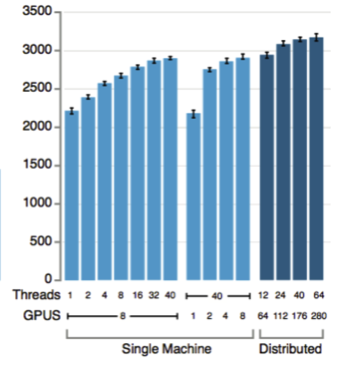
That's not factoring in other information, like Sedol now being familiar with alphaGo's strategies and improving his own strategies against it.
So there is a good chance he is now evenly matched with AlphaGo, and likely much better than the single machine version.
A human is far, far, leagues, more efficient at learning than today's AIs. These AI requires millions of hours of man time of data to even come close to competing at the level of an expert person which did the same, and even arguably far better, in a "few decades".
It took some serious hardware for Deep Blue to defeat Garry Kasparov. Now there are smartphone apps with that same level of Chess-playing skill. And if anything the AlphaGo approach is more amenable to running on lower-specced hardware without requiring help from Moore's Law (because you simply train it better).
Hassabis and Silver kind of reminded me of developers given the details of a bug that was notoriously difficult to find.
edit; I can't wait for the reviews of the entire 5 game series. If a book came out I'd very likely buy it. A book discussing both Go and AlphaGo AI at the same time consisting of people among the top of their respective fields would be amazing.
Imagine what AI, in different fields, means for humanity if it has so much to teach us, just by being able to "think" differently. I sure hope that one day they start writing philosophy and, doing so, potentially legitimize everything that currently makes humans unique and extraordinary.
(also during the actual game with more details, but I can not find the exact time again). Edit : can not find game3 commentary but during game 4 he is coming back to it again with interesting details as for why this is a great opportunity to inspire human players : https://youtu.be/yCALyQRN3hw?t=7097
Basically, once in ancient Japan and more recently a Chinese origin player in Japan, both incredibly strong players, surprised everyone with never before seen moves that subsequently where integrated in modern game theory. The hope is that the same could happen here.
Dolphins are about as intelligent as us, too. Are dolphins amoral? Do they delegitimize Beethoven, Tesla, Gödel, Einstein, and da Vinci?
If we invented dolphins, and they began to replace and displace us, then maybe? I don't think it is about the intelligence, but in how we use it of course. Dolphins don't really have any control of my life or those around me.
That sounded a lot more paranoid than I meant, I actually agree with what I think you are saying
How are you making this comparison?
/s
http://www.deepseanews.com/2013/02/10-reasons-why-dolphins-a...
While it's somewhat news to me, I'm very glad to hear we've moved past that.
I have no reason to doubt that quantitatively we have made some progress - although Pinker's arguments are most definitely not universally accepted in the scientific community.
That's quite an accomplishment.
I hope your reductionist explanation is not accurate because it would imply that we are already so highly conditioned to machines and to AI that this match is thought to be no different from a match between two humans.
Q: We heard there's now an anti-Lee Sedol website in Korea?
A: I don't even have time for my fans. I don't care about haters. ("나를 좋아하는 팬들에게도 신경을 못 쓰는데 그들에겐 당연히 신경 끈다.")
Or, writing from the point of view of our mechanical successors to this world, for helping to advance a highly ethical field that could exterminate that genocidaly murderous evolutionary abomination that was the human race. Who incidentally thought they were extraordinary but couldn't even play Go.
And for a game that was thought to be many decades away in terms of computer capabilities, this probably should be a time to think of the possible consequences of AI improvement and take a close look at it.
That line of reasoning would be worth a laugh, if it wasn't so widespread in the general population.
>Both have to do with right and wrong, but amoral means having no sense of either
Well that's true then! A nice quote is from Feynman in regards to scientific research.
"To every man is given the key to the gates of heaven; the same key opens the gates of hell. — Richard Feynman "
We really have no idea yet how this AI research will play out.
I don't quite like the line "Delegitimize all that makes people unique and special" But that's my only real disagreement.
You're treating Lee Seedol as if he is a fixed dataset to be trained on. Why can't he also be a "NN" who can also "refine" his AI[0] and thus be hearder for Alpha Go to compete with?
You're putting too much faith in the machine and dropping the person, that might not be completely fair.
[0] Albeit not artificial in this case.
If you care about being unique and extraordinary more than about reason, knowledge, truth, the observable reality, and the search for what it really means to be sentient, then and only then you may call AI "amoral".
Also, you are being racist against artificial sentient beings, and being racist is hopefully not what makes humans extraordinary.