erostrate
Should you push arguments that seem ridiculously unacceptable to the vast majority of people, thereby reducing the weight of more acceptable arguments you could possibly make?
I'm not saying there's anything wrong, and I'm oversimplifying a bit, but I still find this amusing.
If my end goal was to apply this to everyone at some point, I would probably start with such a restricted law, then extend it step by step later.
Travelling 6 miles (9.7 km) by motorcycle
Travelling 17 miles (27 km) by walking
Travelling 20 miles (32 km) by bicycle
Travelling 230 miles (370 km) by car
Travelling 1,000 miles (1,600 km) by jet
Travelling 6,000 miles (9,656 km) by train
But switching from car to bicycle for short trips still increases life expectancy due to health effects.
Sources: https://en.wikipedia.org/wiki/Micromort https://www.ncbi.nlm.nih.gov/pmc/articles/PMC2920084/
Certainly agree. The point is that coming up with the idea, writing it as an equation, or an architecture diagram in a paper, is a small fraction of the effort that goes into making the idea work in a model showing good performance on real life datasets.
For example, just taking a random paper that Schmidhuber claims should give him credit for GANs, https://people.idsia.ch/~juergen/FKI-126-90ocr.pdf hopefully you can easily see that a lot of work would be needed to turn this into a realistic image generation model. And that is, even if you admit that the idea is strongly related to GANs, which I'm not convinced of but won't spend time on.
> Credit belongs to whoever actually makes it work. >> That is according to whom? Is it a rule you just came up with or accepted practice? And if it's accepted practice, in what community is it accepted practice?
It is accepted practice in the ML community. If it weren't, Schmidhuber wouldn't be complaining.
- Gary Marcus
- Juergen Schmidhuber
- Pedro Domingos
- Max Tegmark
- Eliezer Yudkowsky
Some context for people unfamiliar with ML research: the author, Schmidhuber, is well known for claiming that he should get credit for many ML ideas. Most ML researchers think that:
- He doesn't deserve the credit he claims, in most if not all cases.
- There's a few cases where his papers should have been cited and weren't. That's fairly common.
- People do not get much credit for formulating an abstract idea in a paper or implementing it on a toy problem. Credit belongs to whoever actually makes it work.
- Credit assignment in ML is not perfect but roughly works.
Amazon, Apple and Google are all working on incorporating LLMs but why is it taking so long? Why are these assistants still so bad? ChatGPT has been available for a year, GPT3 API for 3 years. I suspect some of it is legacy tech and legacy researchers from the pre-LLM era.
They are both Pareto-efficient. Here's a chart of cost of transport (calories/gram/km) vs weight (kg) comparing a salmon vs a bicycle vs a jet fighter etc: https://www.bike.nyc/wp-content/uploads/2017/04/efficiency-g...
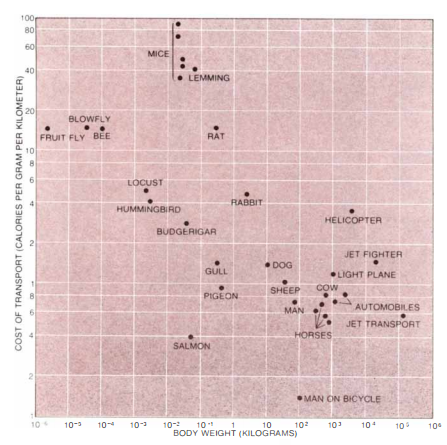
This is a terrible analogy because it captures the good reason why there are billionaires (we reward them for building something useful) and none of the problems that come with it (wealth and power inequality, economic externalities, etc.)
What would you count as evidence that effective altruism fails?
More seriously, any moral theory that strives too much for abstract purity will be vulnerable to adversarial inputs. A blunt and basic theory (common sense) is sufficient to cover all practical situations and will prevent you from looking very dumb by endorsing a fancy theory that fails catastrophically in the real world [1]
[1] https://time.com/6262810/sam-bankman-fried-effective-altruis...
She's using PR to pressure on Apple into implementing the kind of solution her previous company is selling. Won't someone think of the children??
[1] https://www.linkedin.com/in/sarah-gardner-aba90013/ [2] https://www.thorn.org/our-work-to-stop-child-sexual-exploita...
Agreed, but they're facing KKR and Apollo, who are even more sophisticated. PE is a small proportion of CALPERS portfolio. They can't be the top expert everywhere, and they can't be better at PE than PE firms.
> They turn down investments all time because they don't make sense.
But can they turn down a whole asset class?
> If you have a product with high demand and low supply, you can set the terms. It's a sellers market
Maybe we can agree that PE firms are not competing enough on the liabilities side, which makes it difficult for institutional investors to negotiate fees down?
> I have a hard time feeling sorry for highly sophisticated investors complaining about the terms of an investment they had complete free will over investing or not.
To me that sounds like the typical free market fallacy, "no reason to complain or ask for regulation because you can just buy the product elsewhere if you're unhappy". Sure, that works fine when there's enough competition, but I'm not convinced it's the case in PE.
I can think of a few reasons why they don't.
They need 'uncorrelated returns' which PE provides, and it might be worth paying extra fees for this. That does not mean the fees are fair, it just means there is not enough competition. Also institutional investors might not perfectly rational and informed, as the article notes some of these fees are somewhat obscured and investors might be looking more at direct management fees. Relatedly, there is probably an asymmetry of skills and power, as institutional investors are second or third tier firms whereas PE firms are top tier. Finally, there is the usual agency problem, institutional investors are not sufficiently incentivised to reduce fees, because the fees are effectively paid by people who put the money in the funds, namely you and I, via pension funds or sovereign wealth funds.
> Do we need to somehow protect institutional investors who manage tens of billions of dollars? Are they a victim that needs protection?
We need to protect the people who ultimately put the money in the funds, not the chain of asset managers extracting their rents on top of it. Historically for PE these were high net worth individuals, so nobody cared, but nowadays they are California's teachers and Japanese pensioners.
> How is it all that different from a company owned by a majority shareholder who makes bad business deals? What do institutional investors do then? Presumably they use their voting power to stop it, or else just exit their position?
It is a similar agency problem I think. It's easier if you're investing directly in companies, because there are many companies competing with each other to attract institutional investors' money, so they care more about making investors happy.
The underlying question is why aren't PE firms competing with each other to provide lower management fees to attract more institutional money. This has happened in public market funds, with Vanguard for example providing very low fees. But for some reason it doesn't seem to happen in private markets. PE firms compete on where to put the money, trying to win deals against each other, but do not seem to compete that much on where they get the money. I don't know why. It could be that quantitative easing made money so abundant that they had more money than deals to spend it on, so there was no reason to compete.
Edit: to be fair this seems to be happening somewhat now [1]
[1] https://www.ft.com/content/05b0d935-678b-418c-8a86-b1a99bb04...
A-numbers of sequences contributed by [your name] (however, this might be appropriate on your OEIS Wiki user page).
Experience points required for a Pokemon in the "erratic" experience group to be of level n.
The year 10^n decimal digits of pi were first computed (Not well-defined!)
Primes of the form n^3 + 2 n^2 + 37 n + 73.
Non-trivial circulation in decreasing order: numbers of the form lim_{x->+inf}(a[x]b) with b<>1.
You start at the number 1 and you add 2 until you get to the 4th number in the sequence, in which you then add the 1st and 3rd number of the sequence, which will give you 6. Then you do the same thing, adding 2 to each sequence, but for every 4th number you add the 1st and 3rd number before it.
Consecutive Quotients minus a third term x(k) = fix(ax(k-1)/x(k-2))-bx(k-3).
Prime numbers of the form 1 plus n x 10@r (@ means "to the power of") where n is an integer between 1 and 9 inclusive, and r is an integer greater than or equal to 0.
Concatenate a semiprime with a Fibonacci number to obtain a palindrome with at least two distinct digits.
The sequence 1,2,3 (and no further terms are known). The sequence 2,4,6 (and no further terms are known).
Introduction to Cryptography by Christof Paar, I wanted to understand Bitcoin's secp256k elliptic curve on finite fields: https://youtube.com/playlist?list=PL6N5qY2nvvJE8X75VkXglSrVh...
The Maths of General Relativity by ScienceClic, I wanted to understand clearly Einstein's field equations (what the hell is a Ricci tensor) without having to read a book: https://youtube.com/playlist?list=PLu7cY2CPiRjVY-VaUZ69bXHZr...
Do bear in mind the tests that very smart people have proposed in the past (from playing chess to holding a conversation to understanding pictures). And consider the implication for your position if you find it hard to devise a well defined test that would convince you to abandon this position.