150 years ago, the average person was illiterate, poorer (in all senses of the word) and less connected to the world around them. Over a 100 year old grind, schooling fixed all that. Why can't it keep going? So the outlier, super special "phenom" today is the median of tomorrow.
Not true in the case of the US, which famously adopted a culture of universal literacy earlier than the rest of the world. By the mid-19th century, literacy rates among whites were not much different than they are today. It is one of the bright spots of American history; they took literacy very seriously for complicated historical reasons. Their book consumption per capita was also the highest in the world by a very large margin back in those days, which lends evidence.
It may or may not be relevant to your point, but at least in the US the idea that the average person was illiterate is ahistorical. They were the best read population in the world 150 years ago, and took some pride in that.
Regardless of if they achieved their religious objectives, that earnest mission to make every human soul capable of reading the Bible for themselves produced the social good of a literate population capable of reading prodigious amounts of non-Bible content.
It is an interesting consequence of how the religious wars in Europe spilled over into in the early Americas.
If you'd please review https://news.ycombinator.com/newsguidelines.html and stick to the rules when posting here, we'd appreciate it.
The Puritans were always few in number and were demographically displaced by later immigration around the fishing industry in New England.
They were influential in a narrow geography of the Massachusetts Bay Colony for about 50 years. Their own children and grandchildren largely rejected Puritanism resulting in the Half-Way Covenant and the eventual demise of Puritanism. I agree that they're part of the foundational myth, but it's just that myth.
I think some overstate the influence of Radical Protestants on American ideology with offhand references to Max Weber or by calling whatever their pet cause is a fight against "secular puritanism." On the other hand, I do think there are some interesting parallels.
For example, one could argue that the mistreatment of colonists by the mother country was overstated by a population already distrustful of the Crown. I'm no expert, but it would be interesting to read more about that dynamic.
But it surely did happen -- IIRC, Adams and Jefferson were both noting in their correspondence how by the end of the 18th century most of the Puritan descendants had somehow become Unitarians.
Sounds like Americans were literate back then. I also suspect that most were _more_ connected to the world around them. Not the broader world, but the immediate world around them.
> By 1875, the U.S. literacy rate was approximately 80 percent.
> By 1900, the situation had improved somewhat, but 44% of black people remained illiterate.
> The gap in illiteracy between white and black adults continued to narrow through the 20th century, and in 1979, the rates were approximately equal.But the states does have among the lowest literacy rate in the west. Less than 80% was considered literate in 2024, compared to almost 99% in the EU (with a range from 94% to almost 100%).
> literacy rates among whites were not much different than they are today. It is one of the bright spots of American history;
The rates only looked okay if you cut out at least 20% of thr population?
https://en.m.wikipedia.org/wiki/Historical_racial_and_ethnic...
Yeah, it was okay in New England but many states had laws preventing slave education.
As long as you ignore all those pesky non-whites.
> Not true in the case of the US, which famously adopted a culture of universal literacy earlier than the rest of the world.
Later on the a small caviet about it being for whites only, but then goes back to ignoring it by saying
> It may or may not be relevant to your point, but at least in the US the idea that the average person was illiterate is ahistorical. They were the best read population in the world 150 years ago, and took some pride in that.
The average person had a 20% chance of being enslaved and illiterate. Of the remaining ~80% there was high rates, but there was absolutely not universal literacy when there were strict laws in place to prevent it.
> schooling fixed all that
Not globalization, industrialization, and urbanization?
I don't follow. 1979 would have been a high point in closing the black/white economic gap in America (partly because of the falling economic prospects of white Americans at the time).
Schooling has fixed all that, and still works just fine. Just not in America, because that country is rapidly self-destructing. Schooling is still working fine in the rest of the world.
Because an educated populace is harder for the ultrarich to control and abuse, because an educated populace with free time can revolt against those in power, and because as a consequence of those two things ultrarich conservatives have consolidated ownership of media and used it to defund education and convince the population that funding education is bad.
This is the bottom line; this right here.
We're being led to a second dark age ON PURPOSE.
However I'm curious as to why you attribute or limit this to 'conservatives' only. Is this really something exclusive or characteristic of the conservative side? At least where I am from it's the left that's more interventionist in regards to education rather than the right, that interventionism being used to make education more rigid and controlled by a biased government.
And the media is definitely not consolidated, you've got clearly two sides competing at a pretty equal level.
As purely anecdotical data, where I'm from it's actually the opposite, majority hippies, vegan, alternative/free education advocates, etc, and a minority of mostly morally-concerned non-left-leaning (mainly religious) people, as well as specific cases of children with special needs that simply can't adapt to public education because of external reasons (bullies).
As a matter of fact, the hardcore religious right in my country have their own private education institutions, which are quite powerful themselves.
So even the (non-catholic) Christians who homeschool because of religious and moral convictions end up being moderate/center people trying to move away from both extremes.
And two sides at equal levels? Are you living in 1979? Local media is nearly all Sinclair. All the cable networks are owned by conservatives. Even traditionally liberal newspapers like the Washington Post are owned by rich assholes taking over the editorial board. And social media in the US is now dominated by two literal fascists.
From where I'm from I'd say yes, both sides at equal levels more or less, fairly favoured toward the left, but now changing a wee bit because the left went waaaaay too left.
Europe would now seem to be shifting towards the right at some levels, but from historically (recently at least) being fairly leftist.
Anyway, aren't CNN, MSNBC, The Guardian... overtly left-leaning?
For CNN and MSNBC, no. Neither was every truly liberal in the global sense (like the Democratic Party, closer to centrist than anything else) and both have started drifting rightward in the last 4 years such that they're now roughly "American Centrist" with a slight left lean i.e. conservative in most of the rest of the world.
Plus, an "educated" populace is as easy or maybe even easier to control, it's willpower against all odds that characterizes the truly ungovernable.
My SO taught at all 3 kinds of the school in the US, in urban and suburban areas. The pay is bad everywhere, but worst at the non-union schools. Only teachers left have no better options or believe in the religion or cause of teaching, and even they tend to leave such schools the moment they have enough experience or better options. None of this is good for the kids at such schools.
The more affluent schools can afford to hire experts and keep them. I went to a rich(er) high school and had my choice among many specialty electives and advanced placement. My SO's poor highschool was something between prison and daycare. My friend's private school was a religious indoctrination factory. Home schooled friends were often academical average to great, all socially awkward well into adulthood, and many were taught conspiracies or outright lies as long as it fit their parents "biblical worldview".
Public school was an escape from a cult-like community for me. I'm grateful my parents were too poor to force me into an alternative until I was old enough to refuse.
It sounds like you have a beef with how citizens socialize their children into the dominant religion of the society—which is literally considered a human right[1]—and less so with how schools are funded in the U.S.
See Article 18.4 of the International Covenant on Civil and Political Rights: https://www.ohchr.org/en/instruments-mechanisms/instruments/... (“The States Parties to the present Covenant undertake to have respect for the liberty of parents and, when applicable, legal guardians to ensure the religious and moral education of their children in conformity with their own convictions.”)
American subgroups that socialize their children into community religious norms are among the most successful. For example, Mormons: https://americanaffairsjournal.org/2020/11/utahs-economic-ex....
Prohibitions on religious education in public schools—which don’t exist in many developed countries, such as Germany and Sweden—hurts the majority of people who would do better under that system.
Mormons' affluence is in spite of their faith, not because of it. Utah also has more MLMs and scams than most others.
Having lived in a cult-like religion, I'd rather be less wealthy yet mentally well than 'socialized' into magical thinking and all the various idiotic garbage I was taught. Public schools are often one of the only ways kids can escape abusive, exploitive, or otherwise unhealthy circumstances.
Nobody is getting rich running schools. But everyone in the Baltimore public school district continues to draw salaries even though in some high schools many kids are reading at a kindergarten level. https://foxbaltimore.com/news/project-baltimore/77-tested-at....
So let the PE folks take their shot, or at least provide ways for the small fraction of involved parents to get their kids out of failing schools.
> Mormons' affluence is in spite of their faith, not because of it.
Mormons were literally driven out of the rest of the country for their religious beliefs and settled land that has no resources and can barely support farms and agriculture. Yet they built a thriving civilization in the middle of nowhere. Utah is one of the most stunning success stories in the world, up there with Israel and Singapore.
> Having lived in a cult-like religion, I'd rather be less wealthy yet mentally well than 'socialized' into magical thinking and all the various idiotic garbage I was taught. Public schools are often one of the only ways kids can escape abusive, exploitive, or otherwise unhealthy circumstances.
Mormons are tied with Jews for the happiest people in the country. Being socialized into religion, with uniform norms and expectations, is for most people mentally healthy. They’re also literally healthier. They live significantly longer than non-LDS white people: https://www.demographic-research.org/volumes/vol10/3/10-3.pd....
Schooling didn’t fix all that. There have been major advances throughout society in every area: medicine, nutrition, sanitation, manufacturing, electricity, refrigeration, printing, computing, telecommunications… the list goes on and on and on. Some of these things contributed major improvements to the average person.
Advances in medicine and nutrition, for example, contributed to sharp declines in early childhood mortality and morbidity. Advances in reproductive health care (along with everything else) led to huge declines in birth rates. Smaller families have more resources and attention available for each child.
Other advances had less of an impact but still add up when combined. Widespread access to refrigeration improved nutrition and reduced spoilage, allowing increased consumption of meat. More meat means taller, stronger, healthier children.
On the other hand, schooling hasn’t improved all that much in 150 years. You can find lots of writing samples and old exams for schools from back then. The bigger difference is that children stay in school much longer and have less need to rapidly enter the workforce in order to support the family. This last factor is a product of many of the advances listed above.
You might say that's also a success of the schooling (and higher education) system - unless the people who produced these advances were all home schooled, which I somehow doubt...
And many who had a lot of schooling learned to repeat, obey and sit still for 12-16 years.
And maybe had less initiative than they were born with. Maybe they learned to not question what they were told.
1. Thomas Edison Minimal formal education; mostly homeschooled by his mother. Edison was a voracious reader and learned through experimentation.
2. The Wright Brothers (Orville and Wilbur Wright) Neither completed high school. They learned through self-study, practical work, and their experiences running a bicycle repair shop.
3. Henry Ford Left school at 15 years old. Ford learned engineering and mechanics by working as an apprentice.
4. Michael Faraday Minimal formal schooling. Faraday worked as a bookbinder and educated himself through books and observation.
5. Benjamin Franklin Left school at age 10 due to financial constraints. Franklin was self-taught, primarily through reading and experimentation.
6. George Eastman Dropped out of school at age 14. Eastman learned accounting and photography on his own.
7. Elisha Otis Had little formal education and learned mechanics and engineering through work experience.
8. R. G. LeTourneau Dropped out of school in the sixth grade. He learned engineering through hands-on work and experimentation.
9. John D. Rockefeller Dropped out of high school to take a business course and learned through practical experience.
10. Philo Farnsworth Learned electronics and physics by reading and tinkering, despite being unable to afford college.
In what way do you mean this?
Illiterate, yes, but likely better at other skills like milking cows and knowing which plants in the forest were edible. Less connected to the global world and culture, yes, but more connected to the hyper local environment around them. I don't know if the schooling "fixed" anything, it just created a new, national or global template for what a human being should be like.
Children are required to be there. The school has to provide them with all manner of opportunities.
On the flip side, the school can't expect anything from the kids other than attendance. They don't really get to expect a certain level of behavior or performance. They can't relegate the bad actors (behavior or performance) away from those who wish to participate fully. Everyone has to be mixed together.
So you give a certain vocal minority that don't care about the education a heckler's veto. They are regularly disruptive and can't be removed.
Nobody has a solution for actually improving that group of student, but there are enough people involved in public education that demand these students be included in the process that they are trying to wreck.
if by “deal with” you mean serving them fries on their way to a ski trip, perhaps :)
That's so last century. Now about as real as Santa. Now you can only get wealthy by inheritance or gambling. Even if it means gambling with you health you still need to win for it to amount to anything. There's absolutely no way to earn wealth now. I'm not sure if there ever was.
Your original assertion "There's absolutely no way to earn wealth now" is ludicrous: was it possible a month ago? a year ago? a decade ago? Did anyone become wealthy through methods other than gambling or inheritance a month ago? a year ago? a decade ago? If even one person did, this disproves your assertion, unless you want to claim some as-yet-unmentioned recent change that made it possible then and impossible now.
Your supporting theory about gambling is only true if you define every single choice you make in life as a gamble to some extent, which is a weird way of thinking about the world.
As for the "you didn't build that" stuff & snark, I don't recall claiming I did anything all by myself, nor did I see anyone claim you have to do everything all by yourself to "earn wealth". Nice strawman.
Of course. There are many people who are wrong.
> Hopefully it happens for you before your mindset seriously dents your future prospects.
My future is already secured.
> "There's absolutely no way to earn wealth now" is ludicrous: was it possible a month ago? a year ago? a decade ago? Did anyone become wealthy through methods other than gambling or inheritance a month ago? a year ago? a decade ago?
No.
> If even one person did, this disproves your assertion, unless you want to claim some as-yet-unmentioned recent change that made it possible then and impossible now.
Only if you insist on treating the assertion rigidly which is unwise for all assertions pertaining to any other realm than math.
> I don't recall claiming I did anything all by myself
Ah, so you are a person who thinks whatever is said is about them specifically.
> nor did I see anyone claim you have to do everything all by yourself to "earn wealth". Nice strawman.
It's a well known psychological observation that people who achieved success typically misattribute it disproportionately to themselves even if they know it was pure chance.
No."
You should seek professional help.
If those people have worse habits, are less motivated, less educated, less cultured, what is there to gain from it?
Seems like there's only something to lose from adjusting to their shittiness. Like Harrison Bergeron
And seeing the state of California trying to push math classes later because of "equity", seeing public schools dissolving gifted programs, it makes me think that privatization is the only way forward instead of trying to make amends with the current progressive stupidity
This is prejudice in the most basic sense: you literally don't know any of these things about the people you're surrounded by in a society. The person who rides the bus next to you could be a couch potato, or a talented artist, or something entirely different that simply isn't legible to you.
I don't know anything about California's math classes. I'm saying that, on a basic level, anybody who thinks this way about people they don't know is demonstrating the exact traits they're smugly claiming to be above.
Reading your comment, it seems to focus on the individual. “The person” you know nothing about.
The parent comment seems to be Bayesian, the probability of “the person” being something.
I do think it’s possible to simultaneously believe that:
* every single person you meet in every possible circumstance might be an exceptional human
* your are more likely to encounter exceptional humans in specific circumstances and you can optimize for that
I believe this holds true regardless of your definition of exceptional.
A (maybe) obvious example: if you believe exceptional humans want to grow their own food and live on communes, you probably don’t want to live in the financial district of Manhattan. That would be a bad way to optimize for finding people who share your values.
Similarly you’re unlikely to find a thriving software developer community in Springfield Illinois. If you go to Springfield and assume everyone you meet can’t program, you’re going to be wrong - there are good programmers there. But if you want to live around people who know how to code, you don’t move to Springfield Illinois.
Society needs and has exceptional people living in communes, in the financial district, in software development communities, and yes even in Springfield, Illinois.
Sharing your values or not does generally not correlate with exceptional.
If you are just looking for someone in your field to learn a trade from, well, great, but that is hardly the intent of primary education.
I think that this is the core problem - you can't.
You try your thesis. I’ll try mine.
We will see where the other’s grand kids end up.
And if you want to find the best mathematician you stay in academic circles. But the best mathematician of your era might be in a random district in India. So you shouldn't immediately exclude everywhere else, or your 'optimisation' may be a relatively low local maximum.
learning how to be patient and tolerant regarding situations / people / things i do not like or think of as “beneath me”.
tends to lead to better decision making as one can respond, rather than knee jerk react to everything.
edit — also, i tend to find i can learn a lot more useful lessons from beginners.
in the beginners mind there are a lot of possibilities. in the expert’s mind (especially self proclaimed ones) there are few possibilities.
children are a great example of this.
The average kid at the average school is at the 50th percentile. Moreover, the speed of the class isn't even the speed of the average kid because then the 40th and 20th percentile kids would get left behind. To get out of this you'd need a school with a gifted program and enough 90th percentile kids to fill it, and many of them don't have one.
sport?
english lit?
maths?
music?
socialising?
being the mother hen?
being a jock?
teaching everyone else things in the library?
class clown?
being the wacky one?
skateboarding?
acting?
rebelling?
looking after someone who has just been picked on by all the other kids?
schools introduce us to a wide range of children who are representative of the people we’re going to have to deal with later on in life.
not saying there aren’t alternatives.
but specialising for only the 90th percentile of one thing seems like a way to isolate someone later in life because they may not have learned how to deal with people who aren’t in the 90th percentile of that one thing.
and i say that as someone who hated my time at school and has struggled with the repercussions in later life.
i still learned a lot near the classroom tho.
It could be the 90th percentile of science and the 60th percentile of literature and the 40th percentile of music. But if they throw you in with the 50th percentile kids in all cases then you're being held back in science and literature and you're holding back the other kids in music.
> schools introduce us to a wide range of children who are representative of the people we’re going to have to deal with later on in life.
This is why home school families come together so their kids can socialize with one another.
Many homes also lack numerous gifted children and specialist programs.
What if there isn't one within a reasonable distance, or your locality doesn't have school choice?
> Many homes also lack numerous gifted children and specialist programs.
The issue is that you need the absence of children who would hold back the class, not necessarily that you need the presence of other gifted children except insofar as you need to fill out the class, which is not an issue when the class size is one.
I grew some 1,500km north of the nearest city and got by .. still managed to hook up with Terrence Tao and Paul Erdős when I got to university and ran a math club. When one of my kids was ready for high school we got a house in the catchment of the only public school with an aviation program so they could build and fly a light aircraft.
> The issue is that you need the absence of children who would hold back the class,
I enjoyed going to school with hunter gathers in the Kimberley .. I don't feel they held me back, I did get to learn how to fish, to hunt, to swear in several languages.
Despite a lot fighting at high school, on and off the fooball field, I managed to pick up enough abstract algebra to work on CAYLEY/MAGMA which cracked a few quantum encryption candidates recently, enough linear algebra and calculas to author a geophysical processing suite, etc.
Those all sound expensive. Not everyone can afford that.
> I enjoyed going to school with hunter gathers in the Kimberley .. I don't feel they held me back, I did get to learn how to fish, to hunt, to swear in several languages.
Is this something you'd expect to experience in the median US public school?
Distributions aren't all normal, for one. And skill levels are often quantized in a way that majority of people will be above a 50% level on it.
My gripe here is the parent post is an appeal to how "average" students are quite bad. But, there is no substantiation to that point. It is, instead, taken as a given in what is essentially a culture war talking point.
It would help if I wasn't exposed to so many parents that are convinced their kids are somehow gifted among gifted kids.
The point isn't that average is bad, it's that your kid probably isn't exactly average.
You could also want to home school them if they're below average, to keep them from getting left behind. The way a lot of public schools treat kids with developmental disabilities is sadly a lot like the way corporations treat cost centers.
> It would help if I wasn't exposed to so many parents that are convinced their kids are somehow gifted among gifted kids.
Everyone thinks they're above average. Around half of them are right.
And I'm somewhat sympathetic to the idea of homeschooling not being an automatic terrible thing. Sold a Story went a long way to convincing me that some really bad choices were made in how to teach reading.
My main nitpick is that that wity quip at the end is not even wrong. Not all values are population weighted, such that you can certainly have some skills where over half of the population is over what you would call average ability.
And just because I was good at math and writing didn't mean that I "deserved" to be in some separate system where I got the "best" of everything (with diminishing returns). When I eventually encountered people who were afforded just such a deal ("elite" private school in a wealthy area), they were far less impressive than the top college-level facilities they enjoyed as grade schoolers; it seemed like a waste of money that could have been put to more efficient use, as far as society writ large might be concerned.
> When I eventually encountered people who were afforded just such a deal ("elite" private school in a wealthy area), they were far less impressive than the top college-level facilities they enjoyed as grade schoolers
This is exactly the argument in favor of home schooling. If you just throw money at it but pay little attention to it then you get a beautiful campus with expensive landscaping and not necessarily the highest quality education, because it's easier for parents to judge the quality of the facilities than the quality of the instruction. Whereas if you actually care and you want something done right you have to do it yourself.
At some point, the masses say, "No." They realize that they're never getting a seat at that particular table, and turn from fighting over the charity spots to attempts at dismantling their exploitation. From there, you either get a robust public school system that provides a decent education for everyone, or a police state.
Suffice it to say, no one parent's dreams for their kids should come at the expense of another's.
Humility.
People who build their ethics on virtues might believe that, for example, being brave is a virtue. And so, regardless of the consequences, they will aspire to be brave. Similarly, people who believe in virtues will see humility as worth pursuing regardless of whether it makes one better off, long term or short term. It's just good to be humble. End of story.
The reasoning behind non-virtue ethics is usually complicated and subject to debate. It also usually shows that rules derived through such reasoning could contradict the desirable outcomes (that we intuitively find desirable). One of the particularly dangerous and undesirable such outcomes is the belief in moral relativism that opens a door to justifying a lot of actions we'd intuitively find repugnant.
Virtue ethics avoids moral relativism simply by not trying to base ethics in experimentation. Which is why some philosophers find it an appealing approach.
> It's just good to be humble. End of story.
to be axiomatic declarations. My issue with these kind of axioms is they're not really necessary. You can get everything useful by only considering things that are good for somebody. Now, we don't live in a perfectly informed and rational society, so it can be good (for society) to indoctrinate everyone with this axiom. But, as with all axioms, not everyone will believe in them. So, if I'm told,
"You need to be more humble, it's a virtue,"
that's begging the question! I need some external reason to either adopt the axiom or humility. Society as a whole seems to have adopted this axiom, but why is that? There was probably an evolution of axioms, where ones that didn't work got rejected, while ones that mostly worked got inculcated. I think most people overestimate their abilities, which would lead to fighting over positional goods. I think the role of the humility axiom is to prevent such fighting, but it comes with drawbacks.
Since the Enlightenment, most wealth has been created by thinking really hard. This means you really want to rank people near the top accurately, so you can give them resources to go and create their ideas. The axiom of humility regresses everyone toward the mean—which is great when the GDP is measured in bushels, but not so great when it is measured in transistors.
Becoming humble in front of people who suck is learning the wrong life lesson
It's not all about you.
with respect to what metric? economic growth? that's probably not true, lone wolfism is what drives people to develop expertise in the first place
if the metric is community or "sustainability" or something else, is pursuing that metric in the place of economic growth sustainable long term?
The appearance of humility^[0]? I don't really see what there is to gain either.
[0]: Autobiography of Benjamin Franklin, Section II, Paragraph 9
Maybe that's not how society thinks? That's one person's opinion.
You're welcome to that narrative if you find it comforting. It's wildly incorrect however. Half of my family self-identify as semi-literate rednecks. The other half are members of the most prestigious country club in the state they reside in and the least successful of them was a V level executive at a multinational bank. I've cherry-picked the best of both worlds and have done just fine for myself without having to resort to any of the soulless pantomime you're advocating here, which does more to maintain property values in exclusive neighborhoods and feed a certain class of individual's sense of self-worth than anything objective. Water finds it's level I suppose.
> Property taxes pay for schools.
Are there any other countries that use a local-tax funding model for public schools? Most other nations that I know use a national funding model.
https://en.wikipedia.org/wiki/Public_school_(United_Kingdom)
> The schools are "public" from a historical schooling context in the sense of being open to pupils irrespective of locality, denomination or paternal trade or profession or family affiliation with governing or military service, and also not being run for the profit of a private owner.
You could throw an extreme amount of money at schools but require it be spent on specific initiatives. Things like resource officers, hiring someone with specific qualifications, and boatloads of staff training.
You can average that out to a per student basis and say "look we're spending so much on education" but if the money is going to train teachers how to deal with crisis situations like school shooters, it's not really being spent on educating the student. How that money actually gets allocated matters.
Other jurisdictions don't have to put so much into student funding directly.
So, yes, maintenance is a significant portion of spend. The schools were allowed to get into really bad shape, physically, in a way that doesn't at all reflect on the enthusiasm or capability of students or teachers.
Here is the breakdown for Maryland: https://dls.maryland.gov/pubs/prod/NoPblTabPDF/2024PubSchool.... My county, Anne Arundel, received half the state funding of poorer counties. In terms of total funding, it’s below the median, but has above average schools for the state because school quality is more a function of the types of kids in the school moreso than funding.
Doubt it. In my province of Canada (Alberta), school is paid for by provincial taxes and money is distributed based on the amount of students.
That being said, since kids are assigned to schools based on proximity, it's still worthwhile being in a nicer neighbourhood since the kids will come from more affluent families...
Poor schools actually get more government funding per student.
This is why good school districts California usually have ties to non-governmental chairty parents associations that parents contribute directly.
It is also a huge part of why California passed prop 13. After property taxes we're separated from funding local schools, homeowners were simply much less willing to pay for taxes that won't go to their kid or community.
as an outsider, i think cali’s schooling system is beyond fucked, mostly due to the focus on the bottom 25% of students. the middle and high achieving students are being neglected and leaving. positive feedback loop.
society has always been this way, from the hunter gatherer days, to middle ages - that's why people want to become part of the elite.
It's only recently that the average people have had the chance to become elites, rather than be born into it. But the desire to be elites, molded by evolutionary/darwinian pressure, is not gone, nor different, than in the past. Another word for it is "the human condition".
It still mostly depends on being born into it. In the US your odds of going from impoverished to wealthy are extremely slim and socioeconomic mobility is among the worst compared to other developed countries. The US falls behind South Korea, Lithuania, Estonia, Singapore, Malta, and Slovenia, while the Nordic countries top the list.
Depending on the study, socioeconomic mobility in the US has either stagnated since the 1970s or actually declined. Average people have little hope of substantially improving the situation they were born into while the percentage of people born into wealth (but not the 1%) who slide downward in socioeconomic status grows. Wealth inequality continues to accelerate at an insane pace. (https://en.wikipedia.org/wiki/File:1962-_Net_personal_wealth...)

Just about everyone would like to be one of the "elites" but most people would be happy with a fair chance to meaningfully improve their lifestyle.
There's a lot of need for nurses which has made the job attractive, but it's worth noting that wages have been going down (https://www.incrediblehealth.com/wp-content/uploads/2024/01/...), they aren't especially higher than the money other workers make, and the actual working conditions for nurses have gotten worse. Telehealth also threatens to reduce both their wages and the number of (US) nurses we'll need in the future.
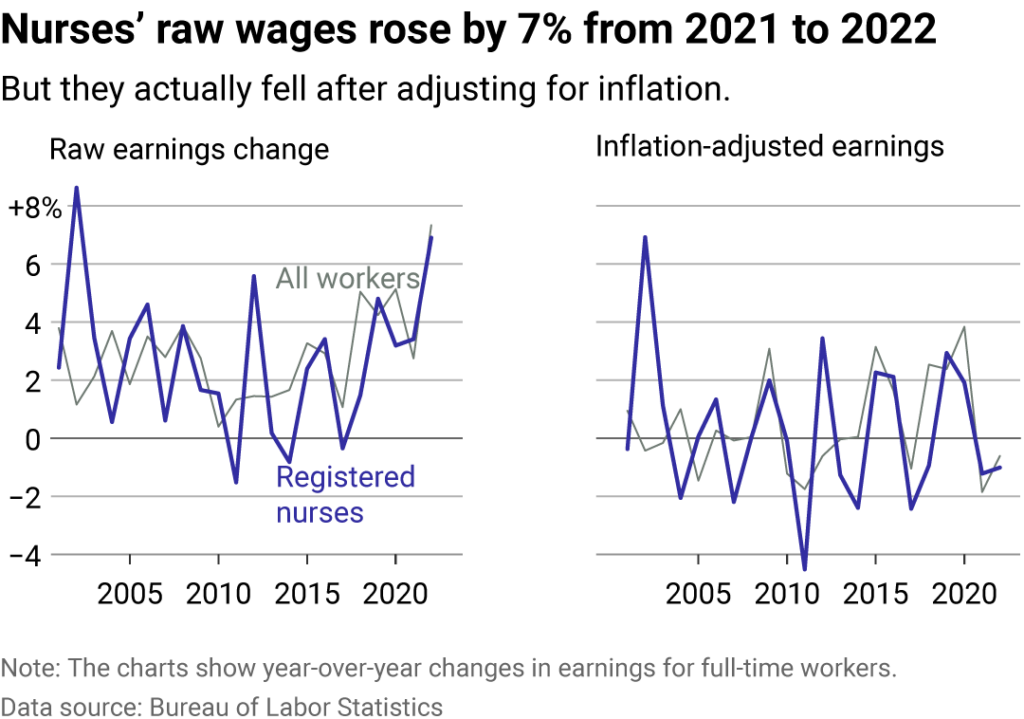
If people just want work, elder care seems like it'd be a safe bet for a while, but those wages and working conditions can be even worse.
Social mobility is a measure of relative rank change. In countries with compressed wage ranges, such as those you mention, “social mobility” is an artifact of the mathematics, it doesn’t mean you are meaningfully wealthier than the average person. You can double your household income in the US to above average and still not be “socially mobile”. Social mobility is not a meaningful measure for continent-sized economically diverse countries.
A person can go from the trailer park to being upper middle class in a place like Mississippi and it doesn’t count as socially mobile because you are being ranked against the household income of someone in Seattle, 3,000 km away. As far as the person in Mississippi is concerned, they are living the dream.
The opportunity to improve your standard of living in e.g. Europe pales in comparison to the opportunity to do so in the US. It won’t be classified as “socially mobile” in the US as an artifact of how the math works, but no one in the US cares.
In countries like the US, you can achieve enormous gains in income and still not be socially mobile by definition. Specifically, it has nothing to do with how easy it is to become wealthy, which is what most people incorrectly intuit it means.
High “social mobility” is worthless if it doesn’t come with a high standard of living.
No, mass of people cant. The thing you describe can happen and not affect the global stats only because it happens to few people in one relatively small location.
Also, I don’t have to deal with average people, I have apps that do that for me.
Having said that, two things can be true, I can prefer not to be around average people and I can be concerned for their lack of flourishing as I do prefer to live in more egalitarian society, especially one that can have better averages.
no better place to see that than in tech and HN
Optimism is the default state of non-broken children.
Sober realism is what's needed and required from adults.
Time to graduate - we have enough optimistic children running around with scissors already :)
Why? Being in tech doesn't make you a hacker. Most people, even very talented engineers, are still happy to follow boss, do a 9 to 5, and don't really bend or break the rules... they don't go against the elite. They see themselves as the elite.
Agreed. "Tech" includes a lot of people who are not hackers.
It's worth pointing out though that the "hacker" types who go with the flow are in many cases doing so motivated by pragmatism and cynicism. They don't really believe in management or in the company or the product, but they gotta stick around until their shares vest or whatever.
Speaking for a friend.
This is exactly what I’m referring to when I tell people that the tech industry changed and is no longer fulfilling.
These are not the only two options. Deciding some people are "the elite" and defining people as being either part of that group or in opposition to it is your choice, but it is not the only choice.
This process is typically called "politics". Thankfully we're mostly aligned that society mostly organizes itself by wealth, so you should sleep easily knowing the "elite" refers to rich assholes.
Nope. For some people it may be valuable. For me it was miserable, almost to the point of being deadly. It does not prepare you for adulthood or life or what have you in any meaningful sense (think about what would happen in your everyday life if someone e.g. decided you had insulted them somehow, and punched you. Think about how different your experience of that probably is to the average person. And then think about what that experience is like for a schoolkid). It's just a whole load of unnecessary suffering.
The people you hear giving up today have tried to fix the system. It's a little insulting to insinuate otherwise. When I was in high school, I tried to start a CS club, but no one was interested. I helped run MATHCOUNTS at the local middle school, and we had five people show up on a good day (<1% of the student body). Most students don't care anymore, and why should they when you have to fight the school to take AP Biology as a freshman? Gifted programs are being eliminated in the name of equity, and common core standards are lower than they ever have been. A friend who immigrated in seventh grade said America's seventh grade math classes are years behind China's (and she went to a better school than me). How do you get years behind in seven years?!
I don't think it is possible to fix the education system. The student body has adopted an anti-learning culture, administrators are lowering standards to raise their metrics, and most teachers would be wholly unfit for an ideal classroom, let alone the ones they're supposed to oversee nowadays. I am all for "burning the house down". I think the best solution would be to fire everyone, raise salaries by 10x, and then hire back 10% as many people. After all, the professorship pyramid scheme has lots of PhDs who might be interested in teaching for $300K/year.
How bad would it have to get to change your mind about this? Suicide is already one of the biggest causes of death in young people, and the biggest known contributing factors are things that are determined by the school environment.
I'm all for paying taxes for the greater good. But I don't want anyone I care about to go through what I went through.
Trying to do that in an completely artificial institution that arbitrarily divides people into age cohorts in a way that resembles no organic social pattern and forces all social interaction to conform to bureaucratic rules is not just not a value experience, but in fact actively inhibits the above goal.
The kinds of social skills and expectations kids develop in a school environment often need to be unlearned entirely in order to function effectively in a complex and dynamic society.
While true, it is true as like a side quest. Just because something is valuable doesn’t mean you should revolve your life around it.
Out here, in my schooling, the first stage of schooling was an elementary school, from ~7-15yo (8 years), and by default, you're enrolled into the nearest school to your home. Sometimes there are ways to choose other schools, but all the other pupils there, are there, because it's their nearest school.
What that means is, that you have, in a same class group (~25 people) a wide distribution of capabilities but also mental states, behaviours, etc. From geniuses that contribute to the whole schooling experience, to kids who somehow manage to stay basically illiterate even after 8 years of schooling, and just cause problems for everyone else. What that means is, that many of the lectures are based around trying to get the lower percentiles to learn at least enough for a minimum passing grade, and the top percentiles are either bored or lose interest. + all the behavioural issues.
After you finished elementary school, your grades of the last few years (2? i forgot) are calculated, you do some standardized testing, the numbers are calculated by some formula, and you get a numeric score, that is then used to enroll into high schools (and in most cases, the top X candidates by that score get accepted to a school, depending on how many apply, and how many open spots (X) there are.
There are many high school options, but most of the smarter kids enroll to 'general' high schools (gymansiums) for the next 4 years (and then college), and even those have reputations for some being better, and others worse, even though they technically teach by the same teaching programme (same courses, same subjects,...). Why are some better? Because smarter kids apply, and you get a high school where ALL of the students are from the "top 20%" of elementary schoolers. That means that teachers don't have to waste their time on "illiterate" kids, there are less behaviour problems, if everyone in class understands the lecture relatively quickly, the teacher can add some extra "college level" lectures, etc. This, for better students, is a much better learning experience, both from school lecture experience, to general interactions with classmates (where you're not the only smart one in the class and have noone to help).
Add to this that smarter kids usually have smarter, more involved parents, and that means that also the teachers have to bring out their A-game, and not just bare minimum to get the kids a passing grade, because the grades and (another) standardized testing is then used to apply to colleges.
So yeah... some separation is not a bad thing.
TLDR: "staying away from averages" might sound stupid, but "removing the 'worst' students lets others perform better" is IMHO true.
What are you talking about?!
I'm a highly educated, "high class" (professional career) person, and I've been socially segregated from "average" people since high school (so, since I was 15). Literally primary school was the last time I ever interacted with "average" people in a meaningful way (beyond "hi, thanks" to the supermarket cashier/bank teller).
Society truly does segregate you by social class, and unless you truly seek different classes (which I don't really, I'm a geek so my interests are quite niche) you don't "normally" interact.
No wonder that "elitist" politicians are so removed from the "average" people (hint: Brexit, Trunmp). Thank god for Twitter, allowing to break social bubbles at least a little bit!
Your kids don't need to be exposed to the often violent whims of society's bottom quartile for 8 hours a day for more than a decade. It doesn't need to happen. It would be better if it did not. It is a net negative experience, whose main lesson is: avoid these people. That can be taught pretty quickly by a parent.
If a system is specifically set up against you, runs poorly, and in a real sense hates you, you have the option to let it fail without you. It is the polite, and least conflict path to leave it to its failure, and to forge your own way.
On the other hand, listening to people who tell you that you are unethical, guilty of an *ism of some kind, or bad, does not have a good track record of success. The path to hell is paved with good intentions. What you suggest is specifically not going to happen on my part.
Then you, as a conscientious citizen, need to put pressure back on the US government. Instead, you are trying to save yourself at the expense of others, who cannot save themselves. You are like a grown-up man, who's trying to escape a sinking ship by pushing women and children off the deck to make way to the lifeboat.
I don't think your attitude warrants any kind of niceties. You should be treated like any other narcissistic egotist. It's not important to convince you, it's more important to either isolate you, or to prevent you from acting in the way you want by other means. Same way how it's not important to convince criminals to do good: it would've been nice if it was possible, but humans don't live long enough, and often lack capacity to reform, while the rest of the society usually lacks the resources to reform the offenders.
A nice bit of irony is that the same top down, authoritarian control your comment strives for is the same sort of control that prevents schools from improving themselves. Massive government control enacted to fix some social ill or another hobbles admins and teachers, preventing them from punishing disruptive kids, and thus ruining the teaching environment.
The idea that the government owns or in anyway deserves control over our children must be opposed, with arms if necessary.
"Improving" a system your opponents control by sacrificing your children's safety and education is a bad idea. The United States has several good options for parents to avoid the hell that modern antiracist educational doctrine has created.
It's an interesting perspective, but I'm afraid it fundamentally misunderstands the nature of real-world human societies and how they hold together over time -- advancing that perspective will inevitably result in society fragmenting into factions that are increasingly at odds with each other, and ultimately collapsing.
Societies are not monolithic entities unto themselves that people somehow owe loyalty to. They're emergent patterns of people -- often with disparate interests and values -- cooperating with each other in pursuit of mutual benefit. Forcing people to be locked into monopolistic social relations that no longer offer those benefits to them is a sure-fire way to destroy society.
We'll be much better off when education in our society is offered by a wide range of approaches that adapt in a bottom-up way to the full diversity of that society, an not dominated by a politicized monopoly that tries to shoehorn everyone into a conformist model that is optimal for no one in particular.
Yet it's not worth the cost of a slowed curriculum.
A billion times this. School is not to train you on Math, English or Science. It's also to teach you how to cooperate, how to reach consensus, how to make decisions as a group, and so on.
These soft skills are absolutely critical to maintain a properly functioning society.
They risk being able to function better in highly controlled environments with other kids that share the same background as them. Not optimal.
to be clear, i do believe that tough personalities that aren't straight up bullying can still happen inside of a group homeschooled environment.
I think the way to handle socializing kids if you homeschool is to enroll them in extracurricular activities where they can meet all kinds of people. If the activity is a good one, you'll still probably avoid the worst types that appear in public schools, and give the kids more exposure to different kinds of people. And if it doesn't work for some reason, you can switch activities or groups more easily than you could ever switch schools.
Plenty of teachers are bullies, including up until Uni.
You're right on pointing out the environments in which homeschoolers often perform poorly, but you used the wrong word. Homeschoolers are bad at more controlled environments, where you must work within the confines of bureaucratic systems run by people who didn't design them. Timesheets, changing place when the bell rings, studying only what's on the test and reproducing at the correct time, speaking differently to people based on how much authority they hold over you according to a system of record--that is difficult for people who are used to a lot of freedom in terms of how they spend their time, and how they interact with other people.
Now, such organizations are banned. The closest analogue is a "student" council, run by an adult, that might get to choose the color of the wallpaper at prom.
Sure, there is selection bias among those who get that far in math, and those who would seek out tutoring. But I had 9th graders coming to me already behaving well as adults. More often than not they were in charge of working things out with me, not their parents.
Every time one of these threads comes up I cringe, because virtually nobody here has worked with a large number of these kids. They just remember the one weird kid who stood out. If homeschoolers were to put forth the same arguments based on the one weird kid from public school, homeschooling would win by a landslide.
People say it's about socialization, but homeschoolers are out there doing it in a normal way all the time. Parent needs to go to the post office -- there is a class on that, and why. Everything can turn into a lesson and not just something taken care of by parents. They come out of this experience with far more adult level socialization and civic knowledge than the average kid, by a wide margin.
Who are kids in high school getting their social queues from? The drug dealers? The bully? The good kids in high school are typically well adjusted because of things taught to them not by their peers, but by their family and community outside of school.
Yes, homeschooling can be done poorly. But it is not inherently a poor education, and in my experience is far superior to the average experience at a public school. Some exceptions apply for those things which a large school may be able to have by aggregating sufficient students and resources toward (marching band, science classes, AP level courses).
Cooperation requires shared goals. I can't cooperate with someone when we're not sharing goals. Young students don't have shared goals other than "survive in this classroom for 11 months out of a calendar year". So there's no lessons in cooperation.
>how to reach consensus,
Of what use is consensus, without shared goals? Sounds more like indoctrination.
>how to make decisions as a group,
Same as above.
>These soft skills are absolutely critical to maintain a properly functioning society.
These skills are actually being used to murder civilization/society, even as we speak. The current fertility rate is sub-replacement, but the children being indoctrinated in public schools are being indoctrinated to be even less fertile than that. Many will grow up to be and remain childless as adults, and as that happens, society will not replace those people who are dying of old age. Society then dies itself just decades later. Your society, such as it is, is absurdly dysfunctional. I suppose if one were to define "properly functioning" as "polite to a fault" or "as peaceful as cattle trudging down the slaughterhouse chute"...
The issue is that some liberal schools of thought are pushing towards detracking in hopes of reducing inequality in a Harrison Bergeron sort of way. So public schools are not offering those advanced courses. E.g. California was going to remove 8th grade Algebra as an option, but thankfully there was enough backlash to stop this.
"I thought you guys usually have a bunch of olympiad medalists though; don't students care about academics at your school?"
"No, there's only really 10–15 of us who try, and hold up the rest of the school's reputation."
"Whims of the state" -- I'd recommend you make sure to advocate for a strong department of education, which for its many activities is a facilitator of credentialing. It's fundamentally societal and operated politically and bureaucratically.
'"modern" moral standard" -- I agree, we should target humanist ideals only as they are sourced from naturalism, otherwise we have neomodern or otherwise misaligned religious tenets creep in as "values" when they're really misplaced. Some folks advocating pro-religious values in schooling are quite insidious -- using religious freedom (where people have a right to practice in their homes and even the public square) as an injection to favor their religion as the majority in an area, to the exclusion of people who do not believe as they do. It's quite sad to see the Constitution, written fundamentally by Deists who were motivated more by motives closer to religious existentialism than current triumphalism, be run so roughshod over!
If you meant something else by modern moral standard, my apologies, I simply see this common thought-terminating cliche in a lot of places and it falls apart with 2 seconds of introspection.
> Learning how to co-exist with people who aren't like you is a universally valuable experience, especially for people who would fashion themselves as "not average."
Context is /everything/.
Dealing with "average" people as an adult means dealing with them under the boundaries, strictures, customs, and etiquette of adults in your society enforced, in some sense at least, by laws, and with people are are, at least in theory, bound to serve and protect who will come to your aid when those boundaries are broken.
Dealing with "average" people (really just the lowest quintile cause all the problems) for me in school resulted in multiple fractures, trips for stitches, and ultimately /my expulsion/ from one school district because I had the gall to hit back rather than just let some kid beat me to death while a teacher watched and did nothing.
I've been accused of all manner of things in other comment threads for my ardent desire to protect my children from what you think of as "average", and I'll happily take your words and savor them because it means my children will never be beaten, robbed, see a dead body at a bus stop on their way home for school, or any of the other horrible shit that happened to me because I had to be surrounded by the "average".
The entire point of my own economic mobility and gaining wealth was to create a better future for my children, and that /very much/ includes their education. You can take your exposure to the "average" a.k.a. unnecessary torture and shove it.
It's difficult to feel optimistic about a society that thinks this way, much less has a cultural and economic elite that is seemingly emboldened to think this way. "Average" people are the norm, the reality that "not average" people will have to deal with for the rest of their lives.
Learning how to co-exist with people who aren't like you is a universally valuable experience, especially for people who would fashion themselves as "not average."