Also: motorcycling.
Generally recommended to always assume you're invisible. There's even an acronym for it: SMIDSY, Sorry mate, I didn't see you.
* https://www.brm.co.nz/s-m-i-d-s-y-road-craft/
* https://www.webbikeworld.com/scientific-studies-explain-smid...
As a pilot, there is a sense of "falling behind the aircraft" when your situational awareness diminishes --- getting ahead of the plane by 30 seconds, then 5 minutes, and then 30 minutes translates to non-flying tasks/jobs too. It's a great mindset for "incident management" in any field.
Part of the experience of riding a motorcycle is being acutely aware of your surroundings at all times.
I rode a motorcycle as my daily commute for years, and then when I switched to a car it felt oddly strange how little I had to pay attention:
(Possibly controversial belief: riding a motorcycle makes you a better car driver. Motorcycling has made me pick up habits like always looking over my shoulder and not solely trusting my mirrors when changing lanes)
I hope that's not controversial, I fully agree with it. Riding a bicycle does pretty much the same thing, even though the evasive maneuvers take a different form. Motorcycles probably train some instincts that are more relevant to driving a car, though, given the speeds involved. Also, motorcycles train people better because they apply more selection pressure: there are plenty of inattentive bicyclists, and most of them are still aboveground. The inattentive motorcyclists, on the other hand, aren't around anymore to drive cars.
I stopped riding a motorbike when I had kids. I was a pretty safe rider and still nearly got hit twice by car drivers assuming that, if cars weren't moving, nothing else on the road would be.
Once by someone in stationary traffic deciding he'd had enough and was going to turn and drive the other way without checking his mirrors (I was going slowly enough that I could just about stop although I came off the bike). And once when a driver suddenly shot out of an invisible side road at speed (again, no cars were moving on the main road).
Completely agree:
1. Finding the gaps in traffic, and hanging out there and chilling. Cars always cluster together. If I crash when I'm in a gap, it's my own fault. But I'm not going to crash because someone veers into my lane while watching Youtube.
(Benefit of motorcycling where lane splitting is allowed: the gap may be ahead, as well as behind. Plus it feels really good to get in front of everyone else when they're all jockeying together to get ahead.)
2. Following distance. Why does everyone follow one car length behind? This is basic driver's ed. If I'm further back I've got time to dodge obstacles, account for slowdowns and react to crashes ahead. This is closely related to #1.
3. Using my turn signals, religiously. I turn them on well before a lane change or turn.
4. Memorizing my route, to avoid distractions. When motorcycling, I don't want my phone out. I need to be caffeinated, laser focused, and geared up for battle.
5. Being comfortable going slow. If I wanted to be fast, I should have put on my helmet :)
Ended up with a sore knee, bent forks and a realisation that leaning plus braking in the wet is a great way to make a nice groove into the asphalt!
I learned my last words were "AAAAAAAAAAAGGHHHHHHHHHH!!!!!!"
Also there's no such thing as a quick hard veer in the wet, the road is like oiled glass.
By "gliding" I mean the acute sensation of the loss of weighted-ness on the road. Like when you hit a patch of ice in a car or when you're at a severe lean angle and the tires start to skip a little.
Let me assure you, there very much is such a thing as a quick hard veer in the wet. My fingers on the keyboard right now are proof, ha-ha
Edit: You do definitely hear that, though. Not saying it doesn't fit, just that I don't like it. :D
Ironically, in 10+ years of cycling in London, the worst accidents I've ever personally witnessed were bike-on-bike crashes on the crowded cycle lanes! Broken bones, possible head injuries, ambulances and police called. I do recall one near-miss involving a bus and a few dooring accidents but nothing the cyclist didn't walk away from.
This always seemed like a weird trade off to me - “you are inconveniencing some pedestrians, so go in this other lane where you can die”
I grew up in Eastern Europe, where technically the laws are similar, but no policeman is going to stop you for riding on the sidewalk. So you naturally mix with pedestrians - that means you travel slower but a lot safer.
I remember going to Barcelona ~ 10 years ago and renting some bicycles to explore the city. I knew that this would be a different experience since the laws are different, but my partner at the time just didn’t care to follow local laws, so she just went on and started going on the sidewalks. The locals were _very_ strict in directing you off of them, no police got involved but I could see that happening if you tried to do that more.
Now I went there last year, and it was like the locals have “lost the war” on that - maybe because the city has built enough bike lanes that the few places where you _had_ to go on a sidewalk you weren’t that much of a nuisance or because the sidewalks themselves got bigger or something else, but the experience was a lot more pleasant than anywhere else I’ve cycled.
Bicycles should _not_ mix with cars in my opinion - let those travel at high speeds, just make mixing of pedestrians and bicycles regulated and safe and all would be well.
Really there’s no one solution that works at every scale. Bikes on sidewalks are also far less safe in deaths per mile than it seems.
Get private cars out of cities. That works
That said, America relies heavily on public transportation even in smaller communities we just call them school buses and ignore em. So cars aren’t the cheapest option even at these scales, but they can be quite convenient when there’s minimal traffic issues.
If you cycle anywhere other than the boardwalk, though, Greek drivers are going to kill you, but I've developed coping strategies (using side-streets).
E-bikes and cargo bikes are also a lot heavier than other bicycles and are getting more common. Due to higher mass and being powered they're quite a bit more dangerous to pedestrians.
https://www.osteraker.se/images/18.5bb0400617c11d33b551007/1...
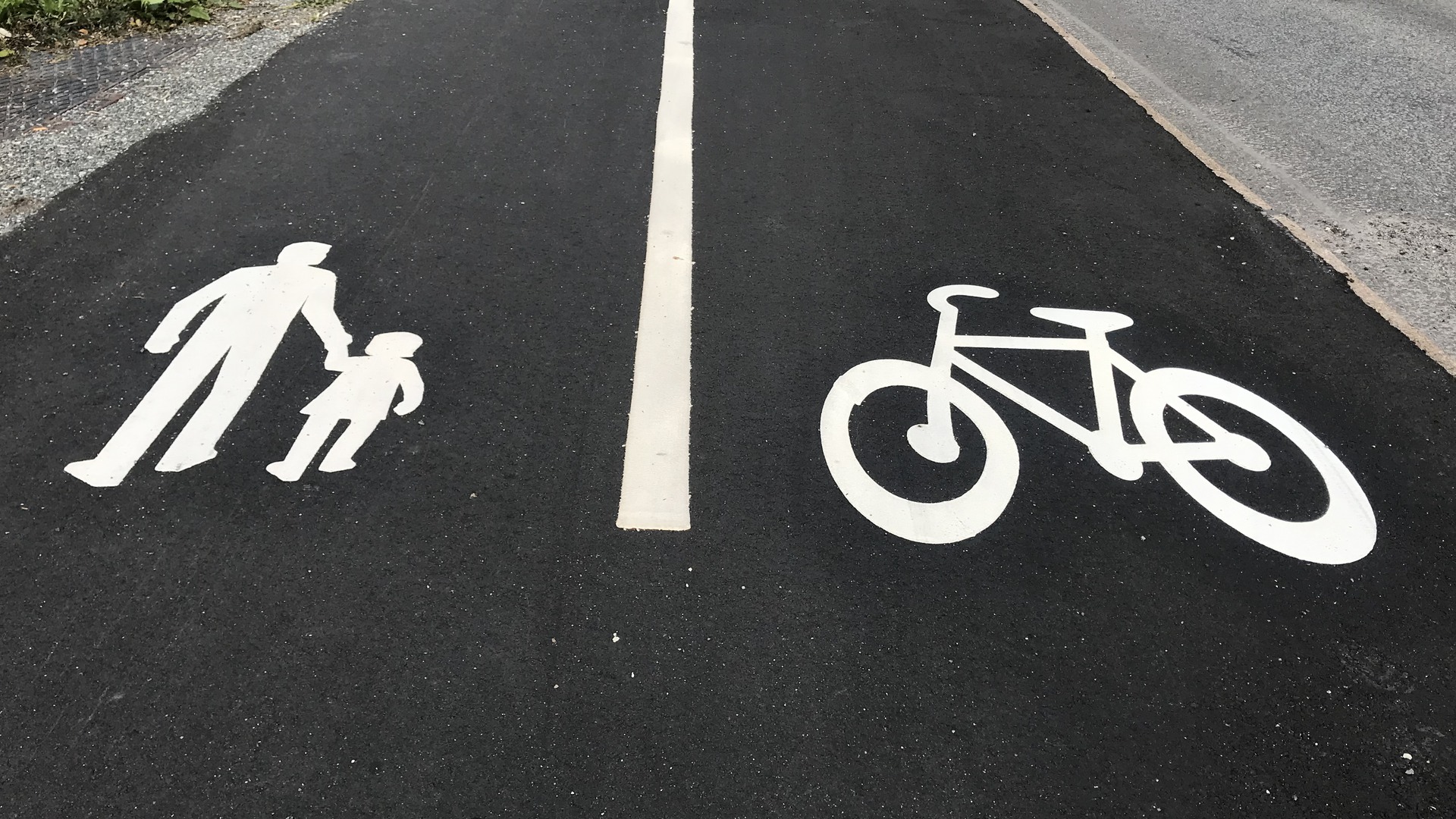
In bigger cities where the foot traffic is high, it's absolutely not possible, in my opinion.
I practice "vehicular cycling" and love being in the road. I also choose routes where I can maintain at least 75% of the speed limit, so lots of 30mph roads.
It's definitely sketchier than the new style infrastructure that's popping up, but it's also way faster. I use a radar and mirror for safety and I keep the speed delta between traffic and myself at a minimum. Only serious injury I've had was getting creamed by an incoming drunk driver at speed.
Best world would be keeping pedestrians, cyclists, and cars all separated for maximum convenience. But failing that, I'd much rather be in a painted bike lane than on a sidewalk.
I am now even more aware and paranoid when cycling but my real solution has to optimise my routes for reduced stress rather than speed or distance - I'll happily take a longer route if I know it's much more chill
Yes
I gave up using my bicycle in the city. It was very good for me, but one mistake and it would be very bad, easily terminal
It is easy to make bicycling safe(r): get rid of the cars
I don't think I've ever seen real suggestions to make a seperated infrastructure grid for pedestrians and bicycles that isn't just a sidewalk or bike lane on an existing road.
That said, can you give specific examples of what you mean by "make car infrastructure worse"? Usually segregation is just a matter of putting a barrier on an existing bike lane and painting lines, which doesn't actually change anything for drivers who stay in the lines. In some cases, a lane may be converted, but this rarely impacts travel times much for the same reasons adding additional lanes doesn't improve travel times. Vancouver did lots of traffic studies on this criticism in particular that you can read if you're interested.
Are you imagining an alternative in which a bike network is added to a city, but not using "existing roads"? Where would these entirely-new roads be placed? Would you knock down the buildings between two car-infrastructure-roads, to pave it for bicycles? I suppose you could remove the car-infrastructure-road entirely and make it just a bike-road / linear park. Or you could put the bike lane underground? Or build a separated-grade elevated parkway network above the city?
[1] https://www.reddit.com/r/bicycling/comments/e0qxxz/we_just_g...
I remain very curious to hear their vision!
This is beyond useless, and is very dangerous as your combining high speed vehicle travel with bikes and pedestrians. The typical response is to then convert the road to a street (e.g. lower the speed limit, reduce lanes, etc) instead of moving pedestrian traffic away from roads. The traffic is still there, because it's the only route, but now you've added the occasional brave and stupid bicyclist or pedestrian.
Beyond that, it's more inefficient for pedestrians, because road layouts tend to follow inefficient directions that add unnecessary travel time for pedestrians.
One time I was going up a hill I've been up and down a million times, only to be shocked to find, after sundown, similar road with a BIKE TRAIL, some person riding their bicycle WITH NO LIGHTS, on a road where you're expected to go 45 (its actually 55 when I googled it!) or more, giving me little time to react, I have NEVER seen someone be so careless on this road, or even ride a bicycle on it, because its not a road for bicycles. So no, it's not just the cars that are dangerous, its the carelessness of bicycle riders that is equally dangerous.
People going to work typically take the most direct route there, which is usually the same road cars take rather than those trails. Thus you see people cycling on the same busy roads you're rushing to work on. That's an urban planning problem and one that I've spent lots of time trying to fix in my own community. In every case it's been held up by people who don't want to spend money on bikes and in one memorable case were worried about a traffic study that estimated an additional 30s worst case scenario for commute length increases.
As for the hill thing, cyclists are not obligated to have rear facing lights in any state I'm aware of, only forward facing. They need to have a rear retroreflector for visibility in most places. These come on all bikes by default and the only way to not have them is to intentionally remove them, which is uncommon. I assume they didn't since you didn't mention it, and I'm also going to assume the road doesn't have a bike lane since you mentioned a bike trail on some similar path instead. In that case, they're probably allowed to be there (though they should have forward facing lights and safety patches for their own sake).
Your responsibility as a driver is to drive at speed where you can identify and safely react to obstacles, including bikes. It sounds like that didn't happen here, but you're blaming someone else for the near miss.
In Florida, my state, they absolutely must:
- A bicycle operated between sunset and sunrise must be equipped with a lamp on the from exhibiting a white light visible from 500 feet to the front and both a red reflector and a lamp on the rear exhibiting a red light visible from 600 feet to the rear.
- A bicyclist who is not traveling at the same speed as other traffic must ride in the designated bike lane or as close as practicable to the right-hand curb or edge of the roadway.
See here:
https://www.flhsmv.gov/safety-center/driving-safety/bicycle-...
Edit also:
At least 24 states require bike lights during certain times of day or in limited visibility conditions, including: Arizona, California, Connecticut, Florida, Georgia, Hawaii, Idaho, Indiana, Iowa, Kansas, and Maine.
It sounds like you live in America in which case I assure you the bike trails you speak of are inadequate to the point that using them is probably less safe than not.
Where are you getting the "expected to go 55" wording from? That's not how laws are written. If you're referring to the speed limit, that's a limit, not a suggestion. Again, telling.
Yes it is the cars that are dangerous, a careless bicycle rider is not capable of harming you in your car in any way.
Cyclists who ride without lights after dark are irresponsible, I'll give you that.
Riding in traffic is an absolute pleasure when you know how to draft vehicles. The suction created by larger box trucks can actually pull you along with minimal effort.
Dedicated bicycle lanes on existing roads are the worst. You are trapped in an area where turning vehicles are going to T-bone you. Pedestrians will tentatively step out on the the asphalt as they ponder crossing the street. Want to swerve around them? Good luck, there are bollards or other barriers now separating the cycling lane from the rest of the larger roadway.
This is why there is a common international driving etiquette to not overtake on the outer lane. Yet, safety maxi city planners, who clearly never pursued cycling at any level, insist upon building dedicated cyclist lanes on the outside. I see many accidents posted as outrage bait on Twitter caused by cyclists attempting to overtake on the outside or being overtaken by cars attempting to turn. As a professional courier, I would have never attempted such maneuvers.
Overtake on the inside, like any other vehicle. Stay behind the brake light on the inside bumper. Be prepared to weave to the inside if the vehicle slows. If you are not keeping pace with traffic, yield to the outside and do not make a pest of yourself. Unless of course there is an immediate intersection, then you should defend against a turning vehicle.
Dedicated cycling lanes have issues and bike trails often do not go to the destinations you need. It is a nice alternative for leisurely cycling, but not applicable utilitarian transportation. I often wonder if the planners of these things have ever used a bicycle to pick up groceries or run errands.
Finally, all of the people crying about how dangerous cycling is, will most likely still complain or find other excuses to not ride their bike. That's fine. I'm not here to convert everyone into a cyclist. Personally, I have no issues sharing the road with cement trucks. "I would start riding my bike to work, if only you built me...", becomes, "It is too hot, cold or rainy to ride bikes" or, "I can't carry groceries on a bicycle, are you crazy?". It is much like the chronically overweight or those who claim they want to quit smoking. These people don't actually want to ride bikes. That's fine, but we shouldn't attempt to accommodate their excuses by wasting money building infrastructure which creates dangerous expectations for motorists and cyclists.
Stated preferences are not always what users want or need.
> Riding in traffic is an absolute pleasure when you know how to draft vehicles. The suction created by larger box trucks can actually pull you along with minimal effort.
Well, I chuckled ;) Just FYI, if you're "drafting" you're probably well within the "if they brake hard, I'm running into them" territory. Proceed at your own risk.
Box trucks are good for beginners because you do not need to be nearly as close. Slightly ahead of the boundary area of the aerodynamic turbulence feels optimal. In dusty conditions you may be able to visually observe this. Also, they generally cannot stop as quickly. Truck drivers know their routes and will more likely hit all of the lights at a uniform speed. You'll more easily hear their motor and gear shifts.
Yes, there are idiots who will try to brake check you, but they are mostly driving cars. A slight turn allows you to pass on the inside. The entire maneuver happens faster than braking. Braking is actually a mistake here, because you can loose traction and the ability to avoid obstacles.
For the rest of your comment, casual cyclists should prefer lower traffic streets and routes. By working incrementally they can build up their comfort levels. Again, the idea that they shouldn't gain the ability to ride in traffic or should have an expectation to never encounter traffic is a recipe for disaster.
It isn't about racing or being the fastest, but learning to cycle, feeling comfortable, interacting with traffic safely and not making a pest of yourself. That can only happen with the right set of expectations. Separate infrastructure doesn't help novices develop the necessary skills.
Then I think you've never met a cyclist. As in actually riding a lot, not as in owning a bike and having occasionally achieved the balancing act. I know enough cyclists to hear about someone getting hit by a car multiple times a year and a large majority of those cases are getting hit in intersections (and in interactions with driveways) while traveling on "separated" bike infrastructure. Because the reality is that it's never really separated, intersections do exist. That "separated" infrastructure? It's merely out of sight out of mind for the drivers. Which would be an effective strategy if your goal was to maximize accidents. Those people who keep getting hit on separate bike lanes? They already make bike lane avoidance a factor in their route selection and yet still most of their hits happen on the small subset of their miles that are on "separated" infrastructure, not on the many, many miles done in the lane.
Yes, some separated bike infrastructure feels nice to use. And a subset of that even happens to not be inherently dangerous. But that's only where that is easy to do. Yes, on an high traffic road that is so close to limited access design that it's always miles per instead of intersections per mile, yes, a well-built bike lane is nice. Even when it's separated. But those that keep cruising side streets, driveways and the like? They are dangerous thrill courses hated by all cyclists but a tiny minority. The tiny minority that sees themselves more like pedestrians who happen to sit while while almost walking than like actual cyclists.
And yes, I know the Netherlands exist. Safety in numbers can move the threshold and the exact same bike infrastructure that would be a bone-crushing through thrill course under little use can become quite tolerable when it's used so much that "out of mind" can never happen. But until you get there, prefer building better bike infrastructure over building more. And better means about separation except where it's for beyond the slightest doubt.
Sure, but there’s nothing we can do about the ground
And with great power comes great responsibility.
I’ve been honked for waiting for a safe way to pass a cyclist. The car behind me then just zooms past the cyclist after I make a manoeuvre. It’s not like all driver are out there trying to be responsible as much as possible.
That means going more to my left (but not to much as to leave enough space on my right), turning a little (the car takes a little more space) and even turning on the turning signal (not the parking signal)
They get pissed (the cars. Walking Grandmas wave at me to greet me), so I hope I don't get shot at some point.
Here's one example:
From WSDOT:
> Pass at a safe distance. Leaving an extra safety buffer in time and space when passing people gives you more ability to see and react, and it’s also the law. Be aware that a bicyclist needs to be positioned in the lane a safe distance away from opening car doors, grates, and other hazards not visible to a driver. Drivers need to move into the other lane when possible or leave at least three feet while passing (RCW 46.61.110). Darkness and weather conditions may affect a driver’s ability to gauge distance.
In all of the places that I have commuted as a cyclist the rule is that cyclists are to ride “as far to the right as is practicable” or similar. Meaning the lane positioning is for the cyclist to be as far to the right as they judge is ‘practicable’, not as far to the right as is possible. Sometimes it is not ‘practicable’ to be on the shoulder or in the right side of the lane.
Source?
It's rare that riding on the side is viable. Easily 90%+ of drivers do not know when and how to pass a cyclist so I have to play babysitter and manage their behavior by positioning myself appropriately.
While stopped, I watched not one, but fifteen freaking cars proceed through the crosswalk without stopping...in a 15 mph speed zone..with a giant box truck stopped in the opposite lane waiting...with flashing lights that clearly indicate tou are required to stop. I was absolutely blown away.
Then there's the seeming 3/4ths of drivers who don't look straight in front of them when they start driving to make a right turn when waiting for a gap in traffic. I've put dents (deliberately) in several of their hoods since I watch for this like a hawk and am ready to yell and smack their hood as soonnas they start moving. I've had them yell at me when it was my fault for not making eye contact, when I literally watched their eyes the entire time I approached and they never once moved them from staring left to see if there were pedestrians.
I don't understand why dangerous driving gets so little enforcement and why the penalies are slaps on the wrist. Let's revoke licenses and confiscate cars.
If that's the case, then so long as most of the economy needs tons of replaceable, underskilled, underpaid drivers IN ADDITION to virtually everyone requiring a car for basic autonomy in most of the country, i see perfectly why there'd be so little enforcement -- it's just perhaps very cynical.
> You could say that jumping out of a plane without a parachute isn't dangerous, it's the ground that's dangerous.
In that metaphor cars are a force of nature. I've also heard "the laws of physics trump the law of man", and "what's more important: being right or being alive". People choose to drive; people choose to cycle; and people choose to walk. When I choose to drive, I have the means to kill someone else and I'm damn well responsible for that risk. After all, the person I hit didn't choose for me to drive.
I agree, and part of my GP point was, I think almost every driver agrees, even in different words: Drivers are very adverse to hitting humans, whether walking or biking.
I don't have evidence, but let's not imagine people are the sociopaths they claim to be on the Internet.
When I bicycle commuted in the city, I had about one incident a week of a driver close passing or cussing me out. In one incident, a driver revved their engine at me and followed me home because I reminded them that they had to give three feet of space when passing. I thought I was going to die when they went for their glovebox. If I ever cycle commute again, it will be with a concealed weapon.
In other contexts, using violence for political ends would be called terrorism. On our roads it's just another day.
There is a whole industry dedicated to selling cameras and warning radar for cyclists because driver attacks are so common in fact.
Every serious cyclist I know has a few stories. One of mine includes a passenger leaning out of a car trying to put a plastic bag over my head.
Another has a builder stop his van to threaten me with a claw hammer.
These days I have cameras too.
I know plenty of cyclists. While some have had accidents with cars, some drivers have driven away rather than face the consequences, I've never heard these stories of naked aggression. I've heard of the occasional argument, but often a self-righteous cyclist is involved.
I know what I know from first hands experience.
I don’t think that anything I could have possibly done could be self-righteous enough to justify the actions of those involved but that’s just my opinion.
To be clear, I'm not talking about mistakes. There's 10x more of those. I'm referring to just people taking dangerous actions with no regard for the safety of anyone.
I think that is the leading cause of road rage and the disregard drivers have towards pedestrians and cyclists.
I don’t have the inclination to look but I’d put good money on statistics showing a negative correlation between enforcement of driving offences against cyclists and cyclist deaths or injuries.
Drivers have very much at stake. They could be accused, tried, and possibly convicted of homicide, and even the first two can dramatically change lives. And nobody wants to kill someone, and live with that trauma for the rest of their lives, and always be known as someone who killed.
Analogously: Since the the election, I've seen endless people blaming Biden, 'the media', etc etc. The only one I'll take seriously is the person who says: 'I failed; I should have done better.'
I vividly remember exactly the circumstances of each.
Most involve me riding as far to the right as practicable while someone driving a car hits me from behind, or quickly passes and does a right hook.
My favorite was the national parks employee who was drunk driving in Yosemite and hit me from behind. I'd love for you to explain how that one was my fault.
Which is why infrastructure in cities should not mix cyclists and cars. That is the real reason why cycling is safer in the Netherlands with separate bicycle paths and bicycle traffic signal.
And no, I’m not going to accept statistics showing a small town in the middle of nowhere is safer. It’s self evident that you’ll not get run over in a place where there are no cars to run you over.
You can say more people cycle in Netherlands but then a lot of people cycle in Spain or Northern Italy as well and those are more populous countries/regions. It's just very hard to get data that include all factors but the data we do get is not so good for Netherlands.
I have cycled in many EU countries and in many areas of those as well. I am 500+ hours on the bike throughout the year and talk to a lot of people who do the same. This is experience worth more than some stereotypes about Netherlands being good for cyclists or whatever. What is good for cyclists are drivers who are careful, don't speed and respect your right to be on the road. This is why Spain doesn't have as many cycling deaths even though tons of people cycle there. It would be even more apparent if you split Spain into regions. Same with Italy (North is good, South not so much).
Poland gets quite a bit of cycling infrastructure now (because that's the only way to get EU funding for roads for cars - what the government really wants). The infrastucture is terrible and dangerous. People die and get hurt because of it every day. It would be much better to just change the law to: "cyclist can be on the road whenever they please and can take the lane when they think it's for their safety".
Now when you have both the data and words of someone who is actually experiencing it every day are you willing to reconsider?
No because the data has a gaping hole: it records cyclist deaths per capita, not cyclist deaths per cyclist.
The UK looks “good” but cyclist uptake is like 1% compared to Dutch uptake which is FAR MORE than 1%. You expect more people to die doing a thing if more people do a thing. Dutch cyclists are also more common than Spanish cyclists, again so you’d expect to see higher numbers.
There’s no breakdown by country and by other party involved in there. Just separate charts, so you can’t say more drivers are running over more cyclists because it’s just not in the data.
Also, I’ve experienced cycling in different European countries and you don’t need 500 hours to see the stark difference between countries that get it and countries that don’t.
> The infrastucture is terrible and dangerous.
This doesn’t surprise me, most countries are shit at it.
> It would be much better to just change the law to: "cyclist can be on the road whenever they please and can take the lane when they think it's for their safety".
This is the law in the UK. Read some Twitter threads and you’ll see drivers don’t appreciate it. The only thing keeping us safe is cameras with good police enforcement.
First of, the statistics you point to are terrible. It's not the first time I've seen EU statistics on cycling be utterly incompetent either, it's weird.
Anyhow:
"Although there are no data available at EU level on the trend in cycling kilometres travelled, it is widely recognized that cycling has increased in popularity over the past decade."
There you go, the entire dataset is invalid.
As a curiosity, please point your attention to the graph of the distribution of fatalities over age categories.
> It's just very hard to get data that include all factors but the data we do get is not so good for Netherlands.
The data is easily accessible and robust: [1] [2].
> This is experience worth more than some stereotypes about Netherlands being good for cyclists or whatever.
Relatively to basically everywhere else, the Netherlands is good for cyclists. That's a fact, not a stereotype.
> Poland gets quite a bit of cycling infrastructure now (because that's the only way to get EU funding for roads for cars - what the government really wants). The infrastucture is terrible and dangerous. People die and get hurt because of it every day. It would be much better to just change the law to: "cyclist can be on the road whenever they please and can take the lane when they think it's for their safety".
If the infrastructure is terrible, the solution is to make it not terrible. Changing laws is a lazy, ineffectual cop-out. It is always more effective to change the infrastructure. Regular people are not going to be cycling amidst vehicles.
---
[1]: https://english.kimnet.nl/publications/publications/2023/11/...
[2]: https://bicycledutch.wordpress.com/2024/03/06/cycling-safety...
Changing the infrastructure is very hard though. Changing laws so car drivers doesn't feel entitled to the road or feel justified committing violence towards cyclists is easy. It just requires political will.
But that the comparison seems apt is pretty endemic of how cars are treated: an absolute must, as if they were a force of nature.
Never mind that a huge chunk of our population can not drive, and are therefore excluded from society by cars. Car dependency is a very exclusionary way to build a town. (Note that there is a difference between allowing cars, and car dependency. Making cars the only permissible way to navigate is car dependency. And it's possible to allow car travel without forcing car dependency, but it requires work and is not the default in the US)
Ambulances aren't though. Same with delivery vehicles. Public transport is, but typically one associated with less cars.
All of these are both dangerous to cyclists and essential in a functioning city.
Last year in my neighborhood we had a cyclist die from making a sharp left turn straight into a tram. It was a track x cycle lane intersection and between the tracks and cycle lane parallel to it from which he turned there's a strip of pavement, so unless you really cut that turn, the tram should be in your field of vision.
Also there's a yield sign for cyclists, but obviously that didn't work.
But I would rather restrict cycling than trams, as the latter perform a valuable service.
He got up and rode away with no explanation.
people forget that cyclists can also get off their bikes and push them along like pedestrians. just put a big sign, and if needed, post a policeman with a ticket book. or make the pavement bumpy enough and they'll get off voluntarily.
All that's needed is for city infrastructure designers to take into account the existence and needs of cyclists. An impossible challenge for 99% of them, sadly.
On one long bridge here, pedestrians and bikes have dedicated roads, on the opposites sides. I regularly see bikers use the sidewalk side, and the same with pedestrians on the biker side; neither is "fun" nor safe. I've actually been yelled at by a biker on the pedestrian side for not noticing him zipping by me... ¯\_(ツ)_/¯ Elsewhere, I regularly see people walking in the middle of the bike lane, where it's a mixed use sidewalk. The road is clearly marked, yet these people are walking there, playing chicken with each cyclist, on purpose.
The reality is that these people are a fairly small minority, but we tend to notice them. So, I wouldn't make blanket statements.
I did not do anything to put said pedestrian cunt at risk. the shared path was wide enough for 5 people, and I passed far enough away from them that I was in no danger of hitting them. I also passed them at barely over walking speed, because I always slow down when passing potentially inattentive creatures.
he, like you, assumed too much and make a fool of himself.
I'm paranoid though and just assume hostile intentions. I slow down to walking speed or even just stop until I'm certain they're clued in.
Are you serious? How can you say that? Cars are, by themselves, much higher risk than bikes. If bikes are dangerous at all is because of cars. The main--heck, I'd say the only--spreaders of dangerosity are cars. In a car-free city, none of the main causes of premature death would be traffic-related.
And we can have ambulances (or not have them!) with or without car-dependent infrastructure. It turns out that non-car-dependent areas also have ambulances and get people to medical care quickly.
And we could get rid of ambulances and even still keep rapid emergency response by having mobile doctors distributed close to people.
Plus, ambulances are not dangerous to bicyclists. Come on. The danger is distracted drivers without blaring sirens on top of them.
Saying "we" in this context assumes you have political power.
It's all there in the public record, easy to find.
All the decisions are politics by definition.
In nearly all of the US it is literally illegal to build out infrastructure with out prioritizing cars and car infrastructure over everything.
This was a political choice that we made, as we do live in a representative democracy.
You must not be riding your bike a lot then. Most recently I had a guy follow me around and threaten to get his gun if I didn't get off the road
I mean you can say that but it's as believable as shooting your rifle without looking in general direction of a crowd of people and then saying you really didn't mean to shoot anyone.
We don't, and cyclists will get nowhere until they take responsibility and stop acting like victims. Everyone who drives around cyclists sees how badly many of them act - on average, IME, much worse than drivers.
It can't really be clearer.
>>Everyone who drives around cyclists sees how badly many of them act - on average, IME, much worse than drivers.
I am sorry but you are just so biased you can't tell black from white. Car drivers speed, don't pay attention, are on the phone all the time. Your view is so far detached from reality is like saying water isn't wet. Again, we have stats, we know who dies, we know who causes more danger. Cyclists and pedestrians are victims of careless drivers every day. You are just spewing complete nonsense that if repeated makes people less safe.
Nice, dude.
As a cyclist I don't think this is completely true. I've been in cars with drivers who do dangerously close passes on cyclists and the common excuse is "oh I just want to scare them" or similar.
So while I guess it's technically true that even these drivers don't technically want to hit the cyclist the distinction is somewhat moot.
On at least two occasions, I've had cars purposely try to hit me when I was skating. I know it was on purpose because in one case the driver said "you're not a vehicle" as he came within inches of hitting me, and in another case the driver, completely unprovoked, began cursing loudly and tried to run me off the road.
You might argue that the first one didn't actively "want" to hit me, but he certainly wouldn't have cared if he did.
> Cars and bikes don't mix except when cars are going bicycle speed.
I wouldn't want to get hit by a car going 15 mph. Or even 1 mph. So I would say cars and bikes don't really mix at all, especially since many drivers are either actively hostile to bikers and skaters, or indifferent about hitting them.
Agreed, f=ma and the car has 10x the mass of you and your bike.
I meant that if they are moving at the same rate then accidents are much less likely. Even when it's just cars and no bikes, if most cars are moving at 80 km/h then a car moving at 20 km/h creates much higher risk of accidents.
> But every one want to get ahead of traffic
They should get a bike! :)
Stats in the UK show that the majority of car/bicycle collisions are due to driver error, not cyclist error. Given the USA standard of driving is much lower, and policing is much less consistent, I’d put good money on that being higher in the USA.
> Cars and bikes don't mix
Yes but you’re looking at the wrong category of people making the mistake.
The cyclists have a better understanding and overview of the trafic sittuation so from the car drivers view it looks like they take bigger risks.
"Cyclists make mistakes, make bad judgments, take big risks, JUST LIKE CAR DRIVERS."
Why would Homo sapiens on bicycles be any less prone to error or negligence or aggression than those in automobiles? Often, the same person does both (at different times)!
For a few very obvious reasons:
1. Cars have significantly less visibility. Often cars run into other cars at speed without having ever even seen them. Now imagine bicycles.
2. Cars are much faster, so mistakes are amplified. Often with cars you're forced to commit to bad decisions because you're simply too fast to abort.
3. Cars are much more powerful, which may bring aggression in people. This is opinion but from my life this is plainly true with everything. The more perceived power something gives a person, the more prone to aggression that person is.
There are many more cars, and bike accidents don't tend to kill people.
That's all exaggerated, but generally I agree. Also bikes are silent, hard to see, especially among cars or at night ...
There are advantages and disadventages to all technology, and it's not a genuine analysis unless we look at them all.
Poor choice of synonym.
But true, the system is very badly 'designed' in lots of places. Mostly where they just wanted to pretend having a system, but not really putting the efforts into (e.g. UK and its 'making bicycle infrastructure by lines painted on pavement' attitude)
Your analogy is car brained and bad.
I live in germany and have an extremely safe bike commute.
I would not commute by bike in the US tho
Spend any time at all on social media and you'll see how untrue this can be. If you think people are lying about their daydreams of assaulting cyclists, just go on YouTube for days of content of drivers swerving at cycliste, throwing things at them, dumping pollutants into their lungs, intimidating them, assaulting them, and more.
So indeed, drivers complaining about cyclists is a joke. In the event of any sort of a collision with a car at all it's the cyclist that loses. Always.
Cyclists make mistakes, make bad judgments, take big risks, just like car drivers. They are human too. You could say cyclists have a bigger incentive to avoid problems, but no driver I know wants to hit someone and injure them, and cyclists I know become inured to the risks after riding for years without injury - it seems to me that human attention loses focus unless something reinforces it; as a result 1 in 1,000 risks are very hard to focus on.
Cars and bikes don't mix except when cars are going bicycle speed. If your system kills people when they make a mistake, your system is very badly designed.