Anyway, while I see all of your points, none of the things I've read in the news make me excited. Recapping meetings or long emails or suggesting how to write are just...not major concerns to me at least.
Microsoft seems to have lost all internal cohesion and the ability to focus the entire company in one direction. It's just a collection of dozens of small fiefdoms only caring about hitting their own narrow KPIs with no overall strategic vision. Just look at the mess of competing interest that Windows 11 and Edge have turned into.
Visual Studio Code, appears to be a code editor with support for C, C#, C++, Fortran, Go, Java, JavaScript, Node.js, Python, Rust, and Julia
Visual Studio, appears to be a code editor with support for 36 languages including C, C++, C++/CLI, Visual Basic .NET, C#, F#, JavaScript, TypeScript, XML, XSLT, HTML, and CSS.
Visual Studio Code, appears to be liked by almost every user and the favorite in a bunch of online polls.
Visual Studio, appears to be unusable junk, widely hated in almost every survey, and unable to even display its own error messages correctly in 2022.
Visual Studio Code is supposedly a "related product" according to Wikipedia: https://en.wikipedia.org/wiki/Visual_Studio#Related_products
How are these related? They seem like Microsoft's internal fiefdoms again.
It's a traditional windows application. .net/WPF I think. Configured via XML
VSCode is free, an electron app, has a plugin store with lots of niche language plugins. Configured via json.
Surely they're using VSCode to exert influence in their Microsofty way, but it feels much less like a prison.
VSCode still feels like a bit much to me (though of a monster than Visual Studio). I'm pretty happy with helix.
Quick, what’s “copilot”?
they are irrelevant on the mobile ecosystem, a place where almost all this features are most relevant and useful
https://crmtipoftheday.com/wp-content/uploads/2017/07/ms-org...
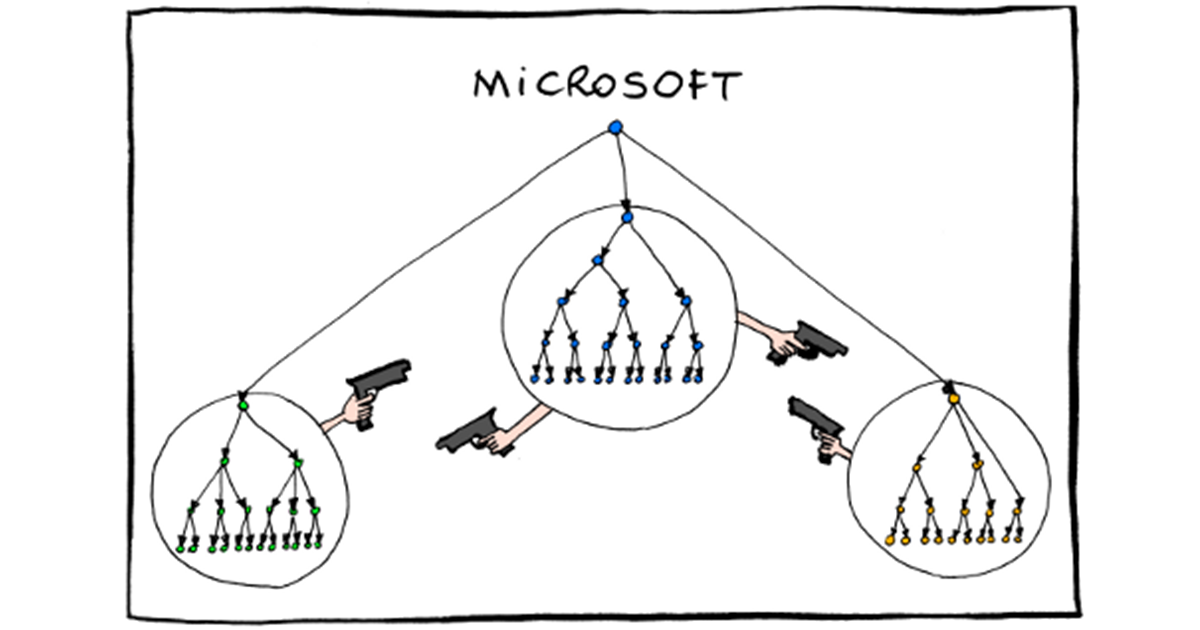
As a(n amateur) fiction writer who pays too much for ProWritingAid each year, I'd love to see if this feature is any good for fiction. I take very, very few of PWA's AI-suggested rewrites, but they often help me see my own new version of a bit of prose.
Like what's going on inside Google, it's getting stupidly political and infighty. If someone tries to build a comprehensive LLM that touches on gmail, youtube, docs, sheets etc, it's going to be an uphill battle.
None of them would work on-device, all would leak your data into the training set.
It showed you contextual cards based on your upcoming trips/appointments/traveling patterns. E.g. Any tube delays on your way home from work. How early you should leave to catch your flight.
This alongside Google Inbox was among the best and most "futuristic" products.
I was glad to see today Apple implementing something similar to both of these.
No wonder they killed it.
There'd be constant sabotage.
Lots of middle management power groups that would prevent a cohesive top down vision from easily being adopted.
Make no mistake, Google is Enterprise.
The more I spend time in mid-large companies, the more I'm amazed that that Apple somehow managed to avoid releasing three different messaging apps that do the same thing.
Your quote really hit me. I trust Apple to respect my privacy when doing AI, but the thought of Microsoft or Google slurping up all my data to do remote-server AI is abhorrent. I can't see how Microsoft or Google can undo the last 10 years to fix this.
Apple is very intrusive. Macos phones home all the time. ios gives you zero control (all apps have internet access by default, and you cannot stop it)
Apple uses your data. you should be able to say no.
And as for your data, they do other things too, a different way. Everything goes to icloud by default. I've gotten new devices and boom, it's uploading everything to icloud.
I've seem privacy minded parents say no, but then they get their kid an iphone and all of their stuff goes to icloud.
I think apple should allow a personal you-have-all-your-data icloud.
I don’t think any large tech company is morally good, but I trust Apple the most out of the big ones to not do anything nefarious with my info.
Their privacy stories are marketing first.
Google and Samsung do.
They went from “Don’t be evil” to a cartoonish “Doctor Evil” character in a decade.
I trust Apple about as far as I can throw them too. They are inherently anti-consumer rights everywhere in their ecosystem. The "Privacy" angle is just PR.
None of the big companies expressly sell your information. Not because they are altruistic, but because it is an asset that they want to protect so they can rent to the next person.
So in other words, "companies operating within a nation are expected to abide by the laws of that nation"?
Apple structures their systems to limit the data they can turn over by request, and documents what data they do turn over. What else do you believe they should be doing?
Much like every other tech company you test the request.
Apple never does.
Citation needed?
Just about everyone else other than the tech companies are actually selling your data to various brokers, from the DMV to the cellphone companies.
First-hand account from me that this is not factual at all.
I worked at a major media buyer agency “big 5” in advanced analytics; we were a team of 5-10 data scientists. We got a firehose on behalf of our client, a major movie studio, of search of their titles by zip code from “G”.
On top of that we had clean roomed audience data from “F” of viewers of the ads/trailers who also viewed ads on their set top boxes.
I can go on and on, and yeah, we didn’t see “Joe Smith” level of granularity, it was at Zip code levels, but to say FAANG doesn’t sell user data is naive at best.
So you got aggregated analytics instead of data about individual users.
Meanwhile other companies are selling your name, phone number, address history, people you are affiliated with, detailed location history, etc.
Which one would you say is "selling user data"?
2) I have run macOS VMs without iCloud. I'm not sure of the nags though. I believe signing out of iCloud will prevent iCloud from contacting Apple.
2) that is entirely NOT true. You should install little snitch and see what happens even if you NEVER sign into icloud. note that the phone home contact is not immediate, it happens in the background at random intervals from random applications.
just some random services blocked by little snitch on a mac:
accountsd, adprivacyd, airportd, AMPLibraryAgent, appstoreagent, apsd, AssetCacheLocatorService.xpc, cloudd, com.apple.geod.xpc, com.apple.Safari.SafeBrowsing.Service, commerce, configd, familycircled, mapspushd, nsurlsessiond, ocspd, rapportd, remindd, Safari, sntp, softwareupdated, Spotlight, sutdentd, syspolicyd, touristd, transparencyd, trustd, X11.bin
(never signed into an apple id)
Doesn't have to be bright red, or even there at all.
There's also this one: https://discussions.apple.com/thread/250727947
I eventually just gave in to stop the nags.
Technically you can by turning off wi-fi and disabling cellular data, bluetooth, location services, etc. for the app.
To your point though, wi-fi data should also be a per-app setting, and it is an annoying omission. macOS has outgoing firewalls, but iOS does not (though you could perhaps fake it with a VPN.)
> Apple uses your data.
> they do other things too, a different way
What specifically do you mean? Their frankly quite paranoid security and privacy white papers are pretty comprehensive and I don’t think they could afford to lie in those.
> Apple should allow a personal you-have-all-your-data iCloud
Advanced Data Protection[0] applies e2ee for basically everything, with the exception email, and doesn’t degrade the seamless multi-device experience at all. For most people this is the best privacy option by a long shot, and no other major platform can provide anything close.
They’ve hampered product experience for a long time because of their allergy against modelling their customers on the cloud. The advent of AI seems to have caught them a bit off guard but the integrated ecosystem and focus on on-device processing looks like it may pay off, and Siri won’t feel 5 years behind Google Assistant or Alexa.
A couple of years ago Apple was busted when it was discovered that most Apple first-party apps weren't getting picked up by packet sniffer or firewalls on macOS.
Apple tried deflecting for a while before finally offering up the flimsy claim that it "was necessary to make updates easier". Which isn't a really good explanation when you're wondering why TextEdit.app needs a kernel network extension.
The user-mode replacement APIs allowed by sandboxed apps had a whitelist for Apple's apps, so you couldn't install some App Store firewall app that would then disable the App Store and screw everything up.
After the outrage, in a point release a few months later, they silently emptied out the whitelist, resolving the issue.
They never issued any kind of statement.
That makes no sense.
Even if it did, the app the would need protection is the App Store, not every single Apple app. In many cases, the fix for the worst case scenario would be "remove firewall app".
Also, given that TextEdit was not an AppStore app, for but one example, but a base image app.
> They never issued any kind of statement.
Shocking. I've had at least two MBPs affected by different issues that were later subject to recall, but no statement there. radar.apple.com may well be read by someone, but is largely considered a black hole.
The platform is heavily internet-integrated, and I would expect it to periodically hit Apple servers. There are a lot of people claiming to be security researchers reporting what Little Snitch told them. There are drastically fewer who would introspect packets and look for any gathered telemetry.
I really haven't seen evidence Apple is abusing their position here.
> Everything goes to icloud by default. I've gotten new devices and boom, it's uploading everything to iCloud.
You need to enable iCloud. You are prompted.
Also, a new device should have next to nothing to upload to iCloud, as its hard disk is still in the factory configuration.
> I think apple should allow a personal you-have-all-your-data iCloud
They have desktop backup. Maybe they should allow third party backup Apps on iPhone, although I suspect data would be encrypted and blinded to prevent abuses by third parties, and recovery would be challenging because today recovery is only possible on a known-state filesystem. The recovery aspect is what really has limited it to the handful of approaches implemented directly by Apple.
Ouch. That's literally a painful thing to read.
But hey, the computer wants you to be happy. Happiness is mandatory.
I'm actually a little gobsmacked anyone on this forum can type those words without physically convulsing.
The even more terrible part is I'm sure it's common. And so via network externalities the rest of us who do NOT trust any of these companies on the basis that all of them, time and again, have shown themselves to be totally untrustworthy in all possible ways, will get locked into this lunacy. I now can't deal with the government without a smartphone controlled by either google or apple. No other choice. Because this utter insanity isn't being loudly called out, spat upon, and generally treated with the withering contempt that these companies have so richly and roundly earned this decision is being made for all society by the most naive among us.
Rather, I think they meant "trust" as in "Apple is observably predictable and rational in how they work toward their own self-interest, rarely doing things for stupid reasons. And they have chosen to center their business on a long-term revenue strategy involving selling high-margin short-lifetime hardware — a strategy that only continues to work because of an extremely high level of brand-image they've built up; and which would be ruined instantly if they broke any of the fundamental brand promises they make. These two factors together mean that Apple have every reason to be incentivized to only say things if they're going to mean them and follow through on them."
There's also the much simpler kind of "trust" in the sense of "I trust them because they don't put me in situations where I need to trust them. They actively recuse themselves from opportunities to steal my data, designing architectures to not have places where that can happen." (Of course, the ideal version of this kind of trust would be a fully-open-source-hardware-and-software, work-in-the-open, signed-public-supply-chain-ledger kind of company. You don't get that from Apple, nor from any other bigcorp. Apple's software is proprietary... but at least it's in your hand where you can reverse-engineer it! Google's software is off in a cloud somewhere where nobody can audit changes to it.)
They are anti right to repair & they have their walled garden on their mobile devices. Their vertically integrated model also leads to unusually high prices. This website in particular would also directly feel the pain of Apple killing apps to implement themselves later, the greedy apple store cut and also not allowing use of hardware features that Apples themselves can use. Consumers feel this indirectly (higher prices, less competition).
Also, don't get it twisted, Apple is still collecting all of your data, even if you ask them not to [0].
0 - https://mashable.com/article/apple-data-privacy-collection-l...
Their vertically integrated model leads to very good customer service. I don't pay extra for Apple Care and I still get treated like an adult if I show up to an Apple Store with some need.
Even when Apple makes a mistake and collects more data than they should, I don't expect that data to influence ads that I see or to be sold to the highest bidder. (As a developer myself, I find that I can be quite lenient on app internal telemetry.) I can also see that ad review is barely a small side hustle to them in their Quaterly Reports and I can also see that most of their ad revenue is from untargeted campaigns. (Microsoft is a bigger ad company than Apple. Google is an ad company deep into its DNA at this point with everything else a side hustle.)
There is a beauty to a well maintained walled garden. Royalty invested a lot of money into walled gardens and Apple maybe doesn't treat you exactly like royalty, but there's a lot of similar respect/dignity there in their treatment of customers, even if they want you to trust them not to touch the flowers or dig below the walls too much. They want you to have a good time. They want their garden to be like a Disney World, safer than the real world.
You may not appreciate those sorts of comforts and that's fine. Plenty of people prefer the beauty and comfort of a walled garden than the free-for-all of a public park (or the squatter's rights of an abandoned amusement park if you don't mind playing unpaid mechanic more often than not). There's a lot of subjective axes to evaluate all of this on.
You should temper your expectations: https://gizmodo.com/apple-iphone-france-ads-fine-illegal-dat...
France’s data protection authority, CNIL, fined Apple €8 million ... for illegally harvesting iPhone owners’ data for targeted ads without proper consent.
If ads are a small percentage of Apple's quarterly reports, that isn't sound reasoning; after all, they make a lot of money in general in a lot of areas.
Fundamentally, ads is an incredibly high margin business with lots of room for growth (particularly when you own the platform and can handicap your competitors) so over time, all tech companies will become ads companies.
I don't think this applies to their watch or tablet business where the limiting factor on lifetime in the market is security/os updates. Most alternatives in that space have significantly worse support cycles.
This used to be true of their phones as well, but the android market seems to be catching up in ways that tablets/wearables have not (see google's 7 year commitment for pixels).
Not sure if it applies to general purpose. Certainly there are non mac computers that we can throw linux on and use for 10+ years and there are examples of apple laptops getting cut off earlier than I'd like (RIP my beloved 12" macbook), but there are often some pretty serious tradeoffs to machines older than 7 years anyway. Also, I'm not sure if apple's strategy re: support lifecycles on products after the AS migration have shifted. It wouldn't surprise me if the first gen m1 products get 10 years of security updates.
We have different ideas. That’s all. There’s no need to look down on each other for it.
Going back to a Linux desktop would be the end of me. I know it.
The one exception I made recently was to dump Windows and move to a Fedora immutable build after seeing how capable the Steam Deck (and Linux) was for all the games I play. I’ll get shot of that if it causes me grief though - or just stop playing games on my PC.
I just don’t have the energy to mess about with it all these days and Apple is the 2nd best option in lieu of that.
I did have a ton of issues with NVidia in the same environment, but after putting a Radeon card in it has been smooth sailing. That’s to be expected I guess.
I doubt I would have tolerated this even a few years ago though and would have ended up like yourself with a dual boot setup.
...is a thing I experience on a regular basis (and that I only really gained confidence in once I actually saw the mistakes cause problems, e.g. password managers)
Ah yes, blame the simple-minded plebes who foolishly cast their noses up at Windows Phone. If only Ballmer were still in charge, surely he'd have saved us from this horrible future of personal, privacy-respecting AI at the edge...
Sorry, but this seems like a very vague claim to me. Can you specifically point out a time where Apple proved itself untrustworthy in a way that impacts personal privacy?
When Apple says they treat my data in a specific way, then yes I do trust them. This promise is pretty central to my usage of them as a company. I'd change my mind if there was evidence to suggest they're lying, or have betrayed that trust, but I haven't seen any, and your post doesn't provide any either.
Here's a few pointers, to get you up to speed [1-5]. Of course there's nothing wrong with monetizing their own user base and selling ads based on their 1PD (or, in the case of Safari, monetizing the search engine placement). But I find it ironic that they make a ton of money by selling ads based on the exact same practices they demonize others for -- user behavior, contextual, location, profile.
[1] https://searchads.apple.com/
[2] Apple’s expanding ad ambitions: A closer look at its journey toward a comprehensive ad tech stack - https://digiday.com/media-buying/apples-expanding-ad-ambitio...
[3] Apple’s Ad Network Is The Biggest Beneficiary Of Apple’s New Marketing Rules: Report -- https://www.forbes.com/sites/johnkoetsier/2021/10/19/apples-...
[4] Apple Privacy Suits Claim App Changes Were Guise to Boost Ad Revenue - https://www.hollywoodreporter.com/business/business-news/app...
[5] Apple is becoming an ad company despite privacy claims - https://proton.me/blog/apple-ad-company
Advertising isn't anti-privacy. Apple's fight was with tracking by third parties without user knowledge or consent. That is independent of, but often used for, advertising purposes.
This is different from say Google determining ads on Youtube based on what you are watching on Youtube.com, and from Amazon or Apple promoting products based on your product searches solely within their respective stores.
Advertising works much better when there is no privacy.
I hope this current fad dies and people return to that older marketing "common sense". Over-targeting is bad for consumers and bad for advertisers, the only people truly benefiting seem to be Google and Meta.
His current state really has made me think about my own tech, about what should be locked down and what really should not be - things that we lock down out of habit (or by force) rather than out of necessity.
Might be interesting if companies offered the ability for someone to be a “steward” over another when it came to sensitive choices (like allowing new logins, sending money, etc). Of course that itself is a minefield of issues with family members themselves taking advantage of their elderly members. But maybe power of attorney would have to be granted?
Rather than putting all of our personal data and accesses under a thick virtual fire blanket, perhaps it is perfectly fine if some of it isn't protected at all, or is protected in ways that could be easily circumvented with just a tiny bit of finagling.
This is now how I'm approaching my own digital foot print, that some not secret things are nowadays wide open, unencrypted and you just need to know where to look to access all of it.
There is sometimes a point to inconvenience in that it requires time and assessment.
For most people the only security they need is actually access to their money, everything else is mostly irrelevant, nobody really cares about weird habits or whatever.
Do they though? Battery performance that 'lies' to you intentionally, planned obsolescence, locked in ecosystems, overtly undercutting the alternatives, marketing that hypes up rather bland features...I admit I don't see your point.
Apple, if anything, seem about as user hostile as Microsoft is these days.
Everything is relative. Apple generally supports their devices with OS updates for longer than most Android phone makers. Their incentives here are well aligned: they get a decent profit from Apple Store no matter how long you use their phone.
I think a lot of the reporting on Apples actions is very click-baity and lack nuance. Take the case when Apple throttled CPU performance of their phones when the battery got old and degraded. It was reported as a case of planned obsolescence, but it was in fact the exact opposite: by limiting the power consumption of the CPU they avoided unexpected phone shutdown due to battery voltage going too low during bursts of high power consumption. A phone that randomly shuts down is borderline use-less. A phone that is slower can at least be used for a while longer. Apple didn't have to do this. They would have spent less R&D money, and had a much lower chance of bad PR backlash, if they just simply did nothing. Yet they did something to keep old phones useful for longer.
> locked in ecosystems
That's a fine balance. Creating a good ecosystem is part of what makes Apple so user friendly. And it's a lot harder to create open ecosystems than having closed ones. Especially when you factor in security and reliability. If Apple diverted resources to making their ecosystems more open I think their ecosystem integration would have been significantly worse, which would have made them lose the thing most users considers Apples primary advantage.
Apple is a mixed bag. They were one of the first to go all-in on USB-C. Sometimes they push aggressively for new open standards that improve user experience. Yet they held on to Lightning for far too long on their phones. But here you get back to the planned obsolescence factor: there's a HUGE amount of perfectly fine Lightning accessories out there that people/companies are using with iPhones. If they killed Lightning too fast I can guarantee you they would have gotten a lot of hate from people who couldn't use their Lightning accessory anymore. With laptops that wasn't a big issue. Adapters are significantly less convenient to use with phone accessories.
Microsoft have no consistency and Google wants you to pray at the altar of advertising.
End to end encryption? Sure, but we’re sending your location and metadata in unencrypted packets.
Don’t want governments to surveil your images? Sure, they can’t see the images - but they’ll send us hashes of illegal images, and we’ll turn your images into hashes, check them against each other, and report you to them if we find enough.
Apple essentially sells unbreakable locked doors while being very careful to keep a few windows open. They are a key PRISM member and have obligations under U.S. law that they will fulfil. Encryption backdoors aren’t needed when the systems that they work within can be designed to provide backdoors.
I fully expect that Apple Intelligence will have similar system defects that won’t be covered properly, and will go forgotten until some dissident gets killed and we wonder why.
For a look at their PR finesse in tricking media, see this, over the CSAM fiasco that has been resolved, in Apple’s favour.
https://sneak.berlin/20230115/macos-scans-your-local-files-n...
There is just a general hypocrisy about Apple that is hilarious.
> I fully expect that Apple Intelligence will have similar system defects
Being able to scan devices for CSAM at scale is a "defect" to you?
- it's anti-user: a device spying on you and reporting back to a centralized server is a bad look
- it's a slippery slope: talking about releasing this caused them to get requests from governments to consider including "dissident" information
- it's prone to abuse: within days, the hashing mechanism they were proposing was reverse engineered and false positives were embedded in innocent images
- it assumes guilt across the population: what happened to innocent by default?
and yes, csam is a huge problem. And btw, apple DOES currently scan for it- if you share an album (and thus decrypt it), it is scanned for CSAM.
Nothing wrong there per se, its just good to realize it.
Using the undocumented but accessible control registers, all the memory protections of the Apple devices could be bypassed. Using this hardware backdoor, together with some software bugs in the Apple system libraries and applications, for many years, until the end of 2023, it has been possible to remotely take complete control of any iPhone, with access to its storage and control of the camera and microphone, in such a way that it was almost impossible for the owner to discover this (the backdoor bugs have been discovered only as a consequence of analyzing some suspicious Internet traffic of some iPhones that were monitored by external firewalls).
It is hard to explain such a trivial security error as not disabling a testing backdoor after production, for a company that has claimed publicly for so long that they take the security of their customers very seriously and that has provided a lot of security theater features, like a separate undocumented security processor, while failing to observe the most elementary security rules.
It is possible that the backdoor was intentional, either inserted with the knowledge of the management at the request of some TLA, or by a rogue Apple employee who was a mole of such a TLA, but these alternative explanations are even worse for Apple than the explanation based on negligence.
https://www.howtogeek.com/746588/apple-discusses-screeching-...
I trust Apple more than I trust Google to not share my data with a large group of corporate entities who want to sell me things I do not wish to buy.
I believe both - and if required, organizations like Mozilla, Ubuntu, Redhat/Oracle, whoever - to comply with law enforcement requests made of them to hand over any data relating to me that they might hold. I'm OK with that. I think Apple has less of that data than Google, and works actively to have less of it. Google works actively to increase the amount of data they have about me.
I think even if you had a functional device using entirely open software, that any organisation you share that data with or use to communicate with using that device - including cloud service providers, network providers, and so on - would also comply with law enforcement.
"Ah!", you say, "But I get to choose which crypto to use! I know it won't have backdoors!". To which I will reply you are unlikely to have read and truly understood the source code to the crypto software you're using, and that such software is regularly shown to have security issues. It's just not true that open source means that all bugs become shallow, and the "many eyes" you're hoping for to surface these issues are likely employed at, err, Apple, Google, Redhat, Ubuntu, Mozilla...
I look at the landscape and I conclude that true open source environments have a ton of issues, Google/Android have far more (for my taste), and that I am more confident in Apple than I am in either myself (even as an experienced tech expert), or Google, or Microsoft, to keep my data private to me to the greatest extent legally permissible.
Do I think "legally permissible" should be extended? Sure. Do I wish a multi-billionaire would throw 50% of the net worth at making open source compete on the same level? Yeah, cool. Do I think any of that is realistic in the next 5 years? No. So, I make my bets accordingly, eyes wide open, balancing the risks...
Apple tells a pretty compelling lie here. Rather than execute logic on a server whose behavior can change moment to moment, it executes on a device you "own" with a "knowable" version of its software. And you can absolutely determine no network traffic occurs during the execution of the features from things announced this week and going back a decade.
The part that Apple also uploads your personal information to their servers on separate intervals both powering their internal analytics and providing training data is also known, and for the most part, completely lost on people.
- They upload your data to their servers. This is a requirement of iCloud and several non-iCloud systems like Maps.
- Where analytics is concerned, data is anonymized. They give examples of how they do this like by adding noise to the start and end of map routes.
- Where training is concerned, data is limited to purchased data (photos) and opted-in parties (health research).
My point is that Apple's code executing on device can be verified to execute on device. That concept does not require trust. Where servers are involved and Apple does admit their use in some cases, you trust them (as much as you trust Google) their statements are both perfectly true and ageless. Apple transitions seamlessly between two true concepts with wildly different implications.
I do not have either Google or Apple accounts and I do not intend to ever open such accounts (despite owning some Android smartphones and having owned Apple laptops).
Because of this, I am frequently harassed by various companies or agencies, which change their interaction metods into smartphone apps and then deprecate the alternatives.
Moreover, I actually would be willing to install such apps, but only if there would be some means to download them, but most of them insist on providing the app only in the official store, from which I cannot install it, because I have no Google account.
I have been forced to close my accounts in one of the banks that I use, because after using their online banking system in the browser for more than a decade, including from my smartphone, they have decided to have a custom app.
In the beginning that did not matter, but then they have terminated their Web server for online banking and they have refused to provide directly their app, leaving the Google store as the only source of it.
I have been too busy to try to fight this legally, but I cannot believe that their methods do not break any law. I am not an US citizen, I live in the European Union, and when an European bank (a Societe Generale subsidiary) refuses to provide its services to anyone who does not enter in a contractual relationship with a foreign US company, such discrimination cannot be legal.
However, to quibble with your last analysis, you're almost certainly entering an agreement with the EU registered legal entity of a multinational company, and you almost certainly already had to do that to obtain the hardware, run the OS, use the browser, etc. The degree to which any of those contracts are enforceable is another matter.
I find unbelievable that a bank has the arrogance of conditioning their services on whether their customers accept to do business or not with some third party.
I see no difference between the condition of having a Google account and for instance a condition that I should buy my car from Audi or from any other designated company, instead of from wherever I want. It is none of my bank's business what products or services I choose to buy or use (outside of special circumstances like when receiving bank credits).
It’s unlikely latency would permit them to proxy every request to fully mask end-user IPs (it’s unclear what “obscured” means), and they would probably include device identifiers and let Microsoft maintain your shadow profile if that could improve ChatGPT output (it may not require literally storing your every request, so denying that is weasel phrasing).
First, it takes much less compute to serve a page than to run an LLM query. LLMs are slow even if you eliminate all network.
Second, your expectations when browsing are not the same as when using a personal assistant.
Right now even when I simply ask Siri to set a timer it takes more than a couple of seconds. Add an actual GPT in the mix and it’s laughable.
In any case, even with a private relay, Apple’s phrasing does not deny sending device identifiers and allowing ClosedAI/Microsoft to build your shadow profile (without storing requests verbatim).
Google wants to track even my physical security key across sites to track me.
How can I trust their AI systems with my data?
So they were effectively asking for the make and model.
There are non-certified authenticators which may have unfortunate behaviors here, such as having attestations containing a hardware serial number. Some browsers maintain a list and will simply block attestations from these authenticators. Some will prompt no matter what.
There is also a bit of an 'Open Web' philosophy at play here - websites often do not have a reason to make security decisions around the make and models of keys. Having an additional prompt in a user conversion path discourages asking for information they don't need, particularly information which could be used to give some users a worse experience and some vendors a strong 'first-mover' market advantage.
In fact, the motivator for asking for this attestation is often for self-service account management. If I have two entries for registered credentials, it is nice if I have some way to differentiate them, such as knowing one of them is a Yubico 5Ci while the other is an iPhone.
Many parties (including Google) seem to have moved to using an AAGUID lookup table to populate this screen in order to avoid the attestation prompt. It also winds up being more reliable, as software authenticators typically do not provide attestations today.
Moreover, none of the service providers auto-named my keys with make/model, etc.
> If I have two entries for registered credentials, it is nice if I have some way to differentiate them, such as knowing one of them is a Yubico 5Ci while the other is an iPhone.
First, Google doesn't differentiate the security keys' name even if you allow for that data to be read, plus you can always rename your keys to anything you want, at any of the service providers I enrolled my keys, so it doesn't make sense.
Moreover, Firefox didn't warn me for any other services which I enrolled my keys, and none of them are small providers by any means.
So, it doesn't add up much.
Depends on where you are. Apple will bend over backwards when profits are affected, as you can see in China.
Ironically, the only time a large company took a stand at the cost of profits was in 2010 when Google pulled out of China over hacking and subsequently refused to censor. Google has changed since then, but that was the high watermark for corporates putting principles over profits. Apple, no.
My impression is that they had little chance to survive in a Chinese market, competing with a severely limited product against state-sponsored search products while also being a victim of state-sponsored cyberattacks.
It was the morally correct decision, but I don't know if they were leaving any money on the table doing so. I suspect the Google of today would also decide not to shovel cash into an incinerator.
Apple has a clear intent that allows the subsequent groups to work towards and contribute to it. Google and Microsoft don’t. They have a vague idea, but not something tangible enough for subordinate leaders to meaningfully contribute to.
There was also likely no team on calculator at all (are there bugs that justify a maintenance team?), so it needed a big idea like 'Math Text' to be green-lit or it would simply never come. This is despite missing calculator being an obvious deficiency, and solving it via a port to be a relatively tiny lift.
[0] https://libgen.is/book/index.php?md5=60B714243482AE3D7B9A83B...
I first bought some devices for myself, then those devices got handed off to family when I upgraded, and now we're at a point where we still use all of the devices we bought to date - but the arbitrary obsolescence hammer came down fairly hard today with the intel cut-off and the iPhone 15+ requirement for the AI features. This isn't new for Apple, they've been aging perfectly usable devices out of support for years. We'll be fine for now, but patch support is only partial for devices on less-than-latest major releases so I likely need to replace a lot of stuff in the next couple of years and it would be way too expensive to do this whole thing again. I'll also really begrudge doing it, as the devices we have suit us just fine.
Some of it I can live without (most of the AI features they showed today), but for the parts that are sending off to the cloud anyway it just feels really hard to pretend it's anything other than trying to force upgrades people would be happy without. OCLP has done a good job for a couple of homework Macs, I might see about Windows licenses for those when they finally stop getting patches.
I'd feel worse for anyone that bought the Intel Mac Pro last year before it got taken off sale (although I'm not sure how many did). That's got to really feel like a kick in the teeth given the price of those things.
The old Macs can still install Linux/Windows/ChromeOS Flex. iPads/iPhones not so much.
Could also be a memory problem. The A17 Pro in the iPhone 15 Pro comes with 8 GB of memory while everything before that has 6 GB or less. All machines with the M1 or newer come with at least 8 GB of memory.
PS: The people who bought the Intel Mac Pro after the M1 was released knew very well what they were getting into.
Which introduces a funny aspect, of the whole NPU/TPU thing. There's a constant stairstepping in capability; the newer models improving only obsoletes older ones faster. It's a bit of a design paradox.
This would be a lot easier to argue if they hadn't gimped their Neural Engine by only allowing it to run CoreML models. Nobody in the industry uses or cares about CoreML, even now. Back then, in 2017, it was still underpowered hardware that would obviously be outshined by a GPU compute shader.
I think Apple would be ahead of everyone else if they did the same thing Nvidia did by combining their Neural Engine and GPU, then tying it together with a composition layer. Instead they have a bunch of disconnected software and hardware libraries; you really can't blame anyone for trying to avoid iOS as an AI client.
Not all those were available from day, except FaceID.
The new AI features will be available on the iPad Air I just ordered, and on my M1 MacBook Air, and I'll be able to play with them there until I'm ready to upgrade my phone. I think these new features sound great, but I'm not in any hurry to adopt them wholesale.
And if you don’t like them you don’t have to use them. I don’t use Siri and it doesn’t bother me that Apple includes it on all their machines.
That's likely true. Unless you were careful to do a lot more than just disabling it, it does use you though, slurping up quite a bit of data.
Separately, the data Siri sends isn't held to the same differential privacy standards as some of Apple's other diagnostics. They just give you a unique ID and yolo it [1]. Unless personalized device behaviors are somehow less identifiable than all the other classes of data subject to deanonymization attacks (demographics, software/hardware version fingerprints, ...), that unique ID is just to be able to pretend to the courts that they tried (give or take Hanlon's razor).
[0] https://news.ycombinator.com/item?id=39927657
[1] https://www.apple.com/legal/privacy/data/en/ask-siri-dictati...
In retrospect though, it may be best that I don't know what I missed.
The iPhone 15 Pros were the first iPhones with 8GB. All M1+ Macs/iPads have at least 8GB of ram.
LLMs are very memory hungry, so frankly I'm a little surprised they support such low memory requirements (especially knowing that the system is running other tasks, not just ML). Microsoft's Copilot+ program has a 16GB minimum.
What is it about this release that has lost your support? Specifically gating the Apple Intelligence stuff to the most modern hardware?
Hardware matters again now in a way it hasn’t for a couple of decades.
My MBP hasn't hasn't been _fully_ supported for many years. The M1-specific features started rolling out in 2021 - ability to run iPad apps being the most obvious one, the ability to get the globe view in maps being the most questionable. IIRC, my MBP did not yet have a M1 Pro/Max version available for sale when they announced the M1-specific features.
The point being, having AI features unavailable doesn't make the Mac unusable any more than it makes an iPhone 15 unusable. Those parts should continue to operate the way they do today (e.g. with today's Siri).
Neither is great, but at least the megacorp has a financial incentive to maintain some of my privacy.
Sounds like some crazy level of meta where your brilliance is applicable to any pair of mega corps...which I don't buy.
Totally agree on the AI points. Google may have incredible research, but Apple clearly is playing to their strengths here.
But for some reason, they decided to just stick to feature tidbits here and there and chose not to roll out quality-of-life UI features to make Gemini use easier on normal apps and not just select Google apps. And then it's also limited by various factors. They were obviously testing the waters and were just as cautious, but imho it was a damn shame. Even summarization and key points would've been nice if I could invoke it on any text field.
But yeah, this is truly the ecosystem benefit in full force here for Apple, and they're making good use of it.
RCS isn't fair, Google wanted the carriers to work on that, but in a disparate ecosystem they also couldn't come to a decision
Also, apple bought up more ML startups than google or microsoft.
This Apple AI presupposes their strong ecosystem, which no one has anything similar to. Google was in a good position years ago, but they are criminally unfocused nowadays.
I'd _love_ to be able to pull down my email from Fastmail, Calendars from iCal, notes from Google Notes etc to a single LLM for me to ask questions from, but it would require all of the different sources to have a proper API to fetch the data from.
Apple already has all it on device and targeted by ML models since multiple iPhone versions ago. Now they just slapped a natural language model on top of it.
It's the benefit of how Apple does product ownership. In contrast to Google and Microsoft.
I hadn't considered it, but AI convergence is going to lay bare organizational deficiencies in a way previous revolutions didn't.
Nobody wants a GenAI feature that works in Gmail, a different one that works in Messages, etc. -- they want a platform capability that works anywhere they use text.
I'm not sure either Google or Microsoft are organizationally-capable of delivering that, at this point.