This depends on whether or not you control for race [0]:
- Asian (556)
- White (531)
- Hispanic (481)
- Black (448)
- Mixed Race (501)
Despite the euroworship in this thread, White-American and Asian-American students outperform Europeans and Asians, respectively (although I don't have data that breaks down those countries' scores by race, so take this with a grain of salt). Quite interesting how people in this thread (whom I suspect are mostly white- and Asian- American males given the hours/site) are talking about how bad the US education system is and how their European friends were all learning Riemann sums in kindergarten.
The system is only failing black and hispanic students. Really tough problem to solve, but the data does not support the conclusion that the American maths education system is "behind" or "failing" as a whole. I would also like to see the scores stratified by income, which my linked paper did not provide.
[0]: https://nces.ed.gov/surveys/pisa/pisa2018/pdf/PISA2018_compi...
America is a society of disparate cultures, regions, communities, and outcomes (often in the same cities) that is far too fine grained to reduce it to generalities (with a few exceptions such as heavily nationally influenced/consistent things like health care insurance, defence spending, Wall St/banking policies, etc).
Some people try to minimize it all to “class” like they found some Pandora’s box for all of life’s problems but that’s just as often flawed as any other generalization.
He must have taken the wrong graph.
Edit: Anyway, 503 is pretty average for Europeans, so it means that Americans are pretty average at math, as you'd expect for a large country. So it is still proof that Americans aren't bad, they are typical.
EDIT:: Nevermind I'm a dumbass. that graph is for reading and literacy.... guess I know how I'd score...
Similar to critiques of the GDP as a metric for success.
It’s not surprising the default critique on Reddit/Twitter is always using some European country with a homogeneous culture and a small population centered around ~2-3 major cities at most vs the entire US.
Now, would I like it to be way above average? Sure, and I'm willing to make the public investment to make that happen. But starting from the premise of "we're failing miserably" is going to lead to the wrong conclusions.
What conclusions would those be?
> It’s not surprising the default critique on Reddit/Twitter is always using some European country with a homogeneous culture and a small population centered around ~2-3 major cities at most vs the entire US.
If you'd prefer you could compare whatever nation you'd like with individual US states. You have plenty of US states to pick and choose from.
Regardless, I don't see this sort of statistics rigour when comparing the US to "Europe" as a whole, in spite of the heterogeneous nature of the whole continent (some countries even have regions where people speak entirely different languages) and the fact that the population of "Europe" is well over twice that of the US.
But I guess the point might just be to shut down discussions to avoid conclusions and introspection.
https://www.washingtonpost.com/local/education/achievement-g...
At a pretty sudden level focusing on education alone is the fault not the solution. When teachers actually get to be teachers it seems US schools do just fine or better than most of the world (not simply comparing to subsets of small homogenous European countries).
You wrote this down yourself, and you still didn't get it?
Some of it is definitely because of the lack of a support system at home (poverty, absent fathers...). But I think a lot of it boils down to culture. And if we're to look at it based on race, White Blacks and Hispanics could all improve.
There's a lot of families where school is seen as unimportant, and where education isn't as valued as it could be.
> Whites from families with incomes of less than $10,000 had a mean SAT score of 993. This is 130 points higher than the national mean for all blacks.
https://www.jbhe.com/features/53_SAT.html
This chart visualizes that point: SAT scores of whites in the poorest segment exceed those of blacks from all but the richest segment, and Asians exceed them no matter their income:
https://resources.corwin.com/sites/default/files/singleton_2...
Your own source mentions not only the correlation between income and SAT scores, but it also points out a link between quality of the education services provided to some communities and social pressure. It's also telling that the outliers are explained in a way that boils down to "they succeed in spite of everything we throw at them".
What? OP's argument was purely race-based. OP made absolutely no point other than underlining race-based correlations. If you remove all race-based remarks from OP's post, nothing is left.
> It never discounted the possibility of other race-related factors (...)
In your own words, you describe OP's post as focusing on "race-related factors", and even then you try to accuse those who point that out of "projecting racist views"?
Are you serious?
You're trying too hard to force your racist beliefs. For starters, correlation is not causation. Nevertheless, even taking your hypothetical outlier at face value, why do you think that your personal belief is enough justification to ignore the blatantly clear and obvious link between poverty and achievement? Do you see any value in that, other than reinforcing racist beliefs?
One easy factor to distinguish is the percentage of immigrants in the Asian population."Around six-in-ten Asian Americans (57%), including 71% of Asian American adults, were born in another country"[1]. The background of a lot of these immigrants made them well-qualified to succeed despite their American socio-economic status on arrival [2].
If you compare that to black people in America, many of who's ancestors were brought here in unsavory ways, only "One-in-ten Black people in the U.S. are immigrants". There's no comparison of the ingress of black people in this country when compared to Asian populations, and consequently we don't see the same US immigrant selectivity boosting the numbers of an already disadvantaged race in the same way.
This is not to say that culture has no effect, since I doubt the high participation rate of Asian children in after-school tutoring necessarily hurts those children [5], but it may represent a smaller part of the overall picture than most people think. Choosing minority races from opposite sides of the success spectrum and underlining some of their differences in a data-driven way may help us better understand and combat the problem of equity.
[1] https://www.pewresearch.org/fact-tank/2021/04/29/key-facts-a...
[2] https://www.insidehighered.com/news/2015/08/04/authors-discu...
[3] https://www.apa.org/pubs/journals/features/aap-aap0000069.pd... (A more in-depth research paper from the authors of the referenced book in [2])
[4] https://www.pewresearch.org/fact-tank/2022/01/27/key-finding...
[5] https://www.edworkingpapers.com/sites/default/files/ai21-367... ("Third, even conditional on income and parental education, private tutoring centers tend to locate in areas with many immigrant and Asian-American families")
Immigration filtering explains a lot, but the general trend holds even for subgroups that aren’t subject to those filters.
Some Asian groups, like Vietnamese, came to the US as refugees, not skilled workers. In 1980, poverty rates among Vietnamese people were among the highest off any ethnic group. Today, Vietnamese have similar income levels to non-Hispanic whites.
Moreover, the kids of poor Asians have much more income mobility than the kids of similarly placed whites. Asian children who grow up in the bottom 20% of the income distribution have a 25% chance of ending up in the top 20%, compared to an 11% chance for white kids. These poor Asians are typically in America as a result of family reunification. Thus, neither the kids nor the parents are subject to filters such as H1B job requirements.
How do you escape the conclusion that culture makes the difference?
Hence, some scholar coined the term "white-adjacent" so they can conveniently cherry-pick and ignore Asians when it's convenient. [0] [1]
[0] https://www.newsweek.com/critical-race-theory-has-no-idea-wh...
[1] https://www.asian-dawn.com/2020/11/17/school-district-catego...
The CRT worldview makes slavery the central event of history, and oppression by whites the central theme. That’s what’s going on in the Nikole Hannah-Jones quote above. How do those folks perceive immigrant groups that come here and tell their kids to shut up and work hard? I think that leads straight to the idea that Asians are complicit in “upholding white supremacy.” And even white people like John Oliver get in on that narrative.
Of course from our perspective we are just raising our kids according to our culture. In broad strokes, both east and south Asian cultures tend to be deferential to authority and emphasize an internal locus of control. If you ask my mom why bangladesh is poor, she’ll point to corruption and other moral failings, not British colonialism. Whether that is accurate or not, that’s completely at odds with the CRT worldview, which emphasizes an external locus of control—blaming oppression by whites for everything.
It is easy to make a case that Nikole Hannah-Jones essentializes the transatlantic slave trade. But it is unreasonable to generalize from Hannah-Jones to a whole field of study without evidence.
The ship has sailed on trying to limit “CRT” to its original academic meaning. People needed a word to refer to the ideology that had suddenly become prominent in public discourse, and “CRT” won. See: https://freddiedeboer.substack.com/p/please-just-fucking-tel...
"Woke" is also an appropriated term. But it's original meaning is actually pretty close to its current meaning; I remember a Lexicon Valley episode where one of McWhorter's academic guests observed that "woke" is what you'd call your crazy uncle at Thanksgiving who thought the flouride in your toothpaste was a government mind control system.
Maybe that course is an outlier, but it does serve as a counterexample to the narrative that "CRT is not being taught in K-12 schools". But, if they are teaching CRT (even by name) in some schools, how close is the CRT they teach to the original academic theories? Given my personal experience at how badly schools can mangle things – I still remember the bizarre errors in my high school computing studies textbook, and the interactions I had with teachers in which I tried to explain why the textbook was wrong, and they couldn't understand anything I was saying – it wouldn't surprise me if high school CRT had little in common with the scholarly version.
But if that's true – wouldn't it just show that critics are not the only people appropriating the term "CRT"? In which case, if people on "both sides" are appropriating "CRT", how is its appropriation any worse than that of "woke"? If you'll accept the appropriation of the latter, why refuse it for the former? With "scare quotes", if need be.
I don't think CRT should be taught to grade schoolers. It's complicated and all you can give students who barely understand civics is a bunch of fortune cookies.
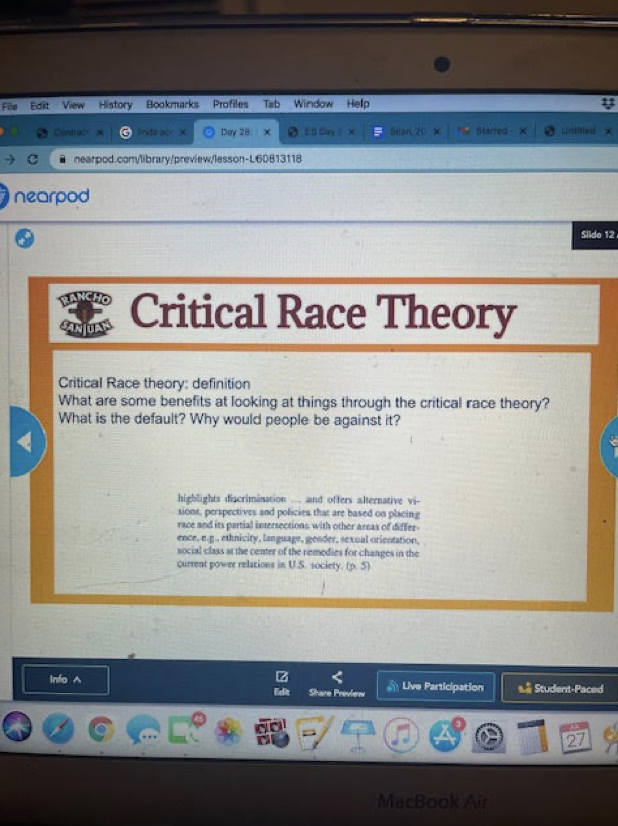
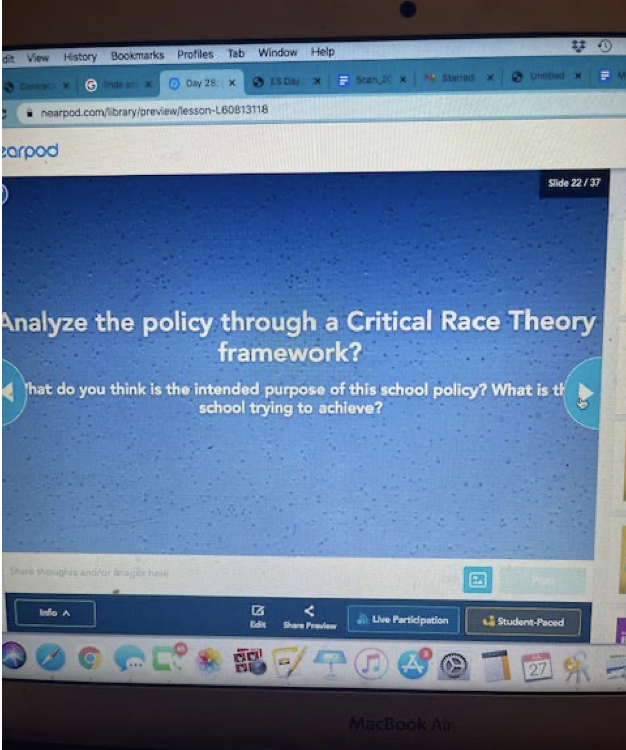
Neither slide contains much content, so they don't really tell us how Rancho San Juan High School (Salinas, CA) has been teaching Critical Race Theory – but they are evidence that they have been teaching it.
Were they teaching it accurately? We don't have enough information to say. But, it wouldn't surprise me that, even if the original scholarly theories have some legitimacy, that a high school tasked with teaching them would mangle them into something else entirely.
There would be a more compelling argument here if either of those slides said something outré. But neither does, so I don't know what I'm supposed to do with this.
Okay, that was my whole point though – "CRT" has been appropriated to mean something different from the original academic theory – and not just by the "anti-CRT" crowd, by "pro-CRT" folks too. So why not just accept that "CRT" now has two meanings, the original scholarly meaning, and a colloquial meaning, and they are different, even though the later grew out of (distortions of) the former?
The appropriation of "CRT" isn't really any different than the appropriation of "woke", which you seemed more okay with.
This is your comment to which I was responding:
> I'd be much more amenable to that if the people "appropriating" terms like CRT weren't doing so to tar actual CRT theorists, but they are, so I'm not at all amenable to it in this case.
And then you said (my emphasis):
> I don't dispute that there are misguided K-8 schools that have been teaching CRT, or what they think CRT is
Doesn't your statement support the idea that "CRT" has evolved in popular usage to mean something different from the original academic theory, and that evolution hasn't purely been due to CRT critics, people who promote/teach "what they think CRT is" have also played a role in that evolution? And hence, that evolution can't be solely blamed on people trying to "tar actual CRT theorists"? Which undermines your argument for resisting it.
Can you point to CRT works that do this? I'd like to read them.
Especially for Asians, a lot of them came to America fleeing persecutions in their home countries... from other Asians! I'm thinking Vietnamese refugees fighting against the communist regime and people from Hong Kong fleeing the Chinese Communist Party at home.
When you look at statistics that say the US is lower in this or that, remember that America takes in millions of dirt poor immigrants each year, and their circumstances skew the numbers. However they get assimilated and integrated, and a generation later their kids are going to the Ivy League and starting businesses.
How about if we look at immigration into the US as a whole vs immigration to the EU as a whole? What do the numbers look like, then?
On the "Education Access" pillar, the Netherlands scored highest, while the US ranks 40th. So I don't think your conclusion is accurate.
It's a lot easier to get in to college in the US than in most of Europe, but it costs a whole lot more (like requiring a degree in the first place, it's a kind of social gatekeeping). I think nowadays like 60% of high school grads attend some amount of college, but only about half of those get an actual degree.
Just last year, Germany has accepted more than a million Ukrainian immigrants – at a population of under 100 million. Yes, exceptional circumstances, but there have been a lot of these in the past decade (consider e.g. the Syrian war). And the number the US accepted in the same year? Just short of 2000. Yes, two thousand, not two millions – at four times the population.
Looking at the statistics, the balance is something like half a million in net(!) arrivals per year in the last decade. (I couldn't find comparable numbers for the US, but granted green cards seems like a reasonable proxy, and that's also less than a million per year, and that's not even accounting for people moving away.) And if you look at the larger EU, the "more than any other developed nation" claim completely falls apart.
The US also gets to cherry-pick immigrants based on skill to a much larger extent than the EU does due to geography alone (requesting asylum generally requires physical presence, and the EU's land and sea borders are a lot easier to cross).
One number I've found puts the estimated number of unlawful entries to the US per year at under 100k, for a total population of around 10 million. The EU sees around 2.5 million immigrants, vs. around 1.5 million emigrants, per year.
GPs claim of "millions of dirt-poor immigrants per year" skewing the numbers doesn't seem realistic to me.
It's an entirely made-up "crisis", but a reliably effective one politically.
https://www.cbsnews.com/news/immigration-border-crossings-us...
I never came across any of the sort.
What I come across frequently is the extension of the American exceptionalism mindset that leads some US natives to believe they are exceptional at math in spite of evidence failing to support their exceptionalism views.
> America is a society of disparate cultures, regions, communities, and outcomes (often in the same cities) that is far too (...)
I also see this all too often: the follow-up to the exceptionalism mindset failing to support their beliefs in a rational basis, and proceeding to cherry-pick subsets that suit their exceptionalism views.
It's like claiming that Americans are all tall athletic and exceptional basketball players, and supporting that exceptionalism view by pointing out that Michael Jordan and LeBron James are US citizens. Meanwhile, ignoring that the average us citizen might have more in common with Danny DeVito.
The US population is over 330M people, and its an unrivaled economic and technological powerhouse. Of course you can find hundreds of exceptional individuals. But being able to find a champion among the masses is not the point of a statement like "Americans are good at math". Baselines matter a lot, and even you admit that the US does not look great by attempting to cherry pick your way out of that.
Most other societies also don’t tend to have every group at average, but some groups above average and others lower.
If you break other societies with higher average scores down by groups along fault lines in those societies, the top groups in those societies will also be doing much better than the bottom groups, and considering they have higher average scores, the top groups will likely be doing better than the top groups in the US.
There are cities in Europe with histories spanning thousands of years, but were apart until only 30 years ago. There are countries with multiple ethnicities, multiple official languages.
Edit: Yes, look at page 34 in that report, it says that white kids scored 25 higher than average, so 503. Where did you get those numbers from, those are wrong.
I'll even retract my point that the US maths education system isn't failing as a whole. When two demographics (30% of the country and growing) are being left behind by the system, then the system is failing as a whole. I really hope to see this change in the future.
2. These countries pretty much all (to varying degrees) have a strong social democratic movement that has been able to set policy during the 20th century, resulting in fairly uniform (compared with USA) support for universal education, healthcare, and other things Americans can’t take for granted.
There is huge variation within Europe for sure, but western/northern european countries do largely cluster together when looked at the world as a whole.
Wait, what? That is exactly what it means. If the groups that are least likely to get external support (ie a tutor, prep, whatever) are under-performing that implies the _standalone_ system is broken. Sure, it is not so broken that it can't be patched with outside aid, but that is true of many things we consider "a failure."
This is akin to saying "Of course my car can get across the country. All I need is the occasional tow-truck, you know, for when it overheats."
Is there reasonable evidence to show that whites and asians receive "external support" at a rate high enough to convincingly explain a 50 to 100 point disparity on this test?
I only skimmed it (read the abstract, checked the graphs, reviewed what stuck out as I scrolled), but quick take aways:
(1) The # of private tutoring centers has tripled to 10k since 1997!
(2) The utilization of the _new_ tutoring centers is primarily by the wealthy (which obviously skews white). In fact, utilization of private tutors by low income folks has gone down in the same period.
(3) They have a section summarizing how Asian-American utilization of tutoring center is high. They even summarize/mention other work that implies tutor usage as primary factor for the high test scores of Asian American students.
I'm not sure how comfortable I am with the second-half of that last point, but finding information from a credible source (Harvard/BU/Brown) wasn't hard.
What is “the system”? you mean to say the school is racist or unfair to black kids..hispanic kids? who is responsible in your opinion?
[1]: https://www.ppic.org/publication/financing-californias-publi...
Your figure is apparently only for "current operations (e.g., staff, materials)" from 2018-19. But that doesn't reflect the already-absurd and ever-growing true cost of California's broken education system. And it isn't directly comparable to your figure for PAUSD's total budget.
"Reflecting the changes to Proposition 98 funding noted above, total per-pupil expenditures from all sources are projected to be $15,654 in 2017-18 and $16,085 in 2018-19"[0]
"K-12 per-pupil funding [in 2022-23] totals $15,261 Proposition 98 General Fund—its highest level ever—and $20,855 per pupil when accounting for all funding sources."[1]
[0]: https://ebudget.ca.gov/2018-19/pdf/BudgetSummary/K-12Educati... (p. 2)
[1]: https://www.ebudget.ca.gov/2022-23/pdf/BudgetSummary/K-12Edu... (p. 3)
[2]: https://www.ebudget.ca.gov/2021-22/pdf/BudgetSummary/K-12Edu... (pp. 11-16)
> States contribute a total of $357.0 billion to K-12 public education or $7,058 per student.
> Local governments contribute $347.4 billion total or $6,868 per student.
I’m assuming the “system” here is talking about the national education system, since that seems to be the topic of the immediately preceding posts. California and SFUD might be different.
The result is that one third of students (22,000) are now in private schools, the remainder (50,000) are in public schools. A lot of SF parents move out of the city 1) for a bigger house and 2) more reliable schooling solution 3) access to GATE programs.
There is a lot of value in being walking distance from your child's elementary school. In SF there is no guarantee where in the city your child will go to school.
None of which you can take for granted in the lower socioeconomic areas.
Maintaining government benefits quickly becomes a full time job because of arcane requirements written by uncaring people. Those in poverty might find themselves disincentivized from seeking higher paying work due to the “welfare cliff” where once the make over X amount, benefits start to go away. In some cases, if they suddenly make nothing (as if they’ve just lost a job or had hours cut), healthcare benefits are yanked away just when they need it most.
It’s very easy to see this as a moral failing, but if you’ve not lived through this situation, you cannot possibly understand the toll that poverty takes on you both physically and mentally. The truth, like with most things, is more complicated.
IF their parents filed a bunch of paperwork--which presupposes the time, literacy and desire to do so. Children don't get to choose their parents.
This is one of the reasons why making school lunches a standard part of school (they're not "free" as they're just part of the budget) is so important.
People dunk on the public schools, but, if there was anything that the webcam schooling of Covid lockdowns showed us, it's that the home lives of a LOT of children in lower socioeconomic areas are really terrible (and also how bad the home lives of a lot of children who nominally aren't in lower socioeconomic areas--but that's a totally different discussion). The fact that public schools tended to provide an oasis in the middle of that chaos became terribly apparent.
Teenagers aren't really aware of how not learning fucks their chances
I've learned math mostly outside the school.
Black students of African heritage, unless the group is very specifically selected (Nigerian-Americans come to mind, with their extremely high average education levels), tend to come out on the bottom in all racially mixed societies in the world. Even the Finnish educational system, touted as one of the best in the world, struggles to educate Somali immigrants to Finnish levels.
The very opposite tends to be true about East Asians and Ashkenazi Jewish students. I am not aware of a single educational system worldwide where either of those groups would be considered under-achieving and needing government or private help.
The standard American answer is that the root cause is systemic racism. I don't believe that; the phenomenon is too widespread and there are other ethnicities that face vicious open racism in their countries, while being extremely successful. Some of the most successful groups in the world are actually direct survivors of genocidal campaigns or lost wars; all that murder didn't break them.
We do a disservice to students in the US by treating Algebra/Calc as advanced math. Typically, American schools judge student math aptitude prior to algebra based on rote memorization of multiplication tables. Potentially with the added benefit of more rote memorization problems if one is in the honors curriculum. Aptitude for this type of problem does not directly translate into aptitude for higher math.
There is nothing particularly advanced about Algebra or Calculus. At most, it's a question of how much time one is willing and able to put into the subject. The fact that most American students do not exit high school with a functional knowledge of single variable calculus is purely an artifact of our curriculum priorities.
- Enrichment, visual, and speedy stuff to build intuition
- Proofy stuff to build rigor and reasoning ability
- Rote stuff to build arithmetic and symbolic manipulation skills
Ideally, it would be balanced this way from kindergarten to mid-undergrad. In practice, most students rotate through these.
You do not build intuition about things without having some amount of those things in your head which is memorization.
It’s a bit late for me now at 38, or at least it feels that way. I never took college math so HS-level algebra and geometry is my current level of understanding and sometimes it really hampers my programming ability.
For instance: this one teaches geometric proofs without mentioning the formalism, just letting you "unlock" the tools from a few "axiom" starter tools.
I stopped after discrete math and analysis-lite class but I wish I took more algorithm and higher level math classes to be better at my craft. It's also hard to take classes when you have competing priorities when you're 30+. I don't know your current situation but I feel like you can totally do it since you have renewed determination for learning.
It was only when I got into programming and it taught me math is actually much more than just meaningless letters and numbers that I finally came around to appreciating it. Programming taught me math is the language spoken by the universe, anything in this universe could be explained with math and it was truly a mindblowing paradigm shift.
Math education needs a complete redo from the ground up, it teaches nothing of value and only serves to mass-produce math-haters to the detriment of us all.
My eastern European Calc II professor once complained when the class wasn't immediately grasping Riemann Sums, "This is grade school calculus!"
Ended in shouting and tears. Every. Single. Time.
Does anyone have a recommendation here?
Funnily all my college math professors and their TAs were notoriously bad at arithmetic. They regularly joked that arithmetic isn’t real math so not a big deal.
My physics professor was an arithmetic magician though. The way he could take a ridiculously complex equation covering the whole blackboard and guesstimate the solution in his head was a marvel to behold.
Maybe. Or maybe it's useless but skill at it is a good measure of how conscientious those students were in high school (e.g. the extent to which they bothered to do their homework). Or any number of other possible explanations.
Memorizing is a directed effort to remember something. Remembering something as a side effect of some other task is not memorization.
Plane Geometry track, on the other hand, was incredibly difficult for me to grasp in university.
Some school admins went nuts about letting a student take calculus in 10th grade because they didn't think it was doable. But I tested out of everything else. I was the first person in the history of the school to do this, only because I came from internationally having completed a trig course in 9th grade. In the US they wouldn't have allowed that in the first place, but here I was, having already done it, because I was given the opportunity outside the US.
I never saw myself having any special learning abilities, I was just moving onto the next thing to learn. I'm not any sort of prodigy, I just hated team sports and liked science and math, and spent lots of my extracurricular time learning about it.* I only moved faster in math because I put so many hours into studying it outside of school, not because I had any innate talent for it. It also made it more fun, because by learning ahead of class, I was learning for myself with much less pressure than learning for some stupid exam.
This "no child left behind" stuff is pure nonsense in the way they are implementing it.
*You see, I was previously growing up in Asia, where STEM is what the "cool kids" do.
On a tangent, I also feel like college math curriculum kinda don't make sense sometimes because you're hit with more computational heavy classes like calc and stats courses and then they break everything down and rebuild you with proof-based and analysis course at the beginning of your junior year.
It's not that surprising, though, given that they've admitted their goal is equality of outcome rather than of opportunity. That's the only way to achieve the former.
If you know that the school's focus isn't on providing the best education possible to your kids, pull them out of that school immediately. If it is a public school (as it is in this case), complain to the school board, vote them out of office if they don't listen and support local efforts to expand school choice to rescue as many kids as possible from that failing public school system that has proven itself incapable of performing its primary function. Even if you get the school board to reverse insane decisions like banning algebra from middle schools, I still wouldn't trust any school system that would even consider doing such things to properly educate kids. I think it beyond a reasonable doubt that the dysfunction in the SF school district is much deeper than just this algebra ban.
Hard to do when you are poor, as many in SF are. SF seems like a rich city on the outside because it has an insane number of rich people but it also has dirt poor people who can’t do anything else.
And IN youth services, something like half of kids don't even go to school, and aren't homeschooled, so let's just forget asking about the quality of education.
The purpose of the state here is to sabotage your kids to their own benefit (in this case: make the education system easier to administrate, to underpay teachers, and above all else protect the power and jobs the system has). They will actively fight, to the point of using violence against you and your kids, if you reject the school system. Be very careful with doing this.
And if you do, you're probably better off pretending you're a fundamentalist christian, or better yet, muslim or hindu or ... objecting to sex ed classes. Seriously.
This is with parents and kids rejecting the school system being big exceptions. If ever 10% of kids become homeschooled, it will get a lot worse.
You'd think this wouldn't happen. Statistics are very clear, for example, that a LOT more kids are abused at school than at home. This is 100% the fault of the school system (failure to prevent personnel from plus failure to supervise kids, and please do not: school do traumatize kids, as everyone kind of knows and research confirms. It's just not something talked about), and has an obvious result: actions by youth services to make kids go to school increases child abuse, rather than decrease it. Likewise, it reduces schooling. You would think this strange if you assume their purpose is to protect kids, rather than their real purpose: to protect schools and the state from kids. If they actually intended to protect kids, obviously, they'd refuse to interfere in these cases.
And for the love of God, DO NOT ask help from youth services under any circumstances, but above all, don't ask them to help with your kid being traumatized or bullied at school. They will 100% blame the kid, refuse do take any action whatsoever in school, and most definitely will not make teachers pay attention and prevent bullying in the playground or anything like that.
And look at that society: it's a sub-saharan "shit-hole" that has ruined its own future because of its borrowed obsession with "social justice" (and the political vermin that exploit them); which think squeezing out its best talent who then achieve wonderful things outside is something to be "proud" of.
There is enough reason to hate the British colonialism, but it is under them that Indians bagged the first Nobel Prizes in Asia. Now, even those universities that produced them are being destroyed due to idiotic tribal dogfighting. Worse, unlike the US case, all this caste-propaganda doesn't even have much historical evidence to begin with!
Such potential wasted.
https://files.eric.ed.gov/fulltext/EJ1124962.pdf
https://equitablemath.org/wp-content/uploads/sites/2/2020/11...
https://www.nctm.org/uploadedFiles/Conferences_and_Professio...
If it comes across that these equity programs are anti-white and anti-Asian it’s because the underlying ideology expressly is those things. Everything revolves around whites as the oppressors, and Asians (and sometimes Jews) figure in only insofar as they “help uphold white supremacy.”
Science is about creating theory that has predictive power, and the malice hypothesis in my experience has predicted future outcomes far better than stupidity.
I propose this often, and it inspires massive pushback every time.
Just give the teachers a $1,000 bonus for every such kid. Give the teachers a free hand in how to go about it. It'll be the cheapest and most effective boost to education you've ever seen.
1. Doing fine, no need to even pay attention to these kids. Now your top performers don't grow as much. 2. On the edge - where most attention will go 3. Meh - maybe a small percentage jump into category 2, where they will be cared about 4. Let them rot - most of the kids at the bottom will just be let to rot
In my career in public schools, I never noticed any efforts by the teachers to grow the top quartile. Or anyone else, for that matter. I attended 4 public schools in different locales. I was pretty much ignored by all the teachers.
I remember first grade. The teacher would set us up in a circle, each student reading one sentence. I found this very dull, and so read the rest of the book while the other students would grind out the sentences. The teacher then asked what the students guessed the next chapter was about. I of course piped up and dumped a summary of the rest of the book. The teacher was not amused, and curtly told me I was not allowed to read ahead of the class.
Nurtured, my adze.
Things have probably gotten worse since. For example, Seattle got rid of all their gifted tracks.
This is also fundamentally a better way to run a country. It really doesn't matter whether the bottom student in the school does or doesn't learn how to add two three-digit numbers by the time he graduates high school. But the top student learning more advanced topics could actually matter.
Private industry uses monetary incentives all the time. They do it because it works.
The carrot is placed exactly where we want it - results.
> you’ve given them an impossible task
I don't buy that for a minute. It's amazing how people find ways to accomplish impossible tasks when the right motivation is given.
You're making an assumption that the issue is that the teachers aren't putting in the effort.
Children are not simple input/output machines you program. A food insecure child with illiterate parents is going to require individualized and intensive resources, where a child who has Doctors for parents will generally show up to school with the knowledge they need.
Gamification of schools is a really great way to get teachers to completely ignore the development of most of the class to focus on one or two kids.
It's amazing that after the widely documented failure of NCLB, people are still promoting these 'work harder' systems.
Not at all. I'm looking at we aren't getting the desired results. We've tried everything but the obvious - pay for results.
> Gamification of schools is a really great way to get teachers to completely ignore the development of most of the class
Quite the opposite. The bonus is per student.
> It's amazing that after the widely documented failure of NCLB, people are still promoting these 'work harder' systems.
NCLB was nothing like I proposed. It's also not about working harder. It's about results.
What you're proposing is not "obvious" to anyone who actually studies education.
>Quite the opposite. The bonus is per student.
How familiar are you with education? Children develop at different paces but are grouped by age, at least until high school. Teachers don't just teach to get the kids to the next grade, or at least they shouldn't. Under what you are proposing, it doesn't make sense for a teacher to spend any time on a kid who is already going to go on to the next grade. There is no incentive to challenge them with harder books, or harder math problems.
Like, we literally already tried this with NCLB. The ended in the most obvious way possible. Teachers taught to get test results, standards were lowered to make it easier to move to the next grade, children who were excelling were ignored by their teachers who had to focus on children who were lagging.
The whole concept behind 'pay for results' is that you think teachers are not putting the effort they could in.
>NCLB was nothing like I proposed.
I encourage you to do some reading on this topic. You're literally just describing a positive incentive based NCLB. You have the same operating theory that the designers of NCLB had.
>It's also not about working harder. It's about results.
This is a meaningless statement.
I did. The NCLB Act has precisely ZERO monetary incentives for teachers. It has nothing in common with my proposal.
https://www.edweek.org/policy-politics/no-child-left-behind-...
It was obviously written and enacted by people who have no idea how incentives actually work.
They had negative monetary incentives for teachers and schools
>It was obviously written and enacted by people who have no idea how incentives actually work.
It was written by people who don't believe in public education. It's the literal concept you are pushing whether you recognize that or not.
Please provide a reference for negative monetary incentives for teachers.
> It's the literal concept you are pushing
What I'm "pushing" is aligning incentives with the desired results. A system that works every time it's tried.
Besides, if the public schools try my proposal, in no instance will the teachers or schools be worse off. There's literally nothing to lose by trying it.
Again, if you are interested, you should learn, literally, the basic of the subject on which you are speaking
https://www.nber.org/digest/feb15/impact-school-performance-...
You are at this point "debating" the foundation of NCLB, of which it doesn't seem like you know anything about.
> The bonus is per student.
Something something about Goodhart's Law and cobras...
But seriously, think about the second order effects of a powerful incentive like this.
At best, you will likely turn schools into test prep centers where average and advanced students are further ignored (an effect NCLB is already criticized for). Worse is that students able to pass the assessments will realize they are a valuable asset worth $1000 per class by simply failing their pretest and passing their posttest and will figure out ways to trade this with teachers for a cut of the profit or for a grade. Given that trading these test scores is purely positive sum for both students and teachers and that both students and teachers are poor, I think you will see a highly efficient market emerge. And why would schools or states care? They are all making more money!
All of your criticisms of the bonus pay proposal can be easily addressed, as the other ones in this thread.
For example, test the kids once a year at the end of the academic year. There goes the incentive to fail the pretest.
The advanced students can go into the gifted track, which can be operated differently.
> And why would schools or states care?
They don't care now. Proof: Seattle got rid of their gifted programs.
Think about this from the perspective of behavioral economics. Teaching is a profession with a high degree of intrinsic motivation given how stressful it is and how little it pays. Paying for performance on some test primarily rewards people who will game the test because that has a better cost/benefit ratio than heroically catching up kids who are performing several grade levels behind and have a difficult home life. Pay for performance tends to damage morale and increases attrition of intrinsically motivated workers (the kind you really want). This is what happens in controlled psychology experiments and it's what happened with NCLB.
How are you going to game this test:
     1234
    +5678
    -----
    ?????
> it's what happened with NCLB
Once more, NCLB did *NOT* pay teachers for performance.
Plenty of ways. Teacher takes test for student, teacher re-scores test after student is finsihed, student is placed in an IEP that gives them unlimited time and "reading assistance" for test, failing students are placed in small classes and the class size of average students is expanded, failing students are moved from normal schoolwork to test prep, test questions are leaked/sold (we're talking about a multi-billion dollar industry here, right?).
I didn't make up any of these. This is already happening, and it has nothing to do with positive/negative incentive. It's about test-based education and the natural consequence of trying to control a complex system using a simple metric. It's why education theorists are loathed by teachers--because they swoop in with grand theories of how to fix everything without understanding the system and what is and isn't broken.
It's like an outsider thinking a reasonable way to pay a coder is by how many lines of code they write and how many bugs they fix. Or a civil engineer by how many bridges and roads they produce. Because outsiders don't understand the complexity of the system they think the solution must be simple. Since you seem invested in this idea I suggest you go get some input from teachers and see what they say. My guess is you will learn that the problems with public education is multifactorial and that there isn't a simple fix.
It is also insulting to teachers, as if they could have been doing a great job getting the kids to grade level, but chose not to because they weren't financially incentivized enough to do their job.
It may not be the same people though. If teaching in the US was a well-paid and highly respected profession it would presumably retain the most qualified teachers instead of driving them away due to having to find a living wage elsewhere.
That's why you assign the kids to teachers at random, and an independent 3rd party does the assessment.
> It is also insulting to teachers
Only the incompetent ones. The competent ones will be happy to collect those thousand dollar checks.
P.S. Write me a check for $1,000, and I'll cheerfully endure your insults.
This sounds like a way of funneling the best teachers into the already best schools in the richest areas, and making it impossible to employ good teachers in poorer regions -- unless you have a plan to fix this (I realise you've only given a tiny explanation).
That way, the best teachers would want to teach the low performers, because that's where the max bonuses would be.
I will admit I'm in the UK, not the US, but we only do huge standardised tests every 3 years or so, as they are very disruptive.
BTW, there's nothing secret about Asian students' performance. It's just that even the poor families would know to pool the limited resources to educate their kids.
It's unfair that some people develop skills easily when others don't. When equity is the goal this is what happens.
My habits and attitude improved somewhat during undergrad (I figured out in junior year that you can actually read those books you buy!), but as a kid I was a horrible student. I took all honors/AP classes because the normal ones were so boring and slow, not because I had tiger parents.
From all of this, I'm forced to conclude that either everyone just likes to complain and actually math is easy, or some people find it easy and some do not, and I was very fortunate to be one of the former.
It's truly disheartening to see the San Francisco school district's actions resemble something straight out of Orwell's 1984. As someone who has lived in this city for years, it's painful to witness the gradual decline and the rise of corruption overshadowing the progressive spirit that once defined it. Instead of addressing the root cause of poor math education, the district has opted for obfuscation and dishonesty.
It's a classic case of doublethink, where they attempt to hold two contradictory beliefs: that they're doing what's best for the students while simultaneously suppressing their educational growth. Much like the Party in 1984, they seem to prioritize maintaining a facade over genuinely improving education. I wish we could challenge this dystopian approach and hope to meaningfully improve the situation, but at this point, I am not even sure how one would go about doing that.
THE YEAR WAS 2081, and everybody was finally equal. They weren't only equal before God and the law. They were equal every which way. Nobody was smarter than anybody else. Nobody was better looking than anybody else. Nobody was stronger or quicker than anybody else. ...
I think we need something better than winner-takes-all for all elected positions, because it forces you to pick 'the lesser of two evils', knowing that a vote for the person you like the most is really just a 'protest vote'
It's the best way to ensure equal outcomes. Perhaps equal outcomes is just a nasty goal.
Why should a cruel person with tons of advantages and no motivation experience the same as a smart, kind, hard working person? If you’re not for that you can see equal outcomes are a bad goal.
there is no other way, though. if you desire equal outcomes, you have to shackle the best.
i believe Kurt Vonnegot wrote about this...
I think statistics is a better subject to learn early and often. Way more useful across disciplines.
Anyway I think we know that high performing math countries teach math totally different than we do and they produce way better engineers, so why don’t we do what they do?
I mean seriously I work in tech and all the engineers are foreign educated.
https://www.usatoday.com/story/news/education/2020/02/28/mat...
Do you actually mean "pushing them up", or is this code for "filter out underperformers"?
This goes to the root of the issue. What is the whole point of a school? Is it to help students learn and improve? Or is it to serve as a series of challenges to eliminate and filter out people based on arbitrary people?
If the goal is to lift up people, you need to pick them up from down where they are at.
That is simply socialism 101 as portrayed in Rush' "The Trees":
   There is unrest in the forest
   There is trouble with the trees
   For the maples want more sunlight
   And the oaks ignore their pleas

   The trouble with the maples
   And they're quite convinced they're right
   They say the oaks are just too lofty
   And they grab up all the light
   But the oaks can't help their feelings
   If they like the way they're made
   And they wonder why the maples
   Can't be happy in their shade?

   There is trouble in the forest
   And the creatures all have fled
   As the maples scream, "oppression"
   And the oaks just shake their heads

   So the maples formed a union
   And demanded equal rights
   "The oaks are just too greedy
   We will make them give us light"
   Now there's no more oak oppression
   For they passed a noble law
   And the trees are all kept equal
   By hatchet
   Axe
   And saw
I'm inclined to think the concern (that we will run out of supply of people that can do math or something) is overblown. There are plenty of underemployed engineering and science students that took more advanced mathematics classes than the CS kids.
On an anecdotal basis, I went to an elite university in the US (mostly based on luck I think because I was a mediocre student) and there was an implicit expectation was that students seriously pursuing STEM would be starting their curriculum with multivariable calc or linear algebra as a freshmen since the single variable calc requirement would have been knocked out AP/IB credits. I've seen many of my international cohorts going even beyond. I genuinely worry that school systems such as SFUSD is doing a great disservice to its students and the society.