He must have taken the wrong graph.
Edit: Anyway, 503 is pretty average for Europeans, so it means that Americans are pretty average at math, as you'd expect for a large country. So it is still proof that Americans aren't bad, they are typical.
EDIT:: Nevermind I'm a dumbass. that graph is for reading and literacy.... guess I know how I'd score...
Similar to critiques of the GDP as a metric for success.
It’s not surprising the default critique on Reddit/Twitter is always using some European country with a homogeneous culture and a small population centered around ~2-3 major cities at most vs the entire US.
Now, would I like it to be way above average? Sure, and I'm willing to make the public investment to make that happen. But starting from the premise of "we're failing miserably" is going to lead to the wrong conclusions.
What conclusions would those be?
> It’s not surprising the default critique on Reddit/Twitter is always using some European country with a homogeneous culture and a small population centered around ~2-3 major cities at most vs the entire US.
If you'd prefer you could compare whatever nation you'd like with individual US states. You have plenty of US states to pick and choose from.
Regardless, I don't see this sort of statistics rigour when comparing the US to "Europe" as a whole, in spite of the heterogeneous nature of the whole continent (some countries even have regions where people speak entirely different languages) and the fact that the population of "Europe" is well over twice that of the US.
But I guess the point might just be to shut down discussions to avoid conclusions and introspection.
https://www.washingtonpost.com/local/education/achievement-g...
At a pretty sudden level focusing on education alone is the fault not the solution. When teachers actually get to be teachers it seems US schools do just fine or better than most of the world (not simply comparing to subsets of small homogenous European countries).
You wrote this down yourself, and you still didn't get it?
Some of it is definitely because of the lack of a support system at home (poverty, absent fathers...). But I think a lot of it boils down to culture. And if we're to look at it based on race, White Blacks and Hispanics could all improve.
There's a lot of families where school is seen as unimportant, and where education isn't as valued as it could be.
> Whites from families with incomes of less than $10,000 had a mean SAT score of 993. This is 130 points higher than the national mean for all blacks.
https://www.jbhe.com/features/53_SAT.html
This chart visualizes that point: SAT scores of whites in the poorest segment exceed those of blacks from all but the richest segment, and Asians exceed them no matter their income:
https://resources.corwin.com/sites/default/files/singleton_2...
Your own source mentions not only the correlation between income and SAT scores, but it also points out a link between quality of the education services provided to some communities and social pressure. It's also telling that the outliers are explained in a way that boils down to "they succeed in spite of everything we throw at them".
What? OP's argument was purely race-based. OP made absolutely no point other than underlining race-based correlations. If you remove all race-based remarks from OP's post, nothing is left.
> It never discounted the possibility of other race-related factors (...)
In your own words, you describe OP's post as focusing on "race-related factors", and even then you try to accuse those who point that out of "projecting racist views"?
Are you serious?
You're trying too hard to force your racist beliefs. For starters, correlation is not causation. Nevertheless, even taking your hypothetical outlier at face value, why do you think that your personal belief is enough justification to ignore the blatantly clear and obvious link between poverty and achievement? Do you see any value in that, other than reinforcing racist beliefs?
One easy factor to distinguish is the percentage of immigrants in the Asian population."Around six-in-ten Asian Americans (57%), including 71% of Asian American adults, were born in another country"[1]. The background of a lot of these immigrants made them well-qualified to succeed despite their American socio-economic status on arrival [2].
If you compare that to black people in America, many of who's ancestors were brought here in unsavory ways, only "One-in-ten Black people in the U.S. are immigrants". There's no comparison of the ingress of black people in this country when compared to Asian populations, and consequently we don't see the same US immigrant selectivity boosting the numbers of an already disadvantaged race in the same way.
This is not to say that culture has no effect, since I doubt the high participation rate of Asian children in after-school tutoring necessarily hurts those children [5], but it may represent a smaller part of the overall picture than most people think. Choosing minority races from opposite sides of the success spectrum and underlining some of their differences in a data-driven way may help us better understand and combat the problem of equity.
[1] https://www.pewresearch.org/fact-tank/2021/04/29/key-facts-a...
[2] https://www.insidehighered.com/news/2015/08/04/authors-discu...
[3] https://www.apa.org/pubs/journals/features/aap-aap0000069.pd... (A more in-depth research paper from the authors of the referenced book in [2])
[4] https://www.pewresearch.org/fact-tank/2022/01/27/key-finding...
[5] https://www.edworkingpapers.com/sites/default/files/ai21-367... ("Third, even conditional on income and parental education, private tutoring centers tend to locate in areas with many immigrant and Asian-American families")
Immigration filtering explains a lot, but the general trend holds even for subgroups that aren’t subject to those filters.
Some Asian groups, like Vietnamese, came to the US as refugees, not skilled workers. In 1980, poverty rates among Vietnamese people were among the highest off any ethnic group. Today, Vietnamese have similar income levels to non-Hispanic whites.
Moreover, the kids of poor Asians have much more income mobility than the kids of similarly placed whites. Asian children who grow up in the bottom 20% of the income distribution have a 25% chance of ending up in the top 20%, compared to an 11% chance for white kids. These poor Asians are typically in America as a result of family reunification. Thus, neither the kids nor the parents are subject to filters such as H1B job requirements.
How do you escape the conclusion that culture makes the difference?
Hence, some scholar coined the term "white-adjacent" so they can conveniently cherry-pick and ignore Asians when it's convenient. [0] [1]
[0] https://www.newsweek.com/critical-race-theory-has-no-idea-wh...
[1] https://www.asian-dawn.com/2020/11/17/school-district-catego...
The CRT worldview makes slavery the central event of history, and oppression by whites the central theme. That’s what’s going on in the Nikole Hannah-Jones quote above. How do those folks perceive immigrant groups that come here and tell their kids to shut up and work hard? I think that leads straight to the idea that Asians are complicit in “upholding white supremacy.” And even white people like John Oliver get in on that narrative.
Of course from our perspective we are just raising our kids according to our culture. In broad strokes, both east and south Asian cultures tend to be deferential to authority and emphasize an internal locus of control. If you ask my mom why bangladesh is poor, she’ll point to corruption and other moral failings, not British colonialism. Whether that is accurate or not, that’s completely at odds with the CRT worldview, which emphasizes an external locus of control—blaming oppression by whites for everything.
It is easy to make a case that Nikole Hannah-Jones essentializes the transatlantic slave trade. But it is unreasonable to generalize from Hannah-Jones to a whole field of study without evidence.
The ship has sailed on trying to limit “CRT” to its original academic meaning. People needed a word to refer to the ideology that had suddenly become prominent in public discourse, and “CRT” won. See: https://freddiedeboer.substack.com/p/please-just-fucking-tel...
"Woke" is also an appropriated term. But it's original meaning is actually pretty close to its current meaning; I remember a Lexicon Valley episode where one of McWhorter's academic guests observed that "woke" is what you'd call your crazy uncle at Thanksgiving who thought the flouride in your toothpaste was a government mind control system.
Maybe that course is an outlier, but it does serve as a counterexample to the narrative that "CRT is not being taught in K-12 schools". But, if they are teaching CRT (even by name) in some schools, how close is the CRT they teach to the original academic theories? Given my personal experience at how badly schools can mangle things – I still remember the bizarre errors in my high school computing studies textbook, and the interactions I had with teachers in which I tried to explain why the textbook was wrong, and they couldn't understand anything I was saying – it wouldn't surprise me if high school CRT had little in common with the scholarly version.
But if that's true – wouldn't it just show that critics are not the only people appropriating the term "CRT"? In which case, if people on "both sides" are appropriating "CRT", how is its appropriation any worse than that of "woke"? If you'll accept the appropriation of the latter, why refuse it for the former? With "scare quotes", if need be.
I don't think CRT should be taught to grade schoolers. It's complicated and all you can give students who barely understand civics is a bunch of fortune cookies.
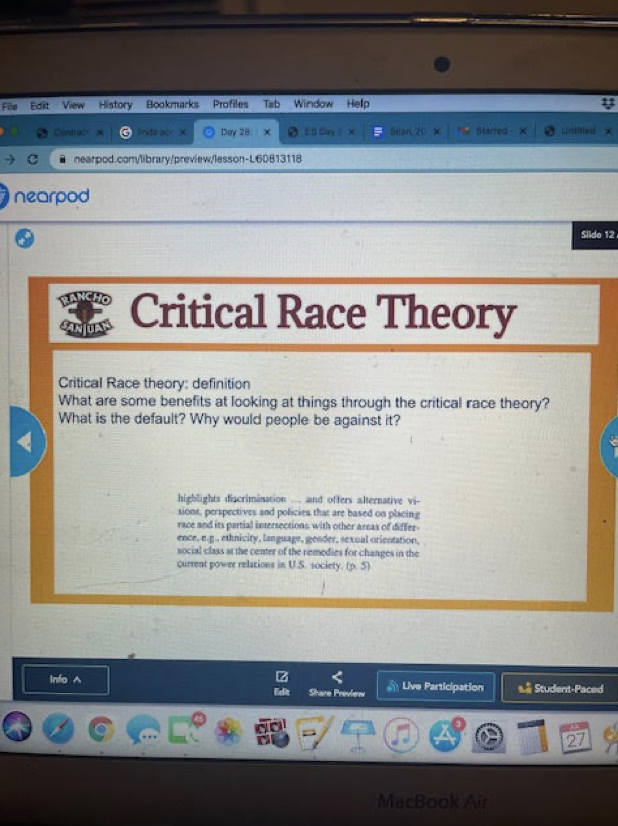

Neither slide contains much content, so they don't really tell us how Rancho San Juan High School (Salinas, CA) has been teaching Critical Race Theory – but they are evidence that they have been teaching it.
Were they teaching it accurately? We don't have enough information to say. But, it wouldn't surprise me that, even if the original scholarly theories have some legitimacy, that a high school tasked with teaching them would mangle them into something else entirely.
There would be a more compelling argument here if either of those slides said something outré. But neither does, so I don't know what I'm supposed to do with this.
Okay, that was my whole point though – "CRT" has been appropriated to mean something different from the original academic theory – and not just by the "anti-CRT" crowd, by "pro-CRT" folks too. So why not just accept that "CRT" now has two meanings, the original scholarly meaning, and a colloquial meaning, and they are different, even though the later grew out of (distortions of) the former?
The appropriation of "CRT" isn't really any different than the appropriation of "woke", which you seemed more okay with.
This is your comment to which I was responding:
> I'd be much more amenable to that if the people "appropriating" terms like CRT weren't doing so to tar actual CRT theorists, but they are, so I'm not at all amenable to it in this case.
And then you said (my emphasis):
> I don't dispute that there are misguided K-8 schools that have been teaching CRT, or what they think CRT is
Doesn't your statement support the idea that "CRT" has evolved in popular usage to mean something different from the original academic theory, and that evolution hasn't purely been due to CRT critics, people who promote/teach "what they think CRT is" have also played a role in that evolution? And hence, that evolution can't be solely blamed on people trying to "tar actual CRT theorists"? Which undermines your argument for resisting it.
Can you point to CRT works that do this? I'd like to read them.
Especially for Asians, a lot of them came to America fleeing persecutions in their home countries... from other Asians! I'm thinking Vietnamese refugees fighting against the communist regime and people from Hong Kong fleeing the Chinese Communist Party at home.
When you look at statistics that say the US is lower in this or that, remember that America takes in millions of dirt poor immigrants each year, and their circumstances skew the numbers. However they get assimilated and integrated, and a generation later their kids are going to the Ivy League and starting businesses.
How about if we look at immigration into the US as a whole vs immigration to the EU as a whole? What do the numbers look like, then?
On the "Education Access" pillar, the Netherlands scored highest, while the US ranks 40th. So I don't think your conclusion is accurate.
It's a lot easier to get in to college in the US than in most of Europe, but it costs a whole lot more (like requiring a degree in the first place, it's a kind of social gatekeeping). I think nowadays like 60% of high school grads attend some amount of college, but only about half of those get an actual degree.
Just last year, Germany has accepted more than a million Ukrainian immigrants – at a population of under 100 million. Yes, exceptional circumstances, but there have been a lot of these in the past decade (consider e.g. the Syrian war). And the number the US accepted in the same year? Just short of 2000. Yes, two thousand, not two millions – at four times the population.
Looking at the statistics, the balance is something like half a million in net(!) arrivals per year in the last decade. (I couldn't find comparable numbers for the US, but granted green cards seems like a reasonable proxy, and that's also less than a million per year, and that's not even accounting for people moving away.) And if you look at the larger EU, the "more than any other developed nation" claim completely falls apart.
The US also gets to cherry-pick immigrants based on skill to a much larger extent than the EU does due to geography alone (requesting asylum generally requires physical presence, and the EU's land and sea borders are a lot easier to cross).
One number I've found puts the estimated number of unlawful entries to the US per year at under 100k, for a total population of around 10 million. The EU sees around 2.5 million immigrants, vs. around 1.5 million emigrants, per year.
GPs claim of "millions of dirt-poor immigrants per year" skewing the numbers doesn't seem realistic to me.
It's an entirely made-up "crisis", but a reliably effective one politically.
https://www.cbsnews.com/news/immigration-border-crossings-us...
I never came across any of the sort.
What I come across frequently is the extension of the American exceptionalism mindset that leads some US natives to believe they are exceptional at math in spite of evidence failing to support their exceptionalism views.
> America is a society of disparate cultures, regions, communities, and outcomes (often in the same cities) that is far too (...)
I also see this all too often: the follow-up to the exceptionalism mindset failing to support their beliefs in a rational basis, and proceeding to cherry-pick subsets that suit their exceptionalism views.
It's like claiming that Americans are all tall athletic and exceptional basketball players, and supporting that exceptionalism view by pointing out that Michael Jordan and LeBron James are US citizens. Meanwhile, ignoring that the average us citizen might have more in common with Danny DeVito.
The US population is over 330M people, and its an unrivaled economic and technological powerhouse. Of course you can find hundreds of exceptional individuals. But being able to find a champion among the masses is not the point of a statement like "Americans are good at math". Baselines matter a lot, and even you admit that the US does not look great by attempting to cherry pick your way out of that.
Most other societies also don’t tend to have every group at average, but some groups above average and others lower.
If you break other societies with higher average scores down by groups along fault lines in those societies, the top groups in those societies will also be doing much better than the bottom groups, and considering they have higher average scores, the top groups will likely be doing better than the top groups in the US.
There are cities in Europe with histories spanning thousands of years, but were apart until only 30 years ago. There are countries with multiple ethnicities, multiple official languages.
America is a society of disparate cultures, regions, communities, and outcomes (often in the same cities) that is far too fine grained to reduce it to generalities (with a few exceptions such as heavily nationally influenced/consistent things like health care insurance, defence spending, Wall St/banking policies, etc).
Some people try to minimize it all to “class” like they found some Pandora’s box for all of life’s problems but that’s just as often flawed as any other generalization.