You're trying too hard to force your racist beliefs. For starters, correlation is not causation. Nevertheless, even taking your hypothetical outlier at face value, why do you think that your personal belief is enough justification to ignore the blatantly clear and obvious link between poverty and achievement? Do you see any value in that, other than reinforcing racist beliefs?
One easy factor to distinguish is the percentage of immigrants in the Asian population."Around six-in-ten Asian Americans (57%), including 71% of Asian American adults, were born in another country"[1]. The background of a lot of these immigrants made them well-qualified to succeed despite their American socio-economic status on arrival [2].
If you compare that to black people in America, many of who's ancestors were brought here in unsavory ways, only "One-in-ten Black people in the U.S. are immigrants". There's no comparison of the ingress of black people in this country when compared to Asian populations, and consequently we don't see the same US immigrant selectivity boosting the numbers of an already disadvantaged race in the same way.
This is not to say that culture has no effect, since I doubt the high participation rate of Asian children in after-school tutoring necessarily hurts those children [5], but it may represent a smaller part of the overall picture than most people think. Choosing minority races from opposite sides of the success spectrum and underlining some of their differences in a data-driven way may help us better understand and combat the problem of equity.
[1] https://www.pewresearch.org/fact-tank/2021/04/29/key-facts-a...
[2] https://www.insidehighered.com/news/2015/08/04/authors-discu...
[3] https://www.apa.org/pubs/journals/features/aap-aap0000069.pd... (A more in-depth research paper from the authors of the referenced book in [2])
[4] https://www.pewresearch.org/fact-tank/2022/01/27/key-finding...
[5] https://www.edworkingpapers.com/sites/default/files/ai21-367... ("Third, even conditional on income and parental education, private tutoring centers tend to locate in areas with many immigrant and Asian-American families")
Immigration filtering explains a lot, but the general trend holds even for subgroups that aren’t subject to those filters.
Some Asian groups, like Vietnamese, came to the US as refugees, not skilled workers. In 1980, poverty rates among Vietnamese people were among the highest off any ethnic group. Today, Vietnamese have similar income levels to non-Hispanic whites.
Moreover, the kids of poor Asians have much more income mobility than the kids of similarly placed whites. Asian children who grow up in the bottom 20% of the income distribution have a 25% chance of ending up in the top 20%, compared to an 11% chance for white kids. These poor Asians are typically in America as a result of family reunification. Thus, neither the kids nor the parents are subject to filters such as H1B job requirements.
How do you escape the conclusion that culture makes the difference?
Hence, some scholar coined the term "white-adjacent" so they can conveniently cherry-pick and ignore Asians when it's convenient. [0] [1]
[0] https://www.newsweek.com/critical-race-theory-has-no-idea-wh...
[1] https://www.asian-dawn.com/2020/11/17/school-district-catego...
The CRT worldview makes slavery the central event of history, and oppression by whites the central theme. That’s what’s going on in the Nikole Hannah-Jones quote above. How do those folks perceive immigrant groups that come here and tell their kids to shut up and work hard? I think that leads straight to the idea that Asians are complicit in “upholding white supremacy.” And even white people like John Oliver get in on that narrative.
Of course from our perspective we are just raising our kids according to our culture. In broad strokes, both east and south Asian cultures tend to be deferential to authority and emphasize an internal locus of control. If you ask my mom why bangladesh is poor, she’ll point to corruption and other moral failings, not British colonialism. Whether that is accurate or not, that’s completely at odds with the CRT worldview, which emphasizes an external locus of control—blaming oppression by whites for everything.
It is easy to make a case that Nikole Hannah-Jones essentializes the transatlantic slave trade. But it is unreasonable to generalize from Hannah-Jones to a whole field of study without evidence.
The ship has sailed on trying to limit “CRT” to its original academic meaning. People needed a word to refer to the ideology that had suddenly become prominent in public discourse, and “CRT” won. See: https://freddiedeboer.substack.com/p/please-just-fucking-tel...
"Woke" is also an appropriated term. But it's original meaning is actually pretty close to its current meaning; I remember a Lexicon Valley episode where one of McWhorter's academic guests observed that "woke" is what you'd call your crazy uncle at Thanksgiving who thought the flouride in your toothpaste was a government mind control system.
Maybe that course is an outlier, but it does serve as a counterexample to the narrative that "CRT is not being taught in K-12 schools". But, if they are teaching CRT (even by name) in some schools, how close is the CRT they teach to the original academic theories? Given my personal experience at how badly schools can mangle things – I still remember the bizarre errors in my high school computing studies textbook, and the interactions I had with teachers in which I tried to explain why the textbook was wrong, and they couldn't understand anything I was saying – it wouldn't surprise me if high school CRT had little in common with the scholarly version.
But if that's true – wouldn't it just show that critics are not the only people appropriating the term "CRT"? In which case, if people on "both sides" are appropriating "CRT", how is its appropriation any worse than that of "woke"? If you'll accept the appropriation of the latter, why refuse it for the former? With "scare quotes", if need be.
I don't think CRT should be taught to grade schoolers. It's complicated and all you can give students who barely understand civics is a bunch of fortune cookies.
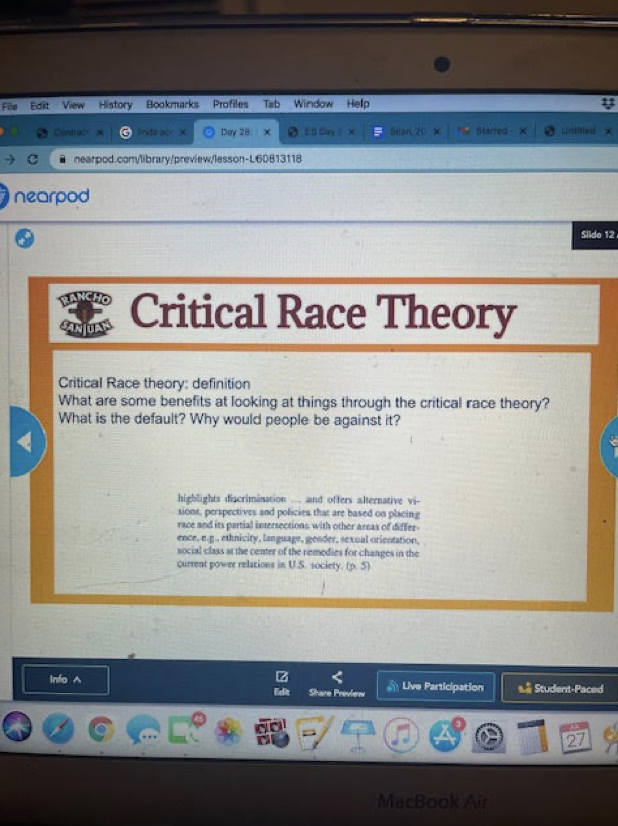
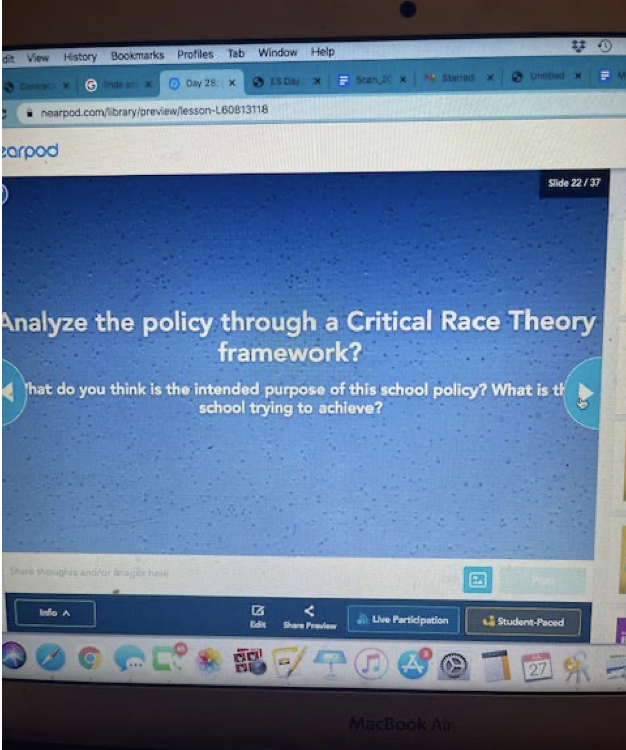
Neither slide contains much content, so they don't really tell us how Rancho San Juan High School (Salinas, CA) has been teaching Critical Race Theory – but they are evidence that they have been teaching it.
Were they teaching it accurately? We don't have enough information to say. But, it wouldn't surprise me that, even if the original scholarly theories have some legitimacy, that a high school tasked with teaching them would mangle them into something else entirely.
There would be a more compelling argument here if either of those slides said something outré. But neither does, so I don't know what I'm supposed to do with this.
Okay, that was my whole point though – "CRT" has been appropriated to mean something different from the original academic theory – and not just by the "anti-CRT" crowd, by "pro-CRT" folks too. So why not just accept that "CRT" now has two meanings, the original scholarly meaning, and a colloquial meaning, and they are different, even though the later grew out of (distortions of) the former?
The appropriation of "CRT" isn't really any different than the appropriation of "woke", which you seemed more okay with.
This is your comment to which I was responding:
> I'd be much more amenable to that if the people "appropriating" terms like CRT weren't doing so to tar actual CRT theorists, but they are, so I'm not at all amenable to it in this case.
And then you said (my emphasis):
> I don't dispute that there are misguided K-8 schools that have been teaching CRT, or what they think CRT is
Doesn't your statement support the idea that "CRT" has evolved in popular usage to mean something different from the original academic theory, and that evolution hasn't purely been due to CRT critics, people who promote/teach "what they think CRT is" have also played a role in that evolution? And hence, that evolution can't be solely blamed on people trying to "tar actual CRT theorists"? Which undermines your argument for resisting it.
Can you point to CRT works that do this? I'd like to read them.
Especially for Asians, a lot of them came to America fleeing persecutions in their home countries... from other Asians! I'm thinking Vietnamese refugees fighting against the communist regime and people from Hong Kong fleeing the Chinese Communist Party at home.