I’ve heard (on HN) of a dozen different companies vying for the heroku replacement spots and yet Fly seemed to capture the attention. I couldn’t name another one off hand.
What I truly want and probably lots of other people too is Flyctl for AWS. The same simplicity to run as fly, but give me something cheap in Virginia or the Dalles.
From the perspective of a recent founder, it's downright spooky to build around any SaaS, considering how few of them have been around for 10+ years, when that is certainly what our business is aiming for.
I know (and share the feels): Devs tend to get excited about the new thing – but if Google Workspace shut down next month, we would be in so much operational trouble. When other peoples fancies stand in the way of the entire operation you are responsible for, it actually begs the question how much closed source SaaS you can allow before it starts to be quite frankly irresponsible.
We are not imagining things. SaaS of all sizes shut down all the time, and when you are heavily relying on them and building software around them to run a business the prospect is spooky as hell.
https://news.ycombinator.com/item?id=32955520
If they are a multiplier for a whole portfolio, there's not much reason for any particular branch to purchase them.
(This post seems like some evidence they might actually be building the wrong thing, though.)
I'm very explicit both internally and externally that an acquisition is a failure mode for Render. We're building this for the very long term and plan to keep it that way.
Are there any examples where the capitalism bottom line is ignored and a company keeps growing with extremely premium generous acquisition offers on the table? I can't think of any, but there could be a few. However, I expect it's pretty rare.
For companies with such tremendous growth, the venture capitalist firms are primarily looking to make their <big-multiplier> return and push priorities accordingly (understandably).
Market forces in capitalism are highly potent.
I’m curious why you think it isn’t? On a long enough timescale all good things seem to be acquired by large megacorps for a fuckton of money.
Slack, Linode, Minecraft, the list goes on. Eventually they all make the thing less than it was before under the founders’ vision. At least from my perspective.
It won’t stop me from cheering them on, but I’m still very skeptical of them not being bought out in 10 years.
What you want to know is the probability of a small, independent, high quality provider remaining independent, high quality and not bankrupt.
It does seem to be rare in the tech space, especially in the US. Becoming one of the largest public corporations on earth is one way to do it, as you suggested, but the odds of that happening are miniscule.
Except Valve I guess, but that was never a public company that could be acquired to satisfy investors in the first place.
Though to be fair, even if render collapsed overnight, I think I’d still be equally satisfied after moving to fly.
> Flyctl for AWS
I would really like fly.io to overcome these hurdles. I bet they will.
Pardon the ignorance, is this not the Amplify CLI [1] ?
At least that single ‘no’ contained a whole wealth of blood and tears to me.
I like Amplify and use it often. However, it isn't well integrated with "normal" backends, so if you want to keep a backend and frontend deployed together you either have to use their Amplify backend API or work out your own deployment.
Google Cloud. It is painfully easy to spin up managed postgres, super easy to deploy gcp cloud functions or gcp cloud run. It isn't expensive either and just works.
I might be paranoid, but I just don't feel comfortable when there's so much in play.
It is postgres + http handlers.
fly.io charges an outrageous 2 cents/GB. Google is over 4x that.
At fly.io rates, 1Gbps average over a month is $6400/mo. Google is tiered and you’re looking at over $10k/mo.
For comparison, a cheap managed switch that can handle 1Gbps cost about $100, maybe a bit more if you want a nice one. A nice router is more. You can rent an entire rack, including power, cooling, and an unmetered 1Gbps for $300-$1k/mo (with maybe some wiggle room on both ends). You can buy a pretty nice server, amortize the price over a week or two, and still come out ahead.
You certainly get considerable value from a major cloud provider, and a lot of their other services are reasonably priced, but, depending on your workload, the egress prices and the corresponding Hotel California factor may make using a major cloud provider a poor proposition.
This becomes very relevant for things like archiving data. If you generate data outside of a major cloud, you can pay a major cloud a very reasonable fee to archive it for you. But if you ever download your archive, it will cost you about half the price of buying an external disk to store it on.
(To be fair, object storage is rather more reliable than a single crappy external drive. But if you access the data more than once, maybe you should have a colo or on-prem copy too.)
If it's sorting and sifting and clicking a bunch of stuff in the console, that's not painfully simple. If it's some easy cli commands, I think that's in the ballpark...
https://github.com/google-github-actions/deploy-cloud-functi...
At Coherence (withcoherence.com) we're focused on a developer experience layer on top of AWS/GCP. You might describe it as flyctl for AWS.
This is likely the biggest culprit for a lot of these companies. Too many of us have grown up in the culture of getting hosting and platform for "free", but at some point the companies providing it still have to pay the bills. There has to be a better pricing model that let's someone deploy their relatively small, low-traffic app for $10s/month or even $200 - $300 / year for the basics (e.g. - Heroku free tier type capabilities). It's not going to save these companies but it would limit excessive growth of their own costs from a free tier while at the same time still being affordable for 1 - 2 person teams who are trying to get something in front of users.
But our team, who has used Heroku for over a decade, got bit multiple times by Heroku having a free tier.
Why were we impacted by other apps? Because Heroku’s load balancers are shared amongst all their apps. That includes all the sketchy apps running on the platform.
If Heroku could somehow isolate us from everyone else? Great - and they offered that for awhile with a reasonably-priced Add-On supported by them called SSL Endpoint. It cost about $15/month and put us into a pool that was shared with other folks willing to spend that much per month to run their app.
I understand that’s not great for a hobby project. But for those of us trying to run a large product on Heroku and not have to spend multiple extra thousands of dollars every month for a Heroku Private Space, this was a great way of pooling: put a small fee in place for one pool of resources. Not many malware writers or other misbehaving app creators will probably want to spend that much per month.
But they axed that a few years ago. Only a couple months after when we were thrown back into the load balancer pool with all the other free apps, one of the IPs was marked as spam and we had to figure out a kind of janky solution.
Additionally, Heroku seemingly spent a ton of resources on free tier support, malware fighting, etc. I hope to see more features on Heroku since they’ve dropped that support… but I haven’t seen much evidence of that in roughly six months since they did that. But we’ll see.
I wish I shared your enthusiasm for where Heroku could go but I have a few friends at Salesforce I've asked about how they see Heroku internally and it really doesn't seem like it is going to get much love. Hope to be wrong though.
I let them know they need to demonstrate that to me. They have a roadmap [1], but it seems to have barely anything moving forward, including some really important concepts like http/2 support.
Free tier is a GTM motion which fully makes sense for novel tech products like Fly because: https://en.wikipedia.org/wiki/Technology_adoption_life_cycle
https://www.oracle.com/cloud/free/
It's still just a free tier so you can't expect good support, but, it's there.
One of the hardest lessons every business needs to learn is how to say no to the users they don't need.
I do wonder however if they'd be better off using less l33t tech - do almost everything on Postgres vs consul and vault, etc. Scaling, failover, consistency, etc is a more well-known problem and there are a lot of people who've ran other DBs at tremendous scale than the alternatives.
Simplicity is the key to reliability, but this isn't a simple product, so idk.
In my experience people who ran Postgres distributed across a WAN tended to use obscure third-party plugins at best, more often a pile of dodgy Perl scripts. Using something designed from the ground up to be clustered seems to have a much better chance of working out than trying to make something that's been built as a single-instance system for decades work across the internet.
The goal should be to make the backend as simple as possible, but no simplier. Complexity here leads to operational burden and toil. But that's why you hire good SREs and treat them well. What's more important is frontend complexity, aka how difficult it is for customers to use. Backend and frontend complexity aren't necessarily linked, which, imo, fly.io achieves, downtime aside.
Whenever a US law and a foreign law conflict, the US law always wins when you are in the United States. Complying with US laws is also a perfectly valid defense if a European citizen or state ends up bringing action against you in a US court.
If the company doesn't comply, fines will be directly taken from customer payments for example.
If the destination bank account is outside the EU, they can't touch it without cooperation from the defendant countries courts - which requires you to file in the defendants venue. If an EU country unilaterally seized intra-bank remittance they would be cut off from the international banking system without hesitation.
You seem to really be grasping at straws here, but the EU is not some all powerful entity that can enforce its laws outside its jurisdiction.
Of course you can, you simply reach for assets within the border of said member country or the EU. As I mentioned in my previous comment, you can for example get the funds from outgoing payments by customers of said company. You can also freeze accounts, prevent ownership or investments by any citizen of that country as well.
> If the destination bank account is outside the EU, they can't touch it without cooperation from the defendant countries courts - which requires you to file in the defendants venue. If an EU country unilaterally seized intra-bank remittance they would be cut off from the international banking system without hesitation.
There is nothing unilateral about a country seising money as payment of a fine from a company. This is a standard tool that every countries' IRS equivalent agency have in their tool belt.
> You seem to really be grasping at straws here, but the EU is not some all powerful entity that can enforce its laws outside its jurisdiction.
I never said that EU is all powerful, however, if business is done within the EU, EU countries have the power to access any and all funds going to the US for companies that do not comply.
They can also decide to block said service as a punitive measure.
Which is exactly what I said. If the US company has an EU subsidiary you sue in that venue that can grant you relief. There are US tax implications of holding foreign assets, so the 1% of US companies with overseas interests create a foreign subsidiary, the other 99% have absolutely nothing within the reach of the EU.
> There is nothing unilateral about a country seising money as payment of a fine from a company.
Funds in transit belong to the sender until they arrive in the destination account. The EU would be seizing the funds of an innocent third party (the customer), and the target company would just shrug and say "your payment didn't arrive send it again." The EU cannot seize a transaction in flight and also compel the target company to honor it against their books.
> if business is done within the EU, EU countries have the power to access any and all funds going to the US for companies that do not comply.
See above. Taking money from random EU customers I guess is something they could do, but I imagine their citizenry would be none too pleased about it.
Let me try to simplify it for you: the EU cannot take what is not in EU jurisdiction without the cooperation of the foreign court. If a company says they were complying with their domestic law which violated EU law, they would likely not receive the cooperation of domestic courts to grant relief.
If say Google were to not follow the GDPR for example, even if they didn't have any European subsidiaries, the EU or a member country would simply make all Google customers pay their subscription fees to them instead of Google as fine payment for the fine. Customers would see no service disruption.
Feel free to call up your credit card or power company and ask them what happens if you send them a payment but it gets seized by the government along the way. Their answer will be that you still owe them money.
In your example the EU customers would be out the money, not Google. With no EU nexus (in your hypothetical) they cannot compel Google to provide services they were not paid for.
Because they would have been notified by a court beforehand and the fine would constitute an outstanding debt linked to a lost lawsuit.
Once that happens, the national collection agencies would take over and use the tools at their disposal, like collecting from customers directly, which is the equivalent of garnishing wages but for companies.
They would then receive regular updates about the remaining debt and what was already paid and by whom.
> Feel free to call up your credit card or power company and ask them what happens if you send them a payment but it gets seized by the government along the way. Their answer will be that you still owe them money.
If Google then refused service to the customers who's payments were redirected to that country's collection agencies, then additional punitive measure would be taken by the country.
Some of the punitive measure could be:
- growing interests on the outstanding debt
- blocking the service within the country or EU
- advertise that Google is delinquent and is refusing to pay it's debt to financial institutions
- prevent banks and financial institutions from loaning money or investing in Google
- configure an embargo for imports and exports towards Google
- extradition requests for C-suite or adding them to Interpol and Europol wanted people list
- etc.
> In your example the EU customers would be out the money, not Google. With no EU nexus (in your hypothetical) they cannot compel Google to provide services they were not paid for.
They can't force Google to provide services but Google will also lose that market (for the EU that's 450M people) and increasing punitive measures.
Also, Google refusing to pay would probably discourage financial institutions anywhere from servicing Google in the future and other countries from authorising Google on it's national market.
It's a combination of low to no enforcement, competitivity-killing laws and unrealistic efforts for said companies to take on.
I can't speak for Hetzner but OVH has also availability issues.
Scaleway seems to go in the right direction but still a bit of work needed
Which alternatives are they based on?
You can use Google Search and be 100% compliant, because Google doesn't see any customer data. Google chrome isn't even a service, I can't imagine how you'd manage to stick customer data in there.
And if you think there are no companies without AWS and Microsoft 360, you need to expand your horizon. I work for one such company, and so do many of my peers.
Google Search will see PII go by if your marketing team is researching leads on LinkedIn for example.
> And if you think there are no companies without AWS and Microsoft 360, you need to expand your horizon. I work for one such company, and so do many of my peers.
And that's great.
What is the services stack your company is implementing?
What kind of alternatives do you use for your email, browser, centralised data storage, etc. ?
> What kind of alternatives do you use for your email, browser, centralised data storage, etc. ?
There are plenty of browser alternatives (firefox, safari, vivaldi, even chromium).
There are dozens if not hundreds of email providers, and you can even provide your own.
You can 'centralize data storage' on disks on hardware you own, on premises or colocated. You could even use one of the dozens to hundreds of managed service and cloud providers.
I meant both clouds and managed email / storages services.
> safari
Don't both Firefox and Safari have telemetry and various ping back services?
> There are dozens if not hundreds of email providers, and you can even provide your own.
> You can 'centralize data storage' on disks on hardware you own, on premises or colocated. You could even use one of the dozens to hundreds of managed service and cloud providers.
Sure you can, I'm just saying that it is rarely if ever done in medium to large companies.
That is not the same as using us based products
They are not going to skimp on the rules. A large part of banking won't, either.
That said, the Biden administration's latest proposal might pass muster if the proposed redress mechanism were truly independent as part of the Judicial Branch of the United States as opposed to the current proposal which is still part of the Executive and thus conflicted in ruling against surveillance decisions of the Executive Branch and its agencies:
https://www.whitehouse.gov/briefing-room/statements-releases...
https://noyb.eu/en/open-letter-future-eu-us-data-transfers
That said, even US citizens don't enjoy meaningful protection against warrantless wiretapping that clearly violates the Fourth Amendment due to the deference the judiciary has given to the executive, so I am not optimistic.
Where does this sentiment come from? Cost of compliance for Facebook is many orders of magnitude higher than cost of compliance for a website for your hairdresser or a restaurant.
In my startup, GDPR was barely a blip on our radar. We had to delete website logs and that's about that. You have to keep record of customers/payment information for laws that supersede GDPR, and that's it if you run a legitimate business not reliant on stealing.
Of course, IANAL, do your own research, etc.
We're inherently faster than other "serverless" platforms due to the scale and homogeneous design of our network, and that network has presence in nearly 50% more cities than it did just 3 years ago. We were plenty fast enough then and we're even faster now.
Other things that customers (still) really care about: developer experience, ease of use, and cost. Nobody likes paying the AWS tax to move data around—they just want to use the best solution from the best cloud provider. Workers and the associated storage primitives allow them to pick and choose from the best that AWS, Azure, Cloudflare, GCP, et al. have to offer.
(Disclaimer: I'm a long time Cloudflare employee focused on App Sec, and I speak to customers regularly who look to Workers largely for compliance reasons, but I don't work on the Developer Platform business. Am sure my Dev Platform peers will chime in with more nuanced answers!)
I feel like Next.js is in a similar position. While their main vision is SSR, I wonder if they are missing out on a chunk of the market that simply doesn't want to think about infra. We use them because we just don't have to worry about webpack or fiddling with deployment and hosting. We could care less about SSR and in fact we disabled it app-wide.
(I didn't find disabling SSR straightforward.)
I wonder if Vercel is underestimating the size of the market that just wants a "Heroku for React".
We often see folks wanting a mix of both. For example, maybe the /about page is static, but the home page is dynamic and personalized based on the visitor. You can do all of this with Next.js. Our future direction is adding even further granularity, enabling this decision at the data fetch level, allowing you to cache results across deployments[3].
[1]: https://beta.nextjs.org/docs/rendering/edge-and-nodejs-runti...
[2]: https://beta.nextjs.org/docs/rendering/static-and-dynamic-re...
I initially fought to get SSR working, fixing hydration errors and making sure our code was isomorphic.
I later realized that I can just use the parts of Next.js we need and turned off SSR. It wasn't a big value add for our particular product.
But doing this wasn't straightforward. I hadn't even realized it was a possibility until I stumbled across a blog post.
I had to copy a NoSSR implementation of the internet. It wasn't just some flag I could toggle for a page.
I've also found myself recommending Next to folks saying "Use Next.js, but btw you don't need use SSR. Make sure the trade-offs make sense."
I'm curious if I'm in the minority of Next.js users. What percentage of them don't need SSR but value everything else?
If you offer data volumes, the low water mark is how EBS behaves. If you offer a really simple way to spin up Postgres databases, you are implicitly promising a fully managed experience.
And $deity forbid, if you want global CRUD with read-your-own-writes semantics, the yardstick people measure you against is Google's Spanner.
The first releases of EBS weren't very good and took a while to get to where we are. Some places still avoid using EBS due to bad experience back in 2011 when it was first released.
I want to gently note since I see a lot of misunderstanding around Spanner and global writes: Global writes need at least one round trip to each data center, and so they're still subject to the speed of light.
It's a delicate balance based on the locations that rows are being read and written. In the case where a row being repeatedly written from only one location and not being read from different location, the writes can be significantly faster than would be naively expected.
Sure, no doubt. My point wasn't really about the particularities. It was around the mistaken idea that I see sometimes where people believe that TrueTime allows for synchronized global writes without any need for consensus.
But, yes TrueTime will not magically allow data to propagate at faster-than-light speeds.
With a username of azurelake though, I'm wondering: what's your real motivation for the "gentle note"? Too many lost sales to GCP because Azure Cosmos DB can't compete?
I giggled. Good witty comment, bravo.
But when you're working on distributed systems that span the planet (say multi-master setups where ~every region can read and even write with low latency), you start thinking of the distance between your datacenters not in miles or kilometers but in milliseconds. The east coast and west coast of the US are at least 14 milliseconds apart:
  % units "2680 miles" "c ms"
  2680 miles = 14.386759 c ms
Because when I think reliable cloud infra, I think Azure.
Usually this results in me jumping on new platforms and then abandoning them once they add too much complexity.
Think it’s bad to potentially technically move your solution from $CLOUD vendor? Wait until you turn around and realize you have at least one full time hire who’s entire role is “$BIGCLOUD Certified Architect” (or whatever) and your entire dev staff was also at least partially selected for experience with the preferred cloud vendor. At any kind of scale you have massive amounts of tooling, technical debt, and institutional knowledge built around the cloud provider of choice.
Then there’s all of the legal, actually understanding billing (pretty much impossible but you’re probably close by now), etc elsewhere in the org. At this point you’ve probably utilized an outside service/consultant or two from the entire cottage industry that has sprung up to plug holes in/augment your cloud provider of choice.
After realizing their cloud spend has ballooned well beyond what they ever anticipated plenty of orgs get far enough to investigate leaving before they realize all of this. Most decide to suck it up and keep paying, or try to somehow negotiate or optimize spend down further.
Cloud platforms are a true masterclass in customer stickiness and retention - to the Oracle and Microsoft level (who also operate clouds).
It’s interesting here on HN because while MS and Oracle are bashed for these practices AWS and GCP (for the most part) are pretty beloved for what are really the same practices.
When working at AWS, a large part of the convincing for an MS shop would be around showing that we can offer a lower price than the 'discounting' that MS provides. Oracle was all about contract expiry.
While there's some complexity around migrating a workload, regardless of where it's at, many places are going into cloud migrations hoping to remain relatively platform agnostic. I've seen many successful migrations to and from different vendors, and often at an SMB or ME scale, in weeks not years.
I’m trying to build more of an intuition around distributed systems. I’ve read DDIA and worked professionally on some very large systems, but I’m wondering what resources are good for getting more on the pulse of what the latest best practices and cutting edge technologies are. Your comment sounds like you have that context so any advice for folks like me?
[0]: https://github.blog/2022-04-15-security-alert-stolen-oauth-u...
> There's no support for a single dedicated IP address for your application. With Heroku, your application's CPU resources are mostly located in one datacenter. Heroku doesn't support HTTP2 or Brotli compression and it doesn't do Edge TLS termination. And it doesn't run your applications on dedicated MicroVMs. These are all things that Fly's Global Application Platform does.
The other comment that mentions Heroku dropping low cost plans is the reason for the explosion in growth as I understand it though.
Heroku PostgreSQL is very simple, yes. But once you need non-trivial scale it's expensive and extremely non-performant. Even a medium-sized RDS will outperform Heroku's most expensive database offering by 20x in my experience. My company doesn't even run PG on Heroku anymore. We have a VPC/Private Space connection to AWS Aurora because the cost/performance difference is so extreme.
I let some folks at Heroku know this who are product managers, and they are investigating it… but I would be shocked if Heroku gets a big performance improvement anytime in, say, 2023.
20X seems like a lot for RDS, though I’d be curious to learn more! We are switching to Crunchy because of that clear cost/performance difference you mention.
Sure you don't need it for 99% of usecases, but if it just works using familiar architectures then it is also strictly better for 99% of usecases so you might as well, and people will naturally want it.
That 'familiar architectures' part is the hard bit, though.
Edge compute can be helpful for static or quite cachable content. But often this is handled as well or nearly as well by a caching CDN.
So that leaves a few cases where edge compute is useful. Where you are globally distributing the data itself (and ideally moving the data around as your users travel or move) which is incredibly rare and expensive to build, and when you need pure computation that needs no request to your backend and if 50ms of latency is important for a pure computation most of the time you can just move it to the client. In my experience these tend to be rare. I would estimate that edge compute is actually helpful for 1-5% of projects, not 99%.
And may I also plug Lunni, a self-hosted Docker Swarm-based PaaS I'm working on right now: https://lunni.dev/
Both work pretty well on $5 servers.
I used to use Dokku but I personally liked the GUI from Coolify so I've been using that. Nice to see that you have a GUI as well, makes configuring apps a lot easier.
(Bridged to Matrix: https://matrix.to/#/#lunni:matrix.org)
Lunni is actually pretty young in terms of community (just me and a few friends now :-), so just a room in Telegram was sufficient so far, but I think it's a good time to start something more official.
https://lunni.dev/docs/deploy/from-git/#github vs https://docs.coollabs.io/coolify/sources
By GitHub app I meant that Coolify makes you install its own custom GitHub app that then allows you to git push to deploy.
Is the actual "production" workflow still pasting a Docker Compose file in? I would much rather have an automated deployment process that doesn't require human input, that way it can be scripted as part of CI/CD, etc.
Personally, I fell in love with `git push production` (naming a git remote `production`) to trigger a deploy. Ironically I didn't like this back when I first tried Heroku, but it's grown on me since. As of now, I have a custom git receive hook on my server (building a NAS from "scratch" using IaC on my home server) that triggers a redeployment using Docker Compose.
Also, you mention Swarm... what does Lunni bring with Swarm as opposed to simple Docker Compose? Does it distribute across multiple systems?
Unlike Kubernetes or Nomad though, it uses mostly the same concepts Docker Compose does, to the point that your development docker-compose.yml file will likely just work there (with some minimal tweaks). I love this website that talks more about it: https://dockerswarm.rocks/
> I would much rather have an automated deployment process that doesn't require human input, that way it can be scripted as part of CI/CD, etc.
This is almost doable with Lunni. This guide will walk through setting up a CI for a typical webapp that packages it in a Docker image and pushes to a registry: https://lunni.dev/docs/deploy/from-git/ (currently for GitLab CI + Registry, and GitHub Actions + GHCR only)
As for the continuous delivery, we're gonna have a webhook that you can call when your CI pipeline is finished. It's not exposed in the UI yet but I'll try to prioritize it (now that I remember I wanted to do it :')
`git push production` feels a bit easier, but I'm a bit concerned about bloat: for this to work, we'll have to bundle some sort of CI and container registry with Lunni. I think sticking with third-party CI is a more elegant approach here.
    docker buildx build --push ...
    curl -X POST https://lunni.example.com/api/webhooks/c8aaa9b8-1bda-4a99-820c-36a75d31f8a7
Have you in all honesty and with first hand experience, deployed and supported in prod on swarm over hundreds of servers?
I know that it is possible to outgrow Swarm – I think that's a nice problem to have actually. We might include some tools for “graduating” from Lunni to something more serious like Kubernetes at some point.
Re: business model: both Coolify and Dokku are open source, so even if their development stops, you can continue to use them no matter what. (You do have to pay for your own servers though :-) So it's not a PaaS in the traditional sense (like Fly.io or Heroku), but more like “build your own PaaS” thing.
For proxying requests, Dokku currently supports:
    - nginx on the host (default)
    - traefik (via docker labels)
    - caddy (via docker labels)
    - haproxy (via docker labels)
I can't say anything else about Coolify since I haven't used it in a while, but I'd be curious as to what other parts are more modern about Coolify than Dokku.
About the modern part: that was my opinion based on the way I recall Dokku and Coolify, and a quick scroll through the docs of both, so I might be really wrong here! I definitely need to check out both Dokku and Coolify again sometime.
One of the main features of Dokku is it's extensibility. You can cut one part out and replace it with another quite easily, and proxying is an example of that. I think that flexibility allows folks to use it in more situations than one otherwise would, though at the cost of being more difficult to maintain (and harder to have cohesion between parts of the system at times).
I don't really have a business model. I do take donations from Open Collective (and Github Sponsors, which funnels to OC) and there is Dokku Pro, but those don't collect anywhere near the funds I'd need to stop my dayjob (at least now. Maybe someday?).
My business model is that code releasing is something I'm pretty passionate about. Dokku isn't even originally my project (Jeff Lindsay started it, I just took it over), but I've been working on it for almost a decade. It's open source and fairly simple, so even if something happened to me, others could theoretically continue the project on as desired (or build on top of it if need be).
I'd be interested in hearing any of your other concerns though :)
I checked the repo and yeah, it checks out, Dokku _is_ pretty manageable with a decently small codebase. Having a low bus factor is really important for me. I'll check it out soon, and hopefully leave a donation to help you keep the project going too :)
I use caddy as the proxy, since I found the traefik configuration absolutely incomprehensible. Now I use only 2 labels to proxy instead of 15.
Portainer is also cool – we're using it internally as an API, actually! I've been using it before starting Lunni and my only objection is the UI. Portainer is kinda like a Swiss army knife for containers, but with this power comes the complexity, too.
For example, to see service logs, you have to pick an environment, then go to Stacks, find your stack, find the service you need, open it and then you'll see the service logs button. In Lunni, you open your stack right from the dashboard and click logs button right beside your service name: https://u.ale.sh/lunni-screenshot-logs-button.png
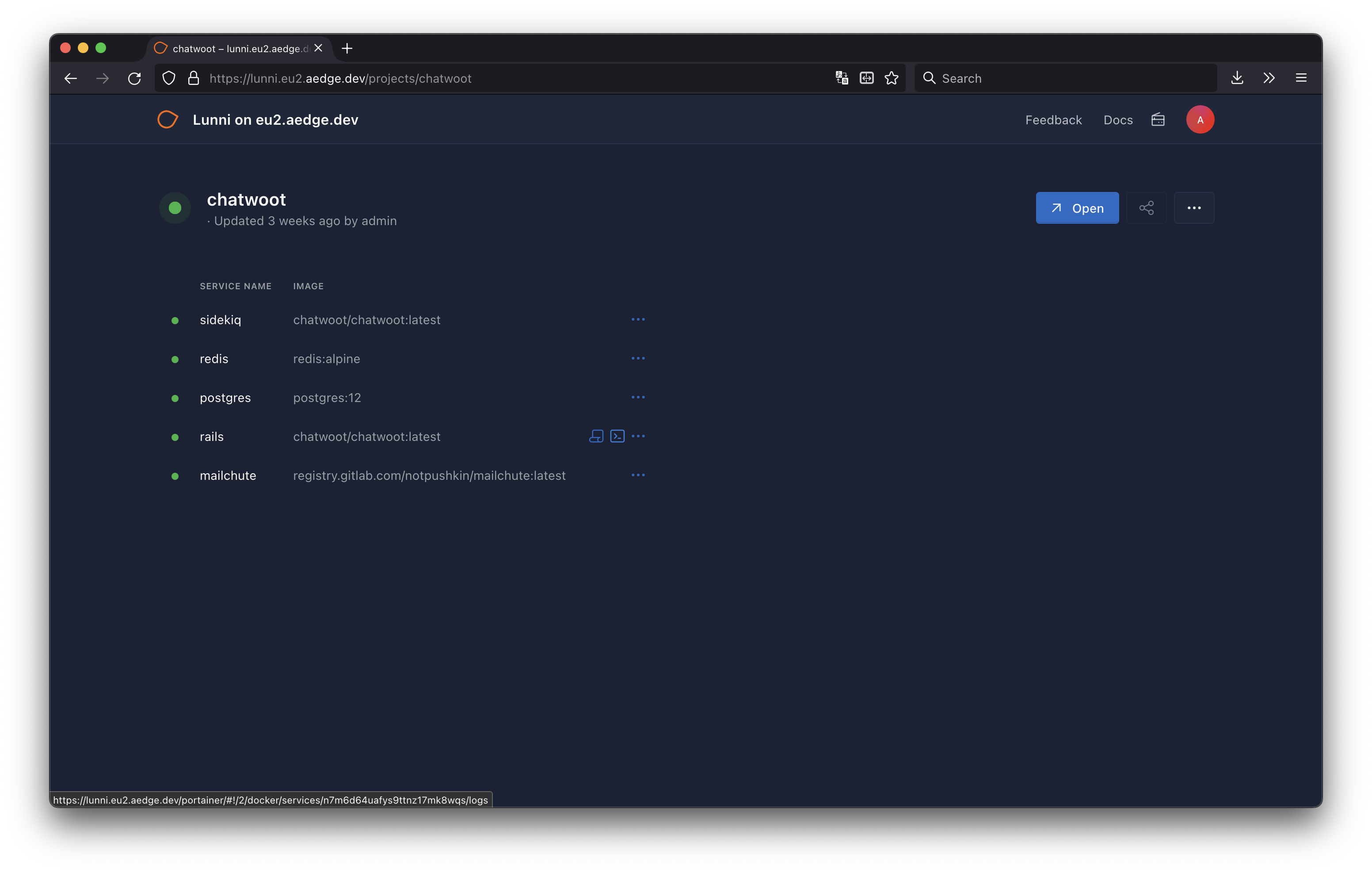
Dokku doesn't have an _official open source_ UI. There are a few unofficial OSS ones (Ledokku is the latest) that I'm aware of.
There is have a commercial offering in Dokku Pro (https://pro.dokku.com). It's paid (one-time lifetime license) but only so that I can at least partially cover my development time on it. The project is enough work on top of Dokku that I feel it is justified, especially as there is nothing stopping others from doing so, OSS or otherwise.
They build on existing tech that is already working, so it is more stable.
I selfishly hope Fly put all their focus toward becoming Heroku 2.0. I’m sure some people care about all the edge latency stuff but I don’t know many of them.
I am sympathetic with much of Kurt's post. We spent a long time building solutions to several of the areas highlighted (managed PG, persistent volumes, secret management and service discovery).
Making radical changes to architecture on a live cloud platform is always a challenge.
On the front-end Northflank is a next-gen PaaS built for high DX, speed, and powerful capability (real-time UI, API, CLI, GitOps, IaC).
Our backend is built using Kubernetes as an OS: providing a huge amount of flexibility on service discovery, load-balancing, persistence/volumes and scale.
The benefit of using Kubernetes is a universal API across all major cloud providers. We can scale clusters and regions across EKS, GKE and AKS in seconds, either in our managed PaaS or inside our customer's own cloud account.
Our managed dataservices: MySQL, Postgres, Redis, Mongo, Minio are all built using Kubernetes Operators with a small but mighty team.
From a generous free tier to autoscaling to managed postgres and other advanced PaaS/DevOps automation workflows Northflank offers something unique.
One thing we've noticed, though, is that people do actually want Heroku but close to users. It's not exactly edge compute. In some cases, it's "Heroku in Tokyo". In others it's "Heroku, but running in all the english speaking regions".
I think the thing that ate up most of our energy is also the thing that might actually make this business work. We built on top of our own hardware. That's the thing that made it difficult to build managed Postgres. We put way more energy into the underlying infrastructure than most nü-Heroku companies. The cost was extreme, but I'm like 63% sure this was the right choice.
If Salesforce kept investing in heroku, it might not. But there is a huge loss of confidence in heroku's future going on among heroku's customers right now, which is part of what you're seeing.
And frankly... your tool seems more mature and... not to be rude to competitors but seems to have more of that certain `je ne sais quoi` of Developer Experience Happiness that heroku _used_ to have and other competitors including the one you mention don't really quite seem to have yet. Does what you expect/need in a polished and consistent way.
That work you put into the underlying infrastructure definitely shows, and was the right choice.
So I understand why people are looking to you as a heroku replacement. I am too! (And I don't really need the edge compute stuff; although I could potentially see using it in the future, and it shows you folks are on top of things).
And while I kept reading you saying on HN comments that you _didn't_ want to be a heroku replacement, so were unconcerned with the few places people were mentioning where you still felt short -- when I saw your investment in Rails documentation and tools (and contribs back to Rails), I thought, aha, i think they've realized this is a market _looking for them_, which they are only a couple steps from.
When you mention in OP a "heroku exodus" to you... I'm curious if that was all people who left when heroku ended free tier stuff, and they've all come to you for your free tier stuff... becuase that does seem dangerous, such a giant spike in users who are not paying and don't bring revenue with them! I don't personally use very much heroku free tier stuff. I hope if that's a challenge, it's one you can get over. I don't think you are under any obligation to offer free stuff that can be used for real production workloads indefinitely -- although, as I'm sure you know, free stuff is huge for allowing people to try _before_ they buy, and whatever limits you put on it to try to prevent indefinite production use get in the way of someone's "try before you buy" too... and at this point, _reducing_ your free offerings is a lot harder PR-wise than having started out with less in the first place. :(
We will have an option to not scale all the way to 0 to support this scenario.
If the market is big enough to support AWS/GCP/Azure as $N00B businesses, it’s not a leap to imagine a future where both Fly and Render are incredibly successful, loved, and independent businesses spanning decades. Let's keep at it.
Goodbye Heroku. :(
I noticed you mention Vault lives in the US, I'm sure you've already heard of this pattern, but Vault (Enterprise) supports [multi-region clusters for performance and DR](https://developer.hashicorp.com/vault/tutorials/day-one-raft...)
Something like linkerd on Kubernetes would be stronger, I suspect. But I don't know the exact nature of your problems.
There's a lot of Nomad at , just won't get any publicity but that's different.
If anyone else is looking.
Can't you make the argument that Heroku got out of this market on purpose? I know they were bought out by "ye old corporate greedy meanie overlord" or whatever but... I'm sure there is data that showed it made sense from a "make money business" perspective to not be in that market.
The cost aside, I'm wondering how fly or heroku support their customers when they grow to microservices ecosystems.
The problem shifts from deploying easily to deploying reliably meaning one release of a service should not break the other services. Other problems appear too, like service discovery, peer authentication, gateways, test and staging environments where there are downstream dependencies, etc.
Are customers supposed to leave when they grow to this level? Or are there solutions for these?
Fly (to my understanding) at its core is about edge compute. That is where they started and what the team are most excited about developing. It's a brilliant idea, they have the skills and expertise. They are going to be successful at it.
However, at the same time the market is looking for a successor to Heroku. A zero dev ops PAAS with instant deployment, dirt simple managed Postgres, generous free level of service, lower cost as you scale, and a few regions around the world. That isn't what Fly set out to do... exactly, but is sort of the market they find themselves in when Heroku then basically told its low value customers to go away.
It's that slight miss alignment of strategy and market fit that results in maybe decisions being made that benefit the original vision, but not necessary the immediate influx of customers.
I don't envy the stress the Fly team we under, but what an exciting set of problems they are trying to solve, I do envy that!